Once again brilliantly combining the lyrical observation of F. Scott Fitzgerald with the laser-bright social satire of Evelyn Waugh, Jay McInerney gives us the stunningly accomplished and profoundly affecting final volume in the tetralogy charting the marriage of Russell and Corrinne Calloway, now in their sixties, against the backdrop of various crises that have bedeviled our society in the past forty years.
The celebration of the thirty-fifth wedding anniversary of Russell Calloway’s best friend, Washington Lee—the least likely monogamist of his acquaintance somehow having become over the years a model husband and father—at the Odeon in the Spring of 2020 sparks an at once funny and moving autumnal reckoning with mortality as the specter of the Covid-19 virus spreads. In this moment of unprecedented upheaval—frantic and fraught real-time response, piercing personal and political impact—the Calloways find themselves and their marriage tested in ways they could never have anticipated as fatal consequences ensue.
John Barrett McInerney Jr. is an American writer. His novels include Bright Lights, Big City, Ransom, Story of My Life, Brightness Falls, and The Last of the Savages. He edited The Penguin Book of New American Voices, wrote the screenplay for the 1988 film adaptation of Bright Lights, Big City, and co-wrote the screenplay for the television film Gia, which starred Angelina Jolie. He is the wine columnist for House & Garden magazine, and his essays on wine have been collected in Bacchus & Me (2000) and A Hedonist in the Cellar (2006). His most recent novel is titled The Good Life, published in 2006.
The cover of See You on the Other Side caught my eye in a bookstore last month. I read the synopsis, bought it, and as I began reading, grew hesitant — It felt slightly formal and pretentious. I feared I made a mistake, but as I kept reading, this quickly faded and I found myself invested in the book.
This is the story of Russell and Corrine, a married couple in their 60s with two adult children. They live in NYC and it’s March 2020, the early days of the pandemic. As Russell and Corrine navigate this unprecedented time, they are both reflecting on their lives, individually and as partners in marriage, as parents, as co-workers in their respective careers, and as friends. The story also includes perspectives from people close in their lives, all trying to grapple with the unusual time.
I really, really liked this story and found myself immersed in the fictional, yet realistic world. It brought back the unease of the 2020, now much more tolerable to read about, personally, half-a-decade removed. It’s worth noting the focus of See You on the Other Side is more about a marriage and a family than the pandemic itself.
This was my first read by Jay McInerney and it won’t be my last. As it turns out, See You on the Other Side is the 4th, and final, book he’s written in this world (though he’s written several others). I plan to go back and read the preceding books which is unusual for me, but I enjoyed this one that much — It can be read as a standalone though, I did not feel lost while reading it.
I highly recommend See You on the Other Side, a moving, sometimes sad, slightly humorous, and realistic story.
Of marriage, mortality, and Manhattan: love in the time of lockdown.
"If we are separated I will try to wait for you on your side of things." — W. S. Merwin, Travelling Together
Reminiscent at times of Elizabeth Strout's Lucy by the Sea, See You on the Other Side by Jay McInerney captures the strange, suspended terror of the early days of the COVID-19 pandemic seen through the eyes of a couple in their sixties - except here, Russell and Corrinne Calloway don't have the luxury of fleeing New York City for a second home in the country. They stay put as the city around them slowly empties, shutters itself, and begins to feel almost unrecognizable. And perhaps nowhere felt the pandemic quite like New York: a city built on closeness, movement, noise, and human contact suddenly forced into isolation and fear.
With their children now grown, Russell and Corrinne find themselves confronting not only a global crisis, but also the quieter existential reckoning that comes with age, long marriage, and the unsettling realization that time is finite. Their daughter is opening a restaurant at the worst possible moment imaginable, just before lockdown; their son is caught up in the increasingly desperate Bernie Sanders campaign. Around them, friendships shift, old habits calcify, and mortality suddenly feels impossible to ignore.
Running through the entire novel is the fear of separation, of losing people while still trying to remain connected to them. As much as this is a novel about a marriage, it is also a love letter to a pre-pandemic New York - to restaurants, crowded dinners, friendships, chance encounters, and all the rituals of city life that suddenly felt fragile.
What surprised me most was how deeply attached I became to Russell and Corrinne. They are not always easy people to understand, let alone agree with, but McInerney writes them with such warmth, sharpness, and humanity that I found myself genuinely caring about them and their future.
The writing is elegant and observant throughout, balancing social satire with genuine emotional depth. There is melancholy here, but also tenderness, humor, and an awareness of how strange it is to keep living through history while still worrying about marriages, careers, politics, children, and dinner reservations.
See You on the Other Side is the fourth and final installment in McInerney's Calloway tetralogy (following 1992's Brightness Falls, 2006's The Good Life, and 2016's Bright, Precious Days), though I went into it completely unaware of that fact. I had no trouble reading the novel as a standalone, but I am sure it carries even more weight if you've followed Russell and Corrinne's story from the start.
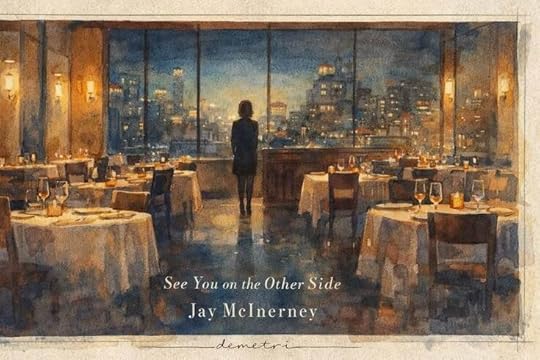
As both the conclusion to a decades-long chronicle of one fictional marriage and an elegy a portrait of New York on the brink of irrevocable change, See You on the Other Side is thoughtful, wistful, and unexpectedly moving. A novel about love, aging, and survival in every sense of the word, it feels less like a pandemic novel than a meditation on endurance: of marriage, friendship, family, and the cities that shape us. Both intimate and expansive, melancholy yet strangely comforting, it captures that disorienting moment when the world abruptly changed - and the deeply human instinct to keep reaching for one another anyway. And that cover? Perfection.
Many thanks to Knopf, Pantheon, Vintage, and Anchor | Knopf for providing me with an ARC via NetGalley in exchange for my honest review.
"See You on the Other Side" was published on April 14, 2026, and is available now.
Jay McInerney's fourth and concluding chapter in his Calloway tetralogy opens at the Odeon restaurant in TriBeCa, March 2020, where publisher Russell Calloway and his wife Corrine, both just turned sixty, are attending Washington Lee's thirty-fifth anniversary party.
Russell still thinks the pandemic is overblown; Corrine, who runs Nourish New York, a food-rescue charity, suspects catastrophe is two weeks away. Their daughter Storey is opening her Greenpoint restaurant, Condrieu, that very same night, in what turns out to be the single worst week in the city's history to open a restaurant. Washington's son Mingus, a Yale-educated writer of legendary procrastination who has owed his publisher a novel for seven years, is nominally Storey's boyfriend, though his most loyal relationship is with distraction.
The city locks down. Corrine contracts Covid at the Odeon party and spends two weeks quarantined in the bedroom, where Russell leaves trays of toast outside the door while texting Astrid Kladstrup, a young Brooklyn novelist whose manuscript about Lady Emma Hamilton and her older lover shows up in Russell's inbox accompanied by escalating innuendo. He reads it and declares it excellent. Storey fights the governor on outdoor dining restrictions with an op-ed in Air Mail, co-written with Mingus, who promptly resurfaces as a writer and, usefully, as a boyfriend.
Russell manages to stay almost faithful for most of a year, trading suggestive texts with Astrid while rereading Anna Karenina and taking prophylactic Cialis, until one September evening he crosses the Williamsburg Bridge in an Uber to visit her...
I read the book without the preceding three. Coming in fresh, I experienced Russell and Corrine as fully formed people rather than as long-running characters whose history I would be obliged to track. Nothing clouded my reading with backstory or loyalty to earlier versions of these people.
McInerney is writing about a class that takes itself enormously seriously, and he is clearly both inside it and amused by it. The satire only works if the characters are genuinely insufferable on the surface. I laughed with them rather than grinding my teeth at them as I usually do with novels of the uppity.
The historical texture – the pandemic protocols, the restaurant shutdowns, the Page Six ecosystem, the fentanyl crisis dressed up as a dinner party – is perhaps the book's most underrated achievement. McInerney smuggles recent history into domestic drama smoothly and with authenticity.
Jay McInerney made his name in 1984 with Bright Lights, Big City, a cocaine-dusted dispatch from the downtown Manhattan of studio apartments and VIP rooms, written in the second person as though the narrator were too wrecked to claim his own story. He has spent the forty years since refining his territory: the Upper West Side marriage, the literary lunch, the wine that costs too much and the affair that costs more.
Born in 1955 in Hartford, Connecticut, he studied at Williams College, worked briefly as a fact-checker at The New Yorker, and has since produced eight novels, three essay collections on wine, and an ongoing demonstration that one zip code, examined with sufficient acuity, contains the entire tragicomedy of late-capitalist ambition.
See You on the Other Side is a goodbye to a generation that threw terrific parties and a reckoning with what those parties cost. The pandemic is described in the book the way it arrived in reality, as an insult nobody ordered. McInerney's great gift here is the straight face he keeps while placing these gilded people inside a public catastrophe.
A long marriage is a living document, subject to amendment and repair, and love persists through acts of spectacular stupidity. The Page Six era has changed nothing about human appetite or human guilt. McInerney knows this, and he makes you laugh about it before he makes you ache. The marriage resolution is a nail-biter and a tear-jerker.
Now I have to read his other books. This one was excellent 👏 ❤️ 🇮🇱
“Each marriage is a mystery, an iceberg of which only a fraction is visible from the outside, above the surface”
I can literally say I’ve been waiting decades to say goodbye to Russell and Corrine. Their love story has acted as a living document of marriage, aging and mortality, its observations exploring the historical texture of a generation.
Loved it. Ignore the New York Times review. If you like the other McInerney books, and have followed the books about Russell and Corrinne Calloway, you’ll like this one, too. As a long-time New Yorker, I completely understand the nostalgia that accompanies living in the city in different phases of your life, and McInerney captures it well - in addition to the envy, FOMO, keeping up with the Jones’s, etc. that comes with life in the city no matter how seemingly successful you may be. A very good read with some unexpected twists and turns that remind you we never know how quickly life can change.
This is a surprisingly tender and at times moving novel from an author who tends to be low grade “guy’s guy” in his work. That said, McInerney is no Norman Mailer (thankfully), nor does he indulge in the catty vituperative scratching of Gore Vidal. While his heroes are almost always unreflectively catnip to women (women can’t seem to resist the main male character of this and his other books…they line up and paw at his well-tailored suits and rub against his Lauren polo shirts with abandon) they are also oddly gentlemanly and vulnerable. I like both those traits, and it’s a nice step away from the “sardonic = good” writing so prevalent today.
Others have summed up the story in their reviews, I’ll just say this: I rolled my eyes a LOT throughout this book, but am glad I stuck with it, because the end was oddly moving and beautiful. McInerney loves Fitzgerald, and it shows. In this, the final chapter of Rusell and Corrinne Calloway’s story, his characters move on…boats against the current, borne back ceaselessly into the past.
Ever since reading Bright Lights, Big City nearly forty (???) years ago, I've been a fan of Jay McInerney. I love a story set in New York City and I've really enjoyed following Russell and Corrine over the four novels he's written beginning with Brightness Falls. Like with John Updike's Harry Angstrom, it's fun to see familiar characters live through the same times as we do and see how they change and grow. Or not grow, in the case of Rabbit. See You on the Other Side opens during the pandemic and touches on the 2020 election (though very oddly not the 2021 insurrection), BLM, Me Too, and other cultural moments of the time. The pandemic only started about six years ago so these things aren't that far in our rearview mirror, but I found it interesting to read about a New Yorker's experience living through it. I will say there's an awful lot of talk about wine, but I know that's important to the author so I that's fine. On the other hand, I may have to visit Odeon the next time I'm in New York.
So far (pg 30) it’s Boomerslop: The Novel with all the predictable political stances and social credit back-patting that does a disservice to the art - and for a Covid novel it is so far surprisingly vague as to where in the pandemic timeline it is taking place … bunch of rich people partying it up at restaurant openings should be fertile ground to revel in biting satire, but unfortunately that isn’t what happens
So far (pg 68) it’s picking up, but I have a quibble about the namedropping of pop culture from 2020s: the drops seem to be more dated (if not outright anachronistic) than if he’d just returned to his lane and referenced 80s stuff…like he felt he had to Connect with the Kids and show he’s hip to Hamilton and LCD Soundsystem, Jay-Z and Tupac. This could entirely be the fault, or by-product, of his in-house editors: seen an interview where he laments their heavy hand in keeping things on a sensitivity spectrum.
So far (pg 145) I think the main problem for me is that I’m just not in the mood to relive 2020 again so soon - some decent moments so far include a wine tasting event that devolves into political debate (dangerously close to just being sock puppets for McInerney) and the son dating an OnlyFans model, musings on the publishing industry quite interesting but way too glossed over…then the pace quickens, we got restaurants closing and then a few pages later suddenly riots and protests- like the author had a checklist…
And so we reached the other side of the book. The last 80 pages were fantastic, moving even. At times a lyrical feast. McInerney had the outline for a great novel here but overall it certainly seemed a rushed affair - which I guess can be forgiven because as I understand this was written under the shadow of grave health concerns (brain and heart surgery) - so it’s probably why a book that covers March 2020 to June 2023 are condensed into less than 300 pages. A conundrum- it seems like the book would have benefited from either pruning it down to 200 pages or expanding it to 500.
I had been trying to get back into reading novels for a little while now—picked up a handful of books and nothing stuck. Then Jay McInerney drops See You on the Other Side and I finally had a book I couldn’t put down.
Bright Lights, Big City was one of those books for me decades ago—the kind that just hits at the right time and stays with you. Coming back into this world now really connected with me… a little older, perhaps more reflective, and still with that same voice that pulled me in so long ago.
First book in a long time I didn’t have to force. That alone says a lot.
I have read almost all of Jay’s books. They are all superbly written. I am very close to these books as I was in NYC in 70’s and 80’s and am same age as Jay M and the major characters. The books speaks to many issues those of us well into our 60’s as we move into being the older generation. It weaves the lives of our grown children into the complex narrative. Bravo JM.
Russell and Corrine, both in their 60’s, navigate life in New York City at the start of the pandemic. Their daughter is opening a new restaurant and their son is working on the struggling Bernie Sanders campaign. Readers are reminded of how much Covid affected our lives in this book about every day life during the pandemic. The Nobel is beautifully written and while it’s part of a series, it certainly can be read as a standalone book( I did). I found myself thoroughly engaged and it was very hard to put down.
The conclusion of the series and could’ve probably garnered 5-stars if not for the fact that the previous book in the series was my favorite. Bittersweet ending but so very good.
The Room That No Longer Agrees With the Life Inside It Jay McInerney’s “See You on the Other Side” is a novel of marriage, vanity, timing, and social weather, where nothing quite breaks and everything quietly goes out of fit. By Demetris Papadimitropoulos | April 13th, 2026
A room prepared for company and lit for elegance, yet already quietly altered by absence – this twilight restaurant interior distills “See You on the Other Side” into one image of urban polish, social weather, and a life that no longer quite agrees with itself.
The neatest lie well-upholstered lives tell is not that they are happy, but that they are coherent. People who have spent decades becoming themselves tend to assume that the visible shape of things – the marriage, the publishing job, the apartment, the table at the right restaurant, the cultivated appetite, the practiced ease in certain rooms – is also the shape of truth. “See You on the Other Side” begins when that confidence starts to fray. Not at the blowup, not at the confession, not at the scene in which someone finally says the unsayable. Earlier than that. At the point when the dinner still happens, the suit still fits, the city still flatters, and the life no longer matches its own script.
Jay McInerney has written a pandemic novel, yes, but only in the way a barometer is about weather. What interests him is not the public event in the abstract. It is the small, visible failures by which private order begins to give itself away. The room that does not fill. The greeting that no longer knows whether it is allowed to become a hug. The marriage that has not broken and yet has stopped making the same promise. The man who still sounds like himself after the facts have begun to disagree.
That it begins at the Odeon is exactly right. Russell Calloway, moving into his sixties with the manners of a man who still half believes he is the room’s natural center of gravity, arrives with his wife, Corrine, for the anniversary dinner of old friends. Here the novel stops setting the table and starts eating. McInerney gives Russell one of those opening passages in which memory, appetite, vanity, and urban nostalgia all show up dressed for the same party. The restaurant becomes a repository of earlier editions of himself – publishing ambition, seduction, literary vanity, old downtown glamour, the whole costly creed. He looks at Corrine and sees, through the face before him, the younger woman she once was. He looks at the room and sees the version of himself who once believed that wanting a life and having one were nearly the same thing.
Around him, party talk turns brittle as news of the virus spreads. Some guests are alarmed. Some are jauntily unconcerned. Some want the moral shine of concern without sacrificing the evening. Everyone is still trying to keep the old choreography from wobbling. Then Russell receives a text from a younger woman asking when she can see him again, and the evening tilts and never quite rights itself. This will not be a novel about a public crisis descending on otherwise stable lives. It will be a novel about lives already under strain meeting a year with a special talent for removing ambient support.
From there the book moves into money, work, food, and family. Corrine, who runs a food-rescue nonprofit and possesses the kind of practical intelligence that makes other people’s eloquence look suspiciously recreational, becomes the novel’s pressure gauge. She is the one person here still able to count heads, costs, and consequences. Through her we enter the service corridors of city life: donor calls, chef panic, warehouse pickups, gala spreadsheets, all the ungilded labor that allows Manhattan and Brooklyn to go on admiring their own sophistication. McInerney is very good on this back-of-house world – not because he romanticizes competence, but because he understands that most lives are held together not by epiphany but by logistics.
Through Storey, Russell and Corrine’s daughter, the novel finds the first room in which history can be counted table by table. She has opened a restaurant in Greenpoint, and the opening night is the book’s hinge. Corrine takes the ferry out, arrives in a room that should be buzzing, and finds those treacherously visible empty tables. Nobody screams. Nobody storms out. The room simply fails them. The humiliation is not cinematic. It is hospitality-grade, which is worse. The hostess keeps smiling. The greeting cannot quite become a hug. The kitchen hums with the crisp panic of service trying to pass for calm. McInerney has the good sense to let the dining room do its own work. He does not bang a spoon against the saucepan marked Symbolism. The room says everything: about timing, about merit, about the cruelty with which a year can make a private dream look like bad planning.
That scene also makes plain what sort of wager the novel is making. “See You on the Other Side” is built in continuous chapters, with no formal partitions, no interludes, no structural handrails, no scenic overlook where the reader can stop and be told what everything means. It declines to pretend that life waits for third acts. Things change here by accumulation, repetition, and drag. The wrong text. The wrong room on the wrong night. The wrong kind of confidence surviving a few pages too long. A launch that never becomes an opening. A marriage going taut without ever quite announcing itself as crisis. Readers looking for a clean hinge, a proper snap of plot, may resist this. Readers willing to let a dining room do the work of a plot twist will see how exactly the design matches the argument. The point is not that nothing happens. The point is that the things that happen do not come to us arranged as revelation.
The prose is built for this kind of pressure. McInerney’s sentences come fully alive when silverware, vanity, and class all catch the same light. He writes long, well-cut sentences that can take in décor, social blocking, and private self-flattery in a single pass. The diction is finely status-aware without becoming fussy. Menus, neighborhoods, old institutions, wine, tiny cultural markers, habits of greeting – all arrive not as decorative detail but as social information. He knows exactly what a room is doing to the people inside it, and what they are doing back to the room. He is especially good on places whose meanings have shifted while their surfaces remain reassuringly intact. Russell walking through the cleaned-up Meatpacking District and measuring the polished present against the rancid, charged memory of its earlier life is not city writing for pleasure alone. A block becomes address, alibi, and obituary all at once. The best sentences in the novel perform a similar trick. They do not announce importance. They let observation turn faintly sour.
Russell is the book’s most revealing study in self-flattery. He is a publishing man, a connoisseur of style and milieu, and a known Manhattan type: the cultivated older literary gentleman who still thinks polish counts as exemption. His affair-shaped mess with Astrid Kladstrup, a younger literary figure whose talent and vulnerability become disastrously entangled with his vanity, finally gives the later pages something sharp enough to cut with. When Astrid dies of an overdose after Russell has been with her, drift stops looking elegant and starts leaving copy behind. The scandal arrives in calls, newsprint-flat phrasing, marital panic, damage-control language, the whole humiliating conversion of private vanity into public fact. McInerney does not turn this into lurid punishment machinery, and that choice matters. He has no interest in staging a morality play for readers who prefer their fiction pre-sorted. But without Astrid, the novel might have mistaken atmosphere for stakes. With her, the air turns dangerous. Russell can no longer sustain the flattering story of himself as patron, appreciator, complicated man of feeling. Other people now get to tell his story, and they are much worse stylists.
The novel has no use for one of our favorite lies about ambition: that talent and labor reliably beat timing. Storey’s restaurant is not shown to be foolish or untalented. It is badly timed. Corrine’s competence does not spare her grief or exhaustion; it merely makes her the first to hear the hiss in the pipe and the last to leave the room. Russell does not become a monster; he becomes smaller, less plausible to himself, and finally less protected by the polish with which he has lacquered his life. Beneath all the varnish sits the collapse of domestic alibis – the household stories people tell to keep the furniture from moving. Russell still thinks of himself, for too long, as nuanced where the book sees something simpler and sadder: a man whose talk has remained quick on its feet after his life has begun to sag.
This is the novel’s most exact trick. It shrinks the pandemic to the size at which it was actually lived: an opening night that never fills, a warehouse of produce, a donor’s social opportunism, a statement drafted under pressure, a marriage discovering that survival and restoration are not synonyms. It feels less like commentary than a barometric reading taken in a dining room. McInerney is too skilled to bang topicality like a saucepan. What he wants instead is pressure – how a historical event enters already-made lives and alters them without granting them the dignity of dramatic reinvention. That is why the book feels diagnostic rather than reactive. It does not merely say that the world changed. It notices what stopped working first.
The bill, naturally, arrives later. The finish that gives the novel distinction also drains some heat from it. The middle is not shapeless, but it does soften. Because McInerney is committed to accumulation rather than rupture, there are stretches where pressure is easier to admire than to feel. Russell’s arc belongs to a very recognizable Manhattan species, and there are moments when one sees the contour of the fall before one feels its sting. What saves the novel from déjà lu is not novelty but patience: the patience with which the surrounding world strips him of narrative centrality. Still, that patience has a cost. A book so committed to social weather can occasionally underplay the force of the storm.
If the novel occasionally recalls “The Love Affairs of Nathaniel P.” by Adelle Waldman in its interest in male self-deception, or “Fleishman Is in Trouble” by Taffy Brodesser-Akner in its account of marriage under pressure among the articulate and self-regarding, that kinship is real. But the comps tell you only which shelf to approach. They do not tell you what kind of weather you will find once the book is open. McInerney’s novel is sadder, steadier, and much less interested in winning the argument.
The ending refuses to cheat. There is no grand correction, no cleansing confession, no theatrical redistribution of moral weight. McInerney knows better. He wastes no time on restoration fantasies. Instead he offers the meaner, truer thing: the same people waking up inside a different set of rules. Marriage here is not romance, prison, tragedy, or salvation. It is a structure that absorbs the blow and keeps standing, though not in quite the same outline. Readers who want fiction to make damage legible through climax may find this withholding. McInerney’s point is harder than that. By the time clarity arrives, most of the important changes have already happened. The damage is no longer arriving. It has become ordinary.
That is why the novel hangs in the air afterward. Not because the plot is intricate, but because the social weather is. You do not finish it with the sense of having watched a grand design click into place. You finish it with the feeling of having sat in a room long enough to notice the oxygen thinning. My rating is 84/100, which for me translates to 4 Goodreads stars: a strong recommendation for readers who value tact, formal nerve, and a social sentence sharp enough to cut while still smiling. McInerney’s truest insight is also his meanest: by the time people know their lives have changed, they are usually already saying the new lines. The old script keeps clearing its throat. The glasses are still on the table. The check still has not come.
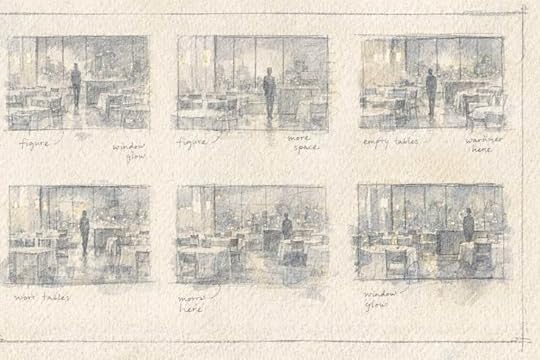
These early thumbnail studies test how a restaurant interior, a solitary figure, and a field of empty tables might be arranged so that the final watercolor could hold the book’s central tension between social polish and quiet misalignment.
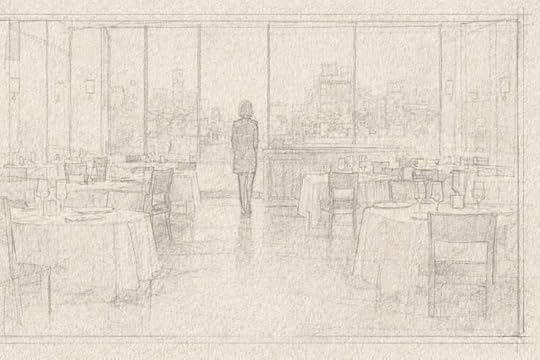
The faint underdrawing reveals the hidden order beneath the finished image – window lines, table spacing, figure placement, and carefully protected negative space all set in place before atmosphere and light begin to loosen them.
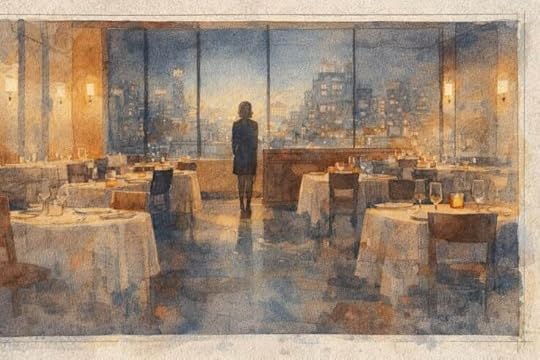
At this stage the painting begins to shift from structure into feeling, as the first warm and cool washes establish the blue-hour tension that gives the final room its elegance, loneliness, and altered air.
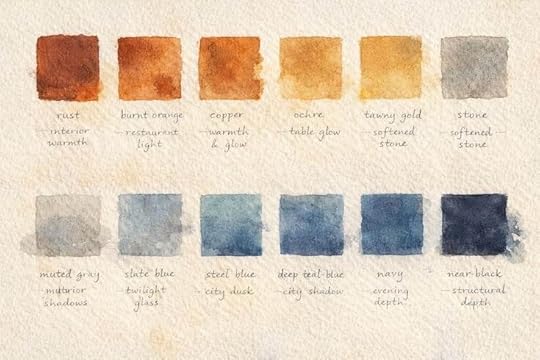
The swatch sheet fixes the painting’s emotional logic in advance, binding the image to the cover’s rust, ochre, slate-blue, and deep nocturnal palette before the restaurant interior fully emerges on the page.
All watercolor illustrations by Demetris Papadimitropoulos.
I can't say I'm sorry to end this series - I'd hoped to see more character growth as Russel and Corrine aged, but Russell seemed like the same man-child until the final page. And Corrinne's transformation to a person of faith was not believable. I'm left wondering what these books were for?
In a time when gold-spray-painted oligarchs are laying waste to our civil liberties, our economy, our government and our safety, here comes a guy who married into massive wealth with a slobbering Valentine to spending and cheating.
The author makes such a to-do of his personal life that overlaying it on this mess of a book is the only way to make sense of it. Turns out both are terrible!
His Fox-news-coded quotes insulting “woke culture” jostle appallingly alongside his endless name-dropping of Jean-Michel Basquiat.
Irony, Jay.
You’re soaking in it.
Twould be fascinating if this irony were explored… or hinted at…. But it only arrives IRL.
This is self-serving ode to becoming vastly rich without doing very much and the goodbye-to-emotions glee that accompanies such a golden ticket. Through the magic of time, Mcinerney’s BoHo characters have arrived at a Hearst level of acquisition. Their attitudes and stresses about being so money-adjacent could be richly mined, but McInerney steps up to the cash register as unashamed as any Real Housewife with a murky past. Our Real Housewives play at Culture with more acquisitiveness blah blah blah. Edith Wharton would have made of these dressmaker bills a nuanced morality play. McInerney just loves him a Balmain frock.
There is little accurate portrayal of real marriage intimacy and much enthusiastic cheating and anachronistic skirt-chasing. I’m going to stop writing this review because I hate thinking about this book. It is adolescent wish fulfillment and meaningless typing and it is starkly terrible. His poor, mega-wealthy wife.
And Poor America.
G-d rest your soul, Jean-Michel. You do not deserve this.
I've read of most of Jay McInerney's books, right from the beginning, as he was part of that generation of celebrity writers that became part of the story, from the '80s on. As a somewhat younger teen in nearby NJ, I could catch a glimpse of an impossibly fun and sexy lifestyle looming after college.
As ballyhooed as his early work was, it clearly started to wane until he wrote Brightness Falls, the first in the tetralogy of the Calloways, obvious stand-ins for himself/Morgan Entrekin. And the first three of them were centered around crises and how the couple and their marriage reacted, including 9/11, the 2008 financial crisis, and an affair. This one is centered on Covid, but also more poignantly, on the passing of time. Children become adults, hair turns grey, one loses at least some of the pep in one's step, and ultimately, the body may fail while the spirit is forever 30.
And all of that is meaty grist for a novel. But as technically proficient as McInerney is, and I do think he can craft lovely sentences, he seems to be limited a little by his "brand" as chronicler of a certain milieu of NY society; consequently his roman a clef type barely veiled mentions of certain celebrities, constant name dropping of famous restaurants and brands, which feels less a Bret Easton Ellis kind of commentary on materialism than it is a matter-of-fact reflection of a narrowness of this universe. I mean, I've been to McNally restaurants a million times, but its not obvious to me that a reader in Chicago will have the same Proustian associations with Odeon as McInerney clearly has.
My other gripe with the book is that its not obvious to me what it's "about," in the sense that its a pretty flat and linear structure, so the plot doesn't seem to be about much more than the passing of time and what happens next. There's no obvious arc to it all, and even Covid, its impact on NYC carefully recounted here, sits in the background a little as more context than active participant. I suppose, if anything, its a book about time and mortality, which give it some heft, especially for those of us in middle age, but feels a little thrown together, and more of a de rigueur capstone to the tetralogy than a book that can stand on its own as a window into the human condition.
Tl;dr - As much as he can frustrate me as a writer who seems more bon vivant than serious novelist, I always read McInerney, but found this one a little paint-by-numbers, which is disappointing considering how talented I think he is.
Struggled to finish this. After reading the previous three books charting the lives of the Calloways, I was profoundly disappointed and think that maybe writing it was a mistake. It was quite clumsily written, and I’m not really sure why McInerney felt he had to write it. It is nowhere near as good as the previous three books.
However there are a few really beautiful paragraphs in the book where McInernery proves that somewhere in there is a great writer trying to get out, but the sheer shallowness of the characters, the elitism, the self-interest and self-serving attitude, the name-dropping and branding - even of the face masks they wore during the pandemic, he and his friends didn’t wear common blue ones like everyone else - the whole ‘how can this be happening to us, we summer in the Hamptons’ attitude which seemed okay and acceptable when he first started the series, definitely is not okay now and I found it all a little unpalatable. Even when his wife was in hospital and due to have major surgery and a nurse offered him food, Russell turned round and said no, he’d ordered a delivery for himself from one of his favourite restaurants - that got to me a bit. There are so many examples of sheer real clumsiness like that which made me cringe.
Having said all that, the last two or three chapters were very moving and made me well up, which is why I have given the book two stars instead of just one. But the book was not on the whole an enjoyable experience and I’m glad I’ve managed to finish it - I had thought of abandoning it about halfway through as I got stuck, but I would have missed the ending chapters. This book is not a success and I can see why its publication has been so low-key.
This entire review has been hidden because of spoilers.
𝗦𝗲𝗲 𝗬𝗼𝘂 𝗼𝗻 𝘁𝗵𝗲 𝗢𝘁𝗵𝗲𝗿 𝗦𝗶𝗱𝗲 by Jay McInerney is a love letter to New York City and an ode to lasting relationships, be it marriage, friendship or family.
Set during the early days of the pandemic, it follows Russell and Corrinne Calloway, first introduced 34 years ago in 𝘉𝘳𝘪𝘨𝘩𝘵𝘯𝘦𝘴𝘴 𝘍𝘢𝘭𝘭𝘴. I haven’t read the other books in this series, but I imagine they would provide an even richer background to these characters.
Russell and Corrinne’s long marriage has had its ups and downs and even occasional flings, yet the two have endured. Russell is the head of a publishing house while Corrinne works for a charity distributing food. The novel opens at a birthday party as the signs of the impending crisis begin to surface. Their daughter is about to open her first restaurant, and she’s also navigating a rocky relationship with the son of longtime friends.
Russell has a flirtation with a young debut novelist, while Corrinne faces serious illness due to the pandemic. Their son is now back the city after working on a failed political campaign.
These interconnected stories unfold against the backdrop of wine and food, with McInerney commenting on politics, literature, and the food scene.
I loved this book even while some might find this world a little grating. After all, this is the setting that McInerney knows best. It’s been over 40 years (!) since I first read 𝘉𝘳𝘪𝘨𝘩𝘵 𝘓𝘪𝘨𝘩𝘵𝘴, 𝘉𝘪𝘨 𝘊𝘪𝘵𝘺, and I love McInerney’s now mellower version of New York City.
See You on the Other Side The author revisits the lives of Russell and Corrine Calloway. They are now middle aged and married for many years. Russell is an owner of a small publishing company. Corrine is in charge of a group that supplies food for the hungry in NYC. They are now living in Greenwich Village and their kids, Storey and Jeremy are out of school and living in hipster Brooklyn. Storey is a chef ready to open her new restaurant while Jeremy has been struggling to finish a novel for several years. Storey has been involved with Magnus, the son of the Calloway’s best friends. Then Covid hits and they all are affected. Storey’s restaurant, like others all over NYC, is forced to close. Corrine gets Covid and Russell must care for her while trying to avoid catching it. Then Russell meets Astrid, a flirtatious young author with a book she hopes to get published. Russell becomes smitten with Astrid however things to not go smoothly when he decides to visit her apartment. This novel covers events of the past few years. 9/11, Covid, reaction to the pandemic, left leaning politics and the NYC social scene are included. There are some surprises, happy and unhappy, that May shock readers. I enjoyed this book and the author’s reporting of the everyday lives of upper class New Yorkers. I am now interested in reading the first three novels about the Calloways. I received this ARC from Edelweiss and the publisher.
This Tetralogy (4 books) is exceptional, particularly for anyone enamored by, and living within) the history of New York since the 1980s. The rebirth of the city that particularly started in Soho and Tribeca that J. McInerney writes about is very personal to me, having lived in these two places since I moved into New York from the burbs. It’s sort of an alter ego to Bright Lights Big City (what I am now going to go back and reread). I consumed all four books in the span of about six weeks because the setting is mine. Listening to them was particularly touching. McEnerney does a great job at capturing essence and importance of places like the Odeon, 192 Books, and so many other downtown, cultural landmarks. He also captures the Zeitgeist, reducing it to the tension between art and love and power and money, a perfect framing of Manhattan (in the world) in these four decades.
As an aside, I take exception to the scathing pretentious NYT, Guardian and Time of London reviews of the final book in the quartet (See You on the Other Side). The authors body of work has always been about money and excess and many of the sillier aspects specific to New York downtown culture and life. In fact, characterizing Russell Callaway as wealthy entirely, misses the point, because he is not. Not every artwork needs to be a brilliant masterpiece. I found this book an easy, comfy and perfect ending to the Calloway Quartet, even if less great than the first three.
A beautifully written novel set in New York City during the COVID pandemic. McInerney writes with such precision that the setting becomes an emotional landscape as much as a backdrop. One passage in Chapter 14 I loved and it contains no spoilers: “The city was made for the virus, with its density and its intricate and intimate webs of social connection, its stacked and packed humanity. The most vulnerable target. It had been grand, it had been a paradise, in its way, in its time, a steel and concrete Eden.”
This novel is part of a long running series that follows a marriage over decades, but it reads beautifully as a standalone. Russell, the central character, is brilliantly drawn. At times I loved him, and at times I absolutely did not, which feels exactly right. McInerney goes deep into his characters’ inner lives and captures their contradictions and blind spots with remarkable insight.
This is not a plot driven novel so much as an immersive experience in voice and perspective. I finished this book feeling a little stunned and already running to get McInerney’s backlist. One of the most affecting novels I have read about this moment in time.
Thank you NetGalley and Penguin Random House for sending this DRC book for review consideration. All opinions are my own.
"Jay McInerney gives us the stunningly accomplished and profoundly affecting final volume in the tetralogy charting the marriage of Russell and Corrinne Calloway, now in their sixties, against the backdrop of various crises that have bedeviled our society in the past forty years. The celebration of the thirty-fifth wedding anniversary of Russell Calloway’s best friend, Washington Lee—the least likely monogamist of his acquaintance somehow having become over the years a model husband and father—at the Odeon in the Spring of 2020 sparks an at once funny and moving autumnal reckoning with mortality as the specter of the Covid-19 virus spreads. In this moment of unprecedented upheaval—frantic and fraught real-time response, piercing personal and political impact—the Calloways find themselves and their marriage tested in ways they could never have anticipated as fatal consequences ensue."
I have always been a fan of Jay McInerney, but this one fell far short of my expectations. Yes, he is still a great wordsmith, but the over-dependence on fine wines and gourmet restaurants was more than I could handle. Maybe now that he has finished with the Calloways, we can expect something other than the describing the upper echelons of NYC.
I received an ARC of this novel through NetGalley.
I was unaware when I began reading this book that it is the fourth in a series featuring Russell and Corinne Calloway. I struggled a bit at the book’s beginning, trying to figure out what the characters were about, so it would have helped if I had read the previous books in the series. But once I got going, I was able to fully enjoy the last 85% of the book.
Russell and Corinne are in their 60s, living in New York City. Russell is a book publisher, while Corinne works for a charity the provides food to the needy. This story takes place in 2020-21, beginning with the early days of the COVID pandemic. The Calloways have two children. Storey, their daughter, is opening a restaurant at the most inopportune time, right as restrictions are being imposed on NYC restaurants because of the pandemic.
The characters are all interesting and the book chronicles what life was like at that time. The Calloways lived a bit in the fast lane, mingling with the rich and famous, with times of drug use and marital infidelity.
A fine book and I will go back to read the earlier books in this series.
Knopf Publishing provided an early galley for review.
In a story that started in Brightness Falls (1992) and continued in The Good Life (2006) and Bright, Precious Days (2016), McInerney completes the tetralogy with these characters. As a fan of his since Bright Lights, Big City (1984), I was curious for this upcoming release. Plus, how cool is that cover image? Very!
The writing is exactly what I have come to expect from the author, full of complex and descriptive sentences as well as snappy, natural patter of dialogue. He really has a way with language. Being the same age as the main characters at this point in their story seems to have helped get me past whatever issues I had with the first two offerings in this series (which I only considered "okay" for some reason). Might have to revisit them along with reading the one I missed.
I had to smile when the characters mentioned a number of books I myself had read in 2020. The ending also managed to summon up some emotions as I was certainly moved by it. That's what a good book should do, after all.
I am dating myself when I say I have been a Jay McInerney fan from day one, and See You on the Other Side is a bittersweet final installment for Russell and Corrine, who we first met in Brightness Falls.
Returning to these characters felt like catching up with old friends. The story takes place during the early days of COVID in New York City, and that sense of uncertainty, isolation, and underlying anxiety is captured really well. Russell and Corrine are navigating not just the world around them, but also the evolution of their marriage, family, and the lives they have built together over time.
McInerney has always had a way with New York settings, and that continues here. The city feels like its own character, especially during such a surreal and difficult moment in time.
I was so happy to be reunited with these iconic literary characters one last time. It really does feel like the end of an era.
5 stars.
Thank you to NetGalley and the publisher for the advance copy of this book in exchange for an honest review.