Ithaca is the story of how sudden change comes into a slow life. For 39 years, Daisy Turner has been a professor's wife, typing his notes and helping out. The centerpiece of her life is a weekly open house-a dinner party that always features soup. And then, one day, her husband drops dead. Daisy has nothing to hold onto-except, perhaps, the soup. Then, suddenly, Daisy finds herself entangled with a man whose wife is disabled, mothering a young environmental activist farmer, and swept into the controversy about fracking that has begun to concern their small Ivy League town. What happens when a quiet, almost sedimentary life meets the high-pressure forces of a small town? How does one rebuild after life as you know it is suddenly turned upside down-or is fracked?
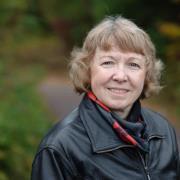
Susan Fish is a writer and editor (storywell.ca) living in Waterloo, Ontario, Canada with her husband, dogs and sometimes with her adult children. She has two Masters degrees, one in Religion and Culture, the other in Theological Studies. Renaissance is her third novel; Seeker of Stars, was published in 2005 (Winding Trail Press) and reissued in 2014 (David C Cook), while Ithaca, was published in 2014. Her writing has appeared in various literary and trade publications, and she has written widely for the nonprofit sector.
Susan Fish presents a novel that is both soulful and timely. At its core is Daisy, a 50-something-year-old resident of Ithaca, who is dealing with the loss of her husband by re-discovering herself and that which surrounds her. Daisy has spent most of her life as a wife and for many years has devoted her Wednesdays to hosting friends and family for a soup-based dinner. As a widow, she is forced to confront the reality that her life had become an appendage to her husband’s. She struggles with continuing her life as it was before and the reader is able to watch the reformation of Daisy’s intra- and inter-relationships.
Soup is both the backbone and the heart of the narrative. Each chapter title features a different type of soup: Three Sisters Soup; Pepper Pot Soup; Borscht; Oyster Mushroom Soup; and so on. These soups range from chunky to smooth and from mild to piquant. In a way, the soups reflect the tumultuous and intense mishmash of feelings and desires that are felt by both Daisy and by a town that is confronting hydro-fracking. Most importantly, though, soup is one part of Daisy’s life that has remained constant since her husband’s death.
The seasonality of the soups represents the rhythms of life: Tomato and basil in September and apple-cheddar-onion in October, for example. The steady seasonality of the soups makes up for the confusion and disruption of a natural rhythm felt by Daisy due to the death of her husband in the springtime. Fish writes from the perspective of Daisy, “It had been spring when my husband died, leaves newly budded and now every leaf was decaying on the ground. Death had come in the middle of life, and now, oddly enough, I felt new life within me” (p.225). Part of the ‘new life’ found within her is due to her newly forged relationships with town members, ultimately fuelled by her enrolment in a university-level course.
Rather subjectively, I must point out how much this book recalls memories of my own experience as an undergraduate student in Sackville, New Brunswick, a university town not so different from Ithaca. As a small town, community events often centred on food and potlucks. Committed and enthusiastic student and town members often found themselves behind a picket line. Similar to in the story, the most recent reason for protest in Sackville amongst environmentalists and non-environmentalists alike has been hydro-fracking, an issue that has proven to be a practically and philosophically dividing issue.
I therefore know first-hand the political nature and contestation of hydro-fracking, and commend Fish on her approach of the matter. Fracking is a politically charged topic, but Fish treads lightly on the matter and offers an exploratory perspective through her characters. The book was not consumed by the politics of fracking. What fracking did indeed do was effectively present a strong metaphor for Daisy’s fractured life.
However, the book is about more than fracking and soup: it’s about dealing with loss, adapting to new situations, pain and healing, and community. These two topics serve as a means of exploring these deeper issues.
Imagery presents itself in this novel through talk of honeybees, rupturing of shale rock, apple orchards and kitchens -- all very real and raw images. Even the names of the characters allude to the beauty of nature and farming: Daisy, Carmel, Aurora…
What I found lacking at times was a challenge to the roles associated with titles. For example, the Halliburton representative was evil and the cardiologist was brusque. But then there are characters like Carmel, a young environmental activist farmer that originally despises hydro-fracking and who eventually finds herself considering (albeit not for long) a proposal with monetary compensation for her property to be fracked. Her humanity and honesty was humbling.
While I was reading Ithaca I found myself picturing myself in Daisy’s shoes: a sad but hopeful widow, cooking soups on Wednesdays, struggling and adapting to her new life daily. I am happy to have read Susan Fish’s Ithaca and recommend it unreservedly.
I've just finished reading Ithaca by Susan Fish and must say that I appreciated it. Different from other books I've read lately. Very reflective and I'd never heard of the term fracking. I learned something new. I like the book.
Since we’re talking soup—or at least we will be—I’d like to offer the literary ingredients that I’d put to use were I cooking up a novel like Susan Fish’s Ithaca (which I loved). First, half a stack of Barbara Pym novels, since Pym is the original chronicler of the unknown fascinating inner-lives of lonely middle-aged women, particularly those who type indices for academic men. Next, toss in a novel or two by Wallace Stegner, or at least All the Little Live Things and Crossing to Safety, for their depictions of the intimacies of long marriages, late-in-life-garnered insight, and—in the case of the latter book—a cozy look at academic communities. Then season with Barbara Kingsolver, perhaps her most recent, Flight Behaviour, for its illumination of the subtle effects of environmental devastation, and as a portrait of how an activist can be borne of an ordinary woman. Let it simmer. Indeed.
Ithaca is the story of Daisy Turner, whose husband has recently died, leaving her unmoored in a world in which she’d always felt so solidly ensconced. Unquestioningly so. Her husband had been everything to her, their grown son far away living his own life in Singapore, and now with him gone, the sole event on Daisy’s calendar (apart from the trip they’d booked months in advance to celebrate their 40th anniversary—what to do about that now?) is the Wednesday suppers, a longstanding tradition in which her husband’s academic colleagues and students and their families would gather together for friendship and conversation and Daisy’s famous soups. The suppers are all she’s got left now, and she constructs her weeks around them, too ashamed to let anybody know the extent of her grief and loneliness, that Arthur’s death has left her without any solid ground to stand on.
But there is something to be said for unsteadiness, because too much steadiness is to have the world be sure, which it’s not, and something also to be said for how the process of reconstructing a broken life can bring forth growth and change and a new kind of resolve. As with those proverbial butterflies flapping their wings, it all starts with a small thing, Daisy invited by a friend to help harvest honey. The hives bought for his wife years ago, ailing from MS, with the hopes that their royal jelly might succeed where her medicine hasn’t, but it doesn’t and her health has only worsened. She can’t even venture out of her house these days, and so Daisy goes with Henry, instead of his wife, and on the way, she notices the signs protesting “fracking” in their area.
Fracking. She doesn’t know the word, but she understands enough about its context—39 years of marriage to a geologist is some kind of education. Oil companies are planning to drill deep into the shale that surround their community for oil deposits—a proposition that promises to save farms from foreclosure and wreak environmental devastation, depending on who you ask. And then at the next Wednesday Supper, Daisy hears the term again, learns a young professor is teaching a night course on the topic. Uncharacteristically, Daisy decides to enrol, surprising herself, and everybody who knows her. Through involvement in her course, her community widens, the Wednesday night suppers becoming more interesting as her “frackivist” pal starts attending, broadening Daisy’s horizons. And Daisy starts asking more questions, about what changes are necessary in her life, about what she needs to hold onto and let go from the past, and of what possibilities are still before her? Never mind the complicating force of her attraction to Henry, her friend with the bee-hives (and the wife!), he for whom she leaned in close to hear something and he kissed her on her ear. He did. And she keeps encountering women at church who seem concerned she’ll steal their husbands—what if, unbeknownst to her, they’re onto something after all?
Fish’s Daisy put me in mind of another Daisy, Carol Shields’ Daisy Stone Goodwill from The Stone Diaries, another small life with large ramifications and great surprises, a women who reinvents herself over and over again. Another novel steeped in stone and geology as well, rooted in the layers upon layers beneath its characters’ feet. With humour, insight and grace, Fish writes similarly of the “small ceremonies” of ordinary life, of human intimacy and kindness and complications.
Her Ithaca is timely and profound, rich with surprises and delight.
In Susan Fish's new novel, a woman who has let herself be defined by her family life is suddenly widowed and is forced to learn a new way to live. When Daisy's geologist professor husband drops dead of a heart attack she feels like her solid, sedentary life has been fracked. The spring of his passing also marks a change in her community. Anti-fracking signs appear on the roadside and Daisy finds herself wondering about them.
Where once Daisy kept herself apart, even in the weekly suppers she hosted while her husband was alive, now she feels the urge to participate. She begins to take a class to learn about fracking. Along the way she meets new people and is exposed to new ideas. She keeps hosting the Wednesday dinners, but becomes involved in them instead of watching from the outside. She begins to find her voice.
The story is quiet and sometimes slow, but Fish's portrayal of human emotion is incredibly complex and perceptive. The secondary characters are so well drawn. One is a young single mother with a struggling family farm. One is a retired professor who rents a room and confesses to having given up a child when she was young. One is a man whose wife has MS and the two of them become close. The way they become close and how close they become has as much to do with her back-story as his. Her new ability to be close to people now that her husband is gone is the main story- but the people she gets close to have complicated, real lives. They don't seem to exist just to help tell Daisy's story. You can imagine they go home and live real lives without her.
Ultimately, this is not a book meant to educate you on fracking or tell you what to think about it. It is more about how Daisy learns to engage with her community, to find her own way to contribute and recognize her value. At first, she dismisses herself as too old, uneducated, just a housewife. But she comes to see her gift of bringing people together and getting them to tell their stories. She learns to balance the parts of her old life with her new desires.
The resolution of the story is a bit open-ended (like life) and felt very true to the character. I enjoyed the read.
When your life revolves around your husband and his work, what do you do when you have to start over? Alone?
Ithaca is a coming-of-age story—for a 59-year-old woman. Daisy Turner's husband, Arthur, was a professor at Cornell University. She typed his notes and kept his home. And made soup for a crowd every Wednesday.
They married young, and Daisy found fulfillment as a wife and mother. Now her son works overseas, and she's a widow. And most of her friends are really Arthur's friends.
She finds herself developing a friendship with a man who is slowly losing his wife to illness, and with a young woman who's an environmental activist. Daisy surprises herself—and her son—by signing up for a university course to learn about fracking. She doesn't know what it is, but the protest signs are everywhere, and she'd like to learn.
There's so much to appreciate about this novel. Daisy seems quiet and ordinary, but it's that very ordinariness that connects with readers.
She's candid about her grief, and the struggles it brings. We can identify. As her concern grows about the possible environmental danger from the fracking proposals, we can relate to this polite, reserved, non-activist who's afraid that by doing nothing she's surrendering the fight.
Most of us have concerns about some issue or another, and we know that feeling of helplessness. It's interesting to watch Daisy discover how she fits into the bigger picture, how she can express her concerns in a way that's true to who she is.
Ultimately, I think that's what the story is about: finding—and being true to—one's identity. Prepare to be charmed by Daisy, and by the town of Ithaca, NY, along the way.
Susan Fish writes beautifully and with an honesty I admire.
The first lines of Susan Fish’s Ithaca pulled me in. “Help out. Those were the magic words that had colored my whole existence. You could always count on Daisy to help out.” Daisy was once a comfortably dependent faculty wife, but as a widow, she sees life from new angles and searches for understanding and connection. Seeking and questioning are appropriate activities for Ithaca, NY, the upstate New York town where the book takes place.
Fish’s descriptions of Ithaca and its surroundings are convincing and loving. I picture myself downtown on the Commons, at beautiful Buttermilk Falls and Fall Creek.
Daisy seems unusually innocent and naive, but soon there are hints of subtle change. She continues to host Wednesday soup dinners, but her recipes move from Tomato-Basil Bisque to Fracking Soup. Fish uses the local anti-fracking movement as an effective metaphor for a derailed and broken life. I enjoyed sections about bee-keeping with the erotic undertones of a new forbidden relationship.
Daisy flowers through friendships with the handsome beekeeper, a young single mother, students in her geology class, and friends who show up for dinner. Her grief about her husband’s sudden death feels underplayed, but Fish surprises me with lines such as: “I’ve never been hit in the face with a shovel before, but that’s what it was like at first.” And “I never got to say goodbye to him, not even for the day, let alone for always.”
By book’s end, Daisy is ready to move toward independence, political engagement, and brave choices. She seems like a real Ithaca woman.
I look forward to hearing Susan Fish read from 'Ithaca' at 3 pm on November 22 at Buffalo Street Books in, you guessed it, Ithaca, NY.
I bought a copy of "Ithaca" for several reasons: mostly because I thought it was a foodie book, but also because it was for sale in a local tea shop where my wife and I were trying out some of their fare (making it easy to leaf through and buy) and because it was written by a local author. It turned out to not actually be a foodie book (like, for instance, "The Hundred-Foot Journey" is), but I was nevertheless not disappointed. In fact, as you can see by the rating I gave it, it's one of the best books I've read in quite a while.
Although food does play a part in the book, it's actually a story about a woman, Daisy Turner, who has just lost her husband of 39 years and has to now carry on with life on her own. All the things that gave her life a sense of stability and normalness in the past are now either gone or brought into question. Of course, some things remain the same, like the Wednesday night soup suppers she continues to host with friends, acquaintances, and sometimes strangers, but her place in them is suddenly different. Daisy is suddenly different. She may look the same on the surface, but underneath, things are cracking and shifting as she deals with her grief, exposes herself to new activities, ideas, and people, and tries to discover who she really is now.
The story is touching, reflective, humourous, sad, and even startling by turns. It's the story of someone's life, and a well-written one at that. All reviews are subjective in the end, but if you have suffered loss, if you are going through a major shift in life as a result of past events or current circumstances, or if you find yourself in a place where you can no longer be the person you once were, I think this book will resonate with you.
First, I'd like to say that I probably wouldn't have ever read this book at all if a quiz on it wasn't worth 5% of my grade in my Women's Studies course. It wasn't a terrible book by any stretch of the imagination, but it also wasn't good enough to compare to the AMAZING books I'm so used to devouring (with my eyes of course).
I really liked the strong female characters, I felt like they were well developed and interesting. I loved Daisy and Carmel especially. I liked the way the characters became a sort of family as the novel went on. The main character, Daisy, was particularly likable. I have to admit that a few times I truly believed that the author had to be Daisy, that's how well her thoughts and feelings were portrayed.
That aside, this really is an amateur novel. It isn't well edited, the plot is as slow as a snail, and although I enjoyed reading it to some extent - I wouldn't have read it if it wasn't mandatory. There are several mistakes throughout the novel that even I could catch, and I am by no means good with the whole grammar thing. On top of that, nothing really happens. I get that Daisy is slowly coming into her own throughout the novel, but it could've been so much more exciting! Where's the drama, the scandal, the thrill? I suppose I am used to fantasy and drama in the books I read, but even still, I felt disappointed with the novel's plot.
Overall, I wouldn't recommend it, but I also wouldn't tell you not to read it. It's an OK novel with some solid characters, despite their place in an overall snooze-worthy plotline.
If anything, the book made me crave a nice bowl of fracking soup.
Official disclosure: I got this book for free through Goodreads First Reads. Thanks guys!
I don't usually read books like Ithaca. Usually I read books that would be called exciting, thrilling, high-adrenaline. Ithaca is none of those, but it was nonetheless a surprising retreat. Ithaca made me feel like I was in a small town, even on my NYC subway commute. I kept thinking of my grandparents and the town they live in. Things are slow and quiet, ordinary and simple, but I'm drawn in by the prospect of a couple days away from fast-paced life. Nothing feels rushed, but even the small things feel important. It's a long slow avalanche, as Daisy says about the local geology, and the reader only gets to see a slice of that avalanche without a neatly tied up ending, which works better than if there were some kind of "happily ever after" (especially considering grief as a central theme).
My biggest disappointment was actually that the specific soups Daisy made didn't feature as specifically as I'd hoped, given that the chapters are all named for them. I do love the Wednesday soup dinners as a source of community and identity for Daisy. I think it's just that with the weather turning cooler I'm planning my own soups and I wanted to drool over these... But no matter, because now I have 14 soup-chapters of inspiration :)
I enjoyed this book. Susan writes well, and I don't just say that because I'm acquainted with her. To the best of my knowledge she's never been a widow, so I was interested to see how she'd handle the subject of widowhood. She did so admirably. And while I knew a teensy bit about fracking before I picked up the novel, I wanted to know more. It's not a topic often covered in fiction, so that was intriguing as well. Susan discusses it in enough detail that the reader gets the gist of what fracking is and why it matters. We also learn something about bee-keeping. Having been to Ithaca and visited Cornell University a few years ago, I enjoyed revisiting this setting.
I like the relationships between Daisy, the main character, her deceased husband Arthur, her son Nick, her classmates (especially Carmel), and those who come to the Wednesday night soup suppers. They all seem real and relatable, and (mostly) people I would like to hang out with. The plot is believable and the ending wraps up nicely. The only thing that would have made the book any better would have been the inclusion of soup recipes in an appendix.
i was privileged enough to receive an early copy of this for free through goodreads first reads on my previous account, and found ithaca to be a warm, pleasant (like a good bowl of soup) experience. it's down-to-earth and not overly ambitious in its message, and sticks with me as something that you can pick up on a lazy day between more demanding reads to come out of the end pleasantly refreshed. susan fish hit some platinum quality inner monologue in daisy jane's voice, and if i were to come across another novel under her name, i would be sure to give it a pick-up.
A perfect recipe for a satisfying and fulfilling read. A soupcon of romance to balance the bitter taste of grief. A global issue to give full bodied flavour. A spice of inner tension to dance deliciously on the tongue. Allowed to simmer slowly and lovingly to develop all the flavours. I was hooked from the first taste and the story continues to linger on like a good bowl of soup on a cold day. I was sorry to see the bottom of the bowl.
Daisy Jane from "Ithaca" lives on in my head now that I have finished this wonderful book. I LOVED IT!!! Susan Fish has written a VERY GOOD BOOK, I congratulate her, it is wonderfully written and I predict she will become one of our best Canadian writers if she keeps writing like that. I absolutely loved the way she ended the book, it was perfect.
Susan Fish's story about life, marriage, grieving, fracking, responsibilities, soup is insightful and authentic. It might not be for everyone, but I think Fish has important things to say and we should listen.
I am going to reflect on this story for a long time.
This was quite a delightful novel, portraying the experiences of a middle-aged woman who has been suddenly widowed. She has most of her life obtained her identity through her professor husband. The story unfolds as she finds herself. There is not spectacular drama, but the story feels "true."
This was an interesting book, drawing parallels between our lives and that of geologic formations. I know want to visit Ithaca and have a wonderful bowl of hot soup.