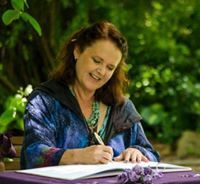
You won't find 'terraglossia' on Google, or in a dictionary. It's a word coined by acclaimed academic and award-winning author Dr Debra Dank in response to the first Europeans' description of Australia as 'terra nullius' - no one's land.
These new arrivals, with their language born far away, silenced and made invisible the more-than-ancient civilisations that have lived in and with this place for many thousands of years. The First Peoples became 'other', spoken for and about in another language, through another culture, not permitted to articulate their essential being and their complex relationships with Country and its entities, unable to participate in the development of a truly Australian dialogue. It is time for the depth of this linguistic colonisation to be recognised, for the deep intellectual traditions of First Nations Australians to be acknowledged and included, for their multiple living communicative practices and expressions to be heard. Terraglossia is a powerful and moving reply to a false claiming, to the need for understanding that only through responsible living with the earth, not just what can be articulated in a language that arrived 250 years ago, will all the voices of Australia truly be heard.
You can feel it recalibrating your understanding of relationships and networks of knowledge and the passage of time and what things are important to notice, and why non Indigenous people do not presently have the language/ thought traditions/ context to understand what we are missing. Cannot recommend Dr Dank’s work highly enough! Especially if you are into semiotics but mainly if you have ever or will ever spend time in ‘Australia’ or have any kind of colonisation or English speaking in your ancestry.
Dank argues here for Indigenous semiotics, a way of seeing, as well as using, language that expresses a sense of inclusion and ecological integration: terraglossia. Less focused than her previous work, this short book or long essay gives glimpses of insight into education and Dank's life, in addition to language. Dank writing is gorgeous - this is a pleasure to read - and her academic and cultural knowledge are whip sharp. I wouldn't have minded more on her central argument, but it is always a pleasure to read.
What a powerful book. An amazing argument for the genuine acknowledgement/inclusion of First Nations knowledge and traditions.
I found the Gudanji linguistic practises absolutely fascinating - like the concept of living tenses/frameworks (the chapter “Listening to the more-than-voices” specifically).
This book just makes you a better person. It forces you to acknowledge that your way of seeing the world is, well, just that. Sometimes uncomfortable but necessary.
I really enjoyed Debra’s book, and the cover designed by her daughter Rhyia Dank is a beautifully composed act of defiance that mirrors the books interrogation and intent. The book allows you to enter her thoughtfulness as a conversation. I’ve always enjoyed my conversations with Debra, and this was an opportunity to see her thinkings in depth. I was lucky enough to go to the book launch and get a signed copy last year and finally sit down to read it now. The title proposes a conceptual counter to terra nullius. “Terraglossia” Deb coins a new word to suggest the tongues of the earth, the idea that Country speaks, and that First Nations languages are not simply systems of communication but living epistemologies. The book moves between theory, cultural critique and reflective prose. Her many years as an educator provide unique insight into language and the way we use it in Australia. She does not present language as a neutral tool; it is political, embodied and contested. Classrooms, courtrooms and policy documents become sites where meaning is negotiated and where Indigenous knowledge is often mistranslated or dismissed. What makes the book compelling is its refusal to reduce Indigenous languages to heritage artefacts. If we continue to think only in the terms provided by 700 year old colonial English, we limit the futures we can imagine and expand contextual meaning to new ways that encapsulate more complex ways of being. For readers engaged in art, education, cultural theory or decolonial practice, it is a text that insists language is never just words, but relationship. For those curious about connection to country, relationality and language in contemporary Australia this is well worth a read!
This is a thought provoking book that asks non-Aboriginal people to be curious about their assumptions and challenge ways of thinking that obscure Aboriginal ways of knowing and more than human agencies. Dank suggests that semiotics is an avenue to reconcile why language alone cannot accomplish in order to recognise how Western research practices, narratives, and concepts are not the bedrock upon which the country we now call Australia came to be. Dank’s writing is beautiful in its clarity and individuality, interpolating personal experience with gentle calls to action.
There are two quibbles I had that do not detract from my ranking because they are inconsequential to the argument. First, glossia is Latin but originally Greek, meaning tongue, so sometimes the affirmations of its Latin origins are jarring.
Secondly, the insistence of English as a young language compared to Aboriginal languages is a bit misleading since languages evolve and change every 500 years or so and so Protoeuropean should be the point of comparison.
However, these are technicalities that are beside the point: however you classify the instruments of colonisation, they still had the same effect.
In this wonderful, wise tome, Debra Dank says that "there is no result to be found if you Google the term 'terraglossia', and you won't find it in a dictionary -- yet, and perhaps not ever." This is the only thing she gets wrong. It has entered the vocabulary of AI and Google and surely will soon be in every dictionary, because it is such a perfect word to contain the way we need to listen and communicate on this Country, and every land. She has listened, and she offers this to us to learn and change our way of being. Terraglossia, why has it taken us so long to learn the language we should all know, because it is our Mother Tongue.