

What do you think?

Underlake
A richly glittering debut about the interlocked fates of two women, raised worlds apart, who must join forces on an extraordinary journey, diving leagues beneath the water's surface—and straight into the fathomless heart of fear, forgiveness, and love.
Thirteen years ago, Otta escaped the small town of Steels, intent upon becoming a marine biologist. Now she's returned, having failed to achieve her dream, and carrying the guilt of a friend's death during a deep-sea dive. She thinks she may never dive again, but then a stranger appears at her door.
This stranger, May, says that her daughter has run away, and insists that she's under a nearby lake—alive.
Because it turns out the small-town legend of "the underlake" is true: three decades ago, an entire valley and the town in it was flooded to make way for a dam, but the people in that town refused to leave.
Now, they're still living beneath the lake, self-proclaimed “refugees of a world obsessed with change,” connected—and held apart—by an intricate, airtight system of tubes and sealed buildings. To find May's missing daughter, Otta and May must travel deeper and deeper under the water. Along the way, they'll discover communities that have lived in isolation for decades, fomenting extremes of delusion and nostalgia. As the two women bond in the thrall of their search, they are each forced to confront the layers of fear, control, and uncertainty that drive their quest. Together and alone, they must challenge the laws of love and society—and push their bodies to the mortal limit.
Hypnotic and arresting, Underlake How do we claim our place on the great timeline of history, and who do we erase in the process? It brings a poet's attention to language, gesturing at the evocative and ethereal work of Preeta Samarasan and Marilynne Robinson, while also shrewdly exploring the American obsession with inheritance, property, and race. Finally, Underlake is a powerful meditation on what is possible when women reach through time, space, and memory to relate to one another.
Thirteen years ago, Otta escaped the small town of Steels, intent upon becoming a marine biologist. Now she's returned, having failed to achieve her dream, and carrying the guilt of a friend's death during a deep-sea dive. She thinks she may never dive again, but then a stranger appears at her door.
This stranger, May, says that her daughter has run away, and insists that she's under a nearby lake—alive.
Because it turns out the small-town legend of "the underlake" is true: three decades ago, an entire valley and the town in it was flooded to make way for a dam, but the people in that town refused to leave.
Now, they're still living beneath the lake, self-proclaimed “refugees of a world obsessed with change,” connected—and held apart—by an intricate, airtight system of tubes and sealed buildings. To find May's missing daughter, Otta and May must travel deeper and deeper under the water. Along the way, they'll discover communities that have lived in isolation for decades, fomenting extremes of delusion and nostalgia. As the two women bond in the thrall of their search, they are each forced to confront the layers of fear, control, and uncertainty that drive their quest. Together and alone, they must challenge the laws of love and society—and push their bodies to the mortal limit.
Hypnotic and arresting, Underlake How do we claim our place on the great timeline of history, and who do we erase in the process? It brings a poet's attention to language, gesturing at the evocative and ethereal work of Preeta Samarasan and Marilynne Robinson, while also shrewdly exploring the American obsession with inheritance, property, and race. Finally, Underlake is a powerful meditation on what is possible when women reach through time, space, and memory to relate to one another.
320 pages, Hardcover
First published April 21, 2026
About the author
Erin L. McCoy
2 books29 followersErin L. McCoy is the author of Underlake, a novel forthcoming from Doubleday in 2026.
Wrecks, her debut poetry collection, is forthcoming from Noemi Press in October 2025 and was a finalist for the Noemi Book Award.
Erin is a writer, scholar, book editor, and educator in creative writing and Spanish and Latin American literature. She won second place in the 2019–2020 Rougarou Poetry Contest, judged by CAConrad, and her work has appeared in Best New Poets twice, selected by Kaveh Akbar in 2021 and Natalie Diaz in 2017. Her poetry and fiction have appeared or are forthcoming in West Branch, Narrative, Bennington Review, Pleiades, Conjunctions, Beloit Poetry Journal, Nimrod International Journal, and other publications.
Erin holds an MFA in poetry and an MA in Spanish and Latin American literature from the University of Washington. She has received a Fulbright Fellowship; a Critical Languages Scholarship; an Inprint C. Glenn Cambor Fellowship; the University of Washington’s Grace Milliman Pollock Scholarship; and the Oakley Hall III Memorial Scholarship to attend the Community of Writers in California, among other awards.
Erin works as a freelance proofreader Penguin Random House. She serves as acquisitions editor at Entre Ríos Books, where she focuses on discovering Argentine poets for translation. She is an assistant poetry editor at Narrative magazine.
Erin has also won nearly two dozen awards in photojournalism.
Born and raised in Louisville, Kentucky, Erin has lived in Malaysia, Spain, Seattle, and two St. Petersburgs—Russia and Florida.
Wrecks, her debut poetry collection, is forthcoming from Noemi Press in October 2025 and was a finalist for the Noemi Book Award.
Erin is a writer, scholar, book editor, and educator in creative writing and Spanish and Latin American literature. She won second place in the 2019–2020 Rougarou Poetry Contest, judged by CAConrad, and her work has appeared in Best New Poets twice, selected by Kaveh Akbar in 2021 and Natalie Diaz in 2017. Her poetry and fiction have appeared or are forthcoming in West Branch, Narrative, Bennington Review, Pleiades, Conjunctions, Beloit Poetry Journal, Nimrod International Journal, and other publications.
Erin holds an MFA in poetry and an MA in Spanish and Latin American literature from the University of Washington. She has received a Fulbright Fellowship; a Critical Languages Scholarship; an Inprint C. Glenn Cambor Fellowship; the University of Washington’s Grace Milliman Pollock Scholarship; and the Oakley Hall III Memorial Scholarship to attend the Community of Writers in California, among other awards.
Erin works as a freelance proofreader Penguin Random House. She serves as acquisitions editor at Entre Ríos Books, where she focuses on discovering Argentine poets for translation. She is an assistant poetry editor at Narrative magazine.
Erin has also won nearly two dozen awards in photojournalism.
Born and raised in Louisville, Kentucky, Erin has lived in Malaysia, Spain, Seattle, and two St. Petersburgs—Russia and Florida.
Ratings & Reviews
Friends & Following
Create a free account to discover what your friends think of this book!
Community Reviews
Displaying 1 - 30 of 159 reviews

April 5, 2026
I am struggling to classify this book. Modern lit? Yeah, kinda. Sci-fi/Fantasy? Yeah, a little there too. Weird? Definitely but not only. It doesn’t fit neatly under one label, that’s clear. It’s a little bit of finding yourself, rebuilding yourself after a loss (of what was and of what never would be) and fantastical (a city of people living under a lake, yes -under- a lake). Oh and those people? They all center around a reverend who teaches them that everyone “overlake” was struck down for a sin and have been annihilated. But are they the only ones living under the lake? You can see why this one absolutely defies classification. It’s a genre all on its own.
A dam was built and a town or two flooded. A staunch group of people believed the land and god would save them, another relied on a factory to keep them alive hoping salvation came at the hands of the richest family in town. Instead nearly 200 people drowned. Or did they? Otta returns home after a devastating loss only to help a woman named May find her daughter. She claims her daughter is under the lake. Alive. Otta decides to believe her and vows to help find Daphne. What happens from there is nothing like what you’re expecting.
Underlake hits shelves April 21. If you want an unexpected and heartfelt narrative, with just a slice of fantastical, then this one is for you!
Huge thank you to Doubleday and author Erin L. McCoy for sending this ARC in exchange for an honest review. All opinions are my own.
A dam was built and a town or two flooded. A staunch group of people believed the land and god would save them, another relied on a factory to keep them alive hoping salvation came at the hands of the richest family in town. Instead nearly 200 people drowned. Or did they? Otta returns home after a devastating loss only to help a woman named May find her daughter. She claims her daughter is under the lake. Alive. Otta decides to believe her and vows to help find Daphne. What happens from there is nothing like what you’re expecting.
Underlake hits shelves April 21. If you want an unexpected and heartfelt narrative, with just a slice of fantastical, then this one is for you!
Huge thank you to Doubleday and author Erin L. McCoy for sending this ARC in exchange for an honest review. All opinions are my own.

February 15, 2026
I have been blown away by this book. The worlds colliding here are nothing short of INSANE. I found myself researching between chapters just because of the sheer amount of underwater diving knowledge and then laid awake at night thinking how I could live underwater. Because this was so out of my realm of normal thinking, it took some time for me to really understand what was going on in some parts, but the author did an incredible job weaving it all together. Aside from the physics/engineering/science components, these characters had me rooting for them in ways I couldn’t believe. A great read for anyone who’s looking to expand their way of thinking, feeling and navigating grief or wanting to explore the beauty of forgiveness and HOPE.

April 29, 2026
I loved the watery and weird small town setting, but this ended up being a little slow and abstract for my taste.
Thank you to the publisher for the ARC.
Thank you to the publisher for the ARC.
April 29, 2026
I was immediately drawn in by the premise, and overall highly disappointed.
This felt like reading the performance of writing rather than actual writing. A piece that objectively has beautiful prose, but is utterly boring, difficult to follow and somehow not visceral in the slightest … it was trying to be so many things yet ended up being nothing at all.
Also we need to talk about these books written by very obviously far left liberal writers - I don’t like being able to identify an author’s political affiliation just based on the way they write, yet somehow always can. How? Well they don’t integrate properly. It’s like reading a brochure for a school with a wheelchair kid, brown kid, and Asian kid on the front. The random trans sibling, the dead gay BFF with colored hair… these additions were out of place. There’s space for queer characters in writing, obviously, but integrate them appropriately. Like that BFF loss would’ve landed with far more impact had it been the loss of a partner. And the sister being trans was just a random side story line that distracted from the actual plot. Don’t get me started on the way religion was weaved up in here… for lack of a better term- totally UNgracefully. Even the ending of “well it will be their choice if they come up or not!” La dee da you are in liberal La la land! This reader wanted to see SALVATION for those people! A merging of worlds! A draining of the lake! Something powerful- I mean come on.
I struggled so much visualizing this underwater town I think it should’ve come with a map or some kind of visual aid. The descriptions didn’t paint anything for me and no matter how hard I tried I couldn’t get a picture of anything in this book in my mind. I couldn’t comprehend the dam element, (I don’t know anything about dams..probably the average reader doesn’t either?) nor do I feel the diving gear descriptions were helpful.
Also if someone could please help- what was the big connection here? I didn’t get it…
I gave it two stars because I stuck it out till the end and had to see what happened to the missing kid. But overall, this was a mess and just not good :(
This felt like reading the performance of writing rather than actual writing. A piece that objectively has beautiful prose, but is utterly boring, difficult to follow and somehow not visceral in the slightest … it was trying to be so many things yet ended up being nothing at all.
Also we need to talk about these books written by very obviously far left liberal writers - I don’t like being able to identify an author’s political affiliation just based on the way they write, yet somehow always can. How? Well they don’t integrate properly. It’s like reading a brochure for a school with a wheelchair kid, brown kid, and Asian kid on the front. The random trans sibling, the dead gay BFF with colored hair… these additions were out of place. There’s space for queer characters in writing, obviously, but integrate them appropriately. Like that BFF loss would’ve landed with far more impact had it been the loss of a partner. And the sister being trans was just a random side story line that distracted from the actual plot. Don’t get me started on the way religion was weaved up in here… for lack of a better term- totally UNgracefully. Even the ending of “well it will be their choice if they come up or not!” La dee da you are in liberal La la land! This reader wanted to see SALVATION for those people! A merging of worlds! A draining of the lake! Something powerful- I mean come on.
I struggled so much visualizing this underwater town I think it should’ve come with a map or some kind of visual aid. The descriptions didn’t paint anything for me and no matter how hard I tried I couldn’t get a picture of anything in this book in my mind. I couldn’t comprehend the dam element, (I don’t know anything about dams..probably the average reader doesn’t either?) nor do I feel the diving gear descriptions were helpful.
Also if someone could please help- what was the big connection here? I didn’t get it…
I gave it two stars because I stuck it out till the end and had to see what happened to the missing kid. But overall, this was a mess and just not good :(

April 21, 2026
A Haunted Lake, a Bad System, and One Very Overworked Dehumidifier
In “Underlake,” Erin L. McCoy builds a drowned world so vivid it nearly overfurnishes itself – and still makes the descent worth taking.
By Demetris Papadimitropoulos | April 21st, 2026
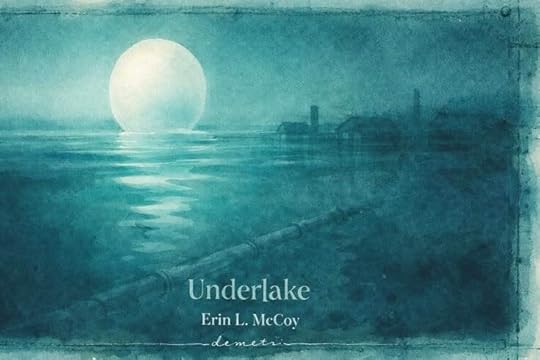
A Lie That Still Delivers Air – A calm lake glows over faint pipes, rooflines, and borrowed light, distilling “Underlake” into the image of a buried world that has not died so much as learned to keep breathing.
A lake is supposed to finish the argument. It covers the road, the church, the factory, the houses – evidence and blame. Water can make disappearance look like weather. In Erin L. McCoy’s “Underlake,” the water does not end the argument. It pressurizes it.
Before anyone dives, the book has already made pressure moral. “Underlake” has a premise with a trapdoor under it: beneath a poisoned lake in rural Kentucky, a town long presumed drowned has survived for decades in sealed buildings, tubes, chimneys, air pockets, and myth. A hook-spending novel would have turned that discovery into spectacle. McCoy chooses the slower danger. She treats the drowned town as infrastructure. It is uncanny because it is maintained. Someone scrubs the algae, guards the water, changes the bulbs, teaches the children the authorized story, opens the hatch, tells the lie again. The thing McCoy gets most right is that her metaphor has plumbing.
Above water, Otta Coates has come home to the place she once mistook distance for escaping. She wanted to become a marine biologist. Instead she became a commercial diver, then returned to Steels after a deep-sea accident that leaves no usable comfort behind. Ethan, her closest companion, is dead. Otta’s mother, Eugenia, is ill, hoarding, cognitively unstable, and still ringed by the old town-stain that has followed her for years: the belief that she helped finance the deluded People’s Council that refused to leave Paintsville before the valley was flooded for a dam. Otta arrives with the story she has used to make Eugenia bearable. This, in fiction as in basements, is usually when the mold begins talking.
Then May appears at Otta’s door. She is awkward, watchful, oddly dressed, and almost unbearably sincere. Her daughter Daphne, she says, has gone missing. She believes Daphne is under the lake, alive. Otta initially hears this as malice, madness, or some local hybrid of the two, another small-town ghost story gnawing at Eugenia’s disgrace. But May is not inventing the Underlake. She is from it.
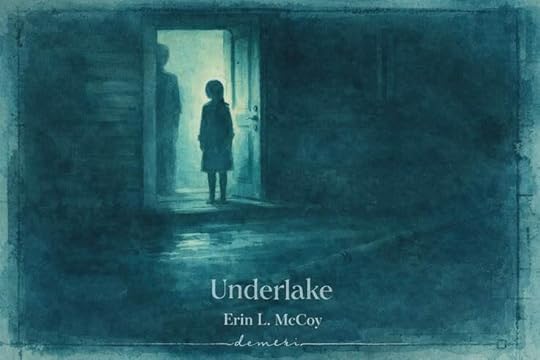
May at the Door – May’s arrival at Otta’s threshold turns local rumor into living testimony, the ordinary doorway becoming the first opening between surface grief and the impossible world below.
The search is simple enough to act as ballast: Otta, who can barely bear to dive after Ethan’s death, must help May look for Daphne beneath a lake no one should swim in or trust. Under that search waits the question a rescue plot would rather not answer: what kind of church, factory, mother, and town would make a child think she must go under to find good water? Daphne is not only the missing girl. She is the test case, the child whose disappearance proves that every kept secret in the Underlake has become part of the air supply.
Below, survival has splintered into rooms, rules, and borrowed air, each one mistaking endurance for order. The Chimneys, May’s home, is governed by Reverend Jewell’s theology, family “fates,” purity doctrine, and the claim that stories belong to those with authority to name history and sin. Henry Weber’s factory chills the premise into machinery: labor, inheritance, water, and obedience locked together. Water clean enough to become power turns into currency, proof, ransom. A daughter’s body becomes collateral. The past becomes something not remembered but serviced.
McCoy writes with a diver’s suspicion of air: every breath matters, and every sealed room has a cost. Her paragraphs gather silt, rust, mold, and grief, then tighten around a blunt fact. Otta’s language often reaches for gauge-lit precision: depth, heliox, decompression, umbilicals, search procedures, the hard math of bodies in hostile environments. She wants fact to discipline terror.
May’s language is the book’s bolder feat. Her narration carries the marks of a world with guards posted at the vocabulary: doctrine, invented terms, religious cadence, deprivation, wonder, and a grammar shaped by having been “storied” before she was ever allowed to tell. McCoy does not use May’s voice as costume. She uses it as evidence of rules lodged in grammar and of a woman learning to speak without permission. May’s syntax is a room she was born in and a tool she is slowly sharpening from the inside.
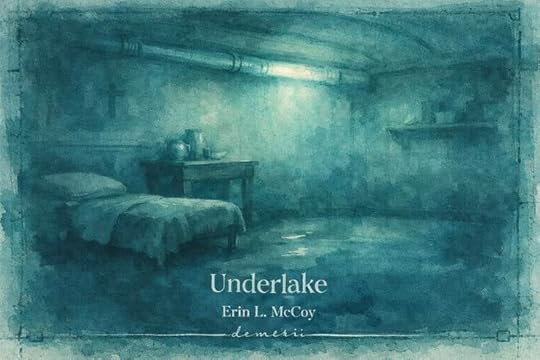
Rooms With Borrowed Air – A sealed Underlake room holds the tenderness and terror of survival, where doctrine, domestic life, and borrowed air have taught people to mistake endurance for order.
That doubleness matters. Otta and May are both survivors of rooms built by rules they did not choose, though only one of them has instruments to name danger as danger. Otta has lived inside grief, debt, class shame, academic failure, professional risk, and the long bruise of her mother’s silence. May has lived inside an underwater theology that made ignorance holy and hierarchy breathable. They need each other not because the novel mints instant sisterhood, but because no one in “Underlake” leaves a false world alone. Freedom here is not a door. It is a sequence of sealed compartments, and someone has to wait while you breathe.
The form follows that need downward. “Underlake” is organized in three parts, with titled sections that move among Otta, May, later Daphne, and depth-marked passages that act as gauges, plaques, and field notes from rooms that should not still exist. The bracketed Otta sections around Ethan’s death and the diving world give the search bodily knowledge: the terror of procedure continuing after hope is gone. The depth-marker sections cut the lake open, showing not a hidden town but several little regimes: who works, who drinks, who marries, who is believed.
The book descends by stages, not by drop. A ghost story becomes real. A real place becomes allotments, rites, and locked doors. A rescue becomes a reckoning. A mother’s crime becomes something more complicated than family legend allowed. The structure does not merely contain the ordeal; it conducts it. Descent is movement through water, but also through the stories each woman has used because no better story was available: Otta’s blame, May’s faith, Daphne’s secrecy, Otta’s belief that leaving Steels meant being free of it.
The opening image of Paintsville Dam and the drowned valley does not remain scenery. It becomes the beam under the floorboards: dam, placard, lake, poisoned fish, sold-off acres, unrecovered bodies, family shame. The book asks what happens when the past is not buried but inhabited by the living. More exactly, it asks what happens when the living have mistaken that occupancy for home.
This is where “Underlake” makes its impossible premise pay rent. It has some of the saltwater grief of Julia Armfield’s “Our Wives Under the Sea,” some of the expeditionary dread of Jeff VanderMeer’s “Annihilation,” and some of the underwater memory-pressure of Rivers Solomon’s “The Deep.” Yet McCoy’s gift is more logistical than those comparisons suggest. She is interested in the impossible, yes, but also in the maintenance ledger of the impossible. This underwater settlement is less wonderland than workplace, which is exactly why it unnerves. It is a bad order that has learned how much to feed people.
The reader’s world knocks from inside the walls. “Underlake” speaks to clean water, displacement, dams, contamination, property, closed doctrine, and the politics of who gets to tell the official story of a place. Its relevance is not announced. It is built into the rooms: a key, a pipe, a faucet, a map no one is allowed to unfold. Power often resides in access: who holds the valve, who guards the room, who names the dead, who decides which water is safe and which body is expendable. If the novel offers a prophecy, it is a practical one: look for the valve. The future will not be decided by ideals alone. It will be fought over gates.
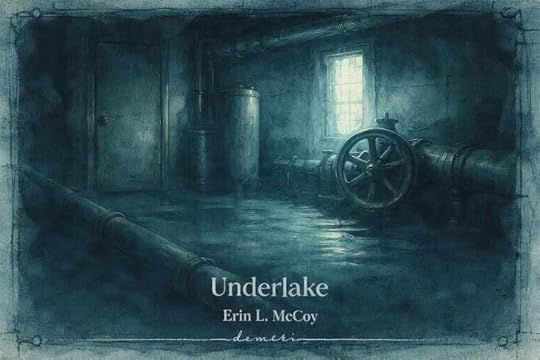
The Valve Room – Pipes, locked water, and cold industrial light render the book’s sharpest moral question in physical terms: who controls access, and who is made to live downstream of that control?
That thoroughness, inevitably, has a cost. McCoy’s imagination keeps producing underwater rooms, small tyrannies, rituals, and improvised republics, and while many are vivid, not all are equally necessary. Some are chambers; a few arrive glass-fronted. The middle can feel overfurnished: another warped household, another emblem of preservation or control or poisoned inheritance. At its best, the novel discovers these spaces. At its weaker moments, a room arrives with its thesis already unpacked, little lamp glowing on the mantle. Henry Weber’s factory is the most revealing example. It gives the book a frightening concentration of water, property, labor, and family money, but Weber sometimes feels like several American failures buttoned into one villain’s coat. The coat fits. It is still a lot of coat.
The sentences pay the same price. McCoy is so good at intensity that the book occasionally forgets the use of lower pressure. Nearly every object arrives charged, damp, symbolic, alive with implication. The result is often remarkable, but the reader may sometimes long for one plain chair permitted to be merely a chair, not a small tribunal of inheritance and rot. Occasionally, the atmosphere could use a dehumidifier. The dehumidifier would, naturally, know a secret.
Still, the excess comes from appetite, not drift. “Underlake” overreaches because it asks one premise to carry a grief novel, search narrative, cult history, ecological parable, family reckoning, labor critique, and mother-daughter myth. That should not work as well as it does. The reason it does is May. Her love for Daphne is desperate, flawed, secretive, and brave. She saves her daughter by breaking rules and hiding good water from her, but that secrecy gives Daphne a terrible inheritance of knowledge. The book is most bruising where it lets love save and harm in the same gesture. Love may save a child. Love may also keep the child inside the room where the parent first learned to survive.
Daphne’s late testimony sharpens the point. Her disappearance is not a mere lost-child device. She leaves because she knows clean water exists and understands, with a child’s dreadful directness, that her own survival has been purchased by secrecy while other children have died. When she is found, the novel does not turn rescue into applause. Daphne has seen enough to know that getting out is not enough if everyone else is still below. She wants to return truth to the Chimneys.
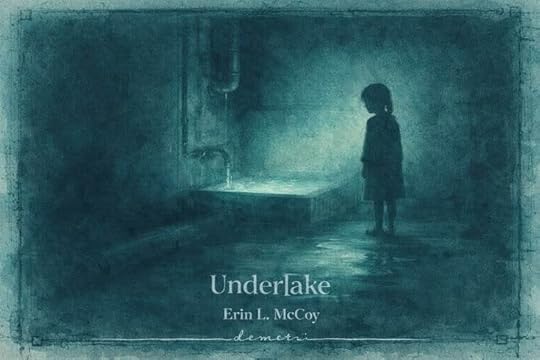
Daphne’s Good Water – A child stands before clean water as if before knowledge itself, carrying the book’s most painful truth: survival can become another inheritance of secrecy.
That desire could have curdled into nobility in a weaker book, but here it is thornier. Daphne is not choosing martyrdom so much as refusing the comfort of abandoning everyone else to the lie. She understands what adults in the novel learn late: the truth is not finished when it frees you. Sometimes that is when it starts making demands.
Otta’s arc is quieter but just as necessary. Her grief over Ethan is not a decorative bruise. It is procedural before it is sentimental: the failed search, the deep water, the possibility that hope becomes performance after ten minutes, the terror of knowing too much about how a body dies underwater. These details make her reluctance to dive again feel earned. Her return to the water with May is not therapeutic in any tidy sense. It is a reentry into risk, guilt, competence, and action. By the end, she cannot save Ethan retroactively. The novel is merciful enough not to offer that insult. But she can learn the difference between the dead she cannot recover and the living who still need her strength.
Eugenia, too, is made less tidy without being excused. The town’s story about her, and Otta’s story about her, have been incomplete. Learning that Eugenia’s supposed crime involved an attempt to help people escape rather than a simple act of delusion or theft does not transform her into a sainted misunderstood mother. It does something better. It shows how partial stories become rooms people are forced to live in. Eugenia remains difficult, withholding, damaged, and damaging. She also becomes someone who tried, failed, hardened, hoarded, and carried a story no one had the patience or language to receive. That late adjustment gives the family plot its ache. It does not absolve. It restores proportion.
The ending satisfies because it refuses to be clean. Daphne survives. May reaches the Overlake. Otta begins clearing the house and swimming again. Clark tries to send water below. Snow and rain refill the tank for now. Yet the Underlake remains. Joan, Arthur, the Chimneys, the factory, and the people still living inside bad stories do not vanish because the protagonists have surfaced. This is rescue with work still attached. A lesser ending would have confused escape with resolution. McCoy gives us rescue, then hands back obligation. Rude, honestly. Also correct.
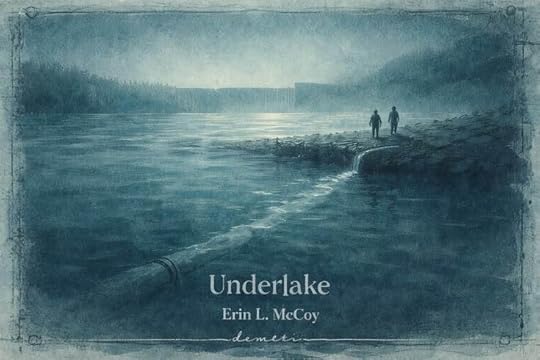
Surfacing With Work Still Attached – The surface offers no clean release, only a colder kind of hope: the recognition that rescue is incomplete while the world below still needs the water moved differently.
My final rating is 87/100, which corresponds to 4/5 stars on Goodreads. The score fits the book’s scale, and its strain: a high-four-star debut with water in its lungs and architecture in its bones, daring enough to make a search plot wait while a civilization explains how it learned to breathe. It drags in places, and its symbolic rooms can be too eager to introduce themselves. But the book is far too original, voiced, and built so its sections descend, stall, flood, and surface to be treated as merely promising.
The hook lingers: a town alive beneath a poisoned lake. The mechanism lingers longer. “Underlake” understands that a false world can be tender, intricate, functional, and fatal all at once. People do not stay only because they are deceived. They stay because someone they love is there, because the air still comes through the pipe, because the old story explains the pain.
In “Underlake,” the past is not a corpse under glass. It is a working system. A lie that still delivers air. The terrifying thing is that it still functions. The hope is that, once someone sees how the water moves, it may become possible, at last, to change where it goes.
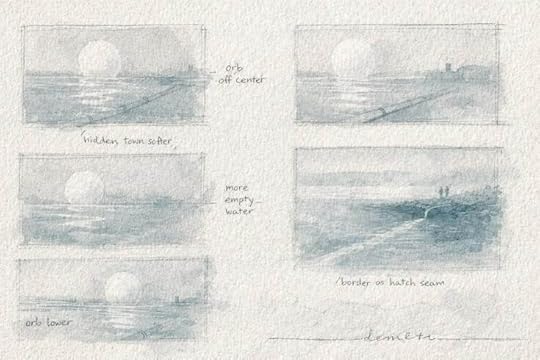
Compositional Thumbnail Sheet – Early thumbnail studies test the balance between lake, orb, pipe, and negative space, showing how the final image began by choosing restraint over spectacle.

Color Swatch Sheet – Cover-derived washes of deep teal, smoky cyan, pale aqua, foggy mint, and near-black green establish the cold emotional weather of the finished watercolor.
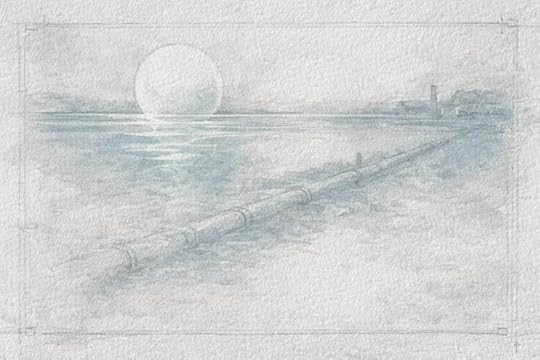
Faint Pencil Underdrawing – The pale pencil structure places the orb, waterline, pipe, chimney, and border before the washes blur them into memory and submerged atmosphere.
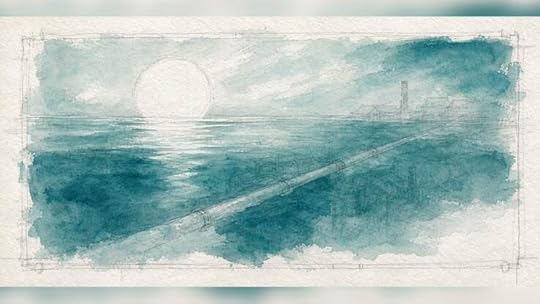
Pencil-Plus-First-Wash Stage – The first thin washes begin turning structure into mood, letting the lake, hidden architecture, and air-pocket glow emerge through pigment rather than detail.
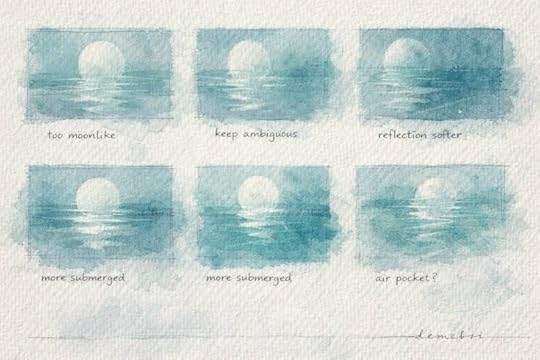
Light / Orb / Reflection Study – Studies of the central glow explore whether the orb reads as moon, bubble, lamp, breath, or memory, preserving the ambiguity that gives the final image its quiet unease.
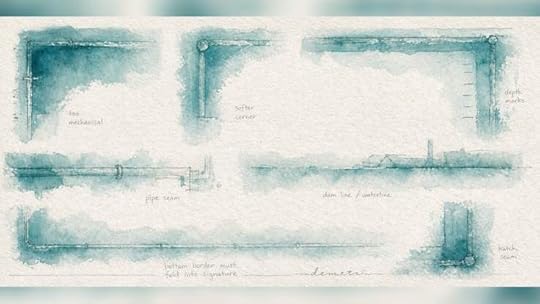
Watercolor Border Study – Border tests translate pipes, hatch seams, depth marks, and waterlines into a hand-painted frame that suggests containment without becoming decorative.
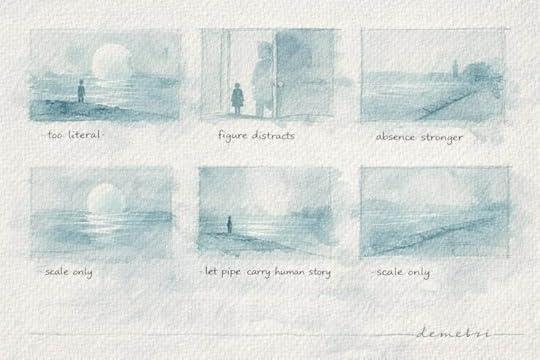
Character Scale / Rejected Figure Study – Small figure studies show what the finished emblematic image deliberately withholds, allowing absence, architecture, and water to carry the human story.
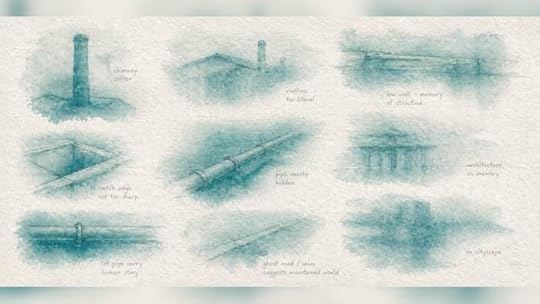
Pipe and Submerged Architecture Detail Study – Architectural fragments, softened pipes, and ghosted rooflines show how the final image balances literal anchors with enough blur to preserve the mystery below.
All watercolor illustrations by Demetris Papadimitropoulos.
In “Underlake,” Erin L. McCoy builds a drowned world so vivid it nearly overfurnishes itself – and still makes the descent worth taking.
By Demetris Papadimitropoulos | April 21st, 2026
A Lie That Still Delivers Air – A calm lake glows over faint pipes, rooflines, and borrowed light, distilling “Underlake” into the image of a buried world that has not died so much as learned to keep breathing.
A lake is supposed to finish the argument. It covers the road, the church, the factory, the houses – evidence and blame. Water can make disappearance look like weather. In Erin L. McCoy’s “Underlake,” the water does not end the argument. It pressurizes it.
Before anyone dives, the book has already made pressure moral. “Underlake” has a premise with a trapdoor under it: beneath a poisoned lake in rural Kentucky, a town long presumed drowned has survived for decades in sealed buildings, tubes, chimneys, air pockets, and myth. A hook-spending novel would have turned that discovery into spectacle. McCoy chooses the slower danger. She treats the drowned town as infrastructure. It is uncanny because it is maintained. Someone scrubs the algae, guards the water, changes the bulbs, teaches the children the authorized story, opens the hatch, tells the lie again. The thing McCoy gets most right is that her metaphor has plumbing.
Above water, Otta Coates has come home to the place she once mistook distance for escaping. She wanted to become a marine biologist. Instead she became a commercial diver, then returned to Steels after a deep-sea accident that leaves no usable comfort behind. Ethan, her closest companion, is dead. Otta’s mother, Eugenia, is ill, hoarding, cognitively unstable, and still ringed by the old town-stain that has followed her for years: the belief that she helped finance the deluded People’s Council that refused to leave Paintsville before the valley was flooded for a dam. Otta arrives with the story she has used to make Eugenia bearable. This, in fiction as in basements, is usually when the mold begins talking.
Then May appears at Otta’s door. She is awkward, watchful, oddly dressed, and almost unbearably sincere. Her daughter Daphne, she says, has gone missing. She believes Daphne is under the lake, alive. Otta initially hears this as malice, madness, or some local hybrid of the two, another small-town ghost story gnawing at Eugenia’s disgrace. But May is not inventing the Underlake. She is from it.
May at the Door – May’s arrival at Otta’s threshold turns local rumor into living testimony, the ordinary doorway becoming the first opening between surface grief and the impossible world below.
The search is simple enough to act as ballast: Otta, who can barely bear to dive after Ethan’s death, must help May look for Daphne beneath a lake no one should swim in or trust. Under that search waits the question a rescue plot would rather not answer: what kind of church, factory, mother, and town would make a child think she must go under to find good water? Daphne is not only the missing girl. She is the test case, the child whose disappearance proves that every kept secret in the Underlake has become part of the air supply.
Below, survival has splintered into rooms, rules, and borrowed air, each one mistaking endurance for order. The Chimneys, May’s home, is governed by Reverend Jewell’s theology, family “fates,” purity doctrine, and the claim that stories belong to those with authority to name history and sin. Henry Weber’s factory chills the premise into machinery: labor, inheritance, water, and obedience locked together. Water clean enough to become power turns into currency, proof, ransom. A daughter’s body becomes collateral. The past becomes something not remembered but serviced.
McCoy writes with a diver’s suspicion of air: every breath matters, and every sealed room has a cost. Her paragraphs gather silt, rust, mold, and grief, then tighten around a blunt fact. Otta’s language often reaches for gauge-lit precision: depth, heliox, decompression, umbilicals, search procedures, the hard math of bodies in hostile environments. She wants fact to discipline terror.
May’s language is the book’s bolder feat. Her narration carries the marks of a world with guards posted at the vocabulary: doctrine, invented terms, religious cadence, deprivation, wonder, and a grammar shaped by having been “storied” before she was ever allowed to tell. McCoy does not use May’s voice as costume. She uses it as evidence of rules lodged in grammar and of a woman learning to speak without permission. May’s syntax is a room she was born in and a tool she is slowly sharpening from the inside.
Rooms With Borrowed Air – A sealed Underlake room holds the tenderness and terror of survival, where doctrine, domestic life, and borrowed air have taught people to mistake endurance for order.
That doubleness matters. Otta and May are both survivors of rooms built by rules they did not choose, though only one of them has instruments to name danger as danger. Otta has lived inside grief, debt, class shame, academic failure, professional risk, and the long bruise of her mother’s silence. May has lived inside an underwater theology that made ignorance holy and hierarchy breathable. They need each other not because the novel mints instant sisterhood, but because no one in “Underlake” leaves a false world alone. Freedom here is not a door. It is a sequence of sealed compartments, and someone has to wait while you breathe.
The form follows that need downward. “Underlake” is organized in three parts, with titled sections that move among Otta, May, later Daphne, and depth-marked passages that act as gauges, plaques, and field notes from rooms that should not still exist. The bracketed Otta sections around Ethan’s death and the diving world give the search bodily knowledge: the terror of procedure continuing after hope is gone. The depth-marker sections cut the lake open, showing not a hidden town but several little regimes: who works, who drinks, who marries, who is believed.
The book descends by stages, not by drop. A ghost story becomes real. A real place becomes allotments, rites, and locked doors. A rescue becomes a reckoning. A mother’s crime becomes something more complicated than family legend allowed. The structure does not merely contain the ordeal; it conducts it. Descent is movement through water, but also through the stories each woman has used because no better story was available: Otta’s blame, May’s faith, Daphne’s secrecy, Otta’s belief that leaving Steels meant being free of it.
The opening image of Paintsville Dam and the drowned valley does not remain scenery. It becomes the beam under the floorboards: dam, placard, lake, poisoned fish, sold-off acres, unrecovered bodies, family shame. The book asks what happens when the past is not buried but inhabited by the living. More exactly, it asks what happens when the living have mistaken that occupancy for home.
This is where “Underlake” makes its impossible premise pay rent. It has some of the saltwater grief of Julia Armfield’s “Our Wives Under the Sea,” some of the expeditionary dread of Jeff VanderMeer’s “Annihilation,” and some of the underwater memory-pressure of Rivers Solomon’s “The Deep.” Yet McCoy’s gift is more logistical than those comparisons suggest. She is interested in the impossible, yes, but also in the maintenance ledger of the impossible. This underwater settlement is less wonderland than workplace, which is exactly why it unnerves. It is a bad order that has learned how much to feed people.
The reader’s world knocks from inside the walls. “Underlake” speaks to clean water, displacement, dams, contamination, property, closed doctrine, and the politics of who gets to tell the official story of a place. Its relevance is not announced. It is built into the rooms: a key, a pipe, a faucet, a map no one is allowed to unfold. Power often resides in access: who holds the valve, who guards the room, who names the dead, who decides which water is safe and which body is expendable. If the novel offers a prophecy, it is a practical one: look for the valve. The future will not be decided by ideals alone. It will be fought over gates.
The Valve Room – Pipes, locked water, and cold industrial light render the book’s sharpest moral question in physical terms: who controls access, and who is made to live downstream of that control?
That thoroughness, inevitably, has a cost. McCoy’s imagination keeps producing underwater rooms, small tyrannies, rituals, and improvised republics, and while many are vivid, not all are equally necessary. Some are chambers; a few arrive glass-fronted. The middle can feel overfurnished: another warped household, another emblem of preservation or control or poisoned inheritance. At its best, the novel discovers these spaces. At its weaker moments, a room arrives with its thesis already unpacked, little lamp glowing on the mantle. Henry Weber’s factory is the most revealing example. It gives the book a frightening concentration of water, property, labor, and family money, but Weber sometimes feels like several American failures buttoned into one villain’s coat. The coat fits. It is still a lot of coat.
The sentences pay the same price. McCoy is so good at intensity that the book occasionally forgets the use of lower pressure. Nearly every object arrives charged, damp, symbolic, alive with implication. The result is often remarkable, but the reader may sometimes long for one plain chair permitted to be merely a chair, not a small tribunal of inheritance and rot. Occasionally, the atmosphere could use a dehumidifier. The dehumidifier would, naturally, know a secret.
Still, the excess comes from appetite, not drift. “Underlake” overreaches because it asks one premise to carry a grief novel, search narrative, cult history, ecological parable, family reckoning, labor critique, and mother-daughter myth. That should not work as well as it does. The reason it does is May. Her love for Daphne is desperate, flawed, secretive, and brave. She saves her daughter by breaking rules and hiding good water from her, but that secrecy gives Daphne a terrible inheritance of knowledge. The book is most bruising where it lets love save and harm in the same gesture. Love may save a child. Love may also keep the child inside the room where the parent first learned to survive.
Daphne’s late testimony sharpens the point. Her disappearance is not a mere lost-child device. She leaves because she knows clean water exists and understands, with a child’s dreadful directness, that her own survival has been purchased by secrecy while other children have died. When she is found, the novel does not turn rescue into applause. Daphne has seen enough to know that getting out is not enough if everyone else is still below. She wants to return truth to the Chimneys.
Daphne’s Good Water – A child stands before clean water as if before knowledge itself, carrying the book’s most painful truth: survival can become another inheritance of secrecy.
That desire could have curdled into nobility in a weaker book, but here it is thornier. Daphne is not choosing martyrdom so much as refusing the comfort of abandoning everyone else to the lie. She understands what adults in the novel learn late: the truth is not finished when it frees you. Sometimes that is when it starts making demands.
Otta’s arc is quieter but just as necessary. Her grief over Ethan is not a decorative bruise. It is procedural before it is sentimental: the failed search, the deep water, the possibility that hope becomes performance after ten minutes, the terror of knowing too much about how a body dies underwater. These details make her reluctance to dive again feel earned. Her return to the water with May is not therapeutic in any tidy sense. It is a reentry into risk, guilt, competence, and action. By the end, she cannot save Ethan retroactively. The novel is merciful enough not to offer that insult. But she can learn the difference between the dead she cannot recover and the living who still need her strength.
Eugenia, too, is made less tidy without being excused. The town’s story about her, and Otta’s story about her, have been incomplete. Learning that Eugenia’s supposed crime involved an attempt to help people escape rather than a simple act of delusion or theft does not transform her into a sainted misunderstood mother. It does something better. It shows how partial stories become rooms people are forced to live in. Eugenia remains difficult, withholding, damaged, and damaging. She also becomes someone who tried, failed, hardened, hoarded, and carried a story no one had the patience or language to receive. That late adjustment gives the family plot its ache. It does not absolve. It restores proportion.
The ending satisfies because it refuses to be clean. Daphne survives. May reaches the Overlake. Otta begins clearing the house and swimming again. Clark tries to send water below. Snow and rain refill the tank for now. Yet the Underlake remains. Joan, Arthur, the Chimneys, the factory, and the people still living inside bad stories do not vanish because the protagonists have surfaced. This is rescue with work still attached. A lesser ending would have confused escape with resolution. McCoy gives us rescue, then hands back obligation. Rude, honestly. Also correct.
Surfacing With Work Still Attached – The surface offers no clean release, only a colder kind of hope: the recognition that rescue is incomplete while the world below still needs the water moved differently.
My final rating is 87/100, which corresponds to 4/5 stars on Goodreads. The score fits the book’s scale, and its strain: a high-four-star debut with water in its lungs and architecture in its bones, daring enough to make a search plot wait while a civilization explains how it learned to breathe. It drags in places, and its symbolic rooms can be too eager to introduce themselves. But the book is far too original, voiced, and built so its sections descend, stall, flood, and surface to be treated as merely promising.
The hook lingers: a town alive beneath a poisoned lake. The mechanism lingers longer. “Underlake” understands that a false world can be tender, intricate, functional, and fatal all at once. People do not stay only because they are deceived. They stay because someone they love is there, because the air still comes through the pipe, because the old story explains the pain.
In “Underlake,” the past is not a corpse under glass. It is a working system. A lie that still delivers air. The terrifying thing is that it still functions. The hope is that, once someone sees how the water moves, it may become possible, at last, to change where it goes.
Compositional Thumbnail Sheet – Early thumbnail studies test the balance between lake, orb, pipe, and negative space, showing how the final image began by choosing restraint over spectacle.
Color Swatch Sheet – Cover-derived washes of deep teal, smoky cyan, pale aqua, foggy mint, and near-black green establish the cold emotional weather of the finished watercolor.
Faint Pencil Underdrawing – The pale pencil structure places the orb, waterline, pipe, chimney, and border before the washes blur them into memory and submerged atmosphere.
Pencil-Plus-First-Wash Stage – The first thin washes begin turning structure into mood, letting the lake, hidden architecture, and air-pocket glow emerge through pigment rather than detail.
Light / Orb / Reflection Study – Studies of the central glow explore whether the orb reads as moon, bubble, lamp, breath, or memory, preserving the ambiguity that gives the final image its quiet unease.
Watercolor Border Study – Border tests translate pipes, hatch seams, depth marks, and waterlines into a hand-painted frame that suggests containment without becoming decorative.
Character Scale / Rejected Figure Study – Small figure studies show what the finished emblematic image deliberately withholds, allowing absence, architecture, and water to carry the human story.
Pipe and Submerged Architecture Detail Study – Architectural fragments, softened pipes, and ghosted rooflines show how the final image balances literal anchors with enough blur to preserve the mystery below.
All watercolor illustrations by Demetris Papadimitropoulos.

February 14, 2026
52 book challenge for a book that cost me nothing cuz it’s an ARC: thanks to the publisher for allowing me to read this early :)

May 1, 2026
What a strange book! I feel this one had a lot of potential but it fell flat for me in the execution. I didnt feel any connection with the characters and I felt it under delivered. I would have loved to have had the author dive more into the back story of how the underlake towns were created so you could understand and connect more with the building process.

April 24, 2026
The main reason you read a book like this is to answer the question "how does the author make this idea plausible?" And... honestly, she really doesn't. She EXPLAINS it, but not in a way that ever made me believe it. Add to that a cast of characters I didn't particularly care about...

Review of advance copy received from Netgalley
Three decades ago a town was flooded to create a lake when a dam was installed, drowning about 200 people who refused to leave their homes. Unfortunately, the lake is unusable in any capacity due to high lead levels in the water, caused by the paint factory that closed instead of unleading their paint. What people don't know is that the people in the flooded town didn't drown, they reinforced their homes and installed pipes for air and moon pools for entering and exiting their homes. For three decades people have been living, or rather surviving, under the water.
Otta is a failed marine biologist turned deep sea welder who returned home after the death of her one and only friend, and she carries the blame of his death. May, a stranger to Otta, comes to her door and begs for help finding her daughter. She claims daughter is lost in the lake... And alive.
Otta and May dive to find May's daughter in the lake and encounter groups of people who have lived in isolation. What this isolation has done to them and how they react to the outsiders searching where they don't belong. For some, they dream of escaping back to the surface, but are unable to due to the depth and pressure they've been living under for so long. For others, the isolation has only intensified their worst qualities and mania.
How far will Otta and May go to find May's daughter? They'll push their bodies to the extreme while dealing with their own fears, traumas, and lack of control in their lives.
Atmospheric, haunting, and damp, this novel keeps you turning the pages to find out what happens next. I flew through this, finishing in just one morning. I needed to know how the story would unfold and had a hard time putting this book down. I would recommend to anyone who likes writing that deals with religious extremism and trauma, the ways parents can let you down, and the effects of isolation on humanity.
Otta is a failed marine biologist turned deep sea welder who returned home after the death of her one and only friend, and she carries the blame of his death. May, a stranger to Otta, comes to her door and begs for help finding her daughter. She claims daughter is lost in the lake... And alive.
Otta and May dive to find May's daughter in the lake and encounter groups of people who have lived in isolation. What this isolation has done to them and how they react to the outsiders searching where they don't belong. For some, they dream of escaping back to the surface, but are unable to due to the depth and pressure they've been living under for so long. For others, the isolation has only intensified their worst qualities and mania.
How far will Otta and May go to find May's daughter? They'll push their bodies to the extreme while dealing with their own fears, traumas, and lack of control in their lives.
Atmospheric, haunting, and damp, this novel keeps you turning the pages to find out what happens next. I flew through this, finishing in just one morning. I needed to know how the story would unfold and had a hard time putting this book down. I would recommend to anyone who likes writing that deals with religious extremism and trauma, the ways parents can let you down, and the effects of isolation on humanity.
Review of advance copy received from Author
Underlake is like no other book I have ever read. I went into it knowing nothing, the first sentences pulling me in. Before long, I was captured by the stories of Otta and May, told in Erin McCoy’s beautiful and often poetic prose. The world she creates is totally unexpected and yet within the bounds of reality. McCoy addresses themes of mother-daughter relationships, of grief and love, of isolation and survivalism and what despair can look like—but most important, she reminds us that there is always hope, especially when our humanity shines through . A beautifully written novel that sometimes feels like a poem.
March 9, 2026
Underlake by Erin L. McCoy is a solid 3.25 star read for me, mostly because of the atmosphere. The underwater descriptions feels surreal, muted, and slightly off in a way that adds to the unease. The descriptions are where this book really stands out. There’s a quiet, almost eerie quality to the way the world is written that pulls you in.
I just wish the world-building had gone deeper. The idea of an entire town existing underwater is so interesting, but the logistics felt a little brushed over. I kept wanting more detail about how the houses were actually waterproofed & as much detail to the undertake as was put science of the diving. It’s such a strong concept that I wanted it to feel more fully realized.
Overall, I enjoyed the mood and the uniqueness of the setting, but I was left wanting a little more substance behind it. Thanks NetGalley and Doubleday for allowing me to read this ARC.
April 30, 2026
It’s easy to tell a poet wrote this book. Underlake is a multidimensional literary fiction novel that takes place both under and above a lake. The people living in each intricately detailed world believe the other society has perished. As a cross over to the other occurs, the narratives intertwine with one another in unexpected ways. There’s a balanced assortment of grief and destruction and hope and complicated mother/daughter relationships. This is a very detailed, layered story that requires diving into head first. Loved this book! Published April 21. 2026

May 1, 2026
I was pulled in by the concept and disappointed by the execution. A lot was happening while nothing happened at all. I'm sad because the premise was so gripping but, alas, it wasn't for me.
May 4, 2026
this will really make me think twice next time im considering starting a cult at the bottom of a lake

June 6, 2026
Was so excited about this book that I requested my library get a copy.
Alas, it sucked.
Alas, it sucked.

April 29, 2026
Underlake centers around Otta who left her hometown years ago and has returned due to her mother's illness. She's also carrying the weight of a friend's disappearance deep-sea diving. When a stranger shows up wanting to learn how to dive, she isn't sure what to do. The stranger, May, says that she's from the lake where a group of people claimed years ago that they would create an underwater society, pure and separate from the world.
How to describe my experience of this one? A bit ethereal? The writing was haunting and the story a bit genre-defying. I liked moments of this book, but had trouble truly connecting. I was invested enough to want to know how it would end, but there were slow-paced moments throughout when I became a little uninterested. The most compelling parts where those from May's perspective in the underlake. Themes of land, race, religion, motherhood, and culture are threaded throughout, but none of them hit me with a clear, undeniable message. Sometimes sparse and loose, without everything tying together with a nice bow (especially the ending), I could sense the author's background in poetry.
Overall, while this was quite lovely at times, it failed to pack the emotional punch I expected.
Thank you to NetGalley and Doubleday books for the digital review copy and the opportunity to serve as an early reader.
How to describe my experience of this one? A bit ethereal? The writing was haunting and the story a bit genre-defying. I liked moments of this book, but had trouble truly connecting. I was invested enough to want to know how it would end, but there were slow-paced moments throughout when I became a little uninterested. The most compelling parts where those from May's perspective in the underlake. Themes of land, race, religion, motherhood, and culture are threaded throughout, but none of them hit me with a clear, undeniable message. Sometimes sparse and loose, without everything tying together with a nice bow (especially the ending), I could sense the author's background in poetry.
Overall, while this was quite lovely at times, it failed to pack the emotional punch I expected.
Thank you to NetGalley and Doubleday books for the digital review copy and the opportunity to serve as an early reader.
April 30, 2026
This book is so good I literally felt the rush while reading it. Glued to the couch, eyes red, brain on fire, etc. Felt like I was underwater with the characters and seeing the uncanny things though their eyes. The prose is lovely. Everything is just so imaginative. I only wish that there was a map (in a future edition, perhaps?) I hope to teach this one day for environmental lit / speculative fiction !! 👍
February 21, 2026
you don’t read this type of book every day. beautifully written with an incredibly unique concept. Halfway through I had to remind myself that people actually can’t live underwater because that’s how bought in I was to the plot.
This entire review has been hidden because of spoilers.

August 18, 2026
I would like to start off by saying this book was unlike anything else I have ever read. Wow. just... WOW. It blended literary fiction and sci-fi so well. At first, I really struggled with this book because it throws you into the deep end (literally) and as the reader I was confused, overwhelmed with my questions, and a bit lost on the plot. Granted, I went into this book entirely blind so I am sure that didn't help my case. On the flip side, I feel like going in blind is the best way to experience this book. Just don't give up on it. Seriously, I let my Libby hold lapse TWICE but still found myself coming back to it. As I slowly got through part one, I had more questions, but instead of feeling frustrated and lost, I felt more determined than ever to figure out what happens.
The multiple societies and their lack of knowledge of each other just added to the complexities of the narrative. I thought the coolest part of this book was how multi-layered it was. At times you are reading about strained mother/daughter relationships, next you are reading about political control, and then you find yourself wrapped up into an almost religious cult? What blew my mind, is how real it felt like this could be. Maybe not the living under the lake part, but the government moving in and buying up land from homeowners to build a dam and flood that land? Yeah, these days, it sounds pretty plausible to me! I understand that this book is not going to be everyone's cup of tea but I was fascinated. I wasn't emotionally connected to the characters but I didn't feel like I needed to be. I would rate this a STRONG 4.25 stars
The multiple societies and their lack of knowledge of each other just added to the complexities of the narrative. I thought the coolest part of this book was how multi-layered it was. At times you are reading about strained mother/daughter relationships, next you are reading about political control, and then you find yourself wrapped up into an almost religious cult? What blew my mind, is how real it felt like this could be. Maybe not the living under the lake part, but the government moving in and buying up land from homeowners to build a dam and flood that land? Yeah, these days, it sounds pretty plausible to me! I understand that this book is not going to be everyone's cup of tea but I was fascinated. I wasn't emotionally connected to the characters but I didn't feel like I needed to be. I would rate this a STRONG 4.25 stars

October 3, 2026
The main characters were interesting. The storyline in which Otta gets a radically transformed vision of her mother was an engaging idea. Still, the book dragged for me.
May 19, 2026
I wanted to like this book more, but the transitions were confusing for me, just couldn’t get into it.

May 30, 2026
I really disliked this book and almost didn’t finish it. The audio book narrators (one in particular) made it hard to get through. The plot was very confusing and the characters were hard to connect with. Even the setting was hard to visualize the way it was described.

April 23, 2026
haunting story

May 19, 2026
DNF (37% read). I was intrigued by the premise but found certain scenes difficult to visualize and parts of the plot challenging to buy into (an absence of context or information made it hard to suspend disbelief). I hate not finishing a book but reading this felt like a chore and I realized my time was worth much more.

May 26, 2026
Underlake is sad, eerie, and dreamlike.
The village of Paintsville refused to move when a dam was built, even knowing the area would be flooded. Everyone assumes they all died. Instead they learned how to reinforce their buildings to live underwater. Imagine if you could take grocery stores, pharmacies, and churches and transform them into something like Cousteau's Conshelf experiments from the 1960s.
However, these pockets have remained isolated miniature worlds in themselves, since no one in the "Underlake" has the apparatus necessary to swim the distances between the different homes and businesses. This was the most fascinating part of the novel for me; to see the small glimpses into how each pocket, when left for years in isolation, evolved (or devolved) what practices they began, what became ritual, what they held sacred.
The story also has a lot to do with grief. On the upper world, Otta is grieving the death of a close friend in a deep sea diving accident. She returns to her hometown, which happens to be the sister-town to Paintsville. When Otta meets a woman named May, who was born in the church in the Underlake, she becomes pulled into the surreal reality of the submerged world, and how her own family relates to it.
This started off slowly, but the more it went on the more compelling and captivating it became as the world was gradually revealed piece by piece. There are tinges of horror, of dystopia, of science fiction, but in the end it was really unique and beautiful.
The village of Paintsville refused to move when a dam was built, even knowing the area would be flooded. Everyone assumes they all died. Instead they learned how to reinforce their buildings to live underwater. Imagine if you could take grocery stores, pharmacies, and churches and transform them into something like Cousteau's Conshelf experiments from the 1960s.
However, these pockets have remained isolated miniature worlds in themselves, since no one in the "Underlake" has the apparatus necessary to swim the distances between the different homes and businesses. This was the most fascinating part of the novel for me; to see the small glimpses into how each pocket, when left for years in isolation, evolved (or devolved) what practices they began, what became ritual, what they held sacred.
The story also has a lot to do with grief. On the upper world, Otta is grieving the death of a close friend in a deep sea diving accident. She returns to her hometown, which happens to be the sister-town to Paintsville. When Otta meets a woman named May, who was born in the church in the Underlake, she becomes pulled into the surreal reality of the submerged world, and how her own family relates to it.
This started off slowly, but the more it went on the more compelling and captivating it became as the world was gradually revealed piece by piece. There are tinges of horror, of dystopia, of science fiction, but in the end it was really unique and beautiful.
Review of advance copy
Wow! There’s SO MUCH in this book. Cults & mourning & scuba & friendships & the weight of history on a small town & adventure near the end that got me bouncing in my chair I was so worried for the women I had grown to love.
The language is beautiful. Rich and terse at the same time.
I’m still mulling it over like a David Lynch film. It’s really interesting. I wish I had read it for the first time with a group of friends.
The language is beautiful. Rich and terse at the same time.
I’m still mulling it over like a David Lynch film. It’s really interesting. I wish I had read it for the first time with a group of friends.

August 30, 2026
3.75 rounded up to 4 ⭐️
I received a copy of this novel in a Goodreads giveaway in exchange for my honest review.
The more I read dystopian literature, the more it captivates me. This is a solid debut from McCoy of literary dystopian sci-fi that I could not put down. The story of a world below the lake, created when a group of 200 people refused to leave their homes when a dam was created and thus presumed dead, give us a view of an isolated, yet interweaved society. This is, in some ways a sociological study of power, religion, isolation and family, while at the same time has a parallel story going on Overlake with the people who were left in the town when the dam was created. Living in close proximity, but with little to no knowledge of the other "world," the two come to mingle when May shows up from Underlake having made it out, and seeks Otta's assistance to dive back down and search for her missing daughter.
This is a clever story, and while there are certainly some execution flaws, and some confusing pieces of storytelling, I loved the atmosphere and tension created here. Beautifully written in lyrical prose that ebbs and flows like the surrounding water, you can most definitely tell the author is a poet.
If you want a story explaining in detail how the world below water was created, you're out of luck. Besides some minor bits and pieces, you need to just suspend your disbelief and enjoy the character driven story.
I'm shocked at the lower reviews for this book. Maybe it's hit the wrong audience, but I'd highly recommend it to fans of Emily St John Mandel and anyone who enjoys literary sci-fi.
I received a copy of this novel in a Goodreads giveaway in exchange for my honest review.
The more I read dystopian literature, the more it captivates me. This is a solid debut from McCoy of literary dystopian sci-fi that I could not put down. The story of a world below the lake, created when a group of 200 people refused to leave their homes when a dam was created and thus presumed dead, give us a view of an isolated, yet interweaved society. This is, in some ways a sociological study of power, religion, isolation and family, while at the same time has a parallel story going on Overlake with the people who were left in the town when the dam was created. Living in close proximity, but with little to no knowledge of the other "world," the two come to mingle when May shows up from Underlake having made it out, and seeks Otta's assistance to dive back down and search for her missing daughter.
This is a clever story, and while there are certainly some execution flaws, and some confusing pieces of storytelling, I loved the atmosphere and tension created here. Beautifully written in lyrical prose that ebbs and flows like the surrounding water, you can most definitely tell the author is a poet.
If you want a story explaining in detail how the world below water was created, you're out of luck. Besides some minor bits and pieces, you need to just suspend your disbelief and enjoy the character driven story.
I'm shocked at the lower reviews for this book. Maybe it's hit the wrong audience, but I'd highly recommend it to fans of Emily St John Mandel and anyone who enjoys literary sci-fi.

February 26, 2026
Underlake is an atmospheric, tender, and imaginative debut with shades of the world building in Piranesi and Rivers Solomon’s The Deep, and the mix of grief with the natural world in Charlotte McConaghy’s novels. It took me some time to adjust to the rhythm and the structure; there’s a watery consciousness to the first half of the novel that blends the present with memory, making the first half as much backstory as it is plot, and thus, may be better for readers with patience. But, towards the midpoint, this blend of past and present cumulates into an emotionally powerful sequence about mothering in ecological crisis, and in the second half of the novel, the plot becomes quite propulsive and difficult to put down. The world building is throughout is impressively rendered and the thematic considerations of this novel quite poignant in today’s age of resource scarcity, ideological control, and fear of the other. A great novel for well established readers looking for something fresh, and I look forward to McCoy’s next work.
June 10, 2026
Thank you Doubleday and TLC tours for the gifted copy of this debut novel. The more I sit with this, the more I like it. This is one of those books that really makes you think about it for days after putting it down.
McCoy's writing seems very clifi with her descriptions of plant life throughout. While I wasn't all that interested in the plants, once we were exploring underwater regions I loved the descriptive style. I really felt like I was in the lake with the characters. Her prose is very poetic, but not overly flowery.
She explores themes of grief, generational trauma and the extremes that come from isolation. The exploration of isolation and it's effects on society will appeal to people that are fans of cult books. The societal changes almost give the book a dystopian feel as well. Fans of I Who Have Never Known Men are also likley to really enjoy this one.
This was an excellent debut and I will definitely be picking up her next book.
4.5 ⭐️
McCoy's writing seems very clifi with her descriptions of plant life throughout. While I wasn't all that interested in the plants, once we were exploring underwater regions I loved the descriptive style. I really felt like I was in the lake with the characters. Her prose is very poetic, but not overly flowery.
She explores themes of grief, generational trauma and the extremes that come from isolation. The exploration of isolation and it's effects on society will appeal to people that are fans of cult books. The societal changes almost give the book a dystopian feel as well. Fans of I Who Have Never Known Men are also likley to really enjoy this one.
This was an excellent debut and I will definitely be picking up her next book.
4.5 ⭐️

August 24, 2026
An interesting book. A town that has deliberately been sunk under water. A scuba diver with family and roots to that town cones back home after a traumatic incident at an oil rig dive. She is very smart and had lots of school/ job opportunities but emotionally, her younger days history leave scars. What she perceives and what actually was, comes out later.
She is approached by a woman who says her daughter is al under the lake. How is that possible? This woman, May, wants Ottie to teach her how to dive. These two go together and explore. One believing and the other not. Until they both do.
There’s a tangled web of deceit behind the land, the owners current and former, and the water itself.
That was quite interesting to read, but the craziest was how people survived and lived under the water.
The construction/concoctions they put together to live under water. I don’t know if I agree as to how it came about or worked but in this story it did.
Average read - three stars.
She is approached by a woman who says her daughter is al under the lake. How is that possible? This woman, May, wants Ottie to teach her how to dive. These two go together and explore. One believing and the other not. Until they both do.
There’s a tangled web of deceit behind the land, the owners current and former, and the water itself.
That was quite interesting to read, but the craziest was how people survived and lived under the water.
The construction/concoctions they put together to live under water. I don’t know if I agree as to how it came about or worked but in this story it did.
Average read - three stars.
Displaying 1 - 30 of 159 reviews