How does Shakespeare remain Shakespeare when every word is changed? In this playful, meditative exploration of translating the world’s most beloved playwright, Daniel Hahn guides us through the magic of bringing the Bard to a global audience.
"For those who care deeply about language, and about Shakespeare. . . this will be a treasured book." —James Shapiro, author of 1599: A Year in the Life of Shakespeare
Shakespeare may have breathed the air of sixteenth-century England, but today, all the world is his stage. Every year, millions of people, from Bogotá to Borneo, read Hamlet for the first time, thanks to the tireless work of translators. Drawing on the work of the very best of them, Hahn dives into the infinitesimally complicated ways the great playwright is reinvented and yet sounds, somehow, like himself—in Chinese, Dutch, Turkish, and more than a hundred other languages.
From word order, puns, and punctuation to metaphor, accent, and song, Shakespeare’s variety of genius presents an endless set of conundrums, among them: How does Romeo and Juliet’s love story unfold if their dialogue cannot form a sonnet (nor rhyme), as it does in the original? How can you form wordplay around the letter “I” and its sound if its meanings are not shared in other languages? These are just two out of millions of issues facing translators tasked with bringing Shakespeare to non-English languages, non-Shakespearean eras and cultures. To attempt such a feat, they must cut and add beats, maintain rhymes, adapt names and locations, and preserve meaning while not unilaterally prioritizing it, all while knowing that for each word, line, or scene they construct, another option is yet to be discovered.
Traveling the world, Hahn speaks to writers and actors engaging with Shakespeare’s work, sharing stories of his own. Hahn, whose great-grandfather produced one of Brazil’s earliest Shakespeare translations, emerges as a wise and enthusiastic guide, teacher, and sleuth. If This Be Magic does not require knowledge of any other language or more than a passing acquaintance with the Bard’s canon, but it draws out fascinating insights on both. As nerdy as they come (there is a chapter on commas), supremely readable, and funny throughout, this is a book for everyone and a fitting tribute to the Globe’s Bard.
British writer, editor and translator; author of a number of works of non-fiction, including biographies, history, and reading guides and for children and teenagers.
His translation of The Book of Chameleons by José Eduardo Agualusa won the Independent Foreign Fiction Prize in 2007. He is also the translator of Pelé's autobiography, and of work by novelists José Luís Peixoto, Philippe Claudel, María Dueñas, José Saramago, Eduardo Halfon, Gonçalo M. Tavares and others.
A former chair of the Translators Association and national programme director of the British Centre for Literary Translation, he is currently chair of the Society of Authors and on the board of trustees of a number of organisations working with literature, literacy and free expression, including English PEN. He is one of the judges for the 2017 Man Booker International Prize.
The Life of the Line After Its Words Are Gone In “If This Be Magic,” Daniel Hahn treats translation not as literary aftercare but as the perilous, exacting art by which Shakespeare’s speech survives the loss of its original body. By Demetris Papadimitropoulos | April 17th, 2026
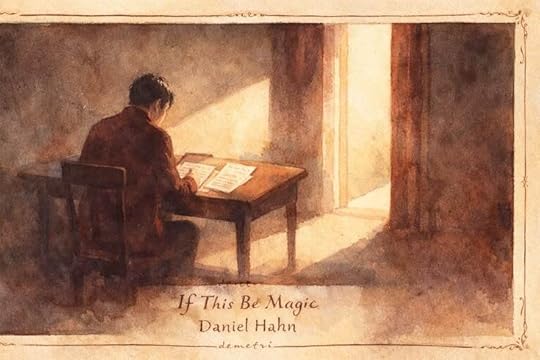
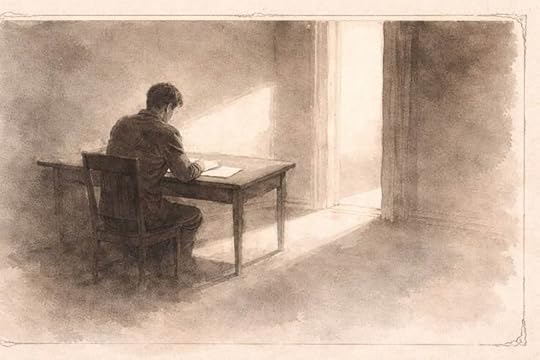
In a room cut by stage-like light, a solitary translator bends over the page, and the book’s central miracle clarifies itself at last: Shakespeare survives not by ease or essence alone, but by the quiet, exacting labor through which language is made to live again.
Many monolingual readers picture translation as an arrivals belt. A book disappears behind a curtain, reappears tagged in another language, and everyone is tacitly asked not to inquire too closely into what got bent in transit. Daniel Hahn’s “If This Be Magic” is interested in that bend, and in the stranger fact that something more than plot can come through it alive. It begins with the question everyone asks – how does Shakespeare remain Shakespeare when every word has changed? – and then makes the question troublesome. What, in literature, belongs to the words themselves, and what belongs to stress, pause, timing, rhyme, syntax, and the peculiar pressure a line exerts in the ear – where it lands, where it hesitates, where it lets the actor breathe? What looks, at first, like a nimble book about Shakespeare in other languages turns out to be a defense of readers who can still hear form as meaning.
The tone is set almost before the argument has laced its boots. Hahn writes with quick wit, easy-footed intelligence, and none of the seminar fog that so often settles over books about literary form. He can be learned without sounding upholstered. The prologue finds him in Denmark after a performance of “Richard II,” heading to meet the translator Niels Brunse. He is not after the respectable old sermon about Shakespeare’s worldwide greatness. He wants the better conversation: syllables, stress, and one stubborn little word in one line of “The Merchant of Venice.” Hahn is at his best when the scale is no larger than a table and two chairs – one translator, one afternoon, one recalcitrant word. Before theory, there is a person fretting over a verb. Before “global Shakespeare,” there is a room, a voice, a choice. That sense of proportion matters, because it tells you almost everything about the book’s method. Hahn is not trying to win by grandeur. He wins by attention.
From there the book proceeds in short, quick chapters, each taking one knot in the language at a time. Verse. Rhyme. Sonnets. Punctuation. Gendered grammar. Economy. Speakability. Names. His cast is a relay team of translators passing Shakespeare through Danish, Turkish, Japanese, Bangla, Welsh, Brazilian Portuguese, French, Hungarian, Chinese, and more. The same snag keeps returning in costume. How do you replace every word without pressing the thing flat into paraphrase? Hahn is less interested in the consoling claim that Shakespeare travels because his themes are “universal” than in the harder truth that literature survives by being remade – in another language’s meter, syntax, and mouth-feel – by people who can hear more than information in a line, people who hear where it must rhyme, lunge, stall, or sing. They hear beat, register, breath, joke, drag, force. They hear where the line has to land, whether on a rhyme, a laugh, or a beat of grief.
That is why this is less a survey than a folder of exhibits. Hahn rarely declares when he can produce proof, and he is right to trust the proof. The chapter on Romeo and Juliet’s first exchange is exemplary. Their shared sonnet is not an ornamental flourish attached to the flirtation afterward; it is the flirtation. In that scene, pattern is part of the point, especially when the point is courtship and the pattern is a sonnet. Its formal neatness, its speed, its little burst of mutual ease are not decorative extras but part of the dramatic event itself. If that matters in English, it matters in translation too. The translator cannot preserve the point and shrug off the pattern, because here the pattern is one way the point gets made. Elsewhere Hahn shows how a rhyme pair in “A Midsummer Night’s Dream” carries comic balance, how a metrical disturbance gives an actor a shove, how a pronoun quietly handles rank, intimacy, insult, or concealment. One of the book’s cleanest pleasures is watching familiar lines show their scaffolding without losing their grace.
He keeps picking at the poverty of gist. People do not come to Shakespeare for the gist, he argues, and the book earns that line rather than merely enjoying it. This is its hinge. Plot is the easiest thing in Shakespeare to carry across a border. What is harder, and what Hahn wants us to respect, is the thing literature does while seeming merely to say something. A line may deliver information and still arrive with gait, pressure, texture, and social temperature – whether it flatters, wounds, stalls, edges toward panic, or asks the actor to breathe half a second later than expected. A translation that preserves the dictionary sense and loses the dramatic life has not done a lesser version of the job; it has done a different job. Hahn’s larger achievement lies here. He is not only defending translators. He is retraining readers. By the end of the book, the casual habit of treating meaning as something that can be decanted cleanly from one sentence into another begins to look less like common sense than like a failure of notice.
That shift in the reader’s notice is inseparable from the prose. In duller hands, this material would blow off as powder. Hahn’s prose keeps it quickened. His sentences know when to clip and when to stretch. Some land in a clean declarative snap; others carry a thought through example and qualification before closing on the right beat. His method can be heard in the prose. Meter, enjambment, syllabic count, rhyme scheme – these terms arrive as tools because he needs them to show where the line bends, where it accelerates, where it gives something away. They never feel like display cabinets for expertise. A metaphor appears, works, and is briskly distrusted. Translation is like cell replacement, like model-building, like alchemy; Hahn is too shrewd not to notice that every metaphor here buckles a little under strain. That habit is not merely winning. It stops the book from flattering itself. It also gives the prose a companionable honesty. Hahn likes metaphor, but he likes accuracy more.
The theater sections put blood back under the argument. Meaning is only the beginning; Hahn wants to know whether the line can still live in a mouth. Can it still be said in one breath without sounding embalmed? Does it still carry an actor through thought? Does it still strike the ear before the mind fully catches up? This emphasis on speakability is one of the book’s shrewdest decisions. It keeps the discussion from turning into a glass case of lexical ingenuity. Words here are not merely signs. They are cues, permissions, pressures. A verse line tells an actor where to stress, where to move faster, where to hold back, where to let a thought topple into the next. Hahn’s sensitivity to that bodily life is one of the reasons the book stays lively even when it is discussing the sort of thing casual readers are trained to call fussy. He knows that a stress pattern becomes immediately less fussy once it starts determining whether a line can still stand up onstage.
He is also wryly exasperated, and not without cause. He keeps returning to the indignities translators endure: being wrongly quoted, barely named, lazily conflated, sometimes treated as though one version may as well be any other. This is not a side issue. It is part of the book’s argument about what readers and critics fail to notice. “If This Be Magic” shares with Edith Grossman’s “Why Translation Matters” a desire to drag translation out of the annex and back into the main house, though Hahn is less manifesto than case law. He proves value rather than announcing it. He also shares with Emma Smith’s “This Is Shakespeare” a brisk, anti-stuffy intelligence, but his emphasis falls elsewhere: on the global afterlives of a canonical writer and on the labor that makes those afterlives possible. By the end, the translator no longer appears as the person who arrives after the art is done. The translator is one of the places where the art, so often hidden in plain sight, becomes visible. Put more bluntly: if the book is about Shakespeare in translation, it is also about how much work vanishes once readers decide that only the source deserves admiration.
The present sneaks in sideways. Hahn is not writing a brisk sermon about what is wrong with reading now, and the book is better for that restraint. Still, you feel, beneath the Shakespearean surface, a running argument with a culture that wants the takeaway without the texture. Reading for extract, skim-reading, summary culture – all linger at the edges here. Hahn’s objection is not antiquarian. He is not defending old books because they are old. He is defending the claim that form is part of thought, not the wrapping it happens to arrive in. The late AI chapter sharpens the concern without shrinking the book into a headline argument. Hahn tests machine outputs, notes what they can do, and shows where they lose their spring: the rhythm goes flat, the tone goes generic, the line keeps its meaning and loses its pulse. He is not interested in demonology. He is interested in the embarrassment of our own lowered expectations. We have spent so long underrating human subtlety that we are startled whenever it turns out not to be easily automated. Here again the book’s relevance is organic rather than forced. Shakespeare is the subject, but the pressure of the present is unmistakable.
All that said, the book’s chosen structure imposes a real cost. The segmented architecture is both its bounce and its brake. At its best, the short-chapter design mirrors the work it describes: translation as an accretion of local, exacting decisions. Each chapter takes one knot in the language, worries it loose, and moves on before the lesson grows stale. That makes the book unusually readable for something so full of meter, rhyme, grammar, and lineation. At flatter passages, though, the same design means Hahn extends his proof more often than he enlarges his stakes. The reader is persuaded again, brilliantly, rather than newly surprised. This is the book’s central limitation. One admires the chapters more than one feels them locking together. The argument accumulates impressively, but not always with the sense of mounting inevitability that would push the book from very strong to truly commanding. The brilliance is recurrent. The escalation is less so.
Still, it keeps earning the attention it spends. Hahn knows his material and how to stage it. He does not pad, grandstand, or counterfeit depth in a grave voice. He knows when an example has done enough work and when one more flourish would only blur the line. That restraint matters as much as the wit. There is a kind of literary nonfiction that mistakes allusion for knowledge and polish for judgment. Hahn has judgment. He knows how to make a point land and when to leave it standing. He also knows that a book about form cannot afford dead prose, and so his own style remains nimble enough to honor the subject without mimicking it. The result is a book that feels welcoming without being soft, expert without becoming sententious, learned without lapsing into professional self-regard.
For me, it lands at 88/100 – 4/5 stars: a strong, stylish, genuinely rewarding work of literary nonfiction whose virtues are substantial and whose limitation is structural rather than fatal. That rating matters because the book’s tone should not be mistaken for slightness. This is not a lightweight pleasure, nor is it a monumental one. It is something rarer, and in some ways more useful: a book that changes the pressure in the reader’s ear. After it, you read more slowly. You hear more. You begin to distrust your own paraphrases. You become a little less willing to say “close enough” about a line whose effects you can now feel arriving from several directions at once.
The epilogue knows when to leave the room. Hahn returns to the title’s promise of magic only to refuse the supernatural version. There is wonder here, yes, but wonder generated by craft so exact it looks effortless from the back row – which is usually how literary labor disappears. That distinction is the whole point. Call it magic and the worker vanishes. Call it craft and the worker returns, along with labor, memory, wit, and the patience required to make a line sound as though it had always belonged in its new language. Hahn leaves you with a bracing thought. What looks, from the cheap seats, like literary survival is usually made one beat at a time, one hinge at a time, by somebody who heard that the comma was not garnish after all, but load-bearing timber.
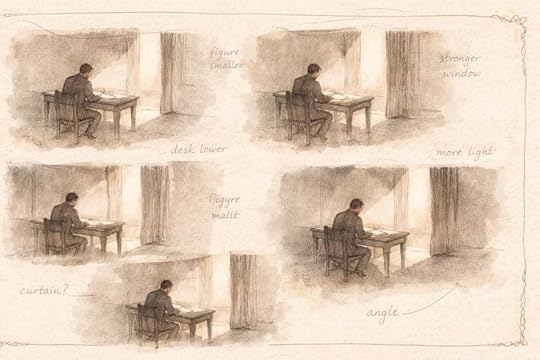
These early thumbnail variations test the painting’s essential problem – how to arrange solitude, light, and the worktable so the final image feels less like illustration than like the quiet architecture of attention itself.
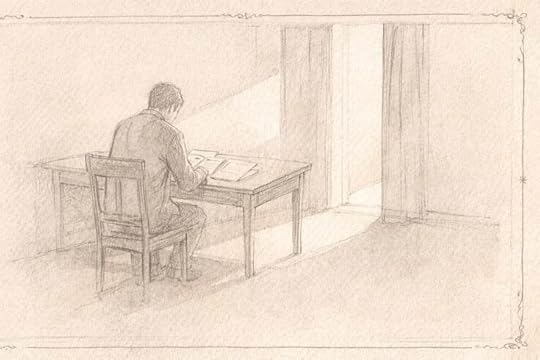
The faint underdrawing reveals the painting’s hidden skeleton: the seated figure, the angled desk, and the window’s geometry before color, atmosphere, and emotional weight begin to settle over them.
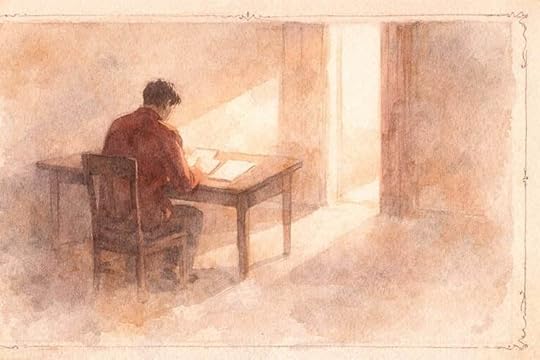
With the first washes laid over the drawing, the image begins to breathe, and the room shifts from structure into mood as paper, light, and silence start finding one another.
This tonal study works out the image’s real drama in advance, showing how a single band of light and a few shadowed planes can carry the emotional burden of solitude, labor, and withheld performance.
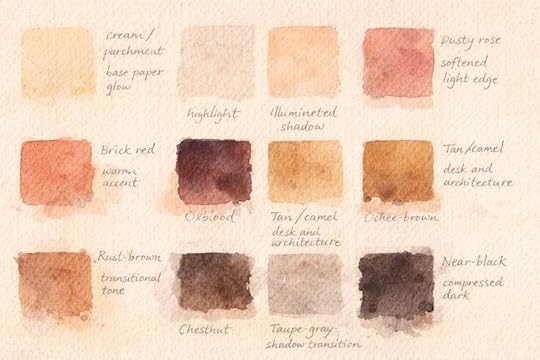
The swatch sheet establishes the cover-derived palette’s full logic, showing that the finished image’s warmth, restraint, and muted theatricality arise from deliberate color discipline rather than decorative instinct.
All watercolor illustrations by Demetris Papadimitropoulos.
The author of the book is a translator and discusses the difficulties of translating Shakespeare into different languages. How not everything translates perfectly and sometimes things are lost in that translation. This was really interesting and would definitely recommend it.
Thanks so much to NetGalley for the free Kindle book. My review is voluntarily given, and my opinions are my own.
The Publisher Says: How does Shakespeare remain Shakespeare when every word is changed? In this playful, meditative exploration of translating the world’s most beloved playwright, Daniel Hahn guides us through the magic of bringing the Bard to a global audience.
Shakespeare may have breathed the air of sixteenth-century England, but today, all the world is his stage. Every year, millions of people, from Bogotá to Borneo, read Hamlet for the first time, thanks to the tireless work of translators. Drawing on the work of the very best of them, Hahn dives into the infinitesimally complicated ways the great playwright is reinvented and yet sounds, somehow, like himself—in Chinese, Dutch, Turkish, and more than a hundred other languages.
From word order, puns, and punctuation to metaphor, accent, and song, Shakespeare’s variety of genius presents an endless set of conundrums, among them: How does Romeo and Juliet’s love story unfold if their dialogue cannot form a sonnet (nor rhyme), as it does in the original? How can you form wordplay around the letter “I” and its sound if its meanings are not shared in other languages? These are just two out of millions of issues facing translators tasked with bringing Shakespeare to non-English languages, non-Shakespearean eras and cultures. To attempt such a feat, they must cut and add beats, maintain rhymes, adapt names and locations, and preserve meaning while not unilaterally prioritizing it, all while knowing that for each word, line, or scene they construct, another option is yet to be discovered.
Traveling the world, Hahn speaks to writers and actors engaging with Shakespeare’s work, sharing stories of his own. Hahn, whose great-grandfather produced one of Brazil’s earliest Shakespeare translations, emerges as a wise and enthusiastic guide, teacher, and sleuth. If This Be Magic does not require knowledge of any other language or more than a passing acquaintance with the Bard’s canon, but it draws out fascinating insights on both. As nerdy as they come (there is a chapter on commas), supremely readable, and funny throughout, this is a book for everyone and a fitting tribute to the Globe’s Bard.
I RECEIVED A DRC FROM THE PUBLISHER VIA NETGALLEY. THANK YOU.
My Review: Translating words between languages, even ones that swim in the same linguistic rivers and in generally the same direction, is an exacting, laborious practice of alchemy. It recombines elements of the original material at specific temperatures (states of emotion) and adds/subtracts new substances (words in the translator's own language) and anneals the result in the great body of water that is the translation's target culture. What shape the new thing has, what its properties are, is now set and there for everyone to see.
Does it still resemble the original ideas put forth by William Shakespeare? Can it? Every word is new. Every sound is not early-modern English. But it's meant to be a work by Shakespeare available to someone from a culture the Bard of Stratford-on-Avon would not remotely recognize. Is it Shakespeare?
I was fascinated by the idea of this effort to contextualize the art of translation by viewing it through this very specific lens. A translator takes on a huge task every time they opt to make another artist's work over into words the original artist does not know. The decisions, the word-by-word consideration of connotations, denotations, cultural nuance, generational nuance...and that's just the words themselves, not the way these basic units of meaning interact with the plot, lead to possible subtexts that aren't in the original but certainly work in the gestalt of the particular story....
Why would you choose to do that work, let alone do it for a writer of international superstardom and with legions of self-appointed guardians of His Sacred Words/Ideas/Intentions? And then there's the small matter of how incredibly linguistically inventive, how unnervingly acutely emotionally observant the writer was...how to make that available in a tongue like German that's close to our English let alone, say Swahili?
I read this collection of case files Author Hahn, with his ancestral connection to a Shakespeare translator, created for us, in one sitting. It was a long day, interrupted for water coming in and going out and two sandwiches. It's not necessary to do that. It's not even particularly advisable as I came away with a distinctly overloaded spirit trying too hard to consolidate my feelings into my insights to be anything but restless for hours while trying to get to sleep. I dreamed of reading "A Midsummer Night's Dream" and its transformations, its miscommunications, its shape-shifting between farcical comedy and subtle elucidation of desire compressed into a sentence that seems to be more about etiquette violated than courtly power flouted...in Croatian (in the dream I understood it but in life not at all). It was still Shakespeare, only not in English that honestly needs footnotes and a glossary for my midcentury American brain to get the whole of it.
And then there's the end use of the translation. Sure, some will simply read it as texts, able to easily stop to find a dictionary, to indulge the idle whim of looking up a play's local-culture history. But lots more people will hear this translation enacted into a play. An actor, professional or amateur, will speak the translator's/Shakespeare's words. If you don't already know how very very different spoken words are from those marks on a page, read this sentence aloud. Does it still feel the same, is it easier to understand, harder to understand, are the words themselves familiar or weird, do you know from the look of the sentence how to say it out loud....
All these details are part of the art that a translator signs up to give their audience. It is even more difficult than writing one's own work! I kept wanting to know why these underpaid geniuses undertook such an immense task, knowing success will be not receiving death threats from Shakespeare stans. I don't really feel I got a satisfying answer though, most people just seem to think "well of course I'm going to climb Everest in these Jimmy Choos while wearing a ballgown from Gone with the Wind and carrying these kettlebells. Cat fur to make kitten britches!" So no full-five from me, but close, because the topic of translation is oddly greatly broadened by Author Hahn considering so deeply the ramifications of this extremely specific use of it. I might not feel I know why but I sure as hell know what the point of this labor is.
Spread the love. Share the joy. Commit to the communication of Art to everyone you can reach.
My thanks to NetGalley and Knopf, Pantheon, Vintage, and Anchor for an advance copy of a book that is a bit memoir and a study of how the works of William Shakespeare are told in the languages of the Earth, how the power of the words are brought to the people, the work involved, and the mysteries of how art is translated.
I remember years ago, I might have been in college, I might have been working in a record store. Either way this in the before times, when doing one's research meant hours in libraries, or tracking down people to ask questions of. I was wondering why people who didn't speak a language, could find enjoyment in different forms of art, in something they couldn't speak. I'd like to say it was a question about Shakespeare, or maybe a great poet. It was probably wondering why a band like King Crimson was so huge in Japan. Music I could understand but lyrics and words that could be either too English, or too American, or so deep that even the English and Americans couldn't understand them. How can one translate a rhyming line, when the words used could not rhyme? What is lost in translation, and how and why are certain works so popular? As an English major I knew that different professors, different scholars liked to use different translations. These were questions I thought about, and finally I have a book that answers many of these questions. If This Be Magic: The Unlikely Art of Shakespeare in Translation by Daniel Hahn is a bit of history, a bit of memoir, a bit of language study, with a lot of Shakespeare and women and men who have undertaken the arduous task of translating the words that mean so much to so many, creating an art that loses not of the beauty and the power.
The book begins with a conversation on translating Shakespeare between the author a conversation that struck a nerve and an interest in more study. The author began to randomly order Shakespeare stories in different languages, sometimes receiving plays that he had no idea if they were even Shakespeare's. Hahn is a translator whose languages include Spanish, Portuguese and French, and describes what translating a book is like. Where readers might spend a few hours with a book, a translator might spend months, picking up the rhythms, the way the words flow, and how to make these words flow, which in Shakespeare, can be quite hard. Hahn lists the various translations, researching and conversing with translators all over the world. These men and women share what the works mean to them, how their words reflect not only what the watchers experience, but even the staging of the shows. Hahn even finds a little bit of his own past in previous works, some he didn't even know about.
I book that was far richer and more rewarding than I thought, and one that i enjoyed on quite a lot of levels. The way that Shakespeare is translated, the problem in finding words, and making things fit in iambic pentameter. Especially now when most people are lost in the modern age, to get them to understand the past, can be difficult. Hahn is a very good writer, one who understands the world and restraint it sometimes takes to be a good translator. Hahn looks at how translations has changed over the years, the way stories have been truncated in many ways, and efforts to try and get back to the purest sense. A very noble enterprise.
Shakespeare readers will find this interesting. I enjoyed the discussions about translating, and having a love for literature of real interest. I do hope that Hahn has more books about the world of interpreting the art of others, as Hahn has a real understanding, and an ability to make things clear and concise. I look forward to reading more by Hahn.
Some years ago I was hosting family visiting from Colombia. While showing them around the city, we stopped at a park known for hosting free productions for Shakespeare. Ignorantly, I assumed because of the language barrier, they wouldn’t be interested in returning that night for a performance of Cymbeline . It hadn’t dawned on me that even native English speakers struggle with Shakespeare when they haven’t had enough exposure to Early Modern English. Nor had it occurred to me that our city’s premiere opera company, another stop on our tour, draws in thousands of annual subscribers who, I’m willing to bet, aren’t fluent in the Italian or German the operas are performed in.
Seeing Shakespeare played is different from Shakespeare being read. With text, the uninitiated will fumble with footnotes and annotations. Seeing it staged, the actors do the interpreting for you. Though you may not understand each individual word, you can fill in the gaps through context and visual signifiers. Similarly, opera is able to shatter the language barrier on the strength of its sheer emotionality alone, even if our Italian word-stock starts and stops with the names for differently shaped noodles. They would have no issue with a staging of Shakespeare in English, nor would I with a Spanish production. Though since that summer, I’ve wondered how different our experiences would be in reading ostensibly the same text in different languages. That’s why I was thrilled to receive this ARC from NetGalley and the publisher! Finally, an answer!
It turns out the “how” is not so easy to explain. Each language has its own structure, syntax, conventions and culture it exists in and belongs to. Hahn consults a dozen different translators specializing in languages from German to Swahili to Japanese to Bangla. The topics discussed in each chapter are as diverse as the languages covered: naming conventions, pronouns, syntax, etymology, wordplay, punctuation are all analyzed here.
As Hahn explains, translating is a series of choices that must be made. In order to make decisions regarding the work you’re translating, you have to understand the reason the original author made their choices in the first place. By breaking down “hows” and “whys" of Shakespeare's mechanics and structure, Hahn gives us a masterclass in deconstructing Shakespeare. In doing so, Hahn not only gives us insight into the process of translation, but incredible textual and literary analysis of the plays themselves. As Hahn says, “Nobody reads more closely than a translator.”
If that sounds off-putting, it's not. What could easily be an impenetrably academic book on the mechanics of linguistics is instead accessible, and every bit as fun as it is informative and insightful. This book is seriously funny! Don’t skip the footnotes or you’ll miss out on a lot of the humor. It’s like an all-in-one masterclass on etymology, linguistics, poetic form, Early Modern literature and theatre presided over by an incredibly charming professor.
Admirers of Shakespeare, grammar nerds, lovers of language and linguistics, bilinguals (honestly, just about anyone) will find If This Be Magic to not only be an captivating and insightful read, but a wonderful reference book.
How does Shakespeare remain Shakespeare when every word has changed? That is the question this book sets out to answer. And it does so. In depth, and with a sense of humor.
The humor is appreciated, as is the way the book is organized. Each chapter takes on a different question about translation. One chapter deals with rhyming for example - how do you convey Shakespeare’s rhymes when the words you would translate to don’t rhyme? For that matter, how do you handle the iambic pentameter Shakespeare uses, a poetic structure unique to English that audiences who speak other languages won’t be familiar with?
And how does a translator deal with gendered languages like Spanish, or languages that have more specific words than English for relationships, like uncles (of which there are many in Shakespeare’s plays).
For lovers of the English language there is a lot to like in Hahn’s book, as it highlights some of the idiosyncrasies of our native tongue as viewed through translation to other languages, revealing things about English we wouldn't normally think of.
If the book were more tightly paced it would have worked better for me. I do not come from a world of literary figures or have depth of knowledge on Shakespeare’s plays. Those who do will appreciate Hahn’s stories interspersed with the discussions of translation, stories that I struggled with.
I felt that I’d bit off more than I could chew with this book. When I hit the chapter on “Latinate vocabulary” I was way outside my comfort zone, and I confess I began to skim.
So, sorry to say, it’s a tepid review summary from me — Read it if you have a love of the English language, a literary bent, and a working knowledge of Shakespeare’s plays. In that case, I think you’ll appreciate the author’s humor and stories more than I.
Those who know me can attest I will consume any media related to my beloved William Shakespeare and as a performer and a dramaturg, picking this book up was frankly a necessity.
There are few things that make me happier than nerdy people getting the space to wax poetic about their nerdy interests and this is basically that in book form. Hahn takes readers on a journey through aspects of translation that not only illuminate the "magical" aspects of the practice in both analysis and performance, but unlock new discoveries in Shakespeare's texts through his astute observations and eye for detail. The text is certainly dense in places and I personally would have loved a pronunciation guide so that I could try out some of the translated examples for myself; however, Hahn's sense of humor and tangible love for the work really went a long way in keeping me engaged and yearning for more. I am eagerly awaiting the publication date so that I can pick up a physical copy of this for my collection!
Thank you to Knopf for an ARC of this book in exchange for a fair and honest review!
This is a very niche book, a book about translators who are translating the works of Shakespeare. I am not someone who is very knowledgeable about Shakespeare and his works, or about the world of translators, yet I enjoyed this book. The author, a translator of the romantic languages, walks readers through the intricacies and difficulties of trying to translate Shakespeare. A translator has to do the typical job of a translator, while considering rhyming, iambic pentameter, and trying to preserve idioms. Despite my lack of knowledge on Shakespeare and translation work, I found this book to be accessible, informative, and at times humorous. The author does a great job of bringing the reader in and educating us about his world. I also appreciated his discussion on AI, and how some are trying to use AI tools to translate, and how these are insufficient for purposes such as these. An interesting read for lovers of translation, Shakespeare, or word nerds like myself who just like to learn. I received an ARC, and this is my honest review.
I will asterisk that the formatting on the ARC was a bit wonky because of the actual text from several different languages, but that's to be expected given that it's a translation deep dive. We get a collection of essays from translators of Shakespeare in just about every lanugage you can think of talking about the nuances of language and the nitty gritty of how translation works in this contest. This is exactly my kind of nerdery, honestly. Highly recommended read.
Daniel Hahn insists that he doesn’t believe in magic, but this book goes a long way to convincing us that the art of translation is pretty magical.
Anyone who has read/studied/watched Shakespeare will know how complex his language is, and by the end of this book you will understand just how clever a good translator of his work needs to be.
This is incredibly detailed and informative, using examples from many world languages to explore the intricacies of translating rhyme, rhythm, puns, cultural, grammatical and idiomatic concepts.
It was written in a very accessible way, with a light, humorous touch. Hugely enjoyable.
I see that I am six days too late to be this book’s first review. Frustrating but it was a book to be enjoyed slowly and fully.
I had a nascent interest in translation after reading Megan McDowell’s translation of a couple lines of Pablo Neruda’s I Explain a Few Things in Mariana Enriquez’s Our Share of Night. The lines stuck with me and I ended up looking up multiple translations of the poem which only made me appreciate McDowell’s more so. Last year, I had the treat of sitting in Anton Hur’s dressing room at the Southbank for 40 minutes or so before seeing him speak about translation and this was brilliant and provoked further curiosity. Through this, I had little glimpses through the mist at the art and mastery and joy of translation. Now, this book feels like a perfect find - a veritable fog lamp that scours translation in absolutely infinitesimal detail (note: when a publisher warns you about patience for the nerdiest of close readings, heed it; at some points, I did feel slightly petulant at the attention to detail paid to syllables). Immensely fascinating as a subject and inevitably leads to a better appreciation of Shakespeare and translation, and translators (#namethetranslator) The breadth and depth are unparalleled - 45 languages or so! - and Hahn guides you which such clarity, including through many languages that neither he nor (obviously) I speak. An excellent and impressive feat. I especially loved the explorations into non-linguistic translations - explicitly in opera, dance, music but also when it isn’t the understanding itself that is important but what it conveys. That I unable to articulate what that means only demonstrates Daniel Hahn’s own talents for clarity and understanding, and eloquence.
Note: in a chapter about translating idioms and whether you keep direct translation or ‘equivalent’ in the new language. (There is an interesting point about how Shakespeare will sometimes alter an idiom and therefore as a translator how to ‘incorrectly’ translate an idiom) I digress. What I really liked about this chapter is the power of not translating the idiom, keeping the words exactly as they are so you get an idiom that your audience is unfamiliar with. These phrases are so ingrained in our language that they often go by unnoticed. By taking a different wording, it draws your attention and surprises you with the full extent of the meaning. It’s feels fortuitous timing to follow that book with Good People by Patmeena Sabit where you get phrases like “his heart’s true word” and “closing their necks to God” and through that unfamiliarity you get truer meaning
This entire review has been hidden because of spoilers.
Thank you to Canongate for sending me this proof copy in exchange for an honest review.
Until I read If This Be Magic by Daniel Hahn, I'd never given much thought into how difficult it would be to translate Shakespeare.
But with humour, wit and fantastic insight, Hahn takes us on a journey through the difficulties of translating one of literature's greats across cultures, languages and history. As readers, we realise the art of translation isn't so black and white, but one that is constantly evolving and expanding with time. And that translations themselves, become a work of art alongside original texts. And there's beauty in celebrating that difference.
This is an accessible, interesting and thought provoking read which will reignite your love and appreciation for Shakespeare and translated fiction. Don't be put off by the heavy linguistics, as everything here is broken down and contextualised so well, that even complete language novices will understand.