

What do you think?

Small Town Girls: A Writer's Memoir
A luminous memoir in essays from the Pulitzer Prize–winning novelist, who reflects on her origins and the mysteries of memory.
“Understand: born and raised in West Virginia, you can never truly leave. Those who stay, and those who don’t, stand in the middle of the story, wherever they go.”
Jayne Anne Phillips grew up in the small town of Buckhannon, West Virginia. The distinctly American landscape of Appalachia—dense with forests and small churches, rich in history and misunderstandings—has been the great setting for her fiction, even as she and her boundless imagination have traveled to other times and places. In these pieces, and in her inimitable first-person voice, at once intimate and wide-ranging, Phillips brings us into her childhood and family, most movingly her mother. She recreates the place she calls home, its foundational truths and the densely woven ties between the women of the town. She traces her journey across the country in search of love and work and belonging—her discovery of writing and reading as tools for both survival and revelation—and offers insights into the fellow writers and touchstones that moved and influenced her. From the local beauty salon to the legendary Hatfield–McCoy feud, from Jean Shrimpton and Barbara Stanwyck to Stephen Crane and Breece D'J Pancake, Phillips ponders her relationship with inspiration, spirituality, culture, and the troubled annals of the last American centuries.
Tender, inviting, sparkling with wisdom and open-heartedness, Small Town Girls is part coming-of-age story, part social history, Jayne Anne Phillips’s most personal, most accessible book yet—a love letter to the place and the people who have shaped her perceptions and her writing.
“Understand: born and raised in West Virginia, you can never truly leave. Those who stay, and those who don’t, stand in the middle of the story, wherever they go.”
Jayne Anne Phillips grew up in the small town of Buckhannon, West Virginia. The distinctly American landscape of Appalachia—dense with forests and small churches, rich in history and misunderstandings—has been the great setting for her fiction, even as she and her boundless imagination have traveled to other times and places. In these pieces, and in her inimitable first-person voice, at once intimate and wide-ranging, Phillips brings us into her childhood and family, most movingly her mother. She recreates the place she calls home, its foundational truths and the densely woven ties between the women of the town. She traces her journey across the country in search of love and work and belonging—her discovery of writing and reading as tools for both survival and revelation—and offers insights into the fellow writers and touchstones that moved and influenced her. From the local beauty salon to the legendary Hatfield–McCoy feud, from Jean Shrimpton and Barbara Stanwyck to Stephen Crane and Breece D'J Pancake, Phillips ponders her relationship with inspiration, spirituality, culture, and the troubled annals of the last American centuries.
Tender, inviting, sparkling with wisdom and open-heartedness, Small Town Girls is part coming-of-age story, part social history, Jayne Anne Phillips’s most personal, most accessible book yet—a love letter to the place and the people who have shaped her perceptions and her writing.
208 pages, Hardcover
First published April 21, 2026
About the author
Jayne Anne Phillips
56 books802 followersJAYNE ANNE PHILLIPS is the author of Black Tickets, Machine Dreams, Fast Lanes, Shelter, MotherKind, Lark and Termite, and Quiet Dell. She is the recipient of a Guggenheim Fellowship, a Bunting Fellowship, and two National Endowment for the Arts Fellowships. Winner of an Arts and Letters Award and the Sue Kaufman Prize from the American Academy of Arts and Letters, she was inducted into the Academy in 2018. A National Book Award finalist, and twice a finalist for the National Book Critics Circle Award, she lives in New York and Boston.
Ratings & Reviews
Friends & Following
Create a free account to discover what your friends think of this book!
Community Reviews
Displaying 1 - 30 of 149 reviews
January 28, 2026
Small Town Girls: A Writer's Memoir by Jayne Anne Phillips. This memoir is very well written, with vivid details and various stories of this small West Virginia town. However, I thought this would feel more cohesive, and tell more of Phillips story being a girl growing up in a small town (hence the title). It felt as if it flowed at first providing a back story and different moments in the authors life. There was a brief introduction to family members and the community at large. Somewhere midway through it felt like it was just a compilation of stories put together. It no longer seemed like a memoir which was a bit disappointing.
Thank you to the publisher for the advanced reader copy in exchange for my honest review.
Thank you to the publisher for the advanced reader copy in exchange for my honest review.
April 30, 2026
A smidge over three. Some stories did not work for me, and seemed out of place in a book that is supposed to be a memoir or about a small town in West Virginia. Why did we have to read about the Hatfields and McCoys? I’m not sure the point to be made was worth it, since these types of chapters pulled me out of becoming immersed in the book.
June 9, 2026
I didn’t know anything about the author when I picked this up but I fully expected to learn about her life because it has memoir in the title. That’s not what I got. These were essays, some interesting and compelling, and some were just so random. There are in-depth descriptions of authors I’ve never heard of, TV shows, historical feuds… but very little about the author’s actual life. And even when she did mention something from her past, I couldn’t really understand how she felt about what she was describing. It just didn’t work for me.
May 30, 2026
2.5 stars, not because the writing isn’t good, but because this book is not a traditional memoir and I feel the title is quite misleading. I also feel that many of the online professional reviews/descriptions of this book were misleading. There are several wonderful essays about the author’s youth and family relationships as she was growing up in West Virginia. But many of the essays are on seemingly random (and largely gloomy) topics, only related by the thinnest thread tying them together, and likely only meaningful to the author herself. That’s fine, but I chose to read this book because I believed it would be a memoir about growing up in a small town, the relationships, the culture, the land, and its long-term influence. I have strong family ties to West Virginia and have spent much time there. Unfortunately this memoir didn’t land with me.

May 13, 2026
SMALL TOWN GIRLS
BY: JAYNE ANNE PHILLIPS
As a reader of Jayne Anne Phillip's fiction starting in the 1990's and loving all her novels including her 2024 Pulitzer Prize Winning novel I feel that even though I grew up in New England, and she is a generation older than me I share some things in common with her even though she grew up in West Virginia. Especially in the beginning of her Memoir when she begins by her youth being in Church which my Church had a private school that was affiliated that I attended with a convent on the premises with Nun's that crossed our playground in my earliest years of primary school. She describes a very different education but we both spent our early years influenced by religion and the stained glassed windows and Communion. She is a generation older than me but both our mothers thought our haircuts in our early years have our long hair cut into the humiliation of the Pixie cut which now looking back was adorable in my opinion. She doesn't state if her memory of that wanting our long hair back then has turned into happier nostalgic memories, but does document that she spent her days in Beauty shops, which I didn't since my father's sister was a Beautician and my experience was different regarding there was only one Beauty shop in the historic town where we both share nostalgic memories of the merchants owned businesses were family owned back then.
This Memoir is divided up into twenty-two essays that she pays tribute to her early life in a mesmerizing way that her writing is totally absorbing in that she shares that same religious early years where we both were influenced in memories of our different religious backgrounds but influenced early memories that began for both of us to be strikingly similar during those young primary school days. I spent my early years going to my Paternal grandmother's often with which they had a huge garden and I remember the same yellow trucks that my brother had that were replicas of my father's with her father being much older than her mother which her father sold them. I was fortunate to have Archery which I was quite good at and I look back with nostalgia as it was offered in the school Physical Education which in her case her father set it up at home and her youngest brother misfired and injured her father;s ankle to which he needed hospital care but was not in any way upset with her younger brother after receiving hospital attention but said to her brother encouraging words.
We were both the oldest Grandchild with me being having younger parents and so mine were around until I reached a much older age than she did. I inherited furniture from both sets of grandparents as she recounts she was the recipient of even though she had an older brother so maybe it's more correct that I was the OLDEST GRANDCHILD on my father's side where she was the oldest GRANDDAUGHTER She speaks of West Virginia where she grew up to tell of history in her home state of the coal industry that decimated ponds, rivers, homes which I didn't experience any of that, but she speaks of a cemetery that my town has a history museum and cemetery dating back to the Revolutionary War, where there are signers of the Declaration of Independence buried there. She is very nostalgic for dogs which one of her childhood one's disappeared in juxtaposition to her father saying that he probably got shot which land owners had little consequences compared today which one she remembers disappeared just like my mother's dog named Pepper disappeared in my days before school when I was only three years old, but both of our father's surmised that was why they were suddenly gone. She recalls imagery of picturing her beloved dog's color laying on the ground which I know is a very different review but so many childhood memories surfaced of similar experiences.
Her mother was a school teacher who took night classes to get her Master's degree and this author lost her mother who she was the recipient of her mother's PhD even though she hadn't written her thesis. I went to the same private historic high school in my town that JFK, Jr. attended except the main campus is in my home town which was a little over a mile away except JFK, Jr. went to the boarding school campus, but the same private school that is in a neighboring State that borders ours. This has nothing to do with her education except I have never read an Author who attended the IOWAS Writer's workshop that I didn't love, and she writes of her experience which is of special interest to me since every graduate from there has been my most beloved fiction Author's whose work soars, and my MFA which I received in Creative Writing went under utilized since I pursued life as a stay at home Mom which I wouldn't trade for the world. In no way am I saying that I possess the same trajectories to our older lives, and I will say quite the opposite. It was our earliest years that in her twenty-two vignette essay Memoir that she has done a stellar job that has some reviewers rating her style lower which I don't understand since she I'm assuming shares in one her obvious impressionistic view of Barbara Stanwyck. who Jayne Anne Philips writes an essay about her Matriarch role of the Mother of her three sons, Jarrod, Nick, and daughter Audra. who starred during the 1960's in Big Valley that has some reviewers wondering why she included that in her Memoir of Essays. I remember that show even though Jayne Anne Phillips is a generation older than me, and she may also be which I'm surmising her including had an admiration for an actress who was orphaned before reaching school age had been impressed in her teens by also the fact that Barbara had been nominated twice for her 112 shows as Victoria Barkley, and had starred in 95 full screen roles. I don't think I know the answer to that which only this author does who also immediately names Stephen Crane as just one of her Author mentors who is known for his "Red Badge of Courage."
Jayne Anne Phillips writes about Breece Pancake and her Essays are well written, and although it isn't a linear Memoir she does capture her roots, and it was to me immersive, and I loved it. It's not a traditional Memoir, but offers a lot about a place in time that evoked memories of my own youth even though we grew up in very different backgrounds regarding location I really enjoyed every word of this even though they are essays they are glimpses into her life that evoke her roots in West Virginia both of historic and definitely her family, that will have you so engrossed and happy that you read it.
Publication Date: April 21, 2026
Thank you to Net Galley, Jayne Anne Philips, and Knopf, Pantheon, Vintage and Anchor--Knopf for generously providing me with my Dazzling ARC, in exchange for a fair and honest review. All opinions are my own, as always.
#SmallTownGirls #JaneAnnePhilips #KnopfPantheonVintageandAnchor #Knopf #NetGalley
BY: JAYNE ANNE PHILLIPS
As a reader of Jayne Anne Phillip's fiction starting in the 1990's and loving all her novels including her 2024 Pulitzer Prize Winning novel I feel that even though I grew up in New England, and she is a generation older than me I share some things in common with her even though she grew up in West Virginia. Especially in the beginning of her Memoir when she begins by her youth being in Church which my Church had a private school that was affiliated that I attended with a convent on the premises with Nun's that crossed our playground in my earliest years of primary school. She describes a very different education but we both spent our early years influenced by religion and the stained glassed windows and Communion. She is a generation older than me but both our mothers thought our haircuts in our early years have our long hair cut into the humiliation of the Pixie cut which now looking back was adorable in my opinion. She doesn't state if her memory of that wanting our long hair back then has turned into happier nostalgic memories, but does document that she spent her days in Beauty shops, which I didn't since my father's sister was a Beautician and my experience was different regarding there was only one Beauty shop in the historic town where we both share nostalgic memories of the merchants owned businesses were family owned back then.
This Memoir is divided up into twenty-two essays that she pays tribute to her early life in a mesmerizing way that her writing is totally absorbing in that she shares that same religious early years where we both were influenced in memories of our different religious backgrounds but influenced early memories that began for both of us to be strikingly similar during those young primary school days. I spent my early years going to my Paternal grandmother's often with which they had a huge garden and I remember the same yellow trucks that my brother had that were replicas of my father's with her father being much older than her mother which her father sold them. I was fortunate to have Archery which I was quite good at and I look back with nostalgia as it was offered in the school Physical Education which in her case her father set it up at home and her youngest brother misfired and injured her father;s ankle to which he needed hospital care but was not in any way upset with her younger brother after receiving hospital attention but said to her brother encouraging words.
We were both the oldest Grandchild with me being having younger parents and so mine were around until I reached a much older age than she did. I inherited furniture from both sets of grandparents as she recounts she was the recipient of even though she had an older brother so maybe it's more correct that I was the OLDEST GRANDCHILD on my father's side where she was the oldest GRANDDAUGHTER She speaks of West Virginia where she grew up to tell of history in her home state of the coal industry that decimated ponds, rivers, homes which I didn't experience any of that, but she speaks of a cemetery that my town has a history museum and cemetery dating back to the Revolutionary War, where there are signers of the Declaration of Independence buried there. She is very nostalgic for dogs which one of her childhood one's disappeared in juxtaposition to her father saying that he probably got shot which land owners had little consequences compared today which one she remembers disappeared just like my mother's dog named Pepper disappeared in my days before school when I was only three years old, but both of our father's surmised that was why they were suddenly gone. She recalls imagery of picturing her beloved dog's color laying on the ground which I know is a very different review but so many childhood memories surfaced of similar experiences.
Her mother was a school teacher who took night classes to get her Master's degree and this author lost her mother who she was the recipient of her mother's PhD even though she hadn't written her thesis. I went to the same private historic high school in my town that JFK, Jr. attended except the main campus is in my home town which was a little over a mile away except JFK, Jr. went to the boarding school campus, but the same private school that is in a neighboring State that borders ours. This has nothing to do with her education except I have never read an Author who attended the IOWAS Writer's workshop that I didn't love, and she writes of her experience which is of special interest to me since every graduate from there has been my most beloved fiction Author's whose work soars, and my MFA which I received in Creative Writing went under utilized since I pursued life as a stay at home Mom which I wouldn't trade for the world. In no way am I saying that I possess the same trajectories to our older lives, and I will say quite the opposite. It was our earliest years that in her twenty-two vignette essay Memoir that she has done a stellar job that has some reviewers rating her style lower which I don't understand since she I'm assuming shares in one her obvious impressionistic view of Barbara Stanwyck. who Jayne Anne Philips writes an essay about her Matriarch role of the Mother of her three sons, Jarrod, Nick, and daughter Audra. who starred during the 1960's in Big Valley that has some reviewers wondering why she included that in her Memoir of Essays. I remember that show even though Jayne Anne Phillips is a generation older than me, and she may also be which I'm surmising her including had an admiration for an actress who was orphaned before reaching school age had been impressed in her teens by also the fact that Barbara had been nominated twice for her 112 shows as Victoria Barkley, and had starred in 95 full screen roles. I don't think I know the answer to that which only this author does who also immediately names Stephen Crane as just one of her Author mentors who is known for his "Red Badge of Courage."
Jayne Anne Phillips writes about Breece Pancake and her Essays are well written, and although it isn't a linear Memoir she does capture her roots, and it was to me immersive, and I loved it. It's not a traditional Memoir, but offers a lot about a place in time that evoked memories of my own youth even though we grew up in very different backgrounds regarding location I really enjoyed every word of this even though they are essays they are glimpses into her life that evoke her roots in West Virginia both of historic and definitely her family, that will have you so engrossed and happy that you read it.
Publication Date: April 21, 2026
Thank you to Net Galley, Jayne Anne Philips, and Knopf, Pantheon, Vintage and Anchor--Knopf for generously providing me with my Dazzling ARC, in exchange for a fair and honest review. All opinions are my own, as always.
#SmallTownGirls #JaneAnnePhilips #KnopfPantheonVintageandAnchor #Knopf #NetGalley

June 23, 2026
Small Town Girls reminded me that Jayne Anne Phillips is, first and foremost, a novelist. The writing is beautiful & lyrical, rich with observation, and deeply rooted in place and her love for Buckhannon, West Virginia, and the Appalachian landscape. The forests, rivers, beauty parlors, churches, and small-town rituals are described with affection so that the book feels like a love letter to home, even as Phillips examines reasons to leave it.
What stayed with me most, though, was the book’s attention to women. Phillips writes about mothers, daughters, friendships, and the invisible networks of women who shape a community. The memoir often felt like a celebration of womanhood & a kind of feminist love letter that never announces itself as such.
I enjoyed her reflections on becoming a writer and on the books and authors who influenced her. But, I found it curious that many of the writers she explored were men. I found myself wishing she had spent more time with female literary influences.
My criticism is that the book occasionally loses its center. Phillips writes about history, cultural, and stories from decades—or even centuries—before her own life. While those detours were interesting and beautifully written, they pulled me away from the memoir & ultimately Phillips. I was most engaged when she was writing about her family, her town, and her own experiences. Still, this is a thoughtful, elegant memoir from a master storyteller.
What stayed with me most, though, was the book’s attention to women. Phillips writes about mothers, daughters, friendships, and the invisible networks of women who shape a community. The memoir often felt like a celebration of womanhood & a kind of feminist love letter that never announces itself as such.
I enjoyed her reflections on becoming a writer and on the books and authors who influenced her. But, I found it curious that many of the writers she explored were men. I found myself wishing she had spent more time with female literary influences.
My criticism is that the book occasionally loses its center. Phillips writes about history, cultural, and stories from decades—or even centuries—before her own life. While those detours were interesting and beautifully written, they pulled me away from the memoir & ultimately Phillips. I was most engaged when she was writing about her family, her town, and her own experiences. Still, this is a thoughtful, elegant memoir from a master storyteller.

June 29, 2026
Jayne Anne Phillips packs a lot into these 22 essays. Many memorable passages.
My favorites:
Burning the Trees
Paradise Lost: West Virginia [great]
A Small History
Never Just Dogs
Callie
Stevie [remarkable Stephen Crane tribute ]
Rayme [most unusual acquaintance]
Breece [a tribute to writer Breece Pancake]
Outlaw Heart
She has crafted this unique ability to allow "imperfect" descriptions to permeate or even dominate scenes, so what you're left with is a kind of moving, mysterious essence of things and events. Hard to describe exactly. Sometimes you're trying hard to get to the thing itself, to comprehend, but you're within some other realm and that's kind of the goal: to vaguely apprehend what's being described because it can never be just rational.
My favorites:
Burning the Trees
Paradise Lost: West Virginia [great]
A Small History
Never Just Dogs
Callie
Stevie [remarkable Stephen Crane tribute ]
Rayme [most unusual acquaintance]
Breece [a tribute to writer Breece Pancake]
Outlaw Heart
She has crafted this unique ability to allow "imperfect" descriptions to permeate or even dominate scenes, so what you're left with is a kind of moving, mysterious essence of things and events. Hard to describe exactly. Sometimes you're trying hard to get to the thing itself, to comprehend, but you're within some other realm and that's kind of the goal: to vaguely apprehend what's being described because it can never be just rational.

April 24, 2026
After just a few minutes of listening to the audio, I determined I need to seek out all of Jayne Anne Phillips' books. I absolutely loved her writing! She has a descriptive, poetic prose that is equally as lovely as her thoughtful observations and memories. For those reasons, I really enjoyed much of this "writer's memoir."
I felt most connected to the sections focused on her childhood, personal experiences, recollections of growing up with incredible descriptions of her hometown, and to the relationship with her mother and the grief of losing her.
The drawback of this book for me was the essay structure. I would have preferred a more linear memoir that went even deeper. While some of the essays about writers who influenced her life were interesting at times, they sometimes lost me especially while listening to the audio.
Overall, I loved Phillips' writing so much that I feel I have found a new favorite writer.
I felt most connected to the sections focused on her childhood, personal experiences, recollections of growing up with incredible descriptions of her hometown, and to the relationship with her mother and the grief of losing her.
The drawback of this book for me was the essay structure. I would have preferred a more linear memoir that went even deeper. While some of the essays about writers who influenced her life were interesting at times, they sometimes lost me especially while listening to the audio.
Overall, I loved Phillips' writing so much that I feel I have found a new favorite writer.
July 25, 2026
Jayne Anne Phillips is an American writer. Her 2026 memoir Small Town Girls is blurbed as a memoir of the author's coming of age in small town West Virginia in the 1950s-70s with other West Virginia history thrown in, but the actual content of the memoir is about 33% West Virginia stories (including random long stories about unnamed people or random people the author never personally knew), 67% random essays about other aspects of the author's later life outside of WV.
Phillips grew up in Buckhannon, a small town in North Central WV that had a population of around 6000 in the 1950s and around 5200 today (compared to my mom's West Virginia hometown of Hinton, which boasted around 6000 people in the 1950s but only around 2200 today). Parts of this story resonated with me based on stories my mom has told me from her own upbringing, including families experiencing extreme poverty in the hollers and the economic downturns as time passed. I was hoping to hear more of the aforementioned stories, but it seemed like Phillips' family was better off, socializing more with white collar folks than struggling with economic hardship themselves, so telling those stories in more detail likely would've fallen out of Phillips' purview.
Further reading: WV stories
Rocket Boys by Homer Hickam
The Glass Castle by Jeannette Walls
My statistics:
Book 137 for 2026
Book 2243 cumulatively
Phillips grew up in Buckhannon, a small town in North Central WV that had a population of around 6000 in the 1950s and around 5200 today (compared to my mom's West Virginia hometown of Hinton, which boasted around 6000 people in the 1950s but only around 2200 today). Parts of this story resonated with me based on stories my mom has told me from her own upbringing, including families experiencing extreme poverty in the hollers and the economic downturns as time passed. I was hoping to hear more of the aforementioned stories, but it seemed like Phillips' family was better off, socializing more with white collar folks than struggling with economic hardship themselves, so telling those stories in more detail likely would've fallen out of Phillips' purview.
Further reading: WV stories
Rocket Boys by Homer Hickam
The Glass Castle by Jeannette Walls
My statistics:
Book 137 for 2026
Book 2243 cumulatively

September 5, 2026
Some of these personal twenty-two essays worked great for me, others less so, with the pieces I leaned favorably toward building to a more storylike conclusion. The ones most affecting include “A Small History”, about a poverty-stricken grade-school classmate, and the last entry, “Premature Burial”, balancing, among other things, the deep connection between her and her mother with a horror movie watched in a theater as a young girl. There’s affection bordering on pride in her recollections of her childhood town of Buckhannon, WV, from where she plots her escape at an early age, and its people. At first I considered her history of the Hatfields and McCoys along with appreciations of writers Stephen Crane and Breece D’J Pancake to be misfits, not of the bigger piece, but by the end of the book I understood their place in the larger picture of influence.

April 21, 2026
The Beauty Shop, the Burning Trees, and the Memoir That Knows Too Much
Jayne Anne Phillips’s “Small Town Girls” turns girlhood, gossip, religion, grief, and Appalachian history into a sharp, haunted education in attention.
By Demetris Papadimitropoulos | April 20th, 2026
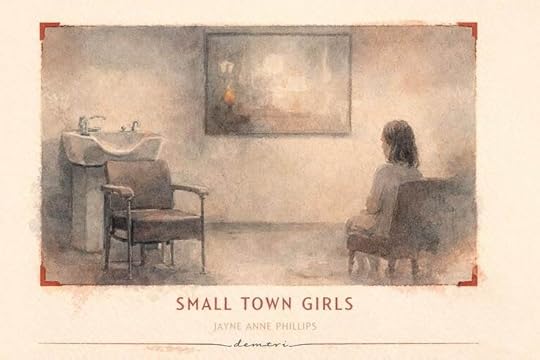
The Room That Taught Her to See – a beauty-shop sink, a waiting child, and faint afterimages of church light, fire, sickroom, and smoke gather the hidden architecture of attention in Jayne Anne Phillips’s “Small Town Girls.”
A beauty shop promises to improve the head. In Jayne Anne Phillips’s “Small Town Girls: a writer’s memoir,” it does something more intimate and more consequential. It teaches a girl how women sound when men are absent. It teaches her that beauty can arrive as care and correction in the same breath. It teaches her that gossip, that supposedly minor art, may be the only unofficial ledger some lives ever receive. The women tilt back into the sinks; their bodies surrender; the talk moves around them like weather. A child sits nearby, allegedly waiting.
In truth, she is taking inventory.
At the sink, she begins to understand what women keep, trade, and disguise. It may look like a return-home memoir, but Buckhannon, West Virginia, is not merely the place Phillips revisits; it is the place that formed her eye, her fear, her silence. What follows is an inventory of sinks, pews, yards, theater seats, sickbeds, and graves. Each place marks her before she understands what has happened. Home, here, is not escaped by leaving. It keeps marking the body long after departure has begun.
Phillips opens by treating “hometown” not as an address-book fact but as a spell with obligations attached. Buckhannon arrives through Main Street, newspapers, comic books, house calls, cemeteries, cornfields, churches, parades, local doctors, the Pringle Tree, and the gold dome of the courthouse. It also arrives through her parents: a mother who carries the town’s memory in her bones; a father whose territory is concrete, machines, boundaries, and work. There are family legends and family omissions: Civil War division, illness, abandonment, death, endurance.
The town is not scenery. It is Phillips’s first apprenticeship in attention. Before she can become the novelist who writes the past so vividly, she has to become the child who notices where the light falls, who knows the smell of sawdust in the bookstore, who learns that local history and family history are not two braided strands but one rope, already around the wrist.
The opening essays show Phillips’s gifts before the book names them. In “Report of the Spies,” the child Phillips attends Methodist Bible school and is overwhelmed by organ music, stained glass, communion language, and the story of Jesus welcoming children. She has a strange bodily shock in the sanctuary, then faints during the basement party afterward, her white organdy dress ruined by Coke and ice. Later, under Reverend Snow, she gives a Sunday school report on the biblical spies sent into Canaan and quietly questions the morality of chosen people taking land from others. The adult narrator refuses to press the scene into a tidy critique of religion. She keeps its weather intact: awe, shame, light in the eyes, the ruined dress, the minister’s kiss, the stained-glass oculus looking down like an eye. Doctrine is not received as belief. It enters as sensation.
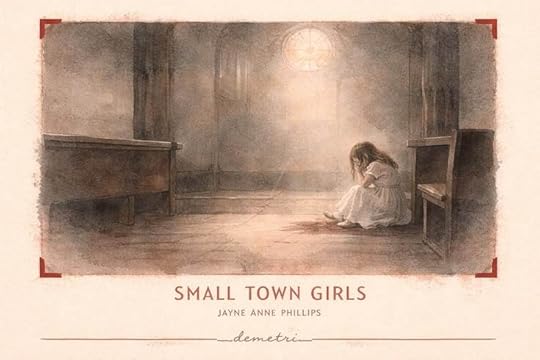
The White Dress Under the Oculus – childhood awe, shame, and bodily bewilderment collect beneath the church light, where belief enters Phillips’s memoir first as sensation rather than doctrine.
“Shop Talk” has the same two-handed intelligence. Phillips remembers accompanying her mother to the beauty shop, where she reads forbidden magazines, listens to women’s stories, watches bodies being washed and handled, and slowly grasps that femininity is work before it is identity. Her mother and the hairdresser study her face and hair, worry over her plainness, and cut her long hair into a humiliating pixie. The episode could settle into a familiar mother-daughter wound, but Phillips is after a less obedient truth. The beauty shop is double-edged: a school of judgment and a weekly refuge; a place where girls learn the cost of being presentable and women, for one afternoon, let someone else tend to them. The essay’s generosity does not erase the sting. It lets the sting and the care remain together: sink, chair, mirror, curlers.
In “Burning the Trees,” the father’s territory comes forward: the acre of land, the boundary fence, the yard, the brothers’ masculine kingdom of toy trucks, dirt roads, bows, arrows, tools, boots, fire. One brother accidentally shoots their father through the boot and ankle. Instead of rage, the father returns from the hospital and praises the boy’s arm. Later he burns caterpillar webs from the fruit trees with a kerosene torch while the children watch. Phillips lets the trees burn first. Only afterward does the image open: the father moving through flame, the little trees flaring, childhood fear brightening into dream, the dead returning through a scene too vivid to leave behind. Meaning comes afterward, smelling faintly of smoke.
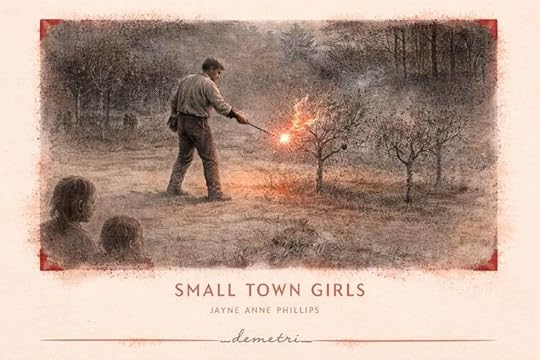
Burning the Trees – a father moves through remembered fire with a kerosene torch, turning a childhood yard into one of “Small Town Girls”’s most vivid images of fear, tenderness, and afterimage.
After these first rooms, the state’s older violences come in with muddy shoes. “Small Town Girls” is made of 22 titled essays rather than formal parts, and Phillips lets the sequence move by echo rather than blueprint. “Paradise Lost: West Virginia” carries the book from natural abundance into settlement, timber, coal, mountaintop removal, fracking, and family inheritance. “Lovelorn Labors: The Hatfield’s and McCoy’s” recasts a caricatured feud as a story of land, scarcity, pride, law, timber, and opportunism. “A Small History” narrows again to a neglected boy near Phillips’s rural road, seen by adults who can register the damage but not fully save him. Dogs, television westerns, fashion magazines, school violence, abortion, child death, literary ancestors, caregiving, and horror cinema all enter the house.
The memoir fills up – thrillingly, then sometimes until the air thins. A stained-glass window, a sink, a father’s punctured boot, a butter plate, a dog’s body, a red Jaguar, a movie seat, a bed, a crematorium: each waits to flare. The past knocks at the same doors until Phillips answers in sentences.
Images arrive before explanation. Phillips writes by gathering, not snapping shut. Her rhythm is cumulative, sensory, often tidal. She begins with domestic nouns with long fuses – hair rollers, fruit trees, boots, butter, dogs, caskets – and lets them absorb pressure until fact begins to glow. Her diction is not ornate in the manner of a writer dressing the sentence for company. It is dense because the remembered world is thick with stored feeling. The smell of a beauty shop, the hush of a doctor’s stairwell, the organ shaking a child’s bones, the waiting body of a dog, the theatrical white of funeral flowers: Phillips writes as if every object has been steeping for decades.
A saving mischief keeps the book from embalming itself. Phillips can be reverent, but she is rarely solemn in the dull way. She understands the comedy of women managing appearances, the absurdity of a red Jaguar meant to turn middle-aged mothers into temporary outlaws, the heroic inconvenience of looking “natural,” which women might well have unionized if they had not been so busy setting their hair. Without that agility, elegy would harden into perfume. Instead, even the lace curtains have a little dirt on them. Good. A perfectly clean memoir is a suspicious object.
Comparisons help here only when kept close. Like Lee Smith’s “Dimestore: A Writer’s Life,” Phillips’s memoir returns to a small-town Appalachian and Southern childhood to recover the making of a writer. Like Annie Dillard’s “An American Childhood,” it is fascinated by perception before explanation. Like Rebecca Solnit’s “The Faraway Nearby,” it trusts association, recurrence, and the braided essay more than direct chronology. But Phillips is less companionable than Smith, less metaphysical than Dillard, less conceptual than Solnit. Her truest mode is gothic domestic witness: she is interested in what the room knew before the child did.
Phillips makes home less a place than a set of trained reflexes: how to look, what to fear, whom to overhear, when to keep still. West Virginia is not a backdrop lacquered in melancholy. It is a place lodged in the nerves: beautiful, exploited, misunderstood, beloved, historically burdened, impossible to leave in any simple way. “Paradise Lost: West Virginia” makes the injury explicit – timber, coal, mountaintop removal, fracking – but Phillips is sharpest when coal seams and kitchen drawers are understood as part of the same bequest. The land is not “context” for the family. The family is one of the ways the land enters history. The beauty shop is not quaint local color. It is a ledger of womanly bargain and warning.
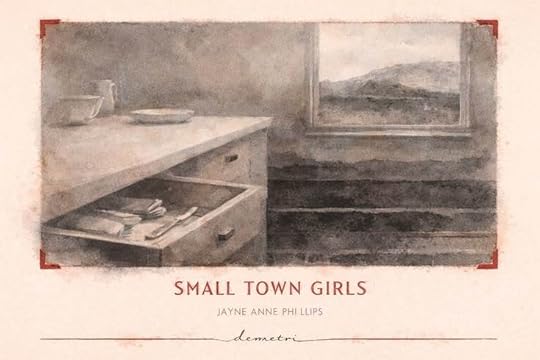
Coal Seams and Kitchen Drawers – household memory and West Virginia’s scarred inheritance meet in one quiet interior, where coal, family, and place become part of the same bequest.
Caregiving gives the book its hardest evidence. In “Taking Care” and “Premature Burial,” Phillips’s mother, vivid throughout as teacher, keeper, critic, worrier, worker, and beloved burden, becomes terminally ill with lung cancer. The daughter becomes caretaker while pregnant and then mothering an infant, building a household around decline, medication, bedside reading, and the daily arithmetic of pain. These scenes are mercifully unsweetened. Care is made of love, impatience, logistics, guilt, tenderness, dread, and the sickening knowledge that devotion cannot make anyone safe. This is witness without rescue: she can tend, but she cannot save.
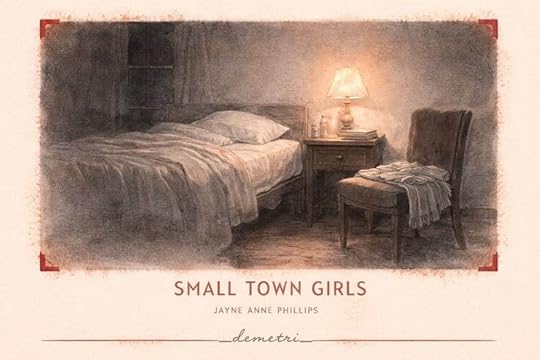
The Bedside Arithmetic – a lamp, chair, book, blanket, and pill bottle hold the unsentimental labor of caregiving, where love becomes witness without rescue.
“Premature Burial” is the right ending because it does not simply close the book; it turns the key on everything before it. Phillips returns to childhood moviegoing, to Roger Corman’s “Premature Burial,” to the terror of bodies trapped alive, to poverty up the rural roads, to sexual threat at the theater, to family rage, to the mother’s suffering, and finally to the crematorium. She watches the smoke of her mother’s body rise into winter fog. Earlier in life, she had imagined escape and redemption as paired possibilities. By the end, departure has lost its glamour. Redemption, if the word can still be used without false consolation, is the circling back: the writer’s attempt to preserve what was emotionally real before shame, silence, and the ordinary vandalism of time can bury it.
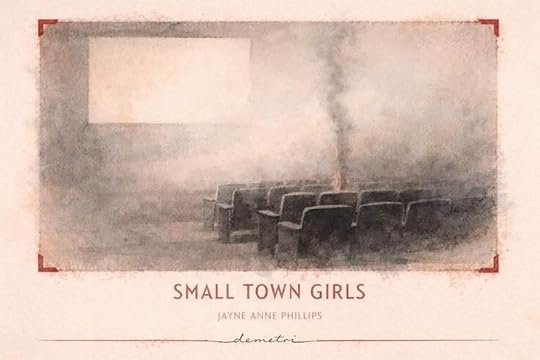
Smoke After the Theater – empty movie seats and rising smoke join childhood fear, mother-loss, and final return, carrying the memoir’s closing movement from escape into witness.
The book’s open-handed structure gives it range, but a few chambers have light without pressure. Phillips’s arrangement depends on recurrence, yet recurrence does not always change the voltage. Home, mother, writing, watching: these are powerful enough to carry the memoir, but they return so often that a few essays feel less like fresh revelations than beautifully lit side rooms. The literary tributes to Crane and Pancake are intelligent and affectionate, but they ask the reader to follow Phillips outward into ancestry and influence rather than deeper into the book’s most volatile domestic core. The Hatfield-McCoy essay and the school-shooting chapter have moral seriousness, but at moments they arrive wearing the badge of their first occasion instead of bending fully into the memoir’s final arc. The house is large. Not every room contains the ghost we came to meet.
The flaw is a draft, not a fault line. Phillips’s prose keeps its pulse even when the form loosens, and the last essays send a clarifying current backward through the earlier ones. A stricter book might have been more concentrated. It might also have been less true to the unruly way the past arrives: bringing relatives, dogs, weather, old movies, bad haircuts, dead writers, local legends, church music, and some unnecessary luggage. Phillips keeps inviting recollection in, and recollection, being recollection, does not always wipe its shoes.
My final rating is 86/100, which translates to 4/5 stars.
What prevents “Small Town Girls” from becoming a handsome recollection is its understanding that the past is not innocent. To remember home is also to remember class shame, gender discipline, religious pressure, environmental ruin, bodies mishandled by illness and desire, children unprotected, women overburdened, and mothers both adored and impossible. Phillips does not pretend that art makes every wound useful. She is too honest for that little seminar lie. What she does suggest is more severe: writing can keep faith with what happened by refusing to make love simpler than it was.
The book has no patience for the souvenir version of the past. It does not set Buckhannon under glass. It lets the town breathe, gossip, embarrass, decay, shine, and accuse. Phillips returns to the old rooms not to restore them but to hear what they were saying all along. The title may sound modest, almost communal, but the memoir itself is haunted by the girls contained in it: those who stayed, those who left, those who died young, those made beautiful against their will, those entrusted with secrets too early, and one who became a writer because some rooms were too alive to leave vacant.
The final image that lingers is not only the smoke at the crematorium, though that is where grief stops being atmosphere and becomes body. It is the child before that: in the church, in the beauty shop, in the yard, in the theater, watching. She does not yet know that attention can become a vocation. She does not yet know that escape will fail. She knows only that something has happened in the room, and that no one else seems likely to say exactly what. Decades later, Phillips returns sentence by sentence. What remains is the light, the smoke, the gossip, the organ music, the mother’s voice, and the burning trees.
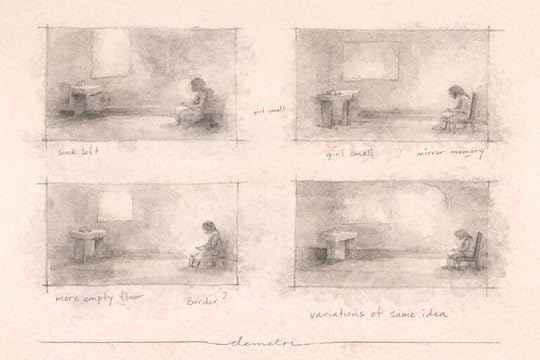
Compositional Thumbnail Sheet – early graphite studies test the placement of sink, child, mirror, and negative space before the final watercolor finds its quiet room of witness.
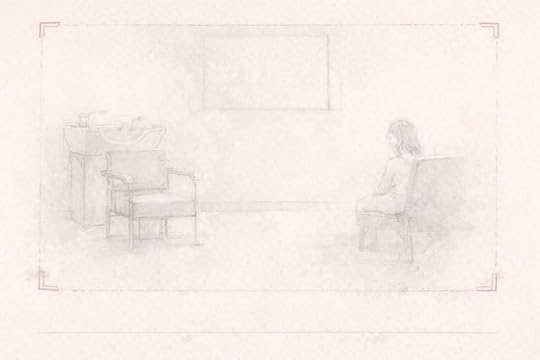
Faint Pencil Underdrawing – the first skeletal lines establish the sink, chair, waiting child, and memory-panel before color begins to make the room breathe.
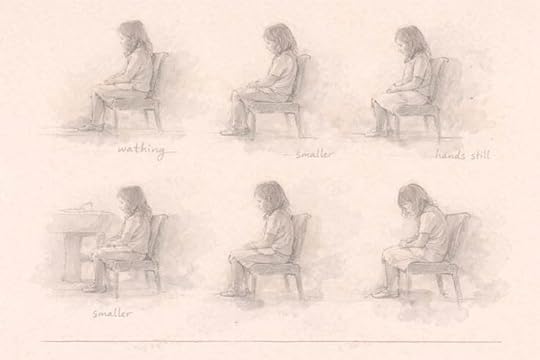
Character Posture Study – small seated-figure studies search for the child’s watchfulness through shoulders, hands, and stillness rather than facial expression.
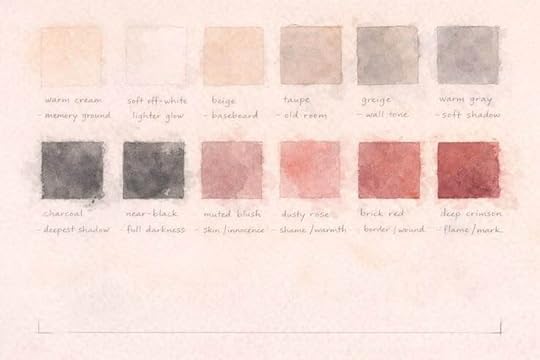
Color Swatch Sheet – muted cream, taupe, charcoal, blush, brick red, and deep crimson tests keep the painting bound to the cover’s restrained memory palette.
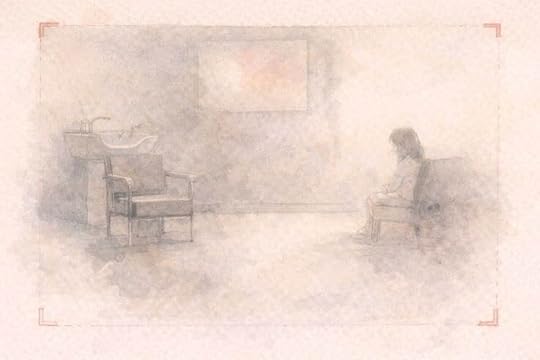
Pencil-Plus-First-Wash Stage – the room begins to emerge in pale gray, taupe, and cream washes, with the first red accents suggesting memory before meaning.
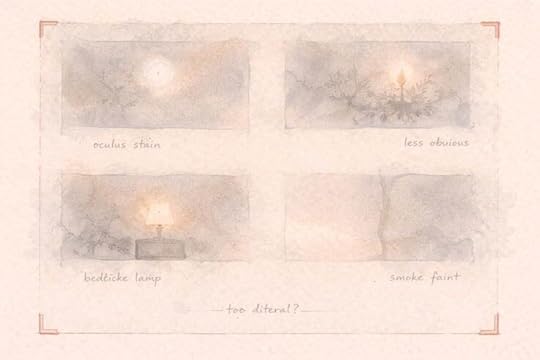
Mirror / Memory-Panel Study – faint washes of oculus, flame, bedside lamp, and smoke test how much symbolism the back wall can hold without becoming a literal montage.
All watercolor illustrations by Demetris Papadimitropoulos.
Jayne Anne Phillips’s “Small Town Girls” turns girlhood, gossip, religion, grief, and Appalachian history into a sharp, haunted education in attention.
By Demetris Papadimitropoulos | April 20th, 2026
The Room That Taught Her to See – a beauty-shop sink, a waiting child, and faint afterimages of church light, fire, sickroom, and smoke gather the hidden architecture of attention in Jayne Anne Phillips’s “Small Town Girls.”
A beauty shop promises to improve the head. In Jayne Anne Phillips’s “Small Town Girls: a writer’s memoir,” it does something more intimate and more consequential. It teaches a girl how women sound when men are absent. It teaches her that beauty can arrive as care and correction in the same breath. It teaches her that gossip, that supposedly minor art, may be the only unofficial ledger some lives ever receive. The women tilt back into the sinks; their bodies surrender; the talk moves around them like weather. A child sits nearby, allegedly waiting.
In truth, she is taking inventory.
At the sink, she begins to understand what women keep, trade, and disguise. It may look like a return-home memoir, but Buckhannon, West Virginia, is not merely the place Phillips revisits; it is the place that formed her eye, her fear, her silence. What follows is an inventory of sinks, pews, yards, theater seats, sickbeds, and graves. Each place marks her before she understands what has happened. Home, here, is not escaped by leaving. It keeps marking the body long after departure has begun.
Phillips opens by treating “hometown” not as an address-book fact but as a spell with obligations attached. Buckhannon arrives through Main Street, newspapers, comic books, house calls, cemeteries, cornfields, churches, parades, local doctors, the Pringle Tree, and the gold dome of the courthouse. It also arrives through her parents: a mother who carries the town’s memory in her bones; a father whose territory is concrete, machines, boundaries, and work. There are family legends and family omissions: Civil War division, illness, abandonment, death, endurance.
The town is not scenery. It is Phillips’s first apprenticeship in attention. Before she can become the novelist who writes the past so vividly, she has to become the child who notices where the light falls, who knows the smell of sawdust in the bookstore, who learns that local history and family history are not two braided strands but one rope, already around the wrist.
The opening essays show Phillips’s gifts before the book names them. In “Report of the Spies,” the child Phillips attends Methodist Bible school and is overwhelmed by organ music, stained glass, communion language, and the story of Jesus welcoming children. She has a strange bodily shock in the sanctuary, then faints during the basement party afterward, her white organdy dress ruined by Coke and ice. Later, under Reverend Snow, she gives a Sunday school report on the biblical spies sent into Canaan and quietly questions the morality of chosen people taking land from others. The adult narrator refuses to press the scene into a tidy critique of religion. She keeps its weather intact: awe, shame, light in the eyes, the ruined dress, the minister’s kiss, the stained-glass oculus looking down like an eye. Doctrine is not received as belief. It enters as sensation.
The White Dress Under the Oculus – childhood awe, shame, and bodily bewilderment collect beneath the church light, where belief enters Phillips’s memoir first as sensation rather than doctrine.
“Shop Talk” has the same two-handed intelligence. Phillips remembers accompanying her mother to the beauty shop, where she reads forbidden magazines, listens to women’s stories, watches bodies being washed and handled, and slowly grasps that femininity is work before it is identity. Her mother and the hairdresser study her face and hair, worry over her plainness, and cut her long hair into a humiliating pixie. The episode could settle into a familiar mother-daughter wound, but Phillips is after a less obedient truth. The beauty shop is double-edged: a school of judgment and a weekly refuge; a place where girls learn the cost of being presentable and women, for one afternoon, let someone else tend to them. The essay’s generosity does not erase the sting. It lets the sting and the care remain together: sink, chair, mirror, curlers.
In “Burning the Trees,” the father’s territory comes forward: the acre of land, the boundary fence, the yard, the brothers’ masculine kingdom of toy trucks, dirt roads, bows, arrows, tools, boots, fire. One brother accidentally shoots their father through the boot and ankle. Instead of rage, the father returns from the hospital and praises the boy’s arm. Later he burns caterpillar webs from the fruit trees with a kerosene torch while the children watch. Phillips lets the trees burn first. Only afterward does the image open: the father moving through flame, the little trees flaring, childhood fear brightening into dream, the dead returning through a scene too vivid to leave behind. Meaning comes afterward, smelling faintly of smoke.
Burning the Trees – a father moves through remembered fire with a kerosene torch, turning a childhood yard into one of “Small Town Girls”’s most vivid images of fear, tenderness, and afterimage.
After these first rooms, the state’s older violences come in with muddy shoes. “Small Town Girls” is made of 22 titled essays rather than formal parts, and Phillips lets the sequence move by echo rather than blueprint. “Paradise Lost: West Virginia” carries the book from natural abundance into settlement, timber, coal, mountaintop removal, fracking, and family inheritance. “Lovelorn Labors: The Hatfield’s and McCoy’s” recasts a caricatured feud as a story of land, scarcity, pride, law, timber, and opportunism. “A Small History” narrows again to a neglected boy near Phillips’s rural road, seen by adults who can register the damage but not fully save him. Dogs, television westerns, fashion magazines, school violence, abortion, child death, literary ancestors, caregiving, and horror cinema all enter the house.
The memoir fills up – thrillingly, then sometimes until the air thins. A stained-glass window, a sink, a father’s punctured boot, a butter plate, a dog’s body, a red Jaguar, a movie seat, a bed, a crematorium: each waits to flare. The past knocks at the same doors until Phillips answers in sentences.
Images arrive before explanation. Phillips writes by gathering, not snapping shut. Her rhythm is cumulative, sensory, often tidal. She begins with domestic nouns with long fuses – hair rollers, fruit trees, boots, butter, dogs, caskets – and lets them absorb pressure until fact begins to glow. Her diction is not ornate in the manner of a writer dressing the sentence for company. It is dense because the remembered world is thick with stored feeling. The smell of a beauty shop, the hush of a doctor’s stairwell, the organ shaking a child’s bones, the waiting body of a dog, the theatrical white of funeral flowers: Phillips writes as if every object has been steeping for decades.
A saving mischief keeps the book from embalming itself. Phillips can be reverent, but she is rarely solemn in the dull way. She understands the comedy of women managing appearances, the absurdity of a red Jaguar meant to turn middle-aged mothers into temporary outlaws, the heroic inconvenience of looking “natural,” which women might well have unionized if they had not been so busy setting their hair. Without that agility, elegy would harden into perfume. Instead, even the lace curtains have a little dirt on them. Good. A perfectly clean memoir is a suspicious object.
Comparisons help here only when kept close. Like Lee Smith’s “Dimestore: A Writer’s Life,” Phillips’s memoir returns to a small-town Appalachian and Southern childhood to recover the making of a writer. Like Annie Dillard’s “An American Childhood,” it is fascinated by perception before explanation. Like Rebecca Solnit’s “The Faraway Nearby,” it trusts association, recurrence, and the braided essay more than direct chronology. But Phillips is less companionable than Smith, less metaphysical than Dillard, less conceptual than Solnit. Her truest mode is gothic domestic witness: she is interested in what the room knew before the child did.
Phillips makes home less a place than a set of trained reflexes: how to look, what to fear, whom to overhear, when to keep still. West Virginia is not a backdrop lacquered in melancholy. It is a place lodged in the nerves: beautiful, exploited, misunderstood, beloved, historically burdened, impossible to leave in any simple way. “Paradise Lost: West Virginia” makes the injury explicit – timber, coal, mountaintop removal, fracking – but Phillips is sharpest when coal seams and kitchen drawers are understood as part of the same bequest. The land is not “context” for the family. The family is one of the ways the land enters history. The beauty shop is not quaint local color. It is a ledger of womanly bargain and warning.
Coal Seams and Kitchen Drawers – household memory and West Virginia’s scarred inheritance meet in one quiet interior, where coal, family, and place become part of the same bequest.
Caregiving gives the book its hardest evidence. In “Taking Care” and “Premature Burial,” Phillips’s mother, vivid throughout as teacher, keeper, critic, worrier, worker, and beloved burden, becomes terminally ill with lung cancer. The daughter becomes caretaker while pregnant and then mothering an infant, building a household around decline, medication, bedside reading, and the daily arithmetic of pain. These scenes are mercifully unsweetened. Care is made of love, impatience, logistics, guilt, tenderness, dread, and the sickening knowledge that devotion cannot make anyone safe. This is witness without rescue: she can tend, but she cannot save.
The Bedside Arithmetic – a lamp, chair, book, blanket, and pill bottle hold the unsentimental labor of caregiving, where love becomes witness without rescue.
“Premature Burial” is the right ending because it does not simply close the book; it turns the key on everything before it. Phillips returns to childhood moviegoing, to Roger Corman’s “Premature Burial,” to the terror of bodies trapped alive, to poverty up the rural roads, to sexual threat at the theater, to family rage, to the mother’s suffering, and finally to the crematorium. She watches the smoke of her mother’s body rise into winter fog. Earlier in life, she had imagined escape and redemption as paired possibilities. By the end, departure has lost its glamour. Redemption, if the word can still be used without false consolation, is the circling back: the writer’s attempt to preserve what was emotionally real before shame, silence, and the ordinary vandalism of time can bury it.
Smoke After the Theater – empty movie seats and rising smoke join childhood fear, mother-loss, and final return, carrying the memoir’s closing movement from escape into witness.
The book’s open-handed structure gives it range, but a few chambers have light without pressure. Phillips’s arrangement depends on recurrence, yet recurrence does not always change the voltage. Home, mother, writing, watching: these are powerful enough to carry the memoir, but they return so often that a few essays feel less like fresh revelations than beautifully lit side rooms. The literary tributes to Crane and Pancake are intelligent and affectionate, but they ask the reader to follow Phillips outward into ancestry and influence rather than deeper into the book’s most volatile domestic core. The Hatfield-McCoy essay and the school-shooting chapter have moral seriousness, but at moments they arrive wearing the badge of their first occasion instead of bending fully into the memoir’s final arc. The house is large. Not every room contains the ghost we came to meet.
The flaw is a draft, not a fault line. Phillips’s prose keeps its pulse even when the form loosens, and the last essays send a clarifying current backward through the earlier ones. A stricter book might have been more concentrated. It might also have been less true to the unruly way the past arrives: bringing relatives, dogs, weather, old movies, bad haircuts, dead writers, local legends, church music, and some unnecessary luggage. Phillips keeps inviting recollection in, and recollection, being recollection, does not always wipe its shoes.
My final rating is 86/100, which translates to 4/5 stars.
What prevents “Small Town Girls” from becoming a handsome recollection is its understanding that the past is not innocent. To remember home is also to remember class shame, gender discipline, religious pressure, environmental ruin, bodies mishandled by illness and desire, children unprotected, women overburdened, and mothers both adored and impossible. Phillips does not pretend that art makes every wound useful. She is too honest for that little seminar lie. What she does suggest is more severe: writing can keep faith with what happened by refusing to make love simpler than it was.
The book has no patience for the souvenir version of the past. It does not set Buckhannon under glass. It lets the town breathe, gossip, embarrass, decay, shine, and accuse. Phillips returns to the old rooms not to restore them but to hear what they were saying all along. The title may sound modest, almost communal, but the memoir itself is haunted by the girls contained in it: those who stayed, those who left, those who died young, those made beautiful against their will, those entrusted with secrets too early, and one who became a writer because some rooms were too alive to leave vacant.
The final image that lingers is not only the smoke at the crematorium, though that is where grief stops being atmosphere and becomes body. It is the child before that: in the church, in the beauty shop, in the yard, in the theater, watching. She does not yet know that attention can become a vocation. She does not yet know that escape will fail. She knows only that something has happened in the room, and that no one else seems likely to say exactly what. Decades later, Phillips returns sentence by sentence. What remains is the light, the smoke, the gossip, the organ music, the mother’s voice, and the burning trees.
Compositional Thumbnail Sheet – early graphite studies test the placement of sink, child, mirror, and negative space before the final watercolor finds its quiet room of witness.
Faint Pencil Underdrawing – the first skeletal lines establish the sink, chair, waiting child, and memory-panel before color begins to make the room breathe.
Character Posture Study – small seated-figure studies search for the child’s watchfulness through shoulders, hands, and stillness rather than facial expression.
Color Swatch Sheet – muted cream, taupe, charcoal, blush, brick red, and deep crimson tests keep the painting bound to the cover’s restrained memory palette.
Pencil-Plus-First-Wash Stage – the room begins to emerge in pale gray, taupe, and cream washes, with the first red accents suggesting memory before meaning.
Mirror / Memory-Panel Study – faint washes of oculus, flame, bedside lamp, and smoke test how much symbolism the back wall can hold without becoming a literal montage.
All watercolor illustrations by Demetris Papadimitropoulos.
May 16, 2026
I had never read Jane Phillips’ books before. I read a review about this book. Since I’m interested in memoirs, especially about people close to my age, I borrowed it from the library. It is a collection of essays based on her experiences as well as family, history, authors and people who influenced her. Some of her writing becomes abstract at times and I have trouble following. A little too “out there“. I eventually became used to her style. My favorite chapters are “Real People“ and “Never Just Dogs”. Now I get her.
I got lost a few times so it’s not five stars, but that’s just my take.
I got lost a few times so it’s not five stars, but that’s just my take.
April 8, 2026
3.5 stars

August 9, 2026
A memoir from an author born the same year as myself, very relatable. 4/B

July 31, 2026
As is often the case, I enjoyed some of the essays that make up this memoir more than others. Some were downright gorgeous.

Did Not Finish
April 18, 2026DNF @ 28%
While I try to branch out and read things that I wouldn't normally enjoy, this hit the trifecta of my least favorite genres. As much as I wanted to push through, I just knew my rating wouldn't reflect the beautiful writing and memoir that others would appreciate more than I would.
Thank you to Alfred A Knopf for a physical copy of the ARC!
While I try to branch out and read things that I wouldn't normally enjoy, this hit the trifecta of my least favorite genres. As much as I wanted to push through, I just knew my rating wouldn't reflect the beautiful writing and memoir that others would appreciate more than I would.
Thank you to Alfred A Knopf for a physical copy of the ARC!

May 11, 2026
Jayne Anne Phillips won the 2024 Pulitzer Prize for NIGHT WATCH, her hard-edged novel about mental health care. This year, she has moved to a gentler subject for her memoir, SMALL TOWN GIRLS.
In 22 vignettes, Phillips paints a soulful portrait of a young woman growing up in Appalachia in the 20th century. The book features some famous history of the area (including the Hatfield–McCoy feud) and many beautifully crafted stories about growing up in small-town West Virginia, along with the requisite rights and eventual wrongs of her country girl training as she cast a wide net and reined in the first inkling of the woman she would become.
“I know now that I loved my hometown, that its long history and layered stories provided the perfect birthplace for a writer… Despite the sometimes-doubtful economy, no one wanted to leave, or so it seemed to me as a child.” The families Phillips writes about, mostly her own (and her particular closeness to her mother), support her statement: generations of people were attached to that financially poor but culturally rich area of the country. She grows up in the midst of all of this history, and it comes to bear quite intensely in her life.
Writers are often taught to “write what they know,” which sometimes can be limiting, especially as fantasy and sci-fi currently has a stranglehold on the literary community. Phillips takes this to heart and lets readers in on some of the most homespun and delightful tales of a young family living just to the right of center in a changing world.
Then Phillips writes a chapter about Stephen Crane, and everything shifts for her. Literature is the jet fuel that propels her into the wide world beyond. It certainly is de rigueur to ask artists about their inspirations and what book/film/painting brought them into the light of a more worldly culture. Rarely do we get to hear the full reason why.
Phillips takes the bandwidth that she has here to write a paean to Crane’s MAGGIE: A Girl of the Streets, which is now a forgotten American classic but opens up a new part of her brain. This portion of the book reflects her move beyond her ancestors, attending college and graduate school away from West Virginia, and finding a home outside the mountains that birthed her. But the history followed her as she moved into the greater world.
Crane’s story reflects some of Phillips’ adventuresome bravado and raises SMALL TOWN GIRLS from a pastoral memoir to a book that really traces the emotional and intellectual growth of a girl who strove to break through the barriers of her gender and upbringing to become a shining voice in the American literary landscape.
Like fellow Appalachian historian Barbara Kingsolver, Phillips shows the full range of her literary skills in even the simplest of stories. Whether writing about dogs or the TV show “The Big Valley,” she has a charming but astute grasp of language and a knack for bringing readers into the conversation, as if she is telling a good campfire story to assembled friends.
SMALL TOWN GIRLS is never mean-spirited but always truthful about how women in small towns who were slated to stay home and beget another generation found a way out thanks to their intellectual prowess, grand imaginations and endless curiosity. Jayne Anne Phillips weaves the kind of totally American story that readers will find easy to love.
Reviewed by Jana Siciliano
In 22 vignettes, Phillips paints a soulful portrait of a young woman growing up in Appalachia in the 20th century. The book features some famous history of the area (including the Hatfield–McCoy feud) and many beautifully crafted stories about growing up in small-town West Virginia, along with the requisite rights and eventual wrongs of her country girl training as she cast a wide net and reined in the first inkling of the woman she would become.
“I know now that I loved my hometown, that its long history and layered stories provided the perfect birthplace for a writer… Despite the sometimes-doubtful economy, no one wanted to leave, or so it seemed to me as a child.” The families Phillips writes about, mostly her own (and her particular closeness to her mother), support her statement: generations of people were attached to that financially poor but culturally rich area of the country. She grows up in the midst of all of this history, and it comes to bear quite intensely in her life.
Writers are often taught to “write what they know,” which sometimes can be limiting, especially as fantasy and sci-fi currently has a stranglehold on the literary community. Phillips takes this to heart and lets readers in on some of the most homespun and delightful tales of a young family living just to the right of center in a changing world.
Then Phillips writes a chapter about Stephen Crane, and everything shifts for her. Literature is the jet fuel that propels her into the wide world beyond. It certainly is de rigueur to ask artists about their inspirations and what book/film/painting brought them into the light of a more worldly culture. Rarely do we get to hear the full reason why.
Phillips takes the bandwidth that she has here to write a paean to Crane’s MAGGIE: A Girl of the Streets, which is now a forgotten American classic but opens up a new part of her brain. This portion of the book reflects her move beyond her ancestors, attending college and graduate school away from West Virginia, and finding a home outside the mountains that birthed her. But the history followed her as she moved into the greater world.
Crane’s story reflects some of Phillips’ adventuresome bravado and raises SMALL TOWN GIRLS from a pastoral memoir to a book that really traces the emotional and intellectual growth of a girl who strove to break through the barriers of her gender and upbringing to become a shining voice in the American literary landscape.
Like fellow Appalachian historian Barbara Kingsolver, Phillips shows the full range of her literary skills in even the simplest of stories. Whether writing about dogs or the TV show “The Big Valley,” she has a charming but astute grasp of language and a knack for bringing readers into the conversation, as if she is telling a good campfire story to assembled friends.
SMALL TOWN GIRLS is never mean-spirited but always truthful about how women in small towns who were slated to stay home and beget another generation found a way out thanks to their intellectual prowess, grand imaginations and endless curiosity. Jayne Anne Phillips weaves the kind of totally American story that readers will find easy to love.
Reviewed by Jana Siciliano

April 23, 2026
⭐️⭐️⭐️⭐️
Thank you to NetGalley for the ebook and Knopf for the physical copy.
📝 Short Summary
This book is a collection of essays that reflects on Jayne Anne Phillips’s roots, the place she came from, and the people and experiences that shaped her as a writer. It is less of a straightforward memoir and more of a reflective look at memory, place, and identity.
Review
Going into this, I was expecting more of a memoir, but this definitely felt more like a collection of essays. That is not necessarily a bad thing, but I do think it changed the way I connected to the book. Some of the essays really worked for me, while others felt a little more distant, so overall this landed at more of a 3.5 star read for me, rounded up to 4.
What I did appreciate most was how clearly the author was able to show readers where she came from. There is a strong sense of place throughout this book, and you can tell how much her upbringing, her hometown, and the landscape around her shaped not only her life, but also her writing. That part felt very vivid. Even when I was not fully locked into every essay, I could still feel the atmosphere and the importance of that setting in her life.
There is also a reflective, thoughtful quality to the writing that makes it clear this book is deeply personal, even if it does not always read like a traditional memoir. It feels more impressionistic at times, more concerned with memory and feeling than with telling one continuous life story. I think that will really work for some readers, especially those who enjoy essay collections and literary reflections on writing, place, and identity.
For me, the strongest parts were the essays where I felt more grounded in her personal experiences and her connection to home. Those moments had more emotional pull and made me feel more invested. Other sections were a little harder for me to fully connect with, which is why this was not a total standout read for me, even though I still found a lot to appreciate in it.
This is a quieter book, one that feels more reflective than emotionally immediate, and I think that is worth knowing going in. It is not the kind of memoir that pulls you through one big personal narrative. It is more layered, more observational, and more focused on pieces of a life than a full continuous arc.
Overall, I did enjoy parts of this, especially the way the author brought her upbringing and surroundings to life. Even though not every essay fully landed for me, there was still enough here that I appreciated, and I can definitely see this connecting with readers who enjoy literary nonfiction and essay driven memoirs.
✅ Would I Recommend It?
Yes, but mostly to readers who enjoy essay collections, reflective nonfiction, and books that are more about place, memory, and identity than a traditional memoir structure.
Thank you to NetGalley for the ebook and Knopf for the physical copy.
📝 Short Summary
This book is a collection of essays that reflects on Jayne Anne Phillips’s roots, the place she came from, and the people and experiences that shaped her as a writer. It is less of a straightforward memoir and more of a reflective look at memory, place, and identity.
Review
Going into this, I was expecting more of a memoir, but this definitely felt more like a collection of essays. That is not necessarily a bad thing, but I do think it changed the way I connected to the book. Some of the essays really worked for me, while others felt a little more distant, so overall this landed at more of a 3.5 star read for me, rounded up to 4.
What I did appreciate most was how clearly the author was able to show readers where she came from. There is a strong sense of place throughout this book, and you can tell how much her upbringing, her hometown, and the landscape around her shaped not only her life, but also her writing. That part felt very vivid. Even when I was not fully locked into every essay, I could still feel the atmosphere and the importance of that setting in her life.
There is also a reflective, thoughtful quality to the writing that makes it clear this book is deeply personal, even if it does not always read like a traditional memoir. It feels more impressionistic at times, more concerned with memory and feeling than with telling one continuous life story. I think that will really work for some readers, especially those who enjoy essay collections and literary reflections on writing, place, and identity.
For me, the strongest parts were the essays where I felt more grounded in her personal experiences and her connection to home. Those moments had more emotional pull and made me feel more invested. Other sections were a little harder for me to fully connect with, which is why this was not a total standout read for me, even though I still found a lot to appreciate in it.
This is a quieter book, one that feels more reflective than emotionally immediate, and I think that is worth knowing going in. It is not the kind of memoir that pulls you through one big personal narrative. It is more layered, more observational, and more focused on pieces of a life than a full continuous arc.
Overall, I did enjoy parts of this, especially the way the author brought her upbringing and surroundings to life. Even though not every essay fully landed for me, there was still enough here that I appreciated, and I can definitely see this connecting with readers who enjoy literary nonfiction and essay driven memoirs.
✅ Would I Recommend It?
Yes, but mostly to readers who enjoy essay collections, reflective nonfiction, and books that are more about place, memory, and identity than a traditional memoir structure.
Review of advance copy received from Netgalley
THANK YOU to #NetGalley and #KnopfPublishing for this INCREDIBLE collection of essays by the singular Jayne Anne Phillips. I've learned so much about her over the course of reading these carefully curated pieces -- one of the most brilliant essay collections I've had the honor of reading).
I share some similarities with the author who hails from Buckhannon, WV. This collection was most definitely a tribute to her roots - town, family, culture, childhood, friends, and dogs (and so much more). I'm typing quickly and trying to tone down the gush of love and emotion I have for this entire collection. Not one essay failed to hold my attention and, even better, many of these nonfiction pieces informed and spotlit aspects of others who preceded (and followed) them! I went through the collection twice for that reason. I learned so much about the WV culture (including historical information) and the Phillips' family (especially Jayne Anne's mother).
I've seen that Phillips has been deemed a "writer's writer" and I can totally understand that sentiment (she describes the writing process and includes accounts of other writers -- from Stephen Crane to Breece D'J Pancake, her experiences at Iowa Writer's Workshop, and her complete joy for books and language. And the agony of a writer NOT being able to write. I am, to a degree, a writer (and I can feel those sentiments) but I'm blessed to be, primarily, a reader and adorer of great writing!! Jayne Anne Phillips delivers - over and over again.
Though I know it would probably be okay to add some quotes from certain essays (the collection is infinitely quotable), I don't want this POSITIVE REVIEW to be flagged as having spoilers by the eyes of AI algorithms so I will refrain from adding anything.
I LOVE THIS COLLECTION. Full Stop. I recommend it to absolutely everyone who loves great writing and the array of topics and subjects is bound to please just about everyone. It's a beautifully human and unifying book of essays and I love Jayne Anne Phillips (her editor, etc. who assisted in pulling this together) and for bringing it into existence. It's exactly what I needed in my life - in this bizarre and angry world -- and it has been an antidote and a lift to read and experience.. I give this memoir ALL THE STARS and then some.
I share some similarities with the author who hails from Buckhannon, WV. This collection was most definitely a tribute to her roots - town, family, culture, childhood, friends, and dogs (and so much more). I'm typing quickly and trying to tone down the gush of love and emotion I have for this entire collection. Not one essay failed to hold my attention and, even better, many of these nonfiction pieces informed and spotlit aspects of others who preceded (and followed) them! I went through the collection twice for that reason. I learned so much about the WV culture (including historical information) and the Phillips' family (especially Jayne Anne's mother).
I've seen that Phillips has been deemed a "writer's writer" and I can totally understand that sentiment (she describes the writing process and includes accounts of other writers -- from Stephen Crane to Breece D'J Pancake, her experiences at Iowa Writer's Workshop, and her complete joy for books and language. And the agony of a writer NOT being able to write. I am, to a degree, a writer (and I can feel those sentiments) but I'm blessed to be, primarily, a reader and adorer of great writing!! Jayne Anne Phillips delivers - over and over again.
Though I know it would probably be okay to add some quotes from certain essays (the collection is infinitely quotable), I don't want this POSITIVE REVIEW to be flagged as having spoilers by the eyes of AI algorithms so I will refrain from adding anything.
I LOVE THIS COLLECTION. Full Stop. I recommend it to absolutely everyone who loves great writing and the array of topics and subjects is bound to please just about everyone. It's a beautifully human and unifying book of essays and I love Jayne Anne Phillips (her editor, etc. who assisted in pulling this together) and for bringing it into existence. It's exactly what I needed in my life - in this bizarre and angry world -- and it has been an antidote and a lift to read and experience.. I give this memoir ALL THE STARS and then some.

Review of advance copy received from NetGalley
I thought this was beautifully written. I enjoyed how this was a memoir, but it wasn't just a story of the author's life, it was moments that made her, changed her, or simply illustrate a feeling of a place or a time. I liked that some of the stories didn't seem like they were about her at all, but they conveyed a feeling we all share and as you progress through the book you start to get the hang of how she renders a feeling, more like brushstrokes and less like a black and white image.
I can see how some people may feel it's just a collection of stories and that it doesn't read like a traditional memoir, but that's what I loved about it. I loved getting the story of a different author or a story that focuses on someone else, but within that story you can relate to just the act of being human and you can see how these people are threads in her life that are all woven together to build her and who she is. I think its title "A Writer's Memoir" is apt because this isn't a memoir like you're use to reading. It is what she says, it's a writer's memoir, it's a writer telling her life in stories, some her own and some those of others.
I must also include that as a West Virginian who has moved elsewhere, it really spoke to the specific feeling I'm convinced only West Virginians know. There's just something in that place that gets into your bones and soul. You can never really go home again, but West Virginia follows you anywhere you go.
There's an understanding of what West Virginia is, her shortcomings, her beauty, the ancient landscape. How it's depicted versus how it really is. She captures the fact that West Virginia is two places, the north and the south, which have different accents, cultures, and could really be two different places entirely. I loved this because it's something I'm always trying to explain about West Virginia and no one truly understands it. I really appreciated this aspect of the storytelling.
Even though I've dedicated two paragraphs to the aspects of the book that are about West Virginia, it's more like the background music throughout the book. The story spans the country, but there's always a tether to where she came from and I just thought it was beautifully done.
I thoroughly enjoyed this book, it's my favorite book of the year so far and I am definitely now on a quest to read everything she's written.
I can see how some people may feel it's just a collection of stories and that it doesn't read like a traditional memoir, but that's what I loved about it. I loved getting the story of a different author or a story that focuses on someone else, but within that story you can relate to just the act of being human and you can see how these people are threads in her life that are all woven together to build her and who she is. I think its title "A Writer's Memoir" is apt because this isn't a memoir like you're use to reading. It is what she says, it's a writer's memoir, it's a writer telling her life in stories, some her own and some those of others.
I must also include that as a West Virginian who has moved elsewhere, it really spoke to the specific feeling I'm convinced only West Virginians know. There's just something in that place that gets into your bones and soul. You can never really go home again, but West Virginia follows you anywhere you go.
There's an understanding of what West Virginia is, her shortcomings, her beauty, the ancient landscape. How it's depicted versus how it really is. She captures the fact that West Virginia is two places, the north and the south, which have different accents, cultures, and could really be two different places entirely. I loved this because it's something I'm always trying to explain about West Virginia and no one truly understands it. I really appreciated this aspect of the storytelling.
Even though I've dedicated two paragraphs to the aspects of the book that are about West Virginia, it's more like the background music throughout the book. The story spans the country, but there's always a tether to where she came from and I just thought it was beautifully done.
I thoroughly enjoyed this book, it's my favorite book of the year so far and I am definitely now on a quest to read everything she's written.
July 6, 2026
Jayne Anne Phillips is a Pulitzer Prize winning author and I've wanted to read more of her work ever since Jeff introduced me to her writing via Machine Dreams when we first married, several decades ago. She came to our local bookstore a few years ago and I was enchanted with her innate gravitas and authenticity.
Surely a memoir by her would be equally enchanting.
Well, it would have been, if this was what I consider a true memoir. Thankfully short, Small Town Girls: A Writer's Memoir is not really about the author, which you'd kind of expect a memoir to be. It's more of an idiosyncratic jumble of things (or essays if you're feeling generous) that meant something to the author: Big Valley Days, the real details behind the battle of the Hatfields and the McCoys, Breece D'J Pancake, Stephen Crane, and a myriad of other subjects alongside Phillips' family and West Virginia history.
To say this was not what I was expecting and why I can't just accept it for its beautiful writing and profound insights is much of the same thing. Phillips is an extraordinary writer and I gave the book four stars because of that but there were times reading this very short book that were a slog, depending on my interest in the subject that was not Phillips. I have always loved Big Valley Days and even watched the first episode that the author describes in such loving detail. I was fascinated by Breece D'J Pancake, an author of whom I had never even heard. And the section on Rayme, a mentally ill casualty of the 60's who was part of Phillips' communal scene, is vivid and moving.
"All of us were consulting a series of maps bearing no relation to any physical geography, and Rayme was like a telephone to another world."
I found most of the book compelling, especially the parts about writers and writing. The details of obscure Hatfields and McCoys were a little too plebeian for my taste, however, as were some other intentional digressions that in some way illuminated Phillips' life, but not mine.
I can not wholeheartedly recommend this book, but I don't regret reading it.
Surely a memoir by her would be equally enchanting.
Well, it would have been, if this was what I consider a true memoir. Thankfully short, Small Town Girls: A Writer's Memoir is not really about the author, which you'd kind of expect a memoir to be. It's more of an idiosyncratic jumble of things (or essays if you're feeling generous) that meant something to the author: Big Valley Days, the real details behind the battle of the Hatfields and the McCoys, Breece D'J Pancake, Stephen Crane, and a myriad of other subjects alongside Phillips' family and West Virginia history.
To say this was not what I was expecting and why I can't just accept it for its beautiful writing and profound insights is much of the same thing. Phillips is an extraordinary writer and I gave the book four stars because of that but there were times reading this very short book that were a slog, depending on my interest in the subject that was not Phillips. I have always loved Big Valley Days and even watched the first episode that the author describes in such loving detail. I was fascinated by Breece D'J Pancake, an author of whom I had never even heard. And the section on Rayme, a mentally ill casualty of the 60's who was part of Phillips' communal scene, is vivid and moving.
"All of us were consulting a series of maps bearing no relation to any physical geography, and Rayme was like a telephone to another world."
I found most of the book compelling, especially the parts about writers and writing. The details of obscure Hatfields and McCoys were a little too plebeian for my taste, however, as were some other intentional digressions that in some way illuminated Phillips' life, but not mine.
I can not wholeheartedly recommend this book, but I don't regret reading it.

July 24, 2026
This is intriging as it spot on nailed the part of West Virginia Philips was born and raised within. Loved how she detailed 100 different aspects that make that location entirely interesting and truly a freedom environment. The history and the individuals were all fascinating. Real and unique and poignant.
But the trouble, for me, is that this is more a series of essays and familial histories rather than a memoir, per se. She tells much of effusions and feelings but not a whole lot of core Jayne Anne Phillips, IMHO. Not in the processes of change and onus to her core, those especially. Actually I would surmise, for me anyway, that is one of the most "impersonal" reveals I've ever read. Private about huge forks in the road to almost all ultimate particular outcomes? Very much hit and miss on "other" topics and opinions. She also uses a course of ending sections in lyrical type analogy or some big letter L literature aside or complete disconnect from the former prose flow. I have read Night Watch and I disliked that aspect immensely. She does it here too. Very diverting? Regardless, it leaves you more quizzical that informed. It's almost like a pushing away or revulsion toward the reader? It says "don't get too close, now!" Makes me wonder way she wrote a "memoir" at all.
Yet then I consider her very short lived parents and the good-byes she has had. Makes you sceptical of authentic "closeness" for sure. So she is not taking tomorrow for granted. Good for her.
My thinking was that she would have had and would have now far more joy if she held any faith in a greater power instead of the indoctrinations she has chosen instead. 2.5 stars rounded up for the efforts of geneological survey and her diligence of looking in all realities to the past. But the title does not represent at least 60% of what she wrote about here. It is mistitled big time.
But the trouble, for me, is that this is more a series of essays and familial histories rather than a memoir, per se. She tells much of effusions and feelings but not a whole lot of core Jayne Anne Phillips, IMHO. Not in the processes of change and onus to her core, those especially. Actually I would surmise, for me anyway, that is one of the most "impersonal" reveals I've ever read. Private about huge forks in the road to almost all ultimate particular outcomes? Very much hit and miss on "other" topics and opinions. She also uses a course of ending sections in lyrical type analogy or some big letter L literature aside or complete disconnect from the former prose flow. I have read Night Watch and I disliked that aspect immensely. She does it here too. Very diverting? Regardless, it leaves you more quizzical that informed. It's almost like a pushing away or revulsion toward the reader? It says "don't get too close, now!" Makes me wonder way she wrote a "memoir" at all.
Yet then I consider her very short lived parents and the good-byes she has had. Makes you sceptical of authentic "closeness" for sure. So she is not taking tomorrow for granted. Good for her.
My thinking was that she would have had and would have now far more joy if she held any faith in a greater power instead of the indoctrinations she has chosen instead. 2.5 stars rounded up for the efforts of geneological survey and her diligence of looking in all realities to the past. But the title does not represent at least 60% of what she wrote about here. It is mistitled big time.

June 20, 2026
This is the memoir about the writer's life and thinking on various topics related to writers and writing--she shares anecdotes about growing up in small town Appalachia, pursuing her dream of being a writer, various friends she had throughout her life, shows she watched growing up, stories about various famous local feuds in her region, shows she watched, the death of her parents, various books she's read and loved, and even the story of some of her dogs. It felt like a grab-bag of various events and thoughts and literary critiques. Although the central driving force of the narrative is ostensibly the death of her parents, I didn't feel I got to know them as people or understood the writer's relationship with them. As a result, the deaths didn't make an emotional impact on me, in my reading experience. I also felt like the writer's life read like many other books I've read before--growing up in a small town, dealing with sexism and social expections, etc. It didn't have anything particularly new or fresh to say about the Boomer generation experience. The long digressions where we get the life story of various writers, TV shows, local legends, celebrities, etc. also took us out of memoir and more into cultural critique. I get it--she was trying to do a kind of time capsule of the culture of her childhood and young adulthood, but there wasn't enough narrative thread connecting the various anecdotes together (not enough "memoir" in the memoir, if you will).

July 15, 2026
This volume is not really a memoir in the traditional sense, but a collection of previously published occasional essays. The topics are various, beginning with her memories of growing up: in church, in the women's world of the beauty parlor, immersed in '60s tv. She celebrates her simple relationship with favorite dogs and her complicated one with her mother as a special child, the only daughter of a divorced parent who died too young. One refrain is her defense of the misunderstood and misrepresented West Virginia Appalachian world of her rearing; another is her rebelliousness and her endless uprooting, journeying through towns and houses and jobs and romantic relationships. Two essays ponder her early abortion and its aftereffects. The unifying thread, if there is one, is the author's voice - at once clear-eyed and unflinching, but also meditative and musing.
Jane Anne Phillips and I are almost the same age, and we share many of the same memories of growing up as precocious readers in small Southern towns. We were both children of fathers who who raised by adoring aunts rather than mothers and who married after WW2 service to much younger girls. I would love to sit on a front porch and chat with her for hours. I would tell her of my experiences as a classmate of one of her favorite writers, and I'd ask her how she (or someone) came to gather this essay collection and offer it as a memoir.
Jane Anne Phillips and I are almost the same age, and we share many of the same memories of growing up as precocious readers in small Southern towns. We were both children of fathers who who raised by adoring aunts rather than mothers and who married after WW2 service to much younger girls. I would love to sit on a front porch and chat with her for hours. I would tell her of my experiences as a classmate of one of her favorite writers, and I'd ask her how she (or someone) came to gather this essay collection and offer it as a memoir.
September 24, 2026
The writer hails from Buckhannon, West Virgina and although she has lived in other places, her hometown has never loosened its grip on her. She paints a vivid picture that I enjoyed reading, which at times evoked memories of where I lived as a child. Phillips offers a social history that honors the place and the people of Appalachia and the Allegheny mountains. Her stand can be defensive against what she feels is now "paradise lost", due to the industrialization: timber mining, coal mining, strip mining, mountaintop mining, and fracking. Her essays are varied and included such topics as the Hatfields and the McCoys, the local beauty parlor in town, a TV western, writers she admired and that influenced her. Her mother is a strong presence in her memoir. Phillips describes her as the "first respectable divorcee", and one of the town's few women to work outside the home. Her mother taught at the elementary school that Phillips attended, where she kept snacks in a drawer for hungry children, and gave them with warm clothing to wear when the weather turned cold. Her mother also pursued a graduate degree and would study at night. There's much honesty and emotional depth as Phillips explores identity and belonging. Indeed, she asserts that those who are born and raised in West Virginia never truly leave.
April 27, 2026
This, then, was how language worked. And if it could save me, it could save us all. from Small Town Girls by Jayne Anne Phillips
Jayne Anne Phillips and I are were born in the same year. For all the differences in where we grew up, so many things she writes about struck a chord.
Toni home perms for preschoolers! Yes, happened to both of us. Reading comic books, specifically the Classics Illustrated, spurred us both to tackle the novels early on. The love for a dog. Recalling girls discussing their favorite Beatle.
“I was my mother’s only daughter,” Philips writes, “the one who would inherit the dishes, the cradles, the women’s things, the stories.” As an only daughter and eldest granddaughter, I inherited treasures from grandparents and great-grandparents.
She writes about Stephen Crane’s Maggie: A Girl of the Streets. For me, it was his poetry that impacted me.
This memoir is a series of essays in which Phillips remembers her roots, her family and hometown, West Virginia’s history and character, and the people and places that made her, is inspiring.
Thanks to Knopf for a free book through NetGalley.
Jayne Anne Phillips and I are were born in the same year. For all the differences in where we grew up, so many things she writes about struck a chord.
Toni home perms for preschoolers! Yes, happened to both of us. Reading comic books, specifically the Classics Illustrated, spurred us both to tackle the novels early on. The love for a dog. Recalling girls discussing their favorite Beatle.
“I was my mother’s only daughter,” Philips writes, “the one who would inherit the dishes, the cradles, the women’s things, the stories.” As an only daughter and eldest granddaughter, I inherited treasures from grandparents and great-grandparents.
She writes about Stephen Crane’s Maggie: A Girl of the Streets. For me, it was his poetry that impacted me.
This memoir is a series of essays in which Phillips remembers her roots, her family and hometown, West Virginia’s history and character, and the people and places that made her, is inspiring.
Thanks to Knopf for a free book through NetGalley.

Review of advance copy received from Netgalley
I expected more of the essays to concern growing up in West Virginia -- they certainly were present, and to me, were the core of the book -- but there were several inclusions which felt a little random and took away from my overall appreciation of the collection.
The author's love of her hometown and home state was apparent and heartfelt, and beautifully described. She has a straight-forward, lightly nuanced writing style which I appreciate and relate to, and having grown up less than a decade later and in an adjacent state to West Virginia, felt like home to me.
The last essay, "Premature Burial," was the one that spoke to me loudest, using the title of an early 60's Roger Corman horror flick to draw parallels with the hidden poverty in her West Virginia town. It was beautifully done.
All in all, I enjoyed this, and hope to read more from the author.
I received a complimentary e-copy of the book from the publisher and NetGalley, and my review is being left freely.
The author's love of her hometown and home state was apparent and heartfelt, and beautifully described. She has a straight-forward, lightly nuanced writing style which I appreciate and relate to, and having grown up less than a decade later and in an adjacent state to West Virginia, felt like home to me.
The last essay, "Premature Burial," was the one that spoke to me loudest, using the title of an early 60's Roger Corman horror flick to draw parallels with the hidden poverty in her West Virginia town. It was beautifully done.
All in all, I enjoyed this, and hope to read more from the author.
I received a complimentary e-copy of the book from the publisher and NetGalley, and my review is being left freely.

Review of advance copy received from NetGalley
Small Town Girls is an uneven but often compelling introduction to Phillips' nonfiction. The strongest essays are the personal ones, where she writes from lived experience - sharply observed and attentive to the textures of small-town life, they have a clarity and immediacy that makes them easy to sink into.
Other pieces didn't work as well for me. Some drift, sometimes into broader West Virginian history, sometimes into reflections on writing itself, and the shift in register is noticeable. These pieces aren't poorly crafted, but they feel like they belong to a different project. I found the change in pace and tone occasionally threw me off a little.
At its best, Phillips' prose is steady, thoughtful and luminous, so it's a shame the lack of cohesion in this collection means its impact is uneven.
*Thank you to Netgalley for the arc in exchange for an honest review*
Other pieces didn't work as well for me. Some drift, sometimes into broader West Virginian history, sometimes into reflections on writing itself, and the shift in register is noticeable. These pieces aren't poorly crafted, but they feel like they belong to a different project. I found the change in pace and tone occasionally threw me off a little.
At its best, Phillips' prose is steady, thoughtful and luminous, so it's a shame the lack of cohesion in this collection means its impact is uneven.
*Thank you to Netgalley for the arc in exchange for an honest review*
May 12, 2026
Being raised in a small town and now living as an adult in a small town, I really felt connected to Phillips’ memoir of her small town in West Virginia. Views she shared were those that I had growing up, people she knew were my people, activities were mine as well. Phillips’ lyrical prose changed midway through the book as she began to show how her writing was influenced by the people she met. It took a different path away from a memoir and into biographical essays of people she knew of, and people she admired. I can see how some might not appreciate these descriptions of other people, and think they did not fit into her memoir. But I saw them as contributing to her coming of age story, survival from small town roots. I particularly loved her essay on Stephen Crane. This memoir is thoughful and touching, a beautifully written love story to her mother and to West Virginia. A good read.
May 26, 2026
This is not a tradition sustained narrative, but rather a collection of autobiographical essays, including a couple that examine the works of authors she admires and finds inspiring--Stephen Crane and Breece D'J Pancake. This was a book that made me feel like taking one more shot at the unfinished novel I've been stalled on. While I was reading it, I was also inspired to read her most recent novel, which I've been meaning to get to--Night Watch. (For some reason, however, when I read books on my kindle, they come up in my list of books read, but I don't het this window to rate them and write reviews).
I've read almost all of her books and have liked them all, but I think Night Watch is her best to date. I loved the narrative structure and the characters' voices and the strong sense of place throughout. It's a haunting story that reminds us of the precarious position of women in times of social upheaval. I would highly recommend both of these books.
I've read almost all of her books and have liked them all, but I think Night Watch is her best to date. I loved the narrative structure and the characters' voices and the strong sense of place throughout. It's a haunting story that reminds us of the precarious position of women in times of social upheaval. I would highly recommend both of these books.
Displaying 1 - 30 of 149 reviews