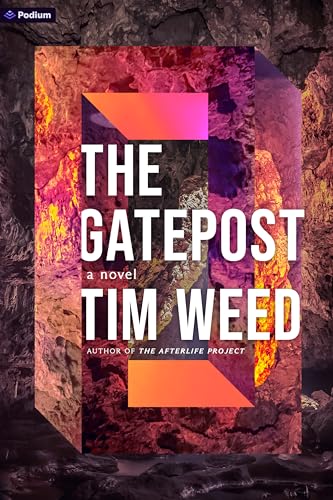
From the author of The Afterlife Project: One woman’s quest to find her vanished father pushes her beyond the boundaries of space, time, and the human mind.
Esme Weatherhead was twelve years old when her father, an amateur scientist and the author of a best-selling book on Mesoamerican shamanism, walked up into the forest on their rural Vermont property and never came back. Twenty years later she quits her job in San Francisco, gets divorced, and moves back to Vermont with the goal of writing a book about her father’s life and disappearance.
In the course of her research, Esme finds an old field journal referencing a cave on the property she hadn’t known about, a series of experiments involving high doses of psilocybin mushrooms, and a series of strangely vivid hallucinations. After searching unsuccessfully for the cave, she hires Lucas St. Pierre, a local geologist, to help her find it. As they try to unravel the truth of her father’s disappearance, Esme and Lucas confront hidden forces that will test their sanity and put their lives at risk, leading to new insights about love, death, and the hidden secrets of life on earth.
Perfect for fans of Susanna Clarke’s Piranesi, Emily St John Mandel’s Sea of Tranquility, and Richard Powers’ Bewilderment, Tim Weed’s The Gatepost blends modern science and ancient cosmology to take readers on a journey offering hallucinatory glimpses into worlds beyond our own.
"This well-researched tale is sure to entertain.” — Publisher’s Weekly
“A compellingly trippy journey.” —Kirkus Reviews
“A wild, luminous ride.” — Crystal King, bestselling author of The Happiness Collector
Tim Weed is the author of four books of fiction. His recent novel, The Afterlife Project, was a best books of 2025 pick from Library Journal and the Toronto Star. He’s won multiple Writer’s Digest Annual Fiction Awards and his work has been shortlisted for the Eric Hoffer Book Award, the Tobias Wolff Award for Fiction, the Prism Prize for Climate Literature, the Fish International Short Story Award, the William Faulkner-William Wisdom Award for a Novel-in-Progress, the New Rivers Many Voices Project, and many others. Tim's essays and articles have appeared in Writers Digest, Literary Hub, The Revelator, The Millions, The Writer’s Chronicle, Talking Points Memo, The Good Men Project, and elsewhere. His latest novel, The Gatepost, comes out May 26, 2026.
I received this ALC from Podium and ARC from NetGalley/Podium
I was able to immerse read this (audio + text) and it completely pulled me in with the mystery surrounding the caves and the artifact. The suspense and anticipation were some of the strongest parts of the story for me because I constantly wanted answers, and the story did a great job slowly building that tension.
The atmosphere really worked, especially with the isolated feel surrounding the caves and the sense that something deeper was happening underneath everything. I also appreciated how the story explored human nature, ownership, and the way people try to claim and control things they barely understand for the sake of making a name for themselves. That ambition also ties into the betrayal in the story, which gave the story more weight. And there was also some romance woven in, adding some emotional pull beyond the suspense itself.
The narration was another big positive for me. It kept me immersed in the story and added to the suspense without overdoing it.
Overall, this was an engaging and atmospheric speculative thriller that kept me curious the whole way through. I’d recommend it to readers who enjoy ancient mysteries, cave exploration, layered suspense, betrayal, a touch of romance, and stories that slowly unravel what’s really happening beneath the surface.
4.5 Stars 💫 Thank you, Podium Entertainment, for the physical ARC and ALC!🩷
I wholeheartedly believe that The Gatepost by Tim Weed is the prime example of 'don't judge a book by its cover.' In a lineup, it's probably not something I would go for at first glance, but that's why we need to try and read new, different things! It's 100% a hidden gem and needs more love! This sci-fi novel full of mystery, complex characters, a superb plot line, and a romantic subplot to top it all off had me hooked from start to finish. It had an amazing depth to it that I wasn't expecting going in. I really enjoyed it and would recommend it!
Shout out to Bradford Hastings for doing a great job of narrating the audiobook!<3
A book that transcends genre, weaving various points of view surrounding a young woman’s search for how and why her father disappeared years ago, The Gatepost delves into reality and variations of it, as well as a love of family and a journey of self-discovery. Well-paced, with a splash of romance, I could not put this book down. I was initially drawn in by the mysterious elements, but I stayed for the characters and the switches between points of views that kept me turning the page, needing to know what happened next in both timelines. I will be recommending this book to my friends and family and I can’t wait for it to be out in the world.
This one is around 4.25 stars for me. This one is a different read from what I usually read and I think that helped my overall enjoyment!
Esme was an interesting character to follow, and the mystery of her trying to piece together what happened to her father, and stumbling onto Stella and seeking out more kept my interest. There also was an action packed ending, and I enjoyed how this one tied up!
I will admit the beginning was a bit slow to get into the story, but once Esme finds the cave I couldn't stop listening. The audiobook narrator had a soothing voice and I enjoyed the audiobook! Thank you Podium Entertainment for my advanced listener copy!
The nitty-gritty: A mysterious ancient artifact is the centerpiece of this well written, carefully researched and plotted story, perfect for readers who love scholarly mysteries.
The Gatepost is another excellent story by Tim Weed, whose last book, The Afterlife Project, was one of my favorite books from last year. The Gatepost didn’t hit quite as hard as The Afterlife Project, since it lacked the incredible sense of awe I felt while reading that book. Still, I was transfixed by Weed’s ideas and his ability to meld science, spirituality and mystery into a top notch tale. There’s a bit of Raiders of the Lost Ark to this story, and the multiple points of view, dual timelines and flashback scenes were masterfully woven together into a cohesive and exciting reading experience.
The story follows three main points of view. Esme Weatherhead is in her early thirties and has recently left her old life behind to pursue a personal project. Her father, Gregory Weatherhead, disappeared twenty years earlier after walking into the forest on their rural Vermont property. His disappearance was never solved—Esme was twelve at the time and she’s been trying to deal with the trauma ever since. She’s decided to write a book about her father’s life—he wrote a bestseller about Indigenous shamanic practices and hallucinogenic experiences—and she’s come back to the family farm, Woodgate, to work on the book and see if she can finally figure out what happened to him.
We also meet Lucas St. Pierre, a down-on-his-luck geologist who is barely scraping by with the occasional consulting job. One day he gets an email from a woman who wants to hire him to help her find a cave on her property. When he meets Esme, he’s struck by her beauty, but also by her tenacity to find the cave, which she believes is connected to her father’s disappearance.
And finally, we follow Gregory Weatherhead himself, who appears to be lost in a world he calls “Graniteworld,” a stark, unfamiliar place that he found himself in after performing a Shamanistic ritual involving hallucinogenic mushrooms. Gregory’s chapters are the biggest mystery of the story. Is he tripping on mushrooms and hallucinating? Is he dead? Or did he actually travel to an alternate world? Readers will get some answers, but not until the end of the story.
A fourth point of view is introduced eventually, a rich collector of rare artifacts named Sebastian Bonney who has ties to both Gregory and Esme and eventually Lucas. Sebastian acts as the villain of the story, as he is trying to get his hands on an ancient relic that doesn’t belong to him.
The story focuses on Esme and Lucas and what they find inside the cave, and for me, these were my favorite parts. In order to understand the object in the cave, the author takes readers back to Gregory’s days working on his PhD thesis, his time in Oaxaca, Mexico, and a spiritualist he meets there who will change his life forever. This is a sweeping tale that incorporates Gregory’s studies in Zapotec culture, Psilocybe cubensis mushrooms, and alternate realities. It’s also a well developed mystery as Esme and Lucas try to discover the connection between Gregory’s disappearance and the cave.
Weed throws in a romance between Esme and Lucas, which didn’t surprise me at all, and I thought it worked really well. There are some interesting side characters who flesh out the story, like Esme’s mother Silvana, who lives in Oaxaca and comes to visit occasionally, Lucas’s fifteen year old daughter Ava, and Zoraida, the shaman who sets Gregory on his path to save humanity. Despite its low page count, this isn’t a quick read, but that’s not a negative. I found myself savoring each page and each new fact and revelation, the slow unveiling of the different mysteries, and I loved getting to know the character’s backstories.
My only complaint is that I wasn’t convinced by some of the choices the characters made. For example, Esme keeps seeing a drone flying over her property but doesn’t worry much about it. At one point Lucas is offered a “seems too good to be true” job and goes along with it anyway, even when he realizes some of the details are extremely sketchy. Lucas also makes a particular choice late in the story that had me shaking my head in frustration, and it didn’t add anything to the story except to make Lucas look bad.
The last section veers into thriller territory, as all the various parts of the story come together, and I loved the way Esme finally gets some closure about her father’s demise. We do get to see what happened to Gregory—sort of—although with the haze of magic mushrooms hanging over his strange experiences, it’s ultimately left up to the reader to interpret the events. A feel-good, satisfactory ending wraps everything up. Tim Weed is an author who deserves wider attention, so if you haven’t tried his books yet, The Gatepost is a great place to start.
Big thanks to the publisher for providing a review copy.
What would you get if you mixed an Indiana-Jones-style plot with a female protagonist, Mesoamerican Shamanism and a liberal helping of hallucinogenic mushrooms? If you said “an intriguing premise for a novel”, then you and I were on the same page, which is exactly why I requested The Gatepost for early review. Unfortunately, this didn’t quite live up to my expectations, and I was left with a 2.5/5-star experience.
The Story: We follow Esme Weatherhead, a 32 year old woman on a mission to write a biography about her father, an amateur scientist who disappeared 20-years ago into a rural Vermont forest. Her “biography-research” is only a thinly veiled excuse for her personal desire for answers about his ultimate fate. When she finds an old research-journal referencing a cave on the, a series of experiments with hallucinogenic mushrooms undertaken by her father, she decided to do some field research herself. With the help of a local geologist embarks on a journey to the caves of Vermont and the depths of her own mind.
What I liked: With a premise like that, there’s clearly a lot of room for adventure, intrigue and thematic resonance alike. The author makes good use of all these avenues. The novel casts a fairly wide net, and although none of it is exceptional, all of it is decent enough. The plot and characters are a little thin but functional to carry the story, the intrigue and mystery keep you going and there are just enough answers to be satisfying at the end, but leave some room to ponder for yourself. When it comes to themes, plenty is touched upon; from spiritualism to love, to greed and themes of nature and eco-conservatism. Again, none of these are explored in real depth, but for a fairly simple story, it manages to tie in a lot to think about.
What I didn’t like: The root of my disappointment can be split up into two categories: the actual quality of the writing, and the mismarketing (the latter obviously not being the authors fault). Whenever you take a course in (creative)writing of any kind, one of the first pieces of advice you’re given is to “show, don’t tell”. There’s something to be said for not taking any of these “writing-rules”, as gospel, but in general this decent advice. This novel clearly missed that fundamental first lesson, as it opens up with full first chapter that is nothing but exposition, that reads almost like a “previously on X-“segment. It’s jarring and sets the tone for what’s to come. The writing doesn’t improve in quality from there. The plot - on an event-by-event-level – is very simple and fairly little happens, and although there are interesting themes and ideas in it, the writing doesn’t have the heft to carry those across meaningfully. Now, I don’t expect every book to be a literary masterpiece, but this is where the mismarketing comes in. Comparing this book to the likes of Susanna Clarke, Emily St. John Mandel and Richard Powers, creates a certain expectation. These are some of the most eloquent literary talents of a generation, and this book just doesn’t match any of theirs in style nor substance. Had this been sold to me as a mystery-adventure, Indiana-Jones-style, I’d have given it a solid 3-star rating. Because I was promised a more literary speculative fiction work, I’m left with a 2.5, rounding down for disappointment-reasons.
Thanks to Podium Entertainment and Netgalley for providing me with an ARC in exchange for an honest review. All opinions are my own.
Very rare that an author comes out of nowhere for me. Tim Weed was an author I admit I never heard of before last year, when his novel the Afterlife Project, showed up in my mail. I was not prepared for the scope of it. Part Generation Ship story, this novel dealt with environmental issues by telling our story over centuries. I loved this novel and thought it was a wonderful surprise.
So when another Tim Weed novel was offered to me, I jumped on it. The Gatepost will interest many of my Dickian fans, but I have to admit it is a topic that is a bit of a turn-off for me. This novel might work better for others, and could be a classic case of “it’s not you novel, it’s me.”
The back cover compares says it is “Perfect for fans of Susanna Clarke’s Piranesi, Emily St John Mandel’s Sea of Tranquility, and Richard Powers’ Bewilderment.” Three books I admit I know nothing about. While it might sound hypocritical, Mesoamerica shaman mind expansion is just not a fictional topic that hooks me.
In the second half, there is a serious exploration of reality, and Weed does this by jumping in timelines. Esme is our point of view character and she is on the hunt for her missing father. The narrative investigates the disappearance, through his journals and high doses of Psilocybin Mushrooms.
The novel also starts with a chapter that is “Told” and not shown. Show don’t tell to me is a fundamental of storytelling, and Weed’s Afterlife Project had a built-in excuse to violate this rule; The Gatepost didn’t. The opening sentence, “Esme Weatherhead kept catching herself talking to a ghost.” This is a fine opening for the novel, but imagine if we were experiencing the conversation? What if it felt like a normal father-daughter conversation, and we slowly realized he wasn’t exactly alive?
This missed opportunity within the first pages colored my experience. There are neat revelations and interesting ideas in the novel for sure. It didn’t work for me as well as the Afterlife Project, a novel I thought was great. Now that being said, your mileage will vary. I have a feeling this book will connect with some readers deeply, it just didn’t totally work for me. Weed is a talented writer and I will continue to read his work.
Blew through this one in a couple days. I would describe it as a playful sci-fi thriller.
True to their Vermont roots, the characters are charmingly unprofessional in a way that is often missed in action-thriller-type narratives. They will stop to make sure their meal doesn’t get burnt before jogging off to meet the high-tech, armed criminals currently invading their property, for instance, or stop mid-chase to slurp down some water from the tap. This is an especially effective touch for Lucas, helping to bring out his defining flaw as a protagonist: a naïveté that makes you want to reach through the page and give him a wake-up call.
On that point, each of the characters is unusually well-equipped with an overarching motivation and a set of blindspots: for Gregory, it’s an ingenuous desire to save humanity from itself, combined with—fitting, given that goal—gross yet endearing fatherly overconfidence. Esme wants closure with her father and her childhood, but she is independent to a fault, and only comes out top once she allows herself to trust Lucas’s competence and intentions. Sebbie is animated by his obsessive posthumous envy of Gregory, and the power of this obsession causes him to repeatedly overplay his hand.
The concept driving the story will also appeal to fungi-curious sci-fi fans. I was totally caught off guard, and delighted by, the suggestion that the power of the stela was essentially explained by a hyperdimensional fungus’s feeding strategy. This touch retains some level of compelling mysticism, while transporting the story roughly from the world of fantasy to that of sci-fi and giving the reader’s imagination a little more structure to hold on to.
All in all, fun read.
This entire review has been hidden because of spoilers.
I was totally absorbed by Tim Weed's The Afterlife Project, so was anxious to get my hands on his follow-up. And although in many respects a very different novel, The Gatepost definitely shares some DNA with its predecessor. Esme's archaeologist father Gregory disappeared in the forests of Vermont when she was twelve years old; twenty years later, she returns to seek out a cave he mentioned in his final diary entries that she believes may reveal his fate. Meanwhile, in a parallel narrative thread, Gregory tells us what happened to him in that cave: as we discover almost immediately, his professional interest in Mesoamerican shamanism led him to experiment with hallucinations induced by psilocybin mushrooms, which gave him visions of awe-inspiring alternative landscapes. At first, he is unable to move from the spot in these visions, and returns to the real world when the effects fade, but when he at last manages to walk around in an hallucination, he is horrified to realise that he's trapped in a granite landscape of 'barren, broken, treeless rock' and bizarre megaflora: 'a colony of very large mushrooms ranging in size from chest-high to twice as tall as himself, with stout white stems and tall gray-brown heads riddled by a kind of honeycomb gridwork.' As in The Afterlife Project, The Gatepost is at its most absorbing and otherworldly when it's describing these other possible landscapes, and although there's a perfectly good thriller plot at play here as well, with Esme trying to protect her father's legacy from unscrupulous interests, it was Gregory's story that really had me riveted. Indeed, I could happily have read another whole book about these alternative realities. This doesn't have the structural ambition of The Afterlife Project, but it's still another strong novel from Weed.
I received a free proof copy of this novel from the author for review.
In its most literal meaning, a gatepost is where a gate hangs open or closed. It might also signify a portal between realms. As metaphor, it may signify confidentiality or a secret. In Tim Weeds novel by that title, it represents all three. As the novel begins, our protagonist, Esme, searches for her father, Dr. Gregory Weatherhead, a former archaeologist, who disappeared from the families rural Vermont homestead some decades before. As a researcher of indigenous Central American shamanic practices, Weatherhead leaves academia for a checkered future as a sometime maple syrup producer and self-described “independent researcher”. His departure from academe has much to do with his discoveries in Central America and his drive to understand and protect an important “artifact” that proves central to the story. What unfolds is a story of psychic exploration that ultimately absorbs Dr. Gregory in both body and soul. Esme is certain that there are clues on the property that give reason to her father’s disappearance. Having recently divorced, Esme seeks closure for her father’s presumed death while seeking her own sense of purpose and happiness. Her search for her father is complicated when she retains the help of a young geologist and her desire for privacy and personal space comes into question. The intrigue rises further when a former colleague and family friend of Gregory Weatherhead appears on the scene. What follows is a race to uncover the truth which reveals much about human love and longing as well as the mysteries that surround human existence. Much is also revealed about human avarice and our propensity to rationalize greed and personal profit. Weed takes on a lot of themes in this book, yet successfully weaves them into a narrative of love, loss, higher consciousness and with a readability that kept me on the edge of my seat.
As an obsessive reader of all the Carlos Castaneda books, I was pleasantly surprised to find this book about a daughter's (Esme) quest to discover what happened to her father (Gregory), when he disappeared 20 years ago, when she was 12 years old. Once touted for his "bestselling book on Indigenous shamanic practices and hallucinogenic experience", Gregory eventually resigned from his position at Columbia University to pursue what he hoped would be a life-changing discovery.
The book centers around Mesoamerican artifacts, a hidden cave, a curandera (healer/medicine woman) from Oaxaca, and the use of psilocybin mushrooms in pursuit of the Inframundo (mythical underworld/netherworld).
I loved the discussions of Mesoamerican culture, the piracy of artifacts, and the introduction of the Sebastian Bonney character as the bad guy. But, Sebastian's character was a little on the nose. You can almost see him swirling a cape and twirling a handlebar mustache.
There is a love interest when Esme invites a struggling geological consultant to help her find the cave her father wrote about in his journals, although an out-of-character outburst by Esme puts the relationship in danger. There is intrigue when a stela is found (a stone pillar, that may have been the portal to the Inframundo), and a race to see who will claim it.
Like the Castaneda novels, I wanted more. I knew I would never really discover answers, so for me the book is all about the journey, the suspense, the theory of the multiverse, the descriptions of the mushroom-induced hallucinations, and the philosophy of an afterlife or alter-life.
Many thanks to NetGalley, and to Podium Entertainment for the chance to read this with my ears as well as on paper.
Tim Weed's latest novel explores the role of psychedelic experiences in ancient indigenous ritual, weaving a convincing, exciting narrative with well-researched cultural references. The Gatepost's lyrical descriptions of natural environments are even richer than those in the author's previous works, and he returns again, with great success, to the principles of quantum mechanics, perfectly integrating what might otherwise be obtuse concepts seamlessly into the story. The reader's mind swims with the possibilities implied by the spooky-action science, even to the point of imagining that the fictional scenario they're reading might exist in some meta-reality.
Informative without being dry, insightful without being preachy, Weed's prose is polished and powerful here, with echoes of Michael Pollan, Crouch's Recursion and the themes of Ancient Apocalypse. For anyone who has peered at their own reflection and wondered what might happen if they reached out and through to the other side, this sci-fi thriller is the transcendent adventure you've been searching for.
Hold on tight, prepare yourself for the journey that begins at The Gatepost.
A huge thank you to NetGalley and Podium Publishing for the ARC.
Immediate thoughts after finishing. I am very privileged to call Weed my mentor and am thankful for the e-ARC!
This is another great book by Tim Weed! The opening voice of Esme and her father set the tale up for an interesting ride. Written in third person with limited omnitience allowed me as a reader to follow along with a full cast of characters. The twists and turns this took me on where complete left handed and even when I think I knew what was happening, nope pivoted! The beginning is a little on the slower side but the ending picks up speed and flies you to the ending quicker than I anticipated. There were a few sections I would have loved to have gotten more detail from Weed's prose, specifically a romance section between our two mains. However this being a more closed door type of romance, and a subplot at that, I understand the lack of detail I am used to in these scenes.
Overall I highly recommend this and can safely say this wasn't something I would have picked up if I didn't know Weed's work previously. I plan to purchase several copies as gifts for some of my romance only friends that need to broaden their horizons!
The Gatepost is an intriguing and fast paced read. I had loved The Afterlife Project from the same writer and so was excited to read his latest book. It does not disappoint.
The book takes place in Vermont and Oaxaca, Mexico. Weed does a great job moving between the two locations, moving through time and moving through the different worlds of indigenous beliefs and western approaches to those cultures. This story offers lots of interesting ideas as well as a riveting storyline. I can not recommend it enough.
Amazing. This is a very well written, fun, wild, modern science, mystery, ancient cosmology, love story, trippy, wild read!!! I love the hidden love story and well as the hallucinogenic aspect to help with the mystery surrounding the two main characters! I really enjoyed a lot about this book and the ending was perfect!
I loved listening to this book from @podiumentertainment on @therealbookfunnel
Another great book from this author. Very readable with well developed characters. Interesting dive into Mesoamerican archaeology and strange goings on. Enjoyed afterlife project slightly more probably with my interests leaning to dystopian worlds. Thank you to the author. Thank you to #netgalley and the publisher for an ARC.
This suspenseful novel weaves two timelines as a daughter searches for her father, who disappeared from their Vermont farm years ago. I was reminded of A Wrinkle in Time: rich descriptions of alien worlds, a villain, a quest into the unknown driven by love. Definitely a page-turner!
Engrossing and rewarding...I've now read three of this author's books, each of which I've enjoyed. He weaves well-crafted stories that are well-written and well-researched. I hope he'll write another book soon!
Weed is a talented, able writer whose strength lies in providing a strong, sensual backdrop to this layered, intriguing contemporary fantasy mystery. Not only did I have a strong visual picture of the setting – I could smell, touch and taste it. Of course, while that’s an admirable trait, it wouldn’t be much good if there wasn’t a strong story peopled with vivid, likeable characters.
The story revolves around an ancient artefact that appears to give those interacting with it otherworldly experiences. So far, so familiar. There’s a sub-genre of books with that premise. Weed takes this idea and nests it within a painful family event – the unexpected disappearance of a clever, principled man, whose adult daughter increasingly feels his presence within the family home after initially retreating there to lick her wounds after a messy divorce and the revelation that the life she’d worked so hard to achieve wasn’t the one she wanted, after all.
Interspersed with this timeline, is that of the disappeared man. He’s wandering through a harsh environment, lost and alone. He has a series of adventures as he battles to stay alive and get back to the family he’s left behind. Over the length of the book, we learn exactly how and why he ended up in this alien landscape.
Meanwhile, Esme scours all her father’s papers and journals, convinced that within the family home and land there’s the answer to his disappearance. However, she’s not the only one looking for him. Or rather – the artefact tied up with his disappearance. Along the way, she elicits the help of geologist, Lucas St. Pierre and they become a strong team as he joins in the search with her.
Esme and Lucas are well-written characters that I quickly became fond of. Both feel their lives are drifting and Lucas, in particular, is increasingly concerned that his life is becoming defined by his failures rather than his achievements. It’s a tricky business writing characters who are experiencing such a hiatus. Most readers don’t want to spend a book with a protagonist who is a loser, or spends a great deal of time examining their inability to succeed. Weed negotiates this tightrope well. While the book starts quite slowly, the pace and tension steadily gathers until I stayed up reading waaay into the early hours to discover what happens next. Particularly as there is also someone who is determined to get hold of the artefact at all costs.
This story turned out to be a memorably gripping read that also examines what defines success within our modern world; the role of fatherhood and its impact; and looking at how spirituality has changed from the ancient world to nowadays. The ending was a surprise which tied everything up satisfactorily and also left me wondering about aspects of the story. I haven’t read this author before, but I’m definitely going to be looking out for his work in the future. Recommended for fans of stories featuring archaeological artefacts with a paranormal twist. While I obtained an arc of The Gatepost from the publisher via Netgalley, the opinions I have expressed are unbiased and my own. 9/10
After absolutely loving Tim Weed's The Afterlife Project last year, I was so excited to get my hands on The Gatepost. I won't say I loved it as much, but there were definitely some very interesting bits. We meet Esme, who after a divorce, finds herself back at her childhood home, retracing her missing father's footsteps for clues of what might have happened to him. She claims it's for a book, but I think it's more for her own closure, as you'd imagine is necessary. Anyway, she finds a cave, and seeks the help of a geologist (enter Lucas) to navigate the place. Esme's story was appealing, as she's clearly going through a lot, and I too was invested in what happened to her father. The problem I had was that I really never got a sense of who Esme and Lucas really are as characters. While we know what happened to them in their pasts, it felt more like a bulleted list than character development.
We also learn very quickly that Esme's father is in Graniteworld. He got there via the cave, and via some Psilocybin mushrooms, but we don't really know the details. Neither does he. But his chapters provide both commentary of the world he finds himself in as well as the Mesoamerican archeology studies that led him to the cave he's in now. It's certainly interesting, and the possibilities that the author posits really were quite thought provoking. I will add that while I enjoyed finding out about Esme's father's past, some of those chapters felt very dense, and often the book felt longer than its 260 pages would suggest.
Bottom Line:
Essentially, I enjoyed the theme and the concepts, but the characters and some of the "extra" messiness didn't hit as hard for me. Still, an overall worthwhile read.
⭐️⭐️⭐️⭐️ a story set in a cave in Vermont is not what it appears to be Happy Day Before Pub Day: May 26th Pages: 254 / 🎧 Audiobook Length: 8h 40m 🎧 Audiobook Rating: ⭐️⭐️⭐️⭐️⭐️
Thank you Podium Entertainment for the gifted ALC, PR package and beautiful paperback ARC. I also received the eARC from NetGalley to highlight to my little striving sci fi reading heart’s delight. This is my honest, voluntary review.
I appreciated the narrator’s performance which absolutely elevated my experience as I immersive read with the audiobook, paperback and ebook. Bradford Hastings did a great job. Podium seems to always have the best narrators and publications. I love them.
This story was twisty and Tim weaved quite a story that made me think hard about life. The tidbits he gave us were clues and I’m still thinking about what he was implying through this story. The implication that there is more to our consciousness and that we have a higher consciousness is so real to me. I believe that concept as humans we have that.
The various characters were all unique. I enjoyed Esme being a strong and determined woman of color and appreciated the way the romance was presented. I wasn’t expecting that. IYKYK. I love a book that expands my mind and this fit that bill.
Perfect for fans of Susanna Clarke’s Piranesi, Emily St. John Mandel’s Sea of Tranquility, and Richard Powers’s Bewilderment, Tim Weed’s The Gatepost blends modern science and ancient cosmology to take readers on a journey offering hallucinatory glimpses into worlds beyond our own.
I was so honored to recieve an advance copy of The Gatepost from Tim Weed (the author), whom I had the privilege of taking two fiction writing classes where he was the teacher, at an organization called GrubStreet.
After reading his previous book the Afterlife Project, I became very intrigued by Tim as a writer. Now that I've finisihed the Gatepost, I can say with confidence what a beautiful and skillful writer he really is.
At the heart of The Gatepost, is really a story about a girl named Esme's confrontation with the grief of her father's death. In fact, her grief drives the whole story and Weed does a fabulous job weaving a rather enchanting, mystical, and intriguing tale about the mystery of his death and the search for an ancient artifcact. Personally, I loved Esme as the central protagnoist character. There was something supremely pure hearted about her and her search for truth. At the same time, as someone who has no background in anything archeological, mesoamerican, or otherwise, I appreciated the opportunity to learn about these cultures and scientific discplines. For anyone intrerested in archelogy/ or ecology, and appreciates a little Indiana-ish Jones kind of mystery, you would love this book! Based on the authors almost parallel explorations of reality in the Afterlife project, makes me wonder if Weed is an undercover scientist/ecologist/archeologist himself.
5/5! This is was a really delightful book to have read over the last two months.
In a word, outstanding! Very inventive and engrossing sci-fi/dark fantasy. The relationship between Lucas St. Pierre and Esme Weatherhead is believable, both characters deeply drawn and likable. Esme’s father, Gregory, an ancient Meso-American scholar and archeologist who disappeared without a trace 20 years before while attempting to find portals into interdimensional omniverses under the influence of psilocybin mushrooms, provides psychedelic introspection and intriguing chemically-induced world views. His hallucinatory ventures give readers solid glimpses into his mindset. Esme, in attempts to discover what happened to her father, duplicates his psychedelic experiments while paying homage to her dad's Mayan stela deep in the bowels of the cave where he disappeared. Her and Lucas's trippy exploits lend a spooky vibe to the proceedings. And Sebastian Bonney makes a great villain. The super wealthy tycoon's maneuverings ratchet up the suspense as he spies on Esme and Lucas, and attempts to steal the priceless stela artifact from Esme.
By far my favorite novel of this year. Weed has a very accessible and commercially viable writing style, and deserves a much bigger audience. The Gatepost has me wanting to read Weed’s other two novels. I highly recommend this superb tale to all who love well-written speculative fiction . . . Jeff Dennis, author of The Cretaceous Chronicles trilogy.
Gatepost is a story of deep meaning embedded in the timeless story of human hope, love and truth. Set in the beautiful state of Vermont in the US, a daughter searches for closure in her scientist father's disappearance. In her search, as a young determined woman, she ventures into other realms of non-ordinary states of consciousness. What she finds is a truth that is more profound than she can imagine.
The author, Tim Weed, a Vermonter himself, paints a picture of the State and it's characters that has substance and honesty. As romantic love grows for daughter Esme with her partenaire, the young geological surveyor, the establishment forces set against her mount. Discovering her father's path to another realm, known to the ancient Mesoamericans, the answer to his disappearance emerges, an answer that points to an alternative reality.
Reminiscent of Terrance McKenna's book, “The Invisible Landscape" and Aldous Huxley's book, “Island”, Tim Weed weaves a wonderful story around a profound truth – our reality is just the surface of a deeper, more meaningful reality, which can give us all insight into saving humanity.
I thoroughly enjoyed reading this book and learned a good amount about geology along the way as well as some ancient methods of Shamanism.
This novel has it all - intrigue, suspense, beauty, romance, science, otherworldliness.
Tim Weed's prose is both beautiful and haunting. Beautiful when it's about family, love and nature. Haunting when it's about otherworldliness.
There are four main characters, Esme Weatherhead, Gregory Weatherhead, Lucas St. Pierre and Sebastian Bonney. Gregory is Esme's father, Lucas is Esme's love interest and Sebastian is Gregory's friend and graduate school roommate.
Each of these four characters is searching for something extremely elusive. At times, it's ethereal, at other times, it's material, and then it's somewhere in between.
The story toggles between the 1980s, the early 2000s and 2024 as well as Vermont and Mexico, yet its arc remains consistent. A family is suffering from tragedy. One person does whatever it takes to help them while another does whatever it takes to destroy them.
The twists and turns, coupled with alluring prose, makes this novel a real page turner. It culminates in a whopper of an ending.
I so hope this book is just the beginning! The Gatepost has all my favorite elements - endearing central characters, a solid villain, abundant archaeological revelations, an unfolding mystery. With a healthy dose of Indiana Jones, a splash of Nancy Drew, and dash of C.S Lewis’s Space Trilogy, The Gate Post is an engrossing, thought provoking and thoroughly enjoyabe read that entertains while raising fascinating questions about the possibility of a multiverse in which reality plays out on parrallel tracks. This is a book for all who wonder what might have happened if they had taken the other branch at the fork in the road. Add to all of that a layer of romance that is sweet and believable, forging a team that I would follow on numerous adventures - especially if they continued in the realm of discovery about ancient civilizations, and the interconnectedness of everything. More quests, more mysteries, more pyschadelic adventures please, for Esme and Lucas!
I really did not care for this book at all. The mystery of the cave was quite interesting, but I think Weed shows his cards far too early on with the solution to that mystery. It kills a lot of the tension. The character writing is also astonishingly poor. They feel like vessels for the action to happen through, not real people with vivid internal lives. This is compounded by Weed glossing over relationship-strengthening conversations. I'm not saying that we needed a full ten pages of dialogue every time that Esme and Lucas got a meal together, but like. Once. Just so I could understand why they as characters liked each other. Their romance was absolutely insufferable as a result, particularly the obligatory third act break-up. I love a good "characters investigate something fucked-up" plot, but I do need at least a little personality from the characters to enjoy that plot.
The Gatepost is a genre-bending novel centered around a woman trying to find her missing father, and an ancient artifact that could hold the key to finding him. External forces are also interested in exploiting this artifact for their own means, making this story an intriguing adventure filled with action, mystery, and mysticism.
The writing in this book causes the reader to care about the main character and her quest to find the truth. The story is heartbreaking, fun, peculiar, and gripping. Readers will enjoy the book’s uniqueness and the escape from reality it provides.
My thanks to the publisher for sending me an Advance Reader Copy of this book. It was provided to me through NetGalley in exchange for an honest review. Everything stated in my review is my own opinion written in my own words.
This novel is as much an intellectual thriller as it is a political one, with ideas about conciseness and the limits of our human minds merging with those of ecology. Tim Weed is attuned to the details of his Vermont AND the emotional mindset of his characters, who find themselves caught up in a mystery bigger than themselves.
Don't read this expecting ALL the answers. Weed is a good enough writer that he leaves enough room for the reader to come to their own conclusions, but it's as thrilling as his previous novel The Afterlife Project, and anyone interested in plant medicine and how these traditions mesh with the modern world should read this book.
Worth nothing too that Weed's main villain may seem like a slightly over the top Bond villain, but when you consider the billionaires ruining our planet, he makes complete sense.
Told from multiple perspectives, The Gatepost is a seamless blend of eco-fiction, suspense, and science fiction about Esmie, a young woman who gives up her career and marriage and moves back to her childhood home, determined to finally solve the mystery that has haunted her for twenty years: how and why did her father simply vanish? With the help of Lucas, a local geologist, she not only discovers the cave where her father conducted the research that ultimately led to his disappearance, but the vast secret the cave keeps. Tim Weed’s novel is multi-layered, delving into themes of time (both geological and human), consciousness, love, life, and death. With an added element of suspense, and even a hint of romance, it’s a page-turning must read.