"You have just opened a book about boobies." Meet the Blue-footed Booby, who does not have any boobies at all, since only mammals have boobies. We learn that mammals have boobies to feed babies -- even though milk can also come from plants. And did you know that boobies, or breasts, vary from person to person, that boobies change over time, and that different animals have different numbers of boobies? Witty and wide-ranging, this eye-opening picture book goes on to explore connections between boobies and mountains, boobies and ancient art and, of course, boobies and you!
Nancy Vo's latest creation is fresh and funny, while serving up just the right amount of fact. Punchy prose is complemented by striking stencil art in a retro palette, making this the perfect gift for curious young children, older children getting to know their bodies, and anyone ready to boldly celebrate boobies!
In a Nutshell: A cheeky little nonfiction picture book about boobies. Not the avian variety but the mammalian kind. A good introductory book on external mammary anatomy. Though I admit I wanted to read about the avian boobies.
~~~~~~~~~~~~~~~~~~~~~~~
“You have just opened a book about boobies.” 👀
From the cover, I honestly thought this book would be about the blue-footed booby! (I should have paid more attention to the placement of the two O’s! 🤭) But the book turned out to be about the other boobies – a surprise.
Some of the jokes would be lost on readers who are unaware of the bird species known as “booby.”
But this nature lover always found the bird’s name hilarious and hence I was thrilled to find a picture book about the bird. I am still unsure if I am happy or not about the unexpected direction this book went in.
The content begins with the bird but soon moves to mammalian mammary glands, covering various subtopics such as who has mammary glands, how many glands, and so on. (Of course, it always calls them “boobies”, but I’m feeling stupid typing “boobies” so many times! 😆) Basically, the book covers all things mammary for major mammals, including humans. I think the inclusion of whales would have made this properly comprehensive.
That said, the execution of the content is a bit disjointed. In the quest to be broad in scope, the book jumps from topic to topic without exploring anything in detail. The end result is hence somewhat flat. Several important points are indicated but not openly mentioned. For instance, one page contains the illustrations of breasts in various shapes and sizes, with the text indicating that breasts aren’t standard in appearance. The sketches include a hairy male chest (took me ages to figure out why those “breasts” were so hairy!) and missing breasts with mastectomy scars (a great idea, but not at all obvious to the typical reader, especially as most people don’t know what mastectomy scars actually look like.) There is also no detailing on why male and female breasts differ.
The text content per page keeps varying. Some pages have minimal lines while others go a bit scientific in their explanation. The language is mostly age-appropriate (except for the tougher anatomical terms), aiming at kids in the 8+ age range who might just have started discovering changes in their bodies. The content is witty and educational.
The illustrations are good, but not to my artistic taste. The blurb describes the style as “stencil art in retro palette”, so I guess I am not a fan of retro colours. The sketches ranged from realistic (like the beautiful graphic of a Black woman nursing her baby) to somewhat abstract (like the above-mentioned page full of boobs in multiple colours that aren’t always in skin tone.)
Overall, this is an udderly informative book, though I am unsure about whom to recommend it to, considering the muddled execution. It might work as a good starting point for middle-graders on this part of mammalian anatomy.
3 stars.
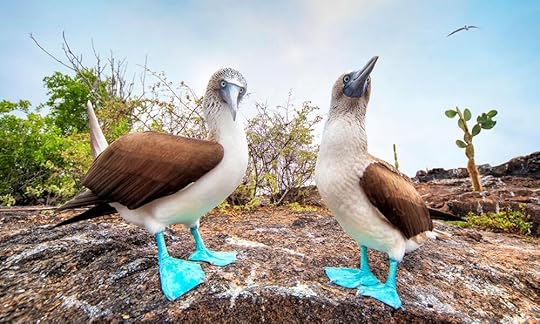
This was a library read, picked up only because of my fondness for boobies… of the avian kind. Here are two beautiful boobies for you!
Pic courtesy: World Wildlife Fund.
Fun fact: The bright blue of the blue-footed booby's feet comes from its diet of fresh fish. The brighter the blue, the healthier the bird.
BOOOOOBS! We've all got them! No, we don't, as Boobies carefully explains - only mammals have boobies. Boobies gives us a many more informative facts about mammary glands, and is in no way sexual. What it is, is funny and wonderfully illustrated.
The are two kinds of boobies: the bird and those that mammals have. Vo's wonderfully cheeky celebration of boobies of all kinds is an absolute delight!
I liked this. The tone is „mammals have boobs, let’s talk about them“ – and sex or gender don’t play into it, because we all have boobs. They only look different, and this picture book celebrates them all, even how they look in humans after mastectomy, the surgical removal of tissue. Different forms, skin tones, hair growth.
We learn that this is a mammal thing, so birds and fish don’t have boobies. That art has shown boobies for a long time, and how different boobies may look in different species. There are puns.
The illustrations are colourful but reduced to the necessary. Simple, but engaging. Listen, if I had a toddler in my life, I’d make sure they’d get their hands on this. I might even read the arc again before deleting it, which I almost never do.
This book is 'udderly' hilarious and I'm glad it was recommended to me by a friend to read it. I snorted from laughing several times throughout. Loved it!
I requested this, fully thinking it was about blue-footed boobies. I was delighted to find that it is, in fact, all about actual boobies! I can't use it for storytime, but it brought me much joy.
Introduce your child to the reason we have boobs. Mammals have boobs to nurse their children. Silly, informative, and covers a difficult topic smoothly.
Hoe tof!? Een boek over boobies, borsten! Een leuk prentenboek voor jong en oud. Van 5-105 jaar staat op de achterflap en dat klopt helemaal.
Tof dat Westera dit informatieve en grappige borstenboek (oorspronkelijk in het Engels door Nancy Vo geschreven) heeft vertaald. Je leert wat zoogdieren zijn, hoe je zelf amandelmelk kan maken, hoeveel tepels een varken heeft en zo veel meer. De tekeningen zijn grappig en schattig. De teksten rijmen vaak, zijn humoristisch en onderwijzend.
Borsten is een geweldige ode aan borsten, mét tepels. Free the nipple, je kan er niet vroeg genoeg mee beginnen. Want elke lichaam is oké en over geen enkel lichaamsdeel hoef je je te schamen. Zonder borsten geen leven. Dank u wel Bette Westera voor deze leuke lofzang!
This has got to be the silliest book with the most information. The illustrations are cool and the colour scheme is unique. It’s cheeky and funny and so much more.
I've never read the word "boobies" so many times in one book. I had thought this would be about the birds called blue-footed boobies, but it was about mammals and mammary glands. It is a good introduction to breasts from a scientific standpoint and shows a variety of animals that possess them.
I accessed a digital review copy of this book through Edelweiss.
The new release shelf at the library is a treasure trove always worth checking out. Not because new books are always better books but because your library is looking for your attention. The people at the helm there are constantly researching books based on literary merit, subject, and what they know about their patrons. Sometimes all of those can come together along with an explosive title and/or cover.
And sometimes it all works because I'm a big, big child.
Boobies was spine-out on the shelf, but I saw the word. I walked by it and snickered because of course it has to be about birds. It was the children's section after all. Then I went about my library business of finding books my kids might like. Then the idea crossed my mind that I should pull out the book, take a picture of it, and send it to my wife with a caption explaining that I'm a big, big child who shouldn't be able to pick out books.
And at first glance I was fine. "Heh, there's the bird. I'm so right." Then I noticed where the O's were on the bird's body. My thoughts immediately shifted to another concern of mine, and I worried that this book will be popping up at school board meetings or used against public libraries over the course of the next year.
So, naturally, I checked it out.
And read it to my kids.
Because it is a book for kids about breasts. Not just on humans. Not just absent on birds. But on all mammals and what they are used for. They exist. They're purposeful. There's something a little silly about them. But they're worth talking about instead of hiding the fact. In general, little girls will grow to develop them. Don't make them feel ashamed. In general, little boys won't have them but will more than likely notice their peers growing them (and notice many women in their lives have them). Don't make them feel weird about it or uncomfortable for noticing they exist. (Make them feel uncomfortable when they take noticing too far.) The human body shouldn't be talked about in hushed tones. The human body exists and is no big deal.
So I appreciate this book for talking to kids about breasts and making light of the subject. For any kid who previously enjoyed Everyone Poops or similar silly books about our body and functions, this book will likely also be enjoyed.
I am laughing at myself because I grabbed this book from my library's shelf, loving Blue-Footed Boobies, and wanted to see what Nancy Vo had to say! No, I didn't know until I read it that it isn't about them at all but about mammary glands and other related things. It's an enticing picture book for younger readers that will entertain, educate, and delight. Nancy Vo keeps the information clear and the child-friendly illustrations close to reality. She starts with the fun fact that Blue-Footed Boobies don't have boobies at all. They're avian, not mammalian, thus begins the explanations of where and why, and how many, all about "boobies" or none. Children wondering about their bodies and changes that will happen with growing older will have an excellent first look at them, in addition to learning about various other animals and plants, with or without boobies! I enjoyed it, but I will have to discover another book about those Blue-Footed Boobies I love!
Human anatomy explained with humor, as only Nancy Vo can!
"Everything you want to know about breasts but were afraid to ask" accurately sums this one up. Full of wit, humor, and puns galore, Vo defines what boobies are, where they may be found, describes the wide range of shapes they can be, always stressing that they are only found on mammals.
Her stencil art was made with matte acrylics and pen on paper. They dance across the pages and add punch to the humor. For example, the dalmatian's eyes pop out when she hears she has 10 teats and there are 16 little puppies running around her. I especially appreciate the 2-page spread with the wide variety of shapes of breasts; they include mastectomies and hairy male breasts.
Not everyone's cup of tea, but could be used to downplay breasts as "dirty" or "sex objects".
My husband’s cousin recommended this book to me & now I recommend it to you. A book about these great pillows of nourishment & comfort. Funnily enough my kids have never used the word boobies before, so they had no idea what to expect when we opened this book. They still call them mum mums bc that’s what we generally referred to breastfeeding as. Even though they’ve weaned since then, the term stuck. My older son asked me, “does everyone call them mum mums or just us?” Just us, lol.
Within these pages there’s a scientific explanation to how we categorize what boobies are and who has them. It goes on to explain how even though a Blue-footed booby has booby within its name, they don’t actually have boobies. They’re avian, and have no mammary glands. To which my son replied, why do they call it chicken breast then? 🤔😳💡
Mammals have mammary glands - boobies. Boobies produce milk. Different animals have different numbers of them, humans are mammals, they only have two. It's something everyone has.
I was sure this was a book about Blue Footed Boobies - it had to be, right? Well, Boobies is a celebration of Boobies - the mammal kind, not the bird. Honestly, I think kids would find this funny as well as informative. It's certainly silly, and a great launch for a discussion about breasts, with either a boy or a girl. The illustrations are accurate but not so realistic that it feels inappropriate. However, I don't think I would necessarily recommend Boobies as a purchase for a school library. I shared my copy with our health teacher who LOVES it!
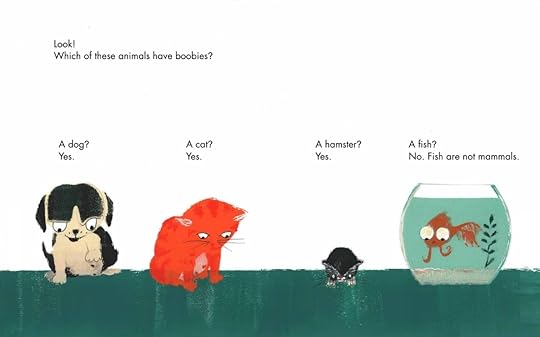
This is like "Everyone Poops," except for boobies. Which, not "everyone" has, but all mammals do. This plays with the word "boobies," featuring blue-footed boobies, as well as some of the mammals who have boobies (and talks about how different animals have different numbers of boobies). Some animals do not have boobies at all (the goldfish looks particularly depressed about this). Also talks about what boobies are for (producing milk to feed young). Amusing and clever and great for introducing little ones who are learning about boobies.
Such a cute way to talk about Boobies, Breasts, Tetons. In very simple terms with softly colored illustrations children will learn about mammals, the characteristics of different boobies, and the purpose of boobies. Children will get a chuckle and perhaps feel a bit shy when discussing this topic but I think will find the information very interesting.
Learning (for the children listening) about yourself and your (potentially awkward) bits should always be this much fun (for the adult doing the reading).
I especially appreciated the drawings of mastectomied mammaries. This would be an helpful intro for any mother explaining breast cancer survival to her child—which I’m imagining is part inspiration for the telling and the artwork…
I love Nancy Vo's picture books. I think I've just turned my two four year old granddaughters into fans as well. This one is all about boobies of course: who has them, how many they have, what they look like, and what they are for. When I asked the girls how many starts they would give this book, 1, 2, 3, 4, or 5, they responded, 100, and 100 million.
Superbe traduction de Caroline Décoste! On aborde le sujet des seins de façon légère avec une touche de science. Je pense à la jeune pré-adolescente en début de puberté que j’ai été et j’aurais probablement aimé avoir ce livre à l’époque! Ça reste court et peu profond, on fait le tour en une vingtaine de pages.
What an interesting way to share different types of boobies with young readers.
Each animal type has different ways of feeding their young, and this book goes into a bit of detail on types, how long they feed their young, and more.
I chuckled at the title but honestly it was a very fun, informative book.
What I thought was amazing was that on the final pages there are drawings of different boobies. The amazing part was that it included breast tissue scars that are left from top surgery.
A book about boobies (even though blue-footed boobies don't have boobies). Give this to kids who are fascinated by the irreverent body parts that make them giggle and make some adults uncomfortable. Pair with "Chicken Cheeks" or Michael Black's "Naked!"