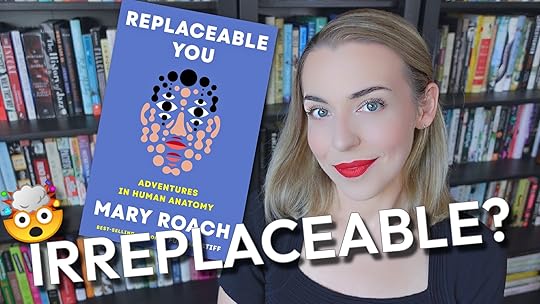
The body is the most complex machine in the world, but what happens when the parts start to fail?Meet the scientists facing the challenge… AN AMAZON AND TIME BOOK OF THE YEAR
Our bodies regenerate at a remarkable rate – our skin replaces itself every month, our blood every four. You can remove ninety per cent of a liver and it’ll still grow back to its original size (please do not try this at home).
Others – the brain, the heart, the eyes – are more complicated. These stay with us for life. So what do we do when they break down? For centuries, medicine has searched for answers – sculpting noses from brass, borrowing skin from frogs and hearts from pigs and crafting eye parts from jet canopies. And as technology has grown ever more ingenious, so have our solutions.
In Replaceable You, Mary Roach sets sail on the uncharted waters of regenerative medicine, exploring the remarkable advances and difficult questions prompted by the human body’s
When and how does a person decide they’d be better off with a prosthetic than their existing limb?
Is there a sensitive way to harvest tissue and bones from the deceased?
Which animals might be the best organ donors?
Through experiments and interviews with patients, physicians, pathologists, engineers and scientists, Roach immerses readers in the wondrous, improbable and surreal quest to build a new you.
***
'Full of engaging accounts of scientific advances in the field of the human body.' The Times
'Addictively readable... Don't miss it.' Deborah Blum, author of The Poisoner’s Handbook
'This is a book that makes you feel clever while also making you laugh.' Daily Mirror
Mary Roach is a science author who specializes in the bizarre and offbeat; with a body of work ranging from deep-dives on the history of human cadavers to the science of the human anatomy during warfare.
Mary Roach is the author of the New York Times bestsellers STIFF: The Curious Lives of Human Cadavers; GULP: Adventures on the Alimentary Canal, PACKING FOR MARS: The Curious Science of Life in the Void; BONK: The Curious Coupling of Science and Sex; and GRUNT: The Curious Science of Humans at War.
Mary has written for National Geographic, Wired, Discover, New Scientist, the Journal of Clinical Anatomy, and Outside, among others. She serves as a member of the Mars Institute's Advisory Board and the Usage Panel of American Heritage Dictionary. Her 2009 TED talk made the organization's 2011 Twenty Most-Watched To Date list. She was the guest editor of the 2011 Best American Science and Nature Writing, a finalist for the 2014 Royal Society Winton Prize, and a winner of the American Engineering Societies' Engineering Journalism Award, in a category for which, let's be honest, she was the sole entrant.
The human body is an incredibly complex machine, and efforts to emulate it enough to replace parts of it are at the very least difficult, if not impossible. This is classic Mary Roach with a bit more complicated science.
Click here to hear more of my thoughts on this book over on my Booktube channel, abookolive!
In my opinion, this is a slightly less entertaining book by Mary Roach. She still glories in the oddities of her chosen subject, but there seem to be fewer occasions for it. I was pleased to learn that Roach has a friend, Steph, who seems to be willing to drop everything and fly to Tbilisi to attempt to interview a surgeon who has used a cancer patient's finger to replace his penis. Steph makes smart-alec comments just like Mary. Everyone needs a friend like this.
Roach is so much more adventurous than I. I find myself wishing that I had her chutzpah. She interviews surgeons, witnesses their procedures, learns about entubation with an anesthesiologist, gets in an iron lung to experience what a polio victim did, treks to Mongolia with an ophthalmic team, and visits a practitioner in Mexico who does butt lifts, among other activities.
Having finished the book, I must confess that I am confirmed in my aversion to ever undergoing another surgery. I am profoundly thankful for the procedures I have benefited from, but I will have to do some serious forgetting before willingly having a joint replacement, despite my gimpy knee. If I never go under anesthetic again, it will be too soon. I discovered that I am more squeamish than I believed about surgery. I've undergone cataract surgery and bless it, but reading about it was difficult. The description of cosmetic surgery, including breast implants, was distressing for two reasons: the blatant disregard for women's health and comfort; and the also blatant assumptions of the male surgeons deciding what is attractive and/or necessary for their female patients. Roach spent time with a surgeon who performs transgender surgeries and who seemed to belong to a minority of doctors who actually asked the client what they wanted and then believed them. For example, when a trans woman tells you that she won't be needing a functional vagina, there's no reason to spend time and resources to create one.
The footnotes along the way are worth the price of admission. Roach is a magpie with an eye for a shiny fact and she remembers very obscure details. I can't imagine how she spends her spare time, but I like to imagine that she reads esoteric journals and rare books. I also am heartened by the number of researchers and physicians who are willing to take time out of their schedules to answer questions, discuss theories, lead tours, and speculate about the future. Their bravery to share their expertise is inspiring.
I maintain my stance that I would love to have coffee with Ms. Roach. I know this is an impossible wish, but boy would it be fun.
Roach turns her always curious eye to replaceable body parts. From prosthetic limbs to 3D printed organs, this engrossing subject matter is made even more fascinating by Mary's enthusiasm and wit. The skin grafting chapter made me a little queasy, so perhaps chose a different book for your lunchtime read.
Many thanks to W.W. Norton and NetGalley for sharing.
I have a strong feeling that this book was more fun to write than it was to read. Cudos to author, the adventures she took must have been amazing to experience but for me as a reader it felt like watching endless pictures from someone elses vacations.
I've read majority of Mary Roaches previous books and always found them very refreshing - author's curiosity is endless if somewhat middle-grade and I've always enjoyed her deep dives into obscure research or shadowy corners of the internet. However, Replacable You is mainly focusing on interviews author had with scientist, doctors and activists and I found them to be pretty weak - the pop science in this book is barely there and instead we are getting a lot of pointless details about what author ate during the discussion, what she saw or how she percived the person she was interviewing. On more than one occasion I found her pretty insensitive/expoitative too - like when she spent the night in an Iron Lung that was belonging to the deceased woman and felt compelled to describe the grief of her spouse. Other than that it was a pretty ok, quick read that briefly touches upon such topics as ostoma bags, amputations, gender changing operations, hair transplants, BBL, xenotrasplantation, cataract operations, skin trasplants and couple more.
✨ ARC Review! ✨ Special thanks to friends over at W. W. Norton & Company for sending me an early copy of Roach’s “Replaceable You” not only to gush over, but to prepare for my interview tomorrow with Mary Roach herself! (If you’re curious yes of course I’m screaming because of it)…
It’s no surprise that this is incredible. You can tell Roach had a fantastic time researching and writing this book. I learned so much, as I always do. The evolution of body modification is one I knew little to nothing about; from hair transplants, to prosthetic limbs, tissue donations, and cataract surgery, Roach with her classic whit and morbid curiosity (I had to) provides another classic with anecdotal stories and in-the-lab updates that sometimes, in the name of science, she experienced for herself.
This is releasing September 19th. Preorder it today, go support her. This was great.
I adore Mary Roach--I will learn whatever she's trying to teach us. This time, it's how doctors and scientists use artificial body parts to replace when their original counterparts malfunction or are irreparably injured. Yes, this is technically a medicine/science book, but, as with all of Roach's work, you could shelve it in the humor section as well. I learned, among other things, that the doctor she was looking to contact in one chapter was the man she lost her virginity to in college and that Mitch McConnell's facial structure may make it harder for him to be intubated.
If you want to learn a new subject but don't want to pick up a dense, textbook-like tome, Mary Roach's books may be for you.
Interesting as always, but didn't quite hit the way some of her past books did. I found her irreverent style started to grate a little bit here, and I suspect that is largely because my tastes have evolved since I first started reading her books. Relatively light, and an intriguing subject, but I think I may have slightly gone off pop science NF.
Replaceable You: Adventures in Human Anatomy – A Masterclass in Scientific Curiosity with Heart Rating: 4.8/5
Mary Roach’s Replaceable You is a triumph of science writing that marries razor-sharp inquiry with disarming humor, taking readers on a wild ride through the frontiers of human body engineering. As someone who devours popular science but often struggles with clinical detachment, I found Roach’s blend of empathy and wit utterly captivating—like having a brilliant, slightly mischievous tour guide through the uncanny valley of medical innovation.
Why This Book Shines Roach’s genius lies in humanizing the surreal. Whether observing cataract surgeries in Mongolia or chatting with ostomates about designer stomas, she elevates technical marvels into deeply personal stories. The chapter on prosthetic limbs—exploring the emotional calculus of choosing augmentation over biological limbs—left me awestruck by both the technology and the resilience of those who use it. Her visits to stem cell labs and xenotransplantation facilities (like China’s “superclean pigsty”) balance wonder with ethical nuance, never reducing subjects to mere curiosities.
Emotional Resonance & Intellectual Thrills This book made me laugh out loud (her description of 1950s iron lung users hosting dinner parties is classic Roach) and pause in reverence (the tissue donor dissection scene is hauntingly beautiful). I appreciated how she normalizes “taboo” topics—vaginal reconstruction using intestinal tissue, for instance—with matter-of-fact compassion. The section on 3D-printed organs sparked equal parts hope and existential dread: Are we solving scarcity or playing God? Roach doesn’t preach answers but lets the questions linger provocatively.
Constructive Criticism While Roach’s irreverence is usually a strength, a few jokey asides during sensitive topics (e.g., donor families’ grief) risked tonal whiplash. The book also leans heavily on U.S. and East Asian case studies; voices from African or South American innovators could have enriched its global perspective. A deeper dive into cost/access barriers of these technologies would’ve added socioeconomic depth.
Final Verdict Replaceable You is Roach at her best—curious, compassionate, and endlessly entertaining. It’s not just about the science of replacement parts but what it means to be irreplaceably human in a world of medical miracles.
Thank you to Edelweiss and W. W. Norton for the gifted copy. This book left me marveling at my own body’s fragility and the audacity of those striving to rebuild it.
Pair with: A strong stomach and a sense of humor—you’ll need both when reading about pig-heart transplants over lunch.
For fans of: Stiff (Roach’s own classic), The Emperor of All Maladies by Siddhartha Mukherjee, and Being Mortal by Atul Gawande.
Thank you to W. W. Norton & Company for providing this ARC for review consideration via NetGalley. All opinions are my own.
Replaceable You is a nonfiction pop-science exploration into the science and culture of body part replacement. From iron lungs to butt implants, Mary Roach lifts the curtain on the most mundane and most scientifically advanced replacement parts medicine has to offer.
Roach approaches the topic or new (or new-to-you) body parts with her signature candor and curiosity. She interjects a layman’s level of grounding to the topics she explores while still being careful to explain the science and research accurately. This is Roach in classic form. If you’ve ever picked up one of her titles before, you’ll find yourself pleasantly fulfilled. The tone is familiar, but she chooses topics that are snappy, interesting, and easily conveyed. In the grand scheme of her works it isn’t my favorite, (the honor, or course, goes to Stiff), but it’s a very good option.
My favorite chapter of this book concerns the one where she witnesses an organ donation in progress. Her account was humanizing across the board; a company concerned with accuracy and dignity, the donor, the slightly concerned family, and the technicians who are both respectful and light through the process. Organ donation can be mired in controversy, and often, as the author states, only gets press for horror stories. It was refreshing to hear about a mundane occasion in which things go right.
One of my favorite things that Roach does in her structuring of the book is find ways to build connections from one topic to another. Rather than chapters standing alone, each a miniature story, they are often linked by through ideas or they build upon each other. I was particularly pleased by the way the chapter about colons being repurposed into neophalluses flower into the trip to see the finger-penis. What a delightful way to show how these medical advances (or experiments) seem to spiral out from one another into new areas of study.
I would say that what I didn’t always find to be on par with the rest of the book is that at times there’s an off putting air from the author. While this is less evident in chapters where she interacts with physicians and researchers, there’s a slightly paternalistic or at least ignorant element to some of her questions or observations when confronted with device users. While she’s never overt and may just be admitting misconceptions through honest recollection, at times it feels uncomfortable to read her bumble through interactions with amputees and bereaved caregivers.
If you like pop science books and are interested in beginning to explore the science of medical devices and implants, this is a great primer on the topic. Like wakes, for Mary Roach fans, you’ll also find her writing to be in fine form. 4.25/5!
Mary R: why aren’t people in China forced to donate their body parts? After all, it is China (literally said this lol) Answer she got: because of religious practices. It’s up to an individual person to choose to donate their body parts. Mary R: I still think they should be forced to do so.
Note: Mary Roach lives in USA where one CHOOSES to donate their body and guess what, Mary isn’t donating hers! lol but she likes the idea of it, but hasn’t decided on it. But hey, other countries should definitely force their citizens to do so, just not her :) (this is based on what she said from previous interviews and her last book called stiff)
Also, the whole book reads like a stack of pamphlets. You’re better off just googling random topics and you’ll get better answers without the cringe level jokes :)
Mary R: I’m often asked if I’m a doctor because of how much medical language I know & they’re so surprised to learn that I am not! Also Mary R: I thought an anesthesiologist was like a medical guard :)
‘Replaceable You: Adventures in Human Anatomy’ by Mary Roach is a delight! If you have read a science book by Roach before and loved it, I can assure you this is another very cool lovable read! She mixes in many deeply researched science subjects, in this case, how scientists are looking for materials the body won’t reject to fix cloudy eye lenses, male-pattern baldness, misbehaving intestines, missing limbs, and many other body-parts issues, never flinching from the sometimes gruesome aspects only medical staff see, with humorous asides which often are completely inappropriate 😂. Some of the work is seriously important to keep people alive, while others might seem to be frivolous in comparison. Nonetheless, serious scientists are working hard on experiments with materials which the body will hopefully accept or on surgical techniques that fix a body problem, whether it is about saving the sight of someone going blind or if it is about women with perfectly good buttocks but they want butts instead that look exactly like Kim Kardashian’s.
I have included the book blurb:
Goodreads Choice AwardNominee for Readers' Favorite Nonfiction (2025)
From the New York Times best-selling author of Stiff and Fuzz, a rollicking exploration of the quest to re-create the impossible complexities of human anatomy.
The body is the most complex machine in the world, and the only one for which you cannot get a replacement part from the manufacturer. For centuries, medicine has reached for what’s available—sculpting noses from brass, borrowing skin from frogs and hearts from pigs, crafting eye parts from jet canopies and breasts from petroleum by-products. Today we’re attempting to grow body parts from scratch using stem cells and 3D printers. How are we doing? Are we there yet?
In Replaceable You, Mary Roach explores the remarkable advances and difficult questions prompted by the human body’s failings. When and how does a person decide they’d be better off with a prosthetic than their existing limb? Can a donated heart be made to beat forever? Can an intestine provide a workable substitute for a vagina?
Roach dives in with her characteristic verve and infectious wit. Her travels take her to the OR at a legendary burn unit in Boston, a “superclean” xeno-pigsty in China, and a stem cell “hair nursery” in the San Diego tech hub. She talks with researchers and surgeons, amputees and ostomates, printers of kidneys and designers of wearable organs. She spends time in a working iron lung from the 1950s, stays up all night with recovery techs as they disassemble and reassemble a tissue donor, and travels across Mongolia with the cataract surgeons of Orbis International.
Irrepressible and accessible, Replaceable You immerses readers in the wondrous, improbable, and surreal quest to build a new you.”
No story Roach tells in the book is dull. All of it is fascinating. Plus she asks the questions all of us would ask if we were as fearless as she, no matter how intrusive or shameless.
The chapters are:
-To Build a Nose: The Dawn of Replacement Body Parts -Gimme Some Skin: Replacing the Human Exterior -Mixed Meats: Humans with Pig Organs, and Pigs with Human Organs -Heart in a Box: Creating Ultra-Long Life Organs -The Vagina Dialogue: Repurposing Your Parts -Giving the Finger: Some Transplants are Tougher Than Others -The Cut-Off Point: Longing for a Prosthetic Leg -Joint Ventures: Woodworking without Wood -Intubation for Dummies: The Brief Terrors of Mechanical Breathing -Heavy Breathing: Inside the Iron Lung -The Mongolian Eyeball: With Cataract Surgery, Sometimes Simpler is Better -The Last Six Inches: Battling the Stigma of Ostomy -Out of Ink: How to Print a Human -Shaft: Hair Transplants Through the Ages -Splitting Hairs: Grow Yourself from Scratch! -The Ass Men: Chasing Perfection with Math and Fat -Some of the Parts: A Day in the Life of a Tissue Donor
The above titles only describe the main subject of the chapter, but there are additional related informational bits and pieces Roach throws in. The history behind each modern development is just as fascinating as what is being done today, sometimes even more so.
Sadly, there is an Epilogue chapter which describes the collapse of the non-profit and for-profit providers of medical care and of the institutions of medical research she profiled in the book because of the Trump Administration’s stoppage of ongoing financial support and grants. Some had contracts with the Federal Government, and they are wondering about what legal options they have to enforce their contracts.
This was so fun to read. I took my time with this one. Mary has been successful in communicating the intricacies of the biomedical processes without sounding a bore. I,truly, hope medical sciences advance further in the coming years and these scientists are successful in their endeavours.
The best thing about this book is how cleverly the author connected the previous chapter to the next one. It made the reading experience flawless and the information is easily retainable.
Replaceable You is the latest nonfiction by Mary Roach. Organized by body parts, it is a mix of the latest medical process and history. I enjoyed this book very much. Mary Roach writes such funny non-fiction books. If you wonder how your body parts, as big as legs and hearts, as small as hair or tears, even just a group of cells, can be replaced to save your life or improve your health, this is the book for you. I am in awe of the latest medical advancement in genetics and surgery, but disappointed that viable organ printing still has a very long way to go.
This book takes you on a journey across a wide spectrum of body‐part replacements. From traditional prosthetics to modern breakthroughs like 3D-printed organs and lab-grown tissues
As is Roach’s signature style, she mixes science reporting, personal stories, travel, and reflections in a way that makes complex concepts readable.
Roach also relies heavily on copious footnotes to add additional quirky facts which does not always make for the smoothest reading experience. My reading tastes these days lean more towards the writings of, for example Sam Kean where offbeat stories are incorporated into the actual narrative.
God, I love Mary Roach. I can’t think of a single writer I’d rather spend a day with. As always, I laughed, I learned stuff, I got grossed out, and I thoroughly enjoyed the footnotes.
I don’t know if I’ve changed or her writing has become a little more cynical, but I used to be a huge fan and for me this last book felt a little bit flat. I found the flippancy about the organs and the xenotransplantation just a bit too much for me.
Thought I would love this one as a scientist but I really wasn’t a fan, some chapters were completely boring imo! The author’s tone kind of just fails to spark interest :/
I did very much appreciate the author shining light on all of the cuts to scientific funding our pos government has been making <3
I have been a fan of Mary Roach for longer than I care to admit. After all, never ask a man his salary or a woman how many books she’s been around to see an author publish. A podcast I like talks about books that give you a case of didjaknowitis. This is what happens when you are reading a book and you cannot stop saying to people, “hey did YOU know?” And you can tell this is a primo quality Mary Roach experience because oh boy did I have didjaknowitis real bad. I was texting my friends, I was chasing my boyfriend around the apartment.
If you have already spent time on the Mary Roach train you know exactly what you’re in for, and if you liked your time there, buckle up. If not, you know what you like and this is probably not for you. It’s not a marked departure from her past work.
If you haven’t yet spent time on the Mary Roach train, allow me to introduce you to Mary Roach, a woman who is just like us, but who has the...gumption? Attitude? Chutzpah? To take her curiosity where the rest of us only dream of. She goes to the cutting edge of science, and then follows the scientists around, badgering them with the questions we only dream of asking. Or offering herself up as a human guinea pig. Anyway, this is not some popular science book written by someone on the sidelines. Mary Roach is in it to win it. Her down to try anything once, can do attitude is why her books are so good. You can start here or anywhere if you think that sounds interesting.
Recommended for people who are still subscribed to National Geographic in their hearts, fans of the podcast Sawbones, and anyone who likes dropping unhinged facts at a cocktail party. I received an arc in exchange for this honest review.
Parts of this were super interesting and other parts dragged on a little for me.
I didn't enjoy it as much as 'Stiff', but maybe that is because it wasn't quite as shocking?! Or possibly I just found the content a little less intriguing.
I will forever find the body to be quite the marvel.
I recently picked up this book, looking for a bit of a break from more serious readings. After reading her previous works, I have become accustomed to her explorations of human anatomy, and I really did enjoy the bizarre medical history she presents here. The book explores the history and future of regenerative medicine, covering everything from the early days of "sculpting noses from brass" to modern xeno-pigsties in China. Roach posits that the human body is "the most complex machine in the world, and the only one for which you cannot get a replacement part from the manufacturer." She has a talent for making clinical subjects approachable with bizarre musings and witty remarks that make her journalistic style enjoyable. I think I have become a bit too cynical though, because I couldn't help but think about the lack of systemic or critical lens that she has for the topic at hand.
What really surprised me was how easily the book detaches medical advancement from the economic base that funds it. Roach travels to a stem cell "hair nursery" in San Diego and a high-tech burn unit in Boston, framing these places as triumphs of human ingenuity. However, she fails to examine who actually has access to these replacement parts. When science treats the human body as a machine needing manufactured parts, those parts become commodities traded in capitalist markets. The reality is that the wealthy elite will have access to bespoke 3D-printed kidneys and "hearts from pigs," while the global working class will continue to sell their actual biological organs to survive. Roach treats regenerative medicine as a universal human triumph rather than an emerging luxury market for the capitalist class. On the bright side, she does critiques the cultural stigmas that hinder medical research. But, even then, I find that Roach is too invested in the novelty of science to see the structural problems behind it. In a chapter talking about the work of Orbis International performing cataract surgeries in rural Mongolia, she really missed out on an easy opportunity to comment on this issue. While restoring sight is objectively beneficial, the framing relies on a dynamic where Western medical charity is positioned as the solution to global health inequalities. It ignores the imperialist wealth extraction that keeps such regions impoverished and reliant on foreign medical aid in the first place. If we have the technology to grow organs from stem cells, but millions die because they cannot afford basic healthcare, the problem is not a lack of scientific advancement. The problem is the artificial scarcity imposed by the state and the private medical industry.
To be fair, one should not expect every single book to have a materialist critical lens or a systematic view. A book can just be a nice package of humor and interesting facts right? Well it can be, for sure, but then forgive me for pointing out that its lackluster in this regard too. The stories within are not as captivating as the ones in Stiff, not as funny as the ones in Bonk and not as informative as the ones in Gulp. So I enjoyed this one the least. Is this because it is worse off than her previous stuff or because I have become more critical? Not so sure. But, I really hope that she shifts her future work towards a better direction.
Witty Mary takes us on another tour of the human body. This time we’re looking at things that can be removed, replaced, or added from/to you. We start strong, with xenotransplants, but also dive into hair transplants and body modifications for esthetical reasons; we address the stigma of colostomy and the taken-for-granted cataract surgery. It’s an amazing reading, funny and yet informative as usual.