

What do you think?

Femmephilia: Love Letters to Trans Mermaids, Queer Mothers, and Marilyn Monroe
From the author of Enemy Feminisms and Abolish the Family, an original diagnosis of femmephobia in our culture, and a vision of a life-giving femme feminism for all.
To be femme is to embody a dispossessed femininity, to be freighted with freedom, to refuse to be made proper or institutionalized. To love it is to embrace love for women (be they butch or not) in the broadest sense. In Femmephilia, Sophie Lewis makes the case for the vital importance of politicized femme-ness: a feminism that is self-consciously artificial, extravagant in its erotic and political appetites, and staunchly anti-work, abolitionist, and utopian. Femme labors deserve our care, respect, and support, but instead face dismissal from masculinist antagonists and feminist allies alike.
Where neoliberal women’s empowerment has failed to combat the eruption of right-wing, anti-trans, and anti-feminist attacks, Lewis argues that femmephilia can help us imagine a radical future. In essays on the high femme genius of Marilyn Monroe and trans yearning in the myth of Apollo and Daphne; on octopuses and girlbosses, reluctant heterosexuals, lesbian separatists, and anti-work cats; and on a mother on strike from maternity, Femmephilia offers a new logic of liberation for all feminized people.
To be femme is to embody a dispossessed femininity, to be freighted with freedom, to refuse to be made proper or institutionalized. To love it is to embrace love for women (be they butch or not) in the broadest sense. In Femmephilia, Sophie Lewis makes the case for the vital importance of politicized femme-ness: a feminism that is self-consciously artificial, extravagant in its erotic and political appetites, and staunchly anti-work, abolitionist, and utopian. Femme labors deserve our care, respect, and support, but instead face dismissal from masculinist antagonists and feminist allies alike.
Where neoliberal women’s empowerment has failed to combat the eruption of right-wing, anti-trans, and anti-feminist attacks, Lewis argues that femmephilia can help us imagine a radical future. In essays on the high femme genius of Marilyn Monroe and trans yearning in the myth of Apollo and Daphne; on octopuses and girlbosses, reluctant heterosexuals, lesbian separatists, and anti-work cats; and on a mother on strike from maternity, Femmephilia offers a new logic of liberation for all feminized people.
346 pages, Paperback
Published June 16, 2026
About the author
Sophie Lewis
11 books131 followersSophie Lewis is a freelance writer living in Philadelphia, teaching courses for the Brooklyn Institute for Social Research. Her first book was Full Surrogacy Now: Feminism Against Family, and her essays have appeared in the New York Times, Harper’s, Boston Review, n+1, the London Review of Books and Salvage. Sophie studied English, Politics, Environment and Geography at Oxford, the New School, and Manchester University, and is now an unpaid visiting scholar at the Feminist, Queer and Transgender Studies Center at the University of Pennsylvania.
Ratings & Reviews
Friends & Following
Create a free account to discover what your friends think of this book!
Community Reviews
Displaying 1 - 30 of 35 reviews

July 27, 2026
"When certain feminists first turned against girly things, it was a giant error in Western women’s liberation history." So goes the opening line of Femmephilia--a rather eclectic mix of essays on femininity, play, eroticism, Marilyn Monroe, mermaids, mothering, polymaternalism, and macho feminism. While I agree with the premise that denigrating expressions of femininity essentially devolves into girlboss/white feminism and merely reinforces hegemonic structures with the admission of select women under a system of exceptionalism, I do find this book quite a mess of rabbit trails and unfocused ideas. Marilyn Monroe, for example, is of such great importance to Lewis as to be listed in the subtitle but the analysis is thin. To establish a trend and historical context, I just needed more to embellish her point. I don't disagree with her conclusions, but I was looking for a bigger picture claim or something of greater substance. The Monroe section read like an academic's justification of how she used her time during the pandemic. Mermaids as well felt like an aside rather than a fully developed analysis. I do think positive assertions (the benefit of embracing femininity) are generally harder to analyze and argue in gender theory (particularly given that masculinity and femininity are really stereotypes when you come down to it) as opposed to an assessment of the damaging effects of hegemonic systems like patriarchy, so it's understandable that finding her feet may be difficult. I appreciate the amount of theorists I was introduced to in the text. It's a great jumping off point for further reading. The text itself, however, I found fairly unsatisfying as a self-contained championing of the femme.
Many concepts (full surrogacy, for example) were mentioned as asides that link to Lewis' other books (this is my first book by her so I found it a bit jarring). Throwaway statements that lack definition within the text seemed to be most prevalent within some of the most substantive sections, however, which was quite disappointing. A convention of academic writing is to be highly referential and this seemed to be her tactic in making many of her key points but I did not feel it translated well for a general readership. It points to other texts to read on subjects that interest me but, again, I don't feel the points were well made within the containment of the text itself. One throwaway comment was on non-monogamy being implied as essential to liberation. This is something that gets pressured in queer circles and especially on trans women that feels coercive and gross to me. How is non-monogamy inherently liberatory under capitalism? I assume this is something she writes about in greater detail in her book on Abolishing the Family but as someone who has been in several non-monogamous relationships and eventually decided that they aren't suited for me (and particularly the guilt-tripping and moralism of poly evangelists), this framing of non-monogamy as an essential political stance is disturbing to me. Having a monogamous relationship is as valid a choice as having a non-monogamous one and they are equally prone to patterns and systems of instrumentalization and exploitation.
Anyhow, my favorite takeaways in the text:
* “Feminists who exceptionalize prostitution in their anticommodification worldviews, however—for instance, 'sex should never be for sale,' an idealism oddly impervious to the fact that it practically never hasn’t been—may think they are defending “natural” female dignity, but they are merely shoring up anti-femme morality, that is, the wife—whore hierarchy.”
* The contextual information on Dworkin was very interesting. While I disagree with Dworkin on many of her conclusions in Pornography, I do find her writing and analysis often very strong (especially in Right Wing Women). I do feel that Lewis doesn't give Dworkin quite enough credit, though she does seem to position herself as a rival on opposite sides of the feminist sex wars. Even Bell Hooks cites Dworkin in her assessment of how patriarchy harms men in Hooks' exceptional and life-affirming text for men The Will to Change. While it's entirely fair to call Dworkin a misandrist, Hooks was very clearly very invested in lifting up and supporting men in deconstructing patriarchy. That said, Lewis does make an apt point that misandry inevitably devolves into transphobia and should be treated as a dog whistle. I also think it's important to treat Dworkin within her historical context. She was writing from a standpoint under which sex work was often the only mode of employment available to women and, in fact, was the only mode of survival she herself had available for a time (according to her at least. I'm no Dworkin historian so I'm taking her word for it). That life experience is likely to skew your perspective but that does not mean that perspective is without value (it just needs to balanced with other opposing viewpoints in my opinion). Regardless, it is quite eye opening to learn about Dworkin's endorsement of kinky sex with her husband in her first published work before moving onto her very misandrist-heavy writings later in life. Also interesting the separatist, feminist colony notion that Dworkin apparently writes about in her later work. It gives helpful context to Dworkin's human failings and was interesting to read about. I also agree with her and noted in my own review of Pornography that Dworkin appears to be an unwitting progenitor of Pornography Studies as a serious discipline. It would have been interesting for her to engage more substantially with Dworkin's ideas but I understand that it wouldn't fit neatly with the book's thesis to do so.
* "Under capitalism, as Alva Gotby notes, 'families are work relations.' They trap feminized people in isolated unwaged workplaces and function predominantly to generate present and future workers for capital to wring value from."
* “this kin-making outside the bounds of biogenetic and procreative registers—that we make 'kin, not babies.' But it is less often remarked upon, certainly among straight people, that people often make babies who, in fact, never become kin. Haraway knows this, and, to her credit, lays constant stress on what one might call the need to make kin of babies—to make xenofam, as it were, out of one’s already-existing biofam.”
* The octopus and the erotic was interesting to read about.
* I enjoyed the vampire section though I am a Torrey Peters fangirl so any analysis of her work is an easy sell for me.
Many concepts (full surrogacy, for example) were mentioned as asides that link to Lewis' other books (this is my first book by her so I found it a bit jarring). Throwaway statements that lack definition within the text seemed to be most prevalent within some of the most substantive sections, however, which was quite disappointing. A convention of academic writing is to be highly referential and this seemed to be her tactic in making many of her key points but I did not feel it translated well for a general readership. It points to other texts to read on subjects that interest me but, again, I don't feel the points were well made within the containment of the text itself. One throwaway comment was on non-monogamy being implied as essential to liberation. This is something that gets pressured in queer circles and especially on trans women that feels coercive and gross to me. How is non-monogamy inherently liberatory under capitalism? I assume this is something she writes about in greater detail in her book on Abolishing the Family but as someone who has been in several non-monogamous relationships and eventually decided that they aren't suited for me (and particularly the guilt-tripping and moralism of poly evangelists), this framing of non-monogamy as an essential political stance is disturbing to me. Having a monogamous relationship is as valid a choice as having a non-monogamous one and they are equally prone to patterns and systems of instrumentalization and exploitation.
Anyhow, my favorite takeaways in the text:
* “Feminists who exceptionalize prostitution in their anticommodification worldviews, however—for instance, 'sex should never be for sale,' an idealism oddly impervious to the fact that it practically never hasn’t been—may think they are defending “natural” female dignity, but they are merely shoring up anti-femme morality, that is, the wife—whore hierarchy.”
* The contextual information on Dworkin was very interesting. While I disagree with Dworkin on many of her conclusions in Pornography, I do find her writing and analysis often very strong (especially in Right Wing Women). I do feel that Lewis doesn't give Dworkin quite enough credit, though she does seem to position herself as a rival on opposite sides of the feminist sex wars. Even Bell Hooks cites Dworkin in her assessment of how patriarchy harms men in Hooks' exceptional and life-affirming text for men The Will to Change. While it's entirely fair to call Dworkin a misandrist, Hooks was very clearly very invested in lifting up and supporting men in deconstructing patriarchy. That said, Lewis does make an apt point that misandry inevitably devolves into transphobia and should be treated as a dog whistle. I also think it's important to treat Dworkin within her historical context. She was writing from a standpoint under which sex work was often the only mode of employment available to women and, in fact, was the only mode of survival she herself had available for a time (according to her at least. I'm no Dworkin historian so I'm taking her word for it). That life experience is likely to skew your perspective but that does not mean that perspective is without value (it just needs to balanced with other opposing viewpoints in my opinion). Regardless, it is quite eye opening to learn about Dworkin's endorsement of kinky sex with her husband in her first published work before moving onto her very misandrist-heavy writings later in life. Also interesting the separatist, feminist colony notion that Dworkin apparently writes about in her later work. It gives helpful context to Dworkin's human failings and was interesting to read about. I also agree with her and noted in my own review of Pornography that Dworkin appears to be an unwitting progenitor of Pornography Studies as a serious discipline. It would have been interesting for her to engage more substantially with Dworkin's ideas but I understand that it wouldn't fit neatly with the book's thesis to do so.
* "Under capitalism, as Alva Gotby notes, 'families are work relations.' They trap feminized people in isolated unwaged workplaces and function predominantly to generate present and future workers for capital to wring value from."
* “this kin-making outside the bounds of biogenetic and procreative registers—that we make 'kin, not babies.' But it is less often remarked upon, certainly among straight people, that people often make babies who, in fact, never become kin. Haraway knows this, and, to her credit, lays constant stress on what one might call the need to make kin of babies—to make xenofam, as it were, out of one’s already-existing biofam.”
* The octopus and the erotic was interesting to read about.
* I enjoyed the vampire section though I am a Torrey Peters fangirl so any analysis of her work is an easy sell for me.

February 17, 2026
4.5 stars.
What a refreshing take on feminism! This is the first non-fiction book I’ve read this year and I had a great time reading it.
As a femme lesbian who does everything I can to tear down the patriarchal beliefs instilled in me some birth, I have found myself growing particularly tired of the modern feminism that has seeped into all of our lives in recent years. While we have come a long way, things have felt quite regressive over the last couple of years and I find people’s “feminist” takes are often not feminist at all.
While reading this book, I found myself nodding in agreement with most of what Lewis wrote and smiling at some of the witty prose used. As a femme lesbian I deeply appreciated how queer-focused this book was and how Lewis’s queer identity has formed their views of not only those who are similar to them but also of those who are different, and how they champion and find community with those people. This is something I can relate to. I also appreciated how, despite not being one themselves, Lewis displayed a deep appreciation of lesbians and lesbian feminist icons, while both celebrating and critiquing their writing in equal measure. As a lesbian myself, I feel the criticism was justified, as was the celebration.
I feel this book is something that every feminist should read regardless of their sexual orientation or gender identity. It doesn’t fall into TERFy narratives, it actually actively criticises the movement which was so refreshing to read, and tears apart modern feminism in such a brilliant way, giving us some of the bricks to rebuild it bit by bit.
I appreciated the modern examples of “feminist” remakes of Disney films, both celebrating their strengths while also criticising how they missed the mark, especially considering that a lot of these films were made by mostly men. The discussion around family and mothering was interesting and, while I don’t necessarily agree with all of it, I appreciated Lewis’s views on these matters and those of the people they cited in the book.
Overall, this book is an imperative read for anyone who calls themselves a feminist, and I know that it will invite you to reflect upon your own views and what it means to be femme, and why this is integral to society and should be celebrated instead of erased.
Thank you to NetGalley and the publisher for proving me with a free copy in exchange for an honest and voluntarily given review.
What a refreshing take on feminism! This is the first non-fiction book I’ve read this year and I had a great time reading it.
As a femme lesbian who does everything I can to tear down the patriarchal beliefs instilled in me some birth, I have found myself growing particularly tired of the modern feminism that has seeped into all of our lives in recent years. While we have come a long way, things have felt quite regressive over the last couple of years and I find people’s “feminist” takes are often not feminist at all.
While reading this book, I found myself nodding in agreement with most of what Lewis wrote and smiling at some of the witty prose used. As a femme lesbian I deeply appreciated how queer-focused this book was and how Lewis’s queer identity has formed their views of not only those who are similar to them but also of those who are different, and how they champion and find community with those people. This is something I can relate to. I also appreciated how, despite not being one themselves, Lewis displayed a deep appreciation of lesbians and lesbian feminist icons, while both celebrating and critiquing their writing in equal measure. As a lesbian myself, I feel the criticism was justified, as was the celebration.
I feel this book is something that every feminist should read regardless of their sexual orientation or gender identity. It doesn’t fall into TERFy narratives, it actually actively criticises the movement which was so refreshing to read, and tears apart modern feminism in such a brilliant way, giving us some of the bricks to rebuild it bit by bit.
I appreciated the modern examples of “feminist” remakes of Disney films, both celebrating their strengths while also criticising how they missed the mark, especially considering that a lot of these films were made by mostly men. The discussion around family and mothering was interesting and, while I don’t necessarily agree with all of it, I appreciated Lewis’s views on these matters and those of the people they cited in the book.
Overall, this book is an imperative read for anyone who calls themselves a feminist, and I know that it will invite you to reflect upon your own views and what it means to be femme, and why this is integral to society and should be celebrated instead of erased.
Thank you to NetGalley and the publisher for proving me with a free copy in exchange for an honest and voluntarily given review.

September 15, 2026
I usually write longer reviews when I get an ARC but I find it hard to talk about this collection of essays.
Some were just too complicated and if you don't know the authors she cites you will be lost in the name dropping of it all.
Some like the one on Monroe felt aimless
And some were just boring
Suffice to say I was not convinced. I was also disappointed because I don't think its focus is on the discussion of femininity.
I'm sure it's for some people. But not me.
Thank you NetGalley for providing me with an ARC of this book.
Some were just too complicated and if you don't know the authors she cites you will be lost in the name dropping of it all.
Some like the one on Monroe felt aimless
And some were just boring
Suffice to say I was not convinced. I was also disappointed because I don't think its focus is on the discussion of femininity.
I'm sure it's for some people. But not me.
Thank you NetGalley for providing me with an ARC of this book.

June 21, 2026
Sophie Lewis is genuinely just a visionary, no notes. Especially enjoyed Can the Sireniform Speak?, My Octopus Girlfriend, Consider the Lobster, and She Gave Herself Freely.

Read
August 4, 2026It was interesting enough and while I loved the look into the history of mermaids and why the can and are read as queer, the Marilyn Monroe parts were a bit too white feminist for my tastes. Good read regardless

Review of advance copy received from NetGalley
What Softness Has Been Forced to Carry
Sophie Lewis’s “Femmephilia” reads femininity not as decoration or weakness but as a charged site of labor, misrecognition, appetite, and difficult social survival
By Demetris Papadimitropoulos | April 11th, 2026
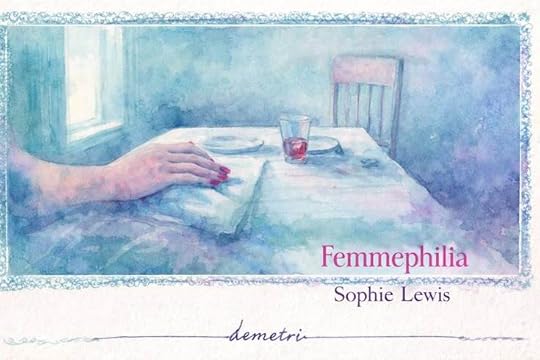
A room after the visible part is over: the hand that straightens the table in this watercolor echoes “Femmephilia’s” deepest claim that what looks like ornament, softness, or mere afterthought is often the hidden labor by which life is steadied and made livable.
“Femmephilia” opens by moving femininity out of the style section and onto the bill. Sophie Lewis’s argument is that what gets called feminine is very often labor with better styling and less pay. Once she changes the books, a good deal of modern life starts to look stingier than it likes to think. Niceness begins to resemble service with lip gloss on it. Care gets shrugged off as disposition. Glamour, in this light, is not a decorative bonus but work done under bad lighting and worse terms.
Lewis makes the case immediately in “Against Nature,” the opening essay and the book’s master key. Feminism, she argues, went wrong when it learned to treat “girly things” as contamination rather than evidence. Femininity had already been smuggled in under the sign of nature: niceness, availability, decoration, selflessness, emotional smoothing. Care. Then it was downgraded for being associated with women and feminized people in the first place. Lewis’s crucial line arrives early: if the problem is unfreedom, the task is to destroy the unfreedom, “not the eros.” That line licenses the whole book. Lewis has no interest in rescuing care, glamour, or sexual display by laundering them into something sterner and more respectable. She wants to show that the gestures most likely to be dismissed as vain, silly, indulgent, or merely private are often the ones by which a day is kept from folding – a room managed, a child soothed, a mood repaired, a meal produced, a life kept going.
The title offers trans mermaids, queer mothers, and Marilyn Monroe, which sounds like a glass-fronted cabinet of glamorous attachments. The book is less a cabinet of affinities than an audit of who gets handed the upkeep. “Femmephilia” is a 17-essay collection with no formal parts, though “Against Nature” serves as manifesto and “Consider the Lobster” as a coda bruised by family history. Between them come essays on Monroe, the “bitch,” beauty, feminist misogyny, momfluencers, cats, octopuses, vampires, and the split between mothering and motherhood. Lewis notes in “A Note on Permissions” that thirteen of the essays appeared in earlier forms. You can feel those seams. The collection has useful bagginess and a few relaunches you can feel under your hand. But it is not scattershot. It keeps putting its fingers on the same live wire: care mistaken for temperament, service misnamed as love, work appearing as instinct, charm, or good nature rather than labor.
The distinction the whole book leans on is between femininity as duty and femme as chosen display – knowingly made, not meekly inherited. Even that matters less as identity paperwork than as a way of asking a harder question. Who smooths, tends, flatters, soothes, decorates, mothers, cleans, and carries? Who makes other people easier to live with, or simply less impossible? Who turns effort into atmosphere and labor into “just how she is”? Lewis writes in the housework-and-history tradition that keeps dragging the household out of the realm of “just life” and back under the harder heading of work. What is distinctive here is that she will not rescue feminized work by washing off the glitter and calling the result politically laundered. She refuses the bargain by which care becomes legitimate only after it has gone gray.
That refusal is vivid in “She Gave Herself Freely,” one of the book’s strongest essays. Lewis begins with the Marilyn Appreciation Society, a pandemic film club, and uses that cheerful premise to show how badly even Monroe’s defenders have often read her. She is not interested in upgrading Monroe from blonde victim to blonde genius. She is interested in Monroe as worker. Self-made. Underpaid. Hungry. Overread as vacancy. The essay gathers the usual Monroe wreckage pile – foster homes, abuse, factory work, pinup labor, hustling. Survival sex. The “Playboy” centerfold. Then it snaps that material into a different shape. The crucial sentence is also the bluntest. Lewis quotes Monroe’s explanation for posing nude: “I was hungry.” That cuts through a great deal of carefully cultivated nonsense. It turns iconography back into appetite, and glamour back into upkeep. Lewis’s Monroe is not feminine emptiness with good lighting, nor a saint restored by serious people at last. She is a woman working very hard not to be mistaken for blankness.
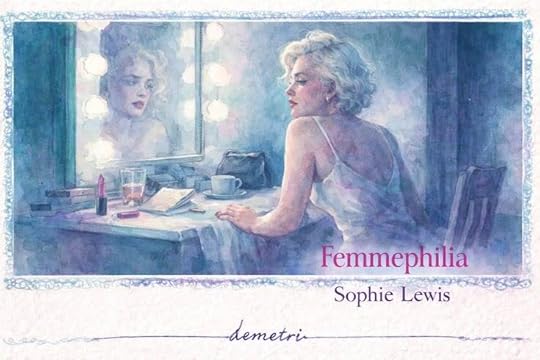
This Monroe-inflected watercolor holds glamour and appetite in the same light, honoring “Femmephilia’s” insistence that feminine radiance is not the opposite of labor, but one of the forms through which labor is most often misread.
This is also where Lewis reveals herself as a critic suspicious of solitary purity. She likes the rewatch, the side glance, the corrective friendship of looking with other people rather than from a lofty solo perch. One of the essay’s loveliest turns comes when she describes Jane Russell’s playful Monroe impersonation in “Gentlemen Prefer Blondes” as a “beautiful act of friendship.” The phrase is doing more than radiating warmth. Friendship, here, becomes a discipline of attention. It means staying with feminized images long enough to stop sneering at them, and long enough to stop mistaking them for vacancy. It keeps the essay from stiffening into a charge sheet decorated with stills.
Lewis applies similar pressure in “On Maintenance and Momfluence,” one of the book’s best present-tense essays. She sees perfectly well what is irritating about sponsored motherhood: the class evasions, the maid-erasing haze of curated dependence, the vanished nannies and babysitters, the whole soft-focus theater of domestic ease. But the sneer is doing nervous work. The momfluencer makes household life look aesthetic and non-economic while also exposing just how much work the household still requires. Someone is still cleaning, soothing, feeding, shopping, driving, scheduling, answering, and watching the child. Someone is still on the clock, even if the feed insists on calling it a vibe. Lewis describes the momfluencer as effecting a “partial unmasking of the gendered sphere of nonwork as economic, as non-natural.” The phrase is worth dwelling on. The problem is not only that domestic labor gets prettified. Prettification may be one of the few ways this culture can stand to look at it at all.
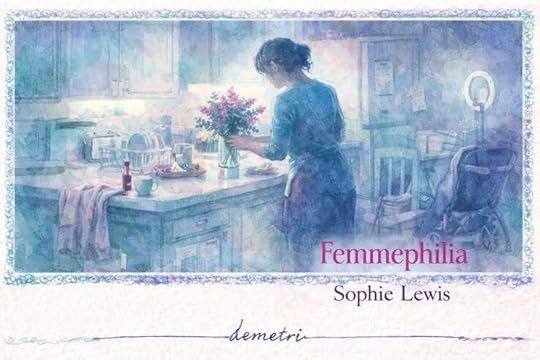
With its polished surfaces and submerged signs of effort, this domestic watercolor answers “Femmephilia’s” argument that the household still asks to be seen as atmosphere long after it has revealed itself to be work.
Lewis writes in sentences that coil, swerve, and kick. They pile up evidence, flick a match at piety, then turn on their heel. Her vocabulary keeps changing posture. Marxist-feminist terminology rubs against camp, anecdote against theory, domestic complaint against erotic wit. She has a sharp eye for the instant when a sanctified argument turns out to be embarrassment in a blazer. A more obedient style would have betrayed the project. Lewis is writing about shine, appetite, softness, seduction, housework, pity, hunger, and all the allegedly unserious surfaces high-minded solemnity likes to patronize. The prose must show that those surfaces can think. Usually it does. At its best, it makes piety sound secondhand and respectability faintly grubby. At its weaker moments, the sentence arrives wearing one necklace too many.
The book builds by return, not by line. “Against Nature” plants such a strong master key that later essays are sometimes half-opened by it before they begin. That gives the book design. It also lets the middle snarl. The gain is coherence. This does not read like a random stack of old magazine pieces under a clever cover. The loss is subtler. Some essays discover; others brilliantly repeat. Lewis has a powerful load-bearing idea, and she is willing to rest a great many objects against it. Sometimes that creates real pressure, as with Monroe or the momfluencer. Sometimes the mechanism yields too easily. You feel the prior-publication seams not because the essays go limp – even the lesser ones have muscle – but because the opening argument has already pre-sorted so much of the later material.
That is where the book starts spending too freely. Not because Lewis is too polemical, too ideological, or too sure of herself. Those complaints usually come from readers who want books like this to apologize for having convictions. The more interesting problem is her pattern appetite. Once Lewis finds the load-bearing idea, she sometimes cannot resist making it carry one argument too many. Because femininity, in her account, touches care, class, race, sexuality, labor, and privatized life, unlike things can start lining up a little too neatly. Often the reach feels earned. Occasionally it irons difference flatter than it should.
In the last essay, the polemic cools and deepens at once. “Consider the Lobster” returns to a distinction Lewis has been building toward all along: “Mother is an institution” versus “Mother is a verb.” On paper that could sound too neat by half. In practice, the essay roughens it beautifully. Lewis writes about her mother, Ingrid: difficult, funny, anti-feminist, intermittently theatrical about motherhood, and often bad at the actual work of mothering. She writes about the other people who did that work instead. She writes about the absurdity of condolences that assume a universal maternal wound, and about the sour comedy of being told to love herself “as she loved me.” Lewis’s answer is a hard no. Here private grief puts public theory on trial. Care stops sounding like a radiant abstraction and becomes what it often is in life: belated, improvised, damaged, obligation-thick, ridiculous, and still somehow necessary.
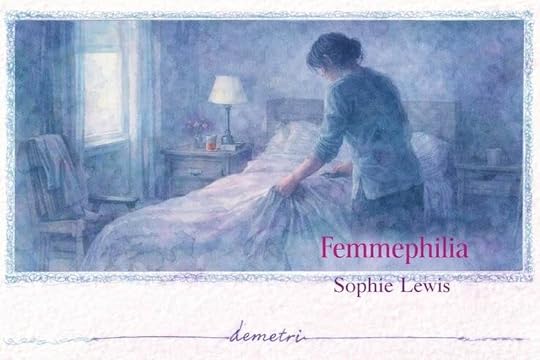
Quietly stripped of spectacle, this late-room watercolor reflects the book’s most painful turn, where care ceases to be a theory of redistribution and becomes the belated, imperfect labor of still showing up.
The late essay changes what the earlier ones are about. Without it, “Femmephilia” would still be a smart, unruly, ambitious collection with real argumentative cheek. With it, the book stops being merely brilliant at diagnosis and becomes willing to bleed for the diagnosis. Lewis has spent the whole collection insisting that care is privatized, sentimentalized, and hidden inside femininity. By the end she has to show what that means when the person who failed at care is your own mother, and when mothering the mother becomes possible only late, awkwardly, and under pressure from death. The theory gets blood in it.
That is also where the book’s current sting becomes clearest. Lewis is writing in the vicinity of disputes about sex work, trans femininity, reproductive technology, anti-feminine feminism, and monetized family life. Timeliness is not the point. The point is that the book catches a culture with flour on its hands: praising care while underpaying carers, sentimentalizing motherhood while outsourcing its labor, sneering at “girl stuff” while leaning on feminized work to keep the day from splitting apart. In that sense, “Femmephilia” sometimes has the intimacy of “The Argonauts” and sometimes the provocation of “Females,” though Lewis is less serene than the first and less icily mannered than the second. Her ambition is not to clean the argument up. It is to leave enough mess in it that life can still be seen.
What stays behind are three figures. Monroe insisting on hunger. The momfluencer accidentally making the household look like a workplace. The mother who held the title and fumbled the verb. Lewis is exceptionally good at finding the load-bearing beam inside a figure other critics might dismiss as vain, embarrassing, overdecorated, unserious, or politically compromised. Once she has found that beam, she can lean on it a shade too often. Still, the mind at work here remains quick, shrewd, and unusually alert to the way hypocrisy tidies itself up for public display. I landed at 90/100, 5 stars: not because the book is flawless, or evenly great, but because it has too much language, too much nerve, and too much unwillingness to flatter the reader’s tidy separations between real work and feminine fluff to be shrugged off as a clever exercise.
Lewis’s wager is not that femininity deserves kinder press. It is that modern life has hidden some of its most necessary forms of upkeep inside the very gestures it is quickest to patronize: the smoothing, the soothing, the flattering, the prettifying, the steadying of rooms, moods, days. “Femmephilia” insists that none of this is decorative to social life. It is part of the carrying of other people’s days without ever showing up on the ledger.
A chipped hand still in the room, straightening the table after the argument.
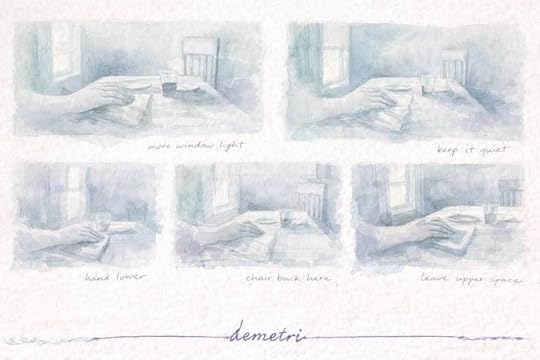
These compositional thumbnails trace the search for the right emotional geometry – not merely a room, but a structure of aftermath, maintenance, and charged stillness capable of carrying the review’s central argument.
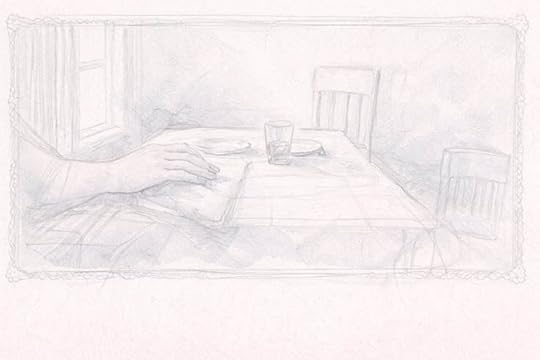
In the faint underdrawing, the painting’s hidden architecture comes into view: the hand, the table, the pulled chair, and the negative space that lets the final image hold both intimacy and restraint.
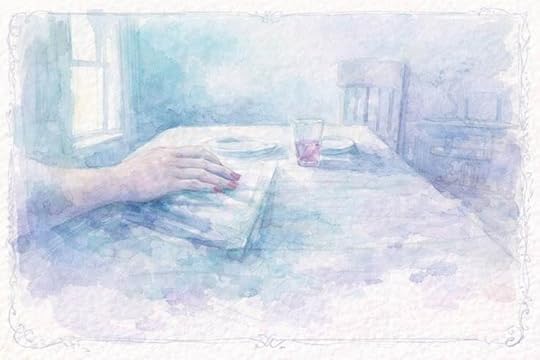
At the pencil-and-first-wash stage, the scene begins to breathe, as cool light and diluted color turn an arrangement of objects into the atmosphere of aftercare the finished watercolor depends on.
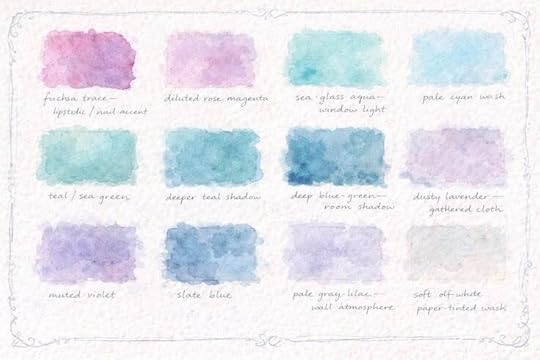
This swatch sheet records the disciplined cover-derived palette – magenta, aqua, teal, lavender, and off-white – through which the watercolor translates glamour, fatigue, and maintenance into one visual register.
All watercolor illustrations by Demetris Papadimitropoulos.
Sophie Lewis’s “Femmephilia” reads femininity not as decoration or weakness but as a charged site of labor, misrecognition, appetite, and difficult social survival
By Demetris Papadimitropoulos | April 11th, 2026
A room after the visible part is over: the hand that straightens the table in this watercolor echoes “Femmephilia’s” deepest claim that what looks like ornament, softness, or mere afterthought is often the hidden labor by which life is steadied and made livable.
“Femmephilia” opens by moving femininity out of the style section and onto the bill. Sophie Lewis’s argument is that what gets called feminine is very often labor with better styling and less pay. Once she changes the books, a good deal of modern life starts to look stingier than it likes to think. Niceness begins to resemble service with lip gloss on it. Care gets shrugged off as disposition. Glamour, in this light, is not a decorative bonus but work done under bad lighting and worse terms.
Lewis makes the case immediately in “Against Nature,” the opening essay and the book’s master key. Feminism, she argues, went wrong when it learned to treat “girly things” as contamination rather than evidence. Femininity had already been smuggled in under the sign of nature: niceness, availability, decoration, selflessness, emotional smoothing. Care. Then it was downgraded for being associated with women and feminized people in the first place. Lewis’s crucial line arrives early: if the problem is unfreedom, the task is to destroy the unfreedom, “not the eros.” That line licenses the whole book. Lewis has no interest in rescuing care, glamour, or sexual display by laundering them into something sterner and more respectable. She wants to show that the gestures most likely to be dismissed as vain, silly, indulgent, or merely private are often the ones by which a day is kept from folding – a room managed, a child soothed, a mood repaired, a meal produced, a life kept going.
The title offers trans mermaids, queer mothers, and Marilyn Monroe, which sounds like a glass-fronted cabinet of glamorous attachments. The book is less a cabinet of affinities than an audit of who gets handed the upkeep. “Femmephilia” is a 17-essay collection with no formal parts, though “Against Nature” serves as manifesto and “Consider the Lobster” as a coda bruised by family history. Between them come essays on Monroe, the “bitch,” beauty, feminist misogyny, momfluencers, cats, octopuses, vampires, and the split between mothering and motherhood. Lewis notes in “A Note on Permissions” that thirteen of the essays appeared in earlier forms. You can feel those seams. The collection has useful bagginess and a few relaunches you can feel under your hand. But it is not scattershot. It keeps putting its fingers on the same live wire: care mistaken for temperament, service misnamed as love, work appearing as instinct, charm, or good nature rather than labor.
The distinction the whole book leans on is between femininity as duty and femme as chosen display – knowingly made, not meekly inherited. Even that matters less as identity paperwork than as a way of asking a harder question. Who smooths, tends, flatters, soothes, decorates, mothers, cleans, and carries? Who makes other people easier to live with, or simply less impossible? Who turns effort into atmosphere and labor into “just how she is”? Lewis writes in the housework-and-history tradition that keeps dragging the household out of the realm of “just life” and back under the harder heading of work. What is distinctive here is that she will not rescue feminized work by washing off the glitter and calling the result politically laundered. She refuses the bargain by which care becomes legitimate only after it has gone gray.
That refusal is vivid in “She Gave Herself Freely,” one of the book’s strongest essays. Lewis begins with the Marilyn Appreciation Society, a pandemic film club, and uses that cheerful premise to show how badly even Monroe’s defenders have often read her. She is not interested in upgrading Monroe from blonde victim to blonde genius. She is interested in Monroe as worker. Self-made. Underpaid. Hungry. Overread as vacancy. The essay gathers the usual Monroe wreckage pile – foster homes, abuse, factory work, pinup labor, hustling. Survival sex. The “Playboy” centerfold. Then it snaps that material into a different shape. The crucial sentence is also the bluntest. Lewis quotes Monroe’s explanation for posing nude: “I was hungry.” That cuts through a great deal of carefully cultivated nonsense. It turns iconography back into appetite, and glamour back into upkeep. Lewis’s Monroe is not feminine emptiness with good lighting, nor a saint restored by serious people at last. She is a woman working very hard not to be mistaken for blankness.
This Monroe-inflected watercolor holds glamour and appetite in the same light, honoring “Femmephilia’s” insistence that feminine radiance is not the opposite of labor, but one of the forms through which labor is most often misread.
This is also where Lewis reveals herself as a critic suspicious of solitary purity. She likes the rewatch, the side glance, the corrective friendship of looking with other people rather than from a lofty solo perch. One of the essay’s loveliest turns comes when she describes Jane Russell’s playful Monroe impersonation in “Gentlemen Prefer Blondes” as a “beautiful act of friendship.” The phrase is doing more than radiating warmth. Friendship, here, becomes a discipline of attention. It means staying with feminized images long enough to stop sneering at them, and long enough to stop mistaking them for vacancy. It keeps the essay from stiffening into a charge sheet decorated with stills.
Lewis applies similar pressure in “On Maintenance and Momfluence,” one of the book’s best present-tense essays. She sees perfectly well what is irritating about sponsored motherhood: the class evasions, the maid-erasing haze of curated dependence, the vanished nannies and babysitters, the whole soft-focus theater of domestic ease. But the sneer is doing nervous work. The momfluencer makes household life look aesthetic and non-economic while also exposing just how much work the household still requires. Someone is still cleaning, soothing, feeding, shopping, driving, scheduling, answering, and watching the child. Someone is still on the clock, even if the feed insists on calling it a vibe. Lewis describes the momfluencer as effecting a “partial unmasking of the gendered sphere of nonwork as economic, as non-natural.” The phrase is worth dwelling on. The problem is not only that domestic labor gets prettified. Prettification may be one of the few ways this culture can stand to look at it at all.
With its polished surfaces and submerged signs of effort, this domestic watercolor answers “Femmephilia’s” argument that the household still asks to be seen as atmosphere long after it has revealed itself to be work.
Lewis writes in sentences that coil, swerve, and kick. They pile up evidence, flick a match at piety, then turn on their heel. Her vocabulary keeps changing posture. Marxist-feminist terminology rubs against camp, anecdote against theory, domestic complaint against erotic wit. She has a sharp eye for the instant when a sanctified argument turns out to be embarrassment in a blazer. A more obedient style would have betrayed the project. Lewis is writing about shine, appetite, softness, seduction, housework, pity, hunger, and all the allegedly unserious surfaces high-minded solemnity likes to patronize. The prose must show that those surfaces can think. Usually it does. At its best, it makes piety sound secondhand and respectability faintly grubby. At its weaker moments, the sentence arrives wearing one necklace too many.
The book builds by return, not by line. “Against Nature” plants such a strong master key that later essays are sometimes half-opened by it before they begin. That gives the book design. It also lets the middle snarl. The gain is coherence. This does not read like a random stack of old magazine pieces under a clever cover. The loss is subtler. Some essays discover; others brilliantly repeat. Lewis has a powerful load-bearing idea, and she is willing to rest a great many objects against it. Sometimes that creates real pressure, as with Monroe or the momfluencer. Sometimes the mechanism yields too easily. You feel the prior-publication seams not because the essays go limp – even the lesser ones have muscle – but because the opening argument has already pre-sorted so much of the later material.
That is where the book starts spending too freely. Not because Lewis is too polemical, too ideological, or too sure of herself. Those complaints usually come from readers who want books like this to apologize for having convictions. The more interesting problem is her pattern appetite. Once Lewis finds the load-bearing idea, she sometimes cannot resist making it carry one argument too many. Because femininity, in her account, touches care, class, race, sexuality, labor, and privatized life, unlike things can start lining up a little too neatly. Often the reach feels earned. Occasionally it irons difference flatter than it should.
In the last essay, the polemic cools and deepens at once. “Consider the Lobster” returns to a distinction Lewis has been building toward all along: “Mother is an institution” versus “Mother is a verb.” On paper that could sound too neat by half. In practice, the essay roughens it beautifully. Lewis writes about her mother, Ingrid: difficult, funny, anti-feminist, intermittently theatrical about motherhood, and often bad at the actual work of mothering. She writes about the other people who did that work instead. She writes about the absurdity of condolences that assume a universal maternal wound, and about the sour comedy of being told to love herself “as she loved me.” Lewis’s answer is a hard no. Here private grief puts public theory on trial. Care stops sounding like a radiant abstraction and becomes what it often is in life: belated, improvised, damaged, obligation-thick, ridiculous, and still somehow necessary.
Quietly stripped of spectacle, this late-room watercolor reflects the book’s most painful turn, where care ceases to be a theory of redistribution and becomes the belated, imperfect labor of still showing up.
The late essay changes what the earlier ones are about. Without it, “Femmephilia” would still be a smart, unruly, ambitious collection with real argumentative cheek. With it, the book stops being merely brilliant at diagnosis and becomes willing to bleed for the diagnosis. Lewis has spent the whole collection insisting that care is privatized, sentimentalized, and hidden inside femininity. By the end she has to show what that means when the person who failed at care is your own mother, and when mothering the mother becomes possible only late, awkwardly, and under pressure from death. The theory gets blood in it.
That is also where the book’s current sting becomes clearest. Lewis is writing in the vicinity of disputes about sex work, trans femininity, reproductive technology, anti-feminine feminism, and monetized family life. Timeliness is not the point. The point is that the book catches a culture with flour on its hands: praising care while underpaying carers, sentimentalizing motherhood while outsourcing its labor, sneering at “girl stuff” while leaning on feminized work to keep the day from splitting apart. In that sense, “Femmephilia” sometimes has the intimacy of “The Argonauts” and sometimes the provocation of “Females,” though Lewis is less serene than the first and less icily mannered than the second. Her ambition is not to clean the argument up. It is to leave enough mess in it that life can still be seen.
What stays behind are three figures. Monroe insisting on hunger. The momfluencer accidentally making the household look like a workplace. The mother who held the title and fumbled the verb. Lewis is exceptionally good at finding the load-bearing beam inside a figure other critics might dismiss as vain, embarrassing, overdecorated, unserious, or politically compromised. Once she has found that beam, she can lean on it a shade too often. Still, the mind at work here remains quick, shrewd, and unusually alert to the way hypocrisy tidies itself up for public display. I landed at 90/100, 5 stars: not because the book is flawless, or evenly great, but because it has too much language, too much nerve, and too much unwillingness to flatter the reader’s tidy separations between real work and feminine fluff to be shrugged off as a clever exercise.
Lewis’s wager is not that femininity deserves kinder press. It is that modern life has hidden some of its most necessary forms of upkeep inside the very gestures it is quickest to patronize: the smoothing, the soothing, the flattering, the prettifying, the steadying of rooms, moods, days. “Femmephilia” insists that none of this is decorative to social life. It is part of the carrying of other people’s days without ever showing up on the ledger.
A chipped hand still in the room, straightening the table after the argument.
These compositional thumbnails trace the search for the right emotional geometry – not merely a room, but a structure of aftermath, maintenance, and charged stillness capable of carrying the review’s central argument.
In the faint underdrawing, the painting’s hidden architecture comes into view: the hand, the table, the pulled chair, and the negative space that lets the final image hold both intimacy and restraint.
At the pencil-and-first-wash stage, the scene begins to breathe, as cool light and diluted color turn an arrangement of objects into the atmosphere of aftercare the finished watercolor depends on.
This swatch sheet records the disciplined cover-derived palette – magenta, aqua, teal, lavender, and off-white – through which the watercolor translates glamour, fatigue, and maintenance into one visual register.
All watercolor illustrations by Demetris Papadimitropoulos.
September 4, 2026
Another in my series, Katie reviews books written by her friends. In Sophie's case, however, we became friends precisely because of her books. I reviewed Full Surrogacy Now back in 2019 and beginning with that review we have managed to create a friendship across an ocean, through a pandemic, with both of us navigating the precarity of free lance, academic adjacent work. I am unabashedly a fan of Sophie's work and at this stage our politics are so intertwined that I often can't remember if an idea I had was mine first, or if it was hers. I am delighted to be in the acknowledgements of this book and even more delighted to read Sophie's thoughts on my essay about Dracula in the chapter on Detransition Baby and vampiric mothering. Needless to say I couldn't have written about "vampires in the gestational commune" without Full Surrogacy Now.
This is not, then, an objective review of an outsider, but it is a very sincere appreciation of an essay collection that I hugely enjoyed. I had read almost all of these essays before, fan that I am, but not only was it wonderful to discover the odd one that had slipped by me (like the great essay about acid and Diane di Prima) it was also lovely to read my old favourites together in a book. The pace of the internet is such that I find a long read much more difficult to get through when I'm reading it on my phone. In this book the essays had some space to breathe, I could pause after each one or dash on hungrily to the next as my fancy took me. This sense of the luxury of having time to read felt very much in keeping with the spirit of femmephilia which is a beautiful love letter, not only to Marilyn Monroe and octopus girlfriends, but to excess, pleasure and the knowledge that mothering one another and ourselves is a crucial part of revolutionary politics. Reading about mermaids in the bath, reading about cats while my son carefully painted the pages with my makeup, I felt very femmephilic. It was also great to see Sophie turn what are essentially a series of writing gigs where she was commissioned to write about, eg Monroe, into a compelling book with an overarching thesis that bound together many of the concerns of her previous work in Abolish the Family, FSN and Enemy Feminisms. The wide range of Sophie's interests and her ability to find exciting news things to say about such varied and eccentric subject matter is always impressive, and particularly so in a work that really shows you how being a cat lady relates to opposing Andrea Dworkin's misandry and to wanting to become a tree.
This book isn't a neat intro to anything, although I think the opening essay on femmephilia could be read as a challenging and timely manifesto. But it is a wonderful text to dip into and pull apart. Always funny but never slight this is the kind of pleasurable reading that requires a lot from you but is all the more pleasurable for it. For all the Lewis-heads out there there are also so many other great essays that Sophie has written over the years (reviews of Midsommar and Sex Education were highlights for me) that are worth seeking out when you have finished this book. The one that I really wanted to see here though is Sophie's piece Double Shift: Dialectic of the Tradwife, which is about Stacey Dooley's encounter with a tradwife and the idea that to frame the lean in feminist as the opposite of the tradwife is to trap women into two binding models of work (productive or reproductive - and probably both at once) without offering any real way out. This essay I think is the missing ingredient in the essay on Momfluencers which combines reviews of two books on contemporary mum culture. I guess I just greedily wanted more on this because of my own current experiments in mothering but I do think that the question of how you can have an anti work, and thus femmephilic politics, when your work is looking after a child is a pressing one that, as always, I selfishly hope Sophie will resolve for me.
All in all I love it, can't you tell.
This is not, then, an objective review of an outsider, but it is a very sincere appreciation of an essay collection that I hugely enjoyed. I had read almost all of these essays before, fan that I am, but not only was it wonderful to discover the odd one that had slipped by me (like the great essay about acid and Diane di Prima) it was also lovely to read my old favourites together in a book. The pace of the internet is such that I find a long read much more difficult to get through when I'm reading it on my phone. In this book the essays had some space to breathe, I could pause after each one or dash on hungrily to the next as my fancy took me. This sense of the luxury of having time to read felt very much in keeping with the spirit of femmephilia which is a beautiful love letter, not only to Marilyn Monroe and octopus girlfriends, but to excess, pleasure and the knowledge that mothering one another and ourselves is a crucial part of revolutionary politics. Reading about mermaids in the bath, reading about cats while my son carefully painted the pages with my makeup, I felt very femmephilic. It was also great to see Sophie turn what are essentially a series of writing gigs where she was commissioned to write about, eg Monroe, into a compelling book with an overarching thesis that bound together many of the concerns of her previous work in Abolish the Family, FSN and Enemy Feminisms. The wide range of Sophie's interests and her ability to find exciting news things to say about such varied and eccentric subject matter is always impressive, and particularly so in a work that really shows you how being a cat lady relates to opposing Andrea Dworkin's misandry and to wanting to become a tree.
This book isn't a neat intro to anything, although I think the opening essay on femmephilia could be read as a challenging and timely manifesto. But it is a wonderful text to dip into and pull apart. Always funny but never slight this is the kind of pleasurable reading that requires a lot from you but is all the more pleasurable for it. For all the Lewis-heads out there there are also so many other great essays that Sophie has written over the years (reviews of Midsommar and Sex Education were highlights for me) that are worth seeking out when you have finished this book. The one that I really wanted to see here though is Sophie's piece Double Shift: Dialectic of the Tradwife, which is about Stacey Dooley's encounter with a tradwife and the idea that to frame the lean in feminist as the opposite of the tradwife is to trap women into two binding models of work (productive or reproductive - and probably both at once) without offering any real way out. This essay I think is the missing ingredient in the essay on Momfluencers which combines reviews of two books on contemporary mum culture. I guess I just greedily wanted more on this because of my own current experiments in mothering but I do think that the question of how you can have an anti work, and thus femmephilic politics, when your work is looking after a child is a pressing one that, as always, I selfishly hope Sophie will resolve for me.
All in all I love it, can't you tell.

August 24, 2026
This is definitely not Feminism 101. Femmephilia is academic, dense, deeply researched, and occasionally sent me down rabbit holes, because I wanted more context for something Lewis referenced. I also think that's part of what made it such a rewarding read.
What I appreciated most was how expansive its feminism felt. At a time when far too many women are loudly embracing TERF ideology while still calling themselves feminists, I was genuinely glad to read a feminist work that doesn't treat trans women as an uncomfortable footnote or an exception to be debated. They are simply part of the feminist narrative as they should be.
I actually recommended this one to my best friend, who is a trans woman, and she loved it too. She specifically appreciated seeing herself included in a book about feminism rather than treated as though trans women exist somewhere outside of that conversation. That meant a lot to both of us.
I also loved the way Lewis examines femininity itself. Instead of treating femme things as frivolous, regressive, or somehow incompatible with liberation, these essays ask us to look more closely at who performs feminized labor, who benefits from it, and why femininity has so often been dismissed even within feminist spaces.
The essays range all over the place from mermaids and mythology to motherhood, Marilyn Monroe, pop culture, queer history, labor, beauty, and feminist theory. I especially loved the discussion of Ursula. Taking something so familiar and looking at it through a completely different queer and feminist lens is exactly the kind of thing that will make this stick with me.
This isn't necessarily a book I'd hand to someone looking for their first introduction to feminism. It assumes you're willing to engage with theory, follow references, and occasionally sit with an argument for a while. I didn't agree with or immediately absorb *every* idea, but I don't need a book to simply confirm everything I already believe. I want it to make me think and this one did.
I received an advance review copy for free, and I am leaving this review voluntarily.
What I appreciated most was how expansive its feminism felt. At a time when far too many women are loudly embracing TERF ideology while still calling themselves feminists, I was genuinely glad to read a feminist work that doesn't treat trans women as an uncomfortable footnote or an exception to be debated. They are simply part of the feminist narrative as they should be.
I actually recommended this one to my best friend, who is a trans woman, and she loved it too. She specifically appreciated seeing herself included in a book about feminism rather than treated as though trans women exist somewhere outside of that conversation. That meant a lot to both of us.
I also loved the way Lewis examines femininity itself. Instead of treating femme things as frivolous, regressive, or somehow incompatible with liberation, these essays ask us to look more closely at who performs feminized labor, who benefits from it, and why femininity has so often been dismissed even within feminist spaces.
The essays range all over the place from mermaids and mythology to motherhood, Marilyn Monroe, pop culture, queer history, labor, beauty, and feminist theory. I especially loved the discussion of Ursula. Taking something so familiar and looking at it through a completely different queer and feminist lens is exactly the kind of thing that will make this stick with me.
This isn't necessarily a book I'd hand to someone looking for their first introduction to feminism. It assumes you're willing to engage with theory, follow references, and occasionally sit with an argument for a while. I didn't agree with or immediately absorb *every* idea, but I don't need a book to simply confirm everything I already believe. I want it to make me think and this one did.
I received an advance review copy for free, and I am leaving this review voluntarily.

Review of advance copy received from Publisher
ty to Haymarket for sending me an ARC <3
so i really liked this and have many feels about it! i keep seeing a couple lower ratings stating this book is a little academic and not a great starter for someone getting into feminist texts, etc. I do agree. I loved this book, but I have also read a majority of the texts Lewis references in her work so it all made sense to me. If i had read this book a few years ago when I was a reading noob, I probably wouldn't have liked it as much.
what i loved about the book
- loved justice for marilyn monroe
- loved the discussion of the little mermaid, justice for ursula
- loved the queen of sparta essay
- loved the essay about feminist misogyny
- also liked the essay on hetero-pessimism, esp cuz im a sad cis het girl. i felt seen but also felt like there were things i could do to make this awful capitalist cis/het/patriachial genocidal world a little bit better
what i didn't like
- did not like the essays ( i think there were 2) in relation to animals. there was one on cats for sure. Lewis says a few things about animal liberation, about speciesism....and doesn't make a single mention about the entire factory farming industry? how the meat/dairy/egg is built on the FEMALE REPRODUCTIVE SYSTEM of non-human animals. or that it's the greatest polluter of the environment....there's truly nothing of substance in this essay. so many points about capitalism and feminism missed.
many people won't agree with me. everyone's a leftist until we talk about animal liberation, about veganism, etc. And I lowkey feel like that's what happened in Lewis's essay. She was so close and then didn't go there because it will alientate readers or whatever. It's a really tough pill to swallow, but the truth is the truth.
Overall a good book but I did have my issues with it.
so i really liked this and have many feels about it! i keep seeing a couple lower ratings stating this book is a little academic and not a great starter for someone getting into feminist texts, etc. I do agree. I loved this book, but I have also read a majority of the texts Lewis references in her work so it all made sense to me. If i had read this book a few years ago when I was a reading noob, I probably wouldn't have liked it as much.
what i loved about the book
- loved justice for marilyn monroe
- loved the discussion of the little mermaid, justice for ursula
- loved the queen of sparta essay
- loved the essay about feminist misogyny
- also liked the essay on hetero-pessimism, esp cuz im a sad cis het girl. i felt seen but also felt like there were things i could do to make this awful capitalist cis/het/patriachial genocidal world a little bit better
what i didn't like
- did not like the essays ( i think there were 2) in relation to animals. there was one on cats for sure. Lewis says a few things about animal liberation, about speciesism....and doesn't make a single mention about the entire factory farming industry? how the meat/dairy/egg is built on the FEMALE REPRODUCTIVE SYSTEM of non-human animals. or that it's the greatest polluter of the environment....there's truly nothing of substance in this essay. so many points about capitalism and feminism missed.
many people won't agree with me. everyone's a leftist until we talk about animal liberation, about veganism, etc. And I lowkey feel like that's what happened in Lewis's essay. She was so close and then didn't go there because it will alientate readers or whatever. It's a really tough pill to swallow, but the truth is the truth.
Overall a good book but I did have my issues with it.

Review of advance copy received from NetGalley
This was my first time reading anything from Sophie Lewis, and I really like her writing style. There is a nice flow and rhythm in the lines, which makes it really enjoyable to read for me. Sometimes you might get the "wait what?" feeling, but stick with it; it will make sense. Sophie has an amazing way of bringing it all together in the end so that it makes perfect sense.
There are many different topics we discuss, and each chapter/essay introduces a new topic of conversation and points to consider.
My favorite ones are "Can the sireniform speak?" and "Consider the lobster." They were the ones that hit me the most, but I don't have one that I didn't like. This will definitely find its place on my favorite non-fiction shelf!
Thank you, NetGally and Haymarket Books, for letting me read the advanced reader copy!
Some of my favorite quotes:
"Besides, for good or for ill, plenty of rage and aggression can and does flow from within femininity."
"But for the majoritarian Ariel, collaboration is not an option. And if she can't access the life on the health care she needs without a visa marriage, then, friends, we will have to smuggle her out and help her make a home in our homes, right here, where her people are."
"The author, or the father, or both, simply cannot believe that a person, especially a woman, might have this desire (to be ugly) in all sincerity. But we can believe her, if we so choose. At least, we can try."
"It was foolish of me to think that a revolutionary could not discuss cats."
There are many different topics we discuss, and each chapter/essay introduces a new topic of conversation and points to consider.
My favorite ones are "Can the sireniform speak?" and "Consider the lobster." They were the ones that hit me the most, but I don't have one that I didn't like. This will definitely find its place on my favorite non-fiction shelf!
Thank you, NetGally and Haymarket Books, for letting me read the advanced reader copy!
Some of my favorite quotes:
"Besides, for good or for ill, plenty of rage and aggression can and does flow from within femininity."
"But for the majoritarian Ariel, collaboration is not an option. And if she can't access the life on the health care she needs without a visa marriage, then, friends, we will have to smuggle her out and help her make a home in our homes, right here, where her people are."
"The author, or the father, or both, simply cannot believe that a person, especially a woman, might have this desire (to be ugly) in all sincerity. But we can believe her, if we so choose. At least, we can try."
"It was foolish of me to think that a revolutionary could not discuss cats."
July 11, 2026
Thank you to NetGalley for the ARC!
Femmephilia is genuinely thought-provoking collection of essays with a little bit of everything inside. The essays include media analysis, history, and personal experiences, sometimes in the same essay, contributing to her discussion of the feminist feminine. I haven't done the most reading on feminism, so I found this text really helpful. It took me a little bit to get into the swing of the book (for reasons that I'll discuss a little late), but once I did, I was TEARING through these essays. I found her description of the difference between "motherhood" as an identity vs "mothering" as an action to be really cool. This is probably the first text on family abolition that I've read, and it was a good reminder that family abolition doesn't mean that no one gets cared for. Another stand-out moment was her analysis of Andrea Dworkin's work and beliefs. Lewis writes about radical feminists with empathy, but she is not at all afraid to call out their work for its numerous flaws.
While there were a lot of interesting points in this collection, there were some structural elements that weakened it for me. I think the order of the essays could have used a little work; they feel like a bit of a random mix, and Lewis could have strengthened and clarified her arguments with a more intentional order. As an example: the first essay is about Marilyn Monroe's subversive femininity, then comes an essay critiquing Lillian Faderman's writing, then an essay about femininity and queerness in Disney retellings of "The Little Mermaid". I was still a little overwhelmed by everything explored in the introduction and would have liked a little more time to get a sense of what femmephilia can look like before getting into what it is not. This is less of a problem on a reread or for someone skipping around, as the reader will already have an idea of what femmephilia is, but it just struck me as slightly odd. Lewis also shares a habit with me of getting to an interesting point in an essay and then quickly wrapping up. Several times Lewis would bring up something really interesting, and then end the essay on the next page.
I also found the constant references to twitter beef "OctopusGate" in a particular essay to just be a bit... gauche? If you're going to write an essay expanding on a tweet that you made that got taken badly, that's fine, but Lewis' discussion of the tweet often felt like "twitter wasn't woke enough for my tweet about this man and an octopus having a romantic relationship". It just made me cringe, for lack of a better word.
Despite those caveats, I did really enjoy this collection, and I hope to one day assign at least sections of it to future students.
Femmephilia is genuinely thought-provoking collection of essays with a little bit of everything inside. The essays include media analysis, history, and personal experiences, sometimes in the same essay, contributing to her discussion of the feminist feminine. I haven't done the most reading on feminism, so I found this text really helpful. It took me a little bit to get into the swing of the book (for reasons that I'll discuss a little late), but once I did, I was TEARING through these essays. I found her description of the difference between "motherhood" as an identity vs "mothering" as an action to be really cool. This is probably the first text on family abolition that I've read, and it was a good reminder that family abolition doesn't mean that no one gets cared for. Another stand-out moment was her analysis of Andrea Dworkin's work and beliefs. Lewis writes about radical feminists with empathy, but she is not at all afraid to call out their work for its numerous flaws.
While there were a lot of interesting points in this collection, there were some structural elements that weakened it for me. I think the order of the essays could have used a little work; they feel like a bit of a random mix, and Lewis could have strengthened and clarified her arguments with a more intentional order. As an example: the first essay is about Marilyn Monroe's subversive femininity, then comes an essay critiquing Lillian Faderman's writing, then an essay about femininity and queerness in Disney retellings of "The Little Mermaid". I was still a little overwhelmed by everything explored in the introduction and would have liked a little more time to get a sense of what femmephilia can look like before getting into what it is not. This is less of a problem on a reread or for someone skipping around, as the reader will already have an idea of what femmephilia is, but it just struck me as slightly odd. Lewis also shares a habit with me of getting to an interesting point in an essay and then quickly wrapping up. Several times Lewis would bring up something really interesting, and then end the essay on the next page.
I also found the constant references to twitter beef "OctopusGate" in a particular essay to just be a bit... gauche? If you're going to write an essay expanding on a tweet that you made that got taken badly, that's fine, but Lewis' discussion of the tweet often felt like "twitter wasn't woke enough for my tweet about this man and an octopus having a romantic relationship". It just made me cringe, for lack of a better word.
Despite those caveats, I did really enjoy this collection, and I hope to one day assign at least sections of it to future students.

Review of advance copy received from Netgalley
Femmephilia is a one-of-a-kind collection of essays on femme-insim, showcasing delightful prose and well thought out insights. The essays in this collection were intriguing and fascinating, merging together to create a solid - and topical - thesis statement. While I must state that at times Lewis' writing felt a little dense, the content was worth puzzling my way through her academic writing. One of my favourite things about Femmephilia is that unlike many modern feminist works, it does not fall into the TERFy narrative that seems to dominate today's media landscape, and instead of spreading freeing thought, it squishes all kinds of people into tiny boxes.
I would recommend Femmephilia to both people who look at the modern feminist movement and see large cracks and rotted limbs, as well as those that are only willing to look at it through rose-coloured lenses. It is a must-read for anyone who has, does, and will call themselves a 'feminist'.
Overall, this book was a breath of fresh air in a time of great authoritarianism, where the rights of women and all non-white non-cis-people are being eroded as the favourite pastime of the rich and powerful. Lewis' prose in poignant and impactful, succinctly delivering her argument. My rating is 4.75 stars.
Thank you to Haymarket Books for providing Femmephilia for review consideration via NetGalley. All opinions are my own.
I would recommend Femmephilia to both people who look at the modern feminist movement and see large cracks and rotted limbs, as well as those that are only willing to look at it through rose-coloured lenses. It is a must-read for anyone who has, does, and will call themselves a 'feminist'.
Overall, this book was a breath of fresh air in a time of great authoritarianism, where the rights of women and all non-white non-cis-people are being eroded as the favourite pastime of the rich and powerful. Lewis' prose in poignant and impactful, succinctly delivering her argument. My rating is 4.75 stars.
Thank you to Haymarket Books for providing Femmephilia for review consideration via NetGalley. All opinions are my own.
March 21, 2026
Definitely not a book to rush through, but one to savour.
It has been a while since I picked up a book that was advertised as ‘feminist’, as similarly to other reviewers, I have found those to be oftentimes transphobic or preaching other outdated narratives. Not this one though. This essay collection highlights among others, the undeniable importance of politicised femme-ness in a culture that still glorifies masculinity, and in general aims to offer a new logic of liberation, as the neoliberal feminist movement failed to combat the flare-up of right-wing attacks.
While not necessarily agreeing 100% with every one of the author’s viewpoints, I thoroughly enjoyed the fresh perspective that was offered on a lot of the subjects discussed.
All in all, I highly recommend you give this book a try, especially if you are fed up with feminist literature only catering to the white heteronormative gaze. Even if it ends up being not your cup of tea, I guarantee you will find something you can take away from it.
I will definitely seek out more of Sophie Lewis’s work in the future!
Thank you NetGalley for the arc!
August 4, 2026
Sophie Lewis has been one of the foundational contemporary voices in forming my politics, first with Abolish the Family and then with Enemy Feminisms. Femmephilia was a highly anticipated read for me and it took me on a beautiful journey that is Sophie’s mind.
This collection of essays dissects myth-making, both historical and contemporary, and translates them through a material lens. Lewis argues that the value of embodying “femme” surpasses the frivolity assigned to it by capitalism and the de-gendering of care work is the only thing that will save us.
Lewis’ didactic approach is endlessly fascinating to me while still making incredibly nuanced and complex ideas accessible. I particularly enjoyed the sections that spoke on motherhood and mothering from a materialist lens. As someone who will have no biological children of their own due to the prohibitive cost of child-rearing, I love reading perspectives on motherhood that challenge the status quo.
The several sections on sex work liberation through a Marxist feminist lens brought me back to Everything for Everyone: An Oral History of the New York Commune, where sex workers lead movements for everyone’s liberation.
This collection of essays dissects myth-making, both historical and contemporary, and translates them through a material lens. Lewis argues that the value of embodying “femme” surpasses the frivolity assigned to it by capitalism and the de-gendering of care work is the only thing that will save us.
Lewis’ didactic approach is endlessly fascinating to me while still making incredibly nuanced and complex ideas accessible. I particularly enjoyed the sections that spoke on motherhood and mothering from a materialist lens. As someone who will have no biological children of their own due to the prohibitive cost of child-rearing, I love reading perspectives on motherhood that challenge the status quo.
The several sections on sex work liberation through a Marxist feminist lens brought me back to Everything for Everyone: An Oral History of the New York Commune, where sex workers lead movements for everyone’s liberation.

Review of advance copy received from Netgalley
I don't think I'm the right audience for this book. But I think you may be if you have already read several feminist books. If you know the subject with more depth than "I just want equality". And/or if you like academic learning.
While the author's essays were interesting and made me think, they're full of reference to other authors, other feminist theories, other revolutionary ideas. It's full of long, hyphenated, complicated words and notions I am not familiar with.
This felt like something that would fit right in a curriculum on feminism in a higher education setting.
In addition to that, while I did enjoy some of the essays, especially the ones related to pop culture, I disagree with the author on many things. I'm not radical enough for this book. I don't want to break the family unit. I don't want to promote drug use. I don't want a full on war on everything our society currently is. Changes? Yes. Complete anihilation? No.
A copy of this book was provided to me by NetGalley. All opinions are my own.
While the author's essays were interesting and made me think, they're full of reference to other authors, other feminist theories, other revolutionary ideas. It's full of long, hyphenated, complicated words and notions I am not familiar with.
This felt like something that would fit right in a curriculum on feminism in a higher education setting.
In addition to that, while I did enjoy some of the essays, especially the ones related to pop culture, I disagree with the author on many things. I'm not radical enough for this book. I don't want to break the family unit. I don't want to promote drug use. I don't want a full on war on everything our society currently is. Changes? Yes. Complete anihilation? No.
A copy of this book was provided to me by NetGalley. All opinions are my own.
June 29, 2026
Femmephilia: Love Letters to Trans Mermaids, Queer Mothers, and Marilyn Monroe by Sophie Lewis is a bold and thought-provoking exploration of femininity, feminism, identity, and the cultural meanings attached to being femme.
What stands out is the book’s willingness to challenge traditional ideas about gender, liberation, and social expectations. Through essays that connect politics, culture, history, and personal experience, Lewis presents a compelling vision of femme identity as something powerful, creative, and transformative.
The book offers a rich perspective for readers interested in feminist theory, queer studies, gender politics, and contemporary conversations about identity and belonging. While its ideas are ambitious and intellectually challenging, it provides a meaningful invitation to rethink how society understands femininity and freedom.
A significant read for those seeking deeper conversations around feminism, representation, and the evolving possibilities of gender and self-expression.
What stands out is the book’s willingness to challenge traditional ideas about gender, liberation, and social expectations. Through essays that connect politics, culture, history, and personal experience, Lewis presents a compelling vision of femme identity as something powerful, creative, and transformative.
The book offers a rich perspective for readers interested in feminist theory, queer studies, gender politics, and contemporary conversations about identity and belonging. While its ideas are ambitious and intellectually challenging, it provides a meaningful invitation to rethink how society understands femininity and freedom.
A significant read for those seeking deeper conversations around feminism, representation, and the evolving possibilities of gender and self-expression.

Read
July 14, 2026"the femmephilic horizon I'm squinting at is non-identitarian, antiwork, and universalizing in its movement of mutual holding, decorating, exalting, and babying. This is less about connecting existing femmes and more about unleashing the femme in all ofus, in the sense of care-hunger and pleasure-giving. . . . Femme-inism ought to be one name for the commune-building endeavor that will unleash gender abundance, demystify labor, and rediffuse earthly responsibilities across the whole of humanity. . . . None of this is private. None of it is low priority. It's a matter of class war, which is to say, of the self-abolition of the workers, which is to say, an attempt to birth a way of being together that might be worthy of the name ' human.' It's a matter of earthly survival" (15).
I was always chasing the high of the first essay, and even though I never quite got there again, I enjoyed ever second of the sprint. Loved these essays. All academic writing should be half this alive. Newest Sophie Lewis fangirl!
I was always chasing the high of the first essay, and even though I never quite got there again, I enjoyed ever second of the sprint. Loved these essays. All academic writing should be half this alive. Newest Sophie Lewis fangirl!

Review of advance copy received from NetGalley
Wow, so the first essay in this collection hooked me immediately. As a femme lesbian, I found it extremely relatable and relevant to me. It was wonderful to read, so articulately, about the intricacies of a queer “femme” identity and how it is distinct from “femininity” and why. The rest of the book continued with excellent discussions on feminism, queer and body politics that were challenging and complex. It is an academic read, but I wasn’t expecting anything less. I enjoyed the way Lewis integrates her personal experience into some very heavy intellectual explorations. I feel that those choices made these ideas more digestible, at least for me!
Also, ummm excuse me, Sophie, how very dare you remind me why I had a huge crush on Angela Davis when I was a young scholar! 🤭
Thank you to Haymarket Books and NetGalley for an ARC of this book in exchange for my honest review.
Happy Pride, femmes
Also, ummm excuse me, Sophie, how very dare you remind me why I had a huge crush on Angela Davis when I was a young scholar! 🤭
Thank you to Haymarket Books and NetGalley for an ARC of this book in exchange for my honest review.
Happy Pride, femmes

June 17, 2026
firstly, the cover is beautiful and the title and description really caught my attention. my expectations from the description were more essays similar to the opener, "against nature," but many of the other essays didn't fit the topic of femmephilia in the way i wanted.
i'm glad that i read this but i think it wasn't fully for me. as others have mentioned, the writing style is very dense. there are often references to other books/theories/pieces of media which isn't uncommon in essay collections and theory but in combination with the dense writing style hindered comprehension. as i was reading i thought there were interesting ideas, but would have difficulty recounting what the essay was about after finishing it. maybe i'm calling myself stupid on main but i think that the best writing can make complex ideas more clear and accessible.
thank you to NetGalley and Haymarket Books for the digital ARC in exchange for an honest review!
i'm glad that i read this but i think it wasn't fully for me. as others have mentioned, the writing style is very dense. there are often references to other books/theories/pieces of media which isn't uncommon in essay collections and theory but in combination with the dense writing style hindered comprehension. as i was reading i thought there were interesting ideas, but would have difficulty recounting what the essay was about after finishing it. maybe i'm calling myself stupid on main but i think that the best writing can make complex ideas more clear and accessible.
thank you to NetGalley and Haymarket Books for the digital ARC in exchange for an honest review!

Read
June 23, 2026As a queer femme I loved just about everything about this book.
We get both clear out analysis of multiple depictions of feminine softness, and the push and pull of societal demands, and the bodies those demands are made upon in bringing those depictions to a wider audience through the filmography of Marilyn Monroe, and the encroachment of momfluencer culture among others, and a celebration and demand that eroticism care and Joy be parts of analysis and parts of any socialist utopia worth having.
Each essay can certainly be read separately, many have appeared elsewhere, but reading them together, gives us the opportunity to see in many layers and with criticism that both allows space for screwing up and being wrong without failing too acknowledge and also for appreciating the sometimes threads sometimes rivers of the best that is available in work and words from figures of and works from history that have been sometimes lionized and sometimes reviled.
We get both clear out analysis of multiple depictions of feminine softness, and the push and pull of societal demands, and the bodies those demands are made upon in bringing those depictions to a wider audience through the filmography of Marilyn Monroe, and the encroachment of momfluencer culture among others, and a celebration and demand that eroticism care and Joy be parts of analysis and parts of any socialist utopia worth having.
Each essay can certainly be read separately, many have appeared elsewhere, but reading them together, gives us the opportunity to see in many layers and with criticism that both allows space for screwing up and being wrong without failing too acknowledge and also for appreciating the sometimes threads sometimes rivers of the best that is available in work and words from figures of and works from history that have been sometimes lionized and sometimes reviled.
July 16, 2026
Thank you Netgalley for an advanced readers copy of this book!
Five star read !
This is the first time I have read a nonfiction book on feminist and queer ideas and I loved it! I wasn't sure what to expect when I first started reading, but I was pleasantly surprised at how easy this was to read and follow, even if I didn't have a lot of background knowledge of individuals or history brought up. The essays I really enjoyed was She Gives Herself Freely, Can The Sireniform Speak and on Maintenance and Momfluence, all of which gave me a different perspective on topics I already knew about. A few essays were not as impactful simply because I didn't have a basic understanding of the information being referenced, but overall this book gave me a lot to sit and think about and gave a lot of fresh perspectives, and an optimistic one considering todays political climate, that I really enjoyed. Overall a five star read for me.
Five star read !
This is the first time I have read a nonfiction book on feminist and queer ideas and I loved it! I wasn't sure what to expect when I first started reading, but I was pleasantly surprised at how easy this was to read and follow, even if I didn't have a lot of background knowledge of individuals or history brought up. The essays I really enjoyed was She Gives Herself Freely, Can The Sireniform Speak and on Maintenance and Momfluence, all of which gave me a different perspective on topics I already knew about. A few essays were not as impactful simply because I didn't have a basic understanding of the information being referenced, but overall this book gave me a lot to sit and think about and gave a lot of fresh perspectives, and an optimistic one considering todays political climate, that I really enjoyed. Overall a five star read for me.
September 26, 2026
i will forever be recommending this to people. so many essays deal with so many facets of how our past feminist, communist, queer, etc. thinkers have come to impact our current politic. lewis pays special attention to class in almost all her critique and theorizing, relentlessly and necessarily. this collection has plenty of reference to her old work which i appreciate as well as reference to her child abolition book coming out, which i personally cannot wait for. the last essay in this book, about lewis's late mother, their complicated relationship, and the way she has influenced lewis's own politic and outlook had me actually shedding tears at my place of work. also! great essays about shulasmith firestone and andrea dworkin for those who are looking to get acquainted with them and their deeply divisive work. everything i could want in a book from lewis. someone please read any or all of the essays so we can talk about them, i will give you my book.

Review of advance copy received from NetGalley
another sophie lewis banger!
this was so fun, and really felt whimsical but at the same time so dense, academic, and well researched. this is an eclectic collection of essays ranging from topics including the little mermaid, my octopus teacher, sophie's relationship with her mother (and her death), and equal parts interrogations and praises of many feminist thinkers of the past. i could listen to sophie lewis talk about anything, and i really appreciate how nuanced her discussions are and the many many connections she seemingly effortlessly can make between past, present, and future. super happy to have read this one early.
*thank you to the publisher and netgalley for the eARC*
this was so fun, and really felt whimsical but at the same time so dense, academic, and well researched. this is an eclectic collection of essays ranging from topics including the little mermaid, my octopus teacher, sophie's relationship with her mother (and her death), and equal parts interrogations and praises of many feminist thinkers of the past. i could listen to sophie lewis talk about anything, and i really appreciate how nuanced her discussions are and the many many connections she seemingly effortlessly can make between past, present, and future. super happy to have read this one early.
*thank you to the publisher and netgalley for the eARC*
Review of advance copy received from Netgalley
This book made me laugh, it made me think, and it would have made me cry if that was a thing I did at books. Laugh out loud funny for the intellectual who wants a wild and informative ride but also at times quite poignant. I loved the thoughtful language. I enjoyed all of the book, but the last essay about mothers will stay with me for a while, as a person with a biological mother who leaves much to be desired. Without being too specific in a public forum, I will say I deeply relate to many sentiments the author voices about her mother and appreciated the tenderest skin shared here. But I also truly appreciated the conceptualization of mother-ers - it prompted me to reflect on my mother-ers and this conceptualization felt a little healing itself. Maybe I'll even share excerpts with my own mother-ers.
Also... is Ursula sexy? I never thought that before reading this book (I can genuinely say I've never consumed erotic Ariel-Ursula content nor did I know it existed) but I think I've had a bit of an awakening. (Where might one get said Ariel-Ursula content, just out of curiosity? Asking for a friend).
Also... is Ursula sexy? I never thought that before reading this book (I can genuinely say I've never consumed erotic Ariel-Ursula content nor did I know it existed) but I think I've had a bit of an awakening. (Where might one get said Ariel-Ursula content, just out of curiosity? Asking for a friend).

Review of advance copy received from NetGalley
I wanted to like this book so badly. The premise called to me like a siren in the sea, but I fear I may not be the target audience while getting into the meat of it.
While the authors voice is strong and the work itself throughly thought out and researched, it wasn’t for me.
I am femme4butch and this feels catered to femme4femme audiences. Which is not a shock as the author states their love for in one of their early essays.
While the authors voice is strong and the work itself throughly thought out and researched, it wasn’t for me.
I am femme4butch and this feels catered to femme4femme audiences. Which is not a shock as the author states their love for in one of their early essays.

July 16, 2026
By subverting contemporary viewpoints on the construction of modern femininity, this essay collection encourages seasoned femmephiles to re-examine their understanding of what it means to truly empower women and work toward liberation. Inclusivity and imagination are keys to this approach, described in detail in this fun, informative text.
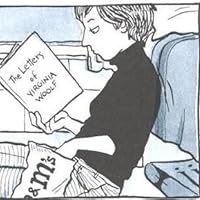
Review of advance copy received from Edelweiss+
2.5 stars. As a lesbian and anti-porn feminist, there was much I disagreed with Lewis on. However, there is no denying that this is an incredibly well-researched and deeply thought-out work.

July 17, 2026
There were essays in this -- particularly anything bashing the JK Rowling brand of TERF -- that had me punching the air.
Did Not Finish
August 3, 2026A book about other books, but not especially readable on its own. Let this not be your first book of its kind to grace your shelves.

August 4, 2026
Fascinating and phenomenal! 10 outta 10!
Displaying 1 - 30 of 35 reviews