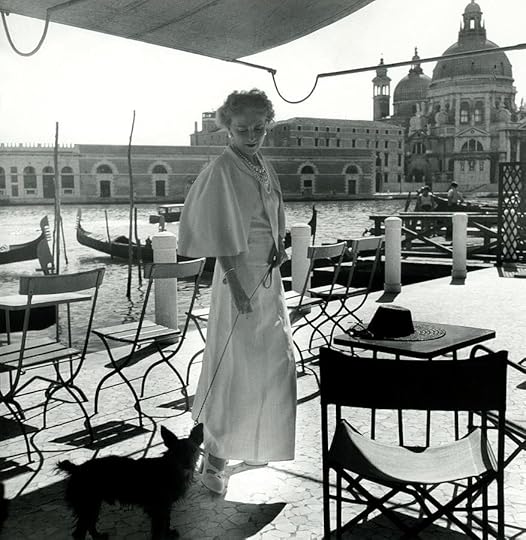
Diplomat, writer and poet, traveller and socialite, friend of Proust, Giraudoux, and Malraux, Paul Morand was out of the most original writers of the twentieth century. He was French literature's globetrotter, and his delightful autobiography is far from being yet another account of a writer's life. Instead it is a poetic evocation of certain scenes among Morand's rich and varied encounters and experience, filtered through the one constant in his life, the one place to which he would always Venice.
Paul Morand was a French diplomat, novelist, playwright and poet, considered an early Modernist.
He was a graduate of the Paris Institute of Political Studies (better known as Sciences Po). During the pre-war period, he wrote many short books which are noted for their elegance of style, erudition, narrative concision, and for the author's observation of the countries he visited combined with his middle-class views.
Morand's reputation has been marred by his stance during the Second World War, when he collaborated with the Vichy regime and was a vocal anti-Semite. When the Second World War ended, Morand served as an ambassador in Bern, but his position was revoked and he lived in exile in Switzerland.
Post-war, he was a patron of the Hussards literary movement, which opposed Existentialism. Morand went on to become a member of the Académie française; his candidature was initially rejected by Charles de Gaulle, the only instance of a President ever exercising his right to veto electees to the academy. Morand was finally elected ten years later, though he still had to forgo the official investiture).
Paul Morand was a friend of Marcel Proust and has left valuable observations about him.
Estas memorias fueron escritas por el diplomático Paul Morand en los años setenta del pasado siglo, cuando comenzaba la democratización del turismo y él se encontraba al final de su vida exiliado después de haber sido embajador para el Gobierno de Vichy, colaboracionista con el régimen nazi.
Paces impuestas, negociadoras, gloriosas, infamantes, eso es la política. No he amado más que la paz. Esa fidelidad me acarreó raras infidelidades de la suerte. Me hizo, en 1917, pasar por una izquierda muy avanzada, para dejarme, en 1940, en un Vichy maurrasiano donde no me sentía menos desorientado. El hombre no cambia, es el mundo el que gira a su alrededor.
Esperaba una especie de gran confesión vital, llena de porqués y de propósitos de enmienda, pero no, digamos que como personaje decide desertar de la Historia para buscar refugio en el arte, optando por un melancólico culto a la Belleza, por un venecianismo decadente y muchas veces empalagoso. A pesar de las fiestas en los palazzos y de las docenas de amigos singulares, como Picasso, Proust y Chanel, acaba como aquel viejo desencantado de la Europa hemipléjica, como él la llama, del Asia del petróleo, de la América del tedio, contagiando de acritud cualquier observación sobre esta luminosa ciudad. Termina su vida despachándose a gusto contra la pintura iconoclasta, la música dodecafónica, el feminismo, la democracia… Vamos, que todo mal.
I look on that world of yesteryear without resentment, nor regret; quite simply, it no longer exists; for me, at least, since it continues, without any bother or fuss, in a universe that is a little more brutal, a little more doomed, and in which the average level of virtues and vice must have remained more or less constant. It is merely that its ways are no longer mine [...] there's nothing left for me to do down here except make way; I shall never accustom myself to electronic gadgetry, nor to living in a country whose fate is being determined six thousand kilometers from where I live. Everything sets one's teeth on edge in this world where it is always rush hour and where children want to be Einsteins;
Throughout History, Venice has shown two faces: sometimes a pond, sometimes the open sea, one moment peddling lethargy in bookshop windows, the next exploding into a far-flung imperialism'
That black little canal; at the far end, at the very top of the perspective, there is a house of a dull red colour; as the sun goes down, its beams suddenly alight on the façade and illuminate it just as one lights a candle. Water lends a depth to the sounds, a silky retentiveness that can last for over a minute; it is as if one was sinking into the depths.
This reader, having but a fraction of Morand's education and none of his worldly experience, can only half comprehend the splendour that gilds his prose, but even if understood only in part, it fully fascinates. The writing reflects the author - cultured, elegant in thought, musing but not rambling, exhibiting a control that is not imposed but learned, permeating. This book is part 'sketch' of a place and part autobiography. Moving from a dignified past to the years of World War Two to finally face an unexpected and uncertain present, details Venice not just as a place, but as an experience. His observations of the city unfold in sensory, personal, aesthetic, and historical dimensions, and attesting to the cultivated mind behind their conception, there are no strict boundaries between these 'types' of reflections. The memory of witnessing the auctioning of an art collection ('April 1964, Crazy Bidding') provokes a Proust quotation, the history of the Palazzo Labia, the venue of the auction, appears casually, and, between the suggested disconnection between art and the market (or rather, the incomprehension that these two wildly different concepts would ever meet, and that they do, any hope of reassuring reconciliation) lurks something like sadness:
'Beneath M.R.'s ivory hammer, an entire art-lover's world would vanish; artefacts have no master. Only the Tiepolos would remain, their fate bound to that of the walls of the empty building. [...] Above them was the throng of goddesses, painted as permanent frescoes, and who were now mistresses of a deserted Palazzo Labia, laughing for all eternity, like the Rhinemaidens. Detached from their supports, in whose arms would these beautiful women now lie? Where would these Bacchuses parade their drunkenness, or these Ceres their harvests?'
The dignity of this passage belongs to the lament. Although Morand at other instances is quick to assume indifference, that loss seeps through. It leaves one wondering whether such insouciance is dignified concealment - which is probably the best.
Morand raconte ses Venises. Il narre plusieurs épisodes de son existence plus ou moins liés à Venise et aux visites ou séjours qu'il y fit. Le récit est truffé d'anecdotes historiques et souvent passionnantes tant sur la ville que sur ses mondanités dont Morand était particulièrement friand. Malheureusement, certaines histoires font trop de références à un monde perdu et à des célébrités aujourd'hui inconnues ce qui nuit parfois à l'intérêt du récit. Une vision littéraire qui reste toutefois passionnante sur une époque et une ville qui reste éternelle.
Quelle belle langue. Ci-dessous quelques exemples de jolies trouvailles. Mais c’est un poil perché quand même. C’est une superbe promenade littéraire mais dont on comprend à peu près un mot sur deux. Trop de noms de lieux inconnus et trop de noms de personnes de l’époque qui ont compté pour l’auteur mais dont la réputation ne nous est pas parvenue. Il s’ensuit une lecture difficile.
Venises « Ce Monceau que nomment plaine ceux qui n’ont jamais gravi chaque matin la rue de Courcelles »
« Devant le soleil à son déclin mes couchants sont ceux de Turner; mes nuages, des ciels de Courbet, des plafonds de Tiepolo; je n’imagine pas d’autres dégels que ceux de Monet, toutes mes femmes ont le ventre de de Rodin ou les jambes de Maillol »
« La vieillesse vit sous le signe moins : on est de moins en moins intelligent, de moins en moins bête »
« Au sommet du campanile j’embrassais Venise, aussi étalée que New York est verticale, aussi saumonée que Londres s’offre en noir et or. L’ensemble est lavé d’averses, très aquarellé, avec des blancs rompus, des neiges morts, relevés par le cramoisi sombre de façades pareilles à la chair de thon »
A sort of memoir written by the 20th century French writer/diplomat Paul Morand. The book features episodes from Morand's long and eventful life with the common thread being Venice, a city which obviously held great cultural and personal significance for the writer. Maybe there was something lost in the translation -- from what I understand he was a great prose stylist but this scarcely comes across in the English translation -- but I personally found it to be mostly underwhelming, although some of the historical detail is undoubtedly fascinating. Morand himself comes across as a frivolous, despicable person (something which wouldn't in and itself be a problem if the book wasn't so dull). A elitist snob who was also out and out racist; he also seemed to be very turned on by hippies. Morand was also a great name dropper and counted Proust and D'Annunzio amongst his acquaintances. However unless you're a fan of Belle Epoque French literature most of them will be very obscure.
Much of this did nothing for me, though there were some splendid moments. Most interesting was seeing how Venice changed for Morand over the years, although I found it disappointing that he seemed to end up in a rather curmudgeonly place at the end. What is it about people that leads us to believe that the things and places we love have all gone to hell by the ends of our lives? Maybe that's just one way we prepare for death, by coming to dislike everything we once loved during our later years.
My first book by Morand and will not be the last one. This one was a wonderful reading adventure, a mixture of memoirs and travelogue, or social and art criticism. Most of all we get to feel the melancholy of an old man who travelled a lot and loved even more: loved art, loved beauty, and loved the West, condensed especially into one magnificent city: the Serenissima Venice.
Another great thing about this English edition of 'Venices' is its translation. I have to admire this one; kudos to the editor/translator. And it wasn't an easy at all job. The edition, Pushkin Press, is very nice, and with neat and perfect sized typo.
Finished this applauding in my head. What a wonderful read. Paul Morand is now holding a place on my short list of people I'd happily be stranded on a deserted island with/invite to dinner, living or dead/whose books I'd rescue from the burning library...and on.
Morand is a knowing romantic. He grasps where his romanticism comes from and where it led him. Venice as the "thread" of his life is a perfect anchor for the roaming, romantic soul.
"Naive and foolish, it never occurred to me that we have duties toward Beauty..." p.33
"I have never learnt grammar; it's nothing to be proud of, but it seems to me that if I were to learn it today, I should no longer be able to write; my eye and my ear were my only teachers, the eye especially. Good writing is the opposite of writing well." p. 11
"'Well brought-up people do not swear.' (I immediately make up a list of all the swear-words I can remember)." p.155