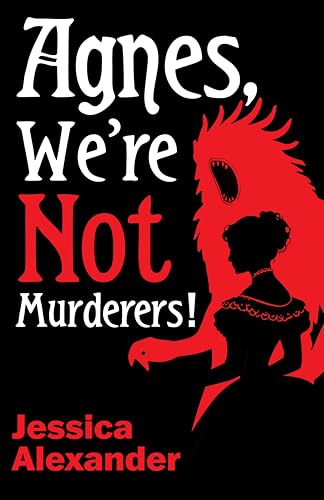
Lesbian vixens from another dead world thread through moon-drenched cornfields and opulent drawing rooms in this literary horror remix of iconic gothic sagas.
Agnes is wasting away. In a bed of velvet and silk, she dreams of death—and Mary.
Mary—a wraith with bloodstained gown and mouth—drips mystery and menace. She materializes beside a lake, beneath a pear tree, outside the window. She turns servants feral and plunges the manor into anarchy. Since her arrival, nothing is right. The maids snarl. The nights grow strange. Agnes swoons.
Her brother, Arthur, calls it a sickness. A curse. He stalks the halls with scissors in his fist. He wants purity and order. He’ll strike out the unintelligible. He is not the only one. Others have begun to stir—jilted lovers, disgraced doctors, moralists with sharpened knives. The disorder is spreading. It’s riotous. Contagious. They’ll purify the world in flame.
Written partially through footnotes and with a mystery of interwoven red text, Agnes, We’re Not Murderers! is an atmospheric gothic vampire journey for fans of Kathe Koja and Mark Z. Danielewski.
This book left me fascinated yet also incredibly confused. I really liked the premise of the book and I was intrigued by the way the story was told. Though the story excels at creating a real gothic atmosphere. It left me utterly confused about the storyline, so much so that I wouldn’t be able to sum up what happened if someone asked due to the fact that just SO many things happened which are, in part, all connected with each other. Besides, the way the book is written with the annotations was pretty confusing too especially having to switch back and forth between the pages. I think if I’d read this as a physical copy it might’ve been much better. However, and I want to stress this, the story is certainly worth a read. Alone through the unique way it’s told and the way it easily creates this gothic atmosphere with a nod to the classics like Camilla or even the atmosphere of Northhanger Abbey. A solid 3 stars from me. Thank you to Netgalley and the publisher CLASH Book's for giving me a free copy of this book to review.
this novel is everything that should excite me - a lesbian, atmospheric gothic vampire story - yet it reads like gibberish. it tries to be too many things at once: a novel, an author's ongoing footnote to the text, and, at times, a lecture on the gothic genre. as a result, it ultimately falls flat. in its attempt to be unique despite its acknowledged influences, it becomes messy and convoluted, partly because its formatting is ill-suited to an ebook and partly because jessica alexander's ambitions do not align with the novel's scope.
I couldn't get into this at all - it was sentences jumbled together with no rhyme or reason. I normally love a narrator with personal footnotes but these ones were just silly and excessive with telling me "who is Clara? See page 138," and "see page 67 for more fog," and the like over and over.
Perhaps it reads better in paperback but for ebook it was too confusing to attempt to go on.
Thank you to CLASH Books and Netgalley for the ARC.
With a nod toward classics like Carmilla and Northanger Abbey, and weaving in footnotes almost like House of Leaves, Agnes, We’re Not Murders is a 3.5 stars rounded up to a 4.
Usually, books have a compelling plot with lackluster language. In this case, the language was superb with absolutely sparkling humor, but I struggled with the plot. I did start over at least once. I kept reading for the laughs even though I couldn’t be sure what was happening.
I’ve added the author’s other works to my TBR pile, because she is hilarious, although I’m not sure this was the book for me.
Thanks to NetGalley and Clash books for the advanced copy in exchange for my honest review.
What a fascinating and confusing read. I am befuddled and delighted.
This book drew me in with its premise and the abundance of footnotes, oh how I loved the footnotes. Unfortunately, without a physical copy to more easily swap to and from different places, I felt a little lost several times. But it's exciting! I want to grab a copy for the full release, so I can read through it again and collect the passages that go together, and write down who is where or when and what.
This, for me, is a book unlike any other I can remember reading in recent times, and I mean it. It's not terribly long but it captured me even more so for the time it held me. I think the best way to go about reading it is in one go, and then give yourself some rest and return to it anew. Maybe with a notebook at hand, to write things down. (It has also ignited my desire to start a commonplace book yet again..)
Thank you to Netgalley and the publisher for this ARC.
Bad Doctors, Worse Brothers, and Women Who Refuse Their Assigned Plot The sly, lush, mutinous intelligence of Jessica Alexander’s “Agnes, We’re Not Murderers!” By Demetris Papadimitropoulos | April 3rd, 2026
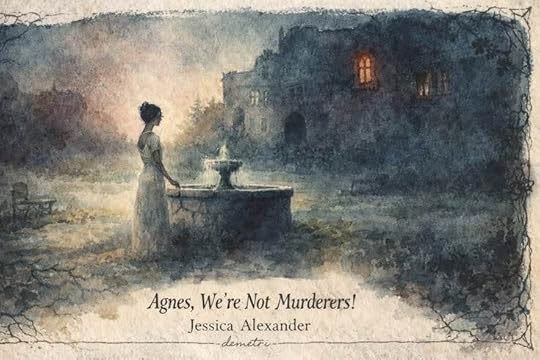
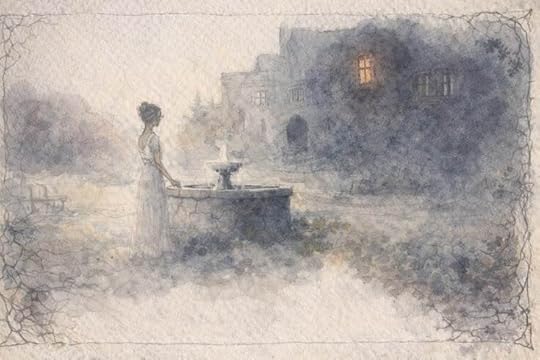
A solitary woman beside a cracked fountain, half-caught in twilight and half-held by the dark house behind her, becomes the book’s clearest emblem of longing under watch, where desire, memory, and interpretation all begin to feel like forms of custody.
Most gothic novels ask who is haunting the house. Jessica Alexander’s “Agnes, We’re Not Murderers!” asks a nastier question: who profits from calling a woman a ghost. That shift matters. Alexander is not simply reviving abbeys, portraits, invalids, revenants, and bad doctors for the fun of rearranging antique furniture, though she is certainly having some fun. She is interested in naming as an act of power. To call a woman sick, cursed, monstrous, romantic, dead, or dangerous may look like knowledge from a civilized distance. Up close, it starts to look like custody.
Alexander takes the old stage machinery and teaches it bad habits. There are abbeys and convents, portraits and trunks, moats, fountains, hidden passages, letters, invitations, commonplaces, doctors and counterfeit doctors, and women who keep returning through the wrong account. In lesser hands, all this would settle into costume: velvet, fog, a little blood at the lip, everyone arranging themselves into agreeable tableaux of doom. Here the furniture turns mutinous. A portrait accuses. A trunk withholds. A wall seems to carry a pulse. The opening letter flirts, threatens, and sends you elsewhere before you have had time to sit down. Before Part I has properly settled, the novel has already taught you one of its crooked rules: whenever a straight line toward explanation appears, take the side door.
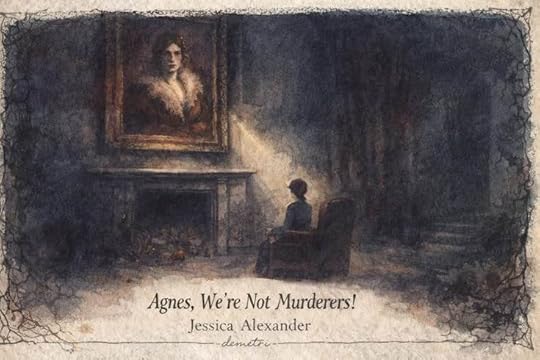
A room arranged around a portrait that no longer behaves like decoration but like witness turns the novel’s gothic interior into a tribunal, where likeness itself becomes a form of pressure.
Agnes enters under surveillance: brother, Physician, room, bed, narrative already tightening around her. Mary, by contrast, arrives like a breach in the wall, by windows, in gardens, beside water, in every place where desire shares a border with unreality. Agnes wants her at once. She wants to know her, keep her, perhaps even be remade by her. Alexander is too sharp to varnish that wanting into innocence. Agnes’s desire matters because it is moving and because it is vain, jealous, and possessive. She wants Mary. She also wants Mary to be hers. One desire seeks contact. The other seeks a usable form of certainty. The book keeps returning to that split. It does not trust anyone’s wish to “understand” another person if what they really mean is pin her down.
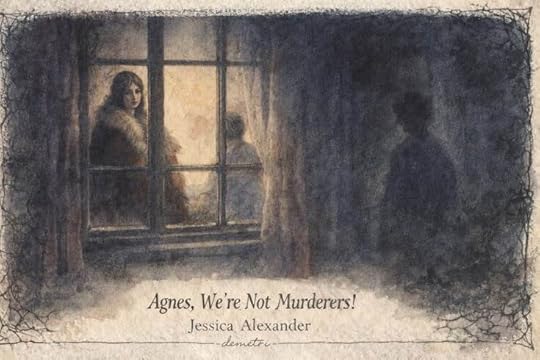
Poised between threshold and apparition, this visit at the window catches the book’s most unsettling exchange between haunting and desire, where recognition arrives already touched by error.
The men, meanwhile, keep mistaking their authority for usefulness. Martin arrives with rescue already rehearsed and is told, briskly and correctly, that he is not the hero here. Arthur wants order with scissors in hand. The Physician wants explanation. Later there will be Clara, Laura, Catherine, the inn, the convent, the old Countess, the journals, and the bungled science of men who keep confusing interpretation with control. Bodies are opened, moved, buried, lost, revived, and found again under false captions. Thomas is Thomas until he is not. Arthur becomes a General and remains, beneath the braid and swagger, the same acquisitive fool. The convent refuses to burn. The dead refuse the terms of their death. The living keep trying to force both facts into a version that leaves their own dignity intact.
A neat summary would flatter the wrong qualities. “Agnes, We’re Not Murderers!” does not move like a case file. It coils, doubles back, inserts a letter where a scene ought to be, gives you a confession only to spoil it with the next account, and keeps bringing the same image round with a different assignment. A portrait is likeness, then accusation, then witness. A trunk is dowry chest, coffin, bad archive, and gag. The fountain turns from trysting place to death site to threshold where one woman mistakes another for memory. Each new document offers certainty in one hand and snatches it with the other. The novel does not simply delay information. It makes information itself suspect. By the time an explanation arrives, it already carries the fingerprints of whoever needed it.
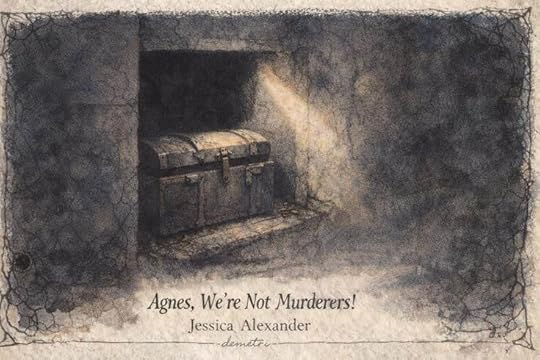
Half archive, half coffin, the hidden trunk distills the novel’s obsession with what stories bury, preserve, and withhold, making secrecy feel less like absence than like a charged physical object.
That recursive structure is not decorative cleverness. It is the novel’s argument in motion. Alexander is staging diagnosis, courtship, and criticism as neighboring acts. All three begin with attention. All three quickly risk reduction. The doctor wants to classify. The lover wants to know. The narrator wants to account for what happened. The trouble is that each of those appetites can become a way of shaving a life down to the version one can bear. The footnotes are crucial here. They do not adorn the novel’s intelligence. They heckle it, spoil it, and reroute it. They interrupt the main line with theory, grief, parody, memoir, classroom anecdote, and bad memory, as if annotation itself had become another haunted corridor. The loose comparison to “House of Leaves” is not useless, but it is not quite right either. Alexander is after something warmer, messier, and more bodily. She is less interested in textual instability as a game than in the number of ways a story can be made to serve the people telling it.
The prose is what makes that mess feel inhabited rather than merely intricate. Alexander writes in a split register that can hold gothic formality, acid comedy, bodily disgust, and sudden tenderness without sounding like four novels elbowing one another in a corridor. One man’s “predilection for abstraction” has “ossified his face,” which is not just funny but exact. A wall can throb. A scrap of fur, a parasol, a shoe buckle, a little green spit, these details recur until they stop behaving like ornaments and start behaving like evidence: of desire, of accusation, of somebody’s bad attempt to make a life file neatly. The sentences spool out, then snap shut. Just when the novel risks sinking into candlelit seriousness, it bites through the drapery.
Without that tonal quickness, the whole arrangement would suffocate under its own richness. Alexander is very funny about male vanity, failed expertise, and the astonishing confidence with which fools narrate other people’s lives. Arthur’s blurred memory of old crimes as if they were mildly awkward social episodes is comic right up until it curdles. The Doctor, staggering beneath his own theories and failed ambitions, is ghastly, then absurd, then ghastly again. Even Venice gets a sly turn, with egrets, heiresses, comic mistiming, and men too swollen with themselves to notice reality slipping its leash. The laughter does hard work. It keeps the novel from polishing its darkness into heirloom silver. It also prevents the book from becoming reverent about its own apparatus, which would have been fatal.
And the ache lives in the relations, not in some imported weather of prestige sorrow. Agnes wants Mary. Clara wants Mary. Laura wants the girl who arrives as ghost, substitute, mistake, or answer. Mary herself is snagged by so many stories, wanted as symptom, beloved, threat, explanation, that she nearly dissolves into the fact of being awaited. Haunting here is not only about the dead. It is also about wanting that cannot settle into any respectable shape without falsifying itself. One of the novel’s better, harsher insights is that queer desire is not magically redeemed by its distance from sanctioned forms. It can be as acquisitive, as self-deceiving, as narratively hungry as anything else. That makes the book more convincing, not less tender.
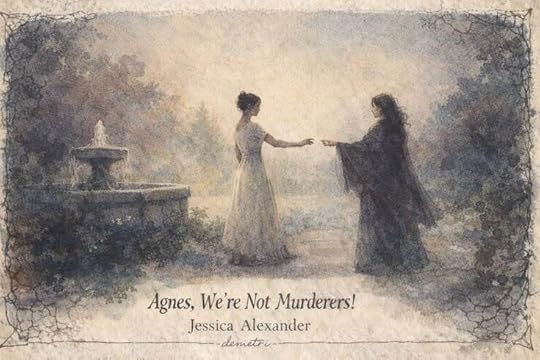
A reaching hand that cannot quite become contact gives visual form to one of the novel’s deepest sorrows: the hope that recognition might heal, and the knowledge that it may instead misname.
This is where Alexander’s novel earns its real force. It turns the gothic into a custody battle over meaning. All the old props that usually get to look innocent, the portrait, the ruined house, the physician, the hidden chamber, the cursed lineage, the dead woman who will not lie still, are dragged into the witness box. Why are certain women so quickly rendered as cases, doubles, monsters, wives, or dead beauties? What pleasure is being gratified when another person is finally said to make sense? The answer, the novel suggests, is often the pleasure of being right about someone else. Or, worse, the pleasure of being absolved by the story one has told about her.
The book’s greatest strength is also where it incurs its cost. The recursions often sharpen the novel’s pressure, but not always. Some returns come back hotter. Others merely come back. A few of the men flatten into fixed roles, pompous doctor, acquisitive brother, sentimental incompetent, and while they are frequently funny, not all of them keep gathering force. Alexander sometimes likes the contraption a touch more than she needs to. You can feel her pleasure in the apparatus, and occasionally the reader is asked to admire the mechanism when a firmer cut might have made the scene draw more blood. This is not a book whose weakness lies in timidity. It lies in the fact that abundance can become drag, and that recursion can lower voltage when it means to intensify it.
Still, I would rather read a novel that risks surplus, distortion, and one return too many than one that behaves impeccably while discovering nothing. Alexander’s overreach is the overreach of abundance. The same lushness that can slow the novel also keeps it from drying into argument. There is mud on the hem here. The book likes the wrong texture, the room with one object too many, the sentence that nearly tips over, the image that comes back because nobody has yet learned how not to stare at it. When it repeats itself, it is often because repetition is one of its subjects, how violence becomes routine, how desire becomes ritual, how stories survive by being told again badly.
That gives the novel an organic relevance that does not feel imported or dutiful. Alexander does not need to drag the present in from outside; it is already there in every act of explanation disguised as care. The book’s concern with diagnosis, narrative custody, archival power, and the urge to turn another life into usable evidence needs no topical gloss. Doctors, brothers, lovers, and readers all want roughly the same thing here: for reality to lie still long enough to confirm the version in which they were right all along. That is not a contemporary problem only. It is an old, cheerful, self-excusing human one. The novel just happens to be unusually alert to how ugly it looks under lamplight.
For me, it lands at 89/100 – 4 stars: an excellent, high-risk novel whose finest powers are artistic and intellectual first, emotional second, and whose unevenness comes from surplus rather than thinness. I admired it more readily than I surrendered to it. That is the right response to a book that wins by insistence, not by ease. Its best images do not merely linger; they keep changing jobs after the book is shut. The battered trunk becomes archive, joke, coffin, and accusation all over again in memory. The wall keeps its pulse. The fur-clad woman remains visitation, memory, appetite, and misreading at once. The fountain keeps working through scene after scene as if water could remember what people cannot.
The ending finally says out loud what the whole novel has been doing in bad faith and excellent form. To tell is to shape, and shape here often means reducing a life to the usable part. The dead do not return simply because they were wronged. They return because no one has yet managed to put them in the right story without doing them fresh damage. What the book leaves behind is not a solution but a suspicion: that the wish to solve was the ugliest impulse in the room. Not who did it, then. Who needed it said that way, and what, exactly, they hoped would stay inside the frame and under glass.
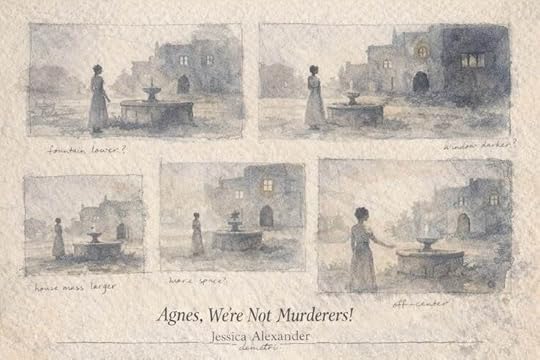
These first small studies search for the uneasy balance of woman, fountain, and house, proving that the final image’s haunted stillness begins not in detail but in spacing, weight, and who seems to be watching whom.
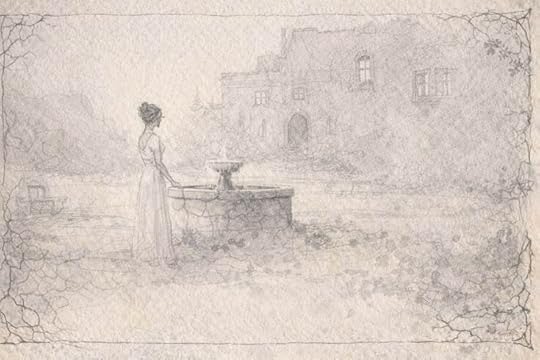
The underdrawing reveals the quiet armature beneath the finished watercolor, where architecture, interval, and silhouette establish the image’s real drama before atmosphere ever enters the paper.
With the first wash in place, the composition begins to discover its emotional weather, as light, shadow, and diluted color turn a drawing of objects into a scene of exposure, waiting, and pressure.
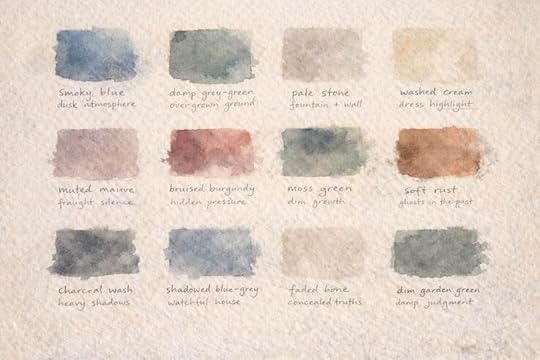
This swatch study translates the book’s cover palette into a dusk-toned watercolor language, testing how bruised greens, smoky blues, and pale stone might carry the image’s tension without explaining it away.
All watercolor illustrations by Demetris Papadimitropoulos.
Tragically, a disappointing read, but like Britney Spears, I choose my own destiny.
I read /forced myself to read roughly 75% of it, so I will still write a quick review of my thoughts:
- First of all, the formatting is an absolute nightmare on a digital device. - The writing is sadly a nightmare as well. It feels like Miss Alexander got a Thesaurus gifted for her birthday and now wants to show off. Yes, the prose is eloquent, but in a way that feels disingenuous. - The pacing of the story is confusing, and I tried (trust me) to follow along. Even after 170 pages, after going back and forth, even re-reading certain chapters, I still have no idea who is who and why I should care for any of these characters. - The story wants too much. I do appreciate that this novel is not your average run-of-the-mill book, but it runs into a problem that a lot of the new-age/lit fic books like "Woman Eating" before it stumble upon: it wants too much. As a reader, I am being presented with a gothic horror novel, a literary version of the author in the footnotes, there's discussion about death, dating men and literary essays on gothic novels/movies, so on and on. The main problem is that it doesn't go into anything in-depth. "Agnes, We're Not Murderers!" dips its toes into so many ideas that, in my mind, it lost track of what it wants to be.
picked this one up randomly off my library's new release shelf, so i think i had a leg up on my fellow reviewers, in that my experience was totally blind and also a physical book to flip thru. i admit 20 pages in, i stopped to text my partner "😡um. i thought this was about lesbians??? why are we only focusing on men and their desires??😡🤢" but i kept reading and i was sat and locked in for the rest of the journey!
-this is a book that needs to be read physically!!
-you need to have patience/enchantment for repetition!
-this is a book for readers who enjoy creating character webs!
-low genre-savvy entry point, HOWEVER, i encourage readers to check the wiki for each author and book referenced for a fuller experience! great jumping off point to dip your toe into established classics in both gothic and post-modern
-this is niche but the feeling i had reading it was like being in middle school and going over to my friend's house to play a poorly translated surreal otome game together and try and figure out all the branching storylines and true ending.... iykyk.
NEGATIVES-
i think it needed a BIT more filler to bridge gaps in narratives. i appreciate that this book tried to slim down, especially with the repetition of flipping back and forth of footnotes and rereading of pages in new context. but i think we could have sat longer in the emotions of a few "characters".
there were also many glaring typos and printing errors, some of which required me to logic out which page i actually needed to turn to. it made me sad thinking no one went thru for a final edit.... hire me!!!!!
POSITIVES- i really really reallyyyy enjoyed the autobiographical footnotes. once i realized what was happening, it made the story so much more nuanced. grief, longing, repression, fear, hatred... and historical facts 😂 i liked that!
i know some hated it, but i really enjoyed the meshing and unreliability of which "character" is still "that" character. i had other life obligations, so it took a week to finish this book... i found myself thinking about it multiple times a day and weighing my feelings on the plot and characters. i'll be honest that this is probably objectively a 3/5 book (even with typos and stuttering plot, its above most books out on the shelves!) ......but..... my PERSONAL enjoyment is a 4/5. if it were edited more thoroughly, i could easily see this being a 5/5 read. i actually wish it leaned further into the gothic horror of era compliant comphet and pregnancy and femicide and even the incest of it all. i think this book needs an extra push into the true genre, no holds barred, a real tooth-and-nail, bile-rising experience. just my thoughts!
This entire review has been hidden because of spoilers.
I was promised lesbian vampires. I read this whole book and I'm honestly not sure what I got...
This was a strange, confused book. It read as a book within a book, a tale of characters, archetypes within the genre, repeating stories echoing through time. I was quite a way through the story before I realised that the footnotes were written by someone outside of the story. And that they were in our present time, although the book itself was set in some indeterminate 'gothic past'.
Agnes, the character in the title, fades out of the story about a third of the way through. It's hard to know what was the point of her character, or anyone within this book.
This doesn't work in kindle format. It needs to be read as a physical paperback if it has any chance of doing what it aims to do. There are a *lot* of footnotes in this book, on almost every single page. Sometimes as many as six, sometimes only one but then that footnote takes up the majority of the page. Not only are the footnotes in bright red, but so are random words of the main tale itself. Plus the footnotes themselves were weird. They fell into three board categories - either they were simple things like 'for more about X see page y' or they were flat out spoilers to the text 'but this isn't the real B, B is somewhere else' or, the most interesting of the three, they were musings on the present day persons life, another layer and the hint of something worthwhile. But only ever a hint.
More often than not, the ones that told you to go to another page to learn more eventually lead you on a loop back to the first footnote, without you being any the wiser. And its awkward to do that in a kindle book when you can so easily flip between pages of a physical one.
This feels like it was trying to copy books like House of Leaves, but went too overboard with the concept. Sometimes, less really is more.
I want to be confused, tested if I know I'm reading one of those type of books, but I still want to feel like I'm actually reading a tale that could make sense.
In the end, it felt like this book ate itself, an ouroboros, before collapsing under the weight of it. If you want to give it a try, at least get the physical version to give yourself the best chance.
~Thank you to NetGalley for the ARC in return for an honest review~
Agnes, We’re Not Murderers! by Jessica Alexander #dnf #arc #agneswerenotmurderers
CW: I didn’t read far enough to notice any. Vampires, I think.
From NetGalley: Lesbian vixens from another dead world thread through moon-drenched cornfields and opulent drawing rooms in this literary horror remix of iconic gothic sagas. Agnes is wasting away. In a bed of velvet and silk, she dreams of death—and Mary. Mary—a wraith with bloodstained gown and mouth—drips mystery and menace…She turns servants feral and plunges the manor into anarchy. Since her arrival, nothing is right. The maids snarl. The nights grow strange. Agnes swoons. Her brother, Arthur, calls it a sickness. A curse. He stalks the halls with scissors in his fist. He wants purity and order. He’ll strike out the unintelligible. He is not the only one. Others have begun to stir—jilted lovers, disgraced doctors, moralists with sharpened knives. The disorder is spreading. It’s riotous. Contagious. They’ll purify the world in flame. Written partially through footnotes and with a mystery of interwoven red text, Agnes, We’re Not Murderers! is an atmospheric gothic vampire journey for fans of Kathe Koja and Mark Z. Danielewski.
My thoughts: I got 15% in before giving up. The first four chapters were very confusing and half of the story is told in footnotes. Those footnotes seem to be written by someone in another time period, talking about pizza places and dildos, while the main story seems to be a gothic noir from long ago. Random phrases are in red, sometimes matching with the footnoted parts but sometimes not. A lot of footnotes refer you to other pages in the book. This is difficult to navigate in an e-book but even more so because this book had to be read in the netgalley reader and not on my kindle, which was frustrating. I would have pushed through it if the first chapters made any sense, but since they didn’t, I gave up. This is one of the those books that really must be read in physical form. I would like to finish this at some point but I will need to wait until my library gets it.
Thank you to @clashbooks and @netgalley for the advance copy. (Pub date 6/16/26)
Recommended for readers who like their narratives as puzzles.
In this gothic, sapphic horror novel, the women - the mysterious seductress, the sick relative, the isolated, the forsaken children, the haunting wraiths, the misjudged and young - take center stage. Let's remain like this, except that it, like often, starts with two women, Agnes (sweet, naive, yearning, lonely) and Mary (bloody, suspect, determined), aligned seemingly in spirit and affection. Multiple characters appear as different personas. Likely worth a re-read with the information gained from the first time. Furthermore, the story attempts to endear itself by its creative use of footnotes. For me personally, their effectiveness in execution remains blurry, but we have 3 different kinds of footnotes: the ones commenting on the current narrative (interesting, useful), the ones pleading with the reader to go to another page (famous example: For more fog, go to page ...), and lastly the ones detached from the story and pondering about feminist themes in modern times (covid-inspired, interesting takes but questionable in existence).
A little collection of thoughts from someone who did not enjoy the book for those remaining interested: The story is closer to being an inherently disconnected string of events. Even inside in scenes, some narrative pieces appear to just happen because. Not helped by the footnotes asking you to jump around the pages and rambling. Meanwhile, the writing is a bit insufferable and felt a bit shallow. (But managed a good, gothic-like atmosphere anyway.) The characters appear archetypical, but that was expected and worked with the attempted story. I experienced the book as deeply frustrating and would have DNFed not for it being an ARC and my hope it would all come together at the end. My patience was unrewarded.
Rounded up to two stars for the great, queer atmosphere. Thanks to NetGalley and CLASH Books for an ARC for an honest review.
To be honest, I can't confidently say what I just read.
Weaved with dozens of footnotes, mysterious red text, and two interwoven stories that are in no way told in a linear fashion, Agnes, We're Not Murderers! left me confused and barely grasping what happened. The shifting focus on characters with no strong recognition of change of POV, some chapters had me wonder who was even speaking and acting. It was quite easy to jumble up the characters as there was no discernable way to keep them separated with the chosen format of storytelling. The format also made it twice as difficult to keep the footnotes straight as digital readers cannot easily allow for flipping between pages to keep the information straight.
On the other hand, the prose was unique - a mixture of flowing and stuttering in the most purposeful of ways. It led to me somewhat understanding how the character (of that particular chapter) was feeling or thinking, and many, many pieces are left up to the reader to put together into one coherent, completed puzzle.
The synopsis does not prepare the reader for the type of story that is being told, and I had a hard time reminding myself that this gothic horror-like story was supposed to have vampires in it. With the description of the "illness" it felt less like vampirism and more like an unnamed one that pulls a little bit from other well-known gothic horrors together.
Feeling too disjointed for me, but appreciative of the planning that went into the non-linear storytelling and the beautifully written prose, I'm on the fence on suggesting this book as it can easily be a hit-or-miss with certain readers.
Thank you to NetGalley, the author, and the publisher CLASH books for allowing me an eARC to read and review.
This novel had all the ingredients of a book I should have loved—most notably, its themes and structural resemblance to not one but two (!) of my all-time favorites, Carmilla and House of Leaves. Sadly, that very resemblance was precisely what made comparison to its predecessors almost unavoidable.
As much as I enjoy being pleasantly confused by a narrative, I love even more the experience of a plot that slowly unfolds, allowing me to piece things together as I go. In House of Leaves, the footnotes functioned as clues, satire, or even a well-placed wink to the reader; they weren’t frustrating so much as motivating, pushing us further to uncover the mystery. Here, however, we are dropped into a setting we know nothing about, with characters we have not yet had reason to care for, and footnotes that point to other pages, often seemingly just for the sake of it.
That said, there is much I genuinely appreciated. The prose, for one, is astonishing. Even though I didn’t connect with the story or its characters, reading it was a pleasure in itself, and that alone is a strong indicator of the author’s talent. Some of the dialogue is truly beautiful, and some moments are downright hilarious. I often found myself laughing out loud at the scattered footnotes about the (fictional) author and her real-life experiences.
All in all, I would like to read more by Jessica Alexander, but perhaps in a novel that feels more distinctly her own, and without the weight of other stories hovering so closely in comparison.
~Thanks to Netgalley for providing a digital ARC of Agnes, We’re Not Murderers! in exchange for an honest review. ~
I’m gonna be so honest…. I have no fucking clue what I just read. This book had just enough to intrigue me that I kept reading, but also… I doubt I’ll retain a single thing because the story was just told in a way that was far too confusing. Maybe if I actually could have flipped between the different footnotes, I might have followed this easier, but the formatting of the e-book was terrible for that. Not to mention, the footnotes could also be superfluous or confusing themselves.
The writing was… very hot and cold. Sometimes it flowed, sometimes it was choppy, it could be stream of consciousness or over the top flowery. The alternating perspectives also jumped timelines ( I think?) and many characters were referred to by numerous names but not in ways that were memorable.
This was… weird. I think there’s probably an audience for this book, but I’m most definitely not it.
I actually went ahead and read this one twice...once when I was first approved (Thank you NetGalley and Clash!) and again now that it was closer to release date. The atmosphere is spot on, the story is interesting. The writing itself is just...beautiful. Chef's kiss.
But to say the format is confusing is the most understated way I can put it. If you like escape rooms, large puzzles, or have the time and patience to unpack a little mystery this is excellent. If you use an e-reader, you will be fighting. for. your. life.
The use of footnotes is a unique choice, something I typically encourage and admire in writing. However, flipping around for the footnotes is a little bit of nightmare on e-reader, and it's not really an "opt-out" situation if you want the full experience. Beware this format is not comfortably accessible to everyone.
I want to emphasize that the choices made here aren't bad, just potentially difficult to get through (But totally worth it if you're willing and able, as antics of lovers Mary and Agnes are delightful).
If you're interested in this twisty, turn-y WLW vampire horror, I'd strongly consider purchasing a physical copy (making the page-jumping and annotations a little easier to follow).
So I just finished this, and to be honest, I don't really know how to feel. On one hand, I really liked the idea of how the book was formatted, and was using the footnotes in a really interesting way, and I did really like the writing. On the other hand, I think that the footnotes kind of lose their power, as they require you to flip back and forth a lot, as an ebook (which was the way that I read it), as this became a hassle if you ask me. It made me very confused, and this confusion made it really hard for me to continue in the book, and want to continue reading as i did not understand the story, and even after having finished the book, I still do not really understand what was going on. I do think that this would work a lot better in physical form, and maybe that would clear some of the confusion that I was left with. But even though it was confusing, i finished it, and I was captivated at times, because I do think the writing is nice. Thank you, Netgalley and publisher, for letting me read this ARC :)
I really do not know what I just read. I was delighted and fascinated by the red text and the footnotes, but did I know what any of it meant? No. This really is surreal in a way that I don't really enjoy, if it hadn't been for the footnotes and the humor I'd have rated this way lower. And I do think it's possible to understand the plot of this book, as confusing as it is, but you need to write yourself some notes (which I didn't do) and you need to have a physical copy of the book so you can flip around to different pages and remind yourself of certain people and events. This book doesn't want to give the plot to you, it wants you to work for it and I do love that idea, it's just hard to enjoy in a digital format.
I would say read this if you feel intimidated by House of Leaves but still want to have your brain broken by baffling footnotes.
Thank you to NetGalley and the publisher for a free eARC in exchange for an honest review.
I received this ARC from NetGalley in exchange for an honest review.
I had to DNF this at 36% because I genuinely had no idea what was going on.
I think the use of the footnotes is excessive and overdone especially because some of them just repeatedly tell you to go and look at a different part of the book. It’s very easy to get lost reading it in the digital format whilst looking across the pages. I also found the red words and phrases kind of jarring to read.
It felt like lots of sentences just one after the other and nothing made sense. I couldn’t tell who anyone was or where they were. The writing feels sort of juvenile. I think that there were too many exclamation marks used as well.
I think I can see what the author was trying to do with the footnotes, as like a sort of scavenger hunt? I just don't think it was executed well.
Thanks to NetGalley and the publisher for the ARC of this book.
Not a fan of the indecisive writing style, especially combined with how flowery it can be which can make the narrative flow become awkward in places and feel forced.
One thing that made me feel like the writer was trying way to hard as the use the of similes for the sake of it. A character at one point even makes a simile comparison then doubts his own description. The amount of repetition was making this a difficult read also.
It was just like I was constantly waiting for something to properly happen and if it did I might have missed it as I wasn’t fully engaged as there was also not a single character that I found interesting.
So, unfortunately I am tapping out with this one as I’ve got so many more currently engaging books to get through
Wow, I loved how weird this was. Unbelievably confusing but a hell of a fun time anyway.
I loved the footnotes and how this drew future elements of the story into the now - this plays in so well with the cyclical nature of the story, with the smoke and mirrors, so to speak, and the constant reframing of the narrative. I set myself up with a tablet to read, and a phone to search the footnotes, which worked really well.
It did start to get difficult to keep track of which character kept which moniker which was present in which scene and whether that scene was before or after the scene I'd just read. Definitely not a light-read but I loved how much it made me an active participant in piecing the story together.
I might still not be certain exactly what I read, but I look forward to trying it again!
I received an ARC from Netgalley in exchange for an honest review
"Spoiler" - the title is incorrect. There be murderers.
This is a trippy ride through a dark creature-filled gothic novel, intertwining four women who are more interested in women and the gothic men who are absolute crap to them, thinking they are brilliant and seeing women as things, objects, subjects for their experiments, and convenient scapegoat. It's like reading all of the gothic novels while on acid.
But there's also this beautiful, sad throughline in the footnotes of a more modern world, stretching toward the reason the gothic genre is still here and still strong. Some of it is revealed to you in reverse, some in present, some in past, and all kind of sad.
Although the constant footnotes about lesbians exchanging portraits made me laugh every single time.
Stick with it, once you get the rhythm of the characters, this is quite a ride.
If you asked me what this novel is about, I'd be unable to give a satisfactory answer simply because I have no idea what the plot is. There were moments while reading when I thought, “Ah, I finally see where this is going,” but I was mistaken every time. While I enjoy novels that have a nonlinear narrative, I found that in this case, the mechanism was overly complicated, leaving me unable to follow the action or the characters' identities. That said, the gothic atmosphere is immaculate. It could easily be a contemporary of Carmilla. The footnote system is very innovative, though it occasionally became confusing.
To sum up, it had the potential to be a great gothic vampire novel, but I finished it without understanding what had happened within the narrative.
Well, there's a lot to unpack here. To start, the 3 star is a placeholder rating as I read this in pdf form through Netgalley's reader. With the writing style, moving from footnote to pages forward and backwards, it was just not a good match. i will buy a physical copy and update the review when I have time to sit with it as intended.
That said, I think the style of writing is intriguig, the story has enough layers to be very compelling, and there's enough misdirection to break an Owl's neck.
At this time I wouldn't recommend reading a digital copy of this unless the publisher is able to hyperlink the footnotes and have a retun to page xx link also.
I will update after reading a physical version.
I received an Advance Reader Copy and am leaving a fair and honest review.
I really wanted to like this one and was so exciting for it. Sapphic vampires, gothicism, darkness. It had everything. The footnotes were an interesting concept, unfortunately this didn't work in an ebook format. I kept trying to switch between pages and on one point I just stopped doing so. I think a physical copy would make the novel significantly better, but it would probably still be confusing. Certain footnotes made me intrigued, others confused me way too much. It's a novel about vampires in a certain era and suddenly there are footnotes about Covid? In the end I still don't know who certain characters are, which is quite sad.
I might wanna read it again, but then in a physical copy for sure!
I was genuinely looking forward to reading this book. That's not to say that it was bad by any means. I found myself getting invested in the characters, and the story had a great gothic edge that I absolutely loved. The setup was intriguing and definitely made me want to keep reading.
My issue, though, was with the writing style. I found it so confusing at times that I had to reread sentences just to make sure I understood them correctly. Instead of flying through the book, I felt slowed down by trying to piece everything together, which ultimately took away from my overall reading experience.
Thank you to NetGalley, the author, and the publisher for this free eARC in exchange for an honest review.
Unfortunately, a DNF at 25%.
I was really interested in this premise and format, but I was just confused the entire time. I was more or less having a good time, but it started making me not want to continue, especially when I have other ARCs to get to. I think I'll give this another try in the future, but it was definitely just.... confusing, and it felt like it had no purpose to being confusing. I don't know if I was supposed to follow the footnotes like a choose-your-own adventure or?? Even reading it straight I was confused. And there seems to be no rhyme or reason to the red text. Maybe if I come back to it and finish it it'll make more sense.
Im not quite sure where to start with this review. I really struggled with this book. I was excited and intrigued by the premise and description, however the writing style made my head hurt and was extremely confusing.
The footnotes (if I had followed them) would have had me going back and forth between pages, almost like a "choose your own adventure " book.
I felt like there was a plot there, but it was so deeply buried in lines of words that made no sense, that it was almost invisible.
I was disappointed as I wanted to like this book. Thank you to Netgalley, the publishers and the author for this eARC in exchange for an honest review.
Thank you to Netgalley and CLASH Books for allowing me to review, Agnes, We're not murderers.
I'm rating this 2.5 stars. Not because it wasn't good, but because it was a little all over the place. The footnotes were totally unnecessary and there wasn't a ton of flow to the story.
It would've been easier to explain the relationships between the characters in some other way that didn't require having to flip from the page numbers referenced in the footnotes. I am not against experimenting with formatting and style, but in my personal opinion, footnotes should only ever be used for non-fiction or being snarky in a comedy book.
"Agnes, We're Not Murderers!" is a gothic fiction novel featuring mysteries to solve and with annotations/footnotes throughout the novel. Personally, this book did not work for me. I found the annotations to be almost useless and that the plot was hard to follow and not engaging. Part of my frustration with the annotations might be due to the fact I was reading the ebook and did not flip back as the annotations ask. I believe there were good ideas with this novel but they were not executed well. This book might work for vibe readers.
Thank you to CLASH books and NetGalley for the ARC in exchange for a honest review.