W galaktyce szaleją Wojny Klonów. Separatyści pod wodzą hrabiego Dooku nie ustają w krucjacie przeciwko Republice. Lecz armia kanclerza Palpatine’a, złożona z żołnierzy-klonów walecznie stawia im czoło.
Anakin Skywalker walczy u boku swego Mistrza Obi-Wana Kenobiego. Na każdym kroku czyhają na nich niebezpieczeństwa, a wszystko komplikuje się jeszcze bardziej, gdy w życiu młodego Jedi pojawia się wyznaczona mu na padawankę wścibska czternastolatka.
Nie czas jednak na kwestionowanie decyzji Rady, bo trójka Jedi otrzymuje rozkaz wypełnienia niebezpiecznej misji, od której zależą losy wojny...
#1 New York Times best-selling novelist, scriptwriter and comics author Karen Traviss has received critical acclaim for her award-nominated Wess'har series, and her work on Halo, Gears of War, Batman, G.I. Joe, and other major franchises has earned her a broad range of fans. She's best known for military science fiction, but GOING GREY and BLACK RUN, the first books in her new techno-thriller series RINGER, are set in the real world of today. A former defence correspondent and TV and newspaper journalist, she lives in Wiltshire, England. She's currently working on SACRIFICIAL RED, the third book in the Ringer series, and HERE WE STAND, book three in the NOMAD series.
It's no secret that I love reading Star Wars novels. Whether they're written for a Middle Grade, YA, or Adult audience, I love them all and always find them to be engaging and fun.
Recently I've been rewatching The Clone Wars animated series and that experience has really put me a mood for this whole era of the Star Wars timeline.
On a whim, I decided to grab this audiobook from my library. It is a novelization of the 2008-Clone Wars animated movie. Unsurprisingly, I was hooked within minutes.
I've read two of the other novelizations, The Phantom Menace and Attack of the Clones, and loved them as well. There's something so satisfying about revisiting these stories through a different medium, while getting additional content that helps fill out the story.
This story includes the first time, Anakin Skywalker, at this point a Jedi Knight, meets his new Padawan apprentice, Ahsoka Tano. I was so happy to read about that. I love their relationship and Ahsoka is such a special character.
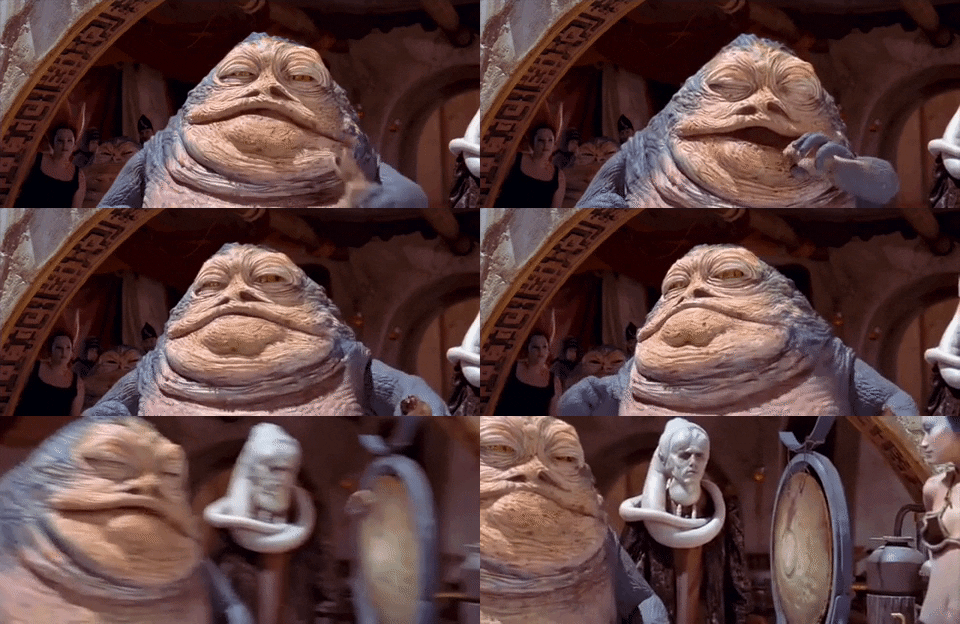
If you aren't familiar with this story, the basic gist is that the Clone Wars are on and Jabba the Hutt's infant son gets kidnapped.
Jabba turns to the Jedi to help; he'll do anything to get his son back. He's a loving father, hard to believe, I know...
The Jedi agree to help, as they want access to Hutt-controlled space lanes to the outer rim. Obi-Wan and Anakin are assigned the mission.
Considering Anakin's early life, he's not thrilled.
Nevertheless, Obi-Wan convinces him and along with Ahsoka and some clone troops, they set out to find the missing Hutlett.
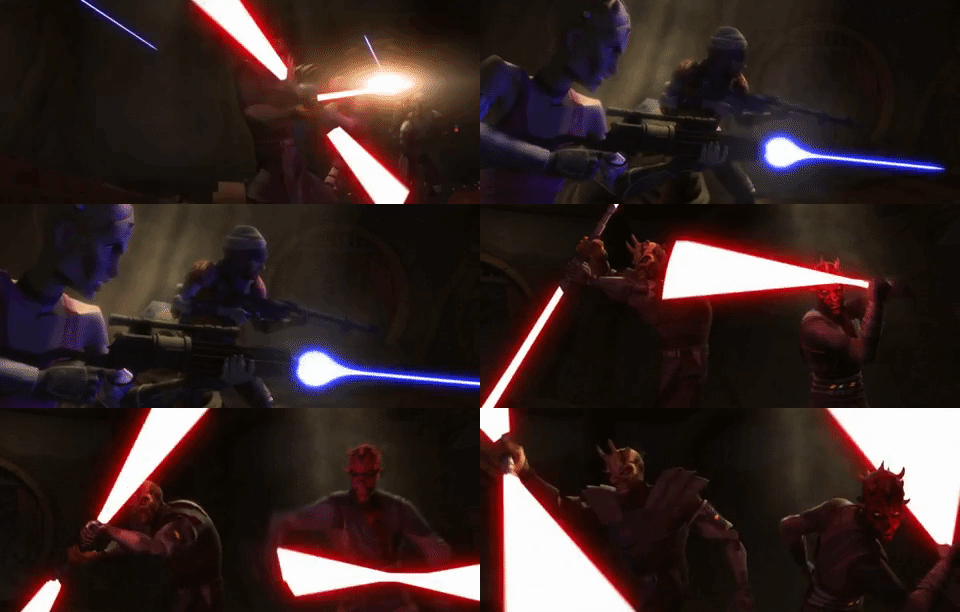
The Separatists are also interested in gaining exclusive access to those space lanes though, and just may have set a trap the Jedi are walking straight into. One involving one of my all-time favorite characters, Asajj Ventress.
This is a definitely a quick and exciting story. I highly recommend the audiobook. The narrator, Jeff Gurner, absolutely slayed it. All the different voices were so unique and true to the characters; his Yoda was spot on.
If you've never listened to a Star Wars novel, but love Star Wars, I highly recommend them. The sound effects, music and voice work are always spectacular. They go above and beyond what you would normally hear on an audiobook.
It's the full experience!
In short, I had an absolute blast with this. It is a fantastic novelization and as expected, the audio format is a stellar production.
It’s funny how the cool and professionally competent original clone troopers were succeeded a few years later by hapless, small-minded extras with markedly poor marksmanship.
Maybe it was the change in helmet design.
Clone Wars, the 2008 novelization of The Clone Wars animated series that takes place in the Star Wars universe just before The Revenge of the Sith (year 22 BBY – Before the Battle of Yavin) allows writer Karen Traviss to further develop characters like Jabba the Hut, Anakin Skywalker, Count Dooku, Ahsoka Tano, and Asajj Ventress.
Lots of action and plenty of story development. And fun. I have mainly stayed away from novelizations, but I may need to reconsider. George Lucas has provided license for dozens of talented writers to expand his vision.
Honestly, I’m surprised at how highly this book is rated, because up there with the greats of the Expanded Universe it is not. After reading a friend’s review, I have to wonder if the book garners praise because people are comparing it against the animated film which it is the novelisation of, and finding Karen Traviss’ retelling to improve what seems to have been a very widely panned film.
As someone who has never seen any of the Clone Wars animated material (didn’t have access to it when it aired, and just never felt compelled later to seek it out), I may be coming at this from a different angle. I will admit that I can see how Traviss has upgraded the source material, and I can tell this because the dialogue is often execrable, but the inner thoughts and motivations of the characters are much more plausible and interesting – obviously the dialogue is what Traviss was saddled with, while the inner monologues are what she brings to the table. So even without viewing the film, I strongly suspect that this book is indeed a better version.
Unfortunately, that is not enough. The source material shines through in the extremely episodic feel of the book. It starts by telling us that Jabba’s son has been kidnapped and Jedi will be sent to track him down, but then we dawdle around for a third of the book on some planet that we haven’t been given a reason to care about, instead of pursuing what is supposed to be the main plot. The fact that the film is cobbled together from a few episodes of a series sticks out like a sore thumb, and a coherent story would never do this.
Another major problem is that it doesn’t make sense within the universe, contradicting previously established lore. The Expanded Universe developed a detailed timeline of the Clone Wars through a whole range of books set between Episode II and Episode III, in which Anakin Skywalker was Knighted shortly before Episode III. But since he can’t have a Padawan unless he’s a Knight, and the animated series wanted them to go on lots of adventures together, it put his Knighting right at the start of the war. This then prompted a massive rejigging of the order in which fans were told to read the books – an order which still didn’t make sense because books that we were now told should come early on referred to events in books which we were now told came after them. Essentially the entire narrative coherency of this slice of time in the story was completely messed up, and honestly it would have been better to keep the book order as it was and market the animated series as a kind of spin-off. I’ve never really understood why, even now, the animated series is deemed to take precedence, as I would have thought that adult targeted books would be higher in the order of canon than a cartoon series for children.
But it’s not just this – other aspects of this story mess with the lore too. It doesn’t make sense to me why the Republic needs access to Hutt space’s hyperspace lanes. In the Star Wars universe, hyperspace is a different space – you can pass through hundreds of star systems; you’ll just emerge on the other side. The only consideration is the necessity to plot routes to avoid large gravity wells such as stars and planets, and there are some starships which serve as interdictors but they can’t target ships individually, they just set up along a well-known route and see what they can catch by casting an unexpected gravity well. So why does the Republic need access to hyperspace lanes through Hutt space when they can just go through it anyway? The thing is, this could have easily been explained away as their maps on the region being poor and outdated and only the Hutts having access to detailed current information for safe routes… but this is never done.
I was also baffled as to why Jabba was in male form despite having just had a baby – his parents’ sibling, Jiliac, remained in female form for some time after the birth of her Hutt infant, suggesting that when Hutts transition to female in order to reproduce they remain female for some time in order to sustain the infant. This is well documented in A. C. Crispin’s The Hutt Gambit, where we learn that Hutt babies spend most of their time in their mother’s pouch (which seems to exist only in female form). Anakin refers to Ahsoka being too young to be a Padawan, at age 14, but Jude Watson’s series following a young Obi-Wan Kenobi firmly established that if a child hadn’t been chosen as a Padawan before turning 13, they were washed out and turned their Force talents elsewhere, such as the AgriCorps.
There was also a fair bit of just plain silliness. I seriously doubt Palpatine would speak one on one with Jabba. That seems like a job for teams of ambassadors and diplomats, or at least the equivalent of a Foreign Minister.
Ahsoka Tano is so very annoying – she has some of the most cringe-worthy dialogue in the whole story – and verging on Mary Sueism. Warps canon to fit her in? Check. Develops a close relationship with one of the major existing characters? Check. It’s borderline. I find it pretty unbelievable that Anakin would be Knighted at the start of the war in any case, let alone given a Padawan straight away.
Even if you find all this totally credible, having to read through Ahsoka calling Anakin “Skyguy”, and the utterly inexplicable decision to name an antagonist “Whorm Loathsom” is enough to make me want to toss this book on the fire. Yes, I know it’s been done before – Elan Sleazebaggano and General Grievous come to mind. That is no excuse to saddle the Star Wars universe with yet another atrocious example of utterly lazy naming practice. Seriously, the lack of effort makes me angry. Most authors in the Expanded Universe at least tried to make non-silly sci fi names, but it seems when it came to the prequel era and a visual medium, everyone just phoned it in.
I have a ton of nostalgia for the Clone Wars movie and show. The movie was the first Star Wars movie I saw in theaters in 2008 and the tv show was the first tv show I watched live on television when it aired. So when I picked up this book, I hoped for a reliving of that nostalgia. Instead what I got was utter frustration.
I believe it is clear reading this book that Traviss was not a particular fan of the source material, and decided to go in her own direction with this book. She still tells the general story, but man, does she deviate in some pretty substantial ways.
I will start by saying that the book, despite it's incredibly short length, does add quite a bit of story. It not only adds a lot of perspective from Dooku, Ventress, Palpatine, and Jabba, but also adds from the perspective of the Clone Troopers. I thought that her additions with the former characters really helped out the book. However, the additions with the clone troopers seemed out of character at times, despite the fact that Traviss has a ton of experience writing clone troopers. I understand why she chose to focus so much of her writing on their perspective, but I think it was the wrong choice for such a novelization.
I usually champion novelizations that add a lot of story. This book doesn't quite add much story as it does perspective. However, my fundamental issue with the book is that it detracts from the existing source material. Either Traviss had an outdated version of the script (which I highly doubt), or she chose to ignore certain elements of the script.
For example: Padme's first encounter with Ziro the Hutt is entirely missing from the book, jumping from her meeting with Palpatine to her being captured by Ziro. It also entirely omits the scene where Padme is saved and captures Ziro. It also entirely cuts a portion of the opening act of the movie featuring Yoda and Windu speaking with clone troopers and also talking with Admiral Yularen. It also cuts a scene with Obi-Wan negotiating with General Loathsom. It also cuts a scene with Ahsoka fighting Mangaguards. And those are just the scenes I remember it cutting off the top of my head!
The movie is not that long, (94 minutes), so there's not much that Traviss had to cover. The fact that she cut out so many scenes is just disappointing. In fact, as my friend put it: its a Travissty. (ba-dum-tiss).
But perhaps an even bigger crime in the book is the changing of the existing dialogue. I understand that sometimes dialogue might change between drafts, and I also understand that the author might want to add some dialogue of their own. But Traviss changes the dialogue in such a way that the events of the scenes play out the same, but the fundamental tone and tenor of the lines are compeltely missed. Maybe this is because the movie plays to a younger audience and Traviss thought it necessary to play this up to an adult audience, but it fails to do what a novelization must first and foremost do: adapt the screenplay to a novel, being true to the spirit of the screenplay.
Overall, I am very disappointed in the book. I think that Traviss gets the most minimal of points for at least generally following the story, but fails spectacularly to be accurate in her adapatation overall. 3 out of 10.
This novel is tricky to review. As an adaptation of a movie, it is constrained by the plot developed by the movie's creators, and so it is reliant on the quality of that story. Unfortunately, The Clone Wars is based on a movie that was critically panned when it was released, so my expectations were low. That being said, the movie it was adapted from was the first part of a series that became a very well-made and compelling part of Star Wars lore, and this story introduced two characters who have gone on to become amongst the most well regarded in the fandom. I will therefore consider the novel on the way that Karen Traviss managed to add to the story of the movie. She does this by getting into the heads of three of the main characters: Anakin, the impetuous Jedi general with a tragic destiny; Rex, the clone captain from the 501st; and Asajj Ventress, Count Dooku's hatred-fuelled sith assassin. Traviss gives us a satisfying insight into the character and motivations of these three - she describes Anakin's rages in battle, and his disatisfaction with the Jedi order. Also, with Ventress we learn how the loss of her Jedi master, and the order's unemotional acceptance of his death led her to lose all faith in the jedi, and to seek revenge for what she believes to be a callous betrayal. Even her relationship with the espionage droid, 4A-7, is made more engaging with the greater attention given to his character than in the movie. I have been a fan of several of Traviss' previous Star Wars novels - in particular Republic Commando: Hard Contact, and she has a particular skill at getting inside the heads of the troopers, and it is with Captain Rex that Traviss' contribution to the character is clearest. Rex is given more depth than in the movie, revealing his loyalty to the Republic tempered with his observation that the war is making his men act like droids, just as the droids are meant to act like men. Also, we see how much of a toll the loss of so many of his troops takes on Rex, and his particular loyalty to Anakin. The character of Ahsoka is treated a little peculiarly, as Traviss emphasises the padawan's togruta heritage, and in particular her predator attributes. This doesn't jibe particularly well with how the character developed in the series as, in that, Ahsoka is generally treated exactly the same as a human teen jedi, except with some unusual cranial features. Plotwise, the book follows the movie exactly - so there were no surprises there. Otherwise, I found this to be an unexpectedly enjoyable book, and I would recommend it to all Star Wars EU fans, especially those that enjoyed the Republic Commando novels.
Humans made the rules in the galaxy, so Jabba the Hutt felt morally obliged to ignore them all.
Great adaptation along with more material and scenes to make it much more interesting. Filled with more info and dialogue in-between characters and of course the time flies easily while reading.
"I know what war does to you." - Obi-Wan Kenobi
It's the same mission as the film, Anakin gets a Padawan, and off to bring back Jabba's son who got kidnapped while Kenobi is going to negotiate with Jabba, everything that goes into the movie is here, just expanded and with a lot more goodies.
"Humility is a requirement for a Jedi." - Anakin Skywalker
Star Wars: The Clone Wars is the first animated feature film with the Star Wars name to be released in theaters. It is also the first theatrically released non-episodic Star Wars movie, as much as people like to think that that distinction goes to Rogue One. Polarizing Star Wars author Karen Traviss was selected to pen the movie's novelization, and I have to say, it was a great choice. Her attempt to turn what was essentially a pilot to what would eventually become a much better TV show into a gritty war story was mostly a great success.
Of all the theatrically released Star Wars movies, "The Clone Wars", in my opinion, is the worst. When I saw it in theaters back in 2008, I left the auditorium lying to myself, saying it was good even though it just didn't feel right. After watching it recently, I personally don't enjoy it any more or less than The Phantom Menace or Attack of the Clones, but if I had to rank the theatrically released star wars films, I'd put this one on the bottom. It's story is boring, the animation is sub-par, and the characters are both literally and figuratively stiff caricatures. It's interesting to note that this movie is boring for the exact opposite reason the first two prequel movies are: while menace and clones have too little action, this one has too much- and it certainly doesn't help that the animation is so wooden. It's pretty easy to say that the story and characters for phantom menace and attack of the clones also are snooze-inducing, and the visual effects also look bad. But I have two reasons for saying that The Clone Wars is worse. 1) The critical and audience reception to Phantom Menace was actually quite positive when it first came out in 1999, and even clones back in 2002 didn't seem to be nearly as hated back then the way it is now. On the flip side, The Clone Wars is not only a mediocre movie now, it was considered bad when it came out. The critical reviews were so scathing that there was an embargo on metacritic. On rotten tomatoes the movie holds and 18%- compared to The phantom Menace's 55%, the second lowest rated star wars movie after that. EW in 2008 declared it one of the 5 worst movies from 2008. It is also the lowest grossing star wars movie at the box office by far- only 68$ million while the rest grossed at least $500 million. Even with the visuals- people say the phantom menace and attack of the clones have crappy CGI now, but back then the effects were considered amazing (ESPECIALLY with Phantom Menace), or at least alot better than they look now. The clone wars on the other hand had crappy animation even in 2008, the year we got Wall-E and Kung Fu Panda. 2) this reason is much simpler- even though the phantom menace and especially attack of the clones are widely despised now, there are still people who defend those two movies especially the segment of the fan base that grew up with the prequels. I don't know a single person, whether that be from real life or a random internet comment, that says the Clone Wars is a great movie- and that's pretty telling. Anyways, I'll run out of text if I keep talking about why the Clone Wars is the worst star wars movie, so I'll just throw down to the book review itself.
THE BAD: Karen Traviss is NOTORIOUS among the star wars fan community for her anti-jedi and anti-republic sentiments, and this book is another exemplary showcase of that. While her anti jedi sentiments in this book come from the perspective of characters who you would believe would have those sentiments (Asajj Ventress, Count Dooku, Jabba the Hutt, and Anakin Skywalker to an extent), I just couldn't help but think she went way to overboard with the jedi/republic trashing. It got so annoying, so unbearably obnoxious, that I had to put the book down and stop reading it for a time. I would have been open to giving this a 5 stars if that was the only flaw, but I have some problems with the characterization as well. Obi Wan is completely out of character in this novel. Even in the prequel films, despite their often pathetic attempts at making anything about the characters stand out at all, at least were able to establish Obi-Wan Kenobi as a patient, stoic jedi master who always tried diplomacy first. Here, he seems overly eager to go into battle. I also had problems with Anakin, in that he was a little too mean-spirited. I get that he doesn't like hutts and he is losing his men, but Rotta is just a child! I also didn't think his feelings toward the council as an inconvenience were completely right- I know he disagrees with them but he still understands where they come from.
THE GOOD: When this book is good, it's really, really good. It turns the lackluster pilot that would thankfully become a much better TV series into, I don't know, a much better book! Karen Traviss does a wonderful job in making the plot not only so much more cohesive, but adding high stakes, and hence filling it with loads of tension that was absent in the movie. Some readers may find it jarring that Obi Wan and Padme, who were spotlighted in the film, have no points of view, but I actually really liked that Traviss kept the focus on Anakin and Rex- because the story is really about Anakin bonding with Asohka and the battles involving the clone troopers. And speaking of the battles, they are some of the most intense action sequences I have read in a Star Wars book- not only are the lightsaber battles really exciting and fun, but the war scenes with the clones trying to survive against the droid forces keeps you on the edge of your seat, making you fear for their lives. Despite my complaints about Obi-Wan and Anakin, the characters are overall fantastic. Jabba the Hutt is given that familiar selfish vile gangster edge, but is balanced with a loving father persona. Traviss is able to pull this off with an extra scene with Jabba and Rotta at the beginning, as well as show how grateful he is when Rotta is brought back to him. In the movie, Rotta felt like a macguffin to give it a plot, just so it had an excuse to deliver some dull action scenes that the animation was clearly not good enough to pull off. However, by making Jabba a sympathetic character, you actually feel bad when Rotta gets kidnapped, you worry when Rotta gets sick, and you truly want to see "Stinky" get back to his family. Because of this, the mission has stakes. Tension. EXCITEMENT. The other extra scenes are also really good. Traviss decides to condense the action sequences found in the movie so she can add lots of extra scenes with Rex and the clones, allowing us to get the point of view of the boots on the ground actually fighting these battles. You see how many clones die, and you see how costly this mission becomes. And to Traviss' infinite credit, she doesn't treat the mandalorians like gods in this novel, or at least is not obvious about it. I don't think Traviss would get nearly as much flak for her opinions of the jedi if at the same time she didn't masturbate to the mandalorians. And given how at the time this book was written Jango Fett was a mandalorian, I'm surprised Rex wasn't given a mandalorian persona at all. Whether it's from the point of view that the clones are mandos or not, Traviss portrays Rex and the other clones in this book like ordinary soldiers just trying to survive. And it works amazingly! I loved how past materials were referenced to give the characters of Anakin, Dooku, and Ventress a lot of depth. I think the context of Anakin's past as a slave on Tatooine from the prequels is incredibly helpful for understanding his motivations in this story. Even though he's a little too mean-spirited sometimes, you totally relate to him and why he feels the way he does about rescuing a huttlet. For Ventress, having the book go into her backstory really helped flesh out her character in this book. Even though the background info on her is no longer canon and the TV show later changed quite a bit about her character, Traviss still used the information effectively to make sense of what makes Asajj Ventress tick and why she wants to kill the Jedi. The Galidraan stuff for Dooku works in the same regard. Speaking of which, this is the best characterization of Count Dooku I have ever seen. There is a perfect mix of scheming, evil sith lord with a man who is frustrated with the jedi, the republic, and the course of galactic history. he comes off in this book as highly intelligent and a chilling menace, and I enjoyed almost every minute he was on the page. Asohka is also done really well, with Traviss making her less annoying and a more relateable young girl trying to satisfy her new teacher, despite him really not wanting to have anything to do with her. I also like the touches of togruta species traits, which probably would have been a nice addition to the character in not just the movie, but the TV series as well. I even liked how Ziro the Hutt was portrayed. If there was anything I truly despised from the film and the Clone Wars TV series as a whole, it was Ziro the Hutt. Most of that came from his disgusting and painful-to-listen-to voice that makes Jar Jar Binks sound like Auli'i Cravalho in Moana. But here, even when I read Ziro's lines in that awful voice, he came off as much smarter and more cunning. I didn't even think it was humanly possible to make Ziro the Hutt anywhere near bearable, let alone compelling. Traviss improves the source material with this novelization on almost every account, from the story to the characters and even the action scenes.
THE CONCLUSION: This novelization for Star Wars: The Clone Wars definitely has some glaring issues, but overall is a great book. The Jedi and republic trashing is definitely grading, but when Traviss gets something right, it can be phenomenal. Truth be told, if I heard that Karen Traviss was going to write a war novel that didn't take place in the Star Wars universe, I would probably be all over it- she's that excellent at writing war scenarios. Even so, if you're a fan of Traviss' work and don't mind her biases, this is a must read that I think you'll find to be close to a masterpiece. If you're looking for a definitive novelization that will help you get a better understanding of the animated feature film, this is probably not the right way to go about it (to be honest, I don't think the movie is even worth trying to understand because of how mediocre it is). While it's a well written novel the backstory presented on Asajj Ventress is no longer canon, and neither is the Galidraan stuff frequently used to anchor Dooku's character. I would say that doesn't matter if you're a legends only fan, but even before the canon reset this movie and TV series messed with established lore. The thing is, this novel is in an extremely weird place- it is a novelization for the canonical version of The Clone Wars but falls back on legends material, especially because the show changed Ventress' backstory. However if the canon/legends clusterkriff isn't a problem for you and you don't mind an interpretation of the movie or just want a really damn good book regardless, this should be worth a read.
THE RANKING: This is a new section I want to start with all my reviews for novelizations of theatrically released star wars movies. Whenever I do a novelization review after this, I'll place it on this list. And with all the new star wars movies Disney is doing, this should be exciting.
8. The Force Awakens: Alan Dean Foster turns one of my favorite star wars movies into a painful snooze-fest where the characters lack their on-screen charm and the dialogue is turned into a mess that can be borderline prequels levels of bad. At least there's some good extra stuff, like how Poe gets off Jakku, info on Starkiller Base, and a bit of backstory for Snoke. The people who hate on the movie annoy me, they can hate on this novelization all they want. it sucks. 7. The Empire Strikes Back: Why are the best star wars movies turned into the worst novelizations? Unlike The Force Awakens novelization, though, this one is actually a fun read. The problem is that it is otherwise nothing more than the script of the movie with added words to make it work as a novel. 6. Return of the Jedi: I was originally going to place this lower than Empire, but Crystal Starr Light in her review makes the point that it does add some new information, even if most of it has since been retconned and I thought what was given added too little. However, giving R2 and Chewie actual dialogue is unforgivably grading, and dull writing made the first half of the book hard to get through. The second half was pretty well done though. 5. The Phantom Menace: While Terry Brooks makes Jar Jar's poop jokes even more awful ("foul-smelling ooze", anyone?), Obi-Wan is unlikeable, and overall not doing the film justice, through extra scenes and good writing in places he makes Qui-Gonn more interesting and likeable, and Anakin feels much more like a believable child. 4. A New Hope: Mostly a surface level regurgitation like the other original trilogy novelizations are, but an extra scene with Luke and his friends in Anchorhead as well as one with Luke seeing the Tantive and the Devastator above Tatooine actually adds a pretty good deal to Luke's character. But it's still not enough to warrant reading more than once if you have a copy of the movie. 3. Attack of the Clones: While the action scenes are dull and the story is still a choppy mess, there is an immense amount of depth given to the characters. Believe it or not, R.A Salvatore kept every crappy line of dialogue from the movie and STILL managed to give Anakin and Padme romantic chemistry! But what truly makes this book great are the emotional and poignant extra scenes featuring the Lars family as well as a scene where Jango and Boba Fett bond as father an son. 2. The Clone Wars: Karen Traviss turns a lame animated movie that was cobbled together from the first 4 episodes of the TV series into an intense war story about sacrifice for a cause that the people involved may not necessarily believe in. A thin, yet convoluted plot becomes a fleshed out and focused narrative, bland CG cutouts become layered, nuanced characters, and sequences that could not be done with the animation available was turned into heart-pounding, stakes-filled action. Even if the canonicity is a bit of a mess and the jedi trashing is annoying, this novelization proves to be an excellent book. 1. Revenge of the Sith: Being the best of the prequels is not saying much when the movie is still loaded with crippling flaws. Yet Matthew Stover was able to turn it into a masterpiece, with every character, especially Anakin, wonderfully fleshed out in a way that made the rise of Darth Vader truly riveting and heart-wrenching. Palpatine is written so well that I almost start falling into his web of manipulation whenever I read the book, and every outlying subplot in the movie is brought into the main plot to form an intricate yet tightly connecting story. Not only is Revenge of the Sith my favorite of the novelizations, it is also my favorite legends novel by far. Whether they be legends, or canon, Stover's Revenge of the Sith blows nearly every Star Wars book out of the water. It is not only one of my favorite star wars books, but one of my favorite books of all time, period.
I read this around the height of my Karen Traviss fanboy days and even then my high school self felt like it wasn’t her best work. It makes sense for Traviss to have adapted the movie given her affinity for clones. She does a pretty great job with Rex’s chapters as well as Ahsoka’s scenes and even Jabba’s. She likewise drops some of the elementary-middle school age content of the film which makes parts of that flawed story better. It’s just that she once again uses the book to overly-bash Jedi, making most of the POVs be from characters that either hate or are frustrated by the Order. It makes sense giving the intent of the prequels yet at the same time its annoying how often she’s on her soap box and/or doing things to denigrate Jedi characters (i.e., Anakin calling Obi-Wan “Kenobi” even though he clearly doesn’t even when he was Obi-Wan’s apprentice). Speaking of Obi-Wan, Traviss cuts his perspective/his hilarious negotiation scene as well as Padme’s scenes (in hindsight Traviss is very biased against non-military female characters and some military ones too) which is kind of unfortunate for a movie novelization and fans of those characters.
So yeah some improvements on the films but some of Traviss’ worst writing traits pop up.
“Maybe she’s like me. Maybe nobody else wanted to train her, either” STOP I’M SAD
The author was kind of dealt a losing hand with this book no matter what because the movie was so awful, but she actually managed to make it pretty good! Especially with Anakin and Ashoka’s relationship. We get some insight into what prompted Anakin to accept Ahsoka as his padawan even though he didn’t want a padawan and she’s pretty insufferable.
cada dia julgo menos o anakin. se eu com dois estágios já to meio maluca imagina ele o chosen one humilhado pelo conselho tendo que esconder o casamento treinar uma moleca cabeça dura e ainda resgatar o filho do manda chuva escravocrata sendo que ele foi escravo na infância. terapia pesada nele
Star Wars: The Clone Wars movie novelization was written by New York Times Bestselling Author Karen Travis. This tale takes place during the Rise of Empire Era, shortly after the events of Attack of the Clones. The story is about 22 years before the battle of Yavin.
SUMMARY: Count Dooku, leader of the Separatist Army, made an attempt to lure the Jabba the Huttinto joining the Separatist movement. The end goal was to have Jabba deny outer-rim hyperspace lanes in his territory, to Galactic Republic forces. Dooku has arranged to have Jabba the Hutts infant son, Rotta, kidnapped. Dooku's apprentice Asajj Ventress and Jabba's cousin, Zrio the Hutt design a plot that frames the Jedi Order as the culprit of kidnaping Rotta.
Anakin Skywalker is assigned a padawan (a 14 year-old Togruta female named Ahsoka), a real surprise to Kenobi and Anakin. Anakin and Ahsoka are then sent on a mission to recover Rotta the Hutt, to maintain neutrality with Jabba. Access to the hyperspace lanes in the outer-rim are an important asset to the Republic's Clone Army.
OVERALL THOUGHTS: I've watched The Clone Wars movie a few years ago, I was not a fan. This novelization, which is based on the screenplay, does a fine job of telling the story in the novel format. I really do not like this story. So many elements are too goofy, unbelievable, and outright annoying. However, Karen Travis did a fine job translating the source material into the novelization. If I had the option to re-watch or re-read The Clone Wars, I would have to re-read the novelization.
I enjoyed reading more of the conflict within Anakin. The title of "The Chosen One" really bothers him, but it does boost his ego. The author did a good job of delving into the young man's struggles. Anakin hasn't gotten over the loss of mother or the way he handled her death, which was actually sad, yet fascinating to see how he coped with the loss. Anakin's irritation with authority was authentic.
Anakin and his newly appointed padawn have a bumpy start. I feel that Ahsoka is a character designed to both mimic and one-up Anakin. They display the same traits; they're cocky, powerful, have problems with authority, and are always trying to take the lead, The nicknames they have for each other is annoying, dare I say, cringy.
Do I recommend you pick up Star Wars: The Clone Warsi? I would say, read the book over watching the film.
RATING: I give The Clone Wars novelization 2/5 stars.
The Clone Wars, of course, replows the soil already turned by the movie of the same name. Don't expect any galactic revelations.
Karen Traviss takes us into the minds of her characters. In The Clone Wars that's best done with members of the 501st, especially Captain Rex. It works least well with Anakin Skywalker. (She doesn't even try with icons like Obiwan Kenobi and Yoda.) However, the Anakin she portrays is slightly out of sync with the wounded spirit who becomes Frankenstein's monster.
She still writes better than most of the SW usual suspects.
Obviously tons of authors are writing these books but I feel like they’re not on the same page about Anakin’s feelings, motivations, and inner monologue. This book doesn’t have great ratings but I feel like it’s still overrated. The plot isn’t bad and the writing isn’t bad but it’s still falling short for me and I can’t quite put my finger on why. What is the point of this book? Also, and I mean this as an insult, this book reads like it was written by a man. 2.5 stars, possibly a little generous. It’s just not for me. I did like Ahsoka.
Though the movie was so-so, this book was one of the better SW novels, providing deeper insight to the characters and motivations behind the story. This is the first SW book that I've actually enjoyed in ages.
3.5* few errors here and there (rex’s designation number is ct-7567, not cc-7567, and also why does everyone keep calling obi-wan by his last name?? even anakin??) but otherwise this was a nice ride! rex’s pov especially was wonderful
Despite my love for Star Wars, I came to TCW pretty late in the game. It wasn't until I was 18 that I finally watched the movie and the show - and then I was kicking myself for not getting into it earlier. That being said, I didn't read the novelization of the movie for a while. However, I recently read/listened to Brotherhood. It was good, but it didn't have Rex or Ahsoka in it, and I missed them. So, I decided to finally pick this book up.
First off - it's been a bit since I saw the TCW movie, so I forgot how action-heavy it was. I'd 100% recommend listening to the audiobook for this one, as the character lines and battle noises really make the experience. I don't think this would've been as enjoyable if I'd just read it on my own.
I didn't realize, going into this, that it wouldn't be a direct novelization of the movie. There are some added scenes in here, but some of them are pretty heavily changed. I was surprised that the lines "You're reckless, little one, you never would've made it as Obi-Wan's Padawan. But you might make it as mine" and "In my book, experience outranks everything" weren't in here. They're some of the most iconic parts of TCW. But their exclusion honestly paved the way for some interesting exchanges with the characters.
Anakin's relationship with Ahsoka is a bit different in here than it is in the movie. Instead of Anakin having the line where he outright tells Ahsoka he'll take her as his Padawan, you see their dynamic develop slowly over the course of the story. I liked how protective Anakin became over her, and how he has to teach her some of the harsher realities of war.
In the same vein, I really enjoyed Rex and Ahsoka's dynamic in here as well. He doesn't have the "experience" line, but he has a nice talk with Ahsoka about preconceived notions and stereotypes. You can see how Rex helps shape Ahsoka from a youngling into a fighter.
Throughout the course of the story, while Anakin and Ahsoka are on their mission to save Rotta, Rex and the 501st are protecting them by holding back Ventress and the droids. You can really see Rex and Anakin's friendship in these scenes - I especially liked the part where Rex tells Anakin to "keep [his] kriffing head down" and, when Anakin claims he can just use the Force to avoid being shot at, Rex responds with "Okay, do it to humor me." Rex's perspective in this book is so great, but I especially liked the scene where Ventress tries to mind control him. It's an amazing scene in every regard.
That being said, Ventress also has some scenes from her POV in here as well, and they were fantastic too. The part where she remarks on how the droid 4A-7 is really her only friend one scene before he gets decapitated by Ahsoka, ooh.
This book places a heavy emphasis on the fact that the galaxy is in full-fledged war, and the tone is appropriately set. The part at the end where Ahsoka realizes that all of the clone troopers she was joking with on Christophsis are now dead was a good, somber moment.
The more I write about this book, the more I remember how much I liked it.
Unfortunately, I discovered that this was simply a novelization of the lackluster Clone Wars animated film that would kick off the far superior TV series after purchasing it. Since it was short, though, I figured I’d power through, considering I’m trying to get through all of the longer Legends books.
If there’s one thing the book does well, it’s diving deep into the mechanisms and thoughts of Anakin, giving us something the film didn’t. But as far as the plot goes, I thought this was stupid. The Jedi and Count Dooku are just presenting a game of “who did it” to Jabba the Hutt based on…. Who captured his son, and there’s a whole battle and several lightsaber duels centered around that. It’s disappointing, because this had all the ingredients for something cool and it ended up being a bit of a flop.
I’ve read a lot of Star Wars books, and this one easily jumped into my top 10. This is one of the best portrayals of Anakin ever, on screen or page. Karen Traviss absolutely understands the characters, their motivations, their fears, their relationships.
I loved that we saw Anakin, Ahsoka and Rex’s POV. When watching the movie, you don’t get that insight. I also thought the action was well-written. Absolutely 5 stars.
This was more of an interpretation of the story in The Clone Wars rather than a novelization. You get a lot of insight into the inner motivations/thoughts of Anakin, Dooku, Ventress, Rex, and Jabba. I would have loved some more info on Ahsoka, Obi-Wan, Padme and even some of the other clones. The Jedi Order is presented in a much more negative light in the book than it is in the film.
This book was interesting enough, and I'd love to read the rest of the books in The Clone Wars series.
The book is good much better then the movie and provides so much interesting information and different points of views that you otherwise wouldn’t get to see.
For 2024, I decided to pick up where I left off after 2022 and reread books published between 2004 and 2011—a hodgepodge of Clone Wars, inter-trilogy, and Original Trilogy stories, plus a smattering of Old Republic Sith. This shakes out to twenty-one novels and four short stories, mainly consisting of the Republic Commando series, the Darth Bane trilogy, the Coruscant Nights trilogy, five Clone Wars books written by the Karens, and four standalone novels.
This week’s focus: the novelization of the Clone Wars movie, Star Wars: The Clone Wars by Karen Traviss.
SOME HISTORY:
Unlike the novelizations of the prequel films, in which the authors got to directly talk with George Lucas and get his ideas behind the film, Karen Traviss didn't get any insider access to Lucas or the Lucasfilm Animation team when working on the novelization of The Clone Wars. She was given the script, and just told to go from there. Star Wars: The Clone Wars by Karen Traviss made it to number thirteen on the New York Times bestseller list for the week of August 17, 2008, and was on the NYT list for two weeks.
MY RECOLLECTION OF THE BOOK:
I saw The Clone Wars in 2008 and wasn’t particularly impressed by it, so I made no effort to seek out the novelization. Like a lot of the books in this year’s reread, I am approaching this one for the first time.
A BRIEF SUMMARY:
Jabba the Hutt's son, baby Rotta, has been captured by Count Dooku's Separatist forces, and it’s up to Obi-Wan Kenobi, Anakin Skywalker, his new Padawan Ahsoka Tano, and the men of the 501st Legion to rescue the baby Huttlet and return him to his father. However, Count Dooku has decidedly other plans in play…
BEHIND THE SCENES:
Jumping back to the mid-2000s, The Clone Wars movie took a lot of people by surprise, including the staff of Lucasfilm Animation! They were working on a new 3D animated show that was due to come out in 2008 when George Lucas said “Hey, why don't we turn this into a film?” So they took an episode that was supposed to occur later in the season (a flashback episode) and made that the first part of the movie—the Battle of Christophsis, in which Anakin and Ahsoka first meet. Then they took a three-parter about Count Dooku kidnapping Jabba's son, and added that as the last three-quarters of the movie. If the movie feels like a number of TV episodes smooshed together, that's because it basically was. The novelization is a (slightly) different beast. It's the same plot and the same dialogue we see in the film, just fleshed out by insights into the characters and greater details into some aspects of the story.
THE PLOT:
If you haven't seen The Clone Wars movie, here’s the plot: we start smack dab in the middle of the Battle of Christophsis, when Ahsoka Tano arrives on a ship from Coruscant and says that Master Yoda sent her as Anakin’s new padawan. Anakin and Ahsoka don’t get along super well, but in the end they’re able to work together and defeat the Separatist forces. They’re not on Christophsis long, though, before they’re told that Jabba the Hutt’s son has been kidnapped and that he contacted the Republic for help. Obi-Wan heads to Tatooine to negotiate with Jabba, while Anakin, Ahsoka, and the 501st guys head for the world of Teth, where the baby Huttlet is being held within a monastery. They’re immediately under attack by Separatist droids, a lot of troopers are killed, but Anakin and Ahsoka get inside and find the Huttlet—only to learn that it’s a trap, and Asajj Ventress is trying to frame (and possibly kill) the Jedi.
Anakin faces off against Ventress, then he and Ahsoka escape to Tatooine with the Huttlet while the few remaining members of the 501st are rescued by Obi-Wan and his troops. On their way to Jabba’s Palace, Anakin is attacked by Count Dooku while Ahsoka gets to the Palace with the baby, and while Jabba is really mad and wants to kill everyone, Anakin proves that they helped him and gets Jabba to grant the Jedi passage through the Hutt Outer Rim. Dooku’s ploy fails, but Sidious reminds him that they have other plots in place.
CHARACTERS:
My favorite character in this book was Captain Rex. I had wondered how Karen Traviss was going to depict Rex because she really likes clones, and turns out he’s probably the best character in the whole book! He comes across really well. He’s our sole clone viewpoint character, and he’s loyal and smart and willing to do a lot for Anakin because he knows that Anakin is willing to do a lot for the 501st. Rex even outsmarts Ventress, for goodness sake. The 501st suffer a lot of casualties on Teth, and by the end they’re down to Rex and five other guys. Despite the odds against them, they have some very cunning ploys and manage to hold on until Cody’s troops relieve them. If other characters are more gray, Rex is unabashedly a good guy the whole time.
We also got Jabba’s POV, which I didn’t expect because while he’s a character in the film, he felt more like a quest-giving NPC. Jabba’s a gangster, but he’s also a fair bit smarter than he appears. He can understand Basic, he just prefers to let his droid translate everything into Huttese and keep that separation between himself and his supplicants. Traviss also expands on why Jabba has dancing girls when he’s a giant slug: he’s trying to present an image of strength to humans and other humanoids, so he has slave girls and musicians and bodyguards even though Jabba as a Hutt doesn’t care for that stuff. (And in fact, it reflects badly on Hutts if they do!) I felt a little bad for Jabba, as he seems to really love his baby slug and just wants him back—but he’s not going to give anything away for free.
Anakin is the Hero without Fear, his men love him, everyone loves him, but he didn’t feel right to me in this book. I think that comes down to two things: the first is that Anakin is constantly right on the edge of boiling anger. In the novelization he sees the ghosts of the Tuskens that he killed, he remembers the blood carver that he killed in Rogue Planet, and he can’t forget the blood and death of so many others by his hands. Anakin is obviously haunted by his mother’s death and the circumstances surrounding it, but I felt like his fuse was a little too short for a story set six months into the Clone Wars. We’ve got a fair bit to go before Revenge of the Sith, yet he seems very close to boiling over. I don’t think Anakin would be there yet, and I think we need the other 2.5 years of the Clone Wars, Padme’s pregnancy, and the Jedi Council’s distrust of him to get him towards that point.
The second is that Anakin always refers to Obi-Wan as “Kenobi” within his internal thoughts, and has a lot of resentment towards his former Master. That level of resentment works for Revenge of the Sith, but I always saw the Clone Wars as the time when Anakin and Obi-Wan connected as friends because they were now on more equal footing. Even when Anakin becomes Vader, he still calls Obi-Wan by his first name! Other characters call Obi-Wan “Kenobi,” like Darth Maul or Ventress, but I don’t think Anakin would—his issues with Obi-Wan are very personal.
I was surprised that we didn’t get the viewpoints of Obi-Wan, Padme, or Ahsoka in this book. In fact, I felt like Obi-Wan and Padme were perhaps sidelined for other characters like Anakin and Rex, as they’re doing things (Obi-Wan negotiating with Jabba, Padme investigating Ziro the Hutt) but we only see their actions through other viewpoints. Padme’s big sequence where she confronts Jabba’s uncle on Coruscant is entirely off page, and we only learn about it when Count Dooku contacts Ziro.
I would have liked Ahsoka’s POV, though, despite her annoying dialogue. Anakin’s internal thoughts about her are weirdly fixated on the fact that Togruta are predators with sharp teeth? I’m sure they are, but that’s strange for Anakin to focus on. Ahsoka is less irritating than she is in the film, but she definitely benefits from future developments in the TV show—this is not the best introduction to her character.
As opposed to Episodes One and Two, where I felt like the films were trying to hide the fact that Palpatine is Darth Sidious, the novelization does not conceal Palpatine’s evil nature, especially as we get his internal thoughts in scenes with the Jedi Council. (He despises Master Yoda.) I was surprised that Palpatine personally took the call from Jabba the Hutt, though. I would have thought that the Supreme Chancellor is far above a Hutt gangster, and that’s a task you’d delegate to someone lower down the Senate totem pole. I don’t doubt that Palpatine would get involved in this situation, since he’s pulling strings left and right on both sides of the conflict, but I don't think that he would talk to Jabba himself.
The two villains carrying out the Separatist plot are Count Dooku and Asajj Ventress, who are slightly at cross purposes here. Dooku has Ventress kidnap Jabba’s son so that they can blame the Jedi and nudge Jabba into siding with the Separatists, but for Dooku’s plan to work they need to return the Huttlet to Jabba intact. Ventress wants to kill the Jedi, and wouldn’t mind killing the baby as well. Ventress also felt a little off to me in the book, perhaps because of the sheer repetition in her internal monologues of how much she hates the Jedi because they abandoned her master on Rattatak. I’d agree that’s a pivotal part of Ventress’s backstory, but I’m not sure that she would constantly dwell on it over and over again. She also has a close connection with the spy droid that Ahsoka destroys, but without seeing them together on missions or learning about their extensive history—Traviss bypasses all of that—her strong feelings of rage and regret at its destruction fall a little flat.
ISSUES:
I remember hearing from different people that The Clone Wars movie is not very good, but that The Clone Wars novelization is so much better than the film. While I would agree that the novelization is better than the movie, I don’t think it’s better than the three prequel novelizations—and is decidedly not in the same tier as the Revenge of the Sith novelization. After all, it can’t differ too much from its source material…an animated film composed of episodes of a TV show intended for children. Even with Karen Traviss’s framing device that shows us Rotta’s kidnapping and Jabba’s response from the very beginning, it feels very episodic. The Battle of Christophsis is there to introduce Ahsoka, and establish the testy dynamic between Anakin and her. When we shift to Teth, I didn’t feel like the world was fleshed out in the way I would expect from an adult novelization. What kind of monastery is this? It sounds like Hutts took it over, but which Hutts? Is it Ziro, because he’s conspiring with Dooku in this kidnapping? Wookieepedia has answers to those questions, but the novelization itself does not. The novel is more focused on the beats of the story than any worldbuilding, and the way the plot unfolds feels like a TV show to me, with each subsequent dangerous situation resolved until we get to the final climax.
Second, a lot of my issues with The Clone Wars movie and TV show and novelization revolve around the fact that during this period of the Expanded Universe (2008-2012 or so), Lucasfilm was adamant that it did fit within the existing EU. That takes a fair bit of rejiggering and hand-waving, like shifting the Clone Wars Multimedia Project to the six months before The Clone Wars begins. I wish they had instead taken a multiverse approach, where the CWMMP was one version of the Clone Wars and The Clone Wars is another version, because the two don’t fit together without a whole lot of retconning. For the novelization, I’m not just talking about the presence of Anakin’s previously unknown padawan, but also the fact that Anakin is knighted immediately after the Battle of Geonosis instead of six months before Revenge of the Sith like in Jedi Trial. If this was its own separate continuity, I think my problems with The Clone Wars would have been mostly solved.
I also wish that the reason why the Jedi are helping Jabba had been tackled a little differently. I like getting the two perspectives of Anakin and Ahsoka towards baby Rotta. Anakin lived under Hutt slavery, and he can’t even smell Hutts without becoming angry. Never in a thousand years would Anakin willingly help Jabba the Hutt—help someone who created this culture of enslavement on his homeworld, whose wealth comes from the suffering of others. The Jedi Order tells him to find the kidnapped Huttlet, but Anakin is not happy about this order. Yet Ahsoka looks at Rotta and sees a sick, scared baby, and doesn’t care at all that he’s a disgusting slug. I can see where both of them are coming from!
But then I start to think deeper, and why are the Jedi helping Jabba track down his kidnapped son? It’s not out of the goodness of their hearts, and I understand: Hutts are gross and immoral and live outside the confines of the Republic. Apparently, it’s because the Republic wants to move around the Outer Rim and needs permission/official hyperspace routes to do so. (I say “official hyperspace routes,” because Palpatine displays a holomap in his office.) But if the Hutts are outside the Republic, why do you need their permission at all? This would have made more sense to me if the Republic wanted secret hyperspace routes that the Separatists didn’t have access to; then it becomes not just an issue of “we should help find a kidnapped baby because we need their permission for travel within their territories” but “there is a key strategic reason why we should help the Hutts, and the Separatists are doubtless looking for the same info.”
The Clone Wars was not originally meant to be a grand sweeping theatrical event, but a television show. And it feels small in scale because that’s how it was intended. I'm not sure this was the best way to kick off The Clone Wars 3D animated show, because the animation style was very contentious at the time—George Lucas wanted the animation to be stylized and non-realistic, like the Thunderbirds TV series from the 1960s. People saw Revenge of the Sith in theaters in 2005, and three years later Lucasfilm released this as a theatrical film. The Clone Wars film is not the same caliber as RotS, and I think it’s unfair to The Clone Wars to present it as if it were.
IN CONCLUSION:
Like the film, The Clone Wars novelization kicks off this new, very different era of the Clone Wars. Compared to the film, we get more insight into the characters since we’re inside their heads, and I really liked what Traviss did with Rex’s character. I was less impressed by her portrayal of Asajj Ventress and Anakin, because they felt off to me. I think the novelization suffers from the same problems as the film: it doesn’t feel sweeping or novelistic, it feels episodic—which I should have expected, considering this is basically four TV episodes smooshed into a single film with some connecting scenes added. I think that the novelization is better than the film, but it doesn’t rise to the level of some of the other Prequel era novels.
Next up: another video game novel, this one about Vader’s secret apprentice Starkiller: The Force Unleashed by Sean Williams.
So much fun, and it makes the movie so much better. The depth of emotion that Traviss brings, especially to Ventress and Rex and Anakin is amazing. Even the Jabba point of view was beautifully written. Honestly, I might consider this a "must read" Star Wars book for any fan of the Prequel era.
"Star Wars: The Clone Wars" - Better Than Watching It
I often have wondered why people read the novelizations of movies they already saw. My experience with the novels for "The Phantom Menace" and "Attack of the Clones," though, showed me that much can be gained. Frankly, if the film "Attack of the Clones" had been made the way the book was written, it would have been a far better movie. So I set out reading "The Clone Wars" with this hope in mind. Having seen the movie several times, I hoped to gain something useful out of reading the novelization. I was not disappointed.
It's clear that the bulk of this story should be the Battle of Teth. Whereas the movie spends nearly equal time on Christophsis and Tatooine as on Teth, the novel wisely accelerates both the Christophsis opening and the Tatooine conclusion (nearly skipping over the Coruscant tidbits entirely) in favor of focusing more on the central tale of Teth. I found this focus to be very effective. The biggest selling point for the novel, though, comes from its insight into each character. Traviss loves to lace dialog with the thoughts of the key participants. This gives us an excellent glimpse into each characters emotions and motivations. I found this very useful with Rex especially. In the film and subsequent TV series, we only get to know Rex from his dialog. This novel shows what goes on beneath the bucket and I love it! Another refreshing development is the revealed dual nature of Palpatine. Since many of the earlier Clone Wars novels preceded the release of Episode III, the publishers preferred to treat us like children and avoid the fact that Sidious and Palpatine were one and the same. Oh. Wait. SPOILER ALERT. Sorry, was that too late? It was so gratifying to see these scenes painted with the delicious spite and hatred of Sidious's thoughts woven within the smooth political language of Palpatine. It let us truly see what it was like for ol' Sheev to live that double life. If you want more of that, read Darth Plagueis.
Lastly, while the book retained the awful AWFUL nickname "Skyguy," it was gracious enough to allow Ahsoka to call the galaxy's #1 droid by his actual name. That's right, none of that "Artoo-y" horror show from the film. Thank you, Karen Traviss! So pick this one up even - though you know the story. It's a great read and fills in some of the gaps in the action (not to mention the dialog) from its big-screen counterpart.
I expected this book to be pretty crappy because I've seen the movie and wasn't overly impressed. The story worked better as a novel for me because it cut out most of the corny and dumb stuff (Ziro the Hutt's voice comes to mind, an abomination). This book was 3.5 stars but I round up for Star Wars books that add something to the EU.
Traviss couldn't change things from the movie, so I'm not holding the ridiculous aspects of teh movie against her. She did a far better job than most adaptations at expanding on what we saw in the movie. She definitely was a better writer than whoever wrote the movies. You can usually tell where she was stuck with crappy dialogue from the movie, but there would be marked improvement once she got to inner thoughts or creating her own scenes. I would definitely read this book again in the future instead of watching the movie again.
I enjoyed
Traviss was weirdly obsessed with Ahsoka being a Togruta. She probably makes at least a dozen mentions of how her species evolved from predators. It just kept coming up and I was wondering, "What does this have to do with anything?" People would even notice that her eyes track rodents like she was going to pounce on it and eat it. It'd be like if I was writing a story featuring humans, and I kept making comments like, "He picked up the lightsaber, using his opposable thumbs like his chimpanzee ancestors" or "He groomed himself fastidiously, likely brought down the evolutionary chain from gorillas". The evolution she mentions from a primitive predator to advanced intelligent species would take millions to billions of years. Why would anyone look at her noticing a rodent and think, "It's probably because millions of years ago her species where predatory beasts."?
I find it interesting that Traviss (she did the same thing in Hard Contact) expects people to understand the acronyms she uses. Some of them you can pretty easily figure out, but not all. Endex was one. We learned in Hard Contact that this means End of Exercise. She used it once or twice in this book and you would have no idea what that meant if you hadn't just read Hard Contact. I still can only guess that recce means reconnaissance. Others were RV (I'm assuming rendezvous), GAR (Likely Grand Army of the Republic), and SBD (I for a while thought Separatist Battle Droid but later figured out it is probably Super Battle Droid). I get that it is almost a certainty that this is how Clone soldiers would speak to one another, but it is a bad decision as an author. It wasn't a big deal.
I don't mind Traviss' anti-republic anti-jedi slant. I've read lots of complaints about this, but I think it is kind of refreshing. Obviously, the Republic was very flawed (huge portions of the galaxy joined the Separatists). The Jedi weren't perfect either. It is nice to see perspectives that fleshed this out a little instead of just having Evil Sith vs Perfect Jedi or Evil Empire bent on subjugation vs Freedom loving Republic. This kind of perspective is especially important for Anakin's POV. He turns his back on the Republic and the Jedi Order in the next movie and joins the Sith. That is pretty jarring from how he acts in the Clone War movie. He went from a little bit angry to murdering younglings almost in the blink of an eye. I think Traviss' view improves the EU a lot by expanding on how he transitioned and showing his frustration with the establishment.
Almost all of my real problems are things out of Traviss' hands because they were part of the movie.
This book is based on the movie Star Wars: The Clone Wars. Even so, the book contains extra dialogue that makes it seem more realistic than the movie. It tells of Anakin and his new padawan, Ashoka as they journey to the planet Teth to rescue Rotta, son of Jabba the Hutt. Only by completing this mission will Jabba allow the Republic Forces to move their troops through his space lanes. Many troopers were lost in the fight, but through the efforts of the two Jedi, Rotta is finally reunited with hi ...more This book is based on the movie Star Wars: The Clone Wars. Even so, the book contains extra dialogue that makes it seem more realistic than the movie. It tells of Anakin and his new padawan, Ashoka as they journey to the planet Teth to rescue Rotta, son of Jabba the Hutt. Only by completing this mission will Jabba allow the Republic Forces to move their troops through his space lanes. Many troopers were lost in the fight, but through the efforts of the two Jedi, Rotta is finally reunited with his father...
I learned that you must do what is right not what you want.
I felt obliged to read this because, though the animated movie was terrible, by mate Karen wrote the novelisation and she's a bloody good writer. Her Star Wars Republic Commando books are worth anyone's time whether you're a Star Wars fan or not because she really gets under the skin of the common soldier. Sadly she couldn't do much about the plot of The Clone Wars' which was Not Her Fault, but she did manage to inject some characterisation into it which the movie sadly lacked. Padawan Ahsoka is lovely – which makes me wonder what happened to her when Order 66 was given to kill all the Jedi. There's real smiler moment comes at the beginning of Chapter four when in all the little quotes at the beginning of chapters Karen includes an intelligence report by Komr'k N-6, one of the minor characters in her Republic Commando books. A little wink from the author to her regular readers.
Despite this being a straightforward novelisation, there's a subtle examination of good and evil going on within the confines of this book's parameters.