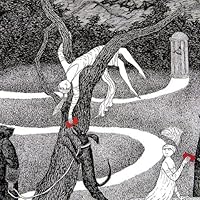
Bewildered and terrified, a young bride finds herself powerless to resist the grotesque horror of an inhuman revenge... and within the accursed walls of Fengriffen Manor, a cycle of torment, lust and nightmarish dread draws even nearer its hideous climax...
David Case (1937-2018) was born in upstate New York. Since the early 1960s he lived in London, as well as spending time in Greece and Spain. His acclaimed collection The Cell: Three Tales of Horror appeared in 1969, and it was followed by the novels Fengriffen: A Chilling Tale, Wolf Tracks, and The Third Grave. His other collections include Brotherly Love and Other Tales of Trust and Knowledge, Pelican Cay & Other Disquieting Tales, and an omnibus volume in the 'Masters of the Weird Tale' series from Centipede Press. In recent years, his selected short horror fiction has been reprinted by Valancourt Books as The Cell & Other Transmorphic Tales and Fengriffen & Other Gothic Tales.
A regular contributor to the legendary Pan Book of Horror Stories series during the early 1970s, as well as a handful of westerns and pseudonymous porn novels, his powerful zombie novella “Pelican Cay” in Dark Terrors 5 was nominated for a World Fantasy Award in 2001.
A fairly delightful Gothic tale that inspired the 1973 Amicus film And Now the Screaming Starts! (which remains one of the best titles around). Fengriffen is a little less lurid and a little less unpleasant than its cinematic counterpart, whether that's a plus or a minus, and it also eschews the crawling hand angle, though makes good use of some severed fingers in its place. A quick and atmospheric read in the "learned men dismiss a woman as hysterical, inadvertently enable a much worse tragedy" vein, with plenty of wonderfully Gothic descriptions and some surprisingly proto-Ligottian takes on psychology and humanities place in the grand scheme of things: "The mind is a descendant of the thumb and the vocal cord, and a malformed child it has always been, a mistake of evolution with the unique ability to bring its own extinction."
The lovely folks at Valancourt Books have released a nice edition with other stories by the author, though the one I read was an older hardcover that just contained Fengriffen...
This odd little novella was the source for the Amicus studios horror film called "And Now the Screaming Starts." The actors were somewhat put out (evidently) when they learned about the title change, somehow being in a movie called "Fengriffen" was more respectable, although the reality is that "Fengriffen" would not have sold well in the film market of the 1970s. The movie has a small cult following today, but the novella would probably be utterly forgotten had not the movie been made. I certainly wouldn’t have read it, for one thing.
The story is narrated by “Dr. Pope,” a late-nineteenth century English doctor who has studied the new science of Psychology at Leipzig (whose school of Psychology opened in 1879, so that does work, unlikely as it may be). He has been summoned to a classically Gothic castle to attend the new bride of the Lord of the Manor. She has been showing symptoms of mental distress, and Fengriffen believes that she no longer loves him. As Dr. Pope investigates, he discovers the classically Gothic curse on the family line, and struggles to free Catherine and the house in general from its grip, but finds that his scientific methods cannot prevail against something so irrational.
The blurb on the dust jacket says that the author “proves himself a master of the genre developed by Poe, LeFanu, and Lovecraft.” I was surprised to see Lovecraft’s name listed on a book published in 1970 – at that time he was largely unknown outside of serious horror and fantasy circles, and certainly unlikely to have been a selling-point. But, if the author himself had anything to do with the blurb, it seems to make sense. While this story has the above-listed classically Gothic elements (borrowed more from LeFanu than Poe), it also has distinctly Lovecraftian characteristics as well. In spite of the century, the protagonist is a “modern” rationalist and a man of science, who finds that human science is inadequate to deal with the horror he must face. He often balks at describing events which he finds “unimaginable,” although adequate hints are present to suggest those events to the audience. Much of his inability to deal with the situation derives from his own Victorian sexual repression, in spite of his Freudian training.
To the degree that the story works, I would say that it is this element that is most interesting. Although Dr. Pope is the narrator, the real center of the story is Catherine Fengriffen, who is the survivor of a rape. It is the inability of the male characters to understand, believe, or even listen to her that is the source of the real horror of the tale. Men in this world simply deny her pain, and placate her by assuring her that she has imagined what happened to her. When the truth is finally revealed, her husband only makes matters worse, while Dr. Pope denies reality right up to the final pages. In fact, there is more than one monster on the loose in this story, and one of them is patriachal culture itself.
Gothic horror novel about a family curse. A great creepy atmosphere is seen throughout the story. This book was adapted by Amicus studios into the 1973 horror movie And Now the Screaming Starts.
Often a film will lead me to its source material - such is the case with FENGRIFFEN, which was filmed by Amicus in 1972 and, after a title change, released in 1973 as ...AND NOW THE SCREAMING STARTS - it wasn't a half-bad gothic thriller with, according to audio-commentator Darren Gross, supernatural elements (such as a dismembered hand) added for the film.
The book (actually, at 133 pages, more of a novella) is long out-of-print, but to my surprise I discovered that it's still in my library's system - two or three clicks of my computer's mouse, and it was available for me to pick up this morning. And from the layer of dust on the book's top edge that blew off in a cloud, it's been a long time since this copy was checked out!
After 74 pages, one thing can definitely be said for David Case: he knew a lot of obscure but very interesting words! I finally had to start writing them down: "Antepenultimate" "Vermicular" Necrophagous" "Laodecian" "Acedia" "Grume" "Dichotomous" "Flagitiousness" "Mendicants" and "Fuscous" to mention a few (the last three occur within a space of about 8 to 10 lines!). Some of them aren't very pleasant!
4/22: A nice little Gothic thriller indeed, with a thought-provoking ending.
My all time favourite gothic horror that can send chills down the spine. Catherine is newly married and looking forward to life with Charles Fengriffin at his family home but things are not as they seem. Stretching back generations a curse has afflicted the Fengriffins and any virgin bride a Fengriffin brings home. Catherine finds out their secret and it's slowly driving her mad, can the doctor from London Charles has hired to help really save Catherine or is he up against demonic forces? Brilliantly crafted with a brooding, sinister atmosphere this is a perfect Halloween tale.
This little novel deserves far wider acclaim. This is gothic in the classic sense of the word, both regarding the imagery employed and the core psychological element. While truly classic in its themes and delivery, it is just masterfully executed, with not a iota of its compact size being wasted. It's a subtle tale whose essentially well-meaning narrator finds his science and rational materialism useless - primarily in a way that they severely limit his understanding of humanity, and then secondarily regarding the supernatural element which is always in the background and whose reality remains ambiguous to the very end. It's a tale where tragedies, both the one unfurling before our narrator's eyes and the recalled past one that led to it, appear to be unstoppable, ever mounting, with characters (none of them evil men) being like these hapless puppets caught in a stream.
Less of a book and more a pitch for the inevitable seventies horror adaptation (which surprisingly for a book that puts carnal relations at the centre of so much of the plot came from the usually pretty sexless Amicus, probably in a moment of late panic that they were losing a natural audience). It’s definitely from the same school of pastiche as Chetwynd Hayes, who always seemed more comfortable a match with Amicus, and has almost exactly the same pleasures as the film version: heavy on the gothic atmosphere, a bit of campness, light on actual dread but heavy on sun Heyer regency romping. I imagine I’ll forget I ever read this as it’s so close in every way to the film that I’ll struggle to differentiate them successfully
There's no doubt that Fengriffen is a good Gothic horror. The writing's beautiful, not unnecessarily cluttered with abstract images. It's difficult to rate this one. I could predict what would happen after the child was born, but the tension between the psychological and supernatural, and supernatural beating the former hands down wasn't what I was expecting. That revealed the true meaning of the curse and the cyclical nature of the story. The back story's kind of fucked up. I have to read some more works by this man. I'm hoping that he wouldn't let me down.
A classic case where a book's obscurity makes it seem much more desirable than it really is. In reality, Fengriffen is a mostly silly and dull pastiche of the Gothic tale. The only innovation is that it is more explicit than most Gothic stories; other than that, it's just a tired rehash. "Sardonicus" by Ray Russell is much more lively (and it's shorter, too!).
The lord of Fengriffen comes home with a new bride, so all should be well within the great hall. 'Tis not to be. Upon her wedding night, the bride is attacked by a mysterious figure. She notices husband pats on her head and tries to assure her all is well, but incident upon incident tells her something sinister walls the corridors of Fengriffen.
Enjoyable, fairly short gothic tale of terror, similar in tone to Poe et al. It kept me hooked to the end, even thought it was fairly predictable. As another reviewer mentioned, the vocabulary sent me to the dictionary more than once - I do love learning new, if arcane, words!
I really enjoyed this book I read it because of Wilum Hopfrog Pugmire a writer I love recommend it. It is scary and has some really nice poetic language in it. Here is a link to Mr. Wilum's review of it. http://www.youtube.com/watch?v=kevwDR...
Very atmospheric story, well told and quickly paced. The story is not unusual, newlyweds, haunted house, husband hiding family curse, etc. The difference is that this is really well told.