RENA PRIEST is a Lummi Tribal Member and a writer. Her debut book, Patriarchy Blues, garnered a 2018 American Book Award. She has been a Sustainable Arts Fellow at Mineral School Artist's Residency, and a nominee for a 2017 Pushcart Prize. Her new collection, Sublime Subliminal, will be released on Floating Bridge Press in the Fall of 2018. She has taught Comparative Cultural Studies, Native-American Studies and Special Topics in the Humanities, at Western Washington University and Fairhaven College. She holds an MFA in Writing from Sarah Lawrence College.
Rena Priest is a big name in my local literary scene, primarily known for her poetry. This is her first collection of essays, and for me, it's the best thing she's yet published.
Priest is an enrolled member of the Lhaq'temish (aka Lummi Nation), one of two indigenous tribal communities native to the county where I live. This deep connection to the human history of this part of the Pacific Northwest provides the author with considerable insight into the ways that free-market capitalism has ravaged not just our environment, but also the practice of building and maintaining human communities.
Not all of these essays are directly focused on profit-driven exploitation, but the many threads that Priest weaves all seem to stem from that source. For example, she writes about the experience of seeking to buy a house on land that was once occupied by the Lhaq'temish. So as a member of that community, she finds herself wrestling with the cruel irony of potentially paying substantial money to buy back land that was stolen from her ancestors. It's painful to think about, although Priest's viewpoint is neither angry nor resentful, but certainly a bit heavy-hearted.
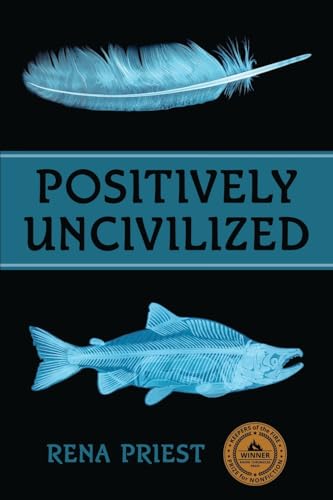
This brilliant set of essays, told through the lyrical prose of Washington's 2021-2023 poet laureate, draws us into the history of the author's people (the Lhaq'temish/Lummi) and their relationship to the land, the deep symbiosis between humans and the ecosystem as mutual caretakers. We learn also of the starkly contrasting approach of the colonizers who have disrespected both the people and the land, repeatedly reneging on treats and breaking laws while scoffing at native ways of caretaking, breaking the delicate balance in ways that have resulted in tremendous harm to the people, the animals, and the land. Yet there is reason for hope: swimming through all of these stories is the sacred salmon, whose spirit remains strong despite all of the harm brought to it by the centuries of colonization, and in that spirit we see a glimmer of a better future if we are once again willing to find symbiosis with the land.
I feel that this should be required reading for anyone who lives in the vicinity of the Salish Sea (i.e. Puget Sound). Highly recommended.
[Note: I had the distinct pleasure of seeing the author read from her book on her tour in Seattle, and am now a proud caretaker of a signed copy.]