

What do you think?

Apple: The First 50 Years
A Simon & Schuster eBook. Simon & Schuster has a great book for every reader.
608 pages, Hardcover
First published March 26, 2026
About the author
David Pogue
234 books121 followersDavid Pogue, Yale '85, is the weekly personal-technology columnist for the New York Times and an Emmy award-winning tech correspondent for CBS News. His funny tech videos appear weekly on CNBC. And with 3 million books in print, he is also one of the world's bestselling how- to authors. He wrote or co-wrote seven books in the "For Dummies" series (including Macs, Magic, Opera, and Classical Music). In 1999, he launched his own series of amusing, practical, and user-friendly computer books called Missing Manuals, which now includes 100 titles.
David and his wife, Jennifer Pogue, MD, live in Connecticut with their three young children.
Ratings & Reviews
Friends & Following
Create a free account to discover what your friends think of this book!
Community Reviews
Displaying 1 - 30 of 127 reviews

May 20, 2026
This book took me over a week to finish...and I'm a fast reader!
I got my first Mac all the way back in 1995, and have owned some sort of Apple device and used it pretty much daily ever since. Reading about old versions of the Mac OS or the iPod with the Click Wheel was like looking at one of my middle or high school yearbooks; it was a reminder of days gone by, when life was (seemingly) simpler. Despite my longtime Apple fandom, there was a lot about the company and its products that I didn't even know, even when it came to devices I actually owned. Any proud Mac user should definitely read this book...but be prepared to invest quite a bit of time!
I got my first Mac all the way back in 1995, and have owned some sort of Apple device and used it pretty much daily ever since. Reading about old versions of the Mac OS or the iPod with the Click Wheel was like looking at one of my middle or high school yearbooks; it was a reminder of days gone by, when life was (seemingly) simpler. Despite my longtime Apple fandom, there was a lot about the company and its products that I didn't even know, even when it came to devices I actually owned. Any proud Mac user should definitely read this book...but be prepared to invest quite a bit of time!
April 2, 2026
This history of Apple doesn’t have terribly much that I haven’t seen before, as a semi-interested Apple watcher, but it is mostly well assembled. It’s got a textbooky aesthetic—tons of inline photos, lots of sidebars—that makes it feel like a reference for the mostly-already-widely known stories of Apple’s history. The book gets less interesting in its final third or so, where we get into the Tim Cook era. I think there are a few reasons for that. First, the company probably just has less intriguing internal drama post–Steve Jobs. And second, many of the people involved are still at Apple, so they’re not spilling the beans on any truly interesting behind-the-scenes stories. (Maybe I’m also just more interested in the aesthetic of 80s/90s computing.) As a result, the last chunk of the book sometimes devolves into lists of products and their features, without a lot of deep analysis or introspection on them.
Also—Pogue’s tone takes some getting used to. He comes across as very colloquial, folksy, and sarcastic. In other words, like a technology opinion columnist (which he is), rather than an author presenting a formal history of Apple. There are also a handful of facts that sounded pretty dubious, and which it seemed like he should have dug deeper on rather than accepting.
Still! The early history stuff remains a fascinating story, and Pogue is at his strongest when he’s recounting the story of Apple’s origins and early years. The heavy photo usage is incredibly helpful here, letting us see those early models of computers right alongside the text.
Also—Pogue’s tone takes some getting used to. He comes across as very colloquial, folksy, and sarcastic. In other words, like a technology opinion columnist (which he is), rather than an author presenting a formal history of Apple. There are also a handful of facts that sounded pretty dubious, and which it seemed like he should have dug deeper on rather than accepting.
Still! The early history stuff remains a fascinating story, and Pogue is at his strongest when he’s recounting the story of Apple’s origins and early years. The heavy photo usage is incredibly helpful here, letting us see those early models of computers right alongside the text.

March 12, 2026
An absolute joy of a book to read. Well researched with quotes from all of the major Apple players both past and present. “Apple: The First 50 Years” puts a lot of Apple mythology to rest revealing the behind scenes practical and emotional struggles bringing many of Apple’s products to market (and many that never saw the light of day). David Pogue’s prose is breezy and effortless despite having to get into the weeds of some of the more technical processes from time to time. If you are a fan of Apple this book is a must, even if you’re not a fan and just want a fun retrospective on the state of the computer industry from the late Seventies until today this book is a must.

Review of advance copy received from Netgalley
“Apple: The First 50 Years,” by David Pogue, is a captivating history of Apple’s remarkable fifty-year journey. The book is divided into four chronological parts, which take readers through the evolution of Apple’s products and services, and the stories of those who created them. We see Apple’s management, creativity and innovation, marketing campaigns, and pursuit of excellence in motion. We also witness the genius of Steve Jobs, without whose passion, vision, and relentless determination Apple would cease to exist.
Part 1 introduces us to Steve Wozniak (“Woz”) and Steve Jobs—from how they met, to their early ventures, to their founding of “Apple Computer Company” on April 1, 1976. We progress through Apple’s early computers, including the Apple II and Macintosh, and explore the development of Apple’s operating system and software. We also experience John Sculley’s power struggle with Jobs, which resulted in Jobs’s demotion and subsequent resignation.
Part 2 covers the years without Steve Jobs, during which multiple Apple CEOs were ousted. Sculley, Pepsi-Cola’s former president, was Apple’s CEO. His eventual removal was due, in part, to his failure to consummate a merger that would lessen the dominance of PCs running Microsoft Windows on Intel chips. Michael Spindler, an engineer already running multiple Apple divisions, took over as CEO. But declining sales and “rock bottom” morale contributed to his removal. Gil Amelio, the CEO of National Semiconductor, became the new CEO. However, consumer sales were not Amelio’s forte. Apple’s mounting financial difficulties elevated its bankruptcy risk and Amelio was fired.
Part 3 centers on Steve Jobs’s return to Apple. After leaving Apple, Jobs founded NeXT, which had developed a dazzling, colorful, and easy-to-use multitasking operating system called NeXTSTEP. Unlike Apple’s Mac OS, which kept crashing, NeXTSTEP was highly stable. So, while Amelio was still CEO, Apple bought NeXT and Jobs returned to Apple in an advisory role. Within a few months of Amelio’s firing, Jobs became Apple’s interim CEO and later its permanent CEO. After returning to Apple, we see Jobs’s genius on full display. We witness the game-changing creation of the iPod, iPhone, iPad, apps, and more, all of which led to Apple’s incredible turnaround. Sadly, we also discover Jobs’s battle with pancreatic cancer, which led to his untimely death.
Part 4 addresses Tim Cook’s tenure as Apple’s CEO. Before Jobs died, he resigned as Apple’s CEO. Cook, who was Apple’s COO, assumed the CEO role. We are taken through several successes under Cook’s leadership, including the dramatic growth in Apple Services (e.g., Apple Music, Apple Arcade, Apple TV+) and the introduction of Apple Watch and Apple Silicon. We also learn about Vision Pro and Apple Intelligence, which are not yet as successful, and about headwinds over app store charges and Apple’s reliance on China.
“Apple: The First 50 Years” is a comprehensive and compelling account of Apple’s first fifty years. The award-winning author skillfully takes readers through Apple’s history, products and services, stories of key employees, and iconic culture. Apple fans, technology and history buffs, and countless others will greatly enjoy the author’s well-written account of Apple’s epic journey. The book also contains numerous photos and images that help bring Apple’s story to life.
[My special thanks to Simon & Schuster and NetGalley for an advance reading copy of this book.]
Part 1 introduces us to Steve Wozniak (“Woz”) and Steve Jobs—from how they met, to their early ventures, to their founding of “Apple Computer Company” on April 1, 1976. We progress through Apple’s early computers, including the Apple II and Macintosh, and explore the development of Apple’s operating system and software. We also experience John Sculley’s power struggle with Jobs, which resulted in Jobs’s demotion and subsequent resignation.
Part 2 covers the years without Steve Jobs, during which multiple Apple CEOs were ousted. Sculley, Pepsi-Cola’s former president, was Apple’s CEO. His eventual removal was due, in part, to his failure to consummate a merger that would lessen the dominance of PCs running Microsoft Windows on Intel chips. Michael Spindler, an engineer already running multiple Apple divisions, took over as CEO. But declining sales and “rock bottom” morale contributed to his removal. Gil Amelio, the CEO of National Semiconductor, became the new CEO. However, consumer sales were not Amelio’s forte. Apple’s mounting financial difficulties elevated its bankruptcy risk and Amelio was fired.
Part 3 centers on Steve Jobs’s return to Apple. After leaving Apple, Jobs founded NeXT, which had developed a dazzling, colorful, and easy-to-use multitasking operating system called NeXTSTEP. Unlike Apple’s Mac OS, which kept crashing, NeXTSTEP was highly stable. So, while Amelio was still CEO, Apple bought NeXT and Jobs returned to Apple in an advisory role. Within a few months of Amelio’s firing, Jobs became Apple’s interim CEO and later its permanent CEO. After returning to Apple, we see Jobs’s genius on full display. We witness the game-changing creation of the iPod, iPhone, iPad, apps, and more, all of which led to Apple’s incredible turnaround. Sadly, we also discover Jobs’s battle with pancreatic cancer, which led to his untimely death.
Part 4 addresses Tim Cook’s tenure as Apple’s CEO. Before Jobs died, he resigned as Apple’s CEO. Cook, who was Apple’s COO, assumed the CEO role. We are taken through several successes under Cook’s leadership, including the dramatic growth in Apple Services (e.g., Apple Music, Apple Arcade, Apple TV+) and the introduction of Apple Watch and Apple Silicon. We also learn about Vision Pro and Apple Intelligence, which are not yet as successful, and about headwinds over app store charges and Apple’s reliance on China.
“Apple: The First 50 Years” is a comprehensive and compelling account of Apple’s first fifty years. The award-winning author skillfully takes readers through Apple’s history, products and services, stories of key employees, and iconic culture. Apple fans, technology and history buffs, and countless others will greatly enjoy the author’s well-written account of Apple’s epic journey. The book also contains numerous photos and images that help bring Apple’s story to life.
[My special thanks to Simon & Schuster and NetGalley for an advance reading copy of this book.]

March 25, 2026
Wow! Just Wow! I wanted this as soon I saw the preorder. I wanted to hear the history of Apple and this delivered in spades. Author David Pogue used to write the excellent Missing Manual series that covered software and hardware for many Apple devices and services. I was sad when it ended. This is a labor of love and you can tell. I purchased both the Kindle version and the audiobook. The author is a former newsman and is an excellent narrator."
David, not that you don't have enough to do already, you are a fantastic narrator with a gorgeous voice."
While the book has wonderful text, color photos and the wonderful sidebars, you must hear this book on audio. Narration is perfect. It made me laugh, cry and just enjoy. It's more like listening to a wonderful story. It also includes audio clips, so you can actually hear Jobs and Cook during the presentations and some of the other Apple veterans. From both Steves early years to the meeting of key friends, creation of the company, Jobs forced exit and triumphant return to the ground breaking products and Tim Cook's sheparding into the next era are covered. Lots of great stories, sidebars and more make this book a keepsake. I was sad when it ended because I enjoyed it so much. I will definitely to listening to and reading this again. 10 stars if I could and Thank you to the author, for taking us on an incredible journey with a wonderful friend.
David, not that you don't have enough to do already, you are a fantastic narrator with a gorgeous voice."
While the book has wonderful text, color photos and the wonderful sidebars, you must hear this book on audio. Narration is perfect. It made me laugh, cry and just enjoy. It's more like listening to a wonderful story. It also includes audio clips, so you can actually hear Jobs and Cook during the presentations and some of the other Apple veterans. From both Steves early years to the meeting of key friends, creation of the company, Jobs forced exit and triumphant return to the ground breaking products and Tim Cook's sheparding into the next era are covered. Lots of great stories, sidebars and more make this book a keepsake. I was sad when it ended because I enjoyed it so much. I will definitely to listening to and reading this again. 10 stars if I could and Thank you to the author, for taking us on an incredible journey with a wonderful friend.

March 21, 2026
I was there too!
What a treat! David Pogue did what only David Pogue could do. Write a big book about Apple from the standpoint of products and services. His writing is compelling with just the right level of detail.
I have been an Apple fanboy since buying my first Mac in 1985. So I didn’t participate as an Apple customer for all of the 50 years, but I came somewhat close (41 years).
What a treat! David Pogue did what only David Pogue could do. Write a big book about Apple from the standpoint of products and services. His writing is compelling with just the right level of detail.
I have been an Apple fanboy since buying my first Mac in 1985. So I didn’t participate as an Apple customer for all of the 50 years, but I came somewhat close (41 years).
January 24, 2026
I have read numerous books about Apple. While this book did not introduce any groundbreaking information, I found it enjoyable nonetheless.
I would like to express my gratitude to NetGalley for providing me with an advance copy of the book.
I would like to express my gratitude to NetGalley for providing me with an advance copy of the book.

May 1, 2026
At 24 hours, this is the longest audiobook I have ever listened to and it is an indication of how good the content and spoken performance are that it held my interest all the way through. The author (and performer) is certainly qualified to present this material, given his news reporting background and attention to detail, his insight into the personalities involved, and his understanding of tech issues involved.
My first computer was an Osborne, a "luggable" with a tiny screen running the CPM system. I had to teach myself BASIC programing to put together some financial analysis programs, but was wowed by the early spreadsheet and word processing programs. I later moved on to the the early IBM desktops. I was blown away a few years later when I first saw a Macintosh in action at the Consumer Electronics Show in Vegas - the simplicity and intuitive nature of the machine was a revelation. Given the lock that the "Wintel" system had on corporate America, I did not get to experience the magic of Apple until I purchased their later products - iPod, IPhone, iPad, Apple Watch, etc.
Part of the fun of this book is the details related to the development of so many things we take for granted in modern computers - color screens, file naming, storage "magic", music delivery, basic operations such as running programs and saving docs reduced to a few steps from the old multi-step, memory taxing approach. David does a great job of getting into the nitty gritty of how these issues were solved.
I also enjoyed his observations related to the development of the modern business environment related to tech. His comment on Apple, could be applied to all businesses - "Luck, strategy, faith and people all played a role. Had they not unspooled exactly the way they did, there would have been no Apple left for Steve Jobs to save."
The saga of Steve Jobs is a great tale - his rise, fall, resurrection, and passing are handled with great skill. I often thought I could never work for a "jerk" like Jobs, but after learning more about his talents, approach, and yes, short comings, I think I probably would have had to tone my ego down a bit and learn some valuable skills.
I needed to look up a portion of the tale which tends to be tough to do in the audiobook format so I stopped by my local bookstore to find it in the hardcopy. The hardcopy blew me away! I had no idea what I was missing in the audiobook - tremendous color pictures of people and products, great examples of engineering magic and easy cross reference of the various issues. Naturally, I had to purchase a copy. Yes, heavy, long and a duplicate of the listening material but worth every penny. I think this is the first time I ended up with audio and hardback and I would do it again!
So, if you have an interest in tech, consumer electronics, business issues, history or the personalities that shaped our world, grab this book in whatever format works for you and get lost in the great writing in the wonderful book that David Pogue has produced. Probably the best business book I have read, and that covers a lot of them!
My first computer was an Osborne, a "luggable" with a tiny screen running the CPM system. I had to teach myself BASIC programing to put together some financial analysis programs, but was wowed by the early spreadsheet and word processing programs. I later moved on to the the early IBM desktops. I was blown away a few years later when I first saw a Macintosh in action at the Consumer Electronics Show in Vegas - the simplicity and intuitive nature of the machine was a revelation. Given the lock that the "Wintel" system had on corporate America, I did not get to experience the magic of Apple until I purchased their later products - iPod, IPhone, iPad, Apple Watch, etc.
Part of the fun of this book is the details related to the development of so many things we take for granted in modern computers - color screens, file naming, storage "magic", music delivery, basic operations such as running programs and saving docs reduced to a few steps from the old multi-step, memory taxing approach. David does a great job of getting into the nitty gritty of how these issues were solved.
I also enjoyed his observations related to the development of the modern business environment related to tech. His comment on Apple, could be applied to all businesses - "Luck, strategy, faith and people all played a role. Had they not unspooled exactly the way they did, there would have been no Apple left for Steve Jobs to save."
The saga of Steve Jobs is a great tale - his rise, fall, resurrection, and passing are handled with great skill. I often thought I could never work for a "jerk" like Jobs, but after learning more about his talents, approach, and yes, short comings, I think I probably would have had to tone my ego down a bit and learn some valuable skills.
I needed to look up a portion of the tale which tends to be tough to do in the audiobook format so I stopped by my local bookstore to find it in the hardcopy. The hardcopy blew me away! I had no idea what I was missing in the audiobook - tremendous color pictures of people and products, great examples of engineering magic and easy cross reference of the various issues. Naturally, I had to purchase a copy. Yes, heavy, long and a duplicate of the listening material but worth every penny. I think this is the first time I ended up with audio and hardback and I would do it again!
So, if you have an interest in tech, consumer electronics, business issues, history or the personalities that shaped our world, grab this book in whatever format works for you and get lost in the great writing in the wonderful book that David Pogue has produced. Probably the best business book I have read, and that covers a lot of them!

June 19, 2026
Fun book for me, I have been -interested- in Apple computers for all 50 years, although I didn’t start actually using them until about ‘91, with some fairly early Macs. (I never used the original Apple II computers, but my uncle had one in the 80s, and boy was I envious!) So it’s been about 35 years for me. The history was mostly vaguely familiar (I read lots of tech journalism) but there were certainly tons of details i didn’t know about, and tons of great photos. And I’ve always enjoyed Pogue’s writing.
June 26, 2026
Here in one book, we have everything you have ever wanted to know about Apple the corporation, and all the many Apple products. There are insights about the Apple, founders, key Apple employees, and key directors. The book is an easy quick read packed full of all sorts of interesting facts and stories Highly recommended.

April 5, 2026
Superhyggeligt nostatrip ❤️

March 29, 2026
Great Reed, amazing history!
Fantastic history of Apple. We’ve heard many of the stories, but now they’ve been fact checked and they’re all in one place. A real page clicker.
Fantastic history of Apple. We’ve heard many of the stories, but now they’ve been fact checked and they’re all in one place. A real page clicker.

March 29, 2026
At its best, an enthralling dive in the products that made this great American company. At its worst, a boring list of projects and product updates. Read it for its great moments but perhaps skip some of the slower sections.

April 15, 2026
Love the first half of the book, full of insight and behind scenes story of how early apple products were created. The 2nd half was mediocre, feels very much like a news summary.

March 22, 2026
I never would've known about this book, until I saw a Facebook ad promoting it. See Facebooks ads sometimes work! I was intrigued, and was interested in reading more about the company history. I knew a little bit, but was ready for a lot more. I do remember as youngster, we had an Apple IIC computer, and I used it.
I think it's really cool that people with similar interests can find each other, as that is how Jobs and Wozniak met way back in 1971! Google the Homebrew Computer Club! I can't even think where society would be if that didn't happen. Would somebody else have stepped up, probably!
This book was very detailed about everything Apple has touched and produced and thought about. Even, what is happening now and in the future is mentioned. From interviews with the key people (Steve Jobs, Steve Wozniak, Tim Cook, and a lot more folks), the story of how all the products and accompanying software came to be is amazing. Just imagine, a bunch of talented people tinkering with something and when it all comes together, it's something unbelievable that everybody wants. How cool is that? To test those things out at work and see what happens is just a normal process at Apple. Of course, there are also a lot of stories of products that failed or got scrapped.
How did Apple get the ideas for retail stories, the App Store, Apple TV, Apple Fitness, the iPhone, and more is all heavily discussed. Some of the technical jargon (processors and memory) was a bit too much for me to comprehend, but later in the book, I got to understand the A chips and the M chips! Scattered throughout the book were small tidbits about some of the key employees along with their education, jobs before and after Apple, and a quick fun fact for them).
Apple also brought a lot of smaller companies because of their software or hardware expertise.
A direct excerpt from the book that I found really interesting:
"Steve Jobs fell in love with Japanese art in high school, and with his calligraphy at Reed College. By the time he co-founded Apple, he was obsessed with design. Jobs and Jony Ive were even notoriously invested in the backs and even interiors of the products."
Goes to show why the unboxing of Apple products is so fun and exciting, and neat. And why a lot of people hold on to the boxes!
For me, I like the simplicity and the fact that all of my Apple products work very well together. I got an iPad, MacBook Air, iPhone 17, and AirPods. Soon, I may add a new Apple Watch as I gave my current one to my son.
One final thing, before I owned Apple products, I always felt overwhelmed and very intimidated at an Apple Store. But now, I can walk in with confidence and am a part of the Apple community.
I think it's really cool that people with similar interests can find each other, as that is how Jobs and Wozniak met way back in 1971! Google the Homebrew Computer Club! I can't even think where society would be if that didn't happen. Would somebody else have stepped up, probably!
This book was very detailed about everything Apple has touched and produced and thought about. Even, what is happening now and in the future is mentioned. From interviews with the key people (Steve Jobs, Steve Wozniak, Tim Cook, and a lot more folks), the story of how all the products and accompanying software came to be is amazing. Just imagine, a bunch of talented people tinkering with something and when it all comes together, it's something unbelievable that everybody wants. How cool is that? To test those things out at work and see what happens is just a normal process at Apple. Of course, there are also a lot of stories of products that failed or got scrapped.
How did Apple get the ideas for retail stories, the App Store, Apple TV, Apple Fitness, the iPhone, and more is all heavily discussed. Some of the technical jargon (processors and memory) was a bit too much for me to comprehend, but later in the book, I got to understand the A chips and the M chips! Scattered throughout the book were small tidbits about some of the key employees along with their education, jobs before and after Apple, and a quick fun fact for them).
Apple also brought a lot of smaller companies because of their software or hardware expertise.
A direct excerpt from the book that I found really interesting:
"Steve Jobs fell in love with Japanese art in high school, and with his calligraphy at Reed College. By the time he co-founded Apple, he was obsessed with design. Jobs and Jony Ive were even notoriously invested in the backs and even interiors of the products."
Goes to show why the unboxing of Apple products is so fun and exciting, and neat. And why a lot of people hold on to the boxes!
For me, I like the simplicity and the fact that all of my Apple products work very well together. I got an iPad, MacBook Air, iPhone 17, and AirPods. Soon, I may add a new Apple Watch as I gave my current one to my son.
One final thing, before I owned Apple products, I always felt overwhelmed and very intimidated at an Apple Store. But now, I can walk in with confidence and am a part of the Apple community.

July 6, 2026
Thorough. Too long? It's all there. A very unbiased look into the good, bad, and ugly of Apple. A company known for innovation and executing smartly on the surface was behind the scenes chaotic. Jobs was visionary and driven but also mercurial. He reminded me of our current POTUS. You either loved him or hated him but Jobs' touch was golden. I am an Apple user now but was into Windows initially. My views on the ethics of Apple being superior to other tech companies were validated and reinforced. The corporate culture of Apple reminded me of the Marine Corps with the focus on the mission and doing the right thing.

September 14, 2026
Solid book!
If you want to learn about Apple, then you have to read this.
If you want to learn about Apple, then you have to read this.

Review of advance copy received from Netgalley
Beyond the Keynote Myth: “Apple: The First 50 Years” and the Hidden Machinery Behind the World’s Most Intimate Tech Empire
By Demetris Papadimitropoulos | February 28th, 2026
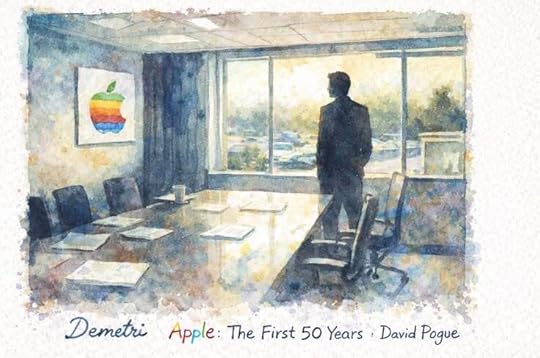
Watercolor Piece by Demetris Papadimitropoulos
“The Return” (1997): In a fluorescent Infinite Loop room, Jobs’s silhouette redraws Apple’s future with the ruthless calm of focus.
David Pogue’s “Apple: The First 50 Years” arrives with the mischievous confidence of a keynote that knows it has the room. The book is, on one level, exactly what its title promises: a brisk, image-rich, anecdote-forward history of the company that taught the modern world to crave rectangles with rounded corners. But Pogue isn’t simply counting anniversaries or building an altar to sleek aluminum. He’s writing an origin story of a sensibility – how a stubborn, aestheticized idea of technology (simple, sealed, delightful; equal parts tool and talisman) became a global operating system for desire. Apple’s story has been told often enough to turn into catechism. Pogue’s advantage is that he knows the catechism, enjoys the catechism, and still bothers to check the footnotes.
The book’s signature move is a kind of cheerful demystification. It refuses the lazy versions of Apple lore, not by dunking on them but by swapping in better stories: the ones that explain how power actually works inside a company built on secrecy, taste, and unreasonable deadlines. Pogue’s voice – wry, plainspoken, a little delighted by human eccentricity, suspicious of sacred cows – keeps the page turning even when the subject is something as potentially sleep-inducing as warehouse inventory or chip roadmaps. He writes the way good tech people talk when they’re not trying to sound like tech people: clean sentences, punchy framing, the occasional dad-joke aside, and an instinct for the telling physical detail (a drawbridge-opening Power Mac, a titanium laptop that made engineers quit, a green LED that says, quietly, “privacy is on”). The effect is that of an accessible guided tour through an institution that has spent five decades insisting you are not allowed in.
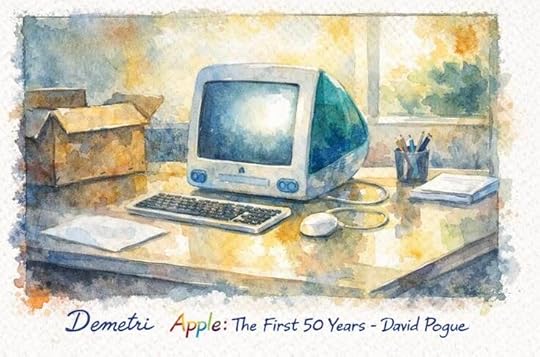
Watercolor Piece by Demetris Papadimitropoulos
“The iMac Moment” (1998): A translucent Bondi-blue iMac glows on a clean desk like a declaration that design can reboot desire.
If Apple has always been, in Jobs’s preferred phrasing, “the whole widget,” Pogue makes a parallel claim about Apple history: you don’t understand the products unless you also understand the choreography that produced them. He is at his best when he treats Apple as a system of constraints – a culture that turns limitation into style. The famed Quadrant of four Macs becomes less a marketing meme than a governing philosophy: focus as theology, the refusal to become Sony or Samsung with their thousands of SKUs. Secrecy becomes not only a tactical advantage but a narrative engine, the reason keynotes landed like cultural events rather than mere product announcements. Even the company’s obsession with packaging is rendered as something like moral philosophy: “You sense care even if you can’t see care,” the idea that the unseen back panel and the invisible internal screws are part of the promise.
Pogue also has a gift for turning engineering into drama without faking conflict where there is none. The most gripping chapters read like a series of elegant emergencies. The iPhone begins as a tablet, detours through the Motorola ROKR misadventure, then gets yanked toward its destiny by a multitouch demo that makes everyone in the room feel the future click into place. The tale of the virtual keyboard – the biggest “how did that not fail?” question of the modern phone – becomes a story about probability, language frequency, and the weird art of making small targets bigger by lying to the finger in mathematically principled ways. The late-stage pivot from plastic to glass is a Pogue-perfect set piece: Jobs, irritated by scratches, calls Corning and essentially dares a dormant 1960s process back to life on a modern deadline. It’s reality distortion field as supply-chain negotiation, the willpower of a founder translated into kiln temperatures and potassium-ion baths.
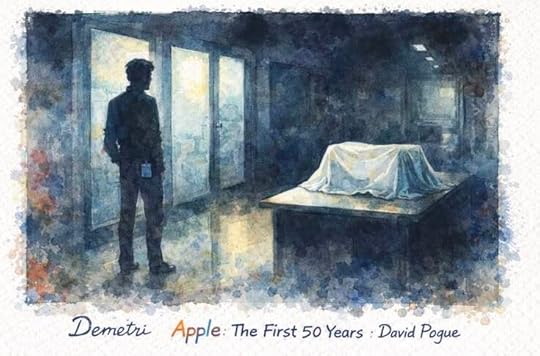
Watercolor Piece by Demetris Papadimitropoulos
“Purple Dorm” (2004–2007): Behind frosted doors and harsh security light, invention happens in secrecy – a covered prototype breathing under pressure.
But Pogue is too seasoned a narrator to pretend that Apple’s magic is only magic. Over and over, he traces the company’s true genius to a consistent, almost unglamorous pattern: recognizing fledgling technologies, simplifying them, and then forcing the entire ecosystem to behave as if simplicity is natural. The iPod didn’t invent digital music; it made the friction intolerable everywhere else. The App Store didn’t invent software marketplaces; it standardized them, taxed them, and made them feel safer than freedom. The Apple Watch didn’t invent wearables; it made “health” a mainstream product narrative, turning your wrist into a lightly regulated clinic and your daily movement into a set of rings you can’t stop trying to close. Even Vision Pro, the book’s most ambivalent marvel, follows the same arc: take an industry’s crude prototype, over-engineer it into a museum-quality experience, and then wait to see if the world is ready to make the leap from “wow” to “why do I need this?”
Pogue’s structure – fifty chapters that behave like well-timed vignettes, each with its own hook and payoff – matches the Apple rhythm he’s describing. There is, throughout, a keynote cadence: unveil the problem, dramatize the constraint, deliver the solution, let the audience gasp, toss in the human aside. That rhythm is not an accident; it is part of the author’s style as a communicator. One can feel the broadcaster’s instinct for pacing and the columnist’s affection for the small absurdities that explain the big machinery. A meeting becomes a myth generator. A debate about the orientation of a laptop logo becomes a parable about whose gaze matters. The “slide to unlock” gesture becomes both an ergonomic safeguard against butt-dialing and a decade-long legal war. The book is full of these little apertures where design becomes sociology.
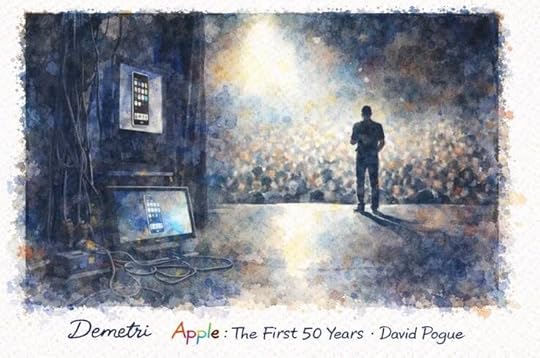
Watercolor Piece by Demetris Papadimitropoulos
“The Keynote Tightrope” (Jan 2007): From the wings, the iPhone arrives as stage magic – a flawless spotlight balancing on a backstage wire of glitches.
And yet, for all its pleasures, the Apple story in 2026 cannot be told as pure triumph. Pogue doesn’t ignore the darker strands, and some of the book’s most modern energy arrives when he stops celebrating the products and starts examining the trade-offs. China, here, is not merely a manufacturing note; it is the operational substrate of Apple’s empire and the geopolitical fault line under its feet. The Foxconn suicide crisis is framed as the moment Western consumers were forced to see the hidden human costs of frictionless gadgets – the dormitories, the churn, the nets that critics called tone-deaf and Jobs defended as pragmatic. Pogue acknowledges the reforms, the audits, the transparency reports, but the broader question hangs in the air: can a company whose brand is care reconcile that promise with a global supply chain optimized for speed and margin? In an era of tariffs-as-threats, export controls, and rising industrial policy, Apple’s reliance on “China speed” reads less like a clever strategy than a vulnerability you can name.
Similarly, the book’s long view on “closed systems” lands with renewed bite at a moment when regulators around the world are treating Apple’s integration not as a virtue but as a possible monopoly costume. The App Store – once a heroic defense against malware and “buggy crud” – becomes, in the later chapters, an arena of injunctions and resentments: Epic’s rebellion, commission battles, forced links, and the dawning reality that “walled garden” is a phrase that can be said with either admiration or accusation. This is where Pogue’s light touch becomes a mixed blessing. His narrative keeps moving, and his tone stays companionable, but the stakes are enormous: control as safety, control as profit, control as power. In 2026, that triangle is not a thought experiment. It is a set of lawsuits, legislative acts, and design changes that alter what “the iPhone experience” even means depending on which country you live in.
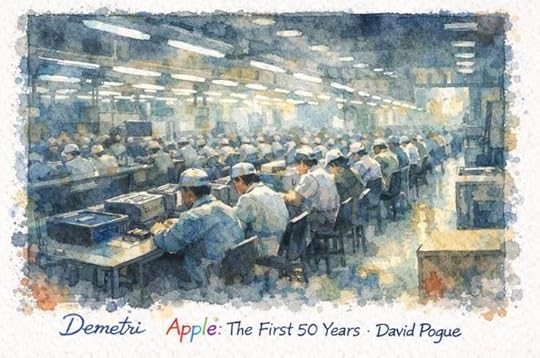
Watercolor Piece by Demetris Papadimitropoulos
“Foxconn / China Speed”: Endless rows and cold dorm light reveal the invisible engine of elegance: scale, discipline, and human cost.
The book’s most delicate chapter, perhaps inevitably, is the one about AI. Here Pogue captures both the cultural vertigo of the ChatGPT era and Apple’s characteristic refusal to behave like a startup. Apple Intelligence, as he describes it, is a suite of “nips and tucks” rather than fireworks: writing tools, summaries, cleanup brushes, a scattering of small conveniences that feel more like iOS features than a new species of mind. Critics yawn; Apple insists it’s “a journey.” The drama arrives with Siri – the promise of a truly personal agent, the demo that makes investors swoon, the delay, the anxiety about hallucinations, the awkwardness of advertising a thing that isn’t shipping. It’s a story that echoes earlier Apple lessons about preannouncing – “Newton,” “AirPower” – but now the stakes include trust itself. Pogue’s reportorial instinct is sharp here: he doesn’t need to declare a verdict, because the narrative contains its own warning. A company that built its modern religion on showing the working product onstage cannot afford too many concept videos.
If there is a quiet thesis threading through all fifty years, it’s this: Apple’s greatest inventions are not devices but expectations. The company taught us to demand beauty from tools, to feel personally wronged by ugly interfaces, to treat friction as an insult. It also taught us to live inside a continuous river of notifications, photos, messages, and streaming media – “the end of boredom,” as Pogue writes – and then to worry about what that river has done to our attention, our politics, and our loneliness. The iPhone’s cultural impact is rendered here as both triumph and complication, an enabling technology that made entire industries possible while also helping to accelerate a world where reality itself is a little easier to stage-manage.
What makes Pogue’s book particularly satisfying is that it’s not only a Jobs epic, though Jobs remains its gravitational center. Pogue is careful to give the supporting cast their due: the engineers who live inside the consequences of perfectionism, the operations leaders who turn ideology into shipping boxes, the designers who argue about invisible corners, the executives who inherit a legend and must do something other than impersonate it. The Cook era, in Pogue’s telling, is less a decline than a pivot: from category-defining hardware to services, from charismatic genius to institutional machinery, from a company that made “things” to a company that makes recurring revenue and ecosystem gravity. There is an argument embedded here that the modern Apple may be more financially formidable than ever – yet culturally less incandescent – and that this might be less a failure of imagination than a shift in the era’s available “low-hanging fruit.”
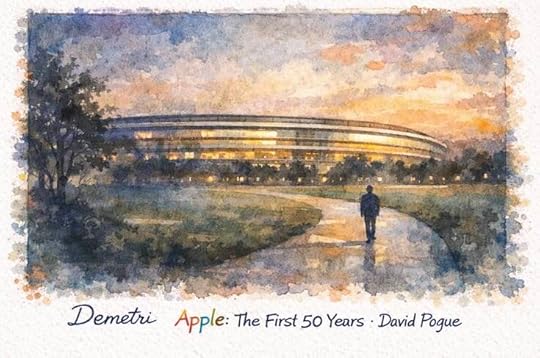
Watercolor Piece by Demetris Papadimitropoulos
“Apple Park + Loss” (2011–2017): The ring at dusk reads like a monument – a quiet architecture of legacy, absence, and continuation.
You can feel, in these later sections, Pogue’s awareness of the books that hover in the background of any Apple history. The myth-busting and the corporate interiority echo “Inside Apple.” The supply-chain and China chapters nod toward the harder, more critical tradition of “After Steve” and “Apple in China.” The design worship and process language recall “Creative Selection” and “Insanely Simple.” The long moral argument about secrecy, focus, and taste is a descendant of “Becoming Steve Jobs,” which framed the founder not as a saint or villain but as an evolving instrument of ambition. Pogue’s difference is tonal: he is less prosecutorial than most of his comps, and more committed to the pleasure of the story. That choice may frustrate readers who want a sharper knife, but it is also the reason the book can do what it does best: make the complicated history readable without making it simplistic.
As a reader, I found myself admiring how Pogue balances three tasks that usually break a book when attempted together: he tells a sweeping corporate history; he explains technology to nontechnical readers without condescension; and he keeps returning to the human texture – the neuroses, the loyalties, the moments of kindness that complicate the caricature of Jobs as pure tyrant. The chapters on loss, on the memorials, and on the quieter acts of care land precisely because Pogue doesn’t oversell them. He trusts the stories: Jobs sneaking an acupuncturist into a hospital room, the private insistence on not asking “what Steve would have done,” the grief of an institution that was, for better and worse, built around a single person’s taste.
To say that a book about Apple is “timely” is almost redundant; Apple is one of the few corporations that functions as a civic infrastructure of everyday life. But this book is timely in a sharper way: it offers a narrative map for the present moment’s anxieties. If you want to understand why regulators are fighting platform power, why privacy has become a selling point, why “made in China” is no longer a neutral label, why AI is both carnival and crisis, why the phone feels like a comfort object and a trap – you could do worse than spend time inside Pogue’s version of the last half century. He doesn’t pretend the story is finished. He ends, instead, with throughlines: focus, secrecy, beauty, simplicity, sustainability, accessibility, privacy – the values Apple cites as its alibi and its engine. Whether those values are enough to carry the company through its next fifty years is the open question. Pogue, wisely, refuses to predict the future with too much confidence. The book’s final effect is something rarer than prophecy: a lucid sense of how the present got built.
In the end, “Apple: The First 50 Years” feels like the product it describes: obsessively assembled, friendly on the surface, intricate underneath, occasionally infuriating in what it chooses to leave out, and undeniably hard to put down. My rating: 89 out of 100.
By Demetris Papadimitropoulos | February 28th, 2026
Watercolor Piece by Demetris Papadimitropoulos
“The Return” (1997): In a fluorescent Infinite Loop room, Jobs’s silhouette redraws Apple’s future with the ruthless calm of focus.
David Pogue’s “Apple: The First 50 Years” arrives with the mischievous confidence of a keynote that knows it has the room. The book is, on one level, exactly what its title promises: a brisk, image-rich, anecdote-forward history of the company that taught the modern world to crave rectangles with rounded corners. But Pogue isn’t simply counting anniversaries or building an altar to sleek aluminum. He’s writing an origin story of a sensibility – how a stubborn, aestheticized idea of technology (simple, sealed, delightful; equal parts tool and talisman) became a global operating system for desire. Apple’s story has been told often enough to turn into catechism. Pogue’s advantage is that he knows the catechism, enjoys the catechism, and still bothers to check the footnotes.
The book’s signature move is a kind of cheerful demystification. It refuses the lazy versions of Apple lore, not by dunking on them but by swapping in better stories: the ones that explain how power actually works inside a company built on secrecy, taste, and unreasonable deadlines. Pogue’s voice – wry, plainspoken, a little delighted by human eccentricity, suspicious of sacred cows – keeps the page turning even when the subject is something as potentially sleep-inducing as warehouse inventory or chip roadmaps. He writes the way good tech people talk when they’re not trying to sound like tech people: clean sentences, punchy framing, the occasional dad-joke aside, and an instinct for the telling physical detail (a drawbridge-opening Power Mac, a titanium laptop that made engineers quit, a green LED that says, quietly, “privacy is on”). The effect is that of an accessible guided tour through an institution that has spent five decades insisting you are not allowed in.
Watercolor Piece by Demetris Papadimitropoulos
“The iMac Moment” (1998): A translucent Bondi-blue iMac glows on a clean desk like a declaration that design can reboot desire.
If Apple has always been, in Jobs’s preferred phrasing, “the whole widget,” Pogue makes a parallel claim about Apple history: you don’t understand the products unless you also understand the choreography that produced them. He is at his best when he treats Apple as a system of constraints – a culture that turns limitation into style. The famed Quadrant of four Macs becomes less a marketing meme than a governing philosophy: focus as theology, the refusal to become Sony or Samsung with their thousands of SKUs. Secrecy becomes not only a tactical advantage but a narrative engine, the reason keynotes landed like cultural events rather than mere product announcements. Even the company’s obsession with packaging is rendered as something like moral philosophy: “You sense care even if you can’t see care,” the idea that the unseen back panel and the invisible internal screws are part of the promise.
Pogue also has a gift for turning engineering into drama without faking conflict where there is none. The most gripping chapters read like a series of elegant emergencies. The iPhone begins as a tablet, detours through the Motorola ROKR misadventure, then gets yanked toward its destiny by a multitouch demo that makes everyone in the room feel the future click into place. The tale of the virtual keyboard – the biggest “how did that not fail?” question of the modern phone – becomes a story about probability, language frequency, and the weird art of making small targets bigger by lying to the finger in mathematically principled ways. The late-stage pivot from plastic to glass is a Pogue-perfect set piece: Jobs, irritated by scratches, calls Corning and essentially dares a dormant 1960s process back to life on a modern deadline. It’s reality distortion field as supply-chain negotiation, the willpower of a founder translated into kiln temperatures and potassium-ion baths.
Watercolor Piece by Demetris Papadimitropoulos
“Purple Dorm” (2004–2007): Behind frosted doors and harsh security light, invention happens in secrecy – a covered prototype breathing under pressure.
But Pogue is too seasoned a narrator to pretend that Apple’s magic is only magic. Over and over, he traces the company’s true genius to a consistent, almost unglamorous pattern: recognizing fledgling technologies, simplifying them, and then forcing the entire ecosystem to behave as if simplicity is natural. The iPod didn’t invent digital music; it made the friction intolerable everywhere else. The App Store didn’t invent software marketplaces; it standardized them, taxed them, and made them feel safer than freedom. The Apple Watch didn’t invent wearables; it made “health” a mainstream product narrative, turning your wrist into a lightly regulated clinic and your daily movement into a set of rings you can’t stop trying to close. Even Vision Pro, the book’s most ambivalent marvel, follows the same arc: take an industry’s crude prototype, over-engineer it into a museum-quality experience, and then wait to see if the world is ready to make the leap from “wow” to “why do I need this?”
Pogue’s structure – fifty chapters that behave like well-timed vignettes, each with its own hook and payoff – matches the Apple rhythm he’s describing. There is, throughout, a keynote cadence: unveil the problem, dramatize the constraint, deliver the solution, let the audience gasp, toss in the human aside. That rhythm is not an accident; it is part of the author’s style as a communicator. One can feel the broadcaster’s instinct for pacing and the columnist’s affection for the small absurdities that explain the big machinery. A meeting becomes a myth generator. A debate about the orientation of a laptop logo becomes a parable about whose gaze matters. The “slide to unlock” gesture becomes both an ergonomic safeguard against butt-dialing and a decade-long legal war. The book is full of these little apertures where design becomes sociology.
Watercolor Piece by Demetris Papadimitropoulos
“The Keynote Tightrope” (Jan 2007): From the wings, the iPhone arrives as stage magic – a flawless spotlight balancing on a backstage wire of glitches.
And yet, for all its pleasures, the Apple story in 2026 cannot be told as pure triumph. Pogue doesn’t ignore the darker strands, and some of the book’s most modern energy arrives when he stops celebrating the products and starts examining the trade-offs. China, here, is not merely a manufacturing note; it is the operational substrate of Apple’s empire and the geopolitical fault line under its feet. The Foxconn suicide crisis is framed as the moment Western consumers were forced to see the hidden human costs of frictionless gadgets – the dormitories, the churn, the nets that critics called tone-deaf and Jobs defended as pragmatic. Pogue acknowledges the reforms, the audits, the transparency reports, but the broader question hangs in the air: can a company whose brand is care reconcile that promise with a global supply chain optimized for speed and margin? In an era of tariffs-as-threats, export controls, and rising industrial policy, Apple’s reliance on “China speed” reads less like a clever strategy than a vulnerability you can name.
Similarly, the book’s long view on “closed systems” lands with renewed bite at a moment when regulators around the world are treating Apple’s integration not as a virtue but as a possible monopoly costume. The App Store – once a heroic defense against malware and “buggy crud” – becomes, in the later chapters, an arena of injunctions and resentments: Epic’s rebellion, commission battles, forced links, and the dawning reality that “walled garden” is a phrase that can be said with either admiration or accusation. This is where Pogue’s light touch becomes a mixed blessing. His narrative keeps moving, and his tone stays companionable, but the stakes are enormous: control as safety, control as profit, control as power. In 2026, that triangle is not a thought experiment. It is a set of lawsuits, legislative acts, and design changes that alter what “the iPhone experience” even means depending on which country you live in.
Watercolor Piece by Demetris Papadimitropoulos
“Foxconn / China Speed”: Endless rows and cold dorm light reveal the invisible engine of elegance: scale, discipline, and human cost.
The book’s most delicate chapter, perhaps inevitably, is the one about AI. Here Pogue captures both the cultural vertigo of the ChatGPT era and Apple’s characteristic refusal to behave like a startup. Apple Intelligence, as he describes it, is a suite of “nips and tucks” rather than fireworks: writing tools, summaries, cleanup brushes, a scattering of small conveniences that feel more like iOS features than a new species of mind. Critics yawn; Apple insists it’s “a journey.” The drama arrives with Siri – the promise of a truly personal agent, the demo that makes investors swoon, the delay, the anxiety about hallucinations, the awkwardness of advertising a thing that isn’t shipping. It’s a story that echoes earlier Apple lessons about preannouncing – “Newton,” “AirPower” – but now the stakes include trust itself. Pogue’s reportorial instinct is sharp here: he doesn’t need to declare a verdict, because the narrative contains its own warning. A company that built its modern religion on showing the working product onstage cannot afford too many concept videos.
If there is a quiet thesis threading through all fifty years, it’s this: Apple’s greatest inventions are not devices but expectations. The company taught us to demand beauty from tools, to feel personally wronged by ugly interfaces, to treat friction as an insult. It also taught us to live inside a continuous river of notifications, photos, messages, and streaming media – “the end of boredom,” as Pogue writes – and then to worry about what that river has done to our attention, our politics, and our loneliness. The iPhone’s cultural impact is rendered here as both triumph and complication, an enabling technology that made entire industries possible while also helping to accelerate a world where reality itself is a little easier to stage-manage.
What makes Pogue’s book particularly satisfying is that it’s not only a Jobs epic, though Jobs remains its gravitational center. Pogue is careful to give the supporting cast their due: the engineers who live inside the consequences of perfectionism, the operations leaders who turn ideology into shipping boxes, the designers who argue about invisible corners, the executives who inherit a legend and must do something other than impersonate it. The Cook era, in Pogue’s telling, is less a decline than a pivot: from category-defining hardware to services, from charismatic genius to institutional machinery, from a company that made “things” to a company that makes recurring revenue and ecosystem gravity. There is an argument embedded here that the modern Apple may be more financially formidable than ever – yet culturally less incandescent – and that this might be less a failure of imagination than a shift in the era’s available “low-hanging fruit.”
Watercolor Piece by Demetris Papadimitropoulos
“Apple Park + Loss” (2011–2017): The ring at dusk reads like a monument – a quiet architecture of legacy, absence, and continuation.
You can feel, in these later sections, Pogue’s awareness of the books that hover in the background of any Apple history. The myth-busting and the corporate interiority echo “Inside Apple.” The supply-chain and China chapters nod toward the harder, more critical tradition of “After Steve” and “Apple in China.” The design worship and process language recall “Creative Selection” and “Insanely Simple.” The long moral argument about secrecy, focus, and taste is a descendant of “Becoming Steve Jobs,” which framed the founder not as a saint or villain but as an evolving instrument of ambition. Pogue’s difference is tonal: he is less prosecutorial than most of his comps, and more committed to the pleasure of the story. That choice may frustrate readers who want a sharper knife, but it is also the reason the book can do what it does best: make the complicated history readable without making it simplistic.
As a reader, I found myself admiring how Pogue balances three tasks that usually break a book when attempted together: he tells a sweeping corporate history; he explains technology to nontechnical readers without condescension; and he keeps returning to the human texture – the neuroses, the loyalties, the moments of kindness that complicate the caricature of Jobs as pure tyrant. The chapters on loss, on the memorials, and on the quieter acts of care land precisely because Pogue doesn’t oversell them. He trusts the stories: Jobs sneaking an acupuncturist into a hospital room, the private insistence on not asking “what Steve would have done,” the grief of an institution that was, for better and worse, built around a single person’s taste.
To say that a book about Apple is “timely” is almost redundant; Apple is one of the few corporations that functions as a civic infrastructure of everyday life. But this book is timely in a sharper way: it offers a narrative map for the present moment’s anxieties. If you want to understand why regulators are fighting platform power, why privacy has become a selling point, why “made in China” is no longer a neutral label, why AI is both carnival and crisis, why the phone feels like a comfort object and a trap – you could do worse than spend time inside Pogue’s version of the last half century. He doesn’t pretend the story is finished. He ends, instead, with throughlines: focus, secrecy, beauty, simplicity, sustainability, accessibility, privacy – the values Apple cites as its alibi and its engine. Whether those values are enough to carry the company through its next fifty years is the open question. Pogue, wisely, refuses to predict the future with too much confidence. The book’s final effect is something rarer than prophecy: a lucid sense of how the present got built.
In the end, “Apple: The First 50 Years” feels like the product it describes: obsessively assembled, friendly on the surface, intricate underneath, occasionally infuriating in what it chooses to leave out, and undeniably hard to put down. My rating: 89 out of 100.

September 24, 2026
最近实在太忙了。这本书拖拖拉拉两周才看完。
网上对这本书好评如潮,但我读完完全无感。标题都说了,这是苹果50年的历史回顾。既然要写50年,就算只挑里程碑来写,也要洋洋洒洒写好几百页。导致最后就是什么都想写,什么都写不透。苹果我们太熟悉了,这本书感觉就像编年史,只写大事件,还都是我们都知道的事,读起来像流水账(这本书给高分的会不会一大半是果粉…)
这样的选题其实完全不如 Apple in China 这样找一个侧重点深度切入。
这本书读完我唯一印象深刻的就是,早年间 Steve Jobs 说「Wozniak 当 Apple 一号员工没问题,前提是我当零号员工。」🤣
网上对这本书好评如潮,但我读完完全无感。标题都说了,这是苹果50年的历史回顾。既然要写50年,就算只挑里程碑来写,也要洋洋洒洒写好几百页。导致最后就是什么都想写,什么都写不透。苹果我们太熟悉了,这本书感觉就像编年史,只写大事件,还都是我们都知道的事,读起来像流水账(这本书给高分的会不会一大半是果粉…)
这样的选题其实完全不如 Apple in China 这样找一个侧重点深度切入。
这本书读完我唯一印象深刻的就是,早年间 Steve Jobs 说「Wozniak 当 Apple 一号员工没问题,前提是我当零号员工。」🤣

August 2, 2026
New information and well organized. I appreciated the color pictures in the hardback edition.

April 14, 2026
On April 1, Apple turned 50 years old and David Pogue the TECH columnist, who is now with CBS but started as the NYT TECH columnist has published a very good company biography which explores both the history of the technologies that Apple has brought to market and the personalities that shaped the company over the last half century. I think writing such a book must have been very tough. Steve Jobs was not exactly the easiest guy to work with and with all the success of the company (from the Apple II through the growth of services and new product categories), the company has mixed some big leaps forward with colossal failures.
Were I to think about who could do such a book best (who was not an insider - a critical qualification for this kind of book.) only three come to mind - Walt Mossberg (in my mind the original TECH columnist from the WSJ) or Joanna Stern - who followed Mossberg at the WSJ or Pogue.
One of the best parts of the book is the asides he sprinkles throughout the book who highlight developments outside of the main story line - those snippets are entertaining and informative.
If I had a criticism of the book I think he is way too kind to the three middle CEOs - Sculley really was a sugar water salesmen, Gil Ameiio and Michael Shindler were ill suited to lead the company. But those points are minor in relation to the real story telling power which Pogue brings to the task. By the way, I think Tim Cook has done a great job in succeeding a legend - based in part on his ability to follow Jobs advice to Cook right before he died (Don't try to figure out WWSJD).
You should read this book if you are a fan of the record of innovation from the company. At the same time you should read it if you want a good understanding of the culture which built and sustained the company through the years.
I've been a shareholder for most of the Company's history and was an original Evangelista - so I am by no means unbiased in my opinions. So this book would be interesting to me on the natural. When Jobs died I read two or three biographies including the hack job done by Walter Isaacson. But this book is more informative than any of those. Pogue offers some genuine insights into an "insanely" great company.
Were I to think about who could do such a book best (who was not an insider - a critical qualification for this kind of book.) only three come to mind - Walt Mossberg (in my mind the original TECH columnist from the WSJ) or Joanna Stern - who followed Mossberg at the WSJ or Pogue.
One of the best parts of the book is the asides he sprinkles throughout the book who highlight developments outside of the main story line - those snippets are entertaining and informative.
If I had a criticism of the book I think he is way too kind to the three middle CEOs - Sculley really was a sugar water salesmen, Gil Ameiio and Michael Shindler were ill suited to lead the company. But those points are minor in relation to the real story telling power which Pogue brings to the task. By the way, I think Tim Cook has done a great job in succeeding a legend - based in part on his ability to follow Jobs advice to Cook right before he died (Don't try to figure out WWSJD).
You should read this book if you are a fan of the record of innovation from the company. At the same time you should read it if you want a good understanding of the culture which built and sustained the company through the years.
I've been a shareholder for most of the Company's history and was an original Evangelista - so I am by no means unbiased in my opinions. So this book would be interesting to me on the natural. When Jobs died I read two or three biographies including the hack job done by Walter Isaacson. But this book is more informative than any of those. Pogue offers some genuine insights into an "insanely" great company.

April 28, 2026
I heard the audio book read by the author. Overall you finish the book understanding what apple products failed and which ones changed many industries. Some of the big wins were using ideals that failed earlier. It covers Steve Job leaving apple in 1985 and returning in 1998, until his death. If you are a Apple fan, you will like the details in the stories. If you wonder why Apple keeps updating their products, they know if they don't another company will.


April 5, 2026
I Thought I Knew Apple. I Was Wrong.
Even Apple nerds will learn something here
I thought I knew this story cold. I have read just about every Apple history out there, along with countless articles and multiple Steve Jobs biographies. I also served as COO of ComputerLand/Vanstar, a major Apple reseller, in the late 80s and 90s, so I came to this with a lot of background and, honestly, a fair amount of skepticism. I did not expect to find much that felt new.
I was wrong.
This book taught me new things, clarified a few points I had either misunderstood or oversimplified over the years, and did it in a way that never felt dry or recycled. That is not easy to do with Apple. Few companies have been written about more, and a lot of books on the subject end up retelling the same familiar mythology with slightly different packaging. This one does more than that.
I listened to it on Audible, and David’s narration was terrific. A special highlight was his use of what he called sidebars, where he would pause to share fun tidbits and extra context. That added a lot to the experience and helped make a 24 hour book move surprisingly fast.
What impressed me most was not just the depth of the reporting, but the way the whole thing stayed engaging throughout. It is full of detail, but never weighed down by it. Coming from my own background in and around that era of the Apple ecosystem, I appreciated that it rang true while still managing to surprise me. That is a pretty neat trick.
If you are interested in Apple, tech history, or simply a very well told story about how a remarkable company evolved over time, this is absolutely worth your time.
Highly recommended.
Even Apple nerds will learn something here
I thought I knew this story cold. I have read just about every Apple history out there, along with countless articles and multiple Steve Jobs biographies. I also served as COO of ComputerLand/Vanstar, a major Apple reseller, in the late 80s and 90s, so I came to this with a lot of background and, honestly, a fair amount of skepticism. I did not expect to find much that felt new.
I was wrong.
This book taught me new things, clarified a few points I had either misunderstood or oversimplified over the years, and did it in a way that never felt dry or recycled. That is not easy to do with Apple. Few companies have been written about more, and a lot of books on the subject end up retelling the same familiar mythology with slightly different packaging. This one does more than that.
I listened to it on Audible, and David’s narration was terrific. A special highlight was his use of what he called sidebars, where he would pause to share fun tidbits and extra context. That added a lot to the experience and helped make a 24 hour book move surprisingly fast.
What impressed me most was not just the depth of the reporting, but the way the whole thing stayed engaging throughout. It is full of detail, but never weighed down by it. Coming from my own background in and around that era of the Apple ecosystem, I appreciated that it rang true while still managing to surprise me. That is a pretty neat trick.
If you are interested in Apple, tech history, or simply a very well told story about how a remarkable company evolved over time, this is absolutely worth your time.
Highly recommended.

March 13, 2026
(This is my review, as published in the Wall Street Journal.)
Tech empires rise and fall so quickly that the mind can hardly conceive of one lasting half a century, but it’s true: In 1976, two 20-somethings named Steve (Jobs and Wozniak) asked their 41-year-old mentor, Ron Wayne, to file the paperwork that created Apple Computer.
Like most people who reach midlife, Apple has a complicated history. The path from a bunch of young people assembling computers in a Silicon Valley garage to the international titan it is today was far from linear. Early successes in helping define and popularize the personal computer were followed by a troubled adolescence that almost proved fatal. That crisis moment created the opportunity for a storied rebirth, setting Apple on the trajectory that has made it one of this century’s most profitable and valuable companies, currently valued near $4 trillion.
“Apple: The First 50 Years” tells the stories that lie behind dozens of Apple’s tech creations. David Pogue has seen many of those years up close, having written for Macworld magazine before becoming a columnist for the New York Times and a correspondent for PBS’s “Nova” and “CBS Sunday Morning.” Apple’s successes are famous, but Pogue doesn’t steer away from discussing the dead-end products and corporate malfunctions. While tech media tends to focus on hot new products and strong personalities, Pogue’s book is resolutely a biography of Apple Inc. itself—one of the most distinctive characters in American business history.
In the early days, Silicon Valley was still full of fruit orchards and Apple was far from the carefully styled corporate behemoth it became. Steve Wozniak and Steve Jobs were a perfect (if unlikely) match. Mr. Wozniak performed a series of technical miracles while designing the components of the earliest Apple computers. Meanwhile, Jobs tapped his innate marketing sensibilities to start selling computers preassembled in friendly plastic cases. This decision made the devices far more appealing to consumers who would never think of building one out of component parts.
Early Apple computers worked like all computers at the time: Users typed in commands via a keyboard. Just as the Apple II was taking off, however, Jobs and other Apple employees (most notably Jef Raskin) became inspired by inventions being created at research labs such as the nearby Xerox PARC, whose staff was building devices with entirely different interfaces. These computers let a user guide a pointer with a mouse, clicking on interface elements and selecting commands from drop-down menus.
Popular myth might suggest the Mac was born full-fledged from Jobs’s brow, but as Pogue details, the truth was much messier. A different Apple computer, the Lisa, had a windowing interface but was so expensive that it had been an overnight flop. Raskin’s Macintosh team was working on building a much simpler and cheaper computer—but Jobs took over the project and kicked Raskin out. Jobs redefined the Mac as a smaller, constrained riff on the Lisa, and that design is what made its debut in a Ridley Scott-directed commercial during the Super Bowl in 1984 and changed how people thought computers should work.
Pogue does not spare any details about the trouble the company went through in the 1980s and ’90s. Jobs was ousted in 1985 by the chief executive he recruited; he started NeXT Computer, purchased Pixar and only returned to Apple when the company was on the brink of running out of money.
These days the corporation doesn’t like to draw attention to that interregnum period, but anyone who believes it was a complete wasteland will be surprised by the numerous successes discussed here, including the PowerBook, which defined the design of modern laptops, and the Newton MessagePad, a handheld computer that was the butt of jokes at the time but now can be seen as a decade-too-early forerunner of the iPhone.
A big problem was that early Mac sales success cloaked some of the severe technical problems that almost led to the company’s failure. Most notably, it struggled to produce a modern multitasking operating system to replace the Mac—and eventually had to buy NeXT to acquire one.
Back in the ’80s and ’90s, Apple’s tiny user base was mostly at universities and in the art and design departments of various firms. Only upon Jobs’s return in 1997 did the company undertake a strategy that would make it appeal to a much larger audience. Apple almost immediately introduced the bulbous and translucent iMac, a hit product that gave the company the necessary cash flow to survive until he could transform the entire business. It’s about as dramatic a business narrative as you could think up.
If Jobs’s return to Apple isn’t the pivot point of the Apple story, that title probably belongs to the introduction of the iPod in 2001. Apple’s pocket music player largely owed its existence to one fortuitous meeting Apple executives had with the maker of a tiny hard drive that didn’t seem to have any practical application. As Jon Rubinstein, then a hardware executive at Apple recounts: “They go, ‘Hey we’ve got this thing. We don’t really know what to do with it.’” But Apple’s team, Pogue writes, knew that “a hard drive the size of an Oreo” would be the perfect platform for a portable music player, and they negotiated exclusive access to the drive.
The iPod broke out of Apple’s traditional markets, became a mainstream hit and drove customers into Apple’s newly opened retail stores. Improved Mac sales followed. Most of all the iPod led Jobs to consider a future where Apple did not merely make personal computers but also produced small, hand-held devices.
Pogue doesn’t limit himself to the creation myths behind the biggest products. After the iPod, there was an iPod Mini, an iPod Nano and an iPod shuffle. Readers less enrapt about the details of these might find themselves skimming sections about them, or those about operating-system updates and later iMac models.
The book’s sweet spot is probably the 2007 introduction of the iPhone, the groundbreaking smartphone that remains the core of Apple’s business. This device was the perfect combination of different projects at Apple, including a touch interface that was originally intended to drive an iPad-like tablet. But the handheld form factor of the iPod, among other factors, influenced the decision to make a phone instead.
Jobs’s decision to forgo the physical keyboard that was standard at the time, thanks to the popularity of BlackBerry devices, was risky: Engineers kept trying and failing to build usable software-based keyboards but couldn’t get one that met Jobs’s exacting standards. (Modern iPhone users frustrated with how easy it is to make mistakes on the keyboard would be horrified by some of the original approaches illustrated in the book.) In the end, they figured it out. Apple’s business exploded with the introduction of the iPhone and the App Store, with annual sequels that increased market share and profits.
As Pogue moves closer to the present day, the candid observations of people involved in building these products begin to fade. The Apple of the second Jobs era was much more tightly guarded than in the wild early days, and many of the main characters still work in the industry, including at Apple. (Pogue did speak on the record with several current employees, an unusual degree of cooperation for Apple—though those recollections are largely anodyne, honed through years of public-relations training.)
The author does leave room for some of the company’s post-iPhone triumphs: The iPad was Apple’s last significant product whose design was driven by Jobs before he died in 2011, and more than 15 years after its introduction, the tablet still is the definitive product in its category. The company’s wireless AirPods headphones may at first have seemed “shockingly weird,” as Pogue writes, but these days it’s more notable when people opt for wired models instead.
The era of Jobs’s successor, Tim Cook, is hard to grasp from a historical perspective. Surely there are many great anecdotes about the creation of the Apple Watch, Vision Pro and the rise of Apple’s in-house chip-design group, all of which will come out when the principals involved have retired. Mr. Cook’s era will mostly be known for its relentless drive toward efficiency and an increased focus on subscription services, which do well for the company’s bottom line but might make for fewer delightful tales told out of school.
To write a biography of a corporation that has lived numerous lives in its 50 years is a huge task, and Pogue’s easy style fits with the enthusiastic culture that has surrounded Apple’s products from the very beginning. While the stories from the ’70s and early ’80s might be familiar to readers of other Apple-focused histories, Pogue was right to include them as a part of this definitive history.
Perhaps for some far-off future anniversary of the company, a book may come along to tell the true story of Apple’s past 15 years of product development. Who knows how many more lives Apple might have lived, and how many more hit products it will have launched, by then?
Tech empires rise and fall so quickly that the mind can hardly conceive of one lasting half a century, but it’s true: In 1976, two 20-somethings named Steve (Jobs and Wozniak) asked their 41-year-old mentor, Ron Wayne, to file the paperwork that created Apple Computer.
Like most people who reach midlife, Apple has a complicated history. The path from a bunch of young people assembling computers in a Silicon Valley garage to the international titan it is today was far from linear. Early successes in helping define and popularize the personal computer were followed by a troubled adolescence that almost proved fatal. That crisis moment created the opportunity for a storied rebirth, setting Apple on the trajectory that has made it one of this century’s most profitable and valuable companies, currently valued near $4 trillion.
“Apple: The First 50 Years” tells the stories that lie behind dozens of Apple’s tech creations. David Pogue has seen many of those years up close, having written for Macworld magazine before becoming a columnist for the New York Times and a correspondent for PBS’s “Nova” and “CBS Sunday Morning.” Apple’s successes are famous, but Pogue doesn’t steer away from discussing the dead-end products and corporate malfunctions. While tech media tends to focus on hot new products and strong personalities, Pogue’s book is resolutely a biography of Apple Inc. itself—one of the most distinctive characters in American business history.
In the early days, Silicon Valley was still full of fruit orchards and Apple was far from the carefully styled corporate behemoth it became. Steve Wozniak and Steve Jobs were a perfect (if unlikely) match. Mr. Wozniak performed a series of technical miracles while designing the components of the earliest Apple computers. Meanwhile, Jobs tapped his innate marketing sensibilities to start selling computers preassembled in friendly plastic cases. This decision made the devices far more appealing to consumers who would never think of building one out of component parts.
Early Apple computers worked like all computers at the time: Users typed in commands via a keyboard. Just as the Apple II was taking off, however, Jobs and other Apple employees (most notably Jef Raskin) became inspired by inventions being created at research labs such as the nearby Xerox PARC, whose staff was building devices with entirely different interfaces. These computers let a user guide a pointer with a mouse, clicking on interface elements and selecting commands from drop-down menus.
Popular myth might suggest the Mac was born full-fledged from Jobs’s brow, but as Pogue details, the truth was much messier. A different Apple computer, the Lisa, had a windowing interface but was so expensive that it had been an overnight flop. Raskin’s Macintosh team was working on building a much simpler and cheaper computer—but Jobs took over the project and kicked Raskin out. Jobs redefined the Mac as a smaller, constrained riff on the Lisa, and that design is what made its debut in a Ridley Scott-directed commercial during the Super Bowl in 1984 and changed how people thought computers should work.
Pogue does not spare any details about the trouble the company went through in the 1980s and ’90s. Jobs was ousted in 1985 by the chief executive he recruited; he started NeXT Computer, purchased Pixar and only returned to Apple when the company was on the brink of running out of money.
These days the corporation doesn’t like to draw attention to that interregnum period, but anyone who believes it was a complete wasteland will be surprised by the numerous successes discussed here, including the PowerBook, which defined the design of modern laptops, and the Newton MessagePad, a handheld computer that was the butt of jokes at the time but now can be seen as a decade-too-early forerunner of the iPhone.
A big problem was that early Mac sales success cloaked some of the severe technical problems that almost led to the company’s failure. Most notably, it struggled to produce a modern multitasking operating system to replace the Mac—and eventually had to buy NeXT to acquire one.
Back in the ’80s and ’90s, Apple’s tiny user base was mostly at universities and in the art and design departments of various firms. Only upon Jobs’s return in 1997 did the company undertake a strategy that would make it appeal to a much larger audience. Apple almost immediately introduced the bulbous and translucent iMac, a hit product that gave the company the necessary cash flow to survive until he could transform the entire business. It’s about as dramatic a business narrative as you could think up.
If Jobs’s return to Apple isn’t the pivot point of the Apple story, that title probably belongs to the introduction of the iPod in 2001. Apple’s pocket music player largely owed its existence to one fortuitous meeting Apple executives had with the maker of a tiny hard drive that didn’t seem to have any practical application. As Jon Rubinstein, then a hardware executive at Apple recounts: “They go, ‘Hey we’ve got this thing. We don’t really know what to do with it.’” But Apple’s team, Pogue writes, knew that “a hard drive the size of an Oreo” would be the perfect platform for a portable music player, and they negotiated exclusive access to the drive.
The iPod broke out of Apple’s traditional markets, became a mainstream hit and drove customers into Apple’s newly opened retail stores. Improved Mac sales followed. Most of all the iPod led Jobs to consider a future where Apple did not merely make personal computers but also produced small, hand-held devices.
Pogue doesn’t limit himself to the creation myths behind the biggest products. After the iPod, there was an iPod Mini, an iPod Nano and an iPod shuffle. Readers less enrapt about the details of these might find themselves skimming sections about them, or those about operating-system updates and later iMac models.
The book’s sweet spot is probably the 2007 introduction of the iPhone, the groundbreaking smartphone that remains the core of Apple’s business. This device was the perfect combination of different projects at Apple, including a touch interface that was originally intended to drive an iPad-like tablet. But the handheld form factor of the iPod, among other factors, influenced the decision to make a phone instead.
Jobs’s decision to forgo the physical keyboard that was standard at the time, thanks to the popularity of BlackBerry devices, was risky: Engineers kept trying and failing to build usable software-based keyboards but couldn’t get one that met Jobs’s exacting standards. (Modern iPhone users frustrated with how easy it is to make mistakes on the keyboard would be horrified by some of the original approaches illustrated in the book.) In the end, they figured it out. Apple’s business exploded with the introduction of the iPhone and the App Store, with annual sequels that increased market share and profits.
As Pogue moves closer to the present day, the candid observations of people involved in building these products begin to fade. The Apple of the second Jobs era was much more tightly guarded than in the wild early days, and many of the main characters still work in the industry, including at Apple. (Pogue did speak on the record with several current employees, an unusual degree of cooperation for Apple—though those recollections are largely anodyne, honed through years of public-relations training.)
The author does leave room for some of the company’s post-iPhone triumphs: The iPad was Apple’s last significant product whose design was driven by Jobs before he died in 2011, and more than 15 years after its introduction, the tablet still is the definitive product in its category. The company’s wireless AirPods headphones may at first have seemed “shockingly weird,” as Pogue writes, but these days it’s more notable when people opt for wired models instead.
The era of Jobs’s successor, Tim Cook, is hard to grasp from a historical perspective. Surely there are many great anecdotes about the creation of the Apple Watch, Vision Pro and the rise of Apple’s in-house chip-design group, all of which will come out when the principals involved have retired. Mr. Cook’s era will mostly be known for its relentless drive toward efficiency and an increased focus on subscription services, which do well for the company’s bottom line but might make for fewer delightful tales told out of school.
To write a biography of a corporation that has lived numerous lives in its 50 years is a huge task, and Pogue’s easy style fits with the enthusiastic culture that has surrounded Apple’s products from the very beginning. While the stories from the ’70s and early ’80s might be familiar to readers of other Apple-focused histories, Pogue was right to include them as a part of this definitive history.
Perhaps for some far-off future anniversary of the company, a book may come along to tell the true story of Apple’s past 15 years of product development. Who knows how many more lives Apple might have lived, and how many more hit products it will have launched, by then?

March 23, 2026
Highly recommended for deep insights into the development process of computers and other advanced technologies. Apple is "different" ... "hard to work for" ... and for many other reason ... these are revealed and explained in the book.
Looooong read. Big book with many useful color illustrations.
Obviously, Steve Jobs as an inventor, investor and product designer is a major force throughout the book. Tim Cook makes his presence felt after Steve is gone. Many other engineers and scientists are highlighted and given credit for moving Apple forward and very quickly.
I may eventually purchase the Kindle version to re-read several sections.
Great book to "gift" to future engineers and to all students in STEM classes. Should be required reading and a STEM class textbook.
The book documents the fact that "doing something that is considered impossible" can be very $$$ rewarding.
Looooong read. Big book with many useful color illustrations.
Obviously, Steve Jobs as an inventor, investor and product designer is a major force throughout the book. Tim Cook makes his presence felt after Steve is gone. Many other engineers and scientists are highlighted and given credit for moving Apple forward and very quickly.
I may eventually purchase the Kindle version to re-read several sections.
Great book to "gift" to future engineers and to all students in STEM classes. Should be required reading and a STEM class textbook.
The book documents the fact that "doing something that is considered impossible" can be very $$$ rewarding.
March 27, 2026
great read!
Well, I've always liked Apple products, but have leaned toward cheaper PCs. Now, I'm an Apple person through and through.
Well, I've always liked Apple products, but have leaned toward cheaper PCs. Now, I'm an Apple person through and through.

April 7, 2026
This was such a great book. My first computer was an Apple, and this book does a wonderful job of telling Apple's story - both the ups and the downs - over the years. I thoroughly enjoyed reading this.

July 10, 2026
I have been an avid fan of Apple products during nearly all of its 50 years. The exception consisted of a relatively short period when the company's quality standards temporarily declined when Jobs was ousted. After Jobs' reinstatement, I was asked to pilot a program using 5 early Macs to encourage reading and writing with my 5th grade students. It was then that I became a true devotee. It was amazing to watch these early, simple computers increase the joy and productivity of every eleven-year-old in my room that year.
The improvement in my students’ enthusiasm for writing, and their willingness to express themselves more clearly and creatively, made me very happy. The boys, especially, got excited with their writing assignments. Many who had previously struggled with pen and paper composition and revision literally took off on the keyboard. The students all were able to work with greater ease and confidence; their reports and essays became objects of pride for them and their parents.
There were no color monitors or access to the Internet on those computers. The programs installed in them were basic word processors with none of the distractors that later have come to bedevil parents and teachers in the last decade.
At home, I upgraded my personal equipment often because I so enjoyed working with Apple’s elegant technology. I loved the results I could produce for my classroom, including digital photography and editing as the technology improved. My school district was incredibly supportive with training, and Apple helped with generous grants for educators.
I had briefly defected to the PC dark side during Jobs' years of exile from Apple; I was disillusioned during that period with the obvious decline in the quality and dependability of Apple products and its poor technical support. The contemporary PCs were not much better, but they cost a tad less so I gave them several disappointing years of the technology aspect of my life.
But Jobs returned on a figurative white horse to save a dying company, and as the computers improved, I renewed my relationship with Apple. Other inventive Apple devices were developed that were fun to use and made life noticeably more manageable. I loved my iPod, got the first version of a new iPhone within months of product release and have continued with high end Apple products, including my indispensable Apple Watch, to this day.
All of this is my justification for a full-throated acclaim of David Pogue's Apple The First 50 Years. As a fan of this company for almost half a century I thought I knew most of its history. Not true it seems...there was so much more that Pogue reveals in this book. Although an admirer of Steve Jobs, the author pulls no punches in describing Jobs' rather egregious personal and professional shortcomings.. At the same time, Pogue vigorously extolls the man's brilliance and determination.
Steve Jobs was a tough, sometimes a thoughtlessly cruel, taskmaster at work, and I can only imagine the difficulties his wife and children must have encountered at home. Yet these personality flaws could be powerful attributes during his persistent demand for innovation and perfection in the products his company developed and sold. He knew who to call on for the detailed technical skills he lacked, and he was able to transmit his obsession for excellence and artistic perfection to his team which resulted in exceptional success. Apple survived and flourished again!
Also to his credit, when he later accepted that cancer would soon end his life, Jobs fully turned the future of Apple over to Tim Cook, a man he liked and respected tremendously, but who, in many ways, was his polar opposite. Pogue devotes the last section of his book to “Apple under Cook,” delineating the company’s adherence to its original heritage of creativity and design. Tim Cook became a true leader, sharing with Jobs the same devotion to quality of product and basic fairness to customers. Finally, Pogue credits Cook with introducing effective organization and marketing practices that have led to astounding success and profits for Apple.
In listening to this book, I have gained a far better understanding of Apple, its evolution, products, and the difficulties involved in creating and managing a major technologyl company in this era. The book could have been a dry, difficult slough for a nontechnical person such as myself. Instead, David Pogue has created an engaging history that includes fascinating glimpses into the personalities and foibles of the many people who participated in this 50 year enterprise.
There is a lot to digest in this book, but one of its greatest assets from my perspective is how well the material is presented. I was always engaged, enjoying every minute of the audiobook which Pogue read in his own distinctive style.
I used the ebook version to see photos and diagrams that enhanced my listening experience. It was all good. Thank you, David Pogue!!
The improvement in my students’ enthusiasm for writing, and their willingness to express themselves more clearly and creatively, made me very happy. The boys, especially, got excited with their writing assignments. Many who had previously struggled with pen and paper composition and revision literally took off on the keyboard. The students all were able to work with greater ease and confidence; their reports and essays became objects of pride for them and their parents.
There were no color monitors or access to the Internet on those computers. The programs installed in them were basic word processors with none of the distractors that later have come to bedevil parents and teachers in the last decade.
At home, I upgraded my personal equipment often because I so enjoyed working with Apple’s elegant technology. I loved the results I could produce for my classroom, including digital photography and editing as the technology improved. My school district was incredibly supportive with training, and Apple helped with generous grants for educators.
I had briefly defected to the PC dark side during Jobs' years of exile from Apple; I was disillusioned during that period with the obvious decline in the quality and dependability of Apple products and its poor technical support. The contemporary PCs were not much better, but they cost a tad less so I gave them several disappointing years of the technology aspect of my life.
But Jobs returned on a figurative white horse to save a dying company, and as the computers improved, I renewed my relationship with Apple. Other inventive Apple devices were developed that were fun to use and made life noticeably more manageable. I loved my iPod, got the first version of a new iPhone within months of product release and have continued with high end Apple products, including my indispensable Apple Watch, to this day.
All of this is my justification for a full-throated acclaim of David Pogue's Apple The First 50 Years. As a fan of this company for almost half a century I thought I knew most of its history. Not true it seems...there was so much more that Pogue reveals in this book. Although an admirer of Steve Jobs, the author pulls no punches in describing Jobs' rather egregious personal and professional shortcomings.. At the same time, Pogue vigorously extolls the man's brilliance and determination.
Steve Jobs was a tough, sometimes a thoughtlessly cruel, taskmaster at work, and I can only imagine the difficulties his wife and children must have encountered at home. Yet these personality flaws could be powerful attributes during his persistent demand for innovation and perfection in the products his company developed and sold. He knew who to call on for the detailed technical skills he lacked, and he was able to transmit his obsession for excellence and artistic perfection to his team which resulted in exceptional success. Apple survived and flourished again!
Also to his credit, when he later accepted that cancer would soon end his life, Jobs fully turned the future of Apple over to Tim Cook, a man he liked and respected tremendously, but who, in many ways, was his polar opposite. Pogue devotes the last section of his book to “Apple under Cook,” delineating the company’s adherence to its original heritage of creativity and design. Tim Cook became a true leader, sharing with Jobs the same devotion to quality of product and basic fairness to customers. Finally, Pogue credits Cook with introducing effective organization and marketing practices that have led to astounding success and profits for Apple.
In listening to this book, I have gained a far better understanding of Apple, its evolution, products, and the difficulties involved in creating and managing a major technologyl company in this era. The book could have been a dry, difficult slough for a nontechnical person such as myself. Instead, David Pogue has created an engaging history that includes fascinating glimpses into the personalities and foibles of the many people who participated in this 50 year enterprise.
There is a lot to digest in this book, but one of its greatest assets from my perspective is how well the material is presented. I was always engaged, enjoying every minute of the audiobook which Pogue read in his own distinctive style.
I used the ebook version to see photos and diagrams that enhanced my listening experience. It was all good. Thank you, David Pogue!!

March 29, 2026
While this is a very detailed and interesting book on the topic, it does not provide any meaningful new information for anyone remotely interested in Apple products.
The book has nice pacing and relevant stories all up until the iPhone. Then, it disassociates and branches out into many different topics with really irrelevant pacing (covering the iPhone X and Liquid Glass before the death of Steve Jobs). This is not a chronological book then?
But, more importantly, the information in almost all of the chapters past 2007 is not novel. It’s oversimplified, and underwritten.
And that is an issue, because we already have many books that cover the development of the iPod and iPhone. In this book, there were a few new facts, like the names of certain designers, three office stories, and two product trivia facts — but every other topic, was covered both in Fedell and Kocienda and Isacsson books on Apple 2000-2007.
Some of the most dramatic product shifts, debates, and clashes happened after the death of Jobs.
Like in 2012 — with the firing of Apple’s ad agency and abrupt shift in Marketing style (covered in a Samsung lawsuit), or in 2013 — with the iOS 7 redesign (This book has a dedicated chapter on Squircle iOS 7 icons, and uses a WRONG icon shape, while the whole point of the whole chapter was the new shape? So many missed details like this, from the weird Microsoft Office font over the modern iPad lineup, to the misaligned Rings graphic on the Watch, to the bad stitching on the Cupertino map on the beginning)
What about the trash-can Mac Pro and the clash the design studio had with the leadership on that? What about the 2014 Apple Watch launch that was fashion focused (New Yorker had a brilliant 20 page expose on this topic in 2014, interviewing Ive and Marc Newson, and Alan Dye, with so much insight and incredible stories about the studio that were so relevant to the shaping of modern Apple, and all of it was missing from this book.)
This historic era brought the 12” MacBook, the notebook that changed the way Apple builds notebooks forever (and not primarily in the negative way people interpret it today). Its developement shaped so much of every Apple product since, yet it was mentioned not a single time in this book?
What about the leadership switch, the launch and design process of products like the failed AirPower, Dynamic Island, AirPods Max, E.Hankey’s departure, the whole industrial design shift in 2021 with the iMac/MacBook Pro… So many key points that defined the past 10 years of Apple, without a single word of them.
Even still with it’s 800 pages, this is a broad overview book with recycled information from the books of past Apple employees and Steve’s biography. And a couple of interviews just because.
This is not a book that provides meaningful knowledge to people interested in Apple, and dissapoints with its premise — this book should be titled Apple 40.
The book has nice pacing and relevant stories all up until the iPhone. Then, it disassociates and branches out into many different topics with really irrelevant pacing (covering the iPhone X and Liquid Glass before the death of Steve Jobs). This is not a chronological book then?
But, more importantly, the information in almost all of the chapters past 2007 is not novel. It’s oversimplified, and underwritten.
And that is an issue, because we already have many books that cover the development of the iPod and iPhone. In this book, there were a few new facts, like the names of certain designers, three office stories, and two product trivia facts — but every other topic, was covered both in Fedell and Kocienda and Isacsson books on Apple 2000-2007.
Some of the most dramatic product shifts, debates, and clashes happened after the death of Jobs.
Like in 2012 — with the firing of Apple’s ad agency and abrupt shift in Marketing style (covered in a Samsung lawsuit), or in 2013 — with the iOS 7 redesign (This book has a dedicated chapter on Squircle iOS 7 icons, and uses a WRONG icon shape, while the whole point of the whole chapter was the new shape? So many missed details like this, from the weird Microsoft Office font over the modern iPad lineup, to the misaligned Rings graphic on the Watch, to the bad stitching on the Cupertino map on the beginning)
What about the trash-can Mac Pro and the clash the design studio had with the leadership on that? What about the 2014 Apple Watch launch that was fashion focused (New Yorker had a brilliant 20 page expose on this topic in 2014, interviewing Ive and Marc Newson, and Alan Dye, with so much insight and incredible stories about the studio that were so relevant to the shaping of modern Apple, and all of it was missing from this book.)
This historic era brought the 12” MacBook, the notebook that changed the way Apple builds notebooks forever (and not primarily in the negative way people interpret it today). Its developement shaped so much of every Apple product since, yet it was mentioned not a single time in this book?
What about the leadership switch, the launch and design process of products like the failed AirPower, Dynamic Island, AirPods Max, E.Hankey’s departure, the whole industrial design shift in 2021 with the iMac/MacBook Pro… So many key points that defined the past 10 years of Apple, without a single word of them.
Even still with it’s 800 pages, this is a broad overview book with recycled information from the books of past Apple employees and Steve’s biography. And a couple of interviews just because.
This is not a book that provides meaningful knowledge to people interested in Apple, and dissapoints with its premise — this book should be titled Apple 40.
Displaying 1 - 30 of 127 reviews