Jump to ratings and reviews
Rate this book

Apple: The First 50 Years

Rate this book
A Simon & Schuster eBook. Simon & Schuster has a great book for every reader.

608 pages, Hardcover

Expected publication March 26, 2026

2 people are currently reading
183 people want to read

About the author

David Pogue

227 books92 followers

David Pogue, Yale '85, is the weekly personal-technology columnist for the New York Times and an Emmy award-winning tech correspondent for CBS News. His funny tech videos appear weekly on CNBC. And with 3 million books in print, he is also one of the world's bestselling how- to authors. He wrote or co-wrote seven books in the "For Dummies" series (including Macs, Magic, Opera, and Classical Music). In 1999, he launched his own series of amusing, practical, and user-friendly computer books called Missing Manuals, which now includes 100 titles.

David and his wife, Jennifer Pogue, MD, live in Connecticut with their three young children.

Ratings & Reviews

What do you think?
Rate this book

Friends & Following

Create a free account to discover what your friends think of this book!

Community Reviews

5 stars
3 (60%)
4 stars
2 (40%)
3 stars
0 (0%)
2 stars
0 (0%)
1 star
0 (0%)
Displaying 1 - 5 of 5 reviews
Profile Image for Demetri Papadimitropoulos.
389 reviews25 followers
Review of advance copy received from Netgalley
February 28, 2026
Beyond the Keynote Myth: “Apple: The First 50 Years” and the Hidden Machinery Behind the World’s Most Intimate Tech Empire
By Demetris Papadimitropoulos | February 28th, 2026


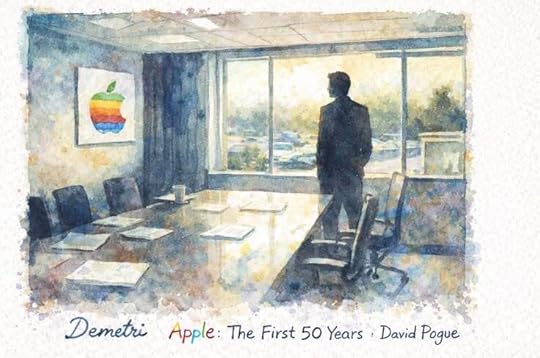
Watercolor Piece by Demetris Papadimitropoulos
“The Return” (1997): In a fluorescent Infinite Loop room, Jobs’s silhouette redraws Apple’s future with the ruthless calm of focus.


David Pogue’s “Apple: The First 50 Years” arrives with the mischievous confidence of a keynote that knows it has the room. The book is, on one level, exactly what its title promises: a brisk, image-rich, anecdote-forward history of the company that taught the modern world to crave rectangles with rounded corners. But Pogue isn’t simply counting anniversaries or building an altar to sleek aluminum. He’s writing an origin story of a sensibility – how a stubborn, aestheticized idea of technology (simple, sealed, delightful; equal parts tool and talisman) became a global operating system for desire. Apple’s story has been told often enough to turn into catechism. Pogue’s advantage is that he knows the catechism, enjoys the catechism, and still bothers to check the footnotes.

The book’s signature move is a kind of cheerful demystification. It refuses the lazy versions of Apple lore, not by dunking on them but by swapping in better stories: the ones that explain how power actually works inside a company built on secrecy, taste, and unreasonable deadlines. Pogue’s voice – wry, plainspoken, a little delighted by human eccentricity, suspicious of sacred cows – keeps the page turning even when the subject is something as potentially sleep-inducing as warehouse inventory or chip roadmaps. He writes the way good tech people talk when they’re not trying to sound like tech people: clean sentences, punchy framing, the occasional dad-joke aside, and an instinct for the telling physical detail (a drawbridge-opening Power Mac, a titanium laptop that made engineers quit, a green LED that says, quietly, “privacy is on”). The effect is that of an accessible guided tour through an institution that has spent five decades insisting you are not allowed in.


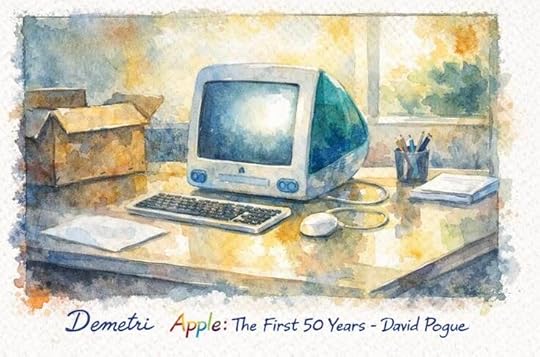
Watercolor Piece by Demetris Papadimitropoulos
“The iMac Moment” (1998): A translucent Bondi-blue iMac glows on a clean desk like a declaration that design can reboot desire.


If Apple has always been, in Jobs’s preferred phrasing, “the whole widget,” Pogue makes a parallel claim about Apple history: you don’t understand the products unless you also understand the choreography that produced them. He is at his best when he treats Apple as a system of constraints – a culture that turns limitation into style. The famed Quadrant of four Macs becomes less a marketing meme than a governing philosophy: focus as theology, the refusal to become Sony or Samsung with their thousands of SKUs. Secrecy becomes not only a tactical advantage but a narrative engine, the reason keynotes landed like cultural events rather than mere product announcements. Even the company’s obsession with packaging is rendered as something like moral philosophy: “You sense care even if you can’t see care,” the idea that the unseen back panel and the invisible internal screws are part of the promise.

Pogue also has a gift for turning engineering into drama without faking conflict where there is none. The most gripping chapters read like a series of elegant emergencies. The iPhone begins as a tablet, detours through the Motorola ROKR misadventure, then gets yanked toward its destiny by a multitouch demo that makes everyone in the room feel the future click into place. The tale of the virtual keyboard – the biggest “how did that not fail?” question of the modern phone – becomes a story about probability, language frequency, and the weird art of making small targets bigger by lying to the finger in mathematically principled ways. The late-stage pivot from plastic to glass is a Pogue-perfect set piece: Jobs, irritated by scratches, calls Corning and essentially dares a dormant 1960s process back to life on a modern deadline. It’s reality distortion field as supply-chain negotiation, the willpower of a founder translated into kiln temperatures and potassium-ion baths.


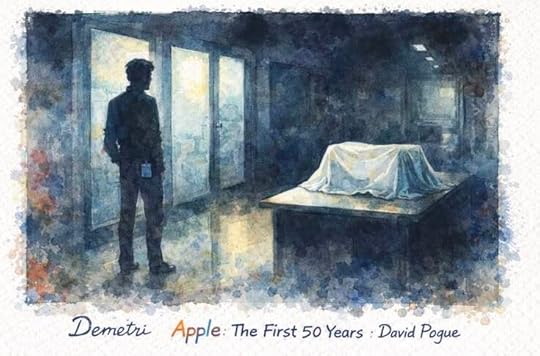
Watercolor Piece by Demetris Papadimitropoulos
“Purple Dorm” (2004–2007): Behind frosted doors and harsh security light, invention happens in secrecy – a covered prototype breathing under pressure.


But Pogue is too seasoned a narrator to pretend that Apple’s magic is only magic. Over and over, he traces the company’s true genius to a consistent, almost unglamorous pattern: recognizing fledgling technologies, simplifying them, and then forcing the entire ecosystem to behave as if simplicity is natural. The iPod didn’t invent digital music; it made the friction intolerable everywhere else. The App Store didn’t invent software marketplaces; it standardized them, taxed them, and made them feel safer than freedom. The Apple Watch didn’t invent wearables; it made “health” a mainstream product narrative, turning your wrist into a lightly regulated clinic and your daily movement into a set of rings you can’t stop trying to close. Even Vision Pro, the book’s most ambivalent marvel, follows the same arc: take an industry’s crude prototype, over-engineer it into a museum-quality experience, and then wait to see if the world is ready to make the leap from “wow” to “why do I need this?”

Pogue’s structure – fifty chapters that behave like well-timed vignettes, each with its own hook and payoff – matches the Apple rhythm he’s describing. There is, throughout, a keynote cadence: unveil the problem, dramatize the constraint, deliver the solution, let the audience gasp, toss in the human aside. That rhythm is not an accident; it is part of the author’s style as a communicator. One can feel the broadcaster’s instinct for pacing and the columnist’s affection for the small absurdities that explain the big machinery. A meeting becomes a myth generator. A debate about the orientation of a laptop logo becomes a parable about whose gaze matters. The “slide to unlock” gesture becomes both an ergonomic safeguard against butt-dialing and a decade-long legal war. The book is full of these little apertures where design becomes sociology.


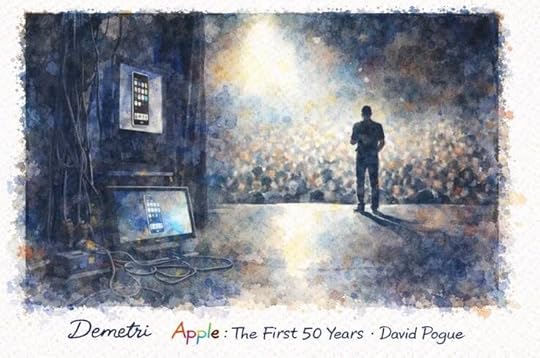
Watercolor Piece by Demetris Papadimitropoulos
“The Keynote Tightrope” (Jan 2007): From the wings, the iPhone arrives as stage magic – a flawless spotlight balancing on a backstage wire of glitches.


And yet, for all its pleasures, the Apple story in 2026 cannot be told as pure triumph. Pogue doesn’t ignore the darker strands, and some of the book’s most modern energy arrives when he stops celebrating the products and starts examining the trade-offs. China, here, is not merely a manufacturing note; it is the operational substrate of Apple’s empire and the geopolitical fault line under its feet. The Foxconn suicide crisis is framed as the moment Western consumers were forced to see the hidden human costs of frictionless gadgets – the dormitories, the churn, the nets that critics called tone-deaf and Jobs defended as pragmatic. Pogue acknowledges the reforms, the audits, the transparency reports, but the broader question hangs in the air: can a company whose brand is care reconcile that promise with a global supply chain optimized for speed and margin? In an era of tariffs-as-threats, export controls, and rising industrial policy, Apple’s reliance on “China speed” reads less like a clever strategy than a vulnerability you can name.

Similarly, the book’s long view on “closed systems” lands with renewed bite at a moment when regulators around the world are treating Apple’s integration not as a virtue but as a possible monopoly costume. The App Store – once a heroic defense against malware and “buggy crud” – becomes, in the later chapters, an arena of injunctions and resentments: Epic’s rebellion, commission battles, forced links, and the dawning reality that “walled garden” is a phrase that can be said with either admiration or accusation. This is where Pogue’s light touch becomes a mixed blessing. His narrative keeps moving, and his tone stays companionable, but the stakes are enormous: control as safety, control as profit, control as power. In 2026, that triangle is not a thought experiment. It is a set of lawsuits, legislative acts, and design changes that alter what “the iPhone experience” even means depending on which country you live in.


Watercolor Piece by Demetris Papadimitropoulos
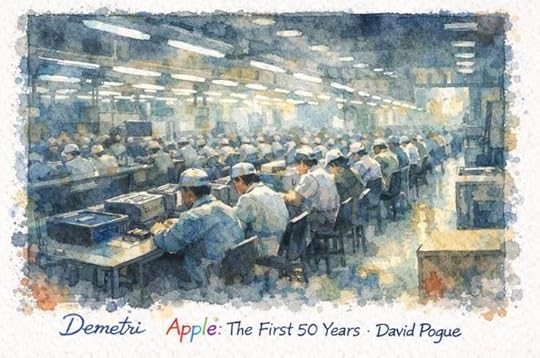
“Foxconn / China Speed”: Endless rows and cold dorm light reveal the invisible engine of elegance: scale, discipline, and human cost.


The book’s most delicate chapter, perhaps inevitably, is the one about AI. Here Pogue captures both the cultural vertigo of the ChatGPT era and Apple’s characteristic refusal to behave like a startup. Apple Intelligence, as he describes it, is a suite of “nips and tucks” rather than fireworks: writing tools, summaries, cleanup brushes, a scattering of small conveniences that feel more like iOS features than a new species of mind. Critics yawn; Apple insists it’s “a journey.” The drama arrives with Siri – the promise of a truly personal agent, the demo that makes investors swoon, the delay, the anxiety about hallucinations, the awkwardness of advertising a thing that isn’t shipping. It’s a story that echoes earlier Apple lessons about preannouncing – “Newton,” “AirPower” – but now the stakes include trust itself. Pogue’s reportorial instinct is sharp here: he doesn’t need to declare a verdict, because the narrative contains its own warning. A company that built its modern religion on showing the working product onstage cannot afford too many concept videos.

If there is a quiet thesis threading through all fifty years, it’s this: Apple’s greatest inventions are not devices but expectations. The company taught us to demand beauty from tools, to feel personally wronged by ugly interfaces, to treat friction as an insult. It also taught us to live inside a continuous river of notifications, photos, messages, and streaming media – “the end of boredom,” as Pogue writes – and then to worry about what that river has done to our attention, our politics, and our loneliness. The iPhone’s cultural impact is rendered here as both triumph and complication, an enabling technology that made entire industries possible while also helping to accelerate a world where reality itself is a little easier to stage-manage.

What makes Pogue’s book particularly satisfying is that it’s not only a Jobs epic, though Jobs remains its gravitational center. Pogue is careful to give the supporting cast their due: the engineers who live inside the consequences of perfectionism, the operations leaders who turn ideology into shipping boxes, the designers who argue about invisible corners, the executives who inherit a legend and must do something other than impersonate it. The Cook era, in Pogue’s telling, is less a decline than a pivot: from category-defining hardware to services, from charismatic genius to institutional machinery, from a company that made “things” to a company that makes recurring revenue and ecosystem gravity. There is an argument embedded here that the modern Apple may be more financially formidable than ever – yet culturally less incandescent – and that this might be less a failure of imagination than a shift in the era’s available “low-hanging fruit.”


Watercolor Piece by Demetris Papadimitropoulos
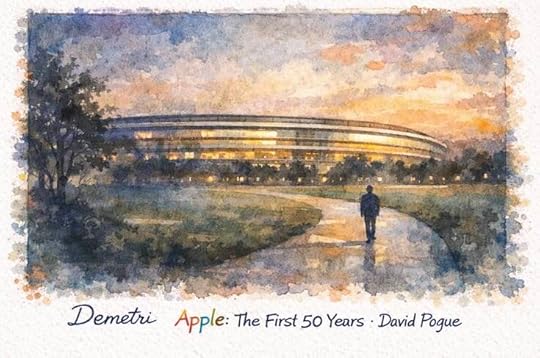
“Apple Park + Loss” (2011–2017): The ring at dusk reads like a monument – a quiet architecture of legacy, absence, and continuation.


You can feel, in these later sections, Pogue’s awareness of the books that hover in the background of any Apple history. The myth-busting and the corporate interiority echo “Inside Apple.” The supply-chain and China chapters nod toward the harder, more critical tradition of “After Steve” and “Apple in China.” The design worship and process language recall “Creative Selection” and “Insanely Simple.” The long moral argument about secrecy, focus, and taste is a descendant of “Becoming Steve Jobs,” which framed the founder not as a saint or villain but as an evolving instrument of ambition. Pogue’s difference is tonal: he is less prosecutorial than most of his comps, and more committed to the pleasure of the story. That choice may frustrate readers who want a sharper knife, but it is also the reason the book can do what it does best: make the complicated history readable without making it simplistic.

As a reader, I found myself admiring how Pogue balances three tasks that usually break a book when attempted together: he tells a sweeping corporate history; he explains technology to nontechnical readers without condescension; and he keeps returning to the human texture – the neuroses, the loyalties, the moments of kindness that complicate the caricature of Jobs as pure tyrant. The chapters on loss, on the memorials, and on the quieter acts of care land precisely because Pogue doesn’t oversell them. He trusts the stories: Jobs sneaking an acupuncturist into a hospital room, the private insistence on not asking “what Steve would have done,” the grief of an institution that was, for better and worse, built around a single person’s taste.

To say that a book about Apple is “timely” is almost redundant; Apple is one of the few corporations that functions as a civic infrastructure of everyday life. But this book is timely in a sharper way: it offers a narrative map for the present moment’s anxieties. If you want to understand why regulators are fighting platform power, why privacy has become a selling point, why “made in China” is no longer a neutral label, why AI is both carnival and crisis, why the phone feels like a comfort object and a trap – you could do worse than spend time inside Pogue’s version of the last half century. He doesn’t pretend the story is finished. He ends, instead, with throughlines: focus, secrecy, beauty, simplicity, sustainability, accessibility, privacy – the values Apple cites as its alibi and its engine. Whether those values are enough to carry the company through its next fifty years is the open question. Pogue, wisely, refuses to predict the future with too much confidence. The book’s final effect is something rarer than prophecy: a lucid sense of how the present got built.

In the end, “Apple: The First 50 Years” feels like the product it describes: obsessively assembled, friendly on the surface, intricate underneath, occasionally infuriating in what it chooses to leave out, and undeniably hard to put down. My rating: 89 out of 100.
Profile Image for Patrick.
19 reviews1 follower
Review of advance copy received from Netgalley
March 9, 2026
“Apple: The First 50 Years,” by David Pogue, is a captivating history of Apple’s remarkable fifty-year journey. The book is divided into four chronological parts, which take readers through the evolution of Apple’s products and services, and the stories of those who created them. We see Apple’s management, creativity and innovation, marketing campaigns, and pursuit of excellence in motion. We also witness the genius of Steve Jobs, without whose passion, vision, and relentless determination Apple would cease to exist.

Part 1 introduces us to Steve Wozniak (“Woz”) and Steve Jobs—from how they met, to their early ventures, to their founding of “Apple Computer Company” on April 1, 1976. We progress through Apple’s early computers, including the Apple II and Macintosh, and explore the development of Apple’s operating system and software. We also experience John Sculley’s power struggle with Jobs, which resulted in Jobs’s demotion and subsequent resignation.

Part 2 covers the years without Steve Jobs, during which multiple Apple CEOs were ousted. Sculley, Pepsi-Cola’s former president, was Apple’s CEO. His eventual removal was due, in part, to his failure to consummate a merger that would lessen the dominance of PCs running Microsoft Windows on Intel chips. Michael Spindler, an engineer already running multiple Apple divisions, took over as CEO. But declining sales and “rock bottom” morale contributed to his removal. Gil Amelio, the CEO of National Semiconductor, became the new CEO. However, consumer sales were not Amelio’s forte. Apple’s mounting financial difficulties elevated its bankruptcy risk and Amelio was fired.

Part 3 centers on Steve Jobs’s return to Apple. After leaving Apple, Jobs founded NeXT, which had developed a dazzling, colorful, and easy-to-use multitasking operating system called NeXTSTEP. Unlike Apple’s Mac OS, which kept crashing, NeXTSTEP was highly stable. So, while Amelio was still CEO, Apple bought NeXT and Jobs returned to Apple in an advisory role. Within a few months of Amelio’s firing, Jobs became Apple’s interim CEO and later its permanent CEO. After returning to Apple, we see Jobs’s genius on full display. We witness the game-changing creation of the iPod, iPhone, iPad, apps, and more, all of which led to Apple’s incredible turnaround. Sadly, we also discover Jobs’s battle with pancreatic cancer, which led to his untimely death.

Part 4 addresses Tim Cook’s tenure as Apple’s CEO. Before Jobs died, he resigned as Apple’s CEO. Cook, who was Apple’s COO, assumed the CEO role. We are taken through several successes under Cook’s leadership, including the dramatic growth in Apple Services (e.g., Apple Music, Apple Arcade, Apple TV+) and the introduction of Apple Watch and Apple Silicon. We also learn about Vision Pro and Apple Intelligence, which are not yet as successful, and about headwinds over app store charges and Apple’s reliance on China.

“Apple: The First 50 Years” is a comprehensive and compelling account of Apple’s first fifty years. The award-winning author skillfully takes readers through Apple’s history, products and services, stories of key employees, and iconic culture. Apple fans, technology and history buffs, and countless others will greatly enjoy the author’s well-written account of Apple’s epic journey. The book also contains numerous photos and images that help bring Apple’s story to life.

[My special thanks to Simon & Schuster and NetGalley for an advance reading copy of this book.]
148 reviews
Review of advance copy received from Netgalley
March 4, 2026
Apple: The First 50 Years is a book for anyone interested in history, creativity, technology, and how things are made. It's a fun read with many twists and turns. A business or a product does not materialize overnight, is rarely easy, and involves many, many players.

For those who lived through the rapid changes in the 70s and the 80s during the birth of consumer-focused computers this book is a historical roadtrip. We meet not only the most familiar but the less well-known persons involved in development of hardware, software, fonts, video, and much much more. The use of profile windows with information of the work before, during, and post-Apple of various individuals is a welcomed touch to emphasize the many people involved and the wide skill sets both personal and professional.

More important is a view of the work. Anyone who only knows about smartphones, tablets, and laptops of today, this history tells you how it came about with the leaps, retreats, exhausting work schedules, and how some things led, sometimes unexpectantly, to what we know and experience today.

Even if some of Apple's story is familiar I still highly recommend reading this book. I read this not as an Apple fan, but as someone interested in history and of technology of all types, (Disclosure: I am a Windows PC owner/user with an Android phone who also owns an iPad. I've used mainframes, a wide range of computer products, and act as my family's tech service. So I'm a generalist consumer and not a developer.)

NOTE: Unpaid review. Thanks to NetGalley for an Advanced Reader's Copy (ARC).
201 reviews1 follower
January 24, 2026
I have read numerous books about Apple. While this book did not introduce any groundbreaking information, I found it enjoyable nonetheless.
I would like to express my gratitude to NetGalley for providing me with an advance copy of the book.
Profile Image for Steve Brock.
664 reviews66 followers
Review of advance copy received from Publisher
March 8, 2026
I have selected this book as Stevo's Business Book of the Week for the week of 3/8, as it stands heads above other recently published books on this topic.
Displaying 1 - 5 of 5 reviews

Can't find what you're looking for?

Get help and learn more about the design.