What do you think?
Rate this book


348 pages, Kindle Edition
First published September 7, 2018
Thanks to NetGalley and Rebellion/Solaris for this advance copy of While the Gods Sleep.
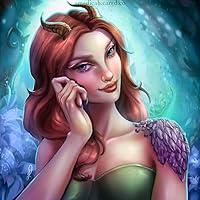
I was drawn to the book by its magnificent cover and tagline: The first book in a new fantasy trilogy where ordinary people stumble into the twisted games of the gods! I looked forward to tales of Zeus, Hera, Dionysus, Athena et al. indulging in whimsy and cruelty while playing with the lives of us ordinary people, and following some poor sod trying to figure out his or her way to staying alive through it all.
However, my expectation was a fair way off, and I eventually ascribed this book a 'DNF' at 60%. The change in expectations wasn't inherently a problem, but I found that the novel as written just didn't have the same pull for me. A few comments:
Characters
The cover and tagline suggest to me that some unfortunate mortal would fall into the road of the Olympians, but the title is literal; in the 60% that I read, all of the Olympians (and many other well-known lesser deities) are genuinely asleep, as in unconscious. Perhaps I'm a fool for not taking the title at face value, thinking it might have been describing e.g. events happening while the Gods were negligently looking the other way - but I don't think I would be alone in this. I did an experiment with my wife to see what she expected based on the cover, title and tagline, and her guess was much the same as mine.
The mortal protagonist interacts with demi-gods and still-magical descendants of the more famous gods, some of which come across vividly while others are a tad forgettable. Naia and Lamia were the most interesting for me; Ty was ok as a protagonist, but I never found myself feeling very connected to him.
Setting
The book's setting alternates between 1970's Athens in the world as we know it and Erebus, a kind of liminal underworld that, in this book, is something like an inverted shadow-Athens. I enjoyed the descriptions once a certain character's sight improved - and L. D. Colter turns a lovely phrase now and then - but Erebus always felt a little undefined for me. I found it difficult to imagine a place in which some mythical creatures/people live in standard residential apartments with lifts/elevators, but the occasional lesser deity lives down the road in an enchanted cave in a park. A few questions were unanswered: what did the resident demigods/mythical beings do in Erebus all day before Ty showed up? Many of them are free from human constraints, and I don't recall a money system. Do they have jobs? Do they swan about like the Olympians used to? I would have liked more exploration here.
Pacing
I tend to prefer character work over plot and world-building in the books I read. As a result, I appreciate the clear effort going into characters' interior worlds and relationships in this book. However, it was overdone for me, and the emphasis on interior thought processes and emotional nuances took a lot of the momentum out of the plot. I'd imagined Ty, a locksmith, as a crafty and creative guy with perhaps questionable morals, jumping from the odd to the bizarre with little time to consider anything beyond how to survive. He is, however, very internally-focused, and I found this element to be somewhat overwritten.
Final thoughts: I might still recommend this for people generally interested in the subject matter, but I would make it clear that the book may be different to what its marketing suggests.