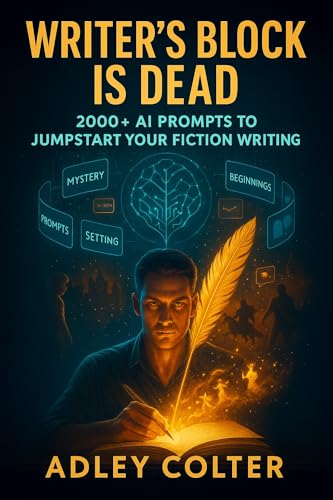
Writer’s Block Is Dead isn’t here to hand you generic, recycled prompts. It’s here to give you a precision-engineered system to generate your ideas—on demand, in your voice, tailored to your genre, emotion, and story needs.
This book is built for real-world writers who don’t have time to wait for the muse. Whether you’re mid-draft, mid-doubt, or mid-crisis, it hands you exactly what your story is missing—structure, spark, and momentum.
You’ll get over 2,000 carefully categorized prompts, each designed
Unlock original character arcs, conflicts, and twists Match the emotional beats your scenes demand Collaborate with AI to go from “idea” to “manuscript” without losing your voice Break through creative blocks tied to perfectionism, burnout, or overthinking
But this isn’t just a toolkit. It’s a shift in how you approach writing.
You’ll also learn the Spark It, Draft It, Make It Yours method—a 3-step system to take any prompt and turn it into a draft that feels authentic, exciting, and fully yours. Plus, you’ll find scene templates, genre-specific strategies, and real examples to guide your process without dictating it.
If you've ever
“I don’t know what to write next.” “My ideas sound flat.” “I’m writing, but I don’t feel inspired.”
Then this book will feel like a lifeline—and a launchpad.
Writer’s Block Is Dead gives you what every writer secretly a way to write with confidence, clarity, and creativity… even on your worst day.
A FAB Guide for Writers Who Struggle with Structure Adley Colter understands what modern writers wrestle with. She doesn’t just provide brilliant prompts but teaches you how to turn your work into scenes, chapters, and ultimately, a finished manuscript. I loved how Colter reframes character creation. Instead of forcing writers to chart every detail before they begin, she focuses on contradictions, emotional gaps, and the complexity of human nature, as seen in characters like “The Reluctant Hero” and “The Compassionate Cynic.” My favorite part of the book is The Revision Generator in chapter 9. Colter understands the chaos of having dozens of disconnected prompt responses floating around your desktop. Her revision system shows you how to spot patterns, build arcs, cluster emotional themes, and let AI help you fill narrative gaps. The advice on expanding prompts into full scenes -- matching character goals with emotional settings -- was a revelation. Colter also tackles the problem no one talks about: what to do when you have too many good ideas. Her method for grouping prompts by theme and emotional trajectory is both intuitive and powerful. Suddenly, seven unrelated fragments become the backbone of a novel about truth, grief, family, or transformation. This book bridges the missing link between creativity and structure. It’s smart, practical, and packed with strategies you can use immediately. If you’ve ever felt stuck because you don’t know how to turn your ideas into a book, this is the guide you’ve been waiting for. Highly recommended for writers at any stage. With Colter’s approach, writer’s block really is dead.
This book piqued my interest since I’ve been stuck with my writing lately. I found a lot of the analysis of why writer’s block happens intriguing as well as how to work through some of the revisions (which we all dread). There were so many varied prompts for all stages of writing from beginning your book, developing characters and setting, to plot twists. I would have to say that the most helpful part of this book for me would be in the last chapter where the prompts help to determine if you are being consistent throughout your book in regards to tone, character arcs, timeline verification, etc. Sometimes after being immersed in revisions, it helps to have another set of eyes look through to analyze. This books suggests that the other set of eyes be AI, which excels at analysis and objectivity. In the end, as the author says, YOU are the writer. This book just helps to jumpstart your creativity and provide some analysis if needed. A very useful book especially if you write and publish independently.
Interesting idea for a reference book, albeit the title does not disclose that this is ONLY for fiction writers. It will not help for any other genre.
Perhaps my biggest objection is the formatting is worse than I would expect from a High School student. Major titles are often the last line on a page, so when you look at a page, you have no idea what the topic is. Also, sub-titles (prompt names) are much more bold than section titles (groups of prompt types), which often left me wondering how these go together? (there was a section title that blurred away in the middle of a page). Then, exactly that -- page breaks are not used to help direct a reader's attention.
Basically, interesting idea, but I found it very hard to find anything remotely useful.
If you’re trying to decide whether to get an e-book or a print book, I definitely recommend a print book (I ordered the e-book, now I’m going to order the print version). Then get out your sticky page flags and your highlighters. There is so much guidance, information and great advice. You’re going to want to mark and highlight sections to revisit as you work through your writing. Definitely read through the book 1st to get an understanding and comprehension of all of the great information and tools that are provided. But if you find items that resonate with you like I did, mark those and come back to them. You may have to reread a few times to make sure you’ve captured everything.