

What do you think?

The Edge of Space-Time: Particles, Poetry, and the Cosmic Dream Boogie
A fresh, charming, socially conscious tour of the mysteries of space-time, from the award-winning author of The Disordered Cosmos
In her highly acclaimed debut, distinguished cosmologist and particle physicist Dr. Chanda Prescod-Weinstein shared with her audience an abiding sense of wonder at the cosmos, while imagining a world without the entrenched injustice that plagues her field. Now, in The Edge of Space-Time, she embraces that cosmic wonder, taking readers on a mind-altering journey to the boundaries of the universe, inviting us to spend time at the edge of what we know about space-time and about ourselves.
Guided by her conviction that for humanity to go forward we must know our cosmic past and drawing on poetry and popular culture—from Langston Hughes, Queen Latifah, and Lewis Carroll, to Big K.R.I.T., Sun Ra, and Star Trek—Prescod-Weinstein renders accessible some of the most abstract concepts of theoretical physics to tell fascinating stories about the history and fundamental nature of our universe. Here we meet the quantum cat that is both dead and alive, learn the difference between dark matter and dark energy, explore the inner workings of black holes, and investigate the possibility of a unified theory of quantum gravity, following our guide out to the far reaches of the cosmic event horizon and down to the tiniest (and queerest) neutrino. Along the way, she calls on us to resist colonial approaches to space exploration and instead imagine a better path forward in our pursuit of humanity’s undeniable connection with the stars.
Through Prescod-Weinstein’s clear-eyed and unique perspective, and informed by her deep knowledge of post-colonial history and Black feminist thought, The Edge of Space-Time argues that physics is an essential way for everyone to look at the universe and presents a compelling case that “the edge” is a powerful vantage point from which to see the big picture.
* This audiobook edition includes a downloadable PDF featuring charts, graphs, and images mentioned throughout, as well as footnotes from the print edition.
In her highly acclaimed debut, distinguished cosmologist and particle physicist Dr. Chanda Prescod-Weinstein shared with her audience an abiding sense of wonder at the cosmos, while imagining a world without the entrenched injustice that plagues her field. Now, in The Edge of Space-Time, she embraces that cosmic wonder, taking readers on a mind-altering journey to the boundaries of the universe, inviting us to spend time at the edge of what we know about space-time and about ourselves.
Guided by her conviction that for humanity to go forward we must know our cosmic past and drawing on poetry and popular culture—from Langston Hughes, Queen Latifah, and Lewis Carroll, to Big K.R.I.T., Sun Ra, and Star Trek—Prescod-Weinstein renders accessible some of the most abstract concepts of theoretical physics to tell fascinating stories about the history and fundamental nature of our universe. Here we meet the quantum cat that is both dead and alive, learn the difference between dark matter and dark energy, explore the inner workings of black holes, and investigate the possibility of a unified theory of quantum gravity, following our guide out to the far reaches of the cosmic event horizon and down to the tiniest (and queerest) neutrino. Along the way, she calls on us to resist colonial approaches to space exploration and instead imagine a better path forward in our pursuit of humanity’s undeniable connection with the stars.
Through Prescod-Weinstein’s clear-eyed and unique perspective, and informed by her deep knowledge of post-colonial history and Black feminist thought, The Edge of Space-Time argues that physics is an essential way for everyone to look at the universe and presents a compelling case that “the edge” is a powerful vantage point from which to see the big picture.
* This audiobook edition includes a downloadable PDF featuring charts, graphs, and images mentioned throughout, as well as footnotes from the print edition.
9 pages, Audible Audio
First published April 7, 2026
About the author
Chanda Prescod-Weinstein
5 books256 followersChanda Prescod-Weinstein is an American and Barbadian theoretical cosmologist, and is both an Assistant Professor of Physics and Astronomy and a Core Faculty Member in Women's and Gender Studies at the University of New Hampshire.
Ratings & Reviews
Friends & Following
Create a free account to discover what your friends think of this book!
Community Reviews
Displaying 1 - 30 of 103 reviews

April 1, 2026
The passion in science and making it accessible to nonscience readers is so important even if I didn’t “get” it all. The attempt to reach lay leaders with complex science is a real gift. Sometimes I got things and that was great. Sometimes I felt like I was on drugs. Overall a real offering. Sometimes the book felt too concerned with connecting every dot to every element of society.

April 21, 2026
Why do you read a popular science book about physics? If, like me, your goal is to expand your mind, then The Edge of Space-Time will achieve that goal several times over. I love reading a good physics book. Every time I read a different scientist’s explanations of Lorentz invariance or the standard model, I get just a little bit closer to understanding (as much as a layperson can get close to understanding) what this is all about. But what makes Dr. Chanda Prescod-Weinstein’s second book so special is that it’s expansive in more than one dimension. As its subtitle implies, this is an intertextual dream boogie, one that will have you thinking as much about literature as leptons.
I can’t believe it has been nearly four years since I reviewed The Disordered Cosmos, Prescod-Weinstein’s first book. So much has changed in our world since then—yet it also feels like so little has, a theme reflected in this book’s closing chapter, “Go Back and Get It,” with a letter addressed to the future. It’s a letter acknowledging the bleakness of the present moment while placing it within its proper context of all the terrible moments past and an appeal to intertwining power of political, scientific, and artistic resistance. It is a very powerful conclusion to an equally powerful book, but I suppose I should go back to the beginning.
To call The Edge of Space-Time merely a physics book is a disservice, for it is far more than that. It is a truly interdisciplinary journey, one that draws on science, yes, but also history and literature and art and media. It’s queer. It’s metaphor. It’s lucid yet dreamy. As much as it is an inheritor of and response to classic physics books like the one from which it takes its title, this book is also an inheritor of literary works.
Prescod-Weinstein is a nerd nerd. Star Trek (particularly Discovery) and Alice in Wonderland are baked into this book’s DNA, along with media I’m personally less familiar with like the 1993 film Sankofa. Prescod-Weinstein doesn’t just casually allude to these titles but rather weaves her entire conversation about physics around them, embedding them deeply and purposefully into the work.
This approach really speaks to me personally. I’m trained as a mathematician and a teacher with a double minor in English and philosophy; I’m qualified to teach both math and English in high school. When someone inevitably asks m which subject I prefer, I can’t give them a simple answer. I love them both, and I don’t view them as being so far apart as most students are brought up to believe. So Prescod-Weinstein’s approach makes perfect sense. Yet it is still quite revelatory, for it’s only in reading this approach that I realize how … incomplete … most other physics books feel.
See, science communicators, in an effort to make their books accessible, tend to approach topics very carefully—famously, of course, Hawking remarks in A Brief History of Time that he restricted himself to a single equation in the entire book for fear of how more math would hurt sales. But even the most lucid and salient of these books often feels incomplete to me, for they set physics apart from other human endeavours (and often other sciences, even). That isn’t the case here, where Prescod-Weinstein recognizes from page 1 that her role is our guide, an interpreter, a storyteller, in a way far more consciously steeped in literary allusion.
Yes, The Edge of Space-Time is accessible in the sense that it is not math heavy. You won’t be bombarded with equations and want to run for the hills. Moreover, Prescod-Weinstein is very reassuring in how she explains the thorniest parts of the book, such as the Stern–Gerlach experiment (which I don’t recall ever hearing about in a popular science text before!). I love how she says, “For those who just want to coast, I’ll flag for you when we’ve come to an important conclusion.” It’s inclusive and welcoming—yet at the same time, she then dives right in with diagrams and explanations, challenging us if we want that challenge.
(As an additional aside, I just want to say I love her explanation of what spin means in the quantum sense. Ever since I realized particles are not actually physical, spinning objects like we’re initially taught in school, the concept of spin hasn’t made sense to me. The way she links spin to angular momentum was so clear it now feels incredibly obvious.)
Beyond the purely scientific discourse, however, this book is accessible through its layers of intertextuality. As you read, you might find yourself forgetting you’ve picked up an introductory physics text and instead wonder if you’ve wandered into an interdisciplinary literature course. Barely a page can go by without Prescod-Weinstein mentioning another book, movie, TV show, or song. I’m walking away from this experience with hella reading, viewing, and listening recommendations, something I wasn’t expecting, and I love it. The Edge of Space-Time doesn’t just challenge you to think deeply about the universe and our place therein: it’s saying one cannot do that without also considering how humans have been doing this for millennia through storytelling and art.
Time and again, the phrase “in conversation with” leaps off the page, as Prescod-Weinstein puts a physics concept in conversation with not just other physics ideas but cultural and literary works too. And this is the beating heart of the syncretic nature of this book, a rebuff of the clinical and sanitized version of science canonized by Great Men in white lab coats. Prescod-Weinstein makes the point here that the dreamers are scientists too. The ancestors were scientists. The artists are scientists. Science is not something reserved for the chalkboard (or whiteboard) and lab; it’s something we humans have done for as long as we can remember. Science is culture. This is profound, for it charts the shape of science’s failure modes—as she pointed out in The Disordered Cosmos and echoes here, modern science as it manifests in academia is profoundly hostile towards women and people of colour because science is not exempt from white supremacist and capitalist bullshit. It also charts the edges of science itself and demonstrates the necessity for science as a pursuit to be in conversation with art (and vice versa).
The moment this really hit me as I was reading was in Chapter 9, “TRAP Phenomenology.” Prescod-Weinstein shares how a 2021 paper got her questioning, “Are the boundaries we imagine for classical physics simply failures of imagination?” This is such an excellent question from both science and philosophy of science perspectives. I really appreciated this moment of vulnerability (among many) from her, along with her careful consideration of this idea. The way she models scientific inquiry and thinking on the page is no small feat.
I want to close with one more quotation that sits with me. The penultimate chapter, “You Are Not Safe in Science,” opens with this:
Honestly? Raising the bar for the quality of prose I expect from all my physics reads going forward. This is why I read books—and not just physics books. Any book. This. The way Prescod-Weinstein reaches across the span between us to talk to me about the stars we both look up at and so generously offer what she knows. The consonance of her prose and the clarity of her explanations and the commitment to using language to resist and rise. The Edge of Space-Time is special. It made me think far beyond the stars central to its tale, and it carries a narrative about science as a flawed human endeavour in conversation with art and politics that I think more of us need to hear. In the face of all that we’re going through in our present time, this book has left me energized and excited for the work ahead.
Originally posted on Kara.Reviews.

I can’t believe it has been nearly four years since I reviewed The Disordered Cosmos, Prescod-Weinstein’s first book. So much has changed in our world since then—yet it also feels like so little has, a theme reflected in this book’s closing chapter, “Go Back and Get It,” with a letter addressed to the future. It’s a letter acknowledging the bleakness of the present moment while placing it within its proper context of all the terrible moments past and an appeal to intertwining power of political, scientific, and artistic resistance. It is a very powerful conclusion to an equally powerful book, but I suppose I should go back to the beginning.
To call The Edge of Space-Time merely a physics book is a disservice, for it is far more than that. It is a truly interdisciplinary journey, one that draws on science, yes, but also history and literature and art and media. It’s queer. It’s metaphor. It’s lucid yet dreamy. As much as it is an inheritor of and response to classic physics books like the one from which it takes its title, this book is also an inheritor of literary works.
Prescod-Weinstein is a nerd nerd. Star Trek (particularly Discovery) and Alice in Wonderland are baked into this book’s DNA, along with media I’m personally less familiar with like the 1993 film Sankofa. Prescod-Weinstein doesn’t just casually allude to these titles but rather weaves her entire conversation about physics around them, embedding them deeply and purposefully into the work.
This approach really speaks to me personally. I’m trained as a mathematician and a teacher with a double minor in English and philosophy; I’m qualified to teach both math and English in high school. When someone inevitably asks m which subject I prefer, I can’t give them a simple answer. I love them both, and I don’t view them as being so far apart as most students are brought up to believe. So Prescod-Weinstein’s approach makes perfect sense. Yet it is still quite revelatory, for it’s only in reading this approach that I realize how … incomplete … most other physics books feel.
See, science communicators, in an effort to make their books accessible, tend to approach topics very carefully—famously, of course, Hawking remarks in A Brief History of Time that he restricted himself to a single equation in the entire book for fear of how more math would hurt sales. But even the most lucid and salient of these books often feels incomplete to me, for they set physics apart from other human endeavours (and often other sciences, even). That isn’t the case here, where Prescod-Weinstein recognizes from page 1 that her role is our guide, an interpreter, a storyteller, in a way far more consciously steeped in literary allusion.
Yes, The Edge of Space-Time is accessible in the sense that it is not math heavy. You won’t be bombarded with equations and want to run for the hills. Moreover, Prescod-Weinstein is very reassuring in how she explains the thorniest parts of the book, such as the Stern–Gerlach experiment (which I don’t recall ever hearing about in a popular science text before!). I love how she says, “For those who just want to coast, I’ll flag for you when we’ve come to an important conclusion.” It’s inclusive and welcoming—yet at the same time, she then dives right in with diagrams and explanations, challenging us if we want that challenge.
(As an additional aside, I just want to say I love her explanation of what spin means in the quantum sense. Ever since I realized particles are not actually physical, spinning objects like we’re initially taught in school, the concept of spin hasn’t made sense to me. The way she links spin to angular momentum was so clear it now feels incredibly obvious.)
Beyond the purely scientific discourse, however, this book is accessible through its layers of intertextuality. As you read, you might find yourself forgetting you’ve picked up an introductory physics text and instead wonder if you’ve wandered into an interdisciplinary literature course. Barely a page can go by without Prescod-Weinstein mentioning another book, movie, TV show, or song. I’m walking away from this experience with hella reading, viewing, and listening recommendations, something I wasn’t expecting, and I love it. The Edge of Space-Time doesn’t just challenge you to think deeply about the universe and our place therein: it’s saying one cannot do that without also considering how humans have been doing this for millennia through storytelling and art.
Time and again, the phrase “in conversation with” leaps off the page, as Prescod-Weinstein puts a physics concept in conversation with not just other physics ideas but cultural and literary works too. And this is the beating heart of the syncretic nature of this book, a rebuff of the clinical and sanitized version of science canonized by Great Men in white lab coats. Prescod-Weinstein makes the point here that the dreamers are scientists too. The ancestors were scientists. The artists are scientists. Science is not something reserved for the chalkboard (or whiteboard) and lab; it’s something we humans have done for as long as we can remember. Science is culture. This is profound, for it charts the shape of science’s failure modes—as she pointed out in The Disordered Cosmos and echoes here, modern science as it manifests in academia is profoundly hostile towards women and people of colour because science is not exempt from white supremacist and capitalist bullshit. It also charts the edges of science itself and demonstrates the necessity for science as a pursuit to be in conversation with art (and vice versa).
The moment this really hit me as I was reading was in Chapter 9, “TRAP Phenomenology.” Prescod-Weinstein shares how a 2021 paper got her questioning, “Are the boundaries we imagine for classical physics simply failures of imagination?” This is such an excellent question from both science and philosophy of science perspectives. I really appreciated this moment of vulnerability (among many) from her, along with her careful consideration of this idea. The way she models scientific inquiry and thinking on the page is no small feat.
I want to close with one more quotation that sits with me. The penultimate chapter, “You Are Not Safe in Science,” opens with this:
Halfway through Space Is the Place, Sun Ra muses that scientists are fed on research while Black people have been fed on freedom. As a Black physicist, I have been fed on both, and I have tried to grow the seeds that my ancestors passed on to me. The ancestors could fly. I do too, whenever I am able to escape into looking at the universe through the lens of quantum fields.
Honestly? Raising the bar for the quality of prose I expect from all my physics reads going forward. This is why I read books—and not just physics books. Any book. This. The way Prescod-Weinstein reaches across the span between us to talk to me about the stars we both look up at and so generously offer what she knows. The consonance of her prose and the clarity of her explanations and the commitment to using language to resist and rise. The Edge of Space-Time is special. It made me think far beyond the stars central to its tale, and it carries a narrative about science as a flawed human endeavour in conversation with art and politics that I think more of us need to hear. In the face of all that we’re going through in our present time, this book has left me energized and excited for the work ahead.
Originally posted on Kara.Reviews.

Read
January 7, 2026
Book Riot’s Most Anticipated Books of 2026:
What can looking to the farthest reaches of the cosmos show us about ourselves? Theoretical cosmologist Dr. Chanda Prescod-Weinstein is a professor of astronomy, physics, and gender studies, and her multidisciplinary approach to some of the biggest questions in space-time is nothing short of mind-blowing. From black holes to dark matter to the particle horizon, Dr. Prescod-Weinstein introduces readers to some of the most fascinating conversations in astrophysics, drawing on pop culture, music, and poetry along the way. It’s a brilliant book that explores what we can learn about life here on Earth by looking up. —Susie Dumond
What can looking to the farthest reaches of the cosmos show us about ourselves? Theoretical cosmologist Dr. Chanda Prescod-Weinstein is a professor of astronomy, physics, and gender studies, and her multidisciplinary approach to some of the biggest questions in space-time is nothing short of mind-blowing. From black holes to dark matter to the particle horizon, Dr. Prescod-Weinstein introduces readers to some of the most fascinating conversations in astrophysics, drawing on pop culture, music, and poetry along the way. It’s a brilliant book that explores what we can learn about life here on Earth by looking up. —Susie Dumond
May 24, 2026
I really wanted to like this book but I feel like it needed editing to make the narration more cohesive. Feels somewhat tangential and fragmented. The interesting bits end up being sandwiched between parts that feel redundant or pedantic, or a narration trying to sell me a book that I’m already reading. Again I think having a stronger editing process could have helped. Full disclosure, I didn’t finish and probably won’t.
September 15, 2026
everything is physics except physics which is poetry

August 28, 2026
Is it cliche to give my first good reads review 5 stars? I finished the book, which is rare for me. If I don’t like something, I don’t usually bother to finish it. So I guess that means all my finished book reviews will probably be 5 stars too.
That aside: I’m not a physicist, nor cosmologist, but it was gripping through the end (even through the passages describing particle mechanics and electrodynamics I didn’t understand.)
It’s a mix of an intro to physics and a narrative of the history of physics, and why space time remains the mystery that it is. It’s non fiction, but the way Chanda talks about quantum theories and the universe might as well be a work of fiction. It makes you imagine the world differently, and takes you on a journey much like Alice through the looking glass. I see the world a bit differently now, annoyingly aware of the smallest pieces that make up everything, yet remain a big question mark in why they exist the way they do.
The book reminds us why science is necessary and reminds us to ask big questions even though we may not get an answer. To be curious is to be human, and being human means we are made of space. The history of the universe is human history too.
If multiverses exist, there is one where I am a theoretical physicist and happy about it. This book let me sink into that reality for a while :)
That aside: I’m not a physicist, nor cosmologist, but it was gripping through the end (even through the passages describing particle mechanics and electrodynamics I didn’t understand.)
It’s a mix of an intro to physics and a narrative of the history of physics, and why space time remains the mystery that it is. It’s non fiction, but the way Chanda talks about quantum theories and the universe might as well be a work of fiction. It makes you imagine the world differently, and takes you on a journey much like Alice through the looking glass. I see the world a bit differently now, annoyingly aware of the smallest pieces that make up everything, yet remain a big question mark in why they exist the way they do.
The book reminds us why science is necessary and reminds us to ask big questions even though we may not get an answer. To be curious is to be human, and being human means we are made of space. The history of the universe is human history too.
If multiverses exist, there is one where I am a theoretical physicist and happy about it. This book let me sink into that reality for a while :)

June 19, 2026
When was the last time a work of nonfiction challenged your imagination? In THE EDGE of SPACE-TIME, particle physicist Chanda Prescod-Weinstein asks us to do the work of a scientist—to go to the edge of your understanding.
Prescod-Weinstein writes that she wants you to experience the cosmos through a cosmologist’s eyes— and she delivers!
"Scientific storytelling is also part of how we write ourselves into being. As with poetry, we do so through symbol and metaphor"
We weave the story as scientists, based on our models, experiments, and data. There is so much speculation in science and I appreciate that Chanda Prescod-Weinstein wrote about this.
I really loved the discussion on the role of metaphor in abstract sciences. And the trepidation that comes when you invoke an imperfect metaphor (like tops for electron "spin") I talk about this a lot with my students, especially wrt quantum mechanics. Our language and our metaphors are limited to our experience and the reality is none of us have truly experienced life on the quantum scale.
This book was so fun. I loved on page 82, using Missy Elliot's song Work It to describe symmetry!! If you are a Star Trek fan, you will love this book! So many Star Trek references! It made me want to go watch the original series (I only wanted STTNG growing up)
I loved learning about quantum field theory—where relativity and quantum mechanics meet. This is an area of physics I don’t know much about and Prescod-Weinstein really trusted her readers to take them on a journey that went deep into the physics which was so satisfying.
This was our July book and this book was a difficult one for a lot of folks (myself included!) since quantum field theory and particle physics are such abstract fields.
We talked a lot about the importance of metaphor and how metaphor breaks down when you don't have the same shared experience. It is really cool to be confused because that is what science is all about.
Prescod-Weinstein writes that she wants you to experience the cosmos through a cosmologist’s eyes— and she delivers!
"Scientific storytelling is also part of how we write ourselves into being. As with poetry, we do so through symbol and metaphor"
We weave the story as scientists, based on our models, experiments, and data. There is so much speculation in science and I appreciate that Chanda Prescod-Weinstein wrote about this.
I really loved the discussion on the role of metaphor in abstract sciences. And the trepidation that comes when you invoke an imperfect metaphor (like tops for electron "spin") I talk about this a lot with my students, especially wrt quantum mechanics. Our language and our metaphors are limited to our experience and the reality is none of us have truly experienced life on the quantum scale.
This book was so fun. I loved on page 82, using Missy Elliot's song Work It to describe symmetry!! If you are a Star Trek fan, you will love this book! So many Star Trek references! It made me want to go watch the original series (I only wanted STTNG growing up)
I loved learning about quantum field theory—where relativity and quantum mechanics meet. This is an area of physics I don’t know much about and Prescod-Weinstein really trusted her readers to take them on a journey that went deep into the physics which was so satisfying.
This was our July book and this book was a difficult one for a lot of folks (myself included!) since quantum field theory and particle physics are such abstract fields.
We talked a lot about the importance of metaphor and how metaphor breaks down when you don't have the same shared experience. It is really cool to be confused because that is what science is all about.

April 13, 2026
This was very much for folks super interested in current theoretical physics, and not as accessible as her first book. Not exactly what I was looking for, but doing this in small amounts I found interestig, even if I didn't get everything.

August 27, 2026
Inspiring AF 🖖🏾

August 28, 2026
it was alright. I appreciate the necessity of interrogating the politics of astrophysics. it doesnt always work here. im not sure i buy this intellectual project of like, discussing social/colloquial usages of words like boundaries to introduce physical definitions of those words. sometimes the same word really does have two meanings. additionally, the physics discussed just felt like a collection of cool anecdotes/findings rather than a meaningful narrative/history/site of sociopolitical investigation. but the explanations were well done and fun!
PS the choice to recontextualize aristotle and plato as philosophers from an "asian peninsula" is absolutely mind boggling to me. what is the point here? thought about it for the rest of my time listening
PS the choice to recontextualize aristotle and plato as philosophers from an "asian peninsula" is absolutely mind boggling to me. what is the point here? thought about it for the rest of my time listening

Read
September 30, 2026Fascinating stuff - the physics are mind-boggling, of course, but I also found the discussion about the power of metaphor to be profound. Special/general relativity remain tough to wrap my head around (I had to look up the definitions 10+ times while reading… and this is after having read a biography about Einstein a while back). I enjoyed the cultural references, although I did wonder if it would make the book feel dated in the future. Thinking about it more, there‘s probably enough context for the references to make them feel more “of their time” in a charming way (e.g. future readers will not have to wonder what “guncles” are).

July 17, 2026
Incredible! Weinstein is the best kind of teacher. The whole time I could tell this was written by an incredibly intelligent thinker, but she imparts expert knowledge through metaphor, example, and reference to reach the lay person. She draws connections between fields of science, politics, philosophy, spirituality (the cosmos!), and poetry to illustrate how everything in our reality is interconnected and interdependent. The letter at the end brought me to tears.

June 9, 2026
At first i thought The Edge of Space-Time would be a reworking of The Disordered Cosmos. I was ok with that because I love the first book. This is no repeat and it really impressed me. There are a few authors I follow in hopes of seeing a vision of society that reshapes itself, at least somewhat gracefully, to live in harmony with ourselves and the environment. Ive been quite lucky recently with Vibrant Matter by Jane Bennett and now this

June 26, 2026
I feel so inspired to do a little bit of everything, I feel like that guy in the episode of Fairly Odd Parents where’s he’s like “I CAN SEE. I. CAN. FIGHT.”

August 10, 2026
I RELISH when someone geeks out about their passion(s), & Prescod-Weinstein geeks out HARD. Come for the wave-particle duality. Stay for the anti-capitalist rhetoric.

Did Not Finish
August 15, 2026Could not keep track with audiobook
Soft DNF
Soft DNF

Read
September 14, 2026This really wasn’t my business and I’m trying to forget I ever read it.

Review of advance copy received from Publisher
Unfortunately for Our Nerves, Reality Is More Complicated Than That
“The Edge of Space-Time” turns the explanatory comforts of popular science inside out and asks us to live, at least briefly, without the shelter of simplification
By Demetris Papadimitropoulos | April 4th, 2026
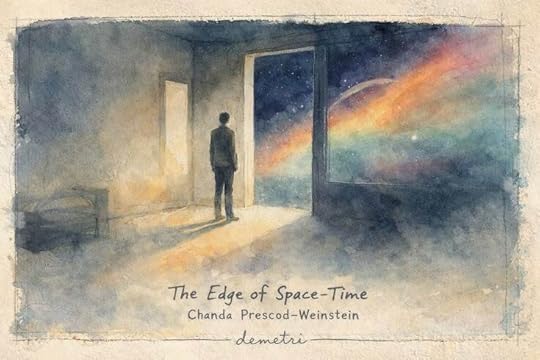
A solitary figure at the threshold between room and cosmos gives “The Edge of Space-Time” its truest image: not the universe as spectacle, but the human strain of trying to look at it honestly without pretending it is simpler than it is.
Most popular science books offer a neat bargain: you bring curiosity, they bring clarity, and everyone leaves feeling a little brighter about black holes. “The Edge of Space-Time” asks for something less flattering. Chanda Prescod-Weinstein does explain cosmology, quantum mechanics, horizons, fields, and the old light by which the universe becomes visible to us at all. But the deeper argument is about explanation itself: who gets to produce it, which metaphors make it possible, what kinds of authority those metaphors smuggle in, and how much they must bend before reality can be made shareable. The book opens under sankofa – go back and get what was forgotten – and takes the proverb seriously as method. In Prescod-Weinstein’s hands, cosmology becomes less a neutral tour of origins than a retrieval effort with teeth: of buried histories, worn language, and human attempts to make the universe thinkable without sanding off everything that resists neatness.
That immediately makes the shelf label “popular science” look a little flimsy – too blunt for the book’s ambitions and too roomy for its precision. The contents page starts arguing before the prose does. “Sankofa, To Begin,” then four parts – “The People Could Fly,” “Queer Phenomenology,” “Through the Looking Glass,” and “Let’s Fly” – followed by “Go Back and Get it.” Even the architecture is teaching you how to read. Understanding here will not arrive by clean ascent. It will come by interruption, return, revision, and strategic loss of confidence. Part I trains the mind in metaphor, motion, light, and field. Part II breaks whatever classical poise still refuses to leave the room. It also includes the pointed “A Note on ‘Great’ Men of Science,” which does more than widen the book’s social frame. It changes the reader’s contract with the physics that follows. Theory is not absolution. Brilliance is not innocence. Part III moves fully into ontological disruption, where particles stop behaving like little objects and the vacuum turns out to be so active that the word “vacuum” begins to sound suspiciously like a euphemism. Part IV turns from abstraction back to use, asking what cosmological knowledge is worth inside institutions still shaped by hierarchy, exclusion, and force. Prescod-Weinstein does not want the reader to move neatly from ignorance to mastery. She wants something slower, stranger, and less flattering: interruption, return, revision, and the loss of borrowed certainty.
The book starts leaning on the reader’s habits of thought almost immediately. Before the lab, before the data, there is language. No one enters physics from some innocent pre-metaphorical innocence. We arrive already living inside comparisons, habits of order, pictures of cause and background, old stories about what counts as fundamental. In a better-behaved specimen of public science writing, this would curdle into a seminar on metaphor. Here it becomes method. A field, a fabric, a boundary, an edge, a stage, a looking glass – each does real explanatory work, and each imports assumptions that eventually have to be examined, corrected, or dropped. Prescod-Weinstein keeps showing how much labor a metaphor can do right up to the point where it starts generating the wrong question. Her handling of the balloon model for expansion is a perfect example. The image helps until it quietly invites the reader to ask what the universe is expanding into, as though space-time required some larger room around it. The metaphor clarifies, then overreaches, then gives way. The slippage is the lesson. Explanation is possible here, the book keeps insisting, but only if we remain alert to the damage done by the very figures that make understanding feel available in the first place.
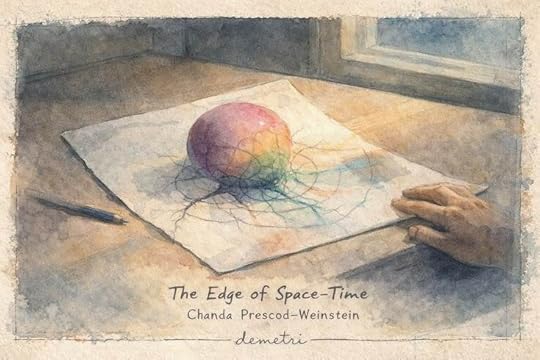
As the familiar model of expansion begins to slip out of usefulness, the painting catches one of the book’s central recognitions: the very metaphors that make the universe thinkable are often the first things to betray it.
At skeleton level, the book moves from metaphor to quantum crisis to ontological reconstruction. Prescod-Weinstein begins by proposing that to do cosmology is to go back and get the history of space-time. From there she moves through space, time, relativity, fields, and light, loosening the reader’s attachment to sturdy nouns. Quantum mechanics enters not as a cabinet of delightful paradoxes but as a sustained insult to common sense. Superposition, spin, Hilbert space, indeterminacy, the double-slit experiment, and the dispute over what any of it means are handled not as party tricks but as questions about what a state is, what a past is, what a particle is, what a measurement is. Midway through, the book strikes one of its favorite matches – “You are an abstract contraption made of nothing” – and from there it starts swinging harder. Matter begins to look less like a cupboard of tiny self-contained things than a pattern of excitations in deeper fields. The vacuum refuses to stay empty and polite. Black holes reopen the question of boundary. Unity remains a hope rather than a possession. By the end, the imperative widens: go back, retrieve, revise, and do not pretend that knowledge can be separated from the institutions and stories that made it.
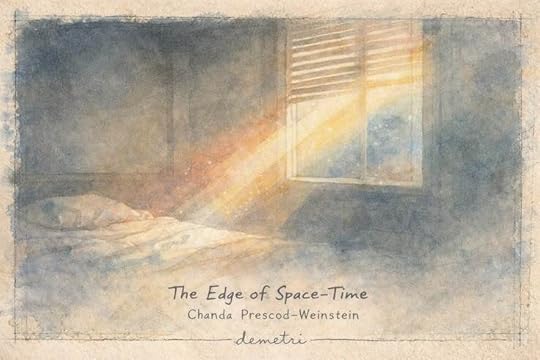
By making an ordinary room feel newly charged and faintly untrustworthy, this image translates one of the book’s most unsettling ideas into feeling: emptiness, once examined closely, refuses to remain empty.
The friction is built into the method. Prescod-Weinstein is not trying to walk readers into easy comfort. A more accommodating writer would turn quantum mechanics into a tray of polished paradoxes, smile winningly, and keep the tour moving. “The Edge of Space-Time” refuses that hospitality. Successful equations are not enough here if they arrive stripped of meaning. Difficulty, likewise, is not treated as a defect in the reader. It is part of the world under description. This is the one stretch where the comparison with Carlo Rovelli’s “The Order of Time” earns its keep. Both writers understand physics as a way of altering consciousness rather than merely stocking it with facts. But Prescod-Weinstein is rougher-edged, funnier, more suspicious of serenity, and much thicker with institutional pressure. If Rovelli often sounds like a philosopher thinking beautifully at dusk, Prescod-Weinstein sounds like a teacher who knows the lesson is hard, knows it matters, and is not above knocking on the desk once or twice to keep the room honest.
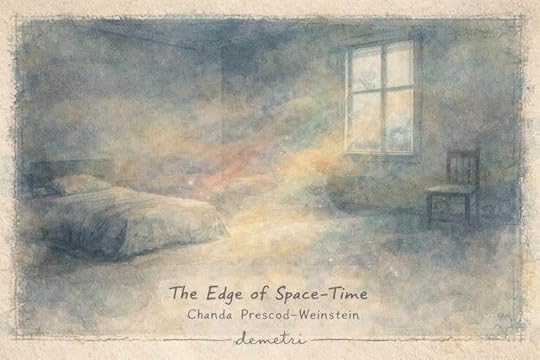
This band of strange, delayed light turns illumination into inheritance, echoing the book’s conviction that to see the cosmos at all is to stand inside distance, memory, and the long arrival of knowledge.
Much of the book’s authority arrives sentence by sentence. Prescod-Weinstein trusts a mixed register and controls it firmly: technical diction, slang, theory, literature, direct address, pop reference, quick comic bite. This might easily have become a pileup. Usually it becomes range. She can move from photons or wave functions to a sentence with real snap, then pivot back into moral seriousness without making the whole enterprise feel stitched together from borrowed tones. The rhythms help. She likes the long, cumulative essay sentence that gathers pressure clause by clause, but she also knows when to cut the wire with something short. That variation matters because abstraction here is never allowed to seal itself off. The prose keeps dragging concepts back toward bodies, histories, institutions, pleasure, and injury. It does not let the reader hide inside the allegedly clean air of technical language.
That is why style here is not garnish. It is where the argument proves it can bear weight. Strip away the mixed diction, the crosscurrents, the willingness to move from Robert Frost to “Star Trek” to quantum field theory within a few pages, and you do not get the same argument in plainer clothes. You get a smaller one. Prescod-Weinstein’s claim that physics is inseparable from metaphor, story, and history cannot survive in a voice that treats those things as detachable accessories. By braiding Frost, Natasha Trethewey, Virginia Hamilton, Lewis Carroll, Langston Hughes, and Black feminist thought into a discussion of cosmology, she is not rummaging around for adornments. She is demonstrating that science already lives among these forms, whether it admits the company or not.
The recursion is load-bearing. Ideas do not appear, do their local service, and vanish. They come back altered. Light begins as illumination and history, then returns as the very condition by which cosmology can see. Edges start as figures for knowledge and end as literal limits of observation and theory. Sankofa begins as proverb and becomes architecture. Even the slide from “The People Could Fly” to “Let’s Fly” risks cuteness and gets away with it because the book has spent so long loading flight with meaning: Black freedom dreaming, speculative imagination, ancestral continuity, the appetite to exceed the terms one inherits. This is not progress by staircase. It is closer to circling a well that keeps getting deeper. Earlier chapters are not simply recalled by later ones. They are revised by them. Prescod-Weinstein slows the reader for a reason. She wants to frustrate the fantasy that difficult knowledge can be mastered once and filed away.
Calling this “accessible physics” gets the shelf right and the book wrong. Many books make hard science sound as though it has already agreed to cooperate. Prescod-Weinstein changes what readability costs. She does not remove difficulty. She redistributes it. She keeps the strain visible. She asks the reader to stay with instability rather than receive a cleaned-up version of it. She also rejects one of public science writing’s oldest comforts: the fantasy of expertise imagined as placeless and morally innocent. Her cosmology is inseparable from Black feminist thought, from skepticism toward scientific hero worship, from suspicion of colonial and militarized models of exploration, and from the insistence that wonder and justice are not rival goods. In that sense “The Edge of Space-Time” feels less like a conventional successor to “The Disordered Cosmos” than a riskier extension of its deepest wager: science shrinks when it denies the social, historical, and rhetorical conditions of its own making.
This is also where some readers will quietly step off. The same method that gives the book force sometimes blurs its forward motion. Prescod-Weinstein returns often to a handful of recurring claims – metaphor matters, science is not neutral, wonder is a human necessity – and there are stretches, especially early on and in the final return, where emphasis starts to soften escalation. The book’s high-voltage compressions can outlast the explanations around them. “You are an abstract contraption made of nothing” is a terrific title and a real burst of rhetorical electricity. It is also the sort of line that may linger longer than the patient argument meant to support it. Readers who come looking for the clean chassis of Brian Greene’s “The Fabric of the Cosmos,” or the brisk altitude of Neil deGrasse Tyson’s “Astrophysics for People in a Hurry,” may well find Prescod-Weinstein’s recursive, essayistic, openly political method slower than they want. That impatience would be justified. This is a book that asks a great deal, including a willingness to accept that clarity may arrive by complication rather than simplification.
Still, the flaw grows from the same ambition as the virtue. A leaner version of the book might also be a less inhabitable one. A tidier version might lose the feeling that understanding here must be built by return, estrangement, and revision. A more decorously balanced version would almost certainly lose the thing that makes Prescod-Weinstein worth reading in the first place: her refusal to discuss the cosmos as though history were some irrelevant weather drifting outside the observatory windows. Its relevance needs no hauling in. The politics are in the wiring. This is not a topical book in the thin sense. It is concerned with durable habits of authority and interpretation – habits about who gets to explain, how they get to explain, and what gets smoothed over in the process.
What keeps the book from going cold is Prescod-Weinstein’s refusal to let critique harden into dead feeling. “The Edge of Space-Time” is unsparing about scientific institutions, but it is not a renunciation of science. It is a demand that science be large enough for human beings rather than merely useful to the systems that prefer them pliable. That warmth is not decorative. It is structural. It keeps the hardest arguments from calcifying. Even the book’s angriest pages are energized by the conviction that curiosity is not a hobby here. It is a condition of dignity. The stubbornness of that conviction gives the book some of its moral pressure. The universe does not become less astonishing because the institutions around it are compromised. If anything, astonishment becomes one more reason not to leave the story in the wrong hands.
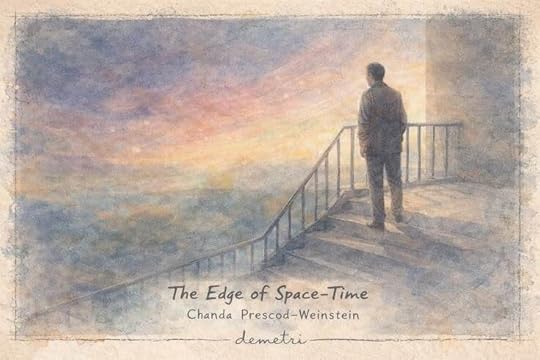
Poised between backward glance and forward motion, this closing image answers the book’s ethic of return with a sober, unfinished lift, as if looking again were the only honest way to keep moving.
For me, “The Edge of Space-Time” lands at 90/100, which translates to 5 out of 5 stars: a book willing to groan under its own reach and strong enough to justify most of the strain, more probing than soothing, more exhilarating than seamless. What remains stuck in the mind is not any single explanation, though there are many sharp ones, but a more suspicious, more alert relation to explanation itself. Prescod-Weinstein begins by telling us that to study cosmology is to go back and get the history of space-time. By the end, the phrase has widened. We are not just retrieving the universe. We are being asked what kinds of minds, and what kinds of stories, might still be capable of meeting it at the edge – and flying there without confusing the map for the sky.
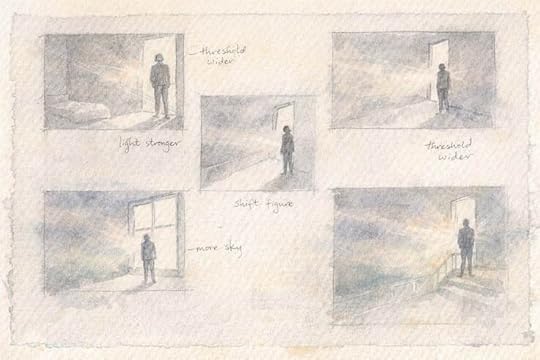
These early thumbnail studies show the painting searching for its true balance of room, threshold, and cosmos, where the final image’s emotional tension had to be solved first as architecture.
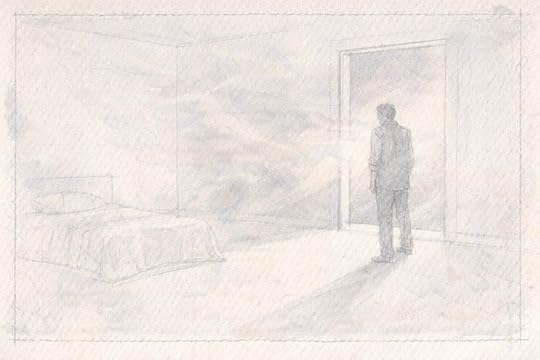
The faint underdrawing reveals the quiet armature beneath the finished watercolor – window, wall, figure, and light arranged before atmosphere could begin to disturb them.
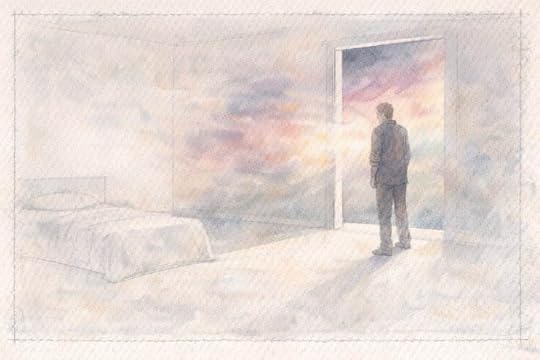
At the first-wash stage, structure starts yielding to mood, and the image discovers the soft instability that lets an ordinary interior begin to feel pressured by something larger than itself.
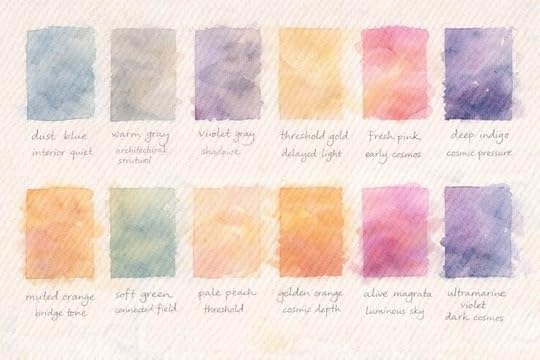
The swatch sheet records the palette logic behind the finished painting, where the cover’s colors are tested, muted, and deepened until the human room and the cosmic field can belong to the same emotional world.
All watercolor illustrations by Demetris Papadimitropoulos.
“The Edge of Space-Time” turns the explanatory comforts of popular science inside out and asks us to live, at least briefly, without the shelter of simplification
By Demetris Papadimitropoulos | April 4th, 2026
A solitary figure at the threshold between room and cosmos gives “The Edge of Space-Time” its truest image: not the universe as spectacle, but the human strain of trying to look at it honestly without pretending it is simpler than it is.
Most popular science books offer a neat bargain: you bring curiosity, they bring clarity, and everyone leaves feeling a little brighter about black holes. “The Edge of Space-Time” asks for something less flattering. Chanda Prescod-Weinstein does explain cosmology, quantum mechanics, horizons, fields, and the old light by which the universe becomes visible to us at all. But the deeper argument is about explanation itself: who gets to produce it, which metaphors make it possible, what kinds of authority those metaphors smuggle in, and how much they must bend before reality can be made shareable. The book opens under sankofa – go back and get what was forgotten – and takes the proverb seriously as method. In Prescod-Weinstein’s hands, cosmology becomes less a neutral tour of origins than a retrieval effort with teeth: of buried histories, worn language, and human attempts to make the universe thinkable without sanding off everything that resists neatness.
That immediately makes the shelf label “popular science” look a little flimsy – too blunt for the book’s ambitions and too roomy for its precision. The contents page starts arguing before the prose does. “Sankofa, To Begin,” then four parts – “The People Could Fly,” “Queer Phenomenology,” “Through the Looking Glass,” and “Let’s Fly” – followed by “Go Back and Get it.” Even the architecture is teaching you how to read. Understanding here will not arrive by clean ascent. It will come by interruption, return, revision, and strategic loss of confidence. Part I trains the mind in metaphor, motion, light, and field. Part II breaks whatever classical poise still refuses to leave the room. It also includes the pointed “A Note on ‘Great’ Men of Science,” which does more than widen the book’s social frame. It changes the reader’s contract with the physics that follows. Theory is not absolution. Brilliance is not innocence. Part III moves fully into ontological disruption, where particles stop behaving like little objects and the vacuum turns out to be so active that the word “vacuum” begins to sound suspiciously like a euphemism. Part IV turns from abstraction back to use, asking what cosmological knowledge is worth inside institutions still shaped by hierarchy, exclusion, and force. Prescod-Weinstein does not want the reader to move neatly from ignorance to mastery. She wants something slower, stranger, and less flattering: interruption, return, revision, and the loss of borrowed certainty.
The book starts leaning on the reader’s habits of thought almost immediately. Before the lab, before the data, there is language. No one enters physics from some innocent pre-metaphorical innocence. We arrive already living inside comparisons, habits of order, pictures of cause and background, old stories about what counts as fundamental. In a better-behaved specimen of public science writing, this would curdle into a seminar on metaphor. Here it becomes method. A field, a fabric, a boundary, an edge, a stage, a looking glass – each does real explanatory work, and each imports assumptions that eventually have to be examined, corrected, or dropped. Prescod-Weinstein keeps showing how much labor a metaphor can do right up to the point where it starts generating the wrong question. Her handling of the balloon model for expansion is a perfect example. The image helps until it quietly invites the reader to ask what the universe is expanding into, as though space-time required some larger room around it. The metaphor clarifies, then overreaches, then gives way. The slippage is the lesson. Explanation is possible here, the book keeps insisting, but only if we remain alert to the damage done by the very figures that make understanding feel available in the first place.
As the familiar model of expansion begins to slip out of usefulness, the painting catches one of the book’s central recognitions: the very metaphors that make the universe thinkable are often the first things to betray it.
At skeleton level, the book moves from metaphor to quantum crisis to ontological reconstruction. Prescod-Weinstein begins by proposing that to do cosmology is to go back and get the history of space-time. From there she moves through space, time, relativity, fields, and light, loosening the reader’s attachment to sturdy nouns. Quantum mechanics enters not as a cabinet of delightful paradoxes but as a sustained insult to common sense. Superposition, spin, Hilbert space, indeterminacy, the double-slit experiment, and the dispute over what any of it means are handled not as party tricks but as questions about what a state is, what a past is, what a particle is, what a measurement is. Midway through, the book strikes one of its favorite matches – “You are an abstract contraption made of nothing” – and from there it starts swinging harder. Matter begins to look less like a cupboard of tiny self-contained things than a pattern of excitations in deeper fields. The vacuum refuses to stay empty and polite. Black holes reopen the question of boundary. Unity remains a hope rather than a possession. By the end, the imperative widens: go back, retrieve, revise, and do not pretend that knowledge can be separated from the institutions and stories that made it.
By making an ordinary room feel newly charged and faintly untrustworthy, this image translates one of the book’s most unsettling ideas into feeling: emptiness, once examined closely, refuses to remain empty.
The friction is built into the method. Prescod-Weinstein is not trying to walk readers into easy comfort. A more accommodating writer would turn quantum mechanics into a tray of polished paradoxes, smile winningly, and keep the tour moving. “The Edge of Space-Time” refuses that hospitality. Successful equations are not enough here if they arrive stripped of meaning. Difficulty, likewise, is not treated as a defect in the reader. It is part of the world under description. This is the one stretch where the comparison with Carlo Rovelli’s “The Order of Time” earns its keep. Both writers understand physics as a way of altering consciousness rather than merely stocking it with facts. But Prescod-Weinstein is rougher-edged, funnier, more suspicious of serenity, and much thicker with institutional pressure. If Rovelli often sounds like a philosopher thinking beautifully at dusk, Prescod-Weinstein sounds like a teacher who knows the lesson is hard, knows it matters, and is not above knocking on the desk once or twice to keep the room honest.
This band of strange, delayed light turns illumination into inheritance, echoing the book’s conviction that to see the cosmos at all is to stand inside distance, memory, and the long arrival of knowledge.
Much of the book’s authority arrives sentence by sentence. Prescod-Weinstein trusts a mixed register and controls it firmly: technical diction, slang, theory, literature, direct address, pop reference, quick comic bite. This might easily have become a pileup. Usually it becomes range. She can move from photons or wave functions to a sentence with real snap, then pivot back into moral seriousness without making the whole enterprise feel stitched together from borrowed tones. The rhythms help. She likes the long, cumulative essay sentence that gathers pressure clause by clause, but she also knows when to cut the wire with something short. That variation matters because abstraction here is never allowed to seal itself off. The prose keeps dragging concepts back toward bodies, histories, institutions, pleasure, and injury. It does not let the reader hide inside the allegedly clean air of technical language.
That is why style here is not garnish. It is where the argument proves it can bear weight. Strip away the mixed diction, the crosscurrents, the willingness to move from Robert Frost to “Star Trek” to quantum field theory within a few pages, and you do not get the same argument in plainer clothes. You get a smaller one. Prescod-Weinstein’s claim that physics is inseparable from metaphor, story, and history cannot survive in a voice that treats those things as detachable accessories. By braiding Frost, Natasha Trethewey, Virginia Hamilton, Lewis Carroll, Langston Hughes, and Black feminist thought into a discussion of cosmology, she is not rummaging around for adornments. She is demonstrating that science already lives among these forms, whether it admits the company or not.
The recursion is load-bearing. Ideas do not appear, do their local service, and vanish. They come back altered. Light begins as illumination and history, then returns as the very condition by which cosmology can see. Edges start as figures for knowledge and end as literal limits of observation and theory. Sankofa begins as proverb and becomes architecture. Even the slide from “The People Could Fly” to “Let’s Fly” risks cuteness and gets away with it because the book has spent so long loading flight with meaning: Black freedom dreaming, speculative imagination, ancestral continuity, the appetite to exceed the terms one inherits. This is not progress by staircase. It is closer to circling a well that keeps getting deeper. Earlier chapters are not simply recalled by later ones. They are revised by them. Prescod-Weinstein slows the reader for a reason. She wants to frustrate the fantasy that difficult knowledge can be mastered once and filed away.
Calling this “accessible physics” gets the shelf right and the book wrong. Many books make hard science sound as though it has already agreed to cooperate. Prescod-Weinstein changes what readability costs. She does not remove difficulty. She redistributes it. She keeps the strain visible. She asks the reader to stay with instability rather than receive a cleaned-up version of it. She also rejects one of public science writing’s oldest comforts: the fantasy of expertise imagined as placeless and morally innocent. Her cosmology is inseparable from Black feminist thought, from skepticism toward scientific hero worship, from suspicion of colonial and militarized models of exploration, and from the insistence that wonder and justice are not rival goods. In that sense “The Edge of Space-Time” feels less like a conventional successor to “The Disordered Cosmos” than a riskier extension of its deepest wager: science shrinks when it denies the social, historical, and rhetorical conditions of its own making.
This is also where some readers will quietly step off. The same method that gives the book force sometimes blurs its forward motion. Prescod-Weinstein returns often to a handful of recurring claims – metaphor matters, science is not neutral, wonder is a human necessity – and there are stretches, especially early on and in the final return, where emphasis starts to soften escalation. The book’s high-voltage compressions can outlast the explanations around them. “You are an abstract contraption made of nothing” is a terrific title and a real burst of rhetorical electricity. It is also the sort of line that may linger longer than the patient argument meant to support it. Readers who come looking for the clean chassis of Brian Greene’s “The Fabric of the Cosmos,” or the brisk altitude of Neil deGrasse Tyson’s “Astrophysics for People in a Hurry,” may well find Prescod-Weinstein’s recursive, essayistic, openly political method slower than they want. That impatience would be justified. This is a book that asks a great deal, including a willingness to accept that clarity may arrive by complication rather than simplification.
Still, the flaw grows from the same ambition as the virtue. A leaner version of the book might also be a less inhabitable one. A tidier version might lose the feeling that understanding here must be built by return, estrangement, and revision. A more decorously balanced version would almost certainly lose the thing that makes Prescod-Weinstein worth reading in the first place: her refusal to discuss the cosmos as though history were some irrelevant weather drifting outside the observatory windows. Its relevance needs no hauling in. The politics are in the wiring. This is not a topical book in the thin sense. It is concerned with durable habits of authority and interpretation – habits about who gets to explain, how they get to explain, and what gets smoothed over in the process.
What keeps the book from going cold is Prescod-Weinstein’s refusal to let critique harden into dead feeling. “The Edge of Space-Time” is unsparing about scientific institutions, but it is not a renunciation of science. It is a demand that science be large enough for human beings rather than merely useful to the systems that prefer them pliable. That warmth is not decorative. It is structural. It keeps the hardest arguments from calcifying. Even the book’s angriest pages are energized by the conviction that curiosity is not a hobby here. It is a condition of dignity. The stubbornness of that conviction gives the book some of its moral pressure. The universe does not become less astonishing because the institutions around it are compromised. If anything, astonishment becomes one more reason not to leave the story in the wrong hands.
Poised between backward glance and forward motion, this closing image answers the book’s ethic of return with a sober, unfinished lift, as if looking again were the only honest way to keep moving.
For me, “The Edge of Space-Time” lands at 90/100, which translates to 5 out of 5 stars: a book willing to groan under its own reach and strong enough to justify most of the strain, more probing than soothing, more exhilarating than seamless. What remains stuck in the mind is not any single explanation, though there are many sharp ones, but a more suspicious, more alert relation to explanation itself. Prescod-Weinstein begins by telling us that to study cosmology is to go back and get the history of space-time. By the end, the phrase has widened. We are not just retrieving the universe. We are being asked what kinds of minds, and what kinds of stories, might still be capable of meeting it at the edge – and flying there without confusing the map for the sky.
These early thumbnail studies show the painting searching for its true balance of room, threshold, and cosmos, where the final image’s emotional tension had to be solved first as architecture.
The faint underdrawing reveals the quiet armature beneath the finished watercolor – window, wall, figure, and light arranged before atmosphere could begin to disturb them.
At the first-wash stage, structure starts yielding to mood, and the image discovers the soft instability that lets an ordinary interior begin to feel pressured by something larger than itself.
The swatch sheet records the palette logic behind the finished painting, where the cover’s colors are tested, muted, and deepened until the human room and the cosmic field can belong to the same emotional world.
All watercolor illustrations by Demetris Papadimitropoulos.

August 18, 2026
A poetic review of current astro-physics. I appreciate the wide range of popular and scientific references that the author engages in. This book expanded the metaphors I use for reality.

May 19, 2026
…abiding metaphors that govern how Black children with white biological parents have historically been interpreted both socially and scientifically, i.e., as mules, the English version….
I had assumed this was an astronomy book.
Apparently this is another rant about social injustice under the mask of astronomy.
Entire first half of book is like this.
Sheesh.
I had assumed this was an astronomy book.
Apparently this is another rant about social injustice under the mask of astronomy.
Entire first half of book is like this.
Sheesh.
June 11, 2026
[DNF] Was looking for a little more time-space stuff. Seemed to have more questions than answers, didn't keep my interest. Read about a third of the book... Moving on. Good and Easy read.
June 10, 2026
Although I mostly enjoyed this book, once the author started using science metaphors for other matters it got into Not Even Wrong territory.
July 12, 2026
In my youth, I was a physics major, and my graduate career, such as it was, was at the University of New Hampshire. (I got my Masters degree before flaming out pre-PhD.) I try to keep up with the field at a dilettante level, and pay some attention to the doings at UNH's Department of Physics. Which is how I became aware of Chanda Prescod-Weinstein (CPW); she is (now) a tenured Associate Professor in the department, and also in Women's and Gender Studies. I reported on her first book, The Disordered Cosmos, here.
Back in the day, physics "survey" courses were labeled, somewhat disdainfully, "Physics for Poets". (The geology version: "Rocks for Jocks".) Especially in the early going, this book reads like transcribed lectures from CPW's "Physics for Poets" course, if she had ever given one. (That hypothesis is strengthened by the book's subtitle.)
And there's nothing wrong with that! CPW is enthusiastic about the field, and she does a decent job conveying the mysteries and weirdnesses that abound in modern physics and cosmology. But one of the constraints of a "for poets" course (or book) is math: you can't write a freaking formula, lest >90% of your students (or readers) zone out (or stop reading). Alas, the only tool we have to describe such phenomena accurately is math. Without that, you're mostly handwaving, albeit in an entertaining way.
CPW's shtick is to interlace her physics with hard-left ranting; odd and irrelevant observations; plugs for her favorite authors poets, and TV shows; and occasional f-bombs (keeping it real!). This may work better for some readers than it did for me. Unfortunately, the rant/physics ratio seems to go up as the book moves along. Genocide, the Middle Passage, Colonialism, capitalism (with its associated evil, neoliberalism), etc., etc., etc. are continual targets of CPW's drive-by commentary.
She is a big fan of the late thug/poet Nikki Giovanni; this made me recall what I wrote about her back in 2009, when UNH invited her to keynote its 2010 Martin Luther King "celebration". (Which they stopped celebrating a few years ago.)
CPW does not like Erwin Schrödinger, avoiding terms like "Schrödinger's Cat" and "Schrődinger Equation". Even though she's complimentary about "queer" manifestations of sexuality, it seems that Erwin's type of queerness was a bridge too far.
Some things just made me wonder what point CPW was trying to make. She identifies Plato as "a philosopher from the Balkan peninsula of Asia." She's talking about Greece! (A couple pages later, Aristotle is "another Balkan peninsula philosopher.")
CPW refers throughout to the "nightmare global-warming scenario", seemingly unaware that even its past advocates have given up on its plausibility.
A trip to Dodger Stadium would not have been complete without the mention of the "mostly Mexican-American families" that Los Angeles kicked out of Chavez Ravine for its construction.
For same reason, CPW can't help but observe that John Stewart Bell (he of Bell's Inequality) "absolutely comes off like a bit of a queen."
Some outright bloopers seemed to have been missed. Ones I noticed: a footnote on page 80 uses the word "acceleration", which should have been "direction"; there's a missing minus sign on an exponent on page 86; the word "enormity" is misused on page 176; and this discussion of a plot point on Star Trek: Discovery on page 250 is truly mystifying:
But it turns out while Dr. Culber was dying at the end of set nonbreaking space between his husband—ship's engineer Paul Stamets (beautifully played by Anthony Rapp)—unintentionally transferred Culber's essence to a fungal network with a kiss.
Nonbreaking space: the final frontier!

June 10, 2026
“How do you practice hope? I practiced by writing a book that I hope reminded you that the universe is bigger than the bad things happening to us, to our comrades, and to people we will never meet halfway across the world.”
Thank you to NetGalley and the publisher for the eARC! This book was published in the US by Pantheon on April 7, 2026.
The Edge of Space-Time is a mind-expanding, politically conscious tour through the edges of what humans know about the universe and what those edges might teach us about ourselves.
Chanda Prescod-Weinstein approaches cosmology as a form of storytelling: to study space-time is to study cosmic origin, motion, boundary, relation, and possibility. As a Black feminist theoretical physicist, she refuses the myth that science is neutral, showing instead how physics is shaped by language, history, power, and the political choices of the people who practice it. Her explanations of relativity, quantum mechanics, photons, dark matter, black holes, and quantum gravity are often technical, but her voice remains warm, funny, irreverent, and full of wonder.
I definitely did not understand everything in this book, and I will not retain everything I did understand, but that almost feels beside the point. Prescod-Weinstein makes abstraction feel like a practice of humility, curiosity, and political imagination. Her work insists that uncertainty is not failure; it is where more becomes possible. I was especially moved by the way she frames queerness as a boundary practice, a way of living at the edge of what is known and pushing toward what else might be true.
This is a book about physics, but it is also about fascism, colonialism, Black history, language, ethics, and hope. Prescod-Weinstein reminds us that “the universe is bigger than the bad things happening to us,” and that learning how to imagine more complete stories of the cosmos may help us imagine more livable futures here on Earth.
📖 Read this if you love: accessible but ambitious science writing; books that treat science as political rather than neutral; Black feminist thought and politically engaged nonfiction; the intersections of physics, language, ethics, and imagination; or queer approaches to knowledge and uncertainty.
🔑 Key Themes: Cosmology as Storytelling, Black Feminist Science & Knowledge Production, Wonder as Political Practice, Quantum Uncertainty & Ambiguity, Colonial Histories of Science, and Imagining Collective Futures.
Content / Trigger Warnings: Enslavement (minor), War (minor), Genocide (minor), Racism (minor).
Thank you to NetGalley and the publisher for the eARC! This book was published in the US by Pantheon on April 7, 2026.
The Edge of Space-Time is a mind-expanding, politically conscious tour through the edges of what humans know about the universe and what those edges might teach us about ourselves.
Chanda Prescod-Weinstein approaches cosmology as a form of storytelling: to study space-time is to study cosmic origin, motion, boundary, relation, and possibility. As a Black feminist theoretical physicist, she refuses the myth that science is neutral, showing instead how physics is shaped by language, history, power, and the political choices of the people who practice it. Her explanations of relativity, quantum mechanics, photons, dark matter, black holes, and quantum gravity are often technical, but her voice remains warm, funny, irreverent, and full of wonder.
I definitely did not understand everything in this book, and I will not retain everything I did understand, but that almost feels beside the point. Prescod-Weinstein makes abstraction feel like a practice of humility, curiosity, and political imagination. Her work insists that uncertainty is not failure; it is where more becomes possible. I was especially moved by the way she frames queerness as a boundary practice, a way of living at the edge of what is known and pushing toward what else might be true.
This is a book about physics, but it is also about fascism, colonialism, Black history, language, ethics, and hope. Prescod-Weinstein reminds us that “the universe is bigger than the bad things happening to us,” and that learning how to imagine more complete stories of the cosmos may help us imagine more livable futures here on Earth.
📖 Read this if you love: accessible but ambitious science writing; books that treat science as political rather than neutral; Black feminist thought and politically engaged nonfiction; the intersections of physics, language, ethics, and imagination; or queer approaches to knowledge and uncertainty.
🔑 Key Themes: Cosmology as Storytelling, Black Feminist Science & Knowledge Production, Wonder as Political Practice, Quantum Uncertainty & Ambiguity, Colonial Histories of Science, and Imagining Collective Futures.
Content / Trigger Warnings: Enslavement (minor), War (minor), Genocide (minor), Racism (minor).

Review of advance copy received from Netgalley
I loved The Disordered Cosmos: A Journey into Dark Matter, Spacetime, and Dreams Deferred" and was very much looking forward to this second book by the author. This book is a tour through theoretical physics for the non-expert, along the lines of Brian Greene's The Fabric of the Cosmos: Space, Time, and the Texture of Reality from 2004, updated with the latest in the field.
While I'm not a physicist, as an avid reader of non-fiction, I found myself skipping ahead for new information that would change my perspective on the history of science, such as the section on Mohism and sentences such as "the colonial approach Europeans took to collecting and collating information was predicated on the idea that their sensibilities were universal and absolute. This applied not just to precepts about land ownership and use, but also motion." Fascinating! These sorts of insights were fewer and farther between as the book went on and got deeper and deeper into explaining concepts of theoretical physics.
I think folks who are lovers of theoretical physics will enjoy this book very much. I was erroneously expecting another book in a similar vein as "Disordered Cosmos", and this was very much my own fault as a reader, because the cover and blurb clearly advertise a very different book. In Dr. Prescod-Weinstein's own words: "There's no good time or place to say this, but I have chosen here because fuck if I was gonna open the book with it. I already wrote extensively in The Disordered Cosmos about the "people problems" of physics, and I won't write the same book twice." Fair enough!
Still, I was longing for just a few more stories about the forgotten women of physics. Perhaps that will be a future book, as Prescod-Weinstein's brilliant debut laid the groundwork, and now is the time for many more to follow her footsteps and start publishing those missing stories.
Thanks to NetGalley and the publisher for the eARC in exchange for my honest review.
While I'm not a physicist, as an avid reader of non-fiction, I found myself skipping ahead for new information that would change my perspective on the history of science, such as the section on Mohism and sentences such as "the colonial approach Europeans took to collecting and collating information was predicated on the idea that their sensibilities were universal and absolute. This applied not just to precepts about land ownership and use, but also motion." Fascinating! These sorts of insights were fewer and farther between as the book went on and got deeper and deeper into explaining concepts of theoretical physics.
I think folks who are lovers of theoretical physics will enjoy this book very much. I was erroneously expecting another book in a similar vein as "Disordered Cosmos", and this was very much my own fault as a reader, because the cover and blurb clearly advertise a very different book. In Dr. Prescod-Weinstein's own words: "There's no good time or place to say this, but I have chosen here because fuck if I was gonna open the book with it. I already wrote extensively in The Disordered Cosmos about the "people problems" of physics, and I won't write the same book twice." Fair enough!
Still, I was longing for just a few more stories about the forgotten women of physics. Perhaps that will be a future book, as Prescod-Weinstein's brilliant debut laid the groundwork, and now is the time for many more to follow her footsteps and start publishing those missing stories.
Thanks to NetGalley and the publisher for the eARC in exchange for my honest review.
July 1, 2026
The Edge of Space-Time: Particles, Poetry, and the Cosmic Dream Boogie is a dazzling exploration of the universe that reminds us science is not merely a collection of equations it is one of humanity's greatest acts of imagination. Chanda Prescod-Weinstein masterfully combines cutting-edge physics with philosophy, poetry, history, and culture to create a work that is intellectually ambitious while remaining remarkably inviting.
One of the book's greatest achievements is its accessibility. Concepts that often seem intimidating quantum mechanics, dark matter, black holes, neutrinos, quantum gravity, and the fabric of space time are presented with clarity, creativity, and genuine enthusiasm. Rather than simplifying the science, Prescod-Weinstein illuminates it through memorable analogies, storytelling, and cultural references that make the mysteries of the cosmos feel wonderfully approachable.
Equally compelling is the book's broader perspective on what science means. Physics is presented not as an isolated academic pursuit but as a deeply human endeavor shaped by history, culture, ethics, and imagination. By weaving together Black feminist scholarship, post-colonial thought, literature, music, and popular culture, Prescod-Weinstein demonstrates that scientific curiosity belongs to everyone and is enriched by diverse voices and experiences.
The writing itself carries a sense of joy and wonder that is infectious. Every chapter invites readers to pause and appreciate both the astonishing complexity of the universe and humanity's enduring desire to understand it. The blend of rigorous scholarship with poetic reflection creates a reading experience that is both intellectually stimulating and emotionally rewarding.
Perhaps most inspiring is the book's invitation to rethink our relationship with the cosmos. Rather than viewing exploration as conquest, Prescod-Weinstein encourages a more thoughtful, inclusive, and ethically grounded vision of humanity's place among the stars. It is a perspective that feels both timely and profoundly hopeful.
Insightful, imaginative, and beautifully written, The Edge of Space Time is a remarkable celebration of scientific curiosity and one of those rare books that expands not only our understanding of the universe but also our appreciation of what it means to be human.
One of the book's greatest achievements is its accessibility. Concepts that often seem intimidating quantum mechanics, dark matter, black holes, neutrinos, quantum gravity, and the fabric of space time are presented with clarity, creativity, and genuine enthusiasm. Rather than simplifying the science, Prescod-Weinstein illuminates it through memorable analogies, storytelling, and cultural references that make the mysteries of the cosmos feel wonderfully approachable.
Equally compelling is the book's broader perspective on what science means. Physics is presented not as an isolated academic pursuit but as a deeply human endeavor shaped by history, culture, ethics, and imagination. By weaving together Black feminist scholarship, post-colonial thought, literature, music, and popular culture, Prescod-Weinstein demonstrates that scientific curiosity belongs to everyone and is enriched by diverse voices and experiences.
The writing itself carries a sense of joy and wonder that is infectious. Every chapter invites readers to pause and appreciate both the astonishing complexity of the universe and humanity's enduring desire to understand it. The blend of rigorous scholarship with poetic reflection creates a reading experience that is both intellectually stimulating and emotionally rewarding.
Perhaps most inspiring is the book's invitation to rethink our relationship with the cosmos. Rather than viewing exploration as conquest, Prescod-Weinstein encourages a more thoughtful, inclusive, and ethically grounded vision of humanity's place among the stars. It is a perspective that feels both timely and profoundly hopeful.
Insightful, imaginative, and beautifully written, The Edge of Space Time is a remarkable celebration of scientific curiosity and one of those rare books that expands not only our understanding of the universe but also our appreciation of what it means to be human.
September 9, 2026
The Edge of Space Time offers an ambitious and accessible journey through cosmology, particle physics, space, and the fundamental questions surrounding our understanding of the universe. Chanda Prescod Weinstein brings concepts such as quantum mechanics, dark matter, dark energy, black holes, neutrinos, and quantum gravity into a broader conversation about humanity and our place within the cosmos. The result is a work of popular science that combines intellectual curiosity with a strong sense of wonder.
One of the book's most distinctive qualities is the way scientific ideas are placed alongside poetry, music, literature, and popular culture. References ranging from Queen Latifah and Big K.R.I.T. to Lewis Carroll, Sun Ra, and Star Trek create an unusual cultural framework for discussing highly abstract scientific concepts. This approach makes the subject feel connected to everyday human creativity rather than isolated within academic science.
The book also expands its discussion beyond scientific explanation. Prescod Weinstein draws on Black feminist thought and postcolonial history to consider how scientific knowledge is shaped by culture, institutions, and assumptions about who belongs within scientific spaces. Her discussion of space exploration and humanity's relationship with the cosmos gives the scientific material an important social and philosophical dimension.
The combination of physics, cosmology, poetry, culture, philosophy, and social thought gives the book considerable crossover appeal. It can attract readers who enjoy accessible science writing as well as students, educators, astronomers, physicists, science communicators, and readers interested in the cultural meaning of scientific discovery. Its perspective also provides an engaging entry point for readers who may not normally approach theoretical physics.
With a Goodreads rating of 4.19 from 359 ratings and 89 reviews, The Edge of Space Time is developing a positive early reader presence. Its national bestseller status and strong critical attention further support its visibility. The book's distinctive approach to explaining complex physics while connecting it with culture, history, and human curiosity creates substantial opportunities for continued discovery among science and general nonfiction audiences.
One of the book's most distinctive qualities is the way scientific ideas are placed alongside poetry, music, literature, and popular culture. References ranging from Queen Latifah and Big K.R.I.T. to Lewis Carroll, Sun Ra, and Star Trek create an unusual cultural framework for discussing highly abstract scientific concepts. This approach makes the subject feel connected to everyday human creativity rather than isolated within academic science.
The book also expands its discussion beyond scientific explanation. Prescod Weinstein draws on Black feminist thought and postcolonial history to consider how scientific knowledge is shaped by culture, institutions, and assumptions about who belongs within scientific spaces. Her discussion of space exploration and humanity's relationship with the cosmos gives the scientific material an important social and philosophical dimension.
The combination of physics, cosmology, poetry, culture, philosophy, and social thought gives the book considerable crossover appeal. It can attract readers who enjoy accessible science writing as well as students, educators, astronomers, physicists, science communicators, and readers interested in the cultural meaning of scientific discovery. Its perspective also provides an engaging entry point for readers who may not normally approach theoretical physics.
With a Goodreads rating of 4.19 from 359 ratings and 89 reviews, The Edge of Space Time is developing a positive early reader presence. Its national bestseller status and strong critical attention further support its visibility. The book's distinctive approach to explaining complex physics while connecting it with culture, history, and human curiosity creates substantial opportunities for continued discovery among science and general nonfiction audiences.

June 9, 2026
I was initially frustrated with this book because I felt like Prescod-Weinstein was trying to make two points at once. I wanted her to decide on what book she wanted to write, one about physics, or one about politics/history/social justice. I understood what argument she was making, that the two are deeply intertwined, but I didn't think she was doing a good job making her case.
The insertions about slavery, or Palestine, or ICE, felt clunky and unrelated to the physics concepts that were being described in the same paragraphs. I got annoyed. I thought these insertions were disruptive.
HELLO??? DUH!!!!
The WHOLE point of activism, literary or otherwise, is to BE disruptive. And I was getting annoyed by that?? WHY! I agree with the author politically and I am also always, sanctimoniously, shoehorning politics into every unrelated conversation. How could I be annoyed at Prescod-Weinstein for doing that same thing? Politics is disruptive, most especially for the people who suffer from covert forms of political violence, people that are oppressed and disenfranchised and openly mocked by their own government. So people like me, that can pop open a good book about physics and tune out all the noise, are exactly the kind of people that need the constant, interruptive, annoying reminders of exactly the kind of world that we are living in.
I would recommend this book for any undergrad astrophysics major like myself. The quantum chapters are particularly interesting. I would also recommend this book to anyone that enjoys learning. Finally, I would recommend this book to people that spend their time doomscrolling and getting depressed about the state of the world. As stated in the book, shit is bleak. However, there is an awful lot of hope embedded in the pages of the book, and a lot of wonder and joy. COMMUNAL hope, wonder, and joy. Because space and science are for all of us, even if there are people with a lot of money that don't want them to be. This was a very good book and I'm glad I picked it up.
The insertions about slavery, or Palestine, or ICE, felt clunky and unrelated to the physics concepts that were being described in the same paragraphs. I got annoyed. I thought these insertions were disruptive.
HELLO??? DUH!!!!
The WHOLE point of activism, literary or otherwise, is to BE disruptive. And I was getting annoyed by that?? WHY! I agree with the author politically and I am also always, sanctimoniously, shoehorning politics into every unrelated conversation. How could I be annoyed at Prescod-Weinstein for doing that same thing? Politics is disruptive, most especially for the people who suffer from covert forms of political violence, people that are oppressed and disenfranchised and openly mocked by their own government. So people like me, that can pop open a good book about physics and tune out all the noise, are exactly the kind of people that need the constant, interruptive, annoying reminders of exactly the kind of world that we are living in.
I would recommend this book for any undergrad astrophysics major like myself. The quantum chapters are particularly interesting. I would also recommend this book to anyone that enjoys learning. Finally, I would recommend this book to people that spend their time doomscrolling and getting depressed about the state of the world. As stated in the book, shit is bleak. However, there is an awful lot of hope embedded in the pages of the book, and a lot of wonder and joy. COMMUNAL hope, wonder, and joy. Because space and science are for all of us, even if there are people with a lot of money that don't want them to be. This was a very good book and I'm glad I picked it up.

August 9, 2026
A delightful read from a writer who nicely straddles the gap between popular and practitioner perspectives. On one level, The Edge of Space-Time belongs to the genre of "what physics looks like now" that I've been following since Isaac Asimov in the 1960s. Brian Greene has been my more recent go to and it's not clear to me how much Prescod-Weinstein adds to the basic story. On the other hand, she's deeply involved in some of the cutting edge research and does a good job giving you a sense of which questions are still wide open and what the prospects are for answering them. She does a wonderful job exploring the importance of metaphors in shaping our sense of the world we live in.
Beyond the science, the book also advances a cultural philosophical argument about the value of subject perspectives that go beyond the white male (hetero) group that has dominated scientific inquiry, for reasons having to do with inequitable educational and funding systems. Positioning herself (I think that's the preferred pronoun) as Black, Jewish, and queer, she both recuperates the largely hidden history of Blacks and women in physics/astronomy and suggests that that history leads to innovative approaches to key research questions. On one level, I get what she's saying; without questions conventional phrasings can and have limited inquiries. But I don't think she gives full credence to the internal dynamics of science, especially theoretical physics and cosmology, that accept and encourage explorations she frames as queer. One place her perspective adds something definite to the book is in the way she draws on 21st century music as a source of metaphors.
Beyond the science, the book also advances a cultural philosophical argument about the value of subject perspectives that go beyond the white male (hetero) group that has dominated scientific inquiry, for reasons having to do with inequitable educational and funding systems. Positioning herself (I think that's the preferred pronoun) as Black, Jewish, and queer, she both recuperates the largely hidden history of Blacks and women in physics/astronomy and suggests that that history leads to innovative approaches to key research questions. On one level, I get what she's saying; without questions conventional phrasings can and have limited inquiries. But I don't think she gives full credence to the internal dynamics of science, especially theoretical physics and cosmology, that accept and encourage explorations she frames as queer. One place her perspective adds something definite to the book is in the way she draws on 21st century music as a source of metaphors.

Review of advance copy received from Netgalley
I'm surprised to say I'm disappointed with this book overall. It definitely has the cutting-edge latest research on cosmology and quantum mechanics that I was hoping to find; and the book begins by drawing attention to the metaphors and other figurative language at the foundations of scientific theories and discourse, which I think is really insightful and important. (I was primed to appreciate this after just finishing and loving the book "God, Human, Animal, Machine.")
But the tone of this book was overly pedantic and that quickly got to me. Sentences like this -- "Also, while I have you, I want to remind you that it's okay to reread something that feels confusing for you the first time" -- appeared throughout the book. You don't need to tell me it's okay to reread something . . . .
Compared to the author's first book, which I felt assumed that readers had a basic familiarity with astronomy and cosmology, this book assumes a reader who is generally way less familiar with science and physics and cosmology and needs everything explained like a textbook. I felt that this change in assumption for the benefit of gaining a wider audience had the opposite effect on me. But I was glad to reach the last part of the book where all of the earlier lessons stack up and the author finally digs into the latest research on quantum mechanics--that part is really cool and well explained.
And a small thing that I only noticed when finishing this review. The author remarks how "spacetime" should be adopted over "space-time" in professional and popular discourse because it shows how spacetime is a truly unique phenomenon, not simply the combination of space and time. But the title of the book is "The Edge of Space-Time!" Why give up on your assertion in the title?
But the tone of this book was overly pedantic and that quickly got to me. Sentences like this -- "Also, while I have you, I want to remind you that it's okay to reread something that feels confusing for you the first time" -- appeared throughout the book. You don't need to tell me it's okay to reread something . . . .
Compared to the author's first book, which I felt assumed that readers had a basic familiarity with astronomy and cosmology, this book assumes a reader who is generally way less familiar with science and physics and cosmology and needs everything explained like a textbook. I felt that this change in assumption for the benefit of gaining a wider audience had the opposite effect on me. But I was glad to reach the last part of the book where all of the earlier lessons stack up and the author finally digs into the latest research on quantum mechanics--that part is really cool and well explained.
And a small thing that I only noticed when finishing this review. The author remarks how "spacetime" should be adopted over "space-time" in professional and popular discourse because it shows how spacetime is a truly unique phenomenon, not simply the combination of space and time. But the title of the book is "The Edge of Space-Time!" Why give up on your assertion in the title?
Displaying 1 - 30 of 103 reviews