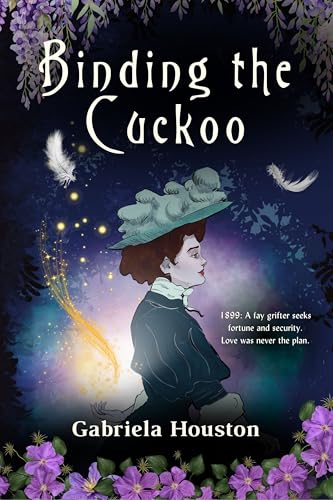
1899: A fay grifter seeks fortune and security. Love was never the plan.
In the late Victorian era, a technological marvel allows scientists to open rifts into the realms of legend. Powerful creatures, weakened and stripped of their memories, are brought to serve the whims of the wealthy elite...
Hare, a young woman with a mythical secret finds herself trapped, facing an unenviable future.
When an equally desperate schoolmistress, Miss Anne Bonningham offers her a chance at freedom, they embark on a daring plan. Disguised as "Miss Edwina Walker," Hare navigates the treacherous waters of London high society, solely focused on securing a marriage and escaping her past.
However, amidst the glittering balls and intricate social games, as hidden agendas surface and a vengeful figure from her past threatens to expose her true identity, Hare must make a embrace a life of comfort and security or choose freedom and a love that could shatter the very foundation of her world.
**The book is meant for a mature audience**
“Houston’ words flow as easily as ink. By turn romantic, soft, funny, and light - her characters spark and her stories linger long in the mind. This is history with added light.”
-Caroline Hardaker, the author of Composite Creatures & Mothtown
"In an alternative universe, during the fin-de-siecle, Hare, a disguised fae, tries to navigate both the London marriage market, and the darker struggles of the binding that her magical kinfolk have fallen prey to. But as a web of intrigue slowly closes around her, and her own concealed identity is threatened, her struggle to maintain both her autonomy and her loyalty to her fellow mythics is further complicated by her own passionate attraction to a young lawyer. Hare is a delightful protagonist, brave and compassionate, and Houston's writing is pacy and effervescent. The book is a beguiling mixture of period romance and fantasy, infused with pathos and drama. It's a witty historical paranormal romance, but it goes deeper than many books in the genre. Houston's books are always informed by her own intuitive knowledge of Slavic folklore as a transhistorical commentary. In Binding The Cuckoo, the lightness and charm of her writing forms a counterpoint to the subtle parallels she draws between the trope of the outsider in fantasy, historical slavery and contemporary xenophobia. Like the alluring Hare, it beguiles the reader till the final pages." - Tracy Fahey, the multi-award-winning author of I Spit Myself Out and What Happens at the End
PRAISE FOR GABRIELA
"The complexities of family relationships, friendships and grief[...] are difficult, and without shying away from them, Houston considers and presents them with care." The National
"Gabriela Houston's writing is both economical and evocative - a rare skill." SFX
"Houston is able to mark the significance of daily events, highlight her characters, and comment on humanity’s capacity for othering." Publishers Weekly
"The development of the characters is some of the most enjoyable I have read in the recent years." SF Book Reviews
"Houston quite brilliantly captures the beauty of unrefined nature through the vivid images she created so that you can just imagine watching everything unfold be
Gabriela was born and raised in Poland, brought up on a diet of mythologies and fairy tales. She spent her summers exploring the woods, foraging and animal tracking with her family. At 19, Gabriela moved to London to study English Literature and obtained a Masters degree in literatures of modernity. She has worked for as an assistant editor and as a freelance writer.
She is the author of Slavic -folklore-inspired novels for adults and children. She lives in London with her husband, children and two cats.
Sign up to her newsletter to get news, writing tips , book recommendations and more!
Binding the Cuckoo follows Hare, a mythic who was torn from her realm into the human world, through a daring plan through London high society in an attempt to find a human husband.
I really enjoyed Binding the Cuckoo, it has that feel of a heist book following Hare as she is introduced into London high society. The unraveling of her backstory is spread out throughout the book, as you find out why exactly her and her “aunt” are trying to secure a wealthy marriage. The twist was a little predictable, but that didn’t bother me because of how good the writing is. You know what’s about to happen because of how the book is set up, and still the unfolding of it is interesting and exciting.
The romance was a sweet, slow burn just with a bit of spice in the latter part of the book. If you don’t love spice, it’s pretty mild so it shouldn’t be too much. The build up was fantastic as Hare and Ernest kind of dance around each other - there is the obvious need for some misunderstandings, but the way they learn about each other as people as really appreciated rather than just the trend of some romance to be “Pretty/Handsome. I love them”. There’s actual character development between them, and you get a real sense of their relationship growing.
I would have liked a bigger exploration of the mythic realm that Hare comes from, but I know the story wasn’t set up for that. Hare isn’t meant to remember much about that realm, but I still wanted more as she meets other mythics throughout the story. There was such a large cast of different mythology and fantastical beings that I wanted to experience more of that. That again is a credit to Houston’s writing though, because she makes you interested in what is meant to be behind the scenes and just a small section of the story.
Shout to the Lady Dowager Winchfield though, somehow she ended up my favourite character for one line. And my second favourite character was a cat, which probably says more about me than anything else. If nothing else convinces you to read this, sassy cat should.
Binding the Cuckoo is a historical romantasy, evocative and enchanting, led by the mysterious Hare, a young woman and mythic, who is set to explore the treacherous world of London’s High Society, while attempting to outrun her past. Hare’s journey begins in New York, where she is trapped in servitude. She carries a mythical secret, being one of the powerful creatures brought to serve the whims of the wealthy elite. The opening scene unfolds with ease, offering an instant connection to an endearing protagonist who I was rooting for from the start. Hare possesses powerful gifts, yet is powerless by circumstance, holding no sway over the direction of her own future, prey to being summonsed at the whim of wealthy humans who look down on her kind. Hare’s character demonstrates the experiences of othering, of being othered, held in servitude, having no autonomy or self-determination, and being of no value to those who would claim her for their own purpose and comfort. She can find herself ripped from her own reality at any moment, showing the face of humans to be monstrous and the need for Hare to be on guard and vigilant. As a servant of a wealthy household, we see her standing on the periphery, central to proceedings yet rendered invisible. Her vulnerability is stark, and her empathy for others, endearing. Freedom would be a dream, and yet when it unexpectedly comes to Hare, it is terrifying, since she is now trapped in the world of humans with no way back to the world she knows. Anne Bonningham is the woman who freed Hare, and now their fates are tied. They travel to London, to the home of Baroness Winchfield, Miss Bonningham’s former student. Hare is introduced as Edwina Walker, Anne’s niece, and thus starts her new life. In many ways Hare is free, but she doesn’t feel free; in high society London only money and position can give true freedom, and both Hare and Anne Bonningham consider ways to achieve this, by Hare securing a good marriage. In high society London, Hare must keep her mythic status secret. Fearing that the Baroness might discover her true identity as a summonsed pet, Hare must say little, voice no opinion, not show her intelligence. Not only does this narrative reveal the vulnerability of Hare’s existence, but also of the Baroness’s. If the Baroness were to discover Hare’s intelligence, it would shake her very foundations, since she believes that summonsed pets are mindless creatures. Hare’s life as a mythic in hiding, exposes the powerful day-to-day discriminations, themes of identity and social prejudices, messaging that reflects real world issues. Unaware of Hare’s true identity, the Baroness decides that Hare is fine enough to introduce to court. And so begins the twists and turns of courtship, duty, survival and love. The backdrop world is alive, lavishly textured with sumptuous attention to detail, with rich furnishings and brightly lit parlours, edged by shades of opium and gin. Among the striped trousers and fine gowns, narrative is well paced, in a story that seamlessly weaves the mundane with the fantastical with hobgoblins as butlers being a natural occurrence. The peppering of magic is delightful and intriguing, and builds into depth of narrative around themes of discrimination and othering. To add to the illusion of her fashionable existence, Anne Bonningham travels with an Eastern European cat shaped spirit, a domovoy, a character that further highlights an unjust world since this spirit is cheaper and deemed less sophisticated than its Western counterpart. In light of being a companion of Anne’s, Hare is left considering her own identity and whether she is a traitor, yet Hare and the cat spirit make for an unlikely alliance. After reflecting on how powerful the spirit is, like herself, and how nothing is truly yours if someone else could just take it away, Hare finds a way to release the domovoy. Whether it will go might be a different matter. The narrative flows with ease, drawing you into a deep dive of decadence and shade, and into the hearts and minds of those who dwell there. Hare is settling into the highlife, muting obvious magical traits in her appearance so as to blend in and not draw attention, while watching the serving folk and empathising with their invisibility. And all the while maintaining a degree of invisibility for herself. As encounters become more familiar, Hare finds herself between two men both wanting of her affections. I enjoyed her internal narrative, exploring her mental landscape, the empathy she holds for others, while working to secure her own safety in a world in which she holds no power. It is a familiar story of survival, the duality of oppressor and oppressed, and the measures people will take to survive, and seek a way to thrive. And it begs the question what would equality look like, and what would it take to achieve that. Romance is building in awkward meetings, told through shifting perspectives between two unlikely and potential lovers. Flirtatious encounters and confusing jealousy make for a believable dynamic that keeps you guessing, not least because the stakes are high, made more so by a threat to expose Hare’s true identity. The representation of love, and the thought-provoking questions it raises is an interesting look at authenticity, and the value of love in the face of inauthenticity. Hare plays the part well, though never feels as though she fits. It is an inner narrative that makes for strong themes of identity, and delivers a protagonist to champion. In turn, the supporting characters are well-rounded, compelling, and with diverse perspectives to illuminate this unfolding world, and the complex relationships within it. Set in a vivid world, the narrative flows throughs the highs and lows, tensions and drama among unexpected loyalties and betrayals. It is a magical tale of uncertainty, of walking on shifting ground, of daring to hope for safety, and maybe, just maybe, finding more. A vivid and magical tale beautifully told.
I was so fortunate to receive an early copy of this book for a review.
This was such a delightful blend of magic, history, and romance. From the very first chapter, I was completely pulled in. The story weaves together love, loyalty, and friendship in a way that kept me both smiling and anxiously turning the pages to see how it would all unfold.
One of my favorite aspects was the presence of strong, capable women who carried the story with both heart and determination. And while every tale needs a villain, what stood out here was how surprisingly lovable most of the characters were I found myself rooting not just for the leads, but for nearly everyone’s growth and happiness.
This book delivered exactly what I love in magical historical romance, rich characters, a touch of suspense, and relationships both romantic and platonic that feel worth investing in. I closed the book with a happy heart and can’t wait to see what this author creates next.
Binding the Cuckoo was an absolutely spellbinding read. It was the perfect blend of some of the things I love most in a book: romance, magic and history. Not to mention all the loveable characters. I thought the concept was very unique and really enjoyable. Scientists having the ability to pull creatures from other realms into the human world was a brilliant idea, even though their motives might not have been. Selling them to work for the wealthy and taking away their powers was not the best way of treating them. I loved how high society was portrayed so well, mixing fact and fiction. I don’t think I had a favourite character as they were all quite likeable. The author’s world building was fantastic and made it easy to see the story play out in my head. Thanks so much to Gabriela for my arc.
was lucky enough to receive an ARC of this! Gabriela's writing always pulls me in, and here I found that I genuinely couldn't put the story down. Romance, cosy fantasy vibes, a twist of dark mythic lore... What's not to love?
This story was an interesting mix of high society vibe, supernatural magical twist, and romance. I loved how the whole premise and the world building were beautifully written - it was deep and layered. And, even set in Victorian era, majority of the women were presented as strong and capable who also had shown courage and strength in tackling their everyday lives which I truly adored. Lastly, the romance in here was not too much or even rushed as well, it was just the right amount of flirty encounters and it just flourished naturally.
Overall, it was an enjoyable read and I cannot wait to see what will happen next! Recommended! ✨️
Thanks to the author Gabriela Houston for reaching out to me with the opportunity to read this and be part of her book tour. As always all thoughts are my own.
This was such an easy read to fall into. I absolutely loved the mix of historical fiction with a fantasy / paranormal twist, running alongside the romantic / friendship entanglements of the characters.
This book had some great world building as it followed Hare, who had all the constraints on women at the time put upon her, only it also added in magic / folklore and magical creature restraints too.
The author created some great MCSs in this which makes the book easy to love. Two strong, determined FMCs who go against expectations. And two friends caught in a love triangle. The relationships of Hare, Brandon, Ernest and Anastasia are cleverly laid out and take several unexpected turns which adds drama and fantasy elements.
Overall this was a very cleverly written story that blended the different genres well. I loved the historical fiction aspects of this alongside the folklore.
This is definitely an author I will be checking out more books from.
Also I can't not comment on how awesome this cover design is! Stunning right!!
Binding the Cuckoo is the first foray into independent publishing from Gabriela Houston, author of The Bone Roots and several other novels rooted in Slavic mythology. Well, perhaps it counts as the second, since I got to know Gabriela as the editor for the Kickstarter-backed, beautifully illustrated anthology Whispers in the Earth: World Folklore Reimagined, to which I contributed a Canadian ghost ship story.
Gabriela kindly sent me a review copy of Binding the Cuckoo. As a fan of her previous work, I was excited to see what her historical fantasy romance had in store.
If you like your fantasy light, but heavy on the sexual tension, this one’s for you. Hare is an outsider protagonist with few options, and I sympathized with her right away.
In the alternate history, “mythics” are otherworldly beings (mostly fairies) brought into our world, where their magic weakens and memories fade, to serve humans. Hare was betrayed by someone she trusted, and has little idea of who she was before. When offered freedom through an alliance with a somewhat unsavory character, there’s little else she can do.
So, we’re off to London, where Hare poses as Miss Anne Bonningham’s American relative seeking a match. If she can secure a good marriage, both she and her “matchmaker” will have their currently dire futures secured.
Cue the high-society socializing, the kind (if a bit silly and arrogant) duke who takes a shine to Hare, and his lawyer friend who clashes with her again and again, with sparks flying. You could call it a love triangle, but where one option represents security and the other a deeper connection, it’s pretty clear how things are going to turn out. The fun is in getting there.
Along the way, we encounter a variety of mythics who can’t pass as human like Hare can, and struggle to get work. Their interactions are nuanced, as they can magically recognize each other but humans can’t recognize them in the same way. I’d love to know more about them and their world, which is only lightly sketched out. Maybe in a future book?
Binding the Cuckoo is an easy, elegant read. It comes out on October 15, and you can pre-order it now.
This is a historical romantasy that follows Miss Edwina Walker, formally known as Hare, and takes place in 1899. Scientists have created the technology to open a rift that allows them to pull creatures from other realms through to the human realm. And in true human style these creatures are stripped of any powers they might have, along with their memories. They are unable to return to their own worlds and are forced to work for the wealthy elite. Hare is one of these creatures and finds herself alone in New York facing an unknown future, not knowing who will buy her next. Then comes Miss Anna Bonningham, who is a school mistress and she offers her a chance to be free. So off they go to London and all the glitz and Glam that high Society brings.
What a great book! I really enjoyed it. I loved the premise of this story and I am glad to say that it did not disappoint. It had me hooked from the very first page. I really liked Gabriella‘s writing style and the world building was fab, the way she weaved the fae and other creatures into everyday life in Victorian England was seamless. The characters were well developed unbelievable, even the faith. There were some great plot twists and a fabulous love triangle. This book was a strong full star read for me and I would definitely recommend.
A fantasy book set in the late Victorian era? Count me in.
To escape her past, Hare transforms herself into Miss Edwina Walker and attempts to fit into the London high society. Of course, not everything goes to plan and she must keep her true identity a secret, focus on securing a marriage, and score her freedom.
This story had a slow start, which made getting into the book a bit difficult. (This comment is more of a diss on me as it takes me a while to understand fantasy books.) However, once the plot began picking up and the world building made sense, I was eager to continue the story. I was flipping page after page during my breaks at work. It was just too good.
I really do like the idea of someone trying to fit into a social circle to benefit them, especially when that someone is a mystic or stands out in someway that isn't deemed as "normal". It adds a lot of excitement and uniqueness to a Victorian story that makes me want to read them.
Thank you, Gabriela Houston, for reaching out and sending me a digital copy of your book!
I read this book last month and loved it so much I had to get myself a shelf trophy
It is a historical fiction with a fantasy twist. This is absolutely one to read if you enjoyed The Rose Bargain or like your Bridgerton but with a bit of fantasy.
Binding the Cuckoo is set in 1899 and follows FMC Hare, a mythic who has been stolen from her home and forced into servitude by the wealthy elite. She is offered a deal, her freedom (of sorts) in exchange for finding a wealthy husband to support her and the lady who bought her.
They move to London and are able to infiltrate the elite of the town where Hare, posing as Miss Edwina, meets the Duke who she hopes to marry. However his best friend has truly caught her eye, but unfortunately, he doesn’t fit in with the bargain she made which leaves her with a very difficult choice.
Tropes Best friend love triangle False identity Secrets and betrayal Magical beings Alternate history
I loved Binding the Cuckoo so much, I genuinely couldn't put it down. Hare and Ernest's sweet slow-burn romance had me so hooked. I absolutely love historical, because I just find it all so much hotter when everyone is so buttoned up and repressed. This was really scratching my Bridgerton itch. The tension and chemistry was sizzling. The romance was so well done and the writing was beautiful. I have such a weakness for a jealous, yearning man and Ernest had me swooning so hard. But this wasn't just a romance. I loved the deeper themes explored and felt so much empathy for Hare and the awful discrimination and othering she experienced. This was such a well-crafted world and the mythics brought into this world was such a unique and very sad concept. I also loved the side characters. Anastasia was a vibe, and Ben was so gracious and swoony. I really hope there are more to come because I am not done with this world. Highly recommend!
A spell-binding romantic fantasy with a level of banter and wit that would make Oscar Wilde proud. Houston pulls out all the stops in this Bridgertonesque story with tense fake dating, heart-breaking secret identities and the gloriously rich setting of an alternative Victorian high society London where the wealthy summon and bind mythical beings to serve their every whim. If you’ve ever asked yourself what My Fair Lady would be like with a fae main character, then this is the story for you.
I was so happy to be able to read this early - the romance completely hooked me and I sped through this book with ALL the emotions.
You'll love this if you're looking for:
Fake dating Bridgerton style Forbidden love Forced Proximity Victorian High Society Setting (with magic!) High octane action-packed endings World mythology Wildean style banter
Have you read historical romantasy?💕 This is my first time and I was pleasantly surprised! I loved the setting of the Victoria era, Hare a mystic is trying to survive as a true lady in society, even though she’s viewed as less than a second class citizen. I genuinely adored these characters and worried about the truth coming out and what would happen to Hare if she was cast out of society. I don’t typically read a lot of romance, many times I feel like I’m reading the same story, but this was unique and compelling with a little spice! This writing style is beautiful, easy to read and exactly what I’m always looking for, something clever and different. Thank you so much @gabrielahouston1 for this gifted copy! Binding the Cuckoo published on 10/15/25 and you can find this on our Amazon storefront. -Casey🧜🏼♀️
Thank you so much, @gabrielahouston1, for sending me a #giftedcopy and for including me as part of your virtual book tour journey. I've loved reading your debut novel, "The Second Bell."
Her books have an amazing blend of Slavic mythology and folklore. Binding the cuckoo, being the first book in the series, has a thread of magic and myth woven into a story of romance. I'm hoping that in the books to come, we'll get to know more about the powerful creatures from the other realms that are tethered to humans by magic. That was a thread that felt like a beginning into a world of its own.
A captivating mix of Victorian intrigue, fantasy, and romance. Hare’s journey through high society is tense, emotional, and full of twists I couldn’t stop reading.
I loved the mystery around Hare and her found relationship between her and Miss Bonningtob was fascinating. They were tied to eachother irrevocably and together needed to work to provide for their future. Full of prejudice and evidence of social standing - Hare’s story shows what freedom looks like, at what cost and that power is the master. Secrets and romance fill the pages and I loved seeing the strength of women in trying to make their way in this mix of worlds. Gabriela Houston has built a world of fae and Victorian London and the story weaves seamlessly between the two.
DISCLAIMER: I voluntarily read and reviewed a review copy of this book. All thoughts and opinions are my own.
I absolutely loved this story! Hare/Edwina and Ernest’s love story was a delicious slow burn I couldn’t put down! The fantasy/Slavic folklore aspect of the book was so fascinating! I’ve never read a historical fantasy romance before, knew nothing about Slavic folklore before reading this book, and Gabriela Houston had me hooked!
Hare/Edwina meets Ernest when she and her “aunt” travel to London to attract a Duke. Ernest is a little skeptical at first, and it leads to some funny clashes between the two; especially since Ernest’s sister is their host, and his best friend is the Duke that Hare’s aunt sets their sights on.
Ernest is probably one of my favorite book boyfriends this year. I just loved how attentive he was to Hare/Edwina, and how he made her feel seen. Hare/Edwina is probably one of my favorite heroines. I loved how strong she was, despite everything that was stacked up against her. I loved how she was with Ernest, that she felt she could be real with him (as real as she could be given the circumstances) and how she constantly sought him out.
I’m looking forward to reading more from this author, and hopefully more from this world.