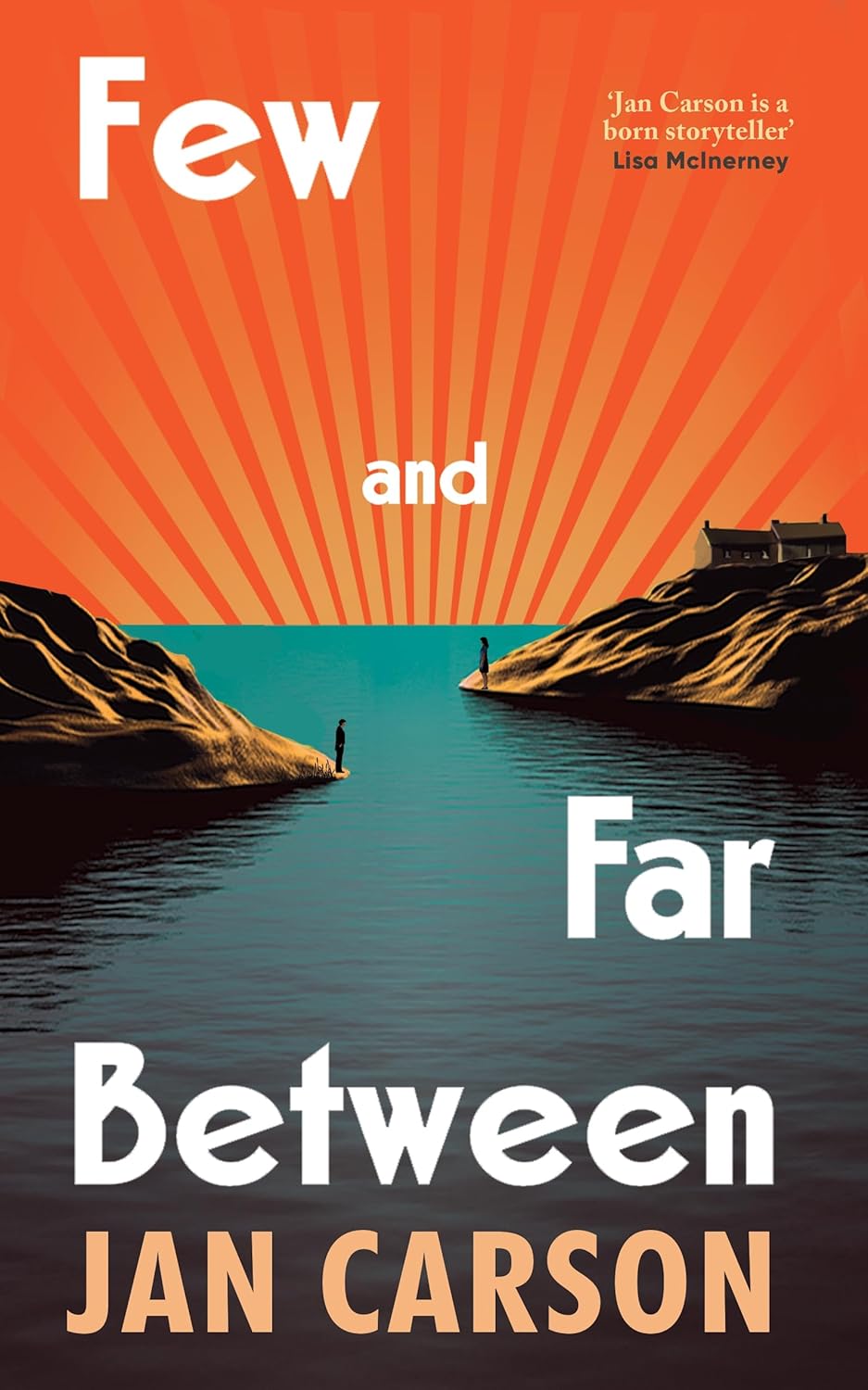
From the award-winning author of The Raptures and The Fire Starters, a stunning, imaginative novel about a community living on a small group of islands. Sometimes a utopia is not all that it seems...
In Few & Far Between, award-winning writer Jan Carson, imagines an alternative version of Northern Ireland’s recent past. A prime minister with a mad plan to create a new county. An archipelago of haunted islands. A community seeking refuge from the Troubles. The perfect place to escape to - or so it appears.
It’s summer 2017 and the last few residents of the Lough Neagh Archipelago are facing imminent eviction. The flood planned to combat a devastating algae outbreak will submerge their homes, forcing them back to the Mainland for the first time in fifty years. How will they cope with modern life? Will the Ark give up its secrets before it sinks? Can they leave the past behind?
Jan Carson is a writer and community arts development officer currently based in Belfast, Northern Ireland. She has a BA in English Literature from Queen’s University Belfast and an MLitt. In Theology and Contemporary Culture from St. Andrew’s University, Scotland. Jan has had short stories published in literary journals on both sides of the Atlantic, has had two of her plays produced for the Belfast stage and is a current recipient of the Arts Council NI’s Artist’s Career Enhancement Bursary. Her first novel, “Malcolm Orange Disappears” will be published by Liberties Press, Dublin on June 2nd 2014.
The internet women are forever having epiphanies: nine times out of ten it’s about making courgette spaghetti or tucking your shirt into your knickers so it’s still hanging out at the back. They make videos about it!
In Jan Carson’s Few and Far Between, this sharp, dry "wise-up" serves as more than just a comedic jab at influencer culture; it is the mission statement for the entire novel.
There is a delicious irony in Carson, a master of magical realism, calling out the superficiality of the digital age. While the internet attempts to manufacture epiphanies out of mundane domestic hacks, Carson uses the surreal to get at the actual, heavy truth of lived experience.
It is 2017, and ageing siblings Robert-John and Marion Connolly are among the last residents of a purely fictional archipelago of islands in Lough Neagh. For those less familiar with Irish geography, the Lough is a very real, large body of freshwater which Carson helpfully describes as either thehole in the doughnutof Ulster or thecyclops eyeof Ireland. In this story, the NI Executive plans to raise water levels to wash away a toxic algae bloom, a move that will submerge the islands and force the siblings to finally confront fifty years of history.
Marion is a warm, caring soul, while her older brother, Robert-John, is a reserved man with few endearing traits beyond a predilection for furtively gorging on Chunky Kit Kat bars. Their link to the modern world is their sister, Rosemarie, who lives a much more "normal" life on the mainland. While she peeves Robert-John, she is Marion’s link to technology and the world of social media.
The surrounding islands host a strange and mythical array of residents, from tree-dwelling rabbits to a hermit-like artist, Sandra, who has insulated herself from all contact with the world.
I listened to this on Audible, and hearing the story narrated in Carson’s own Antrim accent was a revelation. It transported me back to my own early childhood in Antrim Town, sparking a flood of memories I’ve since begun to jot down, perhaps the seeds of my own anthology of growing up during the Troubles.
Carson’s use of magical realism is a brilliant vessel for exploring the psychological impact of our history. Initially, I found myself disliking Robert-John, but by the end, I realised I would miss his inner monologue. His evolution is a highlight: he chooses to leave behind the trauma of an abusive father and resists the pressure to engage in soul-sharing activities like the "Men’s Shed" initiative that Rosemarie believes could help him. He sees that building bird boxes is superfluous in a county full of trees, and he deserves credit for refusing to spend his days "making shit out of wood" just to satisfy a social script.
Rather than providing a literal history, Carson creates haunting metaphors for the province's collective trauma: the traumatised sleepers locked away in hospital wards and the suicide ghosts of Tom’s Hard. These surreal images allow her to examine the layers of experience we’ve navigated, acknowledging the "effluent" of the past that like toxic blue-green algae still occasionally pollutes our present, particularly when leadership from Stormont has been so noticeably absent.
Yet, there is a hopeful undercurrent here. On the whole, Ulster folk are a grounded lot who have always found joy in the gaps between the headlines. In recent decades, the peace process has encouraged a more fulfilling type of co-existence with those we share this weirdly unique place with, allowing us to move beyond the shadows of the past. Through characters like Robert-John and Marion, Carson shows the messy, necessary work of this transition. Perhaps Robert-John will eventually forgo the comfort of those Chunky Kit Kats as he opens up to real relationships, but until then, long live the Chunky Kit Kat (I’m rather partial to them myself!).
This is a five-star read that manages to be hilariously biting while celebrating the resilient and down-to-earth nature of people in this province.
Thank you to @doubledayukbooks for this proof copy.
This was an interesting story. I was pleasantly surprised at how quickly I was sucked in.
Imagine if the Lough Neagh was drained, revealing hidden islands beneath the surface. These islands became the homes for those wanting to escape the conflict in Ireland. People built communities free from labels, prejudice and judgement. A safe haven where life was simple and everyone was happy. Or so it seemed!
But then there was a toxic algae outbreak, which will eventually make the islands uninhabitable. In response to this the government announce a forced flooding of the Lough to help combat the outbreak. Meaning the the islanders are left with no choice but to leave their homes. Gradually, after more than fifty years, people are forced to return to the mainland. To some this wasn’t a problem but to others this was very scary. Some people refused to leave. Bound to the islands with secrets and decided to live in complete isolation - until they had no other choice.
This premise is compelling, but what really pulled me in was the Connolly family. Such a complex, multi layered and troubled set of characters. I loved how there were chapters peppered through the book going back in time, gradually building a fuller picture of who the Connolly’s were and how they came to live on the islands. Then Alex enters their lives and everything shifts. I loved this.
I found the environmental thread and learning about the outbreak interesting, it added another level to the story. But for me, it was the characters that made this story shine.
Carson is a brilliant storyteller. She expertly brought the islands to life but she also blurred the lines between reality and the surreal, which added an eerie feel.
With the vivid descriptions of the islands and the complicated characters there was a constant feeling of unease and tension throughout, but there was also some very moving aspects which made for a very intriguing family drama.
I enjoyed this read. Slightly different for me but It reminded me it’s always worth stepping outside my comfort zone.
A brilliant alternate history and a cracking read. An archipelago of small islands emerges from the depths after a local politician’s gambit to drain the largest lough in Northern Ireland in order to create more habitable space for those seeking sanctuary during the Troubles. The drainage scheme never got off the ground, but Jan Carson explores what might have happened if it had.
There’s such intriguing lore surrounding The Ark, this archipelago of islands. Each island has a unique flavor and distinct inhabitants—some grounded and wholly human, others suspended between worlds, ghostly apparitions caught between life and death. There’s an air of mystery among the residents, especially our sibling protagonists, Marion and Robert-John, who call The Ark home.
Carson paints a vivid picture of the setting and her characters, plumbing the depths of their psyches and the collective traumas that shape them. Marion and Robert-John are suspended in a state of arrested development. They can’t escape their past while they remain on The Ark, yet they can’t leave The Ark because they remain firmly tethered to that past. A rising tide will force their hand.
I had such a wonderful time with this novel. Between the dry humor, the family drama, and the unique island setting, Carson hits all the right notes.
My thanks to the publisher and Edelweiss for an advanced reader copy in exchange for an honest review.
Few and Far Between by Jan Carson is a wonderfully imaginative novel that blends alternative history, family drama, and the lingering shadows of the past.
The story centres on siblings Marion and Robert-John Connolly, who have spent most of their lives on a strange cluster of islands in Lough Neagh known as “The Ark.” The islands were once imagined as a kind of refuge during the years of conflict in Northern Ireland, a place where people might escape the divisions and violence of the Troubles. But as the novel opens in 2017, the last residents of the archipelago are being forced to leave, as the government plans to flood the islands due to a worsening environmental crisis.
What begins as a story about the potential loss of a home gradually becomes something much deeper. Carson explores the way places hold memory, and how communities shaped by trauma often struggle to move forward.
One of the things I loved most about this novel was the atmosphere. The islands feel almost mythical: eerie, beautiful, and slightly unsettling. Carson blends humour with melancholy in a way that feels very true to life, creating moments that are both quietly funny and deeply reflective.
I really loved the writing style. Carson’s prose is warm and witty, and she can create characters who feel both strange and deeply human. The story balances political history and intimate family dynamics in a way that feels both ambitious and very personal.
Pick this book up if you’re looking for something thoughtful, charming, and creative.
**This was an ARC through Goodreads, but my opinions are my own. I do thank the author and publisher for the opportunity to read this book.**
Very good read.
Characters are pretty well developed. Each having a distinct voice, they are flawed and "real" feeling. You have conflicts on multiple levels (internal, between characters, between the environment and between "the powers that be".
Atmosphere and setting are well done. There is a slightly creepy vibe at times, others depressed, resigned, slightly hopeful; there is an ebb and flow that goes with the story and is demonstrated well in the atmosphere and setting.
Writing style was successful with the story. You have multi-timelines, some strange things happening here and quite a few characters to keep up with, but it is well done.
Novel is well plotted and cohesive. You move through the story rhythmically, with little pieces of information being revealed slowly. I personally found the pacing a bit slow in places, but I understand the reasons for that, and it was well written.
It does keep your interest. Chapters are at a good length to keep you moving through pretty steady. Information is revealed at a pretty good rate to keep propelling you forward.
Logic is appropriate to the world in which the story takes place.
It was an enjoyable read. It is not a "light" read, and as pointed out previously, the pacing can be slow at times (while not sluggish) but with reason, and I think the payoff is worth it.
Strange and a bit surreal. Much Ulster Scots, which I appreciated. What would life be like in an alternative Ulster, if Lough Neagh had been partially drained in 1950's , allowing the islands to surface then to populate them ( twenty years later) with a strange set of misfit characters and families seeking refuge in what came to be known as the "Ark". The story centres on siblings Marion and Robert-John Connolly, and there larger than life overbearing and bully of a father RJ, Ursula their good but a cold mother and an outgoing older sister Rosemary. I really liked the use of Ulster Scots and local idioms in this book, it was like listening to my old folks telling tales around the peat fire from past. The beginning of the book may be a little confusing, and hard to discern what is real history and what is the history of this imagined set up, but things like the "sleepers" and the are explained later in the book. The book constantly jumps back and forth in time and between all the main characters. The characterisation of neurodivergent Robert John is perfect. All the characters are instantly relatable to friends and family from my past making the book feel precious and real, not only because of my love of Lough Neagh. I like the way this book outlines the environmental disaster of the algae, which to date (April 2026) is still showing no signs of being solved, unfortunately. Hopefully this novel may increase support for Lough Neagh. At the book launch -Jan Carson gave a tremendous talk about the novel which was also very humourous. Yet for being a very witty novel it also contains much sadness and some physical/ emotional abuse. I did find it was a very dense and often slow to read in places, just due to the sheer amount of emotional scenes being portrayed, taking me three times as long as normal to finish. Yet like a great epic poem, sections could be studied and read many many times, it is just so well written and evocative for anyone who has lived through the "Troubles". This is not light reading, but definitely worthy of your time to truly read slowly and let the scenes seep into your bones, like the damp air from the Lough.
A curious, slightly elusive novel built around an alternative version of Lough Neagh and the archipelago that emerges when it is drained.
The story follows Marion and Robert-John, siblings who grew up on the Ark — a loose, makeshift community that became a kind of refuge during the Troubles. Decades later, they remain among the last inhabitants, looking back on their childhood and the complicated legacy of their father, while the outside world edges closer and the future of the islands becomes uncertain.
Carson moves between past and present, blending the everyday with moments that tilt towards the surreal. The Ark itself has a slightly dreamlike quality, a place shaped as much by belief and memory as by geography. The novel circles around questions of refuge, belonging, and what it means to step away from the wider world, particularly in the shadow of Northern Ireland’s history.
It’s an interesting and distinctive book. I enjoyed reading it, though I never quite felt fully drawn in by it.
I have been a fan of Jan Carson for many years, actually growing up knowing her family quite closely. While I have grown accustomed to her magic realism style, while I was reading this book it definitely had less of this that her previous books, but did that make it any less worth reading? Not in the slightest. Being a Northern Ireland native and living less that 10 minutes from the setting of the book, it is written is such a beautiful, poetic way that truly encapsulates the Northern Irish spirit, colloquialisms and all. Jan states in her acknowledgements that it was " the longest, slowest, most taxing novel I've ever written..." but I can say it was worth every second. I'm far from a literary scholar, but honestly, Few And Far Between is easily the best book I've read in many years and is definitely the best thing I've read from Jan Carson, and that quite the achievement given how much I loved her last novel The Raptures.
I don't know what runs in the water on the emerald island, but if we keep getting these kinds of literally gems, I'm here for it! Jan Carson is a very established writer and this book is no exception. She is a brilliant storyteller and I massively enjoyed this alternate version of history, the sardonic, dry sense of humour that seeps through the pages, the family drama.
This is a story that's immersive, intriguing, thought-provoking, a bit mind-bending, with complex characters and I can't say I was able to predict which way it was going, and the writing/prose is smooth and skilful. I think, if you are familiar with Jan Carson and her writing, you are in for a treat!
Thank you to Jan Carson, Random House UK, Transworld Publishers | Doubleday and NetGalley for this review copy, all opinions are my own.
Few and Far between by Jan Carson . Wow what a story , this is really Marion and Robert John’s story adult children of famous anthropologist Robert John Connelly who came to live on the neigh archipelago in the 1970s. Algae means the lake has to be flooded and while the deliberation is going on we learn about the history and the buried secrets. It is a as usual with Jan Carson a little bit ‘out there ‘ but it is so good. Everybody should read it
Very arresting. Really took off from about a third of the way through. Very reminiscent of 水滴 (Droplets) by Medoruma Shun, which was a fun surprise! Considering how many wacky Okinawan linguistic experiments I've recently been subjected to, the spoken vernacular is captured delightfully here. Nice to read something that sounds like me for a change too.