

What do you think?
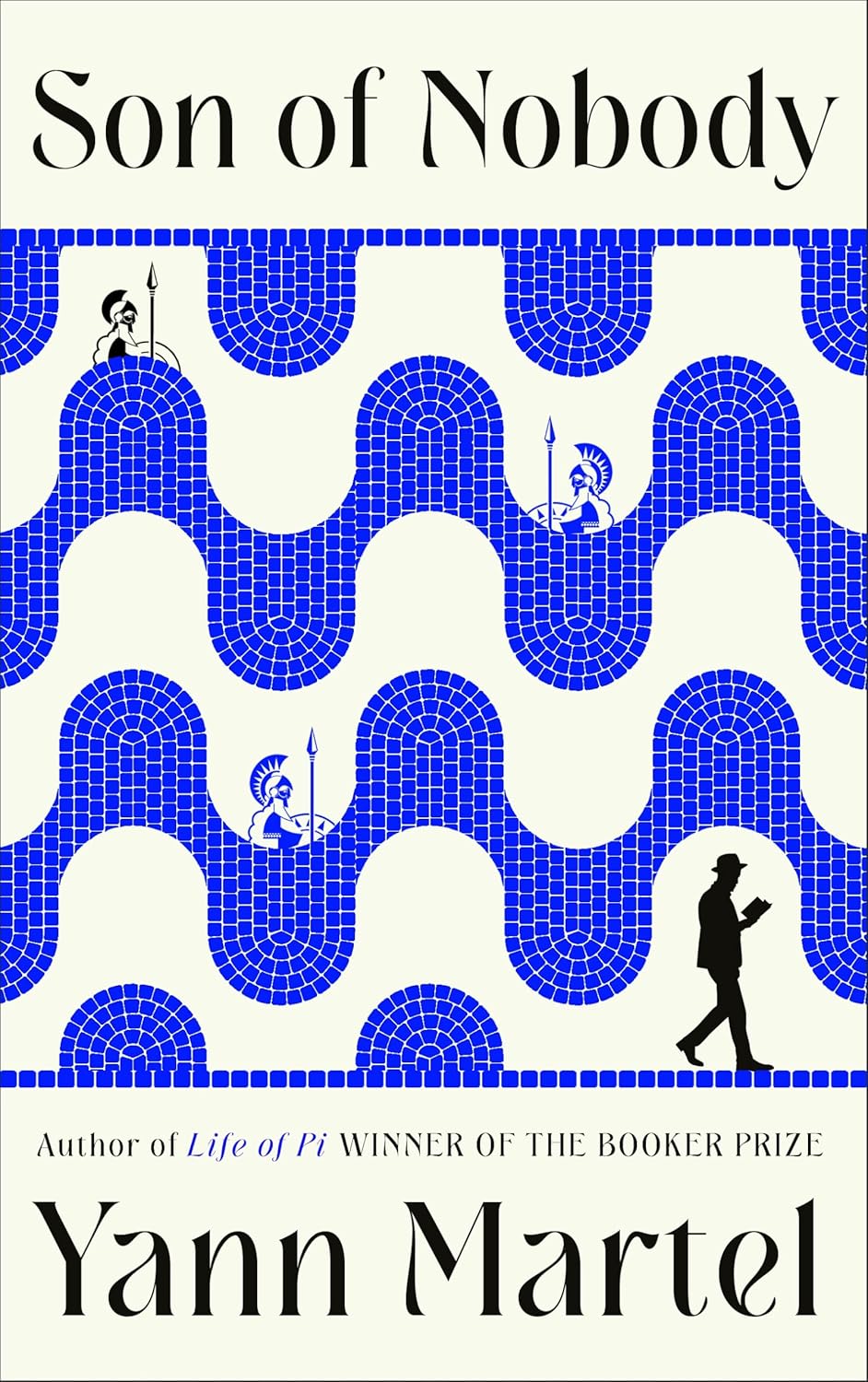
Son of Nobody
The past is never done with: always the song continues
Harlow Donne has devoted his life to the Classical world. When a chance comes up to study an obscure collection of papyrus fragments at Oxford University, he seizes it. Though it means leaving his daughter and fracturing marriage back home in Canada, this is the kind of career break he desperately needs.
In the depths of the Bodleian Library, Harlow discovers a lost account of the Trojan War, a glimpse into the founding of Western civilization itself. He names the epic poem The Psoad , after its protagonist, a Greek commoner identified as Psoas of Midea but known to all as 'son of nobody'.
As sole translator and interpreter of the Psoad, Harlow dedicates the poem and its footnotes to his daughter, Helen. Under his gaze, the text unlocks echoes of Ancient Greece into the present day, and a personal message to his beloved child appears. Despite the two-thousand-year gap between the two, a thread hasn't frayed: the universal song of homesickness and regret, of ambition, love and grief.
In this masterpiece of myth, history and domesticity, Son of Nobody explores how stories become facts, the price we pay to share them and how we live - then, now and always.
Harlow Donne has devoted his life to the Classical world. When a chance comes up to study an obscure collection of papyrus fragments at Oxford University, he seizes it. Though it means leaving his daughter and fracturing marriage back home in Canada, this is the kind of career break he desperately needs.
In the depths of the Bodleian Library, Harlow discovers a lost account of the Trojan War, a glimpse into the founding of Western civilization itself. He names the epic poem The Psoad , after its protagonist, a Greek commoner identified as Psoas of Midea but known to all as 'son of nobody'.
As sole translator and interpreter of the Psoad, Harlow dedicates the poem and its footnotes to his daughter, Helen. Under his gaze, the text unlocks echoes of Ancient Greece into the present day, and a personal message to his beloved child appears. Despite the two-thousand-year gap between the two, a thread hasn't frayed: the universal song of homesickness and regret, of ambition, love and grief.
In this masterpiece of myth, history and domesticity, Son of Nobody explores how stories become facts, the price we pay to share them and how we live - then, now and always.
304 pages, Hardcover
First published March 31, 2026
About the author
Yann Martel
45 books5,544 followersYann Martel is a Canadian author who wrote the Man Booker Prize–winning novel Life of Pi, an international bestseller published in more than 50 territories. It has sold more than 12 million copies worldwide and spent more than a year on the bestseller lists of the New York Times and The Globe and Mail, among many other best-selling lists. Life of Pi was adapted for a movie directed by Ang Lee, garnering four Oscars including Best Director and winning the Golden Globe Award for Best Original Score.
Martel is also the author of the novels The High Mountains of Portugal, Beatrice and Virgil, and Self, the collection of stories The Facts Behind the Helsinki Roccamatios, and a collection of letters to Canada's Prime Minister 101 Letters to a Prime Minister. He has won a number of literary prizes, including the 2001 Hugh MacLennan Prize for Fiction and the 2002 Asian/Pacific American Award for Literature.
Martel lives in Saskatoon, Saskatchewan, with writer Alice Kuipers and their four children. His first language is French, but he writes in English.
Martel is also the author of the novels The High Mountains of Portugal, Beatrice and Virgil, and Self, the collection of stories The Facts Behind the Helsinki Roccamatios, and a collection of letters to Canada's Prime Minister 101 Letters to a Prime Minister. He has won a number of literary prizes, including the 2001 Hugh MacLennan Prize for Fiction and the 2002 Asian/Pacific American Award for Literature.
Martel lives in Saskatoon, Saskatchewan, with writer Alice Kuipers and their four children. His first language is French, but he writes in English.
Ratings & Reviews
Friends & Following
Create a free account to discover what your friends think of this book!
Community Reviews
Displaying 1 - 30 of 1,148 reviews

August 2, 2026
Ancient Greece… Antique heroes… Son of Nobody is a fine literary mystification…
The narrator departs for Oxford to translate ancient papyri… Similar to Ulysses, he leaves his family far behind.
A Lost Trojan War Tradition… Fragments of a new epic poem discovered… Or hoaxed…
Psoas – Son of Nobody… On the arrival all admire the grandeur of Troy…
The narrator reads of love in the poem and he recalls his own love… Helen of Troy… The hellenist’s wife… Love brings happiness… Love causes tragedies…
Ancient times… Modern times… Love was… Love is.
The narrator departs for Oxford to translate ancient papyri… Similar to Ulysses, he leaves his family far behind.
A Lost Trojan War Tradition… Fragments of a new epic poem discovered… Or hoaxed…
In this thesis, I bring to light a lost Trojan War tradition, reclaimed from the past. Whereas in The Iliad, Homer’s omniscient perspective closely aligns with the point of view of the Greek ruling class, in The Psoad, it is commoners who raise their voices, and they have much to say of their experience at Troy.
Psoas – Son of Nobody… On the arrival all admire the grandeur of Troy…
“Behold the sweeping plain of Ilios,”
said one merchant, deep-voiced. “There is your foe,
a city more songed than even Babylon.
There, before your eyes, is King Priam’s Troy,
the favoured destination of the world,
begetter of roads, port of all sea routes,
capital of three seas, agent of three empires,
the vast kingdom that needs no land because
all wealth flows to it, like rivers to the sea.”
The narrator reads of love in the poem and he recalls his own love… Helen of Troy… The hellenist’s wife… Love brings happiness… Love causes tragedies…
Love is alchemical, the great transmogrifier.
I loved Gail like a scribe loves a bard, like a candle loves a flame, like history loves the past, like a tongue loves speech, like a baby loves a honey-dipped finger.
Ancient times… Modern times… Love was… Love is.

Review of advance copy received from Netgalley
Wooof, this is one ambitious novel: Martel creates an epic poem about the Trojan War that offers if not alternative history, then alternative myth to The Iliad, and frames it with a story about the trials and tribulations of a contemporary classicist. The clue: While Homer sings of the glory of gods, heroes, and the nobility, Martel sings about the destiny of commoners, the sons of nobody, while highlighting the eternal truths about the human condition contained in an almost 3,000 year-old story: Our blind wrath leads to madness and total destruction.
The novel's protagonist and narrator Harlow Donne, a PhD candidate who researches Homer at a small Canadian university, receives a scholarship for Oxford University and temporarily leaves behind his wife and nine-year-old daughter Helen (like Helen of Troy, get it?). There, he coincidentally comes across four ostraka that point him to the story of Psoas of Midea a.k.a. the title-giving son of nobody, a common Greek soldier. The ostraka were found at Hymettus, the very place where Harlow decided to become a classicist. Intrigued (and against the wishes of his supervisor), Harlow goes on to re-construct "The Psoad", the tale of Psoad's a life as sung by Thersites, who is the only commoner mentioned in The Iliad - and there are some important differences to the official version of the war as told by the powerful. As Harlow's grandfather, traumatized by the Vietnam War, told him when he was a child: "We are hiding places for monsters".
After the story is set-up in an introductory chapter, it is told in thirty fragments from "The Psoad", with Harlow's commentary pondering the text in comparison to the "Iliad" and historical knowledge, and intertwining it with his personal story, especially the domestic disputes with his wife. His research and explanations are fully addressed to his daughter Helen, she is the driving force behind the research of this small academic laboring in a colossal, historic library - or is it obsession itself? Is it distraction veiled as purpose? Martel does a great job painting a complex, haunted narrator, who knows about the fragility of human truths, and is in many ways connected to his research subject, Psoas, who joined a war to gain loot for his wife and children, sailing off to different shores.
I have to admit that at the beginning, I was struggling with the extensive explanations about history and myth, but once I got into the flow of the novel, it gained momentum. There's also more than one instance when the combination of the timelines feels overly forced and you see the twist in the contemporary timeline coming from a mile away, but this text is so insanely ambitious (feat. a truly absorbing epic poem!) that this doesn't matter all that much. Martel said in interviews that he was inspired by Waiting for Godot (the siege of Troy lasted ten years), but I don't feel this is showing much. Rather, I see why he also references All Quiet on the Western Front, in which we see young men's spirits broken by the vastness of human cruelty. But more than anything, I felt a kinship between the protagonist of At Night All Blood is Black and Psoas.
This is a very worthwhile read and Booker bait galore, and I'm excited to discuss this in comparison to Christopher Nolan's "The Odyssey" (Trailer), because I have a hunch that the book might make the movie epos appear like an outdated spectacle.
The novel's protagonist and narrator Harlow Donne, a PhD candidate who researches Homer at a small Canadian university, receives a scholarship for Oxford University and temporarily leaves behind his wife and nine-year-old daughter Helen (like Helen of Troy, get it?). There, he coincidentally comes across four ostraka that point him to the story of Psoas of Midea a.k.a. the title-giving son of nobody, a common Greek soldier. The ostraka were found at Hymettus, the very place where Harlow decided to become a classicist. Intrigued (and against the wishes of his supervisor), Harlow goes on to re-construct "The Psoad", the tale of Psoad's a life as sung by Thersites, who is the only commoner mentioned in The Iliad - and there are some important differences to the official version of the war as told by the powerful. As Harlow's grandfather, traumatized by the Vietnam War, told him when he was a child: "We are hiding places for monsters".
After the story is set-up in an introductory chapter, it is told in thirty fragments from "The Psoad", with Harlow's commentary pondering the text in comparison to the "Iliad" and historical knowledge, and intertwining it with his personal story, especially the domestic disputes with his wife. His research and explanations are fully addressed to his daughter Helen, she is the driving force behind the research of this small academic laboring in a colossal, historic library - or is it obsession itself? Is it distraction veiled as purpose? Martel does a great job painting a complex, haunted narrator, who knows about the fragility of human truths, and is in many ways connected to his research subject, Psoas, who joined a war to gain loot for his wife and children, sailing off to different shores.
I have to admit that at the beginning, I was struggling with the extensive explanations about history and myth, but once I got into the flow of the novel, it gained momentum. There's also more than one instance when the combination of the timelines feels overly forced and you see the twist in the contemporary timeline coming from a mile away, but this text is so insanely ambitious (feat. a truly absorbing epic poem!) that this doesn't matter all that much. Martel said in interviews that he was inspired by Waiting for Godot (the siege of Troy lasted ten years), but I don't feel this is showing much. Rather, I see why he also references All Quiet on the Western Front, in which we see young men's spirits broken by the vastness of human cruelty. But more than anything, I felt a kinship between the protagonist of At Night All Blood is Black and Psoas.
This is a very worthwhile read and Booker bait galore, and I'm excited to discuss this in comparison to Christopher Nolan's "The Odyssey" (Trailer), because I have a hunch that the book might make the movie epos appear like an outdated spectacle.
April 6, 2026
April 8, 2026 Update I've added several paraphrased or remembered Qs&As from last night's Yann Martel interview at the Toronto Reference Library as an Addendum below.
A Workingman's Iliad 🍁
A review of the Knopf Canada audiobook ARC provided by NetGalley for the Knopf Canada hardcover/eBook/audiobook published March 31, 2026.
I'm a bit of an Iliad nut, so even with a last minute approval for this audiobook ARC edition I had no fear about managing Son of Nobody in only a few days before NetGalley reviews had to be archived.
I don't pretend to being a Homer or Iliad scholar. Most of my early reads were from pre-GR and pre-reviewing days. So I've read and/or listened to the Rieu, Fagles and Mitchell translations/adaptations and still have Watson waiting in the wings (in reserve for the next LBC I think, but now I'm tempted to start it earlier).
I have been equally, or perhaps even more fascinated, by the other readings and adaptations such as Christopher Logue's War Music, Madeline Miller's The Song of Achilles, Pat Barker's The Silence of the Girls, Natalie Haynes' A Thousand Ships, Alice Oswald's Memorial, David Malouf's Ransom, etc.
There seem to be endless possibilities in translation and adaptation. As an anecdote quoted by Alberto Manguel says, a Colombian hill village refused to return their travelling library copy of The Iliad because:
Newcomers should have no fear, Yann Martel is a steady hand in guiding you through Son of Nobody. You don't have to stress about whether or not you've read a Homer version or not. Along the way Martel points out where his fictional epic The Psoad differs from Homer's The Iliad throughout.
In Son of Nobody, Martel becomes Harlow Donne, a fictional discoverer, translator and narrator of a newly discovered Ancient Greek poetry epic which he calls The Psoad after its main character Psoas, the titular Son of Nobody, who is fighting on the side of the Greeks while they besiege Troy in their 10-year grinding stalemate of war. The Canadian Donne has a fellowship grant to work in Oxford University, England and he pieces together the lost epic from pottery and papyrus fragments from the museums there.
Son of Nobody is presented in an unorthodox style. In the audiobook, the translated poem The Psoad is narrated in its chapters by one narrator in a serious epic poetry voice. That is followed by the Footnotes voiced by the second narrator who is the voice of the researcher Harlow Donne. The complete poem segment is read first and then the footnote commentary follows for each chapters i.e. the footnotes do not interrupt the reading. I was only confused at the very beginning with the "Author's Note", which you gradually realize is not Martel's Note but rather that of his fictional Donne.
The footnotes are not just comments on the text. They tell the background story of Donne's family, his wife Gail and daughter Helen, his dealings with his Oxford mentor and his research and observations on Iliad and other Trojan related epics, etc. You will note the parallels of Donne's abandoning his family back in Canada to go off on a foreign expedition i.e. such as Odysseus leaving Penelope in Homer's The Odyssey, Agamemnon betraying his family in order to lead the invasion, etc.
What is especially terrific about Martel's Son of Nobody is that the focus of The Psoad is on a common man, a son of nobody, a cheesemaker in his earlier Greek life, set into the Homeric world that otherwise mostly only spoke of Kings, Princes, Heroes and Gods. Many of the regular Iliad characters still appear, but often in cameo roles only. The main figure on the Trojan side is not even Hector, but an entirely different son of Priam.
Martel takes the opportunity to explode the myths around the Trojan War. The Iliad can be interpreted as a propaganda piece manipulated by the Achaeans (i.e. Agamemnon and Menelaus) to justify their campaign of looting a rich neighbouring kingdom by an invented story of the abduction of Helen of Troy. There is no honour or glory behind it at all. It is blood and sacrifice by the foot soldiers in the trenches to satisfy the greed of the rulers.
The even greater irony or tragedy to this is that even though Martel worked on this book for the past 10 years it has been published exactly at a time when a modern day "mad king" is lying and foaming at the mouth in order to justify his own reckless overseas campaign of war crimes in the quest for loot (whether through oil or manipulation of the stock market / currency / commodities trading and betting).
This was a 5-star experience for all the above reasons and the performance of the narrators enhanced it even further. I look forward to reading this in print.
My thanks to Knopf Canada and NetGalley for the opportunity to listen to this ARC copy of the audiobook, in exchange for which I provide this honest review.
p.s. I'm going to a talk by Yann Martel tomorrow at the Toronto Reference Library, so some further notes may be added to this review as an addendum afterwards.
Addendum
These are as best remembered but with a lot of paraphrasing. Very roughly in order. The interview was one hour. I have added links to the books when mentioned and the dates of publication which Martel did not actually say.
Q: Did Stephen Harper ever answer your letters and book gifts from 101 Letters to a Prime Minister: The Complete Letters to Stephen Harper (2011)? A: No, never.
Q: Would you send books to Mark Carney? A: I think Carney is already a more enlightened individual.
Q: Why is Son of Nobody structured like it is? A: The style of the book wasn't inspired by Nabokov's Pale Fire (1962) (also a poem with lots of footnotes), which is what most people think, but more from reading The Divine Comedy: Inferno - Purgatorio - Paradiso (1320) where the extended footnotes are needed to explain who are all these people that Dante is talking about.
Q: Have you read a lot of Homer? A: I had never read Homer until my wife suggested that I read the Stephen Mitchell translation The Iliad: The Stephen Mitchell Translation (2011). Mitchell's version is leaner as he cuts out a lot of the endless repetitions of "swift-footed Achilles" and "horse-taming Hector," which were needed in the Ancient Greek for the metre, but which get really tiresome in English.
I wrote Son of Nobody on the assumption that the reader had not read Homer's The Iliad, so I tried to provide enough background to it.
Q: Has success changed you as a writer? A: Not at all, except that it has allowed me to provide for my family. Each book is still a journey where I seek to answer a question.
Q (Audience): From what book did you learn the most from asking a question? A: My first book Self (1996) and its exploration of gender fluidity.
Q: Why does Life of Pi (2001) take place over 227 days? A: I chose it because 227 is a prime number, divisible only by itself and 1. An audience member once asked me that as well and then to my surprise said that 22 divided by 7 is Pi (i.e. 3.14...) , so I learn things about my books from my audience that I never even thought of.
Lightning Round:
Q: What were your favourite jobs before you became a writer? A: A tree planter in Northern Ontario, then a dishwasher, and was also a security guard at the Canadian Embassy in Paris, an easy job since most people love us 🍁.
Q: What is the most non-writerly thing about you? A: Everything, I am a slow, slothful kind of writer and not anything like the image I have of how a writer should be.
Q: Which books have you re-read many times? A: Kafka: The Metamorphosis (1915), Hemingway: The Old Man and the Sea (1952).
Q: What famous book have you never read? A: I read a lot of long books between writing. The next one will be Middlemarch (1872), which was a toss-up with Don Quixote (1615).
Q: On a desert island, what food would you take if you could only have one meal choice? A: First answer "tacos," because of fond memories of eating them with my parents / but then on second thought "sushi."
Q: On a desert island, what film/vhs/dvd/bluray would you take if you could only have one? Answer: "How to Build a Raft."
Q: (Fumbled): Matt Damon was in Good Will Hunting directed by Ang Lee who directed Life of Pi and now Matt Damon will be in the new Christopher Nolan film The Odyssey, so are you best friends with Matt Damon?
Audience: Good Will Hunting was directed by Gus Van Sant!
Interviewer: Oh I guess I messed up my final question.
A Workingman's Iliad 🍁
A review of the Knopf Canada audiobook ARC provided by NetGalley for the Knopf Canada hardcover/eBook/audiobook published March 31, 2026.
I'm a bit of an Iliad nut, so even with a last minute approval for this audiobook ARC edition I had no fear about managing Son of Nobody in only a few days before NetGalley reviews had to be archived.
I don't pretend to being a Homer or Iliad scholar. Most of my early reads were from pre-GR and pre-reviewing days. So I've read and/or listened to the Rieu, Fagles and Mitchell translations/adaptations and still have Watson waiting in the wings (in reserve for the next LBC I think, but now I'm tempted to start it earlier).
I have been equally, or perhaps even more fascinated, by the other readings and adaptations such as Christopher Logue's War Music, Madeline Miller's The Song of Achilles, Pat Barker's The Silence of the Girls, Natalie Haynes' A Thousand Ships, Alice Oswald's Memorial, David Malouf's Ransom, etc.
There seem to be endless possibilities in translation and adaptation. As an anecdote quoted by Alberto Manguel says, a Colombian hill village refused to return their travelling library copy of The Iliad because:
They explained that Homer’s story reflected their own: it told of a war-torn country in which mad gods mix with men and women who never know exactly what the fighting is about, or when they will be happy, or why they will be killed.
Newcomers should have no fear, Yann Martel is a steady hand in guiding you through Son of Nobody. You don't have to stress about whether or not you've read a Homer version or not. Along the way Martel points out where his fictional epic The Psoad differs from Homer's The Iliad throughout.
In Son of Nobody, Martel becomes Harlow Donne, a fictional discoverer, translator and narrator of a newly discovered Ancient Greek poetry epic which he calls The Psoad after its main character Psoas, the titular Son of Nobody, who is fighting on the side of the Greeks while they besiege Troy in their 10-year grinding stalemate of war. The Canadian Donne has a fellowship grant to work in Oxford University, England and he pieces together the lost epic from pottery and papyrus fragments from the museums there.
Son of Nobody is presented in an unorthodox style. In the audiobook, the translated poem The Psoad is narrated in its chapters by one narrator in a serious epic poetry voice. That is followed by the Footnotes voiced by the second narrator who is the voice of the researcher Harlow Donne. The complete poem segment is read first and then the footnote commentary follows for each chapters i.e. the footnotes do not interrupt the reading. I was only confused at the very beginning with the "Author's Note", which you gradually realize is not Martel's Note but rather that of his fictional Donne.
The footnotes are not just comments on the text. They tell the background story of Donne's family, his wife Gail and daughter Helen, his dealings with his Oxford mentor and his research and observations on Iliad and other Trojan related epics, etc. You will note the parallels of Donne's abandoning his family back in Canada to go off on a foreign expedition i.e. such as Odysseus leaving Penelope in Homer's The Odyssey, Agamemnon betraying his family in order to lead the invasion, etc.
What is especially terrific about Martel's Son of Nobody is that the focus of The Psoad is on a common man, a son of nobody, a cheesemaker in his earlier Greek life, set into the Homeric world that otherwise mostly only spoke of Kings, Princes, Heroes and Gods. Many of the regular Iliad characters still appear, but often in cameo roles only. The main figure on the Trojan side is not even Hector, but an entirely different son of Priam.
Martel takes the opportunity to explode the myths around the Trojan War. The Iliad can be interpreted as a propaganda piece manipulated by the Achaeans (i.e. Agamemnon and Menelaus) to justify their campaign of looting a rich neighbouring kingdom by an invented story of the abduction of Helen of Troy. There is no honour or glory behind it at all. It is blood and sacrifice by the foot soldiers in the trenches to satisfy the greed of the rulers.
The even greater irony or tragedy to this is that even though Martel worked on this book for the past 10 years it has been published exactly at a time when a modern day "mad king" is lying and foaming at the mouth in order to justify his own reckless overseas campaign of war crimes in the quest for loot (whether through oil or manipulation of the stock market / currency / commodities trading and betting).
This was a 5-star experience for all the above reasons and the performance of the narrators enhanced it even further. I look forward to reading this in print.
My thanks to Knopf Canada and NetGalley for the opportunity to listen to this ARC copy of the audiobook, in exchange for which I provide this honest review.
p.s. I'm going to a talk by Yann Martel tomorrow at the Toronto Reference Library, so some further notes may be added to this review as an addendum afterwards.
Addendum
These are as best remembered but with a lot of paraphrasing. Very roughly in order. The interview was one hour. I have added links to the books when mentioned and the dates of publication which Martel did not actually say.
Q: Did Stephen Harper ever answer your letters and book gifts from 101 Letters to a Prime Minister: The Complete Letters to Stephen Harper (2011)? A: No, never.
Q: Would you send books to Mark Carney? A: I think Carney is already a more enlightened individual.
Q: Why is Son of Nobody structured like it is? A: The style of the book wasn't inspired by Nabokov's Pale Fire (1962) (also a poem with lots of footnotes), which is what most people think, but more from reading The Divine Comedy: Inferno - Purgatorio - Paradiso (1320) where the extended footnotes are needed to explain who are all these people that Dante is talking about.
Q: Have you read a lot of Homer? A: I had never read Homer until my wife suggested that I read the Stephen Mitchell translation The Iliad: The Stephen Mitchell Translation (2011). Mitchell's version is leaner as he cuts out a lot of the endless repetitions of "swift-footed Achilles" and "horse-taming Hector," which were needed in the Ancient Greek for the metre, but which get really tiresome in English.
I wrote Son of Nobody on the assumption that the reader had not read Homer's The Iliad, so I tried to provide enough background to it.
Q: Has success changed you as a writer? A: Not at all, except that it has allowed me to provide for my family. Each book is still a journey where I seek to answer a question.
Q (Audience): From what book did you learn the most from asking a question? A: My first book Self (1996) and its exploration of gender fluidity.
Q: Why does Life of Pi (2001) take place over 227 days? A: I chose it because 227 is a prime number, divisible only by itself and 1. An audience member once asked me that as well and then to my surprise said that 22 divided by 7 is Pi (i.e. 3.14...) , so I learn things about my books from my audience that I never even thought of.
Lightning Round:
Q: What were your favourite jobs before you became a writer? A: A tree planter in Northern Ontario, then a dishwasher, and was also a security guard at the Canadian Embassy in Paris, an easy job since most people love us 🍁.
Q: What is the most non-writerly thing about you? A: Everything, I am a slow, slothful kind of writer and not anything like the image I have of how a writer should be.
Q: Which books have you re-read many times? A: Kafka: The Metamorphosis (1915), Hemingway: The Old Man and the Sea (1952).
Q: What famous book have you never read? A: I read a lot of long books between writing. The next one will be Middlemarch (1872), which was a toss-up with Don Quixote (1615).
Q: On a desert island, what food would you take if you could only have one meal choice? A: First answer "tacos," because of fond memories of eating them with my parents / but then on second thought "sushi."
Q: On a desert island, what film/vhs/dvd/bluray would you take if you could only have one? Answer: "How to Build a Raft."
Q: (Fumbled): Matt Damon was in Good Will Hunting directed by Ang Lee who directed Life of Pi and now Matt Damon will be in the new Christopher Nolan film The Odyssey, so are you best friends with Matt Damon?
Audience: Good Will Hunting was directed by Gus Van Sant!
Interviewer: Oh I guess I messed up my final question.

June 4, 2026
Men will try anything but therapy is perhaps the most overused book trope in the history of stories. And yet, here we are again.
Is this book clever? Absolutely. Is this book good? No. I totally got what it was doing, the connections between the story found by the man in the footnotes intertwining with his own story. I could see where he related to the story, where he saw himself, and the sections he choose to overlook.
That didn't, however, stop him from being absolutely insufferable. A wet, useless man who abandoned his family in favour of his hobby project and now blames his wife for everything that happened after. Sitting through his excuses and reasoning, comforting himself by convincing himself of his wife's faults was excruciating to get though.
Is this book clever? Absolutely. Is this book good? No. I totally got what it was doing, the connections between the story found by the man in the footnotes intertwining with his own story. I could see where he related to the story, where he saw himself, and the sections he choose to overlook.
That didn't, however, stop him from being absolutely insufferable. A wet, useless man who abandoned his family in favour of his hobby project and now blames his wife for everything that happened after. Sitting through his excuses and reasoning, comforting himself by convincing himself of his wife's faults was excruciating to get though.

April 1, 2026
I usually don’t give 2 stars because I don’t finish books I’m not enjoying, but I wanted to give this book a fair chance, so I finished it. I love Ancient Greece and often read a play or dip into The Iliad (Robert Fagles’ is my favorite translation) and I devote every March to reading/rereading different translations of the plays, Homer, of course, and other poets, and even Greek retellings, so I was excited when I saw that this book was coming out in time for March, especially as I loved Life of Pi.
I should have loved a story about an Homeric scholar translating a newly discovered story of two commoners fighting in the Trojan War, while the scholar also chronicles the disintegration of his family in the footnotes; to my dismay I did not. The scholar, Harlow Donne (that name should have been my first clue that this would not work for me) and his wife Gail were both unlikable people who said terrible things to each other in front of their young daughter, Helen, who we were meant to care about, but who was so underdeveloped it was difficult to feel any sympathy for her. Unlikable characters are not a problem, but boring characters are. I can forgive myself for letting the name Harlow Donne pass, but when I read on page 2, “The drawers had thin silver handles that invited my fingers to hook them,” I should have closed the book. That I didn’t is on me.
Knowing that Harlow Donne is an unreliable character, and translator, did not make the inconsistencies in the book make sense: the poem was remarkably developed for having been translated from only thirty fragments; the language in which Harlow Donne writes the poem is unserious, far too casual for a scholar invited to work for a year at Oxford; the alternate history speculations about the real story of Helen and Menelaus, and Helen and Paris, and what trick the Argives really used to open the gates of Troy were fun, I guess, although I’m not sure what they added to the Martel/Donne theory that Psoas, the subject of the poem, was a forerunner of Jesus, but Hades crying when presented with the body of a dead child was just ridiculous and evidence that the author is unfamiliar with Greek mythology.
I think the book suffered from my expectations. The Iliad is a magnificent epic: vivid, visceral, and thrilling, even when describing the actions of soldiers only mentioned once. There are only a few heroes: Achilles, Patroclus, Diomedes, Ajax, Hector, Aeneas, Sarpedon, and Penthesileia are names we all know, but there are countless names of men (over 1000 individuals named according to Google,) mentioned only once, who die inglorious deaths. The Iliad is also moving, it explores universal experiences of ambition, love, hubris, crushing grief, blind rage, nobility in defeat and hollow victory. The Psoad could have been written in the formal style of the classics and still told the story of a common soldier’s grief and loss and The Son of Nobody should have been able to touch this reader with it’s story of misguided ambition, grief and loss, but for me, it did not.
I should have loved a story about an Homeric scholar translating a newly discovered story of two commoners fighting in the Trojan War, while the scholar also chronicles the disintegration of his family in the footnotes; to my dismay I did not. The scholar, Harlow Donne (that name should have been my first clue that this would not work for me) and his wife Gail were both unlikable people who said terrible things to each other in front of their young daughter, Helen, who we were meant to care about, but who was so underdeveloped it was difficult to feel any sympathy for her. Unlikable characters are not a problem, but boring characters are. I can forgive myself for letting the name Harlow Donne pass, but when I read on page 2, “The drawers had thin silver handles that invited my fingers to hook them,” I should have closed the book. That I didn’t is on me.
Knowing that Harlow Donne is an unreliable character, and translator, did not make the inconsistencies in the book make sense: the poem was remarkably developed for having been translated from only thirty fragments; the language in which Harlow Donne writes the poem is unserious, far too casual for a scholar invited to work for a year at Oxford; the alternate history speculations about the real story of Helen and Menelaus, and Helen and Paris, and what trick the Argives really used to open the gates of Troy were fun, I guess, although I’m not sure what they added to the Martel/Donne theory that Psoas, the subject of the poem, was a forerunner of Jesus, but Hades crying when presented with the body of a dead child was just ridiculous and evidence that the author is unfamiliar with Greek mythology.
I think the book suffered from my expectations. The Iliad is a magnificent epic: vivid, visceral, and thrilling, even when describing the actions of soldiers only mentioned once. There are only a few heroes: Achilles, Patroclus, Diomedes, Ajax, Hector, Aeneas, Sarpedon, and Penthesileia are names we all know, but there are countless names of men (over 1000 individuals named according to Google,) mentioned only once, who die inglorious deaths. The Iliad is also moving, it explores universal experiences of ambition, love, hubris, crushing grief, blind rage, nobility in defeat and hollow victory. The Psoad could have been written in the formal style of the classics and still told the story of a common soldier’s grief and loss and The Son of Nobody should have been able to touch this reader with it’s story of misguided ambition, grief and loss, but for me, it did not.

April 18, 2026
This is a novel about a man who is unable to find a balance between his work and family life. He discovers a lost epic about a common soldier from The Iliad, which may seem like a more important job, but the underlying regrets remain the same when you leave your family behind. I liked its structure - part epic poem, part notes mostly about his personal life - and there was nothing difficult about it. I actually find this book quite mainstream-friendly, even if it looks more elitist at first sight.

July 21, 2026
Fortunately, a familiarity with ‘The Iliad’ isn’t necessary to enjoy Martel’s reimagining of Homer’s poem, which parallels the academic and domestic struggles of a Canadian doctorate scholar who believes that he’s discovered an unknown epic poem of the Trojan war, ‘The Psoad.’
Yes, we’re in ‘Possession’ territory - but without the richness, density and literary acrobatics of the beloved 1990 Booker Prizewinner. Instead, there’s a visually arresting split format text (the ancients above, the moderns below) that gives ‘Son of Nobody’ drive and textured layering; some persuasive (albeit far-fetched) arguments on the origins of - and the linking of - the common man with the rise and success of Christianity; the slightly mawkish sentimentality that mars the novel’s closing pages.
Overall, ‘Son of Nobody’ is an interesting premise, but feels more lightweight than it should.
Yes, we’re in ‘Possession’ territory - but without the richness, density and literary acrobatics of the beloved 1990 Booker Prizewinner. Instead, there’s a visually arresting split format text (the ancients above, the moderns below) that gives ‘Son of Nobody’ drive and textured layering; some persuasive (albeit far-fetched) arguments on the origins of - and the linking of - the common man with the rise and success of Christianity; the slightly mawkish sentimentality that mars the novel’s closing pages.
Overall, ‘Son of Nobody’ is an interesting premise, but feels more lightweight than it should.

May 23, 2026
I thought this was going to be literary catnip for reading connoiseurs, appealing especially to those who love epic poetry and how it still speaks to today's lived experiences. The kindest, most dipomatic thing I can say, however, is that a prize-winning author is here being too clever by half.
The overall thrust of this novel might best be described by Martel-as-Harlow Donne in this passage:
So if the bards were spouting fiction, their stories, in the absence of actual history, very nicely explained the end of a people, an age, a civilization, and laid the foundation for what followed. Their stories did something surprising: they made the facts unnecessary. Or, to put it another way, their stories became facts, as solid to build upon. This synergy makes sense. History, however true, needs interpreting, and fiction, however invented, arises from life and reflects it.
Unfortunately, even this invitation to a liberal, fluid treatment of story - be it factual, fictional, or a heady combination of both - won't hold up to stilted dialogue, unsympathetic characters, or glaring inaccuracies. And there is a hefy amount of all of these.
Trouble starts on page one when the Antiquities Study Room at Oxford's Ashmolean Museum is described as being "neon-lit". LED, or low-level fluorescent (or halogen or incandescent) lighting, might all have passed muster near papyrus fragments or pottery shards, but not neon.
Things get weirder as the author tries to wax eloquent, torturing metaphor along the way:
Despite my amazement, which normally would have trussed up my tongue like a chicken about to be roasted, or a body about to be buried at sea, or a hostage being transferred from one hideaway to another, I managed to speak.
The footnotes, purportedly written by a Classics-obsessed but absent father to his daughter in elementary school, are so awkward:
Without your hand in my hand, your voice in my ears, I walked and walked and walked, my face blank while my mind, strapped to the mast of a ship, was in the thrall of a Siren's song.
And all of this continues to the closing scene, in which two profoundly angry parents go at it hammer and tongs over the corpse of their child while the funeral director stands silently, ineptly by:
...I had to fight with your mother, she on one side of you, I on the other, Bryan standing at your head. It was unholy. It was obscene.
I wish I did not know so much about the deaths of children, or the funeral industry, but these are matters with which I am very familiar. Yann Martel is obviously not. Funeral Diretors have professional and ethical responsibilites to maintain order and decorum around the deceased, including intervening when things become disruptive. They are trained to negotiate complicated grief, and obligated to prevent disrespectful interactions or inappropriate behaviors in a viewing area.
A painful disappointment.
2.5 stars
The overall thrust of this novel might best be described by Martel-as-Harlow Donne in this passage:
So if the bards were spouting fiction, their stories, in the absence of actual history, very nicely explained the end of a people, an age, a civilization, and laid the foundation for what followed. Their stories did something surprising: they made the facts unnecessary. Or, to put it another way, their stories became facts, as solid to build upon. This synergy makes sense. History, however true, needs interpreting, and fiction, however invented, arises from life and reflects it.
Unfortunately, even this invitation to a liberal, fluid treatment of story - be it factual, fictional, or a heady combination of both - won't hold up to stilted dialogue, unsympathetic characters, or glaring inaccuracies. And there is a hefy amount of all of these.
Trouble starts on page one when the Antiquities Study Room at Oxford's Ashmolean Museum is described as being "neon-lit". LED, or low-level fluorescent (or halogen or incandescent) lighting, might all have passed muster near papyrus fragments or pottery shards, but not neon.
Things get weirder as the author tries to wax eloquent, torturing metaphor along the way:
Despite my amazement, which normally would have trussed up my tongue like a chicken about to be roasted, or a body about to be buried at sea, or a hostage being transferred from one hideaway to another, I managed to speak.
The footnotes, purportedly written by a Classics-obsessed but absent father to his daughter in elementary school, are so awkward:
Without your hand in my hand, your voice in my ears, I walked and walked and walked, my face blank while my mind, strapped to the mast of a ship, was in the thrall of a Siren's song.
And all of this continues to the closing scene, in which two profoundly angry parents go at it hammer and tongs over the corpse of their child while the funeral director stands silently, ineptly by:
...I had to fight with your mother, she on one side of you, I on the other, Bryan standing at your head. It was unholy. It was obscene.
I wish I did not know so much about the deaths of children, or the funeral industry, but these are matters with which I am very familiar. Yann Martel is obviously not. Funeral Diretors have professional and ethical responsibilites to maintain order and decorum around the deceased, including intervening when things become disruptive. They are trained to negotiate complicated grief, and obligated to prevent disrespectful interactions or inappropriate behaviors in a viewing area.
A painful disappointment.
2.5 stars

September 21, 2026
Lately I have become a great deal more open to retellings of Homer and Greek myths. I used to consider the modern variations as easy variants to read when wanting a relaxing mood, and now I see them as valid forms of an ongoing exercise of retelling of a few of the foundation stones of our culture. Homer, whoever he was or they were, and in the edited work that the Alexandrian scholars produced, were passing on the stories they had inherited.
It is with this attitude that I approached Yann Martel’s displacement of the Iliad. I had read years ago his Life of Pi and greatly enjoyed it then but have not read any other work by him until this one.
This is a strange work, and it functions on several fictional levels. I have read it in electronic format, but I realize now that the printed edition, in which he plays with the layout and the type, is a more suitable format.
On the first plane (and top of the physical page) we read, in verse form, a fictional epic called The Psoad, which narrates the war of Troy from the point of view of a common man, Psoas of Midea, “son of Nobody” (in contrast to Achilles who, for example was “son of Peleus”, o son of somebody). In this shift of perspective Martel is questioning the heroic values of the ancient original epic and replacing them with other more circumstantial and practical considerations. The most striking and factual difference in the Psoas account is the elimination of the wooden horse proposing instead four real life elephants – this way of breaking through the Troy fortifications is not only more believable (and Donne explains why the use of elephants by the Mycenaeans is not really a crazy idea) but also because they add a more dignified solution than the use of yet-another-deceitful trick.
This epic is studied during a stay at Oxford by a Canadian scholar, Harlow Donne, on a grant. The second plane is then provided by the footnotes or annotations to the epic that Donne is writing during his research.
And then there is the circumstances of Donne’s life – his marriage which is on the rocks and his dear daughter. There will be drama here that will partly echo what happens in the Psoad. This is the third plane.
But there is a final stratum and that is the peculiar veil that Martel has extended over the complete text and subtexts. The Gospels provide another foundational text in Western culture that go hand in hand with Homer. Delving deeper in the text Martel draws parallels in both Homer and the Gospels, between the mythical conceptions of life and death, glory, eternity, humanity and divinity. Jesus is thus presented as the Christian Psoas and towards the end of the work we read:
And later:
I think I understand and admire Martel’s wish to go beyond the entertaining story and attain a more spiritual and significant understanding, but it just did not entirely click for me.
It is with this attitude that I approached Yann Martel’s displacement of the Iliad. I had read years ago his Life of Pi and greatly enjoyed it then but have not read any other work by him until this one.
This is a strange work, and it functions on several fictional levels. I have read it in electronic format, but I realize now that the printed edition, in which he plays with the layout and the type, is a more suitable format.
On the first plane (and top of the physical page) we read, in verse form, a fictional epic called The Psoad, which narrates the war of Troy from the point of view of a common man, Psoas of Midea, “son of Nobody” (in contrast to Achilles who, for example was “son of Peleus”, o son of somebody). In this shift of perspective Martel is questioning the heroic values of the ancient original epic and replacing them with other more circumstantial and practical considerations. The most striking and factual difference in the Psoas account is the elimination of the wooden horse proposing instead four real life elephants – this way of breaking through the Troy fortifications is not only more believable (and Donne explains why the use of elephants by the Mycenaeans is not really a crazy idea) but also because they add a more dignified solution than the use of yet-another-deceitful trick.
This epic is studied during a stay at Oxford by a Canadian scholar, Harlow Donne, on a grant. The second plane is then provided by the footnotes or annotations to the epic that Donne is writing during his research.
And then there is the circumstances of Donne’s life – his marriage which is on the rocks and his dear daughter. There will be drama here that will partly echo what happens in the Psoad. This is the third plane.
But there is a final stratum and that is the peculiar veil that Martel has extended over the complete text and subtexts. The Gospels provide another foundational text in Western culture that go hand in hand with Homer. Delving deeper in the text Martel draws parallels in both Homer and the Gospels, between the mythical conceptions of life and death, glory, eternity, humanity and divinity. Jesus is thus presented as the Christian Psoas and towards the end of the work we read:
It was Hades, learning from Psoas of Midea the son of nobody, who expressed the idea: “I must die”. He said it, and it was done. A Greek god was heard by a Jewish god, thanks to a Greek-speaking Jew, Paul of Tarsus, who wrote epistles about a Jewish messiah, the earliest texts of Christianity.
And to the conclusion: Jesus came from the incurable lassitude of a Greek soldier at Troy. From death eternal to life eternal. That is what you do with the sadness of mortals.
And later:
Psoas is still there (Hades), undead, the only living man in hell, just as Jesus is still there, living, the only dead god in heaven.
I think I understand and admire Martel’s wish to go beyond the entertaining story and attain a more spiritual and significant understanding, but it just did not entirely click for me.

May 14, 2026
Homer wrote 2 epic poems, that are foundational works of ancient Greek literature, the Iliad and the Odyssey. Yann Martel, in his book “Son of Nobody, gave us another great story of the Trojan war; unlike Homer though, Martel’s story is not told by a glorious king or a courageous warrior, but by someone history chose to forget. The novel follows Harlow Donne, a classics scholar from Canada who moves for a year to Oxford on a scholarship with the purpose to study ancient papyrus fragments. Although this presents an amazing professional opportunity it also forces him to live behind his wife and young daughter Helen, leading to deepening tensions. During his search he discovers fragments of a previously unknown epic poem regarding the Trojan war. He reconstructs “The Psoad”, named by its protagonist, Psoas of Midea, that was a common soldier fighting with the Greeks. As Harlow translates the text, he adds footnotes that blur the boundaries between ancient Greece and modern ages, Psoas and his personal life. And by that the novel becomes an open dialogue across centuries, revealing that human values and emotions remain untouched by evolution. “Life of Pi” is a book that scarred me for life; this one in addition will remain as a personal favourite based on its epic scale and original conception. Martel returned with a novel that is deeply philosophical and emotionally compelling. He blended mythology with historical fiction and literary experimentation. The book is written with remarkable originality: it moves between ancient Greece and contemporary academia, combining poetry with footnotes full of social commentary and emotional confessions, making the reading experience fascinating. Storytelling becomes larger than life and intellectually engaging with all its existential questions. The final taste is that this is not an ancient story about the Trojan war, but a meditation about family, memory and the human condition.
This is a book about ancient Greece, poems and tragedies. Homer and the Trojan war. About heroes and warriors. What led to the Greek dark ages. Academia and research. A story about class and how it affects history. Aristocrats and commoners. Ordinary people with ordinary lives. About wars and their cost, especially to people that are often ignored. It is also a book about fatherhood and family. Father daughter relationships and the significance of their presence in children’s lives. The pain of failure in your role as a father or husband. The emotional destruction of losing a child. About religion and god fearing. Salvation through faith. A story about everlasting fame and immortality. The sadness of mortality and the inequity of fate. About the repetitive nature of human history. The connection between past and present. How ancient grief and modern loneliness mirror one another. Mostly though, this is a book about storytelling as a never ending invention. Stories that establish facts and change history, and myths with unreasonable elements. About redemption through poetry, ambition and sacrifice. The emotional cost of losing personal happiness in the pursuit of something “larger”. About historical memory, who gets to be remembered and forgotten voices. The “nobodies” of history that deserve to be heard. The fact that ordinary lives matter.
Why should you read “Son of Nobody”?
Because you will realise that humans can relate more with gods that suffer in body and spirit, like greek gods and Jesus, rather than religious figures that are powerful and untouchable.
Because you will realize the possible connections between the Trojan war and Christianity.
Because you will think, once more, why should ordinary men risk their lives in a war so that powerful people can profit.
Because you will wonder to what degree are epic songs history and to what degree fiction? How do stories become accepted truths?
Because you will acknowledge that humans can do extraordinary things in order to heal the trauma of loss.
Favorite quotes:
“In the balance of life, what is the weight of a dream, what is the weight of reality? Which tips the scale?”.
“History, however true, needs interpreting, and fiction, however invented, arises from life and reflects it”.
“We must therefore take the astonishing walls of Troy not as a fear of Bronze Age architecture but as a symbol of the human condition. Like us, Psoas was born to wait before a wall”.
“If Jesus is about life eternal, then Troy is about death eternal “.
“Better to die rich than to live bereft”.
“Life is a delicate invention of the heart. Why wreck it? Why can’t we all just get along?”.
“Life is a walk, and while our bodies are solid, our joints are strong, and our vision is clear, yet we walk on feet of dreams”.
This is a book about ancient Greece, poems and tragedies. Homer and the Trojan war. About heroes and warriors. What led to the Greek dark ages. Academia and research. A story about class and how it affects history. Aristocrats and commoners. Ordinary people with ordinary lives. About wars and their cost, especially to people that are often ignored. It is also a book about fatherhood and family. Father daughter relationships and the significance of their presence in children’s lives. The pain of failure in your role as a father or husband. The emotional destruction of losing a child. About religion and god fearing. Salvation through faith. A story about everlasting fame and immortality. The sadness of mortality and the inequity of fate. About the repetitive nature of human history. The connection between past and present. How ancient grief and modern loneliness mirror one another. Mostly though, this is a book about storytelling as a never ending invention. Stories that establish facts and change history, and myths with unreasonable elements. About redemption through poetry, ambition and sacrifice. The emotional cost of losing personal happiness in the pursuit of something “larger”. About historical memory, who gets to be remembered and forgotten voices. The “nobodies” of history that deserve to be heard. The fact that ordinary lives matter.
Why should you read “Son of Nobody”?
Because you will realise that humans can relate more with gods that suffer in body and spirit, like greek gods and Jesus, rather than religious figures that are powerful and untouchable.
Because you will realize the possible connections between the Trojan war and Christianity.
Because you will think, once more, why should ordinary men risk their lives in a war so that powerful people can profit.
Because you will wonder to what degree are epic songs history and to what degree fiction? How do stories become accepted truths?
Because you will acknowledge that humans can do extraordinary things in order to heal the trauma of loss.
Favorite quotes:
“In the balance of life, what is the weight of a dream, what is the weight of reality? Which tips the scale?”.
“History, however true, needs interpreting, and fiction, however invented, arises from life and reflects it”.
“We must therefore take the astonishing walls of Troy not as a fear of Bronze Age architecture but as a symbol of the human condition. Like us, Psoas was born to wait before a wall”.
“If Jesus is about life eternal, then Troy is about death eternal “.
“Better to die rich than to live bereft”.
“Life is a delicate invention of the heart. Why wreck it? Why can’t we all just get along?”.
“Life is a walk, and while our bodies are solid, our joints are strong, and our vision is clear, yet we walk on feet of dreams”.

December 22, 2025
As a lover of Greek mythology, I was so excited to receive the ARC of Son of Nobody! This was truly an original novel, both in the structure and the alternative account of The Trojan War.
Rather than the increasingly common retellings, Martel imagines The Trojan War through the experience of a long forgotten soldier; he was no Agamemnon or Achilles, just a man fighting a decade long war away from home. Harlow, the academic that discovers his version of events, is also a long way from home at Oxford. Both men miss their wives and children, but remain dedicated to their cause, to their ultimate detriment.
Imaginative, emotional, and reflective - Son of Nobody is a book I will definitely be purchasing and recommending once it reaches shelves.
Rather than the increasingly common retellings, Martel imagines The Trojan War through the experience of a long forgotten soldier; he was no Agamemnon or Achilles, just a man fighting a decade long war away from home. Harlow, the academic that discovers his version of events, is also a long way from home at Oxford. Both men miss their wives and children, but remain dedicated to their cause, to their ultimate detriment.
Imaginative, emotional, and reflective - Son of Nobody is a book I will definitely be purchasing and recommending once it reaches shelves.

April 17, 2026
It's rare that I give books one star because if I don't like something, I just won't finish it. But I had a misguided hope that this book would come together by the end! I was wrong!
This book tells three stories (a retelling of the Trojan War, a scholarly commentary, and a man's sad pathetic life). The man is not likable. The Trojan War story felt like it had been written by AI. The commentary just felt out of place. Three stories. All bad. THREE STORIES. ALL BAD.
The MC was not only unlikeable but I simply didn't care. Life's worst tragedies happened to him and I felt indifferent. Because he was so detached, boring, and honestly insufferable at times. I genuinely don't know what I was meant to get from his story or what the author intended for the reader to feel by the end.
I'm upset because conceptually, what this book set out to do was so cool. Checked so many boxes for things I SHOULD like. But the execution was just not there. This book was at best boring and at worst terribly depressing.
This book tells three stories (a retelling of the Trojan War, a scholarly commentary, and a man's sad pathetic life). The man is not likable. The Trojan War story felt like it had been written by AI. The commentary just felt out of place. Three stories. All bad. THREE STORIES. ALL BAD.
The MC was not only unlikeable but I simply didn't care. Life's worst tragedies happened to him and I felt indifferent. Because he was so detached, boring, and honestly insufferable at times. I genuinely don't know what I was meant to get from his story or what the author intended for the reader to feel by the end.
I'm upset because conceptually, what this book set out to do was so cool. Checked so many boxes for things I SHOULD like. But the execution was just not there. This book was at best boring and at worst terribly depressing.

November 23, 2025
deeply sad meditation on grief and violence, beautiful stuff

April 4, 2026
Ambition, grief, and regret in a reimagining of the Trojan war and its modern-day counterpart.
“History, however true, needs interpreting, and fiction, however invented, arises from life and reflects it.”
In Son of Nobody, Yann Martel returns to big, ambitious storytelling, this time weaving together the ancient and the modern in a novel that is as formally inventive as it is emotionally resonant.
The more you know about Greek mythology - particularly epics like The Iliad and The Odyssey - the more you may get out of this, but even without that background (speaking as someone who studied Latin instead of Greek), the novel remains both intriguing and hauntingly beautiful. At its core is Harlow Donne, an academic who abandons his life in Canada - including his wife, his daughter, and his familial responsibilities - for the opportunity to study a newly discovered ancient Greek text in Oxford at great personal cost.
That text, the Psoad, tells the story of a foot soldier in the Trojan War called Psoas of Midea, or "son of nobody" - a deliberate shift away from kings and heroes to the ordinary lives swallowed by epic conflict. The parallels between this unnamed soldier, far from home, and Harlow himself - equally distant from his family, equally consumed by ambition - are thoughtfully and often poignantly drawn, as is their shared dedication to their cause - and, ultimately, their tragedy and downfall.
Thematically, Son of Nobody is a fascinating reimagining of classical storytelling by creating a new, and very different, legend. By centering an ordinary soldier, Martel quietly questions the grandeur of classical myth, and Harlow's own story mirrors the cost of intellectual and personal ambition. At the same time, the novel is also structurally interesting. In print, it unfolds in a dual narrative format: fragments of The Psoad occupy the upper half of each page, while Harlow's commentary on the text, footnotes, and reflections - addressed to his daughter, aptly named Helen (I see what you did there!) - run below it on the bottom half. The two narratives both complement and continuously enhance and refine each other.
The audiobook, masterfully narrated by Robin Wilcock and Aaron Willis, is a particularly captivating way to experience the story. The use of two narrators mirrors the novel's dual structure and helps clearly distinguish between the timelines. The sections of The Psoad, in particular, benefit from the oral format, making them feel closer to how epics like The Iliad would have originally been experienced. While the audiobook inevitably loses the visual split-page experimentation, it gains clarity and flow, making the transitions between narratives easier to follow, though experiencing both formats simultaneously would offer the fullest benefit.
At its heart, Son of Nobody is not just about myth or history, but about storytelling itself - how we shape it, what we choose to preserve, and what it costs us to do so. Framed as a kind of extended message to his daughter, Harlow's narrative becomes something unexpectedly tender: a love letter from parent to child, a confession, and a meditation on regret.
Unique, thoughtful, inventive, and quietly moving.
Many thanks to Macmillan Audio for providing me with an ARC of the audiobook via NetGalley in exchange for my honest review.
"Son of Nobody" was published on March 31, 2026, and is available now.
“History, however true, needs interpreting, and fiction, however invented, arises from life and reflects it.”
In Son of Nobody, Yann Martel returns to big, ambitious storytelling, this time weaving together the ancient and the modern in a novel that is as formally inventive as it is emotionally resonant.
The more you know about Greek mythology - particularly epics like The Iliad and The Odyssey - the more you may get out of this, but even without that background (speaking as someone who studied Latin instead of Greek), the novel remains both intriguing and hauntingly beautiful. At its core is Harlow Donne, an academic who abandons his life in Canada - including his wife, his daughter, and his familial responsibilities - for the opportunity to study a newly discovered ancient Greek text in Oxford at great personal cost.
That text, the Psoad, tells the story of a foot soldier in the Trojan War called Psoas of Midea, or "son of nobody" - a deliberate shift away from kings and heroes to the ordinary lives swallowed by epic conflict. The parallels between this unnamed soldier, far from home, and Harlow himself - equally distant from his family, equally consumed by ambition - are thoughtfully and often poignantly drawn, as is their shared dedication to their cause - and, ultimately, their tragedy and downfall.
Thematically, Son of Nobody is a fascinating reimagining of classical storytelling by creating a new, and very different, legend. By centering an ordinary soldier, Martel quietly questions the grandeur of classical myth, and Harlow's own story mirrors the cost of intellectual and personal ambition. At the same time, the novel is also structurally interesting. In print, it unfolds in a dual narrative format: fragments of The Psoad occupy the upper half of each page, while Harlow's commentary on the text, footnotes, and reflections - addressed to his daughter, aptly named Helen (I see what you did there!) - run below it on the bottom half. The two narratives both complement and continuously enhance and refine each other.
The audiobook, masterfully narrated by Robin Wilcock and Aaron Willis, is a particularly captivating way to experience the story. The use of two narrators mirrors the novel's dual structure and helps clearly distinguish between the timelines. The sections of The Psoad, in particular, benefit from the oral format, making them feel closer to how epics like The Iliad would have originally been experienced. While the audiobook inevitably loses the visual split-page experimentation, it gains clarity and flow, making the transitions between narratives easier to follow, though experiencing both formats simultaneously would offer the fullest benefit.
At its heart, Son of Nobody is not just about myth or history, but about storytelling itself - how we shape it, what we choose to preserve, and what it costs us to do so. Framed as a kind of extended message to his daughter, Harlow's narrative becomes something unexpectedly tender: a love letter from parent to child, a confession, and a meditation on regret.
Unique, thoughtful, inventive, and quietly moving.
Many thanks to Macmillan Audio for providing me with an ARC of the audiobook via NetGalley in exchange for my honest review.
"Son of Nobody" was published on March 31, 2026, and is available now.

March 31, 2026
The premise of this novel sounded like it would be right up my alley - Ancient Greek myth paired with an emotional personal story and philosophical ideas about life - which is why I gave it a chance despite finding Yann Martel‘s previous novel, Life of Pi, utterly mediocre. Unfortunately, what Martel set out to do here simply did not work (for me).
I mostly enjoyed the Greek epic Martel invented for the novel, though at times it was too casual and modern for it to feel authentic (perhaps this was intended by the author to hint at its fictionality? Perhaps, though, my brain is too shaped by literary scholarship and I, like Harlow, am seeing links where there might as well be none). I absolutely adored the commentary providing background about the Greek literary and mythological tradition, as well as thinking about the implications of the alternative myth. What an interesting approach, to put into contrast two competing versions of a myth, to create another story so that, arguably, both versions lose credibility - to highlight both the subjectivity and the lack of verifiability of these ancient texts. To comment on war, on history, on personal lives and deaths. This is the kind of nerdy content that is quite interesting to me.
I know that this would have probably made the novel readable for a significantly smaller audience, but I found myself wishing that the text stayed within this realm of Ancient Greek myth and philosophical commentary. The personal storyline fell flat for me; I absolutely hated the way it was inserted into the second narrative strand. See, I love a well-executed parallel, and I enjoy academic papers / footnotes as elements of narrative design. But it seemed to me that the connection was disjointed here, that it disrupted the reading flow. To insert the personal story as footnotes but (mostly) not even link them to the quotes properly made it feel like this form was convenient for the story the novel wanted to tell but wasn’t executed thoroughly. Frankly, sometimes the insertion of personal footnotes made so little (academic) sense that I genuinely considered not finishing the novel out of frustration. Only the fact that the middle section mostly abstained from long personal ramblings made up for it. Also, I understand that the way the footnotes were formatted makes sense for the text‘s readability but it would have made more structural sense to have them below the corresponding sections and not at the end of the chapters. I suppose the personal storyline made this structure impractical.
In any case, I also really disliked Harlow as a person, and that didn’t make it easier to enjoy the personal level of the novel, especially since the other characters were not very fleshed out. Conclusion: The concept of merging the two narratives is compelling; I found the execution lacking. The three stars are for the Ancient Greek and the philosophy only.
What Martel sets out to do in this novel is quite ambitious. He creates an alternative history/myth, questions our perception of events as well as concepts of life, and entwines the historical vision with an individual loss. What I experienced was a beautifully creative if somewhat mediocrely written re-imagining of the Troyan War, intriguing meditations on life, grief, war, death, storytelling and history-making, and the lacklustre and weakly connected backstory of an aggravating narrator. At times a stimulating novel, at times frustrating, this had much more potential than it lived up to.
Thank you to Canongate and NetGalley for the digital ARC in exchange for an honest review!
I mostly enjoyed the Greek epic Martel invented for the novel, though at times it was too casual and modern for it to feel authentic (perhaps this was intended by the author to hint at its fictionality? Perhaps, though, my brain is too shaped by literary scholarship and I, like Harlow, am seeing links where there might as well be none). I absolutely adored the commentary providing background about the Greek literary and mythological tradition, as well as thinking about the implications of the alternative myth. What an interesting approach, to put into contrast two competing versions of a myth, to create another story so that, arguably, both versions lose credibility - to highlight both the subjectivity and the lack of verifiability of these ancient texts. To comment on war, on history, on personal lives and deaths. This is the kind of nerdy content that is quite interesting to me.
I know that this would have probably made the novel readable for a significantly smaller audience, but I found myself wishing that the text stayed within this realm of Ancient Greek myth and philosophical commentary. The personal storyline fell flat for me; I absolutely hated the way it was inserted into the second narrative strand. See, I love a well-executed parallel, and I enjoy academic papers / footnotes as elements of narrative design. But it seemed to me that the connection was disjointed here, that it disrupted the reading flow. To insert the personal story as footnotes but (mostly) not even link them to the quotes properly made it feel like this form was convenient for the story the novel wanted to tell but wasn’t executed thoroughly. Frankly, sometimes the insertion of personal footnotes made so little (academic) sense that I genuinely considered not finishing the novel out of frustration. Only the fact that the middle section mostly abstained from long personal ramblings made up for it. Also, I understand that the way the footnotes were formatted makes sense for the text‘s readability but it would have made more structural sense to have them below the corresponding sections and not at the end of the chapters. I suppose the personal storyline made this structure impractical.
In any case, I also really disliked Harlow as a person, and that didn’t make it easier to enjoy the personal level of the novel, especially since the other characters were not very fleshed out. Conclusion: The concept of merging the two narratives is compelling; I found the execution lacking. The three stars are for the Ancient Greek and the philosophy only.
What Martel sets out to do in this novel is quite ambitious. He creates an alternative history/myth, questions our perception of events as well as concepts of life, and entwines the historical vision with an individual loss. What I experienced was a beautifully creative if somewhat mediocrely written re-imagining of the Troyan War, intriguing meditations on life, grief, war, death, storytelling and history-making, and the lacklustre and weakly connected backstory of an aggravating narrator. At times a stimulating novel, at times frustrating, this had much more potential than it lived up to.
Thank you to Canongate and NetGalley for the digital ARC in exchange for an honest review!

March 4, 2026
Not only do you need to like mythology to like this book, you need to like a fictional character’s analysis of mythology. Turns out, I do like both of those things.
June 23, 2026
I saw another review call this book ambitious. That may well be true, but (to put it in academic terms) ambition doesn't get your paper through peer review.
To start with the positives: I really liked the concept of this book, and I had high hopes for it. The format (fragments of a fictional Greek epic at the top of the page, explanations on the text and notes on the life of the researcher at the bottom) reads as a very interesting commentary on the tendency of many academics (and others looking to excel in their field) to make their life into a footnote to their work. I also loved the idea of a Homeric epic devoted to a common soldier - there was so much room for an interesting commentary there. Academia is still much more reserved for the elite than it should be, and it would have been amazing to see that mirrored in a main character who is a first generation scholar, a person of colour, or perhaps another group that still tends to be underrepresented at universities.
However.
What we got instead were incessant parallels between Psoas, the titular main character of the fictional epic, and Jesus - parallels that were pointed out so often, and often with so little relevance, that I wanted to shake the main character by the shoulder and suggest massive revisions to their work before it could ever be accepted for publication. Why focus on such a tenuous comparison when it only distracts from the actually interesting discovery - a potential lost epic from the time of Homer?
I also found it quite distracting that the book contained so many remarks and plot points that are just... not how classics as a field works? I found it difficult to believe that a Homeric scholar would get a huge grant to work in the Oxford papyrology department without any previous experience in that field on the basis of his knowledge of Greek alone, when there would be dozens of young scholars whose Greek is equally good, and who would know their way around a papyrus already. It is very telling that, on p. 296, the main character completely forgets that he himself was the one who put the fragments in this particular order, and that the text of the Psoad as presented to the reader contains no gaps, missing letters or half sentences anywhere - it is just a clean, translatable text. That's just... not something that happens, even in the best-preserved papyri.
To be extremely, annoyingly pedantic for a moment: on p. 99, the main character notes the oddness of wildebeest appearing in a Homeric epic, when they "have never ranged north of the Saharah". While this is very likely true, this brief remark shows that the author is thinking of the text as being written in English in the first instance rather than in Greek. After all, if this had been a Greek text, there would either have had to be other passages that made "wildebeest" into a plausible translation for the word in question, or this is a word that is only attested here, in the Psoad, in which case it becomes very strange indeed that the main character chose 'wildebeest' as a translation, only to be confused about it when writing his commentary.
Professional deformation aside, I think I'm mostly as disappointed as I am because this book had so, so much potential. Particularly in the fragments of the Psoad, there are often striking, beautiful sentences that make me wish that this was a real epic that we could study in more detail. Unfortunately, they are frequently juxtaposed by profoundly silly passages. I would have happily traded the description of Hades' gym-bro workout routine for more emotional buildup.
To start with the positives: I really liked the concept of this book, and I had high hopes for it. The format (fragments of a fictional Greek epic at the top of the page, explanations on the text and notes on the life of the researcher at the bottom) reads as a very interesting commentary on the tendency of many academics (and others looking to excel in their field) to make their life into a footnote to their work. I also loved the idea of a Homeric epic devoted to a common soldier - there was so much room for an interesting commentary there. Academia is still much more reserved for the elite than it should be, and it would have been amazing to see that mirrored in a main character who is a first generation scholar, a person of colour, or perhaps another group that still tends to be underrepresented at universities.
However.
What we got instead were incessant parallels between Psoas, the titular main character of the fictional epic, and Jesus - parallels that were pointed out so often, and often with so little relevance, that I wanted to shake the main character by the shoulder and suggest massive revisions to their work before it could ever be accepted for publication. Why focus on such a tenuous comparison when it only distracts from the actually interesting discovery - a potential lost epic from the time of Homer?
I also found it quite distracting that the book contained so many remarks and plot points that are just... not how classics as a field works? I found it difficult to believe that a Homeric scholar would get a huge grant to work in the Oxford papyrology department without any previous experience in that field on the basis of his knowledge of Greek alone, when there would be dozens of young scholars whose Greek is equally good, and who would know their way around a papyrus already. It is very telling that, on p. 296, the main character completely forgets that he himself was the one who put the fragments in this particular order, and that the text of the Psoad as presented to the reader contains no gaps, missing letters or half sentences anywhere - it is just a clean, translatable text. That's just... not something that happens, even in the best-preserved papyri.
To be extremely, annoyingly pedantic for a moment: on p. 99, the main character notes the oddness of wildebeest appearing in a Homeric epic, when they "have never ranged north of the Saharah". While this is very likely true, this brief remark shows that the author is thinking of the text as being written in English in the first instance rather than in Greek. After all, if this had been a Greek text, there would either have had to be other passages that made "wildebeest" into a plausible translation for the word in question, or this is a word that is only attested here, in the Psoad, in which case it becomes very strange indeed that the main character chose 'wildebeest' as a translation, only to be confused about it when writing his commentary.
Professional deformation aside, I think I'm mostly as disappointed as I am because this book had so, so much potential. Particularly in the fragments of the Psoad, there are often striking, beautiful sentences that make me wish that this was a real epic that we could study in more detail. Unfortunately, they are frequently juxtaposed by profoundly silly passages. I would have happily traded the description of Hades' gym-bro workout routine for more emotional buildup.
This entire review has been hidden because of spoilers.

July 10, 2026
It isn't usually a compliment to say a novel reads like non-fiction, but this book was so compelling and believable. It's about the discovery of a long lost Trojan War epic that tells the tale from the perspective of a common soldier. But in the end, after devoting a devastating amount of time to piecing together his epic, the fictional author comes to understand that none of it really matters. "Either way, the stubbornness of the Greeks and the Trojans is hubris on a cataclysmic scale, insanity breeds insanity, until everything is lost, a joint civilizational suicide...." and it sort if feels like the world we live in now.

May 1, 2026
Harlow Donne is a scholar at a Canadian university who gets an opportunity to study papyrus fragments at Oxford. He and his wife have been having marital troubles. He takes the fellowship over his wife’s objections, leaving her with their nine-year-old daughter. His sponsor saddles him with tedious work, but on his own time Donne reconstructs the story of Psoas, an ordinary man who fought at Troy with the heroes of the Iliad. He builds the fragments into an epic poem and footnotes how it diverges from Homer. The poem, commentary, and family story are given equal attention.
To fully appreciate this novel, I recommend having familiarity with Homer’s Iliad, and probably the Odyssey too, since it contains references to the Cyclops episode and Odysseus's "I am Nobody" segment. I became fully immersed in this work. The prose flows smoothly and the footnotes work remarkably well to provide additional insights. I found both the family chapters and the Psoas poem emotionally moving.
The book contains an Author’s Note, Prologue, and Footnotes, all of which are part of the novel and not to be skipped. I was immediately drawn into this wonderfully creative work. It connects ancient history to present day, exploring the enduring nature of human responses to tragedy. It looks at how obsession can make us forget what matters most in life. I expect to see it on literary prize lists.
To fully appreciate this novel, I recommend having familiarity with Homer’s Iliad, and probably the Odyssey too, since it contains references to the Cyclops episode and Odysseus's "I am Nobody" segment. I became fully immersed in this work. The prose flows smoothly and the footnotes work remarkably well to provide additional insights. I found both the family chapters and the Psoas poem emotionally moving.
The book contains an Author’s Note, Prologue, and Footnotes, all of which are part of the novel and not to be skipped. I was immediately drawn into this wonderfully creative work. It connects ancient history to present day, exploring the enduring nature of human responses to tragedy. It looks at how obsession can make us forget what matters most in life. I expect to see it on literary prize lists.

April 5, 2026
Incroyable, ce livre. Je ne l’ai pas lâché de la journée.
On suit Harlow Donne, étudiant au doctorat en études classiques. Une opportunité se présente à lui : étudier une collection de papyrus en Angleterre. Il laisse tout derrière lui : sa femme et sa fille.
Donne découvre un récit perdu de la guerre de Troie, qu’il nomme la Psoade et découvre un protagoniste alors inconnu de l’Iliade, Psoas fils de personne. Il remet en question l’Iliade d’Homère et change les perspectives et les points de vue.
La retranscription de ce récit épique est alimentée par des notes de bas de page dans lesquelles on retrouve des bribes de la vie de Donne, la propre tragédie qu’il vit parallèlement à ses découvertes sur la tragédie de Psoas, cet homme oublié de l’histoire épique.
Un travail littéraire vraiment intéressant! Un livre qui demande énormément de concentration, on doit suivre le fil, relire certains passages, mais c’est une lecture très stimulante que j’aurais beaucoup de plaisir à relire.
La petite étoile en moins? J’ai trouvé ça touchant, mais pas assez?
On suit Harlow Donne, étudiant au doctorat en études classiques. Une opportunité se présente à lui : étudier une collection de papyrus en Angleterre. Il laisse tout derrière lui : sa femme et sa fille.
Donne découvre un récit perdu de la guerre de Troie, qu’il nomme la Psoade et découvre un protagoniste alors inconnu de l’Iliade, Psoas fils de personne. Il remet en question l’Iliade d’Homère et change les perspectives et les points de vue.
La retranscription de ce récit épique est alimentée par des notes de bas de page dans lesquelles on retrouve des bribes de la vie de Donne, la propre tragédie qu’il vit parallèlement à ses découvertes sur la tragédie de Psoas, cet homme oublié de l’histoire épique.
Un travail littéraire vraiment intéressant! Un livre qui demande énormément de concentration, on doit suivre le fil, relire certains passages, mais c’est une lecture très stimulante que j’aurais beaucoup de plaisir à relire.
La petite étoile en moins? J’ai trouvé ça touchant, mais pas assez?

April 30, 2026
A marvellous, if to my mind uneven, work, whose central idea will likely resonate with any scholar of the humanities deeply absorbed in their field: when one is as fortunate as the Canadian academic Harlow Donne and is afforded the chance to make an original discovery and spend a year in Oxford, one goes, of course; what unfolds at home in the meantime is very much a secondary concern.
The Psoad itself strikes me as the novel’s weak point, though more in terms of execution than conception. What proves genuinely unsettling (in a good way), however, is that the narrative thread, in essence, unfolds in the footnotes. “We all live lives that are footnotes to a greater story,” Martel observes — though one suspects that melancholic, dysfunctional classicists rather more so than most.
The Psoad itself strikes me as the novel’s weak point, though more in terms of execution than conception. What proves genuinely unsettling (in a good way), however, is that the narrative thread, in essence, unfolds in the footnotes. “We all live lives that are footnotes to a greater story,” Martel observes — though one suspects that melancholic, dysfunctional classicists rather more so than most.

April 16, 2026
This audio version was really good!

April 28, 2026
An incredibly ambitious and creative novel, but one that ultimately fell a bit flat for me due to lack of mature writing in both timelines.

July 23, 2026
Son Of Nobody is the fifth novel by award-winning bestselling Canadian author, Yann Martel. Working towards a PhD in Homeric studies, Harlow Donne is in the Classical Greek Collections room at the Ashmolean Library in Oxford when he happens upon a sentence inscribed on ostraka (broken fragments of a clay pot): “I am here because of Psoas of Midea son of nobody”. Intriguing.
But it’s when he has taken up his scholarship of a year in Oxford, working with the venerated Franklin Cubitt on the Oxyrhynchus Papyri, that he comes across another reference to Psoas: now, he’s hooked. Cubitt dismisses his discovery as pseudo-Homerica, the derivative dross of a wannabe.
But at the expense of the (boring!) work he’s meant to be doing for Cubitt, he searches out more: he goes to the Bodleian; he requests interlibrary loans; he searches digital journals and databases, “luring this story out of oblivion”; he even travels to the Middle East.
“Thus did papyrus, parchment, paper, and even the Neo-Hittite cuneiform tablets of Boghazköi reveal to me the mysteries of The Psoad.”
Unable to convince her to accompany him, Harlow has left behind his angry wife, Gail, and his soon-to-be eight-year-old daughter, Helen, who takes a while to forgive his absence on her birthday. He sorely misses them but throws himself into his work to distract himself.
Taking the words of his Canadian PhD supervisor (“Just find something to say”) as permission, the subject of his thesis becomes the story of Psoas, “The Psoad: A Reconstruction of a Lost Trojan War Tradition”
Despite what sounds like an insult (son of nobody), after translating much of what he finds, Harlow wonders “if Psoas was a hero in the making, why had his epic vanished?” He finds plenty of similarities to Homer’s Iliad, but also significant differences: exotic animals, allegations of cannibalism, how and why Helen went to Troy, the fate of her brothers, gay sex, the Trojan Horse, and more.
Eventually he believes he knows the identity of the Psoadic bard, a commoner whose voice is heard once only in the Iliad, understands why the language and imagery are coarser, and why it “celebrates a clever commoner over a scheming noble”. Was he “too stupidly honest to be sanctioned by posterity”, presenting the Greek kings less favourably than they would like to be seen?
He reasons that “there is no historical proof of the existence of any of the characters of the Trojan War and only slight evidence of friction between the Greeks and the Trojans. In a word, it’s all fiction. Does it make sense, then, to quibble about which fiction is truer?” But will that wash with those judging his thesis? And is it important enough to neglect his family?
Martel uses the format of a thesis, which Harlow has dedicated to Helen: the top half of the page gives Harlow’s translation of all the Greek verse pertaining (as he sees it) to Psoas; the lower half, footnotes, often in a quite conversational tone, some explanatory, others very personal, referring to his own life situation and relationships, often prompted by what he finds in the story of Psoas. Martel’s latest is thought-provoking, topical, and heart-breakingly moving.
This unbiased review is from an uncorrected proof copy provided by NetGalley and Canongate Books
But it’s when he has taken up his scholarship of a year in Oxford, working with the venerated Franklin Cubitt on the Oxyrhynchus Papyri, that he comes across another reference to Psoas: now, he’s hooked. Cubitt dismisses his discovery as pseudo-Homerica, the derivative dross of a wannabe.
But at the expense of the (boring!) work he’s meant to be doing for Cubitt, he searches out more: he goes to the Bodleian; he requests interlibrary loans; he searches digital journals and databases, “luring this story out of oblivion”; he even travels to the Middle East.
“Thus did papyrus, parchment, paper, and even the Neo-Hittite cuneiform tablets of Boghazköi reveal to me the mysteries of The Psoad.”
Unable to convince her to accompany him, Harlow has left behind his angry wife, Gail, and his soon-to-be eight-year-old daughter, Helen, who takes a while to forgive his absence on her birthday. He sorely misses them but throws himself into his work to distract himself.
Taking the words of his Canadian PhD supervisor (“Just find something to say”) as permission, the subject of his thesis becomes the story of Psoas, “The Psoad: A Reconstruction of a Lost Trojan War Tradition”
Despite what sounds like an insult (son of nobody), after translating much of what he finds, Harlow wonders “if Psoas was a hero in the making, why had his epic vanished?” He finds plenty of similarities to Homer’s Iliad, but also significant differences: exotic animals, allegations of cannibalism, how and why Helen went to Troy, the fate of her brothers, gay sex, the Trojan Horse, and more.
Eventually he believes he knows the identity of the Psoadic bard, a commoner whose voice is heard once only in the Iliad, understands why the language and imagery are coarser, and why it “celebrates a clever commoner over a scheming noble”. Was he “too stupidly honest to be sanctioned by posterity”, presenting the Greek kings less favourably than they would like to be seen?
He reasons that “there is no historical proof of the existence of any of the characters of the Trojan War and only slight evidence of friction between the Greeks and the Trojans. In a word, it’s all fiction. Does it make sense, then, to quibble about which fiction is truer?” But will that wash with those judging his thesis? And is it important enough to neglect his family?
Martel uses the format of a thesis, which Harlow has dedicated to Helen: the top half of the page gives Harlow’s translation of all the Greek verse pertaining (as he sees it) to Psoas; the lower half, footnotes, often in a quite conversational tone, some explanatory, others very personal, referring to his own life situation and relationships, often prompted by what he finds in the story of Psoas. Martel’s latest is thought-provoking, topical, and heart-breakingly moving.
This unbiased review is from an uncorrected proof copy provided by NetGalley and Canongate Books
April 21, 2026
Yann Martel spent ten years between novels. The man who gave us Pi adrift on the Pacific with a Bengal tiger required a decade to find his next lifeboat, and this time it is a shard of pottery dug out of the Bodleian Library. Small vessel. Enormous ocean.
Harlow Donne, a broke Canadian classicist on a fellowship at Oxford, pieces together fragments of a lost Greek epic he calls The Psoad, after its unlikely hero, a foot soldier from Midea named Psoas.
Pronounce it "so as," Martel instructs. The name is also a muscle, the psoas, deep in the hip, the one that connects torso to leg, the one that lets a man run or kneel.
The Iliad gave its stage to kings, queens, gods, and the occasional divine horse. The one commoner who dares open his mouth in Homer, Thersites, earns a beating from Odysseus and the jeers of the entire Greek army for his trouble. Homer was always better at managing a war than managing a democracy. Martel's gamble is to give Thersites a shadow, an invented twin. Psoas, son of nobody, who went to Troy for loot and came back with something far harder to carry.
The page is split horizontally: ancient epic verse on top, Harlow's scholarly footnotes on the bottom. Poem above, life below. Troy above, Oxford below. Three thousand years ago above, a marriage in free fall below.
The footnotes are where Harlow's daughter Helen, named with the author's characteristic lack of subtlety and absolute right to it, waits in Canada while her father translates a war. Agamemnon sacrificed his daughter Iphigenia to get the fleet to Troy. Harlow sacrifices his Helen to get to the Bodleian.
Psoas fights, loots, rages, and eventually commits acts that drag him past the usual boundary of Homeric heroism into territory the gods tend to adjudicate personally. His descent to Hades produces one of the book's most electrifying moments: the underworld's proprietor, who has received every mortal who ever lived, offers a single observation about what all those lives share.
Harlow assembles a dead man's poem while his own life dismantles itself in real time. The footnotes grow longer. The poem grows stranger. The diction of the ancient verse begins, ever so slightly, to slip out of ancient diction.
A reader with a suspicious nature will start paying close attention to inconsistencies, a funeral pyre for a man still living, an image borrowed from a different century, and wonder exactly what kind of translation is happening here, and who is writing whom.
Martel flew to Turkey and Greece to research this book, and the physical world of the bronze-age siege, the stench, the waiting, the sand, the ten years of boredom punctuated by catastrophic violence, is expressed with the weight of studied obsession.
The verse of The Psoad, written in free verse, has the cadence of something old, not pastiche-old. The line "With our feet we had to fight waves of water, while with our hands we had to fight waves of men" does what good epic poetry has always done: makes war and weather interchangeable.
Is it perfect? A strain of sentimentality keeps surfacing in the later pages, and the Christianity-as-sequel-to-Homer thread in Harlow's footnotes strains credulity. There are moments where the emotional gong is struck one time too many, as if the author, having built something intricate and strange, reaches for the accessible key out of sudden nerves.
What Martel has done here is eccentric and ambitious in equal measure. He has written a Greek epic and hidden it inside a contemporary literary novel.
Psoas went to Troy with nothing, fought with everything, and left behind a song that only exists because one lonely scholar in a famous library refused to let broken pottery stay broken.
The past,in this book, keeps sending messengers. The messengers are always nobodies. The messages always survive them.
❤️ 🇮🇱
Harlow Donne, a broke Canadian classicist on a fellowship at Oxford, pieces together fragments of a lost Greek epic he calls The Psoad, after its unlikely hero, a foot soldier from Midea named Psoas.
Pronounce it "so as," Martel instructs. The name is also a muscle, the psoas, deep in the hip, the one that connects torso to leg, the one that lets a man run or kneel.
The Iliad gave its stage to kings, queens, gods, and the occasional divine horse. The one commoner who dares open his mouth in Homer, Thersites, earns a beating from Odysseus and the jeers of the entire Greek army for his trouble. Homer was always better at managing a war than managing a democracy. Martel's gamble is to give Thersites a shadow, an invented twin. Psoas, son of nobody, who went to Troy for loot and came back with something far harder to carry.
The page is split horizontally: ancient epic verse on top, Harlow's scholarly footnotes on the bottom. Poem above, life below. Troy above, Oxford below. Three thousand years ago above, a marriage in free fall below.
The footnotes are where Harlow's daughter Helen, named with the author's characteristic lack of subtlety and absolute right to it, waits in Canada while her father translates a war. Agamemnon sacrificed his daughter Iphigenia to get the fleet to Troy. Harlow sacrifices his Helen to get to the Bodleian.
Psoas fights, loots, rages, and eventually commits acts that drag him past the usual boundary of Homeric heroism into territory the gods tend to adjudicate personally. His descent to Hades produces one of the book's most electrifying moments: the underworld's proprietor, who has received every mortal who ever lived, offers a single observation about what all those lives share.
Harlow assembles a dead man's poem while his own life dismantles itself in real time. The footnotes grow longer. The poem grows stranger. The diction of the ancient verse begins, ever so slightly, to slip out of ancient diction.
A reader with a suspicious nature will start paying close attention to inconsistencies, a funeral pyre for a man still living, an image borrowed from a different century, and wonder exactly what kind of translation is happening here, and who is writing whom.
Martel flew to Turkey and Greece to research this book, and the physical world of the bronze-age siege, the stench, the waiting, the sand, the ten years of boredom punctuated by catastrophic violence, is expressed with the weight of studied obsession.
The verse of The Psoad, written in free verse, has the cadence of something old, not pastiche-old. The line "With our feet we had to fight waves of water, while with our hands we had to fight waves of men" does what good epic poetry has always done: makes war and weather interchangeable.
Is it perfect? A strain of sentimentality keeps surfacing in the later pages, and the Christianity-as-sequel-to-Homer thread in Harlow's footnotes strains credulity. There are moments where the emotional gong is struck one time too many, as if the author, having built something intricate and strange, reaches for the accessible key out of sudden nerves.
What Martel has done here is eccentric and ambitious in equal measure. He has written a Greek epic and hidden it inside a contemporary literary novel.
Psoas went to Troy with nothing, fought with everything, and left behind a song that only exists because one lonely scholar in a famous library refused to let broken pottery stay broken.
The past,in this book, keeps sending messengers. The messengers are always nobodies. The messages always survive them.
❤️ 🇮🇱
May 4, 2026
An original and ambitious idea for a book which Yann Martel very much did not pull off. It's structured as a classicist's translation of a newly discovered epic about a Greek commoner in the Trojan War, together with footnotes and a fictional author's note. When I studied The Iliad at uni I found Thersites the commoner and the episode where he gets beaten down by elites really interesting so this should have been right up my street but the whole book just seemed not to know what it wanted to be. The footnotes are written in a semi-academic style but also tell the story of the classicist's relationship with his wife and daughter who he basically abandons to go spend a year in Oxford working on the epic. Having had a fair bit of contact with academic works on Homer, I was a bit too aware of the more academic problems with the footnotes, but the bigger issue was that it just seemed so bizarre and unbelievable having a personal story told within the commentary. On top of that, the main character is very unlikeable but I got the feeling that I was meant to find his story touching in some way. The other characters are undeveloped and the way that the bereavement was treated felt like a cheap and poorly executed attempt at cashing in on the grief porn hype... "You're young and tomorrow you may die, so why not savour it all, the beautiful male body, with its hardness, the beautiful female body, with its wetness" was my least favourite sentence of the book lol. But apart from that it was okay I guess😃

Read
March 29, 2026Yann Martel’s Son of Nobody is a difficult novel to pin down. I came away from it feeling that I liked it, even admired it, but I’m not entirely convinced it’s a book for everyone.
At its core, the novel is an inventive reimagining of epic storytelling. It unfolds through a dual narrative structure: on the upper half of each page are fragments of “The Psoad,” a supposedly lost ancient epic reminiscent of The Iliad, while the lower half presents footnotes, commentary, and scenes from the life of Harlow Donne, a modern man entangled in the text’s rediscovery. This unusual format ensures that neither narrative dominates. Instead, they exist in constant dialogue, each reshaping how we interpret the other.
The “Psoad” itself offers a compelling twist on classical myth. Rather than focusing on kings, gods, and heroes, it shifts attention to the perspective of an ordinary person caught in the machinery of war. In doing so, it quietly questions the grandeur of epics like The Iliad, asking why countless lives are sacrificed for the desires of the powerful. This theme is mirrored in the modern narrative, where questions about authority, class, and obedience echo into contemporary life. Why do we follow the will of elites? Why did the Greeks fight a ten-year war for one woman? Martel draws these parallels with a clear sense of purpose.
One of the novel’s strengths lies in its intellectual curiosity. The research elements are engaging, particularly the way the text plays with gaps in historical and literary knowledge. There are also intriguing parallels to The Bible, especially in the way stories evolve, fragment, and are reinterpreted over time. I found these aspects fascinating. They add depth and invite the reader to question how much we truly know about the figures and narratives we think we understand.
That said, the dual structure didn’t entirely work for me. While some transitions between the ancient and modern narratives are seamless and clever, others feel less satisfying. I also found myself wanting more from the modern-day storyline. Harlow Donne’s perspective, while interesting, didn’t always feel as fully developed as it could have been.
I also experienced the audiobook, narrated by Robin Wilcock and Aaron Willis, and the use of two narrators is significant. It reflects the book’s dual structure and feels like a very natural way to present the story. The distinct voices can make the dual point of view easier to follow than in print, and the oral delivery of the Psoad echoes how works like The Iliad were originally performed. I particularly liked the presentation of the Psoad in audio, as it felt closer to how an epic like this would have originally been experienced, giving those sections a sense of rhythm and immediacy. While you do lose the visual split-page experiment, which is central to the book’s identity, you gain clarity in the transitions and a stronger sense of separation between the narratives. Ideally, experiencing both formats would offer the fullest appreciation of what the novel is trying to achieve.
I suspect my experience with the novel was shaped by my recent reading. Having spent time with The Odyssey, not just reading it but exploring it through different interpretations and sources, I felt better equipped to engage with Martel’s experimental approach. Without that background, I might have found the format more challenging. I also think my opinion may change positively after I do my planned deep dive into The Iliad.
Ultimately, Son of Nobody feels like a bridge between classical literature and modern storytelling. It is ambitious, unconventional, and thought-provoking, even if it doesn’t entirely land in every respect. For readers interested in reimagined epics or literary experimentation, especially those familiar with works like The Iliad, this could be a rewarding and stimulating read. Just be prepared for something a little out of the ordinary.
At its core, the novel is an inventive reimagining of epic storytelling. It unfolds through a dual narrative structure: on the upper half of each page are fragments of “The Psoad,” a supposedly lost ancient epic reminiscent of The Iliad, while the lower half presents footnotes, commentary, and scenes from the life of Harlow Donne, a modern man entangled in the text’s rediscovery. This unusual format ensures that neither narrative dominates. Instead, they exist in constant dialogue, each reshaping how we interpret the other.
The “Psoad” itself offers a compelling twist on classical myth. Rather than focusing on kings, gods, and heroes, it shifts attention to the perspective of an ordinary person caught in the machinery of war. In doing so, it quietly questions the grandeur of epics like The Iliad, asking why countless lives are sacrificed for the desires of the powerful. This theme is mirrored in the modern narrative, where questions about authority, class, and obedience echo into contemporary life. Why do we follow the will of elites? Why did the Greeks fight a ten-year war for one woman? Martel draws these parallels with a clear sense of purpose.
One of the novel’s strengths lies in its intellectual curiosity. The research elements are engaging, particularly the way the text plays with gaps in historical and literary knowledge. There are also intriguing parallels to The Bible, especially in the way stories evolve, fragment, and are reinterpreted over time. I found these aspects fascinating. They add depth and invite the reader to question how much we truly know about the figures and narratives we think we understand.
That said, the dual structure didn’t entirely work for me. While some transitions between the ancient and modern narratives are seamless and clever, others feel less satisfying. I also found myself wanting more from the modern-day storyline. Harlow Donne’s perspective, while interesting, didn’t always feel as fully developed as it could have been.
I also experienced the audiobook, narrated by Robin Wilcock and Aaron Willis, and the use of two narrators is significant. It reflects the book’s dual structure and feels like a very natural way to present the story. The distinct voices can make the dual point of view easier to follow than in print, and the oral delivery of the Psoad echoes how works like The Iliad were originally performed. I particularly liked the presentation of the Psoad in audio, as it felt closer to how an epic like this would have originally been experienced, giving those sections a sense of rhythm and immediacy. While you do lose the visual split-page experiment, which is central to the book’s identity, you gain clarity in the transitions and a stronger sense of separation between the narratives. Ideally, experiencing both formats would offer the fullest appreciation of what the novel is trying to achieve.
I suspect my experience with the novel was shaped by my recent reading. Having spent time with The Odyssey, not just reading it but exploring it through different interpretations and sources, I felt better equipped to engage with Martel’s experimental approach. Without that background, I might have found the format more challenging. I also think my opinion may change positively after I do my planned deep dive into The Iliad.
Ultimately, Son of Nobody feels like a bridge between classical literature and modern storytelling. It is ambitious, unconventional, and thought-provoking, even if it doesn’t entirely land in every respect. For readers interested in reimagined epics or literary experimentation, especially those familiar with works like The Iliad, this could be a rewarding and stimulating read. Just be prepared for something a little out of the ordinary.
August 21, 2026
Pre-Read:
I just finished the Odyssey and I am very much still in my Greek era so I went to the library and this was the only Greekish-Odyessyish book they had there. I heard it was from the perspective of a commoner who fought in the war so that's exciting to see rather than the war heroes we already know so much about!
After reading:
The book was alright, it wasn't as vibrant as the Odyssey and nor as descriptive/immersive. I went in expecting a classic as great as those books with charcter, plot, depth, and reltability but I was sadly mistaken. I thought that it was weird or maybe I didn't understand the balance of them acknowledging the Odyessy was fiction but he is also doing a research project to discover what happened to Psoas. To give an example I felt like it was like doing research on a side character in Harry Potter like Ron's Aunt, is there really that much information on it and is that information truly that meaningful? Also I doubt the authors/bards of the Odyssey and lliad even thought that much about the side characters. For a fragmented research it was pretty developed and for a classic book pretty underdeveloped. I did not really like the main character/researcher Harlow Dunne the disrespect and utter rudeness towards his wife was off-putting and also for someone who cares and loves their daughter so much, he did not make much of an effort. Maybe he loved the idea of daughter not her honestly I don't know it felt like rather than a modern re-telling of the myth just a story about a man who doesn't have a good work life balance. If I misunderstood this book please let me know!
I just finished the Odyssey and I am very much still in my Greek era so I went to the library and this was the only Greekish-Odyessyish book they had there. I heard it was from the perspective of a commoner who fought in the war so that's exciting to see rather than the war heroes we already know so much about!
After reading:
The book was alright, it wasn't as vibrant as the Odyssey and nor as descriptive/immersive. I went in expecting a classic as great as those books with charcter, plot, depth, and reltability but I was sadly mistaken. I thought that it was weird or maybe I didn't understand the balance of them acknowledging the Odyessy was fiction but he is also doing a research project to discover what happened to Psoas. To give an example I felt like it was like doing research on a side character in Harry Potter like Ron's Aunt, is there really that much information on it and is that information truly that meaningful? Also I doubt the authors/bards of the Odyssey and lliad even thought that much about the side characters. For a fragmented research it was pretty developed and for a classic book pretty underdeveloped. I did not really like the main character/researcher Harlow Dunne the disrespect and utter rudeness towards his wife was off-putting and also for someone who cares and loves their daughter so much, he did not make much of an effort. Maybe he loved the idea of daughter not her honestly I don't know it felt like rather than a modern re-telling of the myth just a story about a man who doesn't have a good work life balance. If I misunderstood this book please let me know!

April 23, 2026
Son of Nobody is the latest from Booker Prize winner and author of Life of Pi, Yann Martel. The novel centers on Harlow Dunne, a Canadian classicist who arrives at Oxford on an academic fellowship where he discovers a lost Greek epic poem among piles of papyri concerning Psoas, a common soldier who fought in the Trojan War. The book is Dunne's "published" translation of the poem, a retelling of The Iliad littered with footnotes that range wildly from textual criticism to injections of Dunne's personal life. Like Psoas (and Odysseus, for that matter), Dunne is far from home, missing his wife and daughter, and obsessed with his legacy.
Near the beginning, Dunne (or Martel?) writes, "We're all footnotes to a greater story." Quite literally in this book, as Dunne's personal life both unfolds and unravels in citations. Yet, for all its potential, the novel feels hollow. Dunne is a thoroughly unlikable character, and while stories help us make sense of suffering, Martel treats them as instruments created out of desperate necessity in service of survival, identity, or belief.
I'm not averse to stories about tragedy. What I dislike are those stories that seem to revel in it, which is how I'd categorize this one. The image that came to mind as I finished it was that of someone looking at a pile of ash and sweeping their arm in a hopeless shrug: this is all there is. If we are footnotes to a greater story, what a burden it is to be responsible for crafting that story ourselves and demystifying the world around us. Who can bear it? Especially if story is little more than veiled ideology.
Stories are powerful because they transform our circumstances, daring us to believe that what we're facing is not, in fact, the final word. That's the kind of story I want to be a footnote in. It's also the kind of story I prefer to read.
Near the beginning, Dunne (or Martel?) writes, "We're all footnotes to a greater story." Quite literally in this book, as Dunne's personal life both unfolds and unravels in citations. Yet, for all its potential, the novel feels hollow. Dunne is a thoroughly unlikable character, and while stories help us make sense of suffering, Martel treats them as instruments created out of desperate necessity in service of survival, identity, or belief.
I'm not averse to stories about tragedy. What I dislike are those stories that seem to revel in it, which is how I'd categorize this one. The image that came to mind as I finished it was that of someone looking at a pile of ash and sweeping their arm in a hopeless shrug: this is all there is. If we are footnotes to a greater story, what a burden it is to be responsible for crafting that story ourselves and demystifying the world around us. Who can bear it? Especially if story is little more than veiled ideology.
Stories are powerful because they transform our circumstances, daring us to believe that what we're facing is not, in fact, the final word. That's the kind of story I want to be a footnote in. It's also the kind of story I prefer to read.

May 1, 2026
Even as stories within stories go, this one is pretty ingenious: a Canadian scholar sifts through Homeric ruins to uncover a lost epic poem, detailing the ruins of his personal life in the margins of this new old work. And if that sounds a little convoluted, it’s way harder to explain than it is to experience; the actual act of reading this book is an easy hopscotch between Martel’s beautiful, voice-y free-verse and his thoughtful, heartbreaking prose.
The obvious point of the resulting “novel” (insofar as that word can even begin to describe what Martel has created here) lies in the mirrored lives of the modern scholar and the ancient hero he’s excavating, which can feel a little convenient when you remember that one modern author invented all of it. But squint even 10% at this brilliant palimpsest of life and death and art, and its two halves braid easily into a through line — the through line — connecting us to everyone else who ever suffered through something and then wrote about it. What could be truer than that?
The obvious point of the resulting “novel” (insofar as that word can even begin to describe what Martel has created here) lies in the mirrored lives of the modern scholar and the ancient hero he’s excavating, which can feel a little convenient when you remember that one modern author invented all of it. But squint even 10% at this brilliant palimpsest of life and death and art, and its two halves braid easily into a through line — the through line — connecting us to everyone else who ever suffered through something and then wrote about it. What could be truer than that?
Displaying 1 - 30 of 1,148 reviews