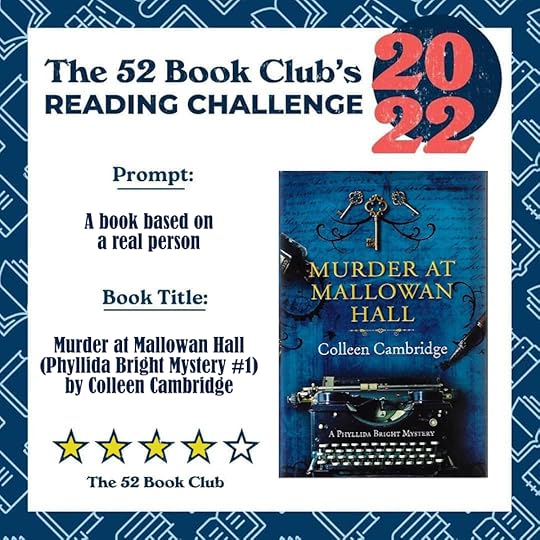
Murder at Mallowan Hall (Phyllida Bright Mystery, #1) by Colleen Cambridge
Synopsis /
Tucked away among Devon's rolling green hills, Mallowan Hall combines the best of English tradition with the modern conveniences of 1930. Housekeeper Phyllida Bright, as efficient as she is personable, manages the large household with an iron fist in her very elegant glove. In one respect, however, Mallowan Hall stands far apart from other picturesque country houses...
The manor is home to archaeologist Max Mallowan and his famous wife, Agatha Christie. Phyllida is both loyal to and protective of the crime writer, who is as much friend as employer. An aficionado of detective fiction, Phyllida has yet to find a gentleman in real life half as fascinating as Mrs. Agatha's Belgian hero, Hercule Poirot. But though accustomed to murder and its methods as frequent topics of conversation, Phyllida is unprepared for the sight of a very real, very dead body on the library floor...
A former Army nurse, Phyllida reacts with practical common sense--and a great deal of curiosity. It soon becomes clear that the victim arrived at Mallowan Hall under false pretences during a weekend party. Now, Phyllida not only has a houseful of demanding guests on her hands--along with a distracted, anxious staff--but hordes of reporters camping outside. When another dead body is discovered--this time, one of her housemaids--Phyllida decides to follow in M. Poirot's footsteps to determine which of the Mallowans' guests is the killer. With help from the village's handsome physician, Dr. Bhatt, Mr. Dobble, the butler, along with other household staff, Phyllida assembles the clues. Yet, she is all too aware that the killer must still be close at hand and poised to strike again. And only Phyllida's wits will prevent her own story from coming to an abrupt end...
My Thoughts /
What I feel is that if one has got to have a murder actually happening in one's house, one might as well enjoy it, if you know what I mean.
— Agatha Christie
Did you know that Agatha Christie met British archaeologist, Sir Max Mallowan (14 years her junior) in February of 1930 and that the two were married in the September of that same year? And that thereafter they spent several months each year on archaeological expeditions in Iraq and Syria? Mallowan reportedly feared she would be repulsed by his job of digging up ancient remains, but on the contrary, she was fascinated, it seemed that meeting him reawakened her interest in life and writing again.
While married to Mallowan, Christie went on to write some of her most famous and successful novels including Murder on the Orient Express in 1934; Death on the Nile in 1937; and Appointment with Death in 1938. She became the prolific writer we remember today, spending her spare time going on annual digs in Iraq with her husband.
TO THE STORY:
He was quite dead — not to mention significantly bloodied due to the fountain pen protruding from the side of his neck
When housekeeper, Phyllida Bright found a dead man sprawled on the floor in her employer's library, stabbed in the carotid, it didn't even occur to her to scream.
As a nurse's aide during the Great War, Phyllida had been witness to worse atrocities; but in her position as housekeeper at Mallowan Hall, home to Agatha Christie and her husband, Max Mallowan, Phyllida hadn't expected this. The dead man, Mr Charles Waring, was a guest at Mallowan Hall - having arrived the night before (uninvited) requesting lodging from a storm raging outside. Mr Mallowan and his writer wife were already host to a number of guests and, since their home was big enough to accommodate another, offered him safe lodging for the night.
It's the 1930s, and, during that time-period it was normal for a grand English country home such as Mallowan Hall to be run by a large servant staff. In the case of Mallowan Hall, a modest manor house with fifteen guest rooms and an array of sitting rooms, parlours and offices, ran smoothly under the rule of housekeeper Phyllida Bright, parlourmaids (Ginny and Mary), chambermaids (Lizzie, Bess and Violet), the footmen (Stanley and Freddie), Mrs Puffley (the cook), the kitchen maids (Molly, Benita and Opal), Mr Dobble (the butler), Amsi (the gardener) and of course, Bradford (the chauffer) - to name a few!!!
Phyllida thought the local constabulary, Constable Greensticks, was a short, pompous man who portrayed himself rather shabbily and nothing at all like her employer's fictional Belgian detective, M. Hercule Poirot. It became obvious to Phyllida that if the investigation into the death of Mr Waring was going to be solved, she was going to have to work the case.
With names like: Eugene Mustard, the Devines, the Harfords, the Budgely-Rhodeses, Mr Grimson and Mr Sloup; and places like 'The Screaming Magpie' and the annual Beetroot and Chicken Foot Festival you know you are in 'jolly Old England'. And while the location (Mallowan Hall) actually existed, the staff and events that are portrayed here are completely fictional. Although the staff might have been fictional, the portrayals are accurate. The 'turf wars' between the upstairs and downstairs servant staff; as well as the battle between housekeeper, butler and cook - were all reminiscent of shows like Upstairs, Downstairs which aired on ITV in the early 1970s.
Cambridge's prose is descriptive and light. The characters, although there is a huge cast, are intriguing and well-developed. The plot is well-paced and full of red herrings, and suspects! I loved how Cambridge brought the ending together - with a denouement - very British! (am I allowed to say that?😂😂).