

What do you think?

The Bat-Man: Second Knight
A Dark Knight Rises Against Fascism—Bat-Man Battles Shadows in 1939 Gotham
Set in 1939, The Bat-Man: Second Knight continues Bruce Wayne’s noir journey following First Knight. After surviving a suspicious car crash with his fiancée, Bat-Man uncovers a conspiracy involving the Brotherhood—a cult led by the enigmatic Monk and aided by a young Jonathan Crane. As Gotham’s elite fall under the sway of fear and isolationist ideologies, Bat-Man discovers the Monk’s true identity. With paranoia gripping the city, Bat-Man joins forces with Golden Age Superman to stop the Brotherhood’s plan before it spreads beyond Gotham and threatens the nation’s future.
Set in 1939, The Bat-Man: Second Knight continues Bruce Wayne’s noir journey following First Knight. After surviving a suspicious car crash with his fiancée, Bat-Man uncovers a conspiracy involving the Brotherhood—a cult led by the enigmatic Monk and aided by a young Jonathan Crane. As Gotham’s elite fall under the sway of fear and isolationist ideologies, Bat-Man discovers the Monk’s true identity. With paranoia gripping the city, Bat-Man joins forces with Golden Age Superman to stop the Brotherhood’s plan before it spreads beyond Gotham and threatens the nation’s future.
152 pages, Hardcover
First published May 5, 2026
About the author
Dan Jurgens
2,276 books296 followersDan Jurgens is an American comic book writer and artist. He is known for his work on the DC comic book storyline "The Death of Superman" and for creating characters such as Doomsday, Hank Henshaw, and Booster Gold. Jurgens had a lengthy run on the Superman comic books including The Adventures of Superman, Superman vol. 2 and Action Comics. At Marvel, Jurgens worked on series such as Captain America, The Sensational Spider-Man and was the writer on Thor for six years. He also had a brief run as writer and artist on Solar for Valiant Comics in 1995.
Ratings & Reviews
Friends & Following
Create a free account to discover what your friends think of this book!
Community Reviews
Displaying 1 - 26 of 26 reviews

February 9, 2026
A friend, EW, lent me the separate issues of the first volume of this series, The Bat-Man: First Knight (2024), the premise of which is to take us back to 1939-40, WWII, the war against Hitler, Nazis, and fascism, with an eye to today, where endless war continues and the threat of worldwide war threatens. Then: A Time of fear. Today: A time of fear.
This second volume, Second Knight (May 5 2026) continues the story, set still in Gotham, where there is a killer loose who leaves a hangman's noose. The Scarecrow. Re-enacting the early days of DC in Gotham, with Lois Lane and Superman easing into the fray with Batman as the vigilante crime-fighter. Retro forties style illustration. We have yet to get to Europe/WWII and its direct link to fascism, though, so we will have be having a Third Knight.
This second volume, Second Knight (May 5 2026) continues the story, set still in Gotham, where there is a killer loose who leaves a hangman's noose. The Scarecrow. Re-enacting the early days of DC in Gotham, with Lois Lane and Superman easing into the fray with Batman as the vigilante crime-fighter. Retro forties style illustration. We have yet to get to Europe/WWII and its direct link to fascism, though, so we will have be having a Third Knight.

July 9, 2026
A perfect blend of comics and Pulp fiction. This comic captures the 1920s feel in both it's visual and prose storytelling. The Magazine sized format if perfect for this awesome comic. Very recommended

July 21, 2026
3.75
Bat-Man and Jim Gordon are in 1940 Gotham..the war is gearing up but Gotham is facing a series of fear inducing staged murders that are making the Citizens more than uneasy.
Plus appearances from Metropolis neighbors
A DC Black Label title that rewrites everything...but to good effect...and has a very different Batman/ Bruce Wayne scenario..but it works.
Bat-Man and Jim Gordon are in 1940 Gotham..the war is gearing up but Gotham is facing a series of fear inducing staged murders that are making the Citizens more than uneasy.
Plus appearances from Metropolis neighbors
A DC Black Label title that rewrites everything...but to good effect...and has a very different Batman/ Bruce Wayne scenario..but it works.

June 13, 2026
I almost did not buy this book. As I did not enjoy the first one. I was very glad to be surprised I really enjoyed this book. Still not my favourite artwork but it matches the style and the time period.
With the back drop of World War II going on in Europe. America has it own problems with their great Depression. However in Gotham there have been a number of grizzly seemingly random killings. Yet the worst is still to come. Could this bring back the Bat-man (that is the way they say/write it here)? With two super villains could their be a worlds finest guest star.
A good gritty book. I like the story is think they got the language of the of the time period down, I think having this as black label and sprinkling of profanity adds to the realism of the dialogue. All in all in all a very good book. The book finishes with a thumbnail variant cover gallery.
With the back drop of World War II going on in Europe. America has it own problems with their great Depression. However in Gotham there have been a number of grizzly seemingly random killings. Yet the worst is still to come. Could this bring back the Bat-man (that is the way they say/write it here)? With two super villains could their be a worlds finest guest star.
A good gritty book. I like the story is think they got the language of the of the time period down, I think having this as black label and sprinkling of profanity adds to the realism of the dialogue. All in all in all a very good book. The book finishes with a thumbnail variant cover gallery.

May 28, 2026
Batman…Ends? 💍
This entire review has been hidden because of spoilers.
August 30, 2026
3.5 stars

August 4, 2026
The Bat-Man: Second Knight collects issues 1-3 of the DC Comics series written by Dan Jurgens, art by Mike Perkins, and colors by Mike Spicer.
Set a short time after the events of First Knight, Gotham’s being rocked by a series of unsolved murders to completely unrelated citizens, leaving the city in fear.
Like First Knight, Second Knight is a throw back to pulp comics from the 1930s and 40s and events in the book are set shortly before the U.S. is poised to enter World War 2. I’m generally not a big fan of the villain that appears in this book as I feel his stories usually tell the same story over and over again, but it worked here. We also get this universe’s introduction from a couple characters who call Metropolis home. I thought this was a strong follow up which actually improved the pacing of its predecessor. I think it’s inevitable that we will get a Third Knight and I’m curious to see where the story will go.
Set a short time after the events of First Knight, Gotham’s being rocked by a series of unsolved murders to completely unrelated citizens, leaving the city in fear.
Like First Knight, Second Knight is a throw back to pulp comics from the 1930s and 40s and events in the book are set shortly before the U.S. is poised to enter World War 2. I’m generally not a big fan of the villain that appears in this book as I feel his stories usually tell the same story over and over again, but it worked here. We also get this universe’s introduction from a couple characters who call Metropolis home. I thought this was a strong follow up which actually improved the pacing of its predecessor. I think it’s inevitable that we will get a Third Knight and I’m curious to see where the story will go.

July 23, 2026
Un peu moins emballé par ce second tome que par le premier, et pourtant il y a Superman. La relation entretenue avec Batman est d'ailleurs plutôt chouette, même si largement déjà vue. Au sujet de l'homme d'acier, je n'ai pas particulièrement aimé sa longue tirade de fin pour justifier son absence lors de la seconde guerre mondiale. Ce qu'il déclare ne manque pas de sens mais ça sonne vraiment comme des excuses, c'est assez fainéant de la part de Jurgens. Quant à l'histoire globale, elle est plutôt sympathique mais assez bateau et sans grande inventivité. Reste néanmoins une ambiance globale fort appréciable, en grande partie dûe au génial Mike Perkins (et quand même aussi à l'écriture de Jurgens).

May 20, 2026
A nice period piece but maybe a little dense at times.

June 16, 2026
The Bat-Man: Second Knight
As Bruce gets closer to Julie Madison, the Scarecrow unleashed his fear gas on Gotham City, causing citizens to turn each other, focusing on the Jewish Community. Luckily, two reporters from Metropolis are in Gotham to cover the premier of Julie's latest movie. As Kent and Wayne quickly unmask each other, the two heroes work to bring down Jonathan Crane, who is intent on selling his concoction to Hitler.
Amazing artwork, which echoes the 30s and 40s style but is refreshingly unique and a plot with real jeopardy for our heroes. There are plenty of iconic panels to enjoy.
As Bruce gets closer to Julie Madison, the Scarecrow unleashed his fear gas on Gotham City, causing citizens to turn each other, focusing on the Jewish Community. Luckily, two reporters from Metropolis are in Gotham to cover the premier of Julie's latest movie. As Kent and Wayne quickly unmask each other, the two heroes work to bring down Jonathan Crane, who is intent on selling his concoction to Hitler.
Amazing artwork, which echoes the 30s and 40s style but is refreshingly unique and a plot with real jeopardy for our heroes. There are plenty of iconic panels to enjoy.

August 28, 2026
This is mainly a review of the third issue but the problems are consistent throughout.
This is BORING. Way too much dialogue to do any world or character building. The time period is set, we know what is happening, give me good character driven stories that escalate this new Batman. Nothing…? There is nothing new to any of these characters. The Bat-Man stays dulls throughout. Only thing new being his costume (same as the first volume) and having a girlfriend (this isn’t going to end good). Otherwise I have no interest in him. Considering his morals are the same and there’s no past events that haunt our present Bruce.
Adding Superman was such a sellout. Instead of using these long three issues to characterize this Batman more, they introduce Superman. Adding nothing to either character besides a morals conversation at the end. He was only included the widen the world of this universe. I’d argue and say that this was more of a Superman comic than a Batman one.
I’ve grown to like Scarecrow at the end. His motivations were understandable (and still evil) but the way him and the Hooded Man were apprehended was a joke. Quick and most definitely forgettable. Plus, why would anybody go to an event that knows is going to be attacked???
Not a fan of this universe. Not a fan of the people who rate this high because it ‘perfectly contrasts modern day politics.’ No it doesn’t. This is a dull series that has a lot more potential than material.
This is BORING. Way too much dialogue to do any world or character building. The time period is set, we know what is happening, give me good character driven stories that escalate this new Batman. Nothing…? There is nothing new to any of these characters. The Bat-Man stays dulls throughout. Only thing new being his costume (same as the first volume) and having a girlfriend (this isn’t going to end good). Otherwise I have no interest in him. Considering his morals are the same and there’s no past events that haunt our present Bruce.
Adding Superman was such a sellout. Instead of using these long three issues to characterize this Batman more, they introduce Superman. Adding nothing to either character besides a morals conversation at the end. He was only included the widen the world of this universe. I’d argue and say that this was more of a Superman comic than a Batman one.
I’ve grown to like Scarecrow at the end. His motivations were understandable (and still evil) but the way him and the Hooded Man were apprehended was a joke. Quick and most definitely forgettable. Plus, why would anybody go to an event that knows is going to be attacked???
Not a fan of this universe. Not a fan of the people who rate this high because it ‘perfectly contrasts modern day politics.’ No it doesn’t. This is a dull series that has a lot more potential than material.
This entire review has been hidden because of spoilers.

July 1, 2026
One thing that thought I had valued about The Bat-Man: First Knight was Jurgen's decision to stay completely within the universe of the 40s and 50s, no need for rogues or for more traditional villians to be crowbarred into the stories of The Bat-Man.
After a quick check on character histories, I discovered how wrong I was: almost all of Batman's traditional villians were added to the continuity 2-3 years after Batman himself was created.
So eating crow on this point, I amend my statement: I appreciate that the first two books feel very much like 1939 and how the main character is still very much out of his league in beginning this crusade.
Superman does make an appearance here, but this crossover is well within regulation, as it harkens back to the inclusion of Batman in the The Adventures of Superman Radio Show (1941-1951).
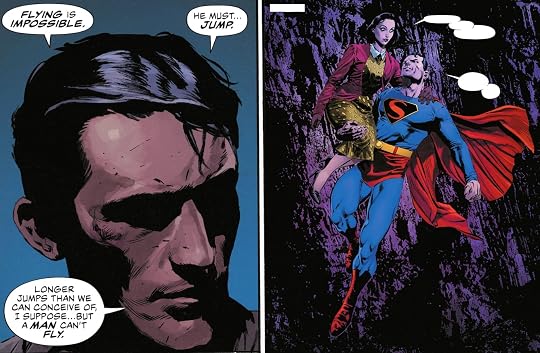
I would highly recommend this series to anyone curious about the the Golden Era of these comics - and Mike Perkin's is so in tune with the era as well.
After a quick check on character histories, I discovered how wrong I was: almost all of Batman's traditional villians were added to the continuity 2-3 years after Batman himself was created.
So eating crow on this point, I amend my statement: I appreciate that the first two books feel very much like 1939 and how the main character is still very much out of his league in beginning this crusade.
Superman does make an appearance here, but this crossover is well within regulation, as it harkens back to the inclusion of Batman in the The Adventures of Superman Radio Show (1941-1951).
I would highly recommend this series to anyone curious about the the Golden Era of these comics - and Mike Perkin's is so in tune with the era as well.

Review of advance copy
It's got the style of the first volume down, but the dialogue is overstuffed with outdated catchphrases.
The intrusion of the real world is less that the prior installment but still present, and while it is easy to accept small changes to the background and the edges of the story (i.e. Clark as an Okie, Thomas Wayne as a soldier) when the author changes* or makes incredulous claims about actual history* (when actual history is a driving part of the story) it takes the reader right out of the tale.
* stating that Bruce was trained by Harry Houdini and trusted enough to learn his secrets is...unbelievable. HH died in 1926. Bruce's parents can't die before 1919 what with WWI and all, so at the very outside, the claim is that HH revealed all to some kid between the ages of 7 and .. 16 maybe? Unbelievable.
The intrusion of the real world is less that the prior installment but still present, and while it is easy to accept small changes to the background and the edges of the story (i.e. Clark as an Okie, Thomas Wayne as a soldier) when the author changes* or makes incredulous claims about actual history* (when actual history is a driving part of the story) it takes the reader right out of the tale.
* stating that Bruce was trained by Harry Houdini and trusted enough to learn his secrets is...unbelievable. HH died in 1926. Bruce's parents can't die before 1919 what with WWI and all, so at the very outside, the claim is that HH revealed all to some kid between the ages of 7 and .. 16 maybe? Unbelievable.

May 9, 2026
The sequel to Bat-Man: First Knight, the Dark Knight in an early 20th-century pulp setting just works. I was a big fan of the first volume. Although on a second read, I did find the story a little simplistic. The sequel ups the stakes, though, and introduces more familiar faces from the wider DC universe. The story fits seamlessly with the time period, with Gotham, and by extension, the United States, on the brink of being involved in the Second World War. The ending could've been a little more spectacular, although solid enough for me to be satisfied. The art, which was the biggest plus in the first volume, remains spectacular and is my favorite aspect of the book. Overall, a great continuation to a black label series that I hope can expand into something wider. 4.3/5.

July 21, 2026
Kind of a dull follow-up to the original. I like the idea of a pulp fiction Batman (or Bat-Man) and the first go-around was exciting and interesting, with a good story and nice combination of detection and fisticuffs. This time around, Bat-man is dealing with a pair of bad guys, the Hood and the Scarecrow, out to terrorize Gotham. Superman is also thrown into the mix, along with Lois Lane. But the story just doesn't gel. It never really comes together in a satisfying way. The art continues to be very good and I like the concept, but if there's going to be a "third knight," I hope Jurgens can come up with something a bit more compelling.

April 2, 2026
I was happy to see First Knight get a sequel, I thought it was a fun read. Batman works so well in a 40s noir setting and that remains true the second time around.
Perkins art is great and he really captures early era Batman. Reimagining Scarecrow as a disgraced chemical weapons manufacturer from the First World War was a great idea for the character. I did find the Rabbi’s character to be a bit awkward, as he’s largely in the book for the sole purpose of ranting about the impending Second World War and European fascism. I suppose global conflict and fascist persecution of minorities is very relevant today, I just think this character came off as clunky.
I assume Bruce Wayne’s proposal to Julie won’t last and he will jump back into action in the future, otherwise the ending of this book doesn’t really jive with the overall theme. If you’re going to write a Batman World War Two story and have him check out of the game right before the war kicks off why even bother? This Batman still has work to do, his world is about to get demonstrably worse.
Perkins art is great and he really captures early era Batman. Reimagining Scarecrow as a disgraced chemical weapons manufacturer from the First World War was a great idea for the character. I did find the Rabbi’s character to be a bit awkward, as he’s largely in the book for the sole purpose of ranting about the impending Second World War and European fascism. I suppose global conflict and fascist persecution of minorities is very relevant today, I just think this character came off as clunky.
I assume Bruce Wayne’s proposal to Julie won’t last and he will jump back into action in the future, otherwise the ending of this book doesn’t really jive with the overall theme. If you’re going to write a Batman World War Two story and have him check out of the game right before the war kicks off why even bother? This Batman still has work to do, his world is about to get demonstrably worse.

August 19, 2026
This isn’t as good as the first volume, but it’s still an enjoyable time. The Superman appearance was a pleasant surprise for me, but by the end, I was wishing they had done a little bit more with him. I still love the premise, and the backdrop of the 20s and 30s, and there are enough twists, turns and surprises in the story that I will definitely come back for the inevitable Third Knight.
This entire review has been hidden because of spoilers.
September 26, 2025
This is a very stylish book but I’m just not into the art style. That is purely personal taste and I can appreciate what it’s doing. The story was fine but not outstanding. It was a good book but didn’t quite hit in the way I was hoping.

May 26, 2026
I enjoyed this a lot more than the first book. It's still gorgeous and, this time, the story is a lot more engaging. I'm of two minds of including Superman in here, since adding him to a Batman origin story always changes the atmosphere, but the Fleischer-vibes are just too good. You might still want to check this one out if, like me, you didn't dig First Knight.

Review of advance copy
As good as the first, hoping for a third.


May 11, 2026
Very good sequel with Scarecrow and Superman both shining in here as really good additions. Main story is also a good mini story that is good in the time period.
May 28, 2026
An enjoyable follow-up to the adventures of the "realistic" golden age Bat-Man. Honestly, this is pretty much the type of story I'd love to see adapted to the big screen.

September 3, 2026
In this 2nd volume, Bat-Man of 1940 meets up with Superman to take down the Scarecrow and a crony. It's solid. Seems like this is meant to be the end of it though.
September 5, 2026
3.5 stars.
I like the premise and the setting. The execution, both in art and writing, isn’t without bumps. As a whole, it’s readable and entertaining.
I like the premise and the setting. The execution, both in art and writing, isn’t without bumps. As a whole, it’s readable and entertaining.

September 7, 2026
Loved this pulpy story as I loved the previous volume. If you like pulpy crime fiction, and like Batman, this is for you!
Displaying 1 - 26 of 26 reviews