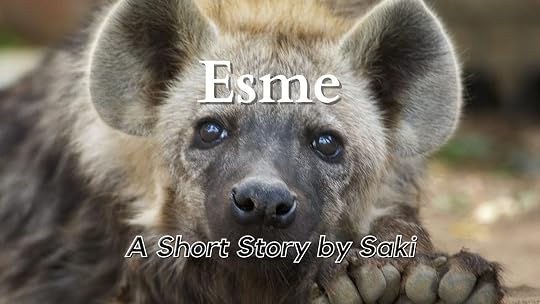
The Baroness recounts a hunting story with a twist. Instead of a fox, the quarry turns out to be an escaped hyena, which adopts her and Constance Broddle and leads them to cover up a heinous killing. Hector Hugh Munro at his most macabre.
British writer Hector Hugh Munro under pen name Saki published his witty and sometimes bitter short stories in collections, such as The Chronicles of Clovis (1911).
His sometimes macabre satirized Edwardian society and culture. People consider him a master and often compare him to William Sydney Porter and Dorothy Rothschild Parker. His tales feature delicately drawn characters and finely judged narratives. "The Open Window," perhaps his most famous, closes with the line, "Romance at short notice was her specialty," which thus entered the lexicon. Newspapers first and then several volumes published him as the custom of the time.
I may not be vegetarian, but I don’t think animals should be killed for fun. Where pest control is necessary, it shouldn’t be dressed up as an elite social “sport”, like fox-hunting, as practised in Britain. Hence, I was not warmly disposed to the characters: one woman recounts a memorable hunt, when she and another woman became separated from the others.
Image: Lady foxhunter: "The Meet - Arrival of the Duke" (Source.)
But I was seduced by deliciously waspish Wildean wit:
"'You're looking nicer than usual,' I said, 'but that's so easy for you.' Before she had got the right bearings of this remark we had settled down to business.”
The catty one-up(wo)manship makes the later casual disregard of the sanctity of some human life even more shocking. And if that didn’t make me detest the main protagonist enough, there’s a final, selfish twist. Horribly (and I would hope, implausibly) brilliant.
Other Quotes
• “Poverty keeps together more homes than it breaks up.”
• “One of those strapping florid girls that go so well with autumn scenery or Christmas decorations in church.”
• “She was looking about as pale as a beetroot that has suddenly heard bad news… an albino beetroot.”
More Saki
I'm gradually collating reviews of Saki short stories under The Best of Saki, HERE, as I read them in a rambling way, over several weeks and months.
You can find his stories, free, on Gutenberg. For example, HERE. Most are very short.
I must say that the synopsis on Goodreads for this brilliantly funny Saki short story has to be one of most poe-faced and sour things that I have ever read. It is also staggeringly inaccurate - there is nothing in this story that belittles or denigrates gypsies (I know that may not be the name used now but I am sure back in 1911 it was the name they used). The story is a comedy of manners - it is not even a critique of aristocratic hunting ladies as Goodreads seems to think. It is satire, it sends up class and custom and certainly demolishes the idea that adults are nice, caring, thoughtful or considerate. Saki doesn't care much for adults of any class, though he spends most time demolishing the foibles of his own.
To get back to this story - it is the first story in his third collection of short stories 'Chronicles of Clovis' a collection of utter perfection - and it is one of his finest. It is a hunting story, which is half the joke but it has to be understood within the context of Saki's time and the class/world/milieu he is demolishing. Saki was ruthlessly honest and that can be cruel but he wasn't about to indulge sentimentality towards his characters when they were portraits of people who in reality were ruthlessly hypocritical.
Saki creates stories as compact and intricate as the movement of a jewelled Swiss watch, and as tart, in their brevity, as a drop of Angostura bitters. ‘Esmé’ (the title itself vibrates like a tuning fork) opens: ‘All hunting stories are the same,’ said Clovis; ‘just as all Turf stories are the same, and all —’ ‘My hunting story isn’t a bit like any you’ve ever heard,’ said the Baroness. ‘It happened quite a while ago, when I was about twenty-three. I wasn’t living apart from my husband then; you see, neither of us could afford to make the other a separate allowance. In spite of everything that proverbs may say, poverty keeps together more homes than it breaks up. But we always hunted with different packs. All this has nothing to do with the story.’ At this particular meet her companion is Constance Broddle. Constance, the Baroness recalls, was ‘one of those strapping florid girls that go so well with autumn scenery or Christmas decorations in church’. ‘I feel a presentiment that something dreadful is going to happen,’ she says to the Baroness before the hunt sets off, ‘am I looking pale?’ She is, thinks her companion, ‘looking about as pale as a beetroot that has suddenly heard bad news’. There ensues a stiff run. The two women, now separated from the field, come across something which is certainly no mortal fox. ‘It stood more than twice as high, had a short, ugly head, and an enormous thick neck’. A stray from the Baskerville estate, perhaps? ‘“It’s a hyaena,” I cried; “it must have escaped from Lord Pabham’s Park.”’ The beast attaches itself, affectionately, to the two ladies. They christen it ‘Esmé’, because they don’t know its sex and are disinclined to physically ascertain the fact. Now trailing the hunt by miles they pass some caravans. Esmé, keen to impress, picks up a ‘half naked gipsy brat’ and brings it back, wailing between its jaws, as a trophy for its new friends. When it is clear they do not want it, Esmé bounds ‘into some thick bushes, where we could not follow; the wail rose to a shriek and then stopped altogether’. Constance goes the colour of an ‘albino beetroot’ and feebly asks, ‘Do you think the poor little thing suffered much?’ ‘The indications were all that way,’ replies the Baroness blandly. They are now on the high road, Esmé padding behind. A car, driving at reckless speed, runs into the beast and kills it – sparing the ladies some tricky explanations to the Master of Hounds. The owner of the vehicle is frightfully apologetic. It was a prize animal, the Baroness sternly informs him. It won the puppy prize at Birmingham the year before. He helps bury Esmé and offers ‘reparation’. The Baroness refuses but ensures he has taken her address. ‘There was a sequel to the adventure, though. I got through the post a charming little diamond brooch, with the name Esmé set in a sprig of rosemary. Incidentally, too, I lost the friendship of Constance Broddle. You see, when I sold the brooch I quite properly refused to give her any share of the proceeds. I pointed out that the Esmé part of the affair was my own invention, and the hyaena part of it belonged to Lord Pabham, if it really was his hyaena, of which, of course, I’ve no proof.’ It is, as the Baroness says, an ‘unusual’ hunting story. Saki, as his first readers would have realised, was poking fun at Lord Rothschild’s (here ‘Lord Pabham’) estate at Tring – England’s first wild animal park, where hyenas and other exotic animal life roamed free. It was first opened to the public in 1892. Lord Rothschild himself was often seen riding round his estate in a zebra-drawn carriage. Saki, one feels, could have made something of that.
This entire review has been hidden because of spoilers.
A darkly comic short story in which a Baroness recounts a hunting adventure involving a lost fox hunt, an escaped hyena named Esmé, and the macabre events that follow, highlighting themes of class, absurdity, and human detachment. The story is narrated by a Baroness to her companion, Clovis, as she recalls an unusual hunt from her youth. While out hunting with her friend Constance Broddle, they become separated from their pack. Early in the story, they encounter an escaped hyena they believe came from Lord Pabham's estate, which follows them. The Baroness names the hyena Esmé, and it quickly becomes attached to them. As they come across a young gypsy child picking blackberries the hyena unexpectedly seizes the child. The incident introduces dark humor and moral ambiguity, as the women watch and grapple with their limited ability to control the animal. Eventually, the hyena kills the child, and the women’s dilemma on how to handle Esmé is resolved when a passing car runs over the hyena, effectively ending the crisis. They present Esmé to the motorist as if it were a pet dog and enlist the motorist's help in burying the animal.
Following the adventure, the Baroness receives a diamond brooch with the name "Esmé" from the motorist, symbolizing a token of gratitude or reparation. This gift leads to a rift between the Baroness and Constance, as the Baroness sells the brooch but refuses to share the proceeds, indicating her selfishness and social detachment.
A definite 5 star story. I am tempted to give this a much higher score.
Amazingly well written with a really great plot.
Some people have accused him of being prejudiced against gypsies. I don't think that is really the case. He did not make any totally racist comments against gypsies. Also, that is the way that people talked back then.
Yes, it is a slightly malevolent story. However, I think it is one of the best short stories I have ever read.