

What do you think?

Keats: Poems
These Everyman's Library Pocket Poets hardcover editions are popular for their compact size and reasonable price which do not compromise content. Poems: Keats contains a full selection of Keats's work, including his lyric poems, narrative poems, letters, and an index of first lines.
256 pages, Hardcover
First published January 1, 1817
About the author
John Keats
1,454 books2,572 followersRich melodic works in classical imagery of English poet John Keats include "
The Eve of Saint Agnes
," "
Ode on a Grecian Urn
," and "
To Autumn
," all in 1819.
Works of Percy Bysshe Shelley include "Adonais," an elegy of 1821 to John Keats.
Work of the principal of the Romantic movement of England received constant critical attacks from the periodicals of the day during his short life. He nevertheless posthumously immensely influenced poets, such as Alfred Tennyson. Elaborate word choice and sensual imagery characterize poetry, including a series of odes, masterpieces of Keats among the most popular poems in English literature. Most celebrated letters of Keats expound on his aesthetic theory of "negative capability."
Wikipedia page of the author
Works of Percy Bysshe Shelley include "Adonais," an elegy of 1821 to John Keats.
Work of the principal of the Romantic movement of England received constant critical attacks from the periodicals of the day during his short life. He nevertheless posthumously immensely influenced poets, such as Alfred Tennyson. Elaborate word choice and sensual imagery characterize poetry, including a series of odes, masterpieces of Keats among the most popular poems in English literature. Most celebrated letters of Keats expound on his aesthetic theory of "negative capability."
Wikipedia page of the author
Ratings & Reviews
Friends & Following
Create a free account to discover what your friends think of this book!
Community Reviews
Displaying 1 - 30 of 48 reviews

June 11, 2019
A thing of beauty is a joy for ever
As a dedicated book reviewer, it is my job to say why I like certain books and dislike others. When it comes to nonfiction, this is reasonably straightforward: if the exposition is clear, if the arguments are logical, if the ideas are reasonable—then it is a worthy book. Nonfiction aims for truth, and truth can at least be tested. With literature, however, the task is somewhat more fraught. Beauty is an unfalsifiable hypothesis. We can break down a novel’s strengths and weaknesses by category—good prose, bad pacing, fine dialogue, shallow characterization—but ultimately these evaluations, however much we justify them, rest upon gut reactions.
Why does one sequence of musical notes create a pleasing melody, another a forgettable ditty, and a third a nonsensical jangle? Why do certain combinations of words strike the ear as just right, and others as discordant? Formal analysis can clarify and categorize the sorts of sounds and structures that people tend to enjoy. But it can never explain why we enjoy them in the first place, nor why different people enjoy them to different extents. If literary criticism is to be a worthwhile exercise it requires, then, that the gut reactions of the audience members are at least roughly alike—that we are similarly constituted as regards to beauty.
Shared education contributes towards this similarity; as does, presumably, the basic resemblance of our natures. But does this bedrock of shared taste constitute something durable and permanent enough so that we may say a great artist hits upon the “truth” of art—appeales to something permanent in ourselves—in the same way that a scientist may hit upon a “truth” of nature? Many have thought so. And it strikes me that something like this must be the case if we wish to call any form of art “universal”—namely, that it is a true expression of what we share.
I mention this because the relationship of beauty to truth is one of the great themes of Keats’ poetry. At the end of his “Ode on a Grecian Urn” he tells us that “Beauty is truth, truth beauty”—a line that has been endlessly analyzed. Certainly the widespread and steady popularity of his poems may argue that, indeed, Keats hit upon some basic truth of art. But what could that mean?
The issue of translation may bear on the question. It is often said that poetry is untranslatable; and the bilingual edition I read ironically proved the point. The Spanish consistently failed to evoke the sublimity of the original. Here, for example, are two famous lines from Keats’ “On First Looking into Chapman’s Homer”:
Then felt I like some watcher of the skies
When a new planet swims into his ken
And here is the Spanish translation:
Entonces me sentí como un astrónomo
cuando ve frente a sí un nuevo planeta
Translated back into English this reads something like: “Then I felt like an astronomer when he sees a new planet in front of him.” Despite preserving the literal meaning, this obviously loses all of the magic of the line. “Watcher of the skies” is infinitely more romantic than “astronomer,” and “sees in front of him” has none of the mystery of “swims into his ken.” In short, the rich beauty of the language does not survive; and the poem becomes a rather bland statement about enjoying a new edition of Homer, rather than an evocation of the grandeur of nature and art.
(I do not think it was the translator’s fault. Spanish is very different to versify than English; and the literal Spanish translation would preserve meaning at the expense of rhythm.)
Yet if Keats’ poetry is truly untranslatable, then how could it contain truth? After all, one could translate Newton’s work into Spanish, French, German, or Japanese, and it would contain just as much truth (or untruth) as in the original. Science is not linguistically bound. Admittedly, the boundary of translation is not equivalent for all forms of poetry. Homer’s works are still riveting in English; and Dante’s vision survives (at least partially) its journey from Medieval Florentine. Lyrical poetry seems to fare the most poorly.
The obvious difference between Homer and Keats is that Homer’s appeal lies in the story, while Keats’ relies on his linguistic brilliance. And, for my part, it is easier to see how a story can contain a semblance of “truth,” rather than a beautiful string of words. Assuming that some experiences in life are universal, that some emotional crises are recurring, that some existential state is inescapable, then a great story may be able to capture something common and durable about the human condition. A beautiful poetic line, on the other hand, has a purely formal appeal—charming not in what it says, but in how it says it—and this perfection of expression, being untranslatable, must fall short of universal art.
Nevertheless, to describe Keats as merely a brilliant wordsmith would be an absurd underestimation. As his letters prove, he was thoroughly educated and keenly intelligent. His poems abound with perplexing classical references. And, in any case, words are never mere sounds; they are laden with meaning; and even the briefest of lyrical poems are pregnant with thought. Contemplation permeates Keats’ work. In his poems we find the focused musings of a highly original man as he meditates on entirely common occurrences: Autumn, Melancholy, Nature, Art—the list goes on.
Here is where Keats’ art may be said to be “universal”—and, in some sense, “true” to the human condition. For many of us have stood, amazed, before a work of art, or felt thrilled upon opening a book, or listened yearningly to a bird singing outside a window—or any number of comparable experiences. Yet only Keats and his ken have taken these fleeting twinges of emotion, reflected deeply upon them, and captured them in words so felicitous that they are impossible to forget once heard. Like the revelers on the Grecian Urn, Keats has frozen time.
It may be that this lyrical form of art, being so bound up in brilliance of expression, is less universal and less durable than works of narrative. But for those who are, by chance, linguistically equipped to enter Keats’ world, then his poems contain just as much artistic “truth” as the oldest tales and the finest melodies.
July 21, 2022
Imagine a world where artistic expression was used as a measure of success rather than money, and Keats was held in higher regard than Jess Bezos. Welcome to my world.
I loved wallowing in Keats poetry again.
I loved wallowing in Keats poetry again.

November 20, 2021
oh, keats. my heart, my love.
this little, beautiful edition will forever live on my bedside table.
this little, beautiful edition will forever live on my bedside table.

July 2, 2022
keats is a new favourite poet / author / person for me, i am absolutely obsessed!! the amount of times this collection made me cry is unreal 🥺

June 20, 2013
I bought this book on my last day in Rome; at the Keats-Shelley House, next to the Spanish Steps. Keats is incomparable, and these little Everyman's Library editions are books to treasure.

January 21, 2023
Disclaimer: My rating is based on the selected poems I had to read for class.
His poems were decent enough, I guess.
I didn't hate them, and I didn't love them. Is it possible to develop an immunity against poetry? Or perhaps I've become so worn down from all the poetic mumbo-jumbo and whatnot that I no longer care. (I wish it was possible to develop an immunity against poetry. That'd be nice.) Anyway, it's an okay read, so therefore 2 out of 5 stars.
Sidenote: I realized as I was about to shelve Keats's Complete Poems and Selected Letters that there was probably a Library Pocket edition for Keats. Since there is, I swapped it out for this book instead.
His poems were decent enough, I guess.
I didn't hate them, and I didn't love them. Is it possible to develop an immunity against poetry? Or perhaps I've become so worn down from all the poetic mumbo-jumbo and whatnot that I no longer care. (I wish it was possible to develop an immunity against poetry. That'd be nice.) Anyway, it's an okay read, so therefore 2 out of 5 stars.
Sidenote: I realized as I was about to shelve Keats's Complete Poems and Selected Letters that there was probably a Library Pocket edition for Keats. Since there is, I swapped it out for this book instead.
Read
December 25, 2022i did not read this book front to back because that would be utter insanity especially while reading other things and during the school year but i have been reading his poetry this month so whatever I suppose
my favorite is still “(ode) To Autumn” I think
I also rather adored “Sleep and Poetry”
my favorite is still “(ode) To Autumn” I think
I also rather adored “Sleep and Poetry”

April 13, 2021
I was looking to get an introduction into Keats (and poetry in general), as I have not really read much poetry as an adult. While many other books of his poems seemed lengthy, this was a good, manageable introduction into his poetry that made me want to go read more of his works...

September 28, 2018
I've got many copies and editions of Keats poems and this I just picked up as a handy pocket book. It's good to take travelling or to just throw in my bag. It brings me a peace of mind that is insurmountable to anything else I've tried. I remember being 16 and falling in love with him every time I read Hyperion.

August 29, 2015
Keats schreef zijn 'Ode on a Grecian Urn' in 1819. Het werk blijft eeuwig voortleven door deze twee prachtige regels: ”Beauty is truth, truth beauty,” – that is all/Ye know on earth, and all ye need to know.’

Read
April 22, 2014Lovely...nice ones to be carried away..!

September 21, 2024
If poetry comes not as naturally as the leaves to a tree it had better not come at all. So said Keats in one of his letters to his publisher, and indeed poetry came naturally to him, as is evident in his works.
Keats succumbed to tuberculosis at an early age, robbing him of his love, his family and friends, and his chance to create even more masterpieces. Still, Keats had much to offer.
What makes Keats unique is his ability to enthrall readers with his magical words, transporting them to his world of poetry. There, they can smell the aromas, hear the ballads, feel the emotions and cry the tears that he talks about in his poems.
Keats is not the easiest poet to read, especially at Beginners level. The true way of enjoying his poetry is by taking one's time through each word; it actually is a paradox, for the longer we take, the more we seem to glide through his words.
Keats succumbed to tuberculosis at an early age, robbing him of his love, his family and friends, and his chance to create even more masterpieces. Still, Keats had much to offer.
What makes Keats unique is his ability to enthrall readers with his magical words, transporting them to his world of poetry. There, they can smell the aromas, hear the ballads, feel the emotions and cry the tears that he talks about in his poems.
Keats is not the easiest poet to read, especially at Beginners level. The true way of enjoying his poetry is by taking one's time through each word; it actually is a paradox, for the longer we take, the more we seem to glide through his words.
June 15, 2020
"Darkling I listen; and, for many a time / I have been half in love with easful Death, / Call'd him soft names in many a mused rhyme, / To take into the air my quiet breath; / Now more than ever seems it rich to die" -Ode to Nightingale
There is no other way to rate Keats his poetry is so romantic and so human at the same time.
I recieved three of these little pocket poetry books for my birthday and I really like them.
There is no other way to rate Keats his poetry is so romantic and so human at the same time.
I recieved three of these little pocket poetry books for my birthday and I really like them.

August 26, 2022
This pocket poets edition offers a great collection of Keats work. I enjoyed the lyric poems and (surprisingly) his letters. His appreciation for beauty, truth, nature and Greek mythology translates really well into his very flowy and exceptionally well rhymed stories. However, the narrative poems were too lengthy for my taste and I found it all to be very much of the same. And in this case that bored me a little.

March 31, 2019
The poems were awesome! I’d never read any of the letters of John Keats at all, so reading those were awesome and a nice way to see into his world and his mind. I highly recommend it if you get the chance to read it.

February 20, 2020
My favourite included:
- Hither, hither, love
- You say you love, but with a voice
- Hence burgundy, claret and port
- There was a naughty boy
- I had a dove, and the sweet dove died
- Hush, hush, tread softly, hush, hush, my dear
- Hither, hither, love
- You say you love, but with a voice
- Hence burgundy, claret and port
- There was a naughty boy
- I had a dove, and the sweet dove died
- Hush, hush, tread softly, hush, hush, my dear
January 8, 2023
Melancholy, symbolic, and in many respects the Wuthering Heights of poetry. I think his employment of inversion, especially in Hyperion and The Fall of Hyperion, is ineffective. Is the Ode to Nightingale overrated? Just a question...jeez.
Favorite: Isabella
Favorite: Isabella

July 7, 2017
He made a joyful sense of melancholy. I loved it.

July 19, 2018
While I do like some of the shorter poems, the long, narrative poems are just not enjoyable for me.
August 7, 2018
Miraculous poetry.

Want to Read
December 4, 2021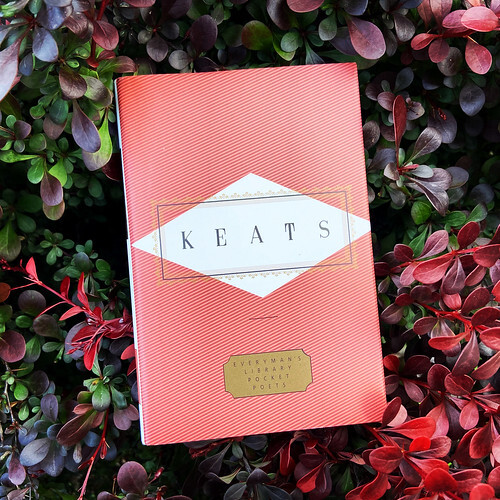

July 29, 2022
I enjoyed Hyperion and Endymion most - and his brief comment about Shelley!
January 22, 2023
We only read some of these for school. Keats is not easy.

Read
May 29, 2023Lyrical poems > letters > narrative poems. Hyperion and Lamia were fun but otherwise … His letters though! Dude needed a little advice from Yoda / Ram Dass: be here now.

January 2, 2024
I love these little collections...they're really well made, and they have a very extensive selection of poets, styles, and themes.
Read
April 3, 2024Keats never fails to light my fire.

Read
July 1, 2025A Keats girlie I am not.

January 4, 2026
I love John Keats!!! There! I've said it out loud!

August 10, 2024
I’m sure he’ll take my feedback on board.
March 14, 2017
Some poems read as tragic premonitions, others celebrate the world's natural beauty, and with the poet's eye forever fixed on the heavens, can be termed sky verse. Keats is fond of mythology and classical allusions. His seasonal tributes are compelling. Then, the monstrous women emerge, the belle dame and Lamia. He is also contemplative in his metapoetry, attempting to grapple with his perplexing art. Haunting narratives like "Lamia" and "Isabella or The Pot of Basil" are imaginatively morbid. "The Eve of Saint Agnes" is a poem where the images are most arresting. In "Hyperion" the story is opaque, losing its earthiness it slips into obscurity. His letters to Fanny Brawne and to Charles Brown are sad, especially in his final farewell (the latter) where he accepts the cruel death that awaits him. Although Keats was not celebrated in his lifetime, his verse belongs to one who loved poetry and there are many memorable odes, lyrics and narratives that remain as a testament to his talents.
Displaying 1 - 30 of 48 reviews