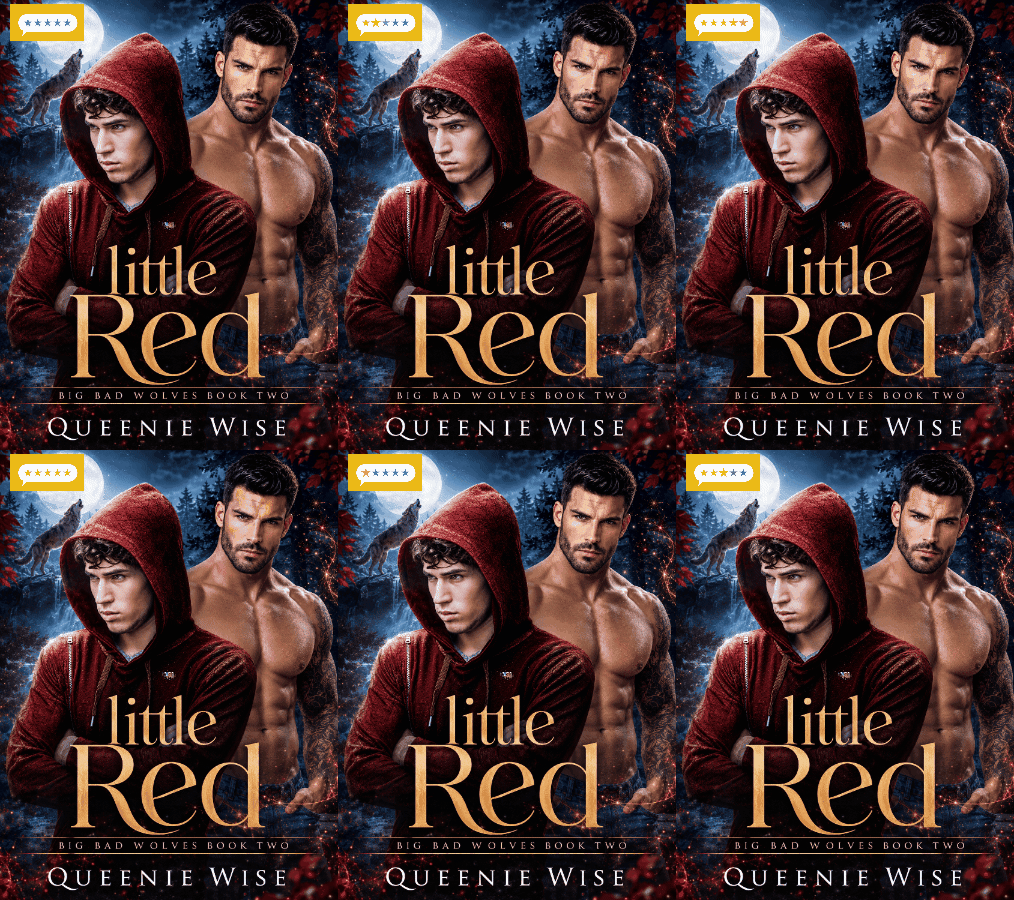
While I’m not sure I have it in me to read Book Three, this book, Big Bad, kept me reading late at night as it explored first pack dynamics, then betrayal, then Peter’s family dynamics. I can’t say exactly what I found so interesting; yes, twinks are always a big plus (although Peter is uncomfortably under age for a good portion of the book, even though nothing happens until he’s 18), but I think my interest is in how the author allows interpersonal relationships to drive the plot. The writing is average and can dip into the dreadful zone often enough, but when the author doesn’t try to force preconceived plot points on her characters but rather go pores where they lead, well, the book becomes darn right engaging. The last 20% is predictable from the first few chapters; if I’d been working with the author, I’d have encouraged her to drop this section or work out something better.
At its core, the books constituting this series are a blatant female revenge fantasy, from the titles riffing off of Little Red Riding Hood, to Peter being called “Little Red,” to Peter embodying the disempowered male youth archetype as an analogy for female disempowerment. Peter is almost raped in the first book, seen as irresistibly pretty, a virgin ripe for the picking, and is treated as fragile and precious by the larger, muscle-bound, overprotective males around him. He’s repeatedly thrown up against walls and trees, arms pinned behind his back, by more powerful, sexually aggressive males. He throws up when emotionally distraught, something none of the other characters do.
In one of this book’s more using painful passages, the author writes:
““You’re so fucking pretty,” Damon muttered, and Peter might have been embarrassed if he wasn’t so turned on.
“I’m not a girl,” he pointed out regardless, impressed that he only sounded a little breathless. He pushed his hips up off the bed to as if to prove his point.
Damon’s eyes darkened at his actions. “Obviously. Doesn’t mean you aren’t prettier than any man – or woman – I’ve ever seen.””
While not effeminate, Peter, at 5’10” and 145 lbs, is feminized by being treated as a fragile princess by many of the bulky, masculine werewolves around him - and it’s his refusal to be treated as neither princess nor helpless twink that drives many of his decisions and thus, also, the plot. He might still be a twink, but he’s not helpless; he endures pain and throws himself into conflict whenever someone he cares about is in trouble.
Some readers will find the numerous parenthetical remarks the writer uses annoying. While they occasionally work to elucidate character, they can jerk a reader out of the fictional world because of their corniness. During foreplay, the author writes "Peter was about to pass out from lack of oxygen (not a bad way to go really), when the man finally pulled away." The parenthetical remarks aren’t necessary and can detract from the scene at hand.
That said, at times the parentheticals seem to elucidate Peter’s tendency to respond to a situation by thinking about them in two or more ways, often with one being a serious response and the other a corny, sheltered, midwestern framing of the situation. To this extent, the parentheticals expose a way of being in the world. But the author isn’t always judicious in their use so that they are often a distraction. In the last 20% of the book, they’re ridiculous.
There are also italicized asides - often capturing recent events or memories, but also in-the-moment commentary on the unfolding action. These tend to be juvenile; they’re not juvenile in the sense of providing insight into 17/18 year old Peter, but because of their clumsiness speak to a juvenile streak in the author. As cliched as it is, this is why authors need good editors to save them from from their worst instincts.
The author excels in plotting and writing what I might call everyday scenes. The book is made up of big “slice of life” scenes against which the more dramatic plot elements take place, and these scenes are wonderfully done. While the writing isn’t always the best, I found my self sinking into the daily rhythms of the characters, absorbing the nuances that revealed more about them. As long as she is describing the quotidian, the author’s writing flows. It’s when she attempts to use metaphors to elucidate a plot point, character trait or emotional reaction that the author’s writing becomes flat footed and clichéd.
There are still questions of literacy that I have when it comes to this author.
1. Damon is repeatedly described as having thick, defined, massive muscles. But on at least two occasions the author describes his muscles as “lithe,” meaning willowy or thin. I imagine it could be argued the author means to use the word’s other shades of meaning, e.g. graceful, nimble or deft, but it’s clear that the word she really means to use is lean - as in lean muscle.
2. Then there’s "The excuse was distressingly familiar, and Peter felt the tedious grasp he had on his control slip." Tedious grasp on his control? This makes no sense in general and doesn’t fit the scene in particular. I assume the author means tenuous.
3. There’s also "Peter had never been particularly subconscious about his dick." Subconscious about his dick? I can’t even begin to parse this. I assume the author felt that simply saying “conscious” here didn’t feel fancy enough so she reached for a word she didn’t know she didn’t understand.
Then there are a small handful of bizarre word choices, words that do make a kind of sense but seem jarring given the context. The first time Damon and Peter appear to be heading toward penetrative sex, the author writes "It bobbed grotesquely between his legs, and Peter was struck by the sudden urge to have it….” Grotesquely? That’s a word that Peter, the POV character, would use to describe part of the man he adores? It’s just weird.
So all in all, a mixed bag is this book. To take their writing to the next level (and I think they can get there), the author needs a strong editor or someone who will demand more from them.