The message of this book is urgent and sobering: The earth's interlocking resources-the global system of nature in which we all live-probably cannot support present rates of economic and population growth much beyond the year 2100, if that long, even with advanced technology. In the summer of 1970, an international team of researchers at the Massachusetts Institute of Technology began a study of the implications of continued worldwide growth. They examined the five basic factors that determine and, in their interactions, ultimately limit growth on this planet-population increase, agricultural production, nonrenewable resource depletion, industrial output, and pollution generation. The MIT team fed data on these five factors into a global computer model and then tested the behavior of the model under several sets of assumptions to determine alternative patterns for mankind's future. THE LIMITS TO GROWTH is the nontechnical report of their findings. The book contains a message of hope, as well: Man can create a society in which he can live indefinitely on earth if he imposes limits on himself and his production of material goods to achieve a state of global equilibrium with population and production in carefully selected balance.
Donella H. "Dana" Meadows was a pioneering American environmental scientist, teacher, and writer. She was educated in science, receiving a B.A. in chemistry from Carleton College in 1963, and a Ph.D. in biophysics from Harvard in 1968. After a year-long trip with her husband, Dennis Meadows, from England to Sri Lanka and back, she became, along with him, a research fellow at MIT, as a member of a team in the department created by Jay Forrester, the inventor of system dynamics as well as the principle of magnetic data storage for computers. She taught at Dartmouth College for 29 years, beginning in 1972.
One of the most important environmental books of all time, which I actually read as millions others did in 1972, largely "discredited" by the "establishment" Pro-Growth industry. It was written by a group of several assembled thinkers--scientists and industrialists, working together, imagine that--of the time called The Club of Rome. It was translated into dozens of languages, and in 1979, some U. S. poll had it that while a third of this country was "pro-growth," another third was actually "anti-growth," consistent with E. P. Shumacher's Small is Beautiful: Economics as if People Mattered, which everyone I knew then also read.
Here's a short summary of what it said:
1. If the trends in world population, industrialization, pollution, food production, water availability and other resource depletion continue unchanged, the limits to growth on this planet will be reached sometime in the next 100 years;
2. It is possible to be alert to these growth trends and establish a condition of ecological and economic stability that is sustainable far into the future. The state of global equilibrium could be designed so that the basic material needs of each person on earth are satisfied and each person has an equal opportunity to realize his or her individual human potential;
3. If the world’s people decide to strive for the second outcome rather than the first, the sooner they begin working to attain it, the greater will be their chance for success.
The short story, 1972-2016: The economic growth people won and the planet lost.
This is the book that poses the difficult question of if intelligent life exists on earth. It is an update of the original Limits to Growth and Beyond the Limits with a couple fewer scenarios. The scenarios all model the consequences of the pursuit of growth measured in terms of industrial output, food, and services.
The authors describe the assumptions that go into their computer model and observe that the majority of resulting scenarios result in overshoot and collapse the world as an environmental and economic system, and they discuss a couple of possible overshoot scenarios before taking a break to restore some optimism by looking at the measures taken to deal with CFCs.
The following scenarios answer a series of 'what if' questions that allow them to model the potential outcomes of intervention in reducing pollution or concentrating on agricultural production. These also tend to end badly. It might be amusing to notice that most of the scenarios involve human society eventually being overwhelmed by the legacy of pollution and the degradation of the environment except for those which have very optimistic assumptions or in which radical change started in the 1980s, but for the fact that we're all on-board this ship of fools.
The answer and the difficulty of the problem is inherent in the question. A world view, or a set of values that pursues growth through the deployment of Capital and seeks a return on that Capital in the context of exponential growth, delayed feedback, non-linear cost increases and diminishing returns exercised on a global scale will result in overshoot and collapse. Just as a population of herbivores on an island will also cycle through population explosion and collapse as they breed beyond the carrying capacity of the land.
For the authors, the solution is to escape from the prison of the concept of growth. Which is a cultural change potentially as far-reaching as the industrial or agricultural revolutions. When one considers the world and who has power in it and what power is in the world as it currently is and what growth means to those who have power, one realises that the alcoholics are in charge of the bar and the chance of there being any beer left before they all die of cirrhosis of the liver seems small indeed.
Overall the sense of societies expanding beyond their environmental limits, adopting new technologies leading to increased complexity and vulnerability reminds me of Brian Fagan's account in The Long Summer of the collapse of prehistoric and early societies in the face of climate change with the impact of switching to labour intensive food sources or the prolonged shortage of food is left recorded on the skeletal remains.
The first time I read it, I was disappointed by this book, possibly because I was too excited by its reputation beforehand. The second time through though I was struck by the oddly gentle tone of the prose.
It is full of interesting titbits but for me the most significant realisation arising out of the book is that the movement into post peak production will not be announced by Angels at the world's imagined corners blowing their trumpets on that last and busy day. We are already post peak in terms of world copper production (and have been for most of the 20th century) but life goes on, the adaptation to the change is accepted unconsciously.
It leads me back to thinking about the collapse of the Roman empire in Western Europe. It is from a historical perspective that it stands out as a shocking event but as experienced for people alive at the time it was a process that took place over decades. St. Augustine felt the psychic shock of the sack of Rome in far off Carthage but was it an event that made an immediate difference to his daily life?
Recommended for its discussion of systems and the check-lists to spot if your society is close to overshoot.
Update September 2014: research by The University of Melbourne has found that historical trends from 1972 to 2010 have matched the business as usual model developed in The Limits to Growth fairly closely meaning that we are still on trend for a general onset of collapse events. it is good to know that even in our uncertain times that our propensity to over consume can be still be relied upon.
The paper's author suggests that the recent global financial crisis was related to the on set of collapse - which since even the airy-fairy world of international banking is not completely disconnected from actual physical activities sounds intuitively reasonable.
شاید همین بزرگ ترین هنر اثری کلاسیک باشد که بگوید چقدر در دنیای فعلی هنوز معنا و کاربرد دارد. به عنوان یکی از اولین آثار با تاکید بر کارکردهای تفکر سیستمی در تحلیل سازوکار مهمترین منابع دنیا و مسائل مربوط به علم پایداری و محیط زیست، به نظرم نوع مدلسازی و تحلیل مسئله و شرح مرزهای سیستم همچنان بسیار درس آموز است. شاید برای کسی که الان بعد از چهل و پنج سال کتاب را میخواند و با تفکر سیستمی و مدلسازی سیستم های پیچیده اشناست بعضی فصلها و مطالب ساده به نظر برسند، اما همین نکته نشان میدهد که چقدر روش بکارگرفته شده در این کتاب فراگیر شده و در مسیر پیشرفت دانش قرار گرفته است
اندیشه ای متمرکز بر تعادل اقتصادی و رساندن سیستم به وضعیت پایدار بجای تاکید بر رشد اقتصادی بعد از این همه سال هنوز هم رادیکال محسوب میشود و صحبت از تاثیر تکنولوژی به شکل تاخیرانداختن در بحران بجای حل آن هنوز هم تامل برانگیز است. اما برای من مهمترین نکته همین نگرش کتاب در توجه به دینامیسم مصرف و آثار درازمدت تصمیمات کلان در زمانی است که صحبت از چنین اندیشه هایی در دوران پس از دوره طلایی اروپا و ظهور بازار مصرف اندیشه ای کلیدی و بسیار آینده نگرانه بوده است.
Thought-provoking book, a classic, on the central problem facing humanity: How to curb the exponential growth in population size and industrial production?
The problem is a mathematical one: within a finite system (the universe, the planet) exponential growth will lead to collapse. Due to our success in mastering the world through science, technology and capitalism, and bettering our existence on many accounts, we have created a culture of techno-optimism. That is, we see technology as the solution to all our problems.
This blinds us to the fact that certain problems are insoluble through technological means. Some problems are social problems, moral problems.
The authors of Limits to Growth argue that only by curbing the growth of population and industrial production can we avoid a collapse of the world system. Both processes are intrinsically tied to physical substrates: people need food, production requires resources, and both food production and industry require the Earth to absorb pollution. Land, resources and pollution-absorption are physical, finite factors. That is, they constrain the amount of people and production.
This is inevitable - it's cold hard logic. The only question is: Do we willingly curb our birth rates and material consumption? Or does the planet itself enforce its boundaries on us? In the first case, we can improve society (based on a state of equilibrium instead of growth). In the last case, humanity will suffer a brutal fate.
Ultimately, the problem is a political one. And it requires a political solution. Unfortunately the Left has captured these themes and politicized them heavily, while also acting as guardians for the current destructive model of society. For example, the authors note (correctly) that all increases in productivity due to technological developments have been absorbed by population growth and increased production.
The Netherlands, for example, is a country that has grown by 2.5 million people in just over 25 years - mostly due to mass migration. During this time, wages remained pretty much the same, while productivity soared sky high. And as mentioned, it is the political Left that is actively promoting this mass migration policies.
The lesson, of course, is you can't have your cake and eat it. You can't criticize the political Right for their capitalism and exploitation of common citizens while at the same time acting as guardians of that exact same system.
We need to have fewer people, work fewer hours, consume fewer material goods. At the same time we need to spend more time on our social relationships, on consuming services (such as education, sports and art). This is possible, it's just a matter of political choice. Both Left and Right obviously don't want this improved state of affairs. Why?
To show it is possible, I will quote Bertrand Russell at length (from his In Praise of Idleness). His brilliant insights speak for themselves:
Suppose that, at a given moment, a certain number of people are engaged in the manufacture of pins. They make as many pins as the world needs, working (say) eight hours a day. Someone makes an invention by which the same number of men can make twice as many pins as before. But the world does not need twice as many pins. Pins are already so cheap that hardly any more will be bought at a lower price. In a sensible world, everybody concerned in the manufacture of pins would take to working four hours instead of eight, and everything else would go on as before. But in the actual world this would be thought demoralizing. The men still work eight hours, there are too many pins, some employers go bankrupt, and half the men previously concerned in making pins are thrown out of work. There is, in the end, just as much leisure as on the other plan, but half the men are totally idle while half are still overworked. In this way it is insured that the unavoidable leisure shall cause misery all around instead of being a universal source of happiness. Can anything more insane be imagined?
A groundbreaking book that is even more relevant today than when it was written.
It was widely criticised at the time and is now often written-off as having been 'widely discredited' - obviously only by people who haven't read the book. As they say many, many times, it is not a prediction - nor could it ever be - but rather an attempt to investigate the "behavior modes" of a connected system of exponential growth and positive feedback loops with finite resources.
No-one can model the future of the entire complex global system with any kind of definitive predictive accuracy, but they can still provide very useful insights into the potential behaviour of a system. No transition can be pinpointed to one time or one place, but a message of caution is still relevant.
Their message was simply this: As the pace of growth increases exponentially, delays in system feedbacks could prove catastrophic as the response time can be too slow to avoid overshoot and an inability to maintain levels of food production, industrial output and capital, and therefore population. No matter how they modified resource levels and technological growth, unchecked growth always ended up with overshoot and collapse.
So far we have managed to avoid all of the limits we've faced collectively, but as the world gets faster and faster, every limit passed simply exposes us to a new one. I compare it to the speed of cars. We have surpassed many of the limits to vehicles in modern times, each capable of higher performance, but yet we have still had speed limits which haven't changed for decades. That is because we recognise that no matter how good the vehicles become, the reaction time and abilities of the driver stay the same. The faster we go, the lower the tolerance for error, and the bigger the mess if anything goes wrong.
It is a sobering read, but it was also a positive one, in that it presented options for how to avoid overshoot. The only problem is that that was 40 years ago. In more recent runs of the model they can no longer find a plausible set of input parameters that avoid overshoot. So let's hope the next limits we encounter are enough of a close call to wake us up to realising that we can't grow materially forever, but not so bad as to be catastrophic.
One of Cambridge Sustainability's Top 50 Books for Sustainability, as voted for by our alumni network of over 3,000 senior leaders from around the world. To find out more, click here.
As a commissioned report to the Club of Rome, The Limits to Growth uses a computer simulation model developed at MIT to investigate five major trends of lgobal concern: accelerating industrialisation, rapid population growth, widespread malnutrition, depletion of non-renewable resources, and a deteriorating environment. The book is revolutionary, not only in challenging modern society's growth obsession, but also in its use of systems dynamics within a sustainability context. This approach recognises that the structure of any system is often as important in determining its behaviour as the individual components.
The authors' subsequent updates, Beyond the Limits (1993) and The 30-Year Update, suggest that the goal of a sustainable society still eludes us.
This, with Ehrlich's The Population Bomb, and other books about human population growth and terrestrial resource depletion rates scared the shit out of me as a young person. The Chinese two-child policy did reduce the population growth rate curve, but the authors, as I recall, did not predict the global environmental impact of human exploitation of planetary resources.
I read this when it was just published, as a 13 year old. It made a haunting impression, and certainly formed my world view. The predictions turned out to be exaggerated, but the tenor was prophetical.
"The planet cannot continue on its current trajectory for another century without collapse." *Checks to see when book was written.* *Published in 1972. 46 years ago.* *Goes ahead and books that ticket to Harry Potter land.*
Introduction: "The Limits to Growth," originally published in 1972 by Donella H. Meadows, Dennis L. Meadows, Jørgen Randers, and William W. Behrens III, is a landmark book that examines the long-term consequences of exponential economic and population growth on a finite planet. It presents a systems dynamics model called World3 to explore the potential consequences of unrestrained growth. This comprehensive review aims to critique the book's main principles and update its key conclusions based on current knowledge and advancements.
Review:
1. Main Principles:
a. Finite Resource Constraints: "The Limits to Growth" highlights the notion that Earth's resources are finite and can be depleted or degraded if exploited beyond their regenerative capacity. This principle still holds true today and serves as an essential reminder of the need for sustainable resource management.
b. Population Growth: The book emphasizes the link between population growth and resource depletion, suggesting that uncontrolled population expansion could outpace the planet's carrying capacity. While population growth rates have declined in many regions since the book's publication, it remains a significant factor in global challenges.
c. Economic Growth: The authors argue that an ever-expanding economy reliant on exponential growth is unsustainable in the long run. They point out that continuous growth eventually leads to overshoot and collapse. This perspective continues to be relevant, as our current economic systems often prioritize short-term gains over long-term sustainability.
d. Pollution and Environmental Impact: "The Limits to Growth" highlights the adverse environmental consequences of industrialization, including pollution and ecosystem degradation. This aspect remains highly pertinent, given the increasing evidence of climate change and its impacts on the planet.
2. Critique:
a. Simplistic Modeling: One critique of the book is its reliance on the World3 model, which oversimplifies complex systems. While the model provided valuable insights into the interplay of population, resources, and pollution, it had limitations in accurately predicting specific timelines and magnitudes of environmental impacts.
b. Technological Progress: The book's main scenario assumes a static technological level, failing to account for the potential of human innovation and technological advancements to address resource constraints and mitigate environmental impacts. This oversight undermines the potential for technological solutions to shape a more sustainable future.
c. Social and Political Factors: The book places limited emphasis on the role of social and political factors in shaping future outcomes. It assumes a relatively uniform global response to the challenges presented, neglecting the complexities of governance, inequality, and power dynamics that influence decision-making and resource distribution.
d. Updated Scientific Understanding: Since the book's publication, there have been significant advancements in scientific understanding, particularly in areas such as climate science, renewable energy, and ecosystem management. Incorporating these insights is crucial for a more accurate assessment of the global predicament.
3. Updated Conclusions:
a. Urgency of Action: The need for action to address the challenges outlined in "The Limits to Growth" is even more pressing today. The increasing severity of climate change, biodiversity loss, and resource depletion necessitates immediate and comprehensive efforts at global, national, and individual levels.
b. Technology and Innovation: Acknowledging the potential of technological progress, it is essential to actively pursue and invest in sustainable technologies, renewable energy sources, and resource-efficient practices. Harnessing innovation can provide opportunities for decoupling economic growth from resource consumption.
c. Integrated Approach: A more holistic approach is required, recognizing the interconnections between environmental, social, and economic systems. Emphasizing equity, justice, and inclusion in decision-making processes can help address systemic issues and promote sustainable development.
d. Policy and Governance: Effective policies, regulations, and international cooperation are vital to steer humanity towards a sustainable path. Recognizing the
The title is kind of clever because to start with they're talking about the absolute physical limits to growth and what happens when we reach them (complete societal collapse), but then later they get onto ways to impose our own limits (you know, to avoid said collapse). Main interesting takeaway from the model was that if you do something about one of the problem factors then all that happens is that one of the others gets you instead - you've got to deal with all of them at once... then looking ways to do that, it was the comment about needing to "suspend political feasibility" that stuck with me because yeah sure there are theoretically solutions but I can't realistically see any of them being attempted because it would be political suicide.
Doom-laden projections aside, this was a really fun global modelling exercise and I'm going to take what joy I can from what was otherwise a super depressing read.
The book which explains real problems we face today. The world model helps in understanding that technological advancement alone will not save humanity from making inhabitable conditions. The suggestions described in the book are something to think about.
Very interested to read the next book - Limits to growth 30 years update.
Great study/research and this is almost 50 years old. I am reminded of Small is Beautiful: Economoics as if People Mattered.
Apparently, we as a society, have chosen to continue to push toward the limits of growth. I mean, shit, we just elected Donald Trump and he is already rolling back environmental regulations that weren't even good enough to begin with. His administration is all about ethnocentrism and manufacturing more. America needs to manufacture less. This economy is more service oriented than it was 50 years ago. Also, we need to work with other countries rather than protect ourselves. As Americans, we tend to be selfish and I think it is difficult for us to imagine a life of real poverty or a life of overcrowding. We need more empathy. It is inhumane to shut out the rest of the world. Capitalism is inherently immoral and that is why we need regulation.
The book examined different models accounting for undiscovered non-renewable resources and technological innovation but it still predicted some sort of growth exceeding capacity before 2100. One thing it didn't discuss is mining asteroids or colonizing other celestial bodies. That could allow for more growth in population and provide more resources/capital. I should've read the 30 Year Update but I was interested to see what their thoughts and recommendations were back then. I might check the update out anyway. One thing I didn't like is they took several pages explaining exponential growth and feedback loops at the beginning. Chaos theory is fun stuff. Dr. Ian Malcolm would agree.
They predicted that the limits to growth on this planet will be reached sometime within the next one hundred years, invoking five major trends of global concert: accelerating industrialization, rapid population growth, widespread malnutrition, depletion of non-renewable resources, and a deteriorating environment.
However, the expectation is that as other, poorer nations increase their level of material wellbeing, they too will reduce birth rates and thus rates of population growth. The “race” between population and resources leads to two related problems: the rate at which resources are being used (and used up) and the inequality in the distribution of resources. There is no doubt that the world Is utilizing resources at historically unprecedented rates. That in itself is a measure of its “success” in mastering the environment and solving the economic problem but it has also given rise to fears of total exhaustion of resources. Such fears are not unreasonable, but they are not well-grounded historically. After all, it was the shortage of timber for charcoal that led to the use of coke for smelting iron ore. There are many other instances in which temporary or localized shortages of particular resources have given rise to substitutes, which often turn out to be more efficient or economical than those that they replaced.
I read this book after watching a documentary called Normal is Over, which is also very good and important.
A read like this calms me like a belief in an afterlife tempers a fear of death; a very interesting introduction to global systems dynamics; sixth graders should be assigned this book as required reading; death to blind technological optimism.
However, I do not think, in response to reading, it would be appropriate to exclaim regarding the length of time over which it has been known that population, production, etc. could not continue to increase infinitely without negative feedback leading to subsequent declines. It is true that an unyielding focus on growth is by its nature nonsensical, but within a free-market economy the blame falls on everyone, and we will all die one day, either comfortably or in agony.
Interestingly, the authors seem moderately pro-nuclear, and I wonder if the discussion of nuclear energy would be different if this book were written today.
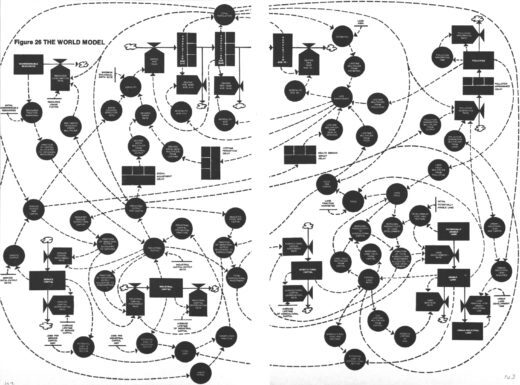
These think-tank papers all read the same. Mostly sensible rhetoric interspersed with wildly dystopian claims. Limits to Growth was the big one though. This changed our understanding of what solid science was from testable hypotheses to fanciful computer modelling. Garbage in, garbage out - as they say.
Have a look at the "world model" they created and you may be able to see the problem here:
Wonder how much finagling they had to do to get reportable model results.
Catastrophic man-made climate change (of the warming kind) gets a slim mention.
In short: updated Malthusian panic-mongering with obvious goal to unite world under global governance.
Classic work everyone must read. Even though it was written nearly 40 years ago, most of the general results are becoming true with every passing year.
Hea, et oluline teos on viimaks ka eesti keeles välja antud. Üle poole sajandi tagasi tehtud analüüs on oma põhiolemuses siiani aktuaalne ja tähistab olulist muutust arusaamas inimkonna majanduse tehnoloogia ja keskkonna omavahelistest mõjudest. Täna oodanuks väljaandest lisaks originaalmaterjalile ka toimetatud ja kommenteeritud versiooni. Kindlasti saanuks visuaalselt kaasajastada ka hulka graafikuid ning lugemise hõlbustamiseks palju rohkem vaeva näha väljaande küljendamisega. Sellest ka 3-tärni hinnang.
Raport "Granice wzrostu" opublikowany został w 1972. Jest w zasadzie matką matek koncepcji de-wzrostowych i/lub post-wzrostowych. Jego krytyki cechują się czasem pseudo-ekonomicznym myśleniem magicznym (typu: bo gdy dany materiał stanie się rzadki, jego cena wzrośnie, więc "wynajdzie SIĘ" jeszcze lepsze zamienniki), ale niektóre niesprawdzone do dziś przewidywania poważnie podważają model.
To co zwróciło moją uwagę to to, że autorzy piszą o emisjach dwutlenku węgla do atmosfery w wyniku spalania paliw kopalnych (szacun, pionierzy), ale zaraz potem antropogeniczny efekt cieplarniany wiążą z efektem ubocznym... ciepłem odpadowym. 🙃
W związku z tym najpierw (trafnie) konstatują, że atom może powstrzymać emisje CO2, ale zaraz potem dodają, że nawet jeśli uda się zastąpić spalanie paliw kopalnych energią jądrową to nie powstrzyma to efektu cieplarnianego (!).
"[...] zmierzona ilość CO2 w atmosferze rośnie wykładniczo, najwyraźniej w tempie około 0,2 procent rocznie. Tylko około połowa CO2 uwolnionego ze spalania paliw kopalnych faktycznie pojawiła się w atmosferze – druga połowa została najwyraźniej wchłonięta, głównie przez wody powierzchniowe oceanów."
"Jeśli potrzeby energetyczne człowieka będą kiedyś zaspokajane przez energię jądrową zamiast z paliw kopalnych, ten wzrost atmosferycznego CO2 w końcu ustanie, zanim przyniesie jakikolwiek wymierny efekt ekologiczny lub klimatyczny."
(ech, był 1972 i właśnie wtedy był najlepszy czas żeby to robić!)
"Istnieje jednak inny efekt uboczny zużycia energii, który jest niezależny od źródła paliwa. Zgodnie z prawami termodynamiki, zasadniczo cała energia wykorzystywana przez człowieka musi ostatecznie zostać rozproszona w postaci ciepła. Jeśli źródłem energii jest coś innego niż energia słoneczna (np. paliwa kopalne lub energia atomowa), to ciepło spowoduje ogrzanie atmosfery, bezpośrednio lub pośrednio, poprzez promieniowanie z wody używanej do celów chłodzenia. Lokalnie ciepło odpadowe lub 'zanieczyszczenia cieplne' w strumieniach powodują zakłócenie równowagi życia wodnego. Atmosferyczne ciepło odpadowe wokół miast powoduje powstawanie miejskich 'wysp ciepła', w obrębie których występuje wiele anomalii meteorologicznych. Zanieczyszczenie termiczne może mieć poważne skutki klimatyczne na całym świecie, gdy osiągnie pewien znaczący ułamek energii normalnie pochłanianej przez Ziemię ze słońca." s. 73.
Obecnie uznaje się, że antropogeniczny influx cieplny za zaniedbywalnie mały w porównaniu z wymuszeniami cieplnymi powodowanymi przez emisję gazów cieplarnianych. To pewnie byłoby kiedyś tam w przyszłości do poprawienia, ale na razie nie należy dać się ludzkości wygumkować zmianom klimatycznym powodowanymi przez dwutlenek węgla i metan.
This book is a remarkable demonstration of how the world system may be condensed to its simplest elements in a way that facilitates worthwhile analysis. Are there limits to growth of the world system? To me, the answer is obviously yes. This book analyses the consequences of that fact, as seen from the early 1970s.
The authors find that the basic behaviour mode of the world system is exponential growth of population and capital, followed by collapse. They conclude that, if there is no major change in the present [world] system, growth of population and industrial growth will certainly stop, and collapse, during the 21st century. This occurs with no change, or with any plausible technological change. By implication, the only way to avoid such collapse is by deliberately limiting population and capital growth.
According to Wikipedia, despite the report facing severe criticism and scrutiny upon its release, subsequent research consistently finds that the global use of natural resources has since been inadequately reformed to alter its basic inferences. Criticism seems to have arisen from a failure to comprehend what the report if saying, or from those (economists, industrialists, investors and politicians) with vested interests in maintaining the present system.
Although ‘pollution’ is one of the main limiting factors included in this analysis, and the exponential increase in atmospheric CO2 is recognised (p.73), the authors merely state ‘If man’s energy needs are someday supplied by nuclear power instead of fossil fuels, this increase in atmospheric CO2 will eventually cease, one hopes before it has had any measureable ecological or climatological effect.’ From a modern perspective, it looks as if climate change as a consequence of the ‘pollution’ of CO2 is going to be a major cause of population and economic collapse. So it seems that the authors were correct, even if they didn’t predict the details - this hardly matters.
This book, and all its previous versions, may someday be seen as one of the critically important modern guideposts for humanity. Its wisdom is a cornerstone for both my novels and non-fiction books.
I was at MIT when the research behind Limits to Growth was being started. I followed Dennis and Donella's efforts (primary authors) since that time. I briefly spoke with Dennis about my effort in 2010 to write LIARS! His 40-year experience, with such high international support in the 70's, only to be squashed by commercial disinformation, plus the loss of Donella in '01, left him pretty discouraged. His "..too late for sustainable development" speech to the Smithsonian in 2012 shows this. (see my website LINK page) I would welcome his involvement in any way he offered. Some of the concepts he presented in the Smithsonian talk have become part of my follow-on writings (the Collapse 2020 series). What makes my writing different from Limits is that, while incorporating the Limits vision, I also explain the specific human behaviors that drove society to accept the disinformation that blocked it. Limits did not get into specific human behavioral details. Any forward-looking efforts need to know this to avoid also being suppressed. People who know the set of books begun with Limits (every 10 years there was a follow-up) will see Collapse 2020 as an extension of it.
A good effort at modeling the economic/environmental interactions of the world and a call to action to help us avoid collapse in the next hundred years or so. We need to put capital into technologies that reduce pollution, increase food/hectare of land, reduce erosion, use resources efficiently etc. This is necessary but not sufficient. We need to reduce the material throughputs of the system by consuming less (lowering our material standard of living in the industrialised countries and raising it in poorer countries), recycling more, gathering better data on the rate of depletion of natural resources, planning and legislating sustainable use quotas, and pricing environmental costs appropriately. Very factual and measured book. I enjoyed it thoroughly and feel I have a much better understanding of the structure of global economic systems.
Il testo fondamentale, nel suo ultimo aggiornamento, per comprendere le dinamiche di quel sistema enormemente complesso che è l'antroposfera. Con modelli matematici di formulazione complicata, ma qui esposti in modo molto semplice e chiaro, vengono mostrati i rischi di collasso della società globale a causa dei limiti strutturali (risorse, inquinamento) generalmente ignorati dalla religione economica: e si evidenzia, con una serie di scenari calibrati, come il nostro margine di azione per un futuro sostenibile si restringa ogni minuto. É necessario agire, subito, senza indugi e senza mezzi termini.
Come ha affermato Dennis Meadows al 5° congresso mondiale dell'ASPO: non ci sarà un nuovo aggiornamento di questo studio. Il dado è tratto: il momento è giunto.
Interesting book, not something you will stay awake to finish. Is is made to be read in the early 2000s, so it is a bit late now. Nevertheless, the concepts are interesting. They explain systemic mechanisms of our modern world and our impact on our planet in a very clear way. For instance how fertility (nb of children per woman) impacts poverty. How can the global political, scientific, and economic system can react to an ecology crisis (on the ozone layer topic). The reason why do overshoot and collapse occur in most scenarios for our future.
I had to read this book so I could critique it in my thesis as part of the theoretical framework of a particular sociologist’s work. As expected, I found it to promote anti-feminist reproductive control sentiment which ignores the impact that population control policy places on indigenous and global South women. The pros include that the authors repeatedly state their report cannot be fully accurate and requires critique and change. Anyway I didn’t find anything enlightening.