

What do you think?

Edom Frrit-Flakk Humbug
“Yüzyıllar boyunca birbirlerini katletmelerine ve geçimsizliklerine karşın insanoğlu, bir an bile doğaya karşı olan savaşını bırakmamış, hatta her geçen gün daha büyük zaferler kazanmıştı. (...) İnsanlık, yalnızca kaslarıyla değil beyniyle de hayatını sürdürmüştü ve anlamsız savaşlarla kendini mahvedeceği yerde düşünmüş, bunun sonucunda da son iki yüzyılda bilgiye ve madenin ehlileştirilmesine doğru daha büyük adımlarla ilerlemeye başlamıştı.”
Gelişmiş bir uygarlıkta muktedirlerin buluştukları bir resepsiyon, doğanın güçleri karşısında her şeye rağmen ne kadar aciz kalacaklarını gösterecek bir tufanın başlangıcına denk gelirse... Kasabasının efendisi olduğuna inanan merhametsiz bir doktor, bir gece ölüm döşeğinde bir hastaya çağrıldığında reddedebilecek cüreti bulduğunda ne kaybedeceğini bilmezse... Yeni dünyaya devasa sermayesiyle gelen Avrupalı esrarengiz bir işadamının gizemlerini sakladığı görkemli binanın sırları çözülmeye kalkışılırsa...
Jules Verne’in sınırsız hayal gücünden doğan üç fantastik öykü: Başka dünyalara göz kırpan “Edom”, insanın habis karakterini aydınlatan mesel “FrritFlakk” ve muktedirlerin gizemlerini aralamaya çalışan “Humbug”... Çağdaşlarıyla dirsek teması kurduğu mini cevelanlar...
Gelişmiş bir uygarlıkta muktedirlerin buluştukları bir resepsiyon, doğanın güçleri karşısında her şeye rağmen ne kadar aciz kalacaklarını gösterecek bir tufanın başlangıcına denk gelirse... Kasabasının efendisi olduğuna inanan merhametsiz bir doktor, bir gece ölüm döşeğinde bir hastaya çağrıldığında reddedebilecek cüreti bulduğunda ne kaybedeceğini bilmezse... Yeni dünyaya devasa sermayesiyle gelen Avrupalı esrarengiz bir işadamının gizemlerini sakladığı görkemli binanın sırları çözülmeye kalkışılırsa...
Jules Verne’in sınırsız hayal gücünden doğan üç fantastik öykü: Başka dünyalara göz kırpan “Edom”, insanın habis karakterini aydınlatan mesel “FrritFlakk” ve muktedirlerin gizemlerini aralamaya çalışan “Humbug”... Çağdaşlarıyla dirsek teması kurduğu mini cevelanlar...
96 pages, Paperback
First published January 1, 1884
About the author
Jules Verne
7,696 books12.5k followersNovels of French writer Jules Gabriel Verne, considered the founder of modern science fiction, include
Journey to the Center of the Earth
(1864) and
Around the World in Eighty Days
(1873).
This author who pioneered the genre. People best know him for Twenty Thousand Leagues Under the Sea (1870).
Verne wrote about space, air, and underwater travel before people invented navigable aircraft and practical submarines and devised any means of spacecraft. He ranks behind Dame Agatha Mary Clarissa Christie as the second most translated author of all time. People made his prominent films. People often refer to Verne alongside Herbert George Wells as the "father of science fiction."
https://en.wikipedia.org/wiki/Jules_V...
This author who pioneered the genre. People best know him for Twenty Thousand Leagues Under the Sea (1870).
Verne wrote about space, air, and underwater travel before people invented navigable aircraft and practical submarines and devised any means of spacecraft. He ranks behind Dame Agatha Mary Clarissa Christie as the second most translated author of all time. People made his prominent films. People often refer to Verne alongside Herbert George Wells as the "father of science fiction."
https://en.wikipedia.org/wiki/Jules_V...
Ratings & Reviews
Friends & Following
Create a free account to discover what your friends think of this book!
Community Reviews
Displaying 1 - 30 of 33 reviews

March 12, 2024
Read in Black Water together with The Short Story Club. A well written spooky short story about a doctor who is called to attend a very ill person. It also include a storm and a volcano eruption.

February 2, 2024
A wonderful, spooky fable that, unusually for Verne, makes no attempt at explanations, whether scientific or otherwise.
It opens, justifiably breaking Elmore Leonard’s first rule for writers (here):
“Swish! It is the wind, let loose.
Swash! It is the rain, falling in torrents.
This shrieking squall bends down the trees of the Volsinian coast, and hurries on, flinging itself against the sides of the mountains of Crimma. Along the whole length of the littoral are high rocks, gnawed by the billows of the vast Sea of Megalocrida.”
Apart from the weather, it’s oddly unfamiliar, with a very visual, but slippery sense of time and place: a strange village of belvederes (only Manguel's translation, which I read first), on a hill, beside water, made me think of Portmeirion, but there’s a volcano, “Arab quarters”, and “bushes and ferns, somewhat like Britanny” [sic]. Even the units of distance (kertses) and currency (fretzers) are of unknown magnitude. Without the storm, it would still make me uneasy.
“A belfry overlooks the town, the square belfry of Saint Philfilena, with bells hung in the thickness of the walls, which sometimes a hurricane will set in motion. That is a bad sign; the people tremble when they hear it.”
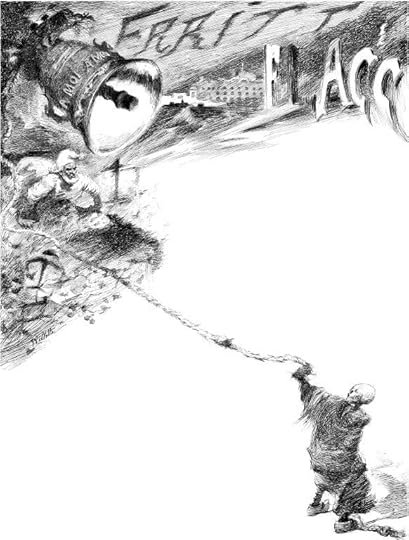
Image: Etching of the doctor being summoned from bed, as the bell tolls, lured by the figure of Death. (Source)
On this dark and stormy night, three women come, one after the other, to knock at the door of the doctor’s grand house, but he won’t attend a patient without cash up front.
“Dr Trifulgas is not superstitious. He believes in nothing - not even in his own science, except for what it brings him in.”
The third woman knocks three times. Ominous.
The twist was predictable before it was revealed, but it was very well told, and I like being left to draw my own conclusions.
(Mis)Translation
This story is onomatopoeically titled “Frritt-Flacc” in the original French, but Manguel prosaically calls it “The Storm”. Manguel loses that sort of wordplay, and also, unaccountably, omits three final paragraphs that compound the air of spooky mystery, and makes less mention of Hurzof, the dog who carries the lamp. He correctly translates “Bretagne”, but misspells it as “Britanny” and adds a weird pre-burial ritual of being “bathed in beer” (it's not a typo for “bier”)!
I found a much better, anonymous, translation from 1892 here, and that's where the quotes above are from.
That said, occasionally, I preferred Manguel:
“The sea looks white, livid, mourning-white. It dazzles the eye as it shatters against the phosphorescent rim of the surf, spilling bucketfuls of glistening worms on the sand.”
versus anon's:
“The sea is white with livid whiteness - a mourning white. It sparkles as it throws off the crests of the surf, which seem like outpourings of glow-worms.”
See also
• Don’t confuse this with Kate Chopin’s story called The Storm, read with Short Story Club last year. It’s equally good, but utterly different. See my review HERE.
• The three women, .
• Medice, cura te ipsum.
Short story club
I read this in Black Water: The Anthology of Fantastic Literature, by Alberto Manguel, from which I’m reading one story a week with The Short Story Club, starting 4 September 2023.
You can read this story in English here.
Manguel's pedestrian translation, from his anthology, is here.
The French original is here.
You can join the group here.
It opens, justifiably breaking Elmore Leonard’s first rule for writers (here):
“Swish! It is the wind, let loose.
Swash! It is the rain, falling in torrents.
This shrieking squall bends down the trees of the Volsinian coast, and hurries on, flinging itself against the sides of the mountains of Crimma. Along the whole length of the littoral are high rocks, gnawed by the billows of the vast Sea of Megalocrida.”
Apart from the weather, it’s oddly unfamiliar, with a very visual, but slippery sense of time and place: a strange village of belvederes (only Manguel's translation, which I read first), on a hill, beside water, made me think of Portmeirion, but there’s a volcano, “Arab quarters”, and “bushes and ferns, somewhat like Britanny” [sic]. Even the units of distance (kertses) and currency (fretzers) are of unknown magnitude. Without the storm, it would still make me uneasy.
“A belfry overlooks the town, the square belfry of Saint Philfilena, with bells hung in the thickness of the walls, which sometimes a hurricane will set in motion. That is a bad sign; the people tremble when they hear it.”
Image: Etching of the doctor being summoned from bed, as the bell tolls, lured by the figure of Death. (Source)
On this dark and stormy night, three women come, one after the other, to knock at the door of the doctor’s grand house, but he won’t attend a patient without cash up front.
“Dr Trifulgas is not superstitious. He believes in nothing - not even in his own science, except for what it brings him in.”
The third woman knocks three times. Ominous.
The twist was predictable before it was revealed, but it was very well told, and I like being left to draw my own conclusions.
(Mis)Translation
This story is onomatopoeically titled “Frritt-Flacc” in the original French, but Manguel prosaically calls it “The Storm”. Manguel loses that sort of wordplay, and also, unaccountably, omits three final paragraphs that compound the air of spooky mystery, and makes less mention of Hurzof, the dog who carries the lamp. He correctly translates “Bretagne”, but misspells it as “Britanny” and adds a weird pre-burial ritual of being “bathed in beer” (it's not a typo for “bier”)!
I found a much better, anonymous, translation from 1892 here, and that's where the quotes above are from.
That said, occasionally, I preferred Manguel:
“The sea looks white, livid, mourning-white. It dazzles the eye as it shatters against the phosphorescent rim of the surf, spilling bucketfuls of glistening worms on the sand.”
versus anon's:
“The sea is white with livid whiteness - a mourning white. It sparkles as it throws off the crests of the surf, which seem like outpourings of glow-worms.”
See also
• Don’t confuse this with Kate Chopin’s story called The Storm, read with Short Story Club last year. It’s equally good, but utterly different. See my review HERE.
• The three women, .
• Medice, cura te ipsum.
Short story club
I read this in Black Water: The Anthology of Fantastic Literature, by Alberto Manguel, from which I’m reading one story a week with The Short Story Club, starting 4 September 2023.
You can read this story in English here.
Manguel's pedestrian translation, from his anthology, is here.
The French original is here.
You can join the group here.

February 5, 2024
"The Storm" is an English translation of Jules Verne's French short story, "Frritt-Flacc." It's an atmospheric story with the wind whipping, the rain pouring, and a nearby volcano erupting. A miserly doctor has been summoned to tend to a critically ill patient. Verne has given the story a horrific twist.

February 3, 2024
“Outside, Hurzof the dog starts to howl once again, pausing at regular intervals, like a cantor between the versicles of a psalm.”
According to Wikipedia, “Frritt expresses the sounds of a roaring hurricane and flacc the sound of falling streams of water during a rainstorm.” That is immensely more evocative than the English translation, “The Storm.”
Verne takes us into this storm, and tells a tale using many other unusual descriptive words. A slightly psychological little journey into the darkness. Very fun.
According to Wikipedia, “Frritt expresses the sounds of a roaring hurricane and flacc the sound of falling streams of water during a rainstorm.” That is immensely more evocative than the English translation, “The Storm.”
Verne takes us into this storm, and tells a tale using many other unusual descriptive words. A slightly psychological little journey into the darkness. Very fun.

September 23, 2019
Denizler Altında 20.000 Fersah, 80 Günde Devr-i Alem, 2 Yıl Okul Tatili, Dünyanın Merkezine Seyahat Jules Verne'in hep bildiğimiz, popüler romanları. Bu komik isimli kitap ise Jules Verne kitaplığına derinlemesine girmesem muhtemelen bilmeyeceğim, birbirinden ilginç üç öyküden oluşan fantastik bir eser. Evet, Jules Verne fantastik de yazmış ve gayet de iyi olmuş. Tabi ki kendi coğrafya uzmanlığı bir şekilde bu hikayelere de girmiş ama özellikle Edom keşke kısa bir öykü değil, başlı başına bir kitap olsaydı dedim.

February 4, 2024
No need to write a review of this story...Cecily has said it all:
https://www.goodreads.com/review/show...
https://www.goodreads.com/review/show...

September 17, 2025
FRANÇAIS: Une très courte nouvelle fantastique de Verne sur un médecin cupide
ESPAÑOL: Relato fantástico muy corto de Verne sobre un médico avaricioso
ENGLISH: A very short fantasy story by Verne about a greedy doctor
ESPAÑOL: Relato fantástico muy corto de Verne sobre un médico avaricioso
ENGLISH: A very short fantasy story by Verne about a greedy doctor

June 15, 2023
I’ve been reading a lot about empathy lately. Not on purpose. It just seems to find me.
This short story runs you about 3 pages, to which I found in the the collection of short stories, “Black Water” by Alberto Manguel.
“The Storm” is a very introspective tale about compassion and self-destruction. I will definitely be reading more Verne after this introduction.
This short story runs you about 3 pages, to which I found in the the collection of short stories, “Black Water” by Alberto Manguel.
“The Storm” is a very introspective tale about compassion and self-destruction. I will definitely be reading more Verne after this introduction.

February 3, 2024
"The Storm" is how this story appears in English, and it is a tale of the supernatural, or perhaps an example of the self-delusion we all practice to one degree or another.
Reading this as part of a group exploring the depths of Black Water: The Anthology of Fantastic Literature, which features stories (such as this one) translated by the editor Alberto Manguel.
Having reached the stage in this anthology where one starts to perceive similarities in stories and anticipate the outcomes; the weight and wallop of the denouement are diminished.
Reading this as part of a group exploring the depths of Black Water: The Anthology of Fantastic Literature, which features stories (such as this one) translated by the editor Alberto Manguel.
Having reached the stage in this anthology where one starts to perceive similarities in stories and anticipate the outcomes; the weight and wallop of the denouement are diminished.

February 11, 2024
Read in English. This was a great story basically describing a major comeuppance. I wish my French were better to read this in French!

July 16, 2025
“Y la ventana se cerró. ¡Veinte fretzers! ¡Bonito hallazgo! ¡Arriesgarse a un catarro o a unas agujetas por veinte fretzers, sobre todo cuando mañana le esperan en Kiltreno, en casa del rico Edzingov, el gotoso, cuya gota le representa cincuenta fretzers por cada visita!” ~ Frritt-Flacc de Jules Verne.
Un breve cuento en el conocemos al doctor Trifulgas, más rácano imposible, se niega a atender a aquellos pacientes que no dispongan de dinero para cubrir sus honorarios.
Una noche de viento (Frritt) y lluvia (Flacc), los pacientes llaman a su puerta (Floc) pero Trifulgas no atiende sin dinero de por medio hasta que una vieja viene a llamarlo para atender al hornero y tras echar cuentas, el médico decide seguirla.
Breve cuento en el que los sonidos tienen un papel importante en la musicalidad de esta historia. Me ha recordado a Un médico rural de Kafka y se me ha quedado un poquito corto pero, vamos, es un cuento.
Un breve cuento en el conocemos al doctor Trifulgas, más rácano imposible, se niega a atender a aquellos pacientes que no dispongan de dinero para cubrir sus honorarios.
Una noche de viento (Frritt) y lluvia (Flacc), los pacientes llaman a su puerta (Floc) pero Trifulgas no atiende sin dinero de por medio hasta que una vieja viene a llamarlo para atender al hornero y tras echar cuentas, el médico decide seguirla.
Breve cuento en el que los sonidos tienen un papel importante en la musicalidad de esta historia. Me ha recordado a Un médico rural de Kafka y se me ha quedado un poquito corto pero, vamos, es un cuento.

February 7, 2024
Read in translation as part of the Short Story Club group read and much debate about translation in general ensued .

August 9, 2021
Un avaro medico, che trascura l'aspetto umanitario della sua professione lavorando solo per i ricchi, rifiuta di visitare un morente fornaio perché i suoi famigliari gli offrono poco denaro. Quando finalmente accetta la somma proposta, giunto alla porta del fornaio realizza di trovarsi nella propria abitazione, vedendo con paura e stupore il proprio corpo steso sul letto. Un bellissimo racconto allegorico che esorta ad una visione meno egoista e più empatica della vita. Bilanciando perfettamente umorismo ed horror, Jules Verne si riconferma eccellente narratore anche nei suoi racconti brevi.

April 15, 2022
Me ha gustado este relato corto. Verne saliendo de su habitual narración de aventuras este es más una historieta de misterio o de terror en otros tiempos. Es entretenido y breve.

February 27, 2024
This story is called “The Storm” in English, but is not available in Goodreads in English to review.
There is a roaring storm in Volsinian beside the Crimma mountains.
There is a little village of a few hundred houses called Luktrop. The Vanglor volcano is nearby.
During the day, the “inner cauldron” releases sulphur fumes, while at night it spews forth long flames.
A notable building in Luktrop is the Six-Four.
In the square tower of Saint Philifenus the bells are tolling in the storm. When this happens, the villagers call it an evil omen.
A miserly doctor called Doctor Trifulgas lives in Six-Four.
A young girl knocks on the door and asks the doctor to come to her father, who is dying. His name is Vort Kartif.
Dr Trifulgas only sees his patients after receiving payment in cash.
He has a dog called Old Hurzof.
Vort Kartif is a poor man so the doctor lies down again.
Twenty minutes later Vort Kartif’s wife knocks on the door and tells him that if he refuses to come the man will die.
She has twenty fretzers for him for payment.
Then Vort Kartif’s mother knocks firmly on the door and tells him the man has had a seizure.
The doc says “”May his mother, his wife and his daughter perish with him.”
He tells her that a seizure costs 200 fretzers, but the mother replies that they only have 120.
After careful thought the doc concludes that 120 fretzers for an hour and a half’s walk plus a half-hour visit is about a fretzer a minute – a small profit, but not bad.
So the doctor puts on his outdoor clothes, his marsh-boots, his fur cape, his woollen hood and his warm mittens.
Then he steps outside and collects the 120 fretzers from the woman.
He whistles for Hurzof and sets out. He hangs a small lamp from its mouth.
The bells of Saint Philifenus are tolling in the wind – a bad sign.
The doc is not superstitious, he believes in nothing but profit.
In Vanglor’s “leaping flames” quaint figures seem to struggle.
The doc and the old woman follow the road by the coast.
He is shown Vort Kartif’s house.
The dog howls.
Suddenly the Vanglor shakes, “a sheaf of flames sprouts up into the sky” and the doc falls backwards.
He gets up and makes his way to the house.
It looks like Six-Four, his own house, with the same windows and the same narrow door.
The door is ajar, he only has to push.
The dog howls. Inside, the house is exactly the same as his own house.
He climbs the stairs and recognizes his own room. Even his Code is open at the same page, 197.
Doctor Trifulgas is afraid. He pulls the curtain around the bed and peers at the dying man lying motionless.
He cries and his dog gives a sinister howl.
It is not Vort Kartif, it is Doctor Trifulgas himself, struck down by an apoplectic seizure.
It is he himself who is going to die.
He pierces a vein in the dying man’s arm, but the blood does not rise.
The man sits up and utters one final cry.
And the doctor falls dead into his own arms.
Next morning Dr Trifulgas’s body is found in Six-Four.
Dr Trifulgas has met his fate.
Nature, including the storm, the flames of the volcano, and the howls of the dog indicate something bad is about to happen.
Also, the evil omen of the tolling of the bells.
The sea looks “mourning-white".
Also, the doc falls backwards before proceeding to the house of the dying man.
There is a roaring storm in Volsinian beside the Crimma mountains.
There is a little village of a few hundred houses called Luktrop. The Vanglor volcano is nearby.
During the day, the “inner cauldron” releases sulphur fumes, while at night it spews forth long flames.
A notable building in Luktrop is the Six-Four.
In the square tower of Saint Philifenus the bells are tolling in the storm. When this happens, the villagers call it an evil omen.
A miserly doctor called Doctor Trifulgas lives in Six-Four.
A young girl knocks on the door and asks the doctor to come to her father, who is dying. His name is Vort Kartif.
Dr Trifulgas only sees his patients after receiving payment in cash.
He has a dog called Old Hurzof.
Vort Kartif is a poor man so the doctor lies down again.
Twenty minutes later Vort Kartif’s wife knocks on the door and tells him that if he refuses to come the man will die.
She has twenty fretzers for him for payment.
Then Vort Kartif’s mother knocks firmly on the door and tells him the man has had a seizure.
The doc says “”May his mother, his wife and his daughter perish with him.”
He tells her that a seizure costs 200 fretzers, but the mother replies that they only have 120.
After careful thought the doc concludes that 120 fretzers for an hour and a half’s walk plus a half-hour visit is about a fretzer a minute – a small profit, but not bad.
So the doctor puts on his outdoor clothes, his marsh-boots, his fur cape, his woollen hood and his warm mittens.
Then he steps outside and collects the 120 fretzers from the woman.
He whistles for Hurzof and sets out. He hangs a small lamp from its mouth.
The bells of Saint Philifenus are tolling in the wind – a bad sign.
The doc is not superstitious, he believes in nothing but profit.
In Vanglor’s “leaping flames” quaint figures seem to struggle.
The doc and the old woman follow the road by the coast.
He is shown Vort Kartif’s house.
The dog howls.
Suddenly the Vanglor shakes, “a sheaf of flames sprouts up into the sky” and the doc falls backwards.
He gets up and makes his way to the house.
It looks like Six-Four, his own house, with the same windows and the same narrow door.
The door is ajar, he only has to push.
The dog howls. Inside, the house is exactly the same as his own house.
He climbs the stairs and recognizes his own room. Even his Code is open at the same page, 197.
Doctor Trifulgas is afraid. He pulls the curtain around the bed and peers at the dying man lying motionless.
He cries and his dog gives a sinister howl.
It is not Vort Kartif, it is Doctor Trifulgas himself, struck down by an apoplectic seizure.
It is he himself who is going to die.
He pierces a vein in the dying man’s arm, but the blood does not rise.
The man sits up and utters one final cry.
And the doctor falls dead into his own arms.
Next morning Dr Trifulgas’s body is found in Six-Four.
Dr Trifulgas has met his fate.
Nature, including the storm, the flames of the volcano, and the howls of the dog indicate something bad is about to happen.
Also, the evil omen of the tolling of the bells.
The sea looks “mourning-white".
Also, the doc falls backwards before proceeding to the house of the dying man.

December 29, 2018
A good short story, nothing more, nothing less. Worth reading before sleeping like a pills.
February 19, 2019
Excelente cuento, con un fuerte mensaje!

January 22, 2020
Es un cuento corto..

February 17, 2020
Está bueno, me gusta la enseñanza que deja.

December 23, 2021
relectura ya que no me acordaba de la historia que es, simplemente, increíble.

December 30, 2021
Un cuento súper cortitito, con un giro raro y a la vez esperado al final.
April 24, 2023
Terminado, me ha sorprendido gratamente, este relato cortisimo de Julio Verne.
Una pequeña joya del terror.
Una pequeña joya del terror.

February 2, 2024
3.5 Stars.
Read it in French for The Short Story Club.
Read it in French for The Short Story Club.
February 4, 2024
Where does lack of compassion and self destruction leave us?

February 11, 2024
Thank you Cecily. What a ride. a very short, beautifully (strangely) written fantasy. Reminded me of Borges.
Frritt-Flacc https://en.wikisource.org/wiki/Frritt...
Frritt-Flacc https://en.wikisource.org/wiki/Frritt...
May 11, 2024
** 1/2


June 17, 2026
Rien de neuf. Courte nouvelle.

January 29, 2024
Something is brewing amidst the misty ruins, not to ruin it for the dear reader, but the spectre (of the specter) of the old doctor who will soon rue in-house visitations, not before an onslaught of colorful nadsat verbiage that brings to my mind A Clockwork Orange - will the doctor's prescription for reform reform him as a herring-salter or is it vice versa, the literary devices devise his demise for unrequited vices and so it transposes from ghastly to ghostly; hence all in all a horrorshow horror show

January 4, 2013
Otro cuento corto que me encontré por ahí. Más que horror te deja en total suspenso.
Displaying 1 - 30 of 33 reviews