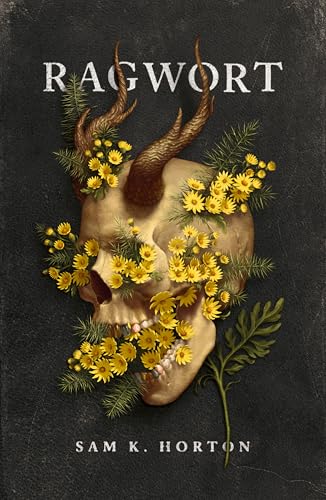
A year on from the loss of Lord Pelagius Hunt of Mirecoombe, new Keeper Nancy Bligh is still struggling. She can banish the spirits and keep peace between the spriggans and piskies, but every time Nancy sleeps, she dreams of drowning. She is haunted by loss, and by whispers from all around of The Mother, and Nancy's witchcraft.
As the only witch left, Nancy is eager for any guidance she can have. When she discovers the possibility that her grandmother, the most powerful witch of her time, might still live, she seizes her chance.
Desperate for answers, Nancy journeys across the Cornish wilds to find her grandmother and uncover the secrets of The Mother, before it is too late.
I loved Gorse last year and couldn't wait to for Ragwort. I'm very pleased that it didn't disappoint.
Ragwort picks up roughly a year after the end of Gorse with Nancy struggling to fill the role of Keeper that she's inherited from Pel. Mirecoombe is still reeling from the disaster of the previous year with everyone searching for someone or something to put their faith in. Some have returned to the old ways, some continue to worship in the ruined church and some seek something new.
Changes are afoot with the arrival of a new priest. a strange song has seeped in to the minds of the villagers and Nancy, desperate for a family connection, travels to coast to find her lost grandmother. But does she have good intentions? Who is the Mother that is suddenly being whispered of by the folk and what of the saint found in the foundations of the church? Nancy must unravel the mysteries and learn to trust her own power.
Nancy is a compelling, if flawed, main character. She's struggling with grief whilst shouldering the burden of protecting the moor, the village and the folk - trying to keep the balance between them all. She's still young and her desperation for a sense of family and belonging causes her to be somewhat naïve. But she's also strong and compassionate, so you still root for her and forgive her mistakes.
As with Gorse, the writing is beautiful. Horton's strength is really in making the landscape feel tangible and lived in. The folk aren't cute and nice but wild, dangerous and believably rooted in the moor. This sequel also picks up the clash of faiths, old and new, whilst adding a new focus on the power of stories.
An excellent sequel and I hope there will be more to come from the series
Thanks to Solaris for providing me with a review copy
The Eythin Legacy series is a historical Fantasy, mixed with folk horror – my two favourite subgenres, no wonder I am absolutely in love with this world. Gorse was under my top five books of last year, so the expectations for the second instalment of this series were high!
After a year full of troubles with the creatures of the Cornish moor, keeper and witch Nancy Bligh needs to deal with yet another problem: whispers of a “mother” are haunting the rural village. Nancy must find her long lost grandmother to get to the roots of this…
Nancy is a compellingly written main character. She is still quite young, still coming-of-age. She is struggling with love, with wanting to belong to a community, with her unpolished magic, constantly questioning herself always, makes big mistakes, but is never hateful or ignorant to creatures and people. I loved the themes of compassion and of finding light in a seemingly dark world through community. The sapphic love story on the side was very well done. When it comes to world building and magic, my review of the first book still stands: the world and magic is so embedded in Cornish folklore, it feels almost like a world that was once truly real. Magic is neither good nor bad, it just is, depending with what intention it is used it can heal or destroy. The writing was a little less uniquely, maybe a little more polished this time, still intentional and creating this dense atmosphere of Cornish landscapes. One thing I did not like though was how unclear the action scenes were to me. I had difficulty to follow them correctly.
All in all: this series is just right for me. I want to read more of Nancy Bligh.
Thanks to Solaris, for providing me with a review copy via Netgalley.
“I will be with you in the dark until you remember there is light and together we will find it“ The found family in this was so touching and the growth of Nancy feeling comfortable in herself and in her friends around her made this a really entertaining read. At times I was a little confused but events were quickly explained after so it didn’t bother me as much. Thank you for allowing me to read this as an ARC edition NetGalley
Gorse (book 1) was one of my favorite five star books from 2025 so I knew I wanted to kick-off the new year with the 2nd 1/2 of this duology.
Horton has built something special here. It’s cozy horror, which is apparently the only kind of horror I like to consume. 🤭😅
The friendship threads in this were my favorite scenes with some of the best lines. Although I didn’t necessarily connect as strongly with the romance or toxic grandmother threads in this- this really felt like a cool, unique TBR gem.
Highly recommend when your mood reading wants clever folklore.
Note: Book 2 isn’t released in the US yet, so I ordered through Blackwells.
Thank you to the publisher and Netgalley for approving me to read this book, I’m rating it 4.0 stars.
I still adore these characters and I’m so glad we got a second book to expand on the world and the mythical creatures we come across. This book takes lore and myth, and brings to life a really interesting story. I like the turn book 2 takes, it feels even more compelling than book 1 with the connection to family history and it still remains a little dark and twisted.
I really recommend this book especially for the autumn season, it’s an ideal read.
I so enjoyed ‘Gorse’ by Sam. K. Horton, and was equally enchanted by ‘Ragwort’ – packed with legend, magic, witchcraft, atmosphere, unexpected and engaging characters, all dispensed in equal measure. The descriptions of the parallel universes – the moors and the underworld – are so cleverly intertwined and described with beguiling imagination.
3.5 ⭐️ Thank you to netgalley and Solaris Books for sending me this arc in exchange for an honest review.
Spoilers ahead.
Now originally when I applied for this arc I didn’t realise it was a sequel so I ended up reading gorse before this, I must say I think I prefer this one to the first book. Horton gives us everything I loved in gorse and given us more! We got more answers to Nancy’s murmur and I adore Nancy as a character so her story was so intriguing and I loved how she came to her own in this one. Plus the added sapphic story shocked me! I love a good sapphic love story and Nancy being sapphic is *chefs kiss*
I admittedly do have a couple of queries for this book though, how Nancy didn’t listen to literally anyone and continuously continued to trust Meloria but I guess she was blindsided as she was family. I also wasn’t a fan of how quickly the final fight happened, and all the characters just died and couldn’t be reversed kind of annoyed me, I think Madge hurt the most, she didn’t get to go to the undermoor and reunite with Pel and Jacob but oh well we can’t have it all.
At the end of the day, Sam K Horton knows how to write a compelling folklore, witchy story! It took a while to pick up for me but when I got to 50% I couldn’t put this book down.
This entire review has been hidden because of spoilers.
THIS MAN KNOWS HOW TO WRITE WITCHERY!! This book is brimming with my own preferred brand of folk witchcraft and plant lore. It also has elements of botanical, folk and body horror - the sort that creeps into your bones rather than smacks you in the face.
In this second book, we are treated to a slice of Cornish coastal folklore and creatures alongside the earthy moorland and the two are combined perfectly, depicted with Sam's lush, whimsical, yet slightly unsettling detail. Nancy is both badass and vulnerable in this story. She makes mistakes and learns some lessons, but her cast of supporting characters (human, underfolk, friend and foe) are intriguing.
This book speaks to family, unlikely alliances, hidden motives, being careful of what you wish for, and a deep desire for reconciliation between the old ways and the new giving life to old stories. There is power in names and tales, and this lesson is learned the hard way here.
I have had to wait and digest this book before I could give my review. But let me start by saying we have another beautful cover. This first book Ragwort has stayed with me since reading it and looking back has actually become one of my favourite reads this year. So when I saw this book advertised I was very excited to get my hands on a copy.
We return to Mirecommbe, Cornwall, a year after the loss of (Pen) Lord Pelagius Hunt of Mirecoombe. Nancy Bligh is now the new keeper, and trying her hardest to bring balance to the moor. Various religious groups are forming, either worshiping the old gods or the new. Still relaving from her grief and anger at the loss of her beloved father, whilst trying to understand and harbour her powers, Nancy is feeling all sorts of emotions. Whispers on the wind from the otherfolk talk of The Mother returning. Intreagued and horrified by this Nancy wonders her fate, and if she will finally find out her capabilites as the mother is her grandmother.
As with the previous book the writing is beautifully descriptive. So much so, that you can transport yourself to Cornwall and feel the damp cold of the moors and even smell the peat if you try hard enough. It is full of magic, myth and creatures of folklore. Another beautiful addition to what I presume with be a trilogy. The author left some unanswered questions that it feels right another book will follow.
I have to say that I didn't love this one as much as the previous book, at times it felt a little slow paced and repetative. I also felt Nancy who was head strong, couragous and extremely brave in book one, second guessed herself a lot in this book and wasn't quite the same character, I admired previously. Having said that it is probably the point and due to her circumstances. I will here for the next book and am excited to stay in this world.
Thank you to NetGalley and Rebellion Publishing Ltd for a copy of this book in exchange for an honest review.
A beautiful series rooted in Cornish folklore. This was a worthy successor to Gorse. I read an eARC of this book so thank you to the author and the publisher.
This continues in the same vein as Gorse, but with new challenges our keeper must face. I would definitely recommend reading the two books in order so you can see the growth of the character and recognise characters from Gorse in Ragwort.
Across both books I absolutely love the use of nature and folklore. These books are so richly gorgeous, with the creatures and botanicals so vividly imagined. We have an entertaining story as well but I could read this book just for the descriptions alone and still have a good time. I love how evocative this is and it’s so easy to picture the setting.
It’s easy to root for the main character in this, to sympathise with her for the challenges and losses she’s faced, to feel frustrated when her good nature lets her be led astray and to passionately wish for her success.
This was entertaining, beautiful and a great follow up to Gorse.
With thanks to NetGalley and the Publisher for an advance copy in exchange for an honest review.
Here’s another golden gem of a book by SK Horton. Like its predecessor, Ragwort is full of delicate and clever imagery, bringing the reader to a Cornwall full of magic and wonder. The writing demands a slowing down; for each sentence to be read without hurry and with attention. The writing, as always, is exquisite, though I will admit the plot does stall on occasions. There are aspects of the story that remain unsolved, and entire chapters that didn’t seem to add anything to the overall arc, and this did make it feel rather slower than necessary at times. Having said that, I’m assuming there will be a third book, and I can’t wait to re-join Nancy and those close to her when it arrives.
A beautifully eerie tale of Cornish folklore, faith and the folk below.
This is such a wonderfully written story. Following on from Gorse, Ragwort sees Nancy, now the Keeper of the Moor, set about releasing her Grandmother, while the village tries to heals from the events of a year ago.
I enjoyed Gorse, and if anything this one was better as we see Nancy come into her own powers more.
I adored the folktale vibes of this book. Steeped in the magic of the world below, of the creatures of folk tales this book was a truly caprivating read. The world the author created in this book was crafted around the kind of tales that get whispered in the dark and passed down for generations.
In this book you get to immerse yourself in a story that truly relays the beauty of nature, and is filled with creatures of myth and magic.
Thanks to netgalley for my gifted ebook. All thoughts are my own.
Ragwort is the highly-anticipated sequel to Gorse, a book which I read and fell in love with earlier this year. So for this book's release, I went to an author event and was able to meet Sam and listen to a fantastic discussion about this series, his inspiration, his creative process, etc. Whilst Gorse remains my firm favourite of the series so far, this was a fantastic sequel. There isn't much I can discuss without spoilers, however I loved the witchcraft which was an addition to this overarching plotline. Also sapphic rep which I fully adored! I really love these characters, I love our main character Nancy's POV and best character of all is Pat, our canine companion who I love every single mention of. What really stands out to me is Sam K. Horton's writing, which is no less than incredible. It is so atmospheric and lyrical and lends itself perfectly to the Cornish setting - truly magical. I love these two books and I'm really hoping more in the Eythin Legacy series, but whatever Sam K. Horton publishes next I will be reading as he is a true literary talent. 4 stars
Thank you to NetGalley, Solaris and Sam K. Horton for the opportunity to read this advanced reader copy.
Ragwort is the second book in The Eythin Legacy, following Gorse. If you haven't experienced the haunting world of Gorse, jump in before diving into this review, as it’s packed with spoilers!
In *Ragwort*, we reunite with the captivating Nancy Bligh, who is grappling with the devastating loss of her father, Pel, as she steps into the formidable role of Keeper of Mirecoombe. Determined to rise above the shadows of her father’s legacy, Nancy battles with her destructive Murmur an untamed magic that Pel urged her to suppress. The village is in chaos, with new cults springing up around Pel, Cleaver, and even Nancy herself, while the mysterious creatures of the moors whisper secrets of The Mother.
As Nancy clings to the folklore surrounding her grandmother, a woman once condemned as a witch, she embarks on a daring quest to find her believing that her grandmother may hold the crucial answers to unlock her powers and reveal the truth about The Mother before darkness descends.
Horton’s writing shines brighter than ever, captivating with the enchanting beauty and eerie menace of Cornwall’s moors and rugged coastline. This novel delves deep into the transformative power of stories the ones we inherit, the ones we cherish, and those that ultimately shape our destiny.
Nancy's journey of grief and empowerment makes her an undeniably intriguing protagonist. Though she occasionally falters with her passivity and seems to master her powers too easily, her character arc is nonetheless compelling. Furthermore, the suspense builds as allies strategically withhold crucial information, ramping up the tension throughout the story.
Themes of family, legacy, and belief pulse vibrantly through the pages, making *Ragwort* a richly layered and haunting read. This beautifully penned sequel to *The Eythin Legacy* stands strong on its own, but for the ultimate experience, start with *Gorse*. My thanks to both Negalley and the publisher Solaris books for an ebook and an honest opinion.
This entire review has been hidden because of spoilers.
Love this Cornish world of piskies, sprites, witches, keepers, etc. Poor Nancy, she tries so hard to do the right thing, but the world is changing. Excellent follow up to Gorse. Could there be a 3rd?
Ragwort is a beautifully rich folklore horror. I absolutely love how the historical Cornish landscape comes to life in this book. The attention to detail transports you to the village and surrounding countryside. As well as this the folklore is amazing, absolutely everything connects to stories of old and captivates you. In terms of characters they have depth, challenges and magic. Even the creatures of myth have clear personalities. This instalment really focused on the power of stories and belief, which I throughly enjoyed. If you want a story filled with wilderness and wonder then this is one to pick up! Thank you to the publisher and NetGalley for an e-copy. This is a voluntary review of my own thoughts.
4.5 Stars. Gorse was one of my favorite reads of 2025, I’m so glad that Ragwort wasn’t a very long wait. Sam K Horton returns us to the Mire again with another beautiful, touching tale of found family, fantastic creatures, burning revenge and love. The stakes are just as high but there’s a more gentle understanding of the worlds that have previously collided, an understanding of compassion and acceptance. I want to live in the word in these pages. His way with prose makes it easy to slip into the time, imagine the beautiful surroundings and creatures and never want to leave. I’m not sure if this is strictly a duology, but I would continually come back to world.
In Ragwort, Horton returns to the lore-steeped moors and villages of Gorse and makes them even better. Nancy's character development stood out for me in this: her doubt and fear, her struggle to fit shoes too big to fill, and her journey of finding roots within her community and the people who care for her. This was an atmospheric read and definitely a fitting sequel. Thank you to NetGalley for the ARC. All opinions are my own.
I’ll be honest – I wanted to like Ragwort more than I did. Partly it was my fault, I think. I had very high expectations of this book and I didn’t get around to reading the first book before tucking into this one. Not that I think the last point makes much difference to my reading experience. Horton deftly fills in the necessary details from the previous adventure so I didn’t flounder at any part of this adventure and there was a strong bonding moment at the start of the book, which meant I quickly cared about Nancy.
First, the positives. The characters are vividly drawn – my favourite being the wonderfully named Abraham Pine-Coffin, the new preacher. It was refreshing to have an open-minded, wise person who embraced the folk culture of the village and made an effort to meet the villagers and Nancy on their own terms. Nancy’s adventures on setting out to rescue her grandmother are gripping – Horton’s take on the unpleasant Keeper on the coast held me throughout. Though the denouement was curiously muted, as we didn’t actually witness the final showdown and only get to know what happens afterwards.
Horton’s love for this wild landscape pings off the page in lyrical passages that brings the story to life. That said, there were a number of times when I was yanked out of the story by some odd phrasing, which I had to stop and consider. It wasn’t that there were grammatical errors – but the sentence construction was unusual enough that I had to stop and think, especially Horton’s habit of not hyphenating the adjectival (descriptive) phrases he’s fond of using. Now, that isn’t necessarily a bad thing. I read quite fast and there are authors I do need to take at a slower pace because the denseness of their prose forces me to do so. The problem is that most of the time, Horton’s prose was fairly straightforward. However, while these odd glitches were a tad annoying at times, they weren’t a dealbreaker.
But what I did find increasingly problematic was the pacing and sheer predictability of the plot. I don’t want to produce Spoilers, so I shall keep my issues fairly generalised. We are quickly told of a foretelling. This is built up – several discoveries are made and the reader knows that these are not what they seem. Nancy, however, doesn’t. Though she is warned several times that something isn’t quite right about the portents. Instead, she ignores the warnings and decides to follow her own instincts. I kept waiting for a sudden twist to put everything on its head. For the tense storyline, so painstakingly and steadily built up – this isn’t a short book – to shoot off into a different direction. It didn’t.
While there is plenty of action – it pretty much follows the initial setup that offered very little in the way of surprises. For me, this turned the book into a bit of a trudge, especially as there is a lot of telling instead of showing. And repetition. I was also disappointed by the main antagonist, who ended up being a bit of a cardboard villain along the lines of – I will do nasty things because I can. And in a story where so many of the characters had nuanced responses to their circumstances – this particularly jarred.
I am conscious this all seems rather negative. I would add that my muted opinion of the book is very much in the minority – most readers have loved it. So if you enjoy lyrical descriptions of the Cornish countryside and stories featuring English fae, then give this story a go. The chances are you’ll love it, too. While I obtained a copy of Ragwort from the publishers via Netgalley, the opinions I have expressed are unbiased and my own. 6/10
Ragwort is the second book by Sam K Horton that takes place in Mirecoombe, Cornwall during the 1700s. Once again the story has a mystery at its core combined with a world at strife, the church vying for control and the superstitious villagers still holding firm beliefs about the ‘others’.
If you haven’t read Gorse then I would encourage you to do so first. Gorse is such a beautiful story to read and I think you would miss seeing Nancy before she is thrust into the role of keeper. Also, be aware that spoilers for the first book (like Spriggans) may be lurking in this review.
Nancy is struggling with the loss of her father, Lord Pelagius Hunt, and the additional burdens this has placed at her door in the form of becoming the new Keeper (before she was ready). On top of this there are whisperings of the return of ‘Mother’. Concerning rumours that see Nancy travelling abroad across the Cornish moors in search of her grandmother.
What I love about this series. The writing. Its beautiful and evocative. A fantastic combination of atmosphere and folklore. The setting is wild, a little harsh and yet beautiful. I mean, as with the first story there is a mystery unfolding here and Lord Pelagius Hunt is still stirring the pot (in spite of his demise) and yet I think I could read these books just for the sheer beauty of the prose and the way they make me feel. Cornwall, and its rugged beauty springs off the pages and it’s quite simply lush.
Which isn’t to say that the story isn’t intriguing, it just took second fiddle to the writing for me personally.
Getting to the story, this one felt a little more convoluted than the first book and it took me some time to get on board with what was going on, but, enjoyable nonetheless and certainly a demonstration of the fact that people are not always as ‘dead’ as they may at first appear.
Nancy played her part very well. She’s a little unsure of herself in this instalment which was no surprise given her hasty advancement into the role of Keeper. She also takes herself out of her comfort zone, trekking across the Cornish wilds in search of answers and at last coming to the seaside. I loved the inclusion of this coastal visit. Once again Horton’s writing excels and brings the place to life.
In conclusion, this was a great instalment in the series, hopefully there are more stories to come from this fascinating and beautiful world.
I received a copy through Netgalley, courtesy of the publisher, for which my thanks. The above is my own opinion.
Ragwort gives us everything I loved in Gorse and more besides. Horton’s prose is as lyrical and immersive as ever. The Cornish moors rise from the page in all their raw, windswept majesty, threaded through with folklore so vivid it feels breathed into the very soil. And this time we’re carried further, to the coast and the restless sea, where I could practically taste the salt on the air and hear the waves battering the rocks. Horton’s landscapes are never just settings - they’re alive, elemental and integral to the tale.
Horton returns to the clash of old beliefs and new religion but this isn't a simple rehash. Instead it's a deeper exploration of how both are bound by stories - stories that shape power, faith and identity. At its heart, this is a novel about the power of stories - the ones we inherit, the ones we share, the ones we craft about ourselves - and the truths they hold, whether whispered, remembered or believed.
At the centre of it all is Nancy Bligh. Strong and courageous, she is burdened by grief and anger, thrust into the mantle of Keeper, and learning to wield a magic that is by turns wondrous and terrifying. Watching her stumble, learn and grow into her power is as compelling as any of the book’s mysteries as she wrestles with legacy, faith and the burden of responsibility.
If I had one frustration, it’s Horton’s return to the trope of poor communication: secrets hoarded, truths withheld, with characters silenced by fear, shame, guilt, or deliberate secrecy and Nancy’s own refusal to listen when answers are given. It fits the themes and her character arc, but for me, it dulled a few emotional blows.
Ragwort is a haunting, beautiful continuation of The Eythin Legacy - and for those who loved Gorse, an absolute must-read. I can't wait to see where Horton takes us next and hope to return soon to this world where spriggans roam the moors, buccas ride the waves and magic whispers around every corner.
Many thanks to Rebellion and NetGalley for the advanced reader copy!
I recently read Gorse and found the premise captivating - a dark fantasy set in the moors of Cornwall, described as ‘The Bear and the Nightingale x Poldark’. When I saw that a sequel was coming up I was excited to see where Sam Horton would bring us next.
The ending of Gorse is a setup for Ragwort - we pick up with Nancy some time after the events of the first book, and see her settling into her role as Keeper. She’s still feeling a mixture of love and betrayal from her father figure Pel, and has a lingering sense that something (or someone) is missing from her life. This leads her on her search for a family member she learns is not quite gone.
As with Gorse, I found Ragwort to be intriguing to read, but drawn out at times. While Nancy is our main character, we have around 5 POVs sprinkled through the novel. That alone isn’t an issue, but the author likes to end many of the chapters with a sinister cliff hanger / hook to keep the air of mystery going throughout the story. While likely aiming to add to the dark and moody atmosphere of the book, it made the journey feel unwieldy.
I loved the setting of the Moor as well as the coast, and Sam Horton’s done a wonderful job of transporting readers there. The romance added in was a pleasant surprise, and I felt like it added to the strength of the characters. I appreciated the underlying theme of found family that came to mind with our new and returning characters. The ending gave me some vibes of ‘Firebird’ from Disney’s Fantasia 2000, and it had me thinking how wonderful would it be if this was animated in the 1980s style of The Last Unicorn.
If you enjoyed Gorse, I definitely recommend you pick up Ragwort as well!
After taking on her late father’s mantle of Keeper of Mirecoombe, Nancy Bligh struggles with the grief and ordeals which claimed him. The otherfolk speak of the return of The Mother, while the inhabitants of Mirecoombe hum a song that whispers of the return of a witch – Nancy’s grandmother. This grandmother may be the key to helping Nancy make sense of her own innate witchcraft and aid in identifying The Mother before it’s too late.
Ragwort is the second novel in The Eythin Legacy series. I hadn’t read the first, but this instalment provides enough context without bogging down the story. The writing is atmospheric, evoking the bleakness of Cornwall’s open moors and the rugged coastline. Themes of family and the power of stories lies at the heart of this novel, making it a compelling read for anyone with an interest in supernatural stories and English folklore.
Personally, I found the evocative writing overused and repetitive, which slowed the pacing. Nancy is likeable, but her tendency to let events unfold rather than trust her instincts and act was frustrating. Equally, some allies offer cryptic warnings only to vanish and reappear too late with information that could have helped Nancy much earlier. Additionally,
I received an ARC from NetGalley in exchange for an honest review.
This builds on everything Gorse was, and for the most part, improves upon it.
Another haunting folk lore tale on the windswept moors in Cornwall. The power of stories is a dangerous one indeed and as one of the characters puts it 'what are we but stories?' This was chilling, another slow burn that again struggled a little with the prose but managed to raise above it to create something that was at parts a fairy tale, a folklore story, religious and something all of its own.
The names are even better this time round. Pine-Coffin as a surname is inspired.
I loved that this again explored the relationship between folklore and religion, but looked at it from a different angle and explored another aspect. I hope this new generation can learn from the mistakes of those who came before.
Why oh why though, was Nancy so obsessed with finding her Grandmother and then trusting her over anyone else in her life? I understand she is searching for family, for a link, for meaning, but to blindly trust and take her side over people who have proven themselves was a bewildering choice.
The ending is bittersweet, as all tales should be, but there is hope out there and all the hints of the Eythin legacy are setting the stage for something special should there be a third book. I certainly hope there is.
~Thank you to NetGalley for the ARC in return for an honest review~
Like its predecessor, Gorse, Ragwort is steeped in Cornish myth and folklore, forces that Nancy must negotiate, contain, or confront. Horton captures that uneasy moment in Victorian Cornwall when Christianity and older beliefs uneasily coexisted, each shaping the community in different ways. Here, that tension becomes even more potent as whispers grow of a figure who is part saint, part goddess - an emerging power fuelled not by doctrine, but by belief itself.
I was fascinated by the recurring excerpts from Alfred Tennyson’s The May Queen woven throughout Ragwort. They echo a thread of yearning and sentimentality that stands in sharp contrast to the raw grief at the heart of Nancy’s story. As Keeper of the moor, she is burdened not only with the weight of her duties but with the unresolved loss of her father and his troubled legacy, as well as her need to forge her own path and believe in her own abilities.
Thank you to @solarisbooks and the author for an advanced, #gifted copy of the book for review - Ragwort is out now!
Thank you to NetGalley, the author and the publisher for this ARC. Ragwort by Sam K. Horton is an absolute masterpiece. From the very first page, I was completely drawn into its atmospheric world-building, lush, vivid, and hauntingly beautiful. The magical Undermoor felt so real I could almost smell the damp earth.
The characters are wonderfully fleshed out, each with depth, humanity and emotion. I especially adored Nancy and Bram, I loved her tenacity and his wisdom and faith, and how they interacted with each other and the other characters. Horton’s rich, lyrical prose and descriptive language elevate every page, weaving magic into even the smallest details.
This is one of those rare books that will stay with me for a long time. Finishing it left me with that bittersweet ache that only truly great stories bring and I’m genuinely sad it ended.
Ragwort by Sam Horton is a novel steeped in folklore, conjuring a world where the fey, witches, and merfolk feel as real as the ground beneath your feet. Horton’s writing is so immersive that I could almost taste the salt spray of the sea and smell the damp peat of the moors. It’s an evocative, sensory experience that lingers long after reading. At times, the prose moves slowly, and I found myself impatient to press forward with the story but the descriptive richness more than made up for it. For readers who love myth, magic, and the old stories that blur the line between our world and the otherworldly, this is a book to savour. thank you to NetGalley and the publisher for the ARC I thoroughly enjoyed reading this
I was lucky, just as I had finished Gorse when Ragwort turned up in my in box and I was straight back into the story which was was just as good, Amazing characters that jump off the page and an electric storyline. Unexpected occurrences which keep the tension level high and an other great conclusion that left me exhausted. I have been really impressed with both the stories so far.