

What do you think?
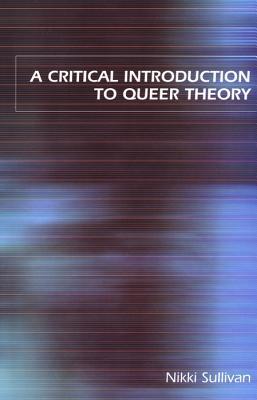
A Critical Introduction to Queer Theory
Explores the ways in which sexuality, subjectivity and sociality have been discursively produced in various historical and cultural contexts
The book begins by putting gay and lesbian sexuality and politics in historical context and demonstrates how and why queer theory emerged in the West in the late twentieth century. Sullivan goes on to provide a detailed overview of the complex ways in which queer theory has been employed, covering a diversity of key topics race, sadomasochism, straight sex, fetishism, community, popular culture, transgender, and performativity. Each chapter focuses on a distinct issue or topic, provides a critical analysis of the specific ways in which it has been responded to by critics (including Freud, Foucault, Derrida, Judith Butler, Jean-Luc Nancy, Adrienne Rich and Laura Mulvey), introduces key terms, and uses contemporary cinematic texts as examples.
The book begins by putting gay and lesbian sexuality and politics in historical context and demonstrates how and why queer theory emerged in the West in the late twentieth century. Sullivan goes on to provide a detailed overview of the complex ways in which queer theory has been employed, covering a diversity of key topics race, sadomasochism, straight sex, fetishism, community, popular culture, transgender, and performativity. Each chapter focuses on a distinct issue or topic, provides a critical analysis of the specific ways in which it has been responded to by critics (including Freud, Foucault, Derrida, Judith Butler, Jean-Luc Nancy, Adrienne Rich and Laura Mulvey), introduces key terms, and uses contemporary cinematic texts as examples.
240 pages, Paperback
First published January 1, 2003
Ratings & Reviews
Friends & Following
Create a free account to discover what your friends think of this book!
Community Reviews
Displaying 1 - 28 of 28 reviews

May 23, 2018
Might be more accurately titled as a Post-Structuralist Introduction to Queer Theory (althought QT might lean heavily in that direction anyway) I still don't feel as if it was really "critical". To me Critical means critiquing, in this case, other QTs but all Sullivan really does is juxtapose opposing viewpoints and leaves the question open ended, I don't really recall her definitively coming down on an issue (She does say things but if x is y then z) but the chapters always end open-ended, and maybe that's the point because "queer" is an open-ended term: the heterogeneity of the heteronormativity of society.
The actual content of the book was good, it uses quite a few post-structuralist theorists and is ostensibly Foucaldian and to a lesser extent Deleuzian (in the intro she mentions the book being rhizomatic) but I do not really know enough to know if this book are those things (She does say power/knowledge a few times! that's foucault!).
One thing that was interesting was how she positioned the poststructural viewpoint to a "humanist" subject. Pretty new to learning this but I suppose it makes sense if you read poststructuralist subject as antihumanist, and as a Foucaldian, I would assume this is what is happening?
For an introduction it was good but this is probably more suited towards upper level undergrads, its not really that hard but some sentences can be confusing. Overall Sullivan does a good job explaining the concept she's using and why she's using it.
The actual content of the book was good, it uses quite a few post-structuralist theorists and is ostensibly Foucaldian and to a lesser extent Deleuzian (in the intro she mentions the book being rhizomatic) but I do not really know enough to know if this book are those things (She does say power/knowledge a few times! that's foucault!).
One thing that was interesting was how she positioned the poststructural viewpoint to a "humanist" subject. Pretty new to learning this but I suppose it makes sense if you read poststructuralist subject as antihumanist, and as a Foucaldian, I would assume this is what is happening?
For an introduction it was good but this is probably more suited towards upper level undergrads, its not really that hard but some sentences can be confusing. Overall Sullivan does a good job explaining the concept she's using and why she's using it.

December 21, 2012
This book offers a good, solid overview of queer theories, though sometimes the discussions are too brief to be very useful. What Sullivan does extremely well is focus the reader on the fact that queer theory is a destabilizing force that refuses distinct categorization, which is one of the trickiest parts for new scholars to pin down.
I knew quite a bit about queer theory before I picked this book up, and I think it would have been a more difficult read had I not had some sort of previous touchstone. Look to this book to add clarity to what you already know.
I knew quite a bit about queer theory before I picked this book up, and I think it would have been a more difficult read had I not had some sort of previous touchstone. Look to this book to add clarity to what you already know.

June 21, 2019
Terrible. Typos in every other chapter. On top of that, after having read the passionate works of Dennis Altman and Mark Thompson this just comes off as dull, uninspired, dry, academic reading with no real care or spirit for the queer movement.

July 5, 2023
Good intro to queer theory and pretty accessible especially if you’re somewhat familiar with poststructuralism. Sometimes kinda shitty writing structure that made it a little confusing to follow but overall enjoyed and was thought provoking! Didn’t feel like I was reading a normal theory book that dragged on and on.

January 12, 2011
This has got to be one of the most amazing non-fiction books that I've ever read. Sullivan is not able to easily introduce a variety of theories to challenge our most basic assumptions about ourselves but also provides us with ample materials to look further and dig deeper in them. It is a must read for anyone at all curious about Queer Theory.

January 24, 2013
For a book that prides itself on being outsider and on-the-fringe of theory/ academe, it sure knocks itself out to be the same as every other overblown theoretical text.

February 23, 2017
Terrible. If you want to make someone stop caring about the gay/queer movement, show them this book.

January 4, 2008
A good overview of the main strands in queer theory, including intersections with race.

June 23, 2019
Very informative. Really helped me understand some things I have observed personally and put them in a historical framework. I'll admit I didn't fully understand some parts, partly because it got pretty philosophical for me, and partly because I read it really fast. But overall it was easy to understand and the bibliography would be great for someone who wanted to delve more deeply into the subject.

January 2, 2020
Sullivan's text was an excellent starting point for anyone looking into an introduction to Queer Theory. While dense at time, the text is quite thorough and provides evidence backed by research for every subtopic discussed
August 25, 2020
Typos in every other chapter, uninspired and painfully acidemic without passion. Covers intersectional issues but often leaves out the complexities of gender. Worth the read for an introduction but is far from a page turner.
March 18, 2018
Pretty good intro to get an overview for students new to queer studies.
March 16, 2025
It was honestly just fine.

Read
June 1, 2025Lest til eksamen, god introduksjonsbok.

May 17, 2022
Gran introducción a la teoría queer. Trata varios temas de relevancia en cada capítulo, usando ejemplos históricos, pero lo que más me gustó es que busca representar múltiples teorías, y las pone a dialogar. Por lo que, si bien sabemos que algunas teorías tienen más apoyo hoy en día, la autora las presenta en discusión con otras que han sido superadas o con las que aún se discute, entregando a les lectores material para debate al evitar posicionarse de forma rígida.
Páginas dobladas: 16
Páginas dobladas: 16

August 17, 2012
This would be such a good book if it were honest about what it's trying to do. It's not as much a 'critical introduction' to queer theory as an attempt to illustrate queer theory through discussions of various queer films and documentaries. It does try to explain the plots and contexts of the films it cites, but it's still very confusing and frustrating to have to read chapter after chapter about films you haven't seen - had the book given me a list of films that will be discussed at the start, I would have went and watched all of the ones I hadn't watched before I started reading the book - perhaps then it would have felt less confusing and boring. The actual content is okay - I guess? - pretty standard stuff, covering most of the more important areas of queer theory (e.g. race, performativity, etc) although, in my view, a little too much attention and space was given to pre-20th century / early 20th contexts / events compared to (more) recent history (e.g. AIDS epidemic is barely referenced and I care about that more than about what kind of nonsense Jean Martin Charcot wrote in the 1880s). Given the fact that this is an intro book, a recommended / further reading list at the end would also have been useful.
Btw, the films discussed are (in order), But I'm A Cheerleader (1999), Stonewall (1995), M. Butterfly (1993), Paris is Burning (1991), Boys Don't Cry (1999), Go Fish (1994) and The Celluloid Closet (1995).
Btw, the films discussed are (in order), But I'm A Cheerleader (1999), Stonewall (1995), M. Butterfly (1993), Paris is Burning (1991), Boys Don't Cry (1999), Go Fish (1994) and The Celluloid Closet (1995).

June 30, 2013
I read this book several years back when I was first learning about queer theory and wanted an advanced introduction to the topic. While some advanced introductions are better at bringing home the way thinkers like Judith Butler or Michel Foucault speak to issues of gender and sexuality in LGBTQ lives today and in the past (the work of Riki Wilchins comes to mind in this department), this is a solid advanced introduction for anyone looking for more information on the topic.

February 4, 2014
Had to read this for my Sexuality and Culture class. I'm sure the media examples Sullivan gave are great, but I haven't seen most of them so they mean very little to me. She also picks a few sources to lean on for every chapter and uses them as if they are gospel while ignoring any possibility that they have their faults. Basically, the book is a combination of basic sources on queer theory with no new arguments being made. Good for beginners; Not so great for someone wanting something new.

January 25, 2008
good like cliff notes are for shakespeare. you get the picture, get a good background and context, but kinda miss the beauty and depth. though it's written as an undergrad reader, i wouldn't assign it. i'm not sure if there are better ones out there, but there should be. i really didn't like her use of pop culture - i actually thought those analyses were pretty weak.

September 13, 2016
Good introductory text on queer theory, its scope and its aims. Ironically, it never truly addresses why queer theory is important, or what it adds methodically. Often it seemed as if "queering" could be used synonymously as "deconstruct". A Critical Introduction to Queer Theory is a relatively accessible place to start, but ultimately unsatisfying.

May 13, 2009
rereading this outside of the classroom. enjoying it so far.

August 13, 2009
Have to read this for a required undergraduate course. It's interesting, to say the least, but I can't say I agree with it or its worldview.

September 16, 2009
Clear, engaging, and very readable introduction to queer theory.

December 19, 2010
An ambitious attempt to understand "queer theory" but the way the book is compiled makes it more confusing than anything.

January 29, 2012
I read it for a class, but it didn't feel like homework. Informative and educational while interesting.

December 15, 2013
not really what I was looking for, but alright as a "beginner's guide", I guess

Want to Read
December 25, 2016Another Christmas pressie from Mr B, in aid of my ongoing education.
Read
February 19, 2019306.766 S951 2003
Displaying 1 - 28 of 28 reviews