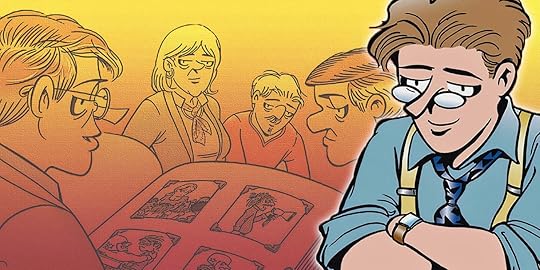
“A compelling biography of one of our nation’s greatest journalists. Outstanding.” —Henry Louis Gates, Jr., Alphonse Fletcher University Professor, Harvard University“Well-reported and -researched.”—Walter Isaacson, New York Times bestselling author of Steve Jobs and Elon MuskA definitive account of the life and work of Garry Trudeau, creator of the massively popular and influential cartoon Doonesbury, based on archival sources and extensive interviews, including with Trudeau himself, and lavishly illustrated with over 200 cartoons and images.Drawing on previously unmined archival materials and extensive interviews with Trudeau, his friends, fellow cartoonists, prominent journalists, and even politicians who were mocked in the strip, Trudeau & Doonesbury is an entertaining romp through both Trudeau’s remarkable life and the last half century of American history.Biographer Joshua Kendall tells the story of the cartoonist and what drove him to put pen to paper. He traces Trudeau’s boyhood in the Adirondack Mountains, his teenage angst in prep school, and his formative years at Yale, where he began drawing his iconic strip. And he shows the changing world it reflected; Doonesbury began appearing in papers nationwide in 1970, and big events, from Watergate to the the war in Vietnam, fueled its popularity and its significance.For more than 50 years, Doonesbury has helped drive the national conversation. The first comic strip to win a Pulitzer Prize, Garry Trudeau’s sprawling narrative featuring a host of beloved characters has reflected America back to itself, capturing the highlights and lowlights of American politics and culture with wit and penetrating insight. And as Doonesbury’s characters aged alongside their creator, Trudeau became one of the preeminent chroniclers of the Baby Boom generation.A unique and compelling biography of both the individual behind Doonesbury and the times he has chronicled, Trudeau & Doonesbury is also a lavishly illustrated, full-color coffee table book featuring more than 200 cartoons, making it perfect for sharing, gifting, and displaying.
Chronicle of the Baby Boomer generation as they age into retirement and the long dirt nap in the era of Trump 2.0 by one of their most effective and popular cartoonists/satirists G. B. Trudeau and his comic stripDoonesbury.
Mid-2020’s Doonesbury Characters
My dead pixels copy was a modest, by modern standards, 345 pages. A dead tree copy would be 352 pages. It had a 2026 US copyright. This book contains 11 chapters and a Bibliography (of sorts).
Joshua C. Kendall is an American author, journalist and biographer. He has five non-fiction books published. This was the first book I've read by the author.
Note that the included comic strips are an important part of the narrative. Ear-reading this book is not recommended.
”All that glitters is not gold." — William Shakespeare, The Merchant of Venice, Act II, Scene VII”
TL;DR
The book was a chronological unpacking of 58 years by the cartoonist and later cultural satirist Garry B. Trudeau's work. Born to what passes for American petty nobility, and starting with his “free-range” childhood, Trudeau was in the vanguard of the Boomer generation at the preppy school of his forefathers Yale University. There, beginning in 1968, the artistically inclined Trudeau began penning for the school newspaper the urtext of what would become the narrative comic strip Doonesbury, which has entertained, informed, and influenced the intertwined culture and politics of two generations. Trudeau was the right guy, in the right place, at the right time. In a period of great social change, he took the narrative form of the humble comic strip, an archaic precursor of today’s more visual communication, out of the “Comics Page” and onto the “Editorial Page” of “The Press”, the most influential news media of the time.
This was not an authorized biography of the notoriously reclusive Trudeau. It is, however, written with his cooperation, which included access to Trudeau's papers archived at Yale. It is also the first and only biography outside of a few earlier newsmagazine articles. The narrative skims along at about 5,000 ft; it rises to capture the heights of Trudeau’s career, but rarely augurs into its barely sketched-out low points. While not quite a puff piece, it comes close. Nobody's life is that golden.
Not being a Boomer, I came to Doonesbury late in its life. I did read the comic, although not religiously. However, by reading this book, my memory was refreshed on the cultural and political history of the end days of the 20th Century and the first decades of the 21st Century through the chronicle of Trudeau's closely intertwined life and comic strip.
The Long Review
I only occasionally read biographies. I have this knee-jerk aversion to anything that smacks of the Great Man (and sometimes Woman) Theory which they serve. However, I have a keen interest in sequential art, which includes comic strips and graphic novels. I also read Doonesbury, when I wore a younger man’s clothes. I wanted to see what I'd missed.
The book includes: comic strips, pictures, and an informal bibliography. There were no footnotes or an Index. The comic strips and pictures were well chosen. I remembered occasional strips, including the notorious ones included. The lack of formal citations was a disappointment. While this book is positioned as a popular work, its eventual scholarly use in cultural or political history will be hampered by its informal citations. However, having a searchable eBook made up for their lack when I was scribbling this review.
The prose was generally clear and concise. I found two minor copy editing mistakes in the prose. Kendall’s background as a journalist shines through, making the narrative easy to read. However, I did find occasional repetition. In addition, every contributing interviewee was mentioned by full name in the narrative, in a quid pro quo for information.
The book’s narrative is generally chronological. Trudeau’s childhood and K-12 schooling are presented strictly chronologically. After he arrives at Yale and starts cartooning, the Doonesbury comic’s narrative chronology, in which Trudeau’s life is intertwined, sets the pace.
Trudeau was born in 1948, in the first cadre of Baby Boomers. His childhood could be considered idyllic. His family were hereditary doctors and the the first family in a rural, upstate New York Adirondack Mountains town. He was a smart, active, free-range kid. He went to public schools with small classes and good teachers, and played in the forest with his pals until it was time to go home for dinner every day. His life changed in his early teens when his mother, a wealthy socialite, grew tired of rural family life and decamped for New York City. He was packed off to college-preparatory (“preppy”) boarding schools. His prep-school cronies who followed him into Ivy League colleges described it as a “real Lord of the Flies experience”.
During this period, Kendall credits him with developing: a talent for art, an aversion to the traditional preppy grooming of young gentlemen for university, and a commitment to the traditional 20th-century nuclear family.
Trudeau hit his stride at Yale, where he was a legacy admission. A keen eye for parody, an agile mind, and a solid education with a strong foundation in literature eventually enabled him to parlay a comic strip he drew for the school newspaper into a nationally syndicated newspaper comic strip while still an undergraduate. The titular Doonesbury is a portmanteau. It combines the 60’s preppy slang of “Doone” for a clueless dude, and the ending “bury” from Charles Pillsbury, the heir to the Pillsbury baking-brand fortune and a classmate of Trudeau’s.
Trudeau was a Boomer nepo-baby at the Eye of the Storm. He was in the fattest part of the mid-20th-century demographic bulge, going through rapid social and political change. He was privileged, smart, adaptive, and well-educated. He could communicate the Zeitgeist of his generation through satire in four black-and-white serial panels, something that hadn’t been done before.
Kendall relates that Trudeau, in the relatively unstructured environment of Yale and post-university life, was an obvious candidate for the role of golden child. It should have been no surprise that five years after college graduation, he won a Pulitzer Prize. However, I suspect it was more a combination of the times and Trudeau’s adaptability in taking Doonesbury’s satire into politics, along with its initial commentary on social anxiety, that were key to his success.
Interestingly, Trudeau was a notorious J. D. Salinger-like recluse throughout his career. He managed his access tightly. While he was frequently out in public, he gave remarkably few interviews. In particular, interviews with newspapers that ran the strip. That Kendall received even the limited access he did was quite remarkable.
Trudeau was fearless with Doonesbury, which was hard on the Greatest Generation Establishment, and folks in the middle of America. It was very Liberal. Boomer drug usage, pre-marital sex, cohabitation, birth control, and homosexuality had strips yanked from publication, only to be brought back later. Lampooning Celebs and political figures likewise led to the strip being yanked or moved to the Opinion section. Larger-than-life folks like Hunter S. Thompson and Donald J. Trump were frequently in the strip. However, through careful work, Doonesbury was never successfully sued, and typically the strip was reinstated. Trudeau had the pulse of the newspaper-reading demographic on his side.
In addition to cartooning, Trudeau has done several other related things during his long career. He's authored books and columns, plays, television series, and movies. Some of his works have reached the stage and screen, although nothing has achieved the same level of success as the strip. I tracked down an early 1977 Doonesbury animation on YouTube (attached). It was peculiar to hear the familiar characters voiced.
A continuing problem I had with this biography was that, akin to the Great Man (and sometimes Woman) Theory, Trudeau could do no wrong, and no problem was insurmountable. There were no reports of Trudeau receiving threats of physical violence or becoming a victim of or threats from the weaponization of the government. (I note and discard the exception of Hunter Thompson’s threats of violence, which were theater.) It's well documented that Trudeau’s first and only wife, and is still with him (remarkable for a Boomer), the American television host and author Jane Pauley has had a years-long struggle with bipolar disorder. This received a scant two pages in the book, despite her having written a memoir about it. I thought there would have been more? For the 20th anniversary of the strip in 1990, the reclusive Trudeau gave an exceptionally rare, cover story interview for Newsweek, with the journalist's first draft, the piece’s editor complained, “There is something wrong with this picture– nobody leads this kind of golden life.” I could have been that editor. The magazine piece was published as it stood.
Over the years, Trudeau grew the strip and aged it. Characters were added, and sometimes they died, which was unheard of in traditional newspaper comic strips. Like Trudeau, his characters eventually had grown children, although character parenthood lagged about a decade behind his own. This reader frankly didn't recognize all the characters in the later strips, having lost track of it more than a decade ago.
Doonesbury was at its peak in the 1970's and 1980s, with a slow fade through the 1990s and the eventual end of daily publication in 2014. Kendall did not auger into this fade. I suspect it was a combination of Marshall McLuhan'sThe medium is the message , and the aging-out of his Boomer target demographic. The medium for Doonesbury was the print newspaper to which it was early suited. At its peak, it was in 1000's of papers. Over the subsequent decades, the closing of local newspapers, the consolidation of the newspaper industry into regional and national distributions, and the proliferation of digital platforms created increased competition for Trudeau's message. At the same time, the number of rheumy Boomer eyes, his target audience, declined in both influence and number. Trudeau moved the strip online early, before most cartoonists. However, his message was just one, amongst millions online, in contrast to its somewhat limited competition "for eyeballs" of earlier decades. Although Sunday publication continues. The end of the daily strip was a watershed event. It appeared as if Trudeau thought there was, except for the Trump administration, nothing political left to skewer. I suspect the loss of the daily strip was more complex than Kendall portrayed it.
Likewise, with the fading 21st-century relevance of the aging out Boomers', Kendall’s narrative during the Obama and Biden administrations was very thin.
Summary
I originally thought this was a book that only a Doonesburyfanboi or fangrrl could love. However, I was wrong. Still, this was a much better cultural and political history than a biography.
What I liked most about this book was that it covered 40 years of cultural and, in the latter part, political history from the late '60s to the oughts through the vehicle of the Doonesbury comic strip. I had forgotten about the Vietnam draft lottery and the 1973 transition to the all-volunteer force, which preoccupied Trudeau and his male classmates. I also realized that “preppies” are no longer misogynists, but they continue to wear blue, Oxford, button-down shirts. I had also blacked out the two-term Reagan Administration and what a witch Nancy Reagan was. The Obama and Biden administrations were almost excluded from the political history, whereas the Trump administrations received close inspection.
What I disliked was the Saint Garry of Doonesbury, portrayal of Trudeau in this biography. “Nobody leads this kind of golden life.” Trudeau graduated from university and was already on his way to a successful and lucrative 50-year career. He was friends with the rich and famous. He's received public honors and accolades. He's had modest professional success outside of the strip. He married and stayed married to a famous, successful celebrity. The couple successfully raised three nepo-babies who stayed out of jail and rehab. Did he sell his soul to the devil that freshman year at Yale?
Trudeau is no longer opaque after reading this. He's only goldenly translucent now. This book was more valuable to me as a cultural and political history than as a biography. However, if you’ve read the comic strip and have memories of it and the 1980’s, you may find this book an interesting walk down memory lane, if consumed with grains of salt.
Wonderful biography of the creator of Doonesbury, beautifully illustrated. The author did a very thorough job. One aspect of the story that really should not have surprised me actually did come as a shock to me, which is that many politicians he mocked sent him fan mail, frequently asking for the original art of the strips they were in. Not surprised that that people took pride in being mentioned in the strip, of course, only that they would reach out to the cartoonist for a gift (which he usually gave them). In short, I highly recommend the book, it really delighted me (and I learned a lot!). If you grew up with Doonesbury you won't want to miss this. And if not, it is a fascinating peek into recent cultural history.
NOTE: One VERY serious flaw: There is no index. This is a book that needs an index. I hope this will be corrected in future editions. A nonfiction book should have an index. This one in particular!
Kendall’s title indicates that his is really about Garry Trudeau’s creation and relationship with his iconic comic strip, Doonesbury, and not a biography laden with juicy, gossipy tidbits. I found this approach and the book fascinating as Kendall covers Trudeau’s formative years in Saranac Lake, NY with his well-to-do family, his miserable prep school years, and his coming-of-age at Yale where he first creates and publishes Doonesbury. Constantly linking current events, social and political, as Trudeau navigates the 1970s and forward to his transformations in his personal development with what the reading public discovers in the comic strip—from his burgeoning liberal politics to feminism (Joanie Caucus), the introduction of LGBTQIA characters, his unswerving support for military veterans (B.D.) and his skewing of both Bush presidents, and most recently, our current MAGA debacle. We do learn some personal information regarding his marriage to Jane Pauley, her battle with mental illness, and his parenting experiences as they help to shape him as a man and his characters in his column. Controversies are explained, and Trudeau takes responsibility for missteps along the way. Kendall begins the book with a Prologue that explains why Trudeau, who is very shy, allowed him to trail him, gave him access to his working notebooks, and original strips material. He also had full access to Trudeau’s Yale archives, letters, notes to and from all kinds of celebrities and politicians. Most of the book is chronological and the author follows it with Acknowledgements, extensive Notes on Sources (Chapter by Chapter), and peppers the chapters with black and white and color reproductions of original strips that serve to illustrate Kendall’s points as he makes them. The final chapter fives us Trudeau’s “obituary” on his imagined legacy and completes the circle of humor, satiric gesturing, and deep thought his cartoons engender. “It is a lot easier to get through the day in the presence of hope.” (318) Amen. RED FLAGS: Bipolar Disorder; Abortion and other political social issues broadly discussed from Gun Control to Combat Injuries. I enjoyed this book on another level: it was a review of my own version of the 1970s+ as my memories of first seeing Doonesbury came alive for me and may appeal to other readers for the same reason. The book was also a crash-course in the history of comic strips, especially those with political opinions. Readalikes may be Monte Beauchamp’s Masterful Marks: Cartoonists Who Changed the World and Debus & Matteuzzi’s Funny Things: A Comic Strip Biography of Charles M. Schulz, Ginger Wadsworth’s Born to Draw Comics: The Story of Charles Schulz and the creation of Peanuts, graphic novels, or biographies: 2008’s Schulz and Peanuts: A Biography by David Miachaelis; Dan Nadel’s Crumb: A Cartoonist’s Life, and Michael Schumacher’s 2010 's Will Eisner: A Dreamer’s Life in Comics.
When Satire Stops Resetting Joshua Kendall’s “Trudeau & Doonesbury” shows how “Doonesbury” turned recurrence, aging, and consequence into a form of civic memory By Demetris Papadimitropoulos | April 1st, 2026
Most satire spoils quickly. It arrives fresh, says its piece, and is gone before the next week’s absurdity has even found the coat rack. “Doonesbury” was the strip that refused those terms. Garry Trudeau’s panels did not merely wisecrack at the latest hypocrisy and then vanish into topical compost. They aged. They remembered. They let people grow older, narrower, sadder, shrewder, more compromised, sometimes kinder, often less sure of themselves. Joshua Kendall’s “Trudeau & Doonesbury” understands this, even when it is busy pressing a louder, shakier proposition about Trudeau as a kind of journalist by other means. Kendall earns his case most fully not in the press-gallery pitch, but in the slower proof that Trudeau turned the daily comic strip into one of the few American forms capacious enough to register politics as lived time.
Kendall shows his cards before the dealer sits down. Before childhood, before Yale, before the long apprenticeship in line and timing, he places the twenty-seven-year-old Trudeau on the Great Wall during Gerald Ford’s China trip, frisbee in hand, moving among the White House press corps as “the ultimate hipster” in a crowd of older correspondents. Before chapter one begins, Kendall has already waved Trudeau past the velvet rope and into the room where cultural rank gets handed out. This will not be the life of a cartoonist who became famous. It will be the life of a claim to public seriousness. Then he rewinds through the Adirondack medical dynasty, the family rupture after Trudeau’s mother leaves, the misery of being sent away to school, Yale and “bull tales,” syndication, Watergate, the Pulitzer, the late-1970s ascent, marriage to Jane Pauley, the 1984 relaunch, Walter Reed, Trump, and an epilogue on legacy. The frame is standard biography; what it carries is the stranger claim that a comic strip can hold more history than its modest size ought to permit. Here chronology is not mere filing. It is the argument. “Doonesbury” matters because it does not reset. Its governing subject is not politics in the abstract, but the way politics settles into a life once the headline has moved on.
The early chapters do the necessary dirty work of making that ambition believable. Kendall is precise on Trudeau’s move from Saranac Lake privilege to the emotional shock of being sent away after his parents’ divorce. He does not use this material simply to produce a neat myth of the sensitive boy who drew his way toward destiny. He uses it to build the vantage from which Trudeau will spend a lifetime looking. Trudeau becomes the child pushed just far enough outside the circle to start studying the circle. He develops an ulcer – the body’s own editorial. He later recalls that art offered “some kind of outlet” for his frustration. What matters is where this satire starts: in estrangement rather than swagger. The strip’s later fluency can make it easy to forget that its first engine was injury. The joke arrived later. First came the child learning how to watch a room he no longer fully belonged to.
At Yale, estrangement acquires a line, a rhythm, and eventually a circulation network. Kendall is sharpest on the strip’s mechanics. “Bull tales” appears in the “Yale Daily News.” Reed Hundt prints it. Jim Andrews of Universal Press Syndicate spots it. Rights, syndication, deadlines, money, and editorial mediation arrive almost immediately. Trudeau’s line may look slyly casual, even primitive, but Kendall makes a persuasive case that the roughness sat atop deliberate labor: notebooks full of ideas, strips built out of order, continuity reverse-engineered after the fact, a sensibility already drawn to what the official paper could not or would not quite say. Kendall strips the work of romance without stripping it of craft. Four panels can outlast a column once they stop forgetting.
There is, of course, the temptation of a tidier rise narrative: Yale prodigy, national strip, Pulitzer, Washington, cultural fixture. Kendall tells that story briskly and well. “Doonesbury” goes national. Washington notices. Trudeau wins the Pulitzer. Newspapers realize that the comics page can carry more political pressure than they had budgeted for. These pages move fast and carry just enough newsroom charge to feel live. But the 1984 relaunch is the hinge. By then Trudeau is married, parenting twins, and facing the oldest problem in serialized art: how do you continue without embalming yourself? His answer was slyly simple, which is part of what made it radical. He let the cast grow up. The gang did not remain preserved in collegiate counterculture. They entered adulthood, where ideals curdle, marriages form and fray, ambition hardens, and compromise stops feeling like a dramatic event and starts feeling like weather. That is the truer claim for Trudeau’s importance. Not that he made smart political jokes, though he did. Not that he sometimes resembled a reporter, though he did. The stronger claim is simpler: he made the newspaper strip answerable to time.
Here the biography grows larger than its own slogan. Kendall plainly wants to place Trudeau alongside journalists and public chroniclers, and he has no shortage of approving witnesses willing to help. Editors, politicians, broadcasters, and cultural grandees file by to certify that “Doonesbury” mattered. Fair enough. It did. But the stronger case lives in the strip’s form, not its aura. The book really wakes up when it lets sequence, recurrence, and accumulated consequence do the arguing. If “Charlie Brown’s America” by Blake Scott Ball asked readers to take the newspaper strip seriously as cultural history, Kendall asks us to see in Trudeau something narrower and stranger: an artist who made serial comedy able to retain aftermath. That is the better claim because it is both less glamorous and more demonstrable. You do not need to accept the full “reported comic strip” argument to see that Trudeau made a form built for yesterday’s joke carry yesterday, today, and tomorrow all at once.
Kendall’s prose is impeccably groomed: lucid, reliable, and sometimes a shade too well mannered. He writes like a seasoned magazine biographer, interested in synthesis rather than ornament, context rather than dazzle. The sentences tend toward medium and long; they braid anecdote, quotation, and interpretation into one steady movement. The diction leans faintly toward canonization, but rarely tips into exhibit hush. It is not stylish prose in the sentence-by-sentence sense. It does not often surprise. What it offers instead is composure. You know where you are. You know why you are there. Its authority is real; so is its habit of awarding stature half a sentence early. Breakthroughs sometimes arrive with less jolt than they deserve because the same calm cadence is doing so much work elsewhere. Kendall is rarely clumsy. He is sometimes too composed for his own subject. One occasionally wants him to loosen his tie, or at least misplace it for an afternoon.
The design, by contrast, is less composed and more cunning. It does not merely support the prose; it makes the same case by other means. This is not a prose biography with a few decorative strips dropped in to brighten the wallpaper. The reproduced cartoons, sketches, letters, and archival materials carry a second argument alongside the narration. The black chapter openers provide hard tonal resets; the interiors give the images enough visual air to function as proof rather than ornament. Prose can tell you that B.D.’s helmet mattered. A reproduced strip can remind you how many years the joke had been running before the joke disappeared. The archive does not merely illustrate Kendall’s points. It makes them. It also restores one of the things prose sheds fastest when describing comics: timing. A page turn becomes a beat. White space becomes pause. A repeated face becomes memory.
At Walter Reed, the book stops asking for respect and earns it. B.D.’s injury in Iraq, his amputation, the recovery, the bureaucracy, the world of patients and families around the hospital – these pages reveal what “Doonesbury” could do once it stopped merely skewering power and started attending to damage. A wounded patient calls Trudeau “the archangel of Walter Reed,” a phrase grand enough to risk embarrassment and earned enough to survive it. Its force comes from the strip’s change of function. Satire does not disappear. It deepens into witness. The old visual joke of B.D.’s football helmet gives way to something harsher, more exposed. The joke was always there. Then, at last, it is not. What remains is a body that history has used. This is where Kendall’s argument about seriousness stops sounding aspirational and starts sounding earned. The strip does not merely comment on public life here. It records its cost.
He is less convincing when he pushes too hard on civic force. The biography wants Trudeau to count, and count publicly, and count high. Fine. He does count. But Kendall sometimes nudges influence toward consequence and consequence toward agency. Watergate plainly enlarged Trudeau’s reach, and “Doonesbury” clearly helped readers metabolize political absurdity. That is not quite the same as saying the strip helped bring down a president. Kendall is on his surest ground when he shows what the strip could hold: continuity, contradiction, injury, ideological drift, cultural memory. He is weaker when acclaim, access, and retrospective prestige do too much of the lifting. The larger narrative would rather confer legitimacy than force a reckoning. There are controversies here, and sharp ones, but the book leans more toward vindication than ordeal. One feels, now and then, that Kendall is introducing witnesses for the defense when a cross-examination might have made the case sturdier.
The thesis returns often enough to sound slightly reassured of itself. Comics as journalism. Satire as public discourse. Trudeau as national chronicler. None of these formulations is false. They simply recur more often than they develop. Kendall’s sharper, less rehearsed insight is that time itself became Trudeau’s real medium. One wishes the book trusted that thought even more than it trusts the honorific language surrounding it. The book says, in effect, “take this cartoonist seriously.” The better pages say something stronger and stranger: this strip learned how to remember.
Only late does the book really nick the nerve. In the Trump years, the problem is not merely that politics has become absurd. Politics was absurd before. The problem is that absurdity now arrives already performing caricature. Earlier in Trudeau’s career, exaggeration sharpened recognition. Under Trump, the subject increasingly showed up already playing his own mask. What, then, is left for satire to do? Kendall is wise enough not to fake an answer where the culture no longer supplies one. That restraint gives the final chapters their credibility. The book chases the present less than it explains why the present now smears as soon as satire tries to get a grip. Satire once seemed to outrun public foolishness. Here it is forced to run beside it, still alert, a little winded. The old machinery still works, but the terrain has changed underneath it.
I come out at 84/100, which for Goodreads purposes makes this a 4-star book: a sharp, durable cultural biography with a recurrent habit of pressing its own case too hard. Kendall has written neither a monument nor a demolition. He has written something more useful than either: a serious account of how a daily newspaper strip kept stretching itself to meet a country that would not hold still.
The book ends where a book like this probably must: legacy, burial ground, memory, afterlife. Yet what lingers is less the epilogue than the strip’s method. What remains is not simply the joke, or the target, or even the claim to public seriousness. It is the refusal to let people bounce back into harmless cartoon stasis once history has worked itself through them. Kendall may slightly overstate what satire can do in public life. He proves something tougher all the same: that in Trudeau’s hands the panel stopped being a place where time paused, and became a place where time left its score in the line.
My thanks to NetGalley and Abrams for an advance copy of a biography on a creator and cartoonist whose work has done much to bring to light the world, politics, and the joys and sadness of being humans, a work that has continued for almost fifty years, and is as relevant today as it was in the late sixties.
I was a huge reader as a child, as was my younger brother. My parents loved going to tag sales and flea markets, so this was a win-win for both of us. I loved books, comic books and comic strips and here on boxes on hot driveways I would find treasures. I think I was about ten, when for a quarter I bought The Doonesbury Chronicles, a big book with a brown cover full of strips. This was an odd collection for there was a lot of dialogue, and no real pratfalls, or big jokes. I kind of knew Nixon, I kind of knew Vietnam, but something about this hit. Plus my Dad was like, oh cool, you should get that. I read the collection and had to agree with Dad, that was cool. I missed a lot I am sure, but something just stuck with me. I started to read the daily and weekend strips also, something I might not have paid attention to, more interested in Snoopy of that loveable alcoholic Andy Capp. Doonesbury taught me much, about storytelling, about character growth, and more importantly about the wide world I lived in. Also I loved Duke, even have the action figure from the Action Figure Collection. About the creator I knew little. In a way meeting one's idols can be a bad thing. After reading this book, I am even more impressed about the creator. Trudeau & Doonesbury: A Biography: The Cartoonist Who Turned the News into Art by Joshua Kendall is a look at the man, the comic strip, and how if changed how we look at news, the people involved in it, how it changed the creator, and the legacy he leaves behind.
Garry Trudeau was born in upstate New York, into a family that came from a long line of health care professionals. Trudeau knew from an early age that medicine was not for him. Trudeau loved to create art, writing and producing plays, and sketching from an early age. Trudeau's parents divorced something which effected him deeply. Also effecting him was the private schools that he went to, places he found not just old fashion and snobby, but barbaric in the treatment of children. Trudeau went to Yale to learn art, a place that gave him much fodder for his later works, gave him friends that he cherished, and let him rub shoulders with power players of the future. Business leaders, politicians, political candidates even a President, who he did not care for. At Yale Trudeau started a comic strip, that caught the eye of a large cartoon syndicate, that signed him. With a name change the comic strip Doonesbury was born, named after the lead characters. The strip took off, earning a readership across the political spectrum, even leading to a denouncement on the Senate floor. Controversy and praise followed, as well did numerous awards, acclaim, and a new bête noire, Donald Trump.
Garry Trudeau is known for his lack of interest in publicity. Even though married to a news commentator Trudeau has preferred to let the work do the talking, with few exceptions. That said this is a wonderful book, and Kendall deserves much praise. The writing is quite good, and Kendall has done remarkable work in both research and interviews. This is not a hagiography, Kendall is quick to point out bad views, and mistakes that Trudeau has made in the past. Kendall really has gotten to the heart of who Trudeau is, what drives him and the work. The making fun of Kissinger, the work he did on telling the stories of wounded soldiers in Iraq. Even Trudeau's ideas on women's lib. All are covered, and for a large book, the narrative moves very well, and never bogs down.
Another fun aspect are all the comic strips, used to highlight certain points. Early misogyny, jokes that might not fly today, and more importantly a strip that is both about being politically aware, and being human. People age, people die in Doonesbury, they change, and grow. Something rare. And something quite powerful. Fans will enjoy this book, as will anyone who loves a good biography. With cartoons. This is the second book by Joshua Kendall I have read, and I will have to read more. I look forward to what Kendall, and Trudeau have planned next.
Full disclosure: I’ve always loved Doonesbury. This book reminded me why.
Author Joshua Kendall takes a deep dive into the life of the comic strip’s creator, Garry Trudeau – not an easy thing to do, as the cartoonist is intensely private and has given few interviews in his 50-plus-year career. For this project, Kendall got Trudeau’s cooperation in the form of access to the cartoonist’s extensive Yale archives, and answers to follow-up questions based on any available material. All of the personal information is used in service of the ongoing development of Doonesbury, and that’s as it should be; Trudeau has always preferred that his work speak for itself.
The first couple of chapters cover the artist’s childhood, his parents’ divorce, his difficult prep school years, and his emergence at Yale as a budding artist and satirist. His early commentaries on college issues tended to take the form of cartoon sketches, eventually leading to the comic strip “Bull Tales,” which ran in the campus newspaper and grew increasingly popular. By the time Trudeau graduated, he had sold the strip – re-christened “Doonesbury” – to the new Universal Press Syndicate.
Some of the influences on his early work are obvious: student protests, the war in Vietnam, campus dating life. Some, I wasn’t aware of, such as a college girlfriend, Annie Hurlbut, who was instrumental in converting Trudeau from a typical young “male chauvinist pig” into a committed feminist. Years later, he went on to stand up for female cartoonists to the point of quitting a professional organization over its then-pervasive sexism.
Five and a half decades is a lot of ground to cover, but Kendall does an admirable job of covering key points in the strip’s development without turning the book into a mere highlights reel. More time is spent on Doonesbury’s early years, accelerating a bit in more recent decades. Always a fan, I found a lot here to admire. Although Trudeau has always been left-leaning, he’s tried to be even-handed in searching for the foibles of all points of the political spectrum. He’s supported our country’s involvement in some, but not all, of its more recent wars, but always felt sympathy for those who served. In the 2000s, he began extensive support for wounded warriors with a series of book projects. I also learned about his creation of a 2013-2014 Amazon streaming series, “Alpha House,” which I’d missed completely.
If you’re already a Doonesbury aficionado, you won’t be disappointed in this book. If you’re not, you’d probably be hard to persuade to pick it up – but I still recommend that you give it a try.
Note: This is a review of the audiobook format. While I thoroughly enjoyed it, the format does have one drawback: the inability to see the strips that are discussed. These, too, were a great walk down memory lane – but I would recommend the promised “coffee table” book format to get the visual experience.
Thanks to RBMedia, and parent publisher Abrams Press, for providing this audiobook for review consideration via NetGalley. All opinions are my own.
Thanks to NetGalley and Abrams Press for the digital copy of this book; I am leaving this review voluntarily.
I cannot begin to tell you how much Doonesbury made an impact on me growing up. My family watched the evening news every night, and we subscribed to both local newspapers as well. I was always a precocious kid, so I read many other things besides the comics page. I’d always been politically aware, but it went up a notch when I started reading the opinion page, which also featured the Doonesbury comic strip. By the time I was in high school, I started hanging out with other politically minded kids who also read the entire newspaper like me. Doonesbury was a universally loved comic.
I loved loved loved this biography of Garry Trudeau, which is really a 3-part biography. One part is the history of the Doonesbury comic, one part is a biography of the artist, and the other third is a history of the United States from 1970 to today. All these threads are interwoven to tell the narrative. I knew little about Trudeau, other than he was married to my favorite morning show host, Jane Pauley. It turns out there was a good reason for that: the dude rarely gave interviews.
The cultural history of the United States in the 1970s through today is explored through the artist’s work. Fans will enjoy learning about the backstory of some of the Doonesbury strips, as well as the genesis of some of the characters, like B.D., Duke, Joanie and more. I was a huge fan of Joanie’s daughter, J.J., and not just because we shared the same initials. We were on the same wavelength all the time. It was uncanny. But by far, my favorite character was George H.W. Bush’s evil twin Skippy. OMG, I still use the reference to this day.
Another thing I loved about this book was something I do not often see in biographies when mentioning art or photographs – the strips that are referenced are actually SHOWN, too! That’s right, as you go through the book, and it talks about certain topics Trudeau addressed in his strip, you get to see the actual artwork. I would say it’s probably better than just having a book of the strips because the context and thought process Trudeau went through is also included. There are also pictures of his worksheets, where he scribbles a bunch of things down, draws a rough sketch of a character, and fleshes out his plan. Truly eye-opening. There’s a reason he won a Pulitzer Prize for Journalism while he was still in his 20s.
Learning that Garry Trudeau is still doing his strip on a weekly basis was great to hear. There’s a whole chapter on how he knew early on that 🍊🤡 was a mine for satire, and that continues today.
The ‘70s was a great time to be a teenager engrossed in politics. (I look back and wonder if such intense interest wasn’t a way of trying to escape everyday teenage life.) Of course, Watergate was the main attraction, now that the ‘60s were over, and most of the idolized leaders were gone. The two newspaper individuals who made Watergate seem downright amusing? Art Buchwald and Garry Trudeau. One wrote satirical political columns; one drew satirical comic strips.
I’m sure I have some of those Watergate columns and comics in a box of my childhood stuff, cut out from the local newspapers I read religiously every day. I know for sure I have a Sunday “Doonesbury” strip about the Loud family. Yes, the first reality show family starring in a 1970s series on PBS, no less. I never watched it. (I never watched PBS until I was in my 20s.) Yet I had read articles about those scandalous Louds and laughed that Sunday as I read “Doonesbury” satirizing the series.
I don’t know how the Louds felt about that Sunday strip, but according to this book by Joshua Kendall, more than one convicted Watergate person wrote to Garry Trudeau telling him how much they liked the comic strips on them! Maybe it was a case that once things get so bad there is nothing left to do but laugh. Or maybe it was yet another sign that Garry Trudeau did not write and draw nasty, hateful comics. His comics hit target after target, but no one was left bloody or dead.
What else did this biography reveal about Mr. Trudeau? Well, it told me everything I now know about him, since I knew nothing about him before reading the book. What was most surprising? He was much more sensitive and caring than I imagined. He experienced the childhood pain of his parents divorcing and then being shipped off to boarding school, two most challenging things for a creative, introspective child. He appeared to handle both well, though, and eventually ended up at Yale.
Yes, Yale. My only big complaint about this biography is there is too much about Yale. (Guess where Mr. Kendall went to college?) The Yale years were not that interesting, even though those years provided the springboard for Mr. Trudeau’s comic career. Most of the rest of the Yale references were strictly for Yalies, too. Actually, the book in general was sort of dry at times, but maybe that’s what happens when you write about a man who has always ferociously protected his privacy.
Why shouldn’t cartoonists and all other creative artists do that? What should be most important to the public is what they create, not their personal lives. Garry Trudeau obviously figured that out at a young age. Joshua Kendall, who has written top-notch material on psychology issues, probably figured out early on when writing this book that what he wrote would have its limits. Kudos to Garry Trudeau for staying as private as he can. Kudos to Mr. Kendall for realizing he would not be able to analyze the cartoonist's life as much as he wanted to do so . . . even though it would have made the book more interesting. :)
(Note: I received a free e-ARC of this book from the author or publisher.)
Brisk and compelling, this biography offers insights into the creator and conception of long-running comic strip “Doonesbury.”
I may be the youngest person to pick this one up. I have loved Doonesbury ever since I found “Doonesbury’s Greatest Hits” on my grandpa’s shelf. I think Trudeau is a master at juggling a big cast of characters, giving them each foibles and idiosyncracies. He’s funny too, keeps things moving forward and never mailed it in.
The book begins with his priviliged upbringing. He came from three generations of doctors and Yale men and shared dining halls with the likes of Howard Dean and George W. Bush (who he never liked from the start). But Trudeau was also marked by his parents’ divorce, his mother’s alcoholism, and an abiding sense of being abandoned to boarding school.
Trudeau is one of the those Boomers who hit the birth lottery—he came up right in the midst of the 60s youth movement, started his comic strip at Yale and had a sweet syndication gig before he ever graduated. He worked hard, and he comes off aware of his good fortune, but it’s hard to even imagine those possibilities today. Sure, there was the fear of the draft, but a ulcer diagnosis from his dad the doctor spared him that, and he was off running and creating his strip.
The book does a good job introducing us to Trudeau’s social mileu and the speed with which he became a phenomenon—it’s funny to see the requests for original drawings from political figures he’s just skewered in the strip. The book is heavy on the seventies and Nixon, but it dips into other eras as well, most notably the still-relevant Iraq War segments focusing on wounded warriors and PTSD.
I wish “Trudeau and Doonesbury” had focused a bit more on the creator’s missteps. We do get movie scripts that don’t come off and musicals that fail to set the world on fire, but apart from a Dan Quayle segment that put too much faith in a jailhouse informant, there’s not much on Trudeau’s regrets. To his credit, in hindsight, his judgment was generally sound—he’s been nailing Donald Trum for who he is since the 1980s.
The book includes plenty of art and strips that enliven the storytelling and give welcome context. If you’re a Doonesbury fan, or simply interested in the time and, this is a worthy read.
Joshua Kendall's Trudeau and Doonesbury is an exceptionally well-researched biography that offers a deep dive into the life of Garry Trudeau and the cultural phenomenon of his iconic comic strip. At times, the book reads like a compelling history text, with rich stories about Trudeau expertly peppered throughout; at other times, it beautifully frames Trudeau’s personal narrative within the broader American historical and political landscape. For fans of the strip and cultural history buffs alike, the depth of context is impressive.
While the content itself is strong, my two primary critiques are closely tied to the fact that I listened to this as an audiobook rather than reading it. - Because the historical context is so vast, the narrative occasionally bogs down in excessive detail that feels irrelevant to Trudeau’s biography. For instance, the author occasionally introduces a minor historical figure and detours into their parents’ identities and where they worked. Without a clear connection to the larger story, the listener easily loses the flow of the narration and the author's primary point. - The description for the book boasts over 200 Doonesbury strips meant to complement and support the text. Unfortunately, this feature is completely lost in the audio format. Listening to a narrator read a comic strip aloud—without being able to easily differentiate who is speaking or see the pictorial context—creates a clunky experience. At times, it was genuinely difficult to ascertain where the biography's narrative ended and the comic strip text began.
Overall, this is a comprehensive and thoughtful look at a political and artistic mastermind, but format matters here. If you are interested in this title, I highly recommend bypassing the audiobook and opting for a print copy or reading it on a Kindle or other e-reader. Being able to actually see the comic strips alongside the text would undoubtedly elevate the reading experience, and I imagine I would have given it a higher rating had I experienced it visually.
Thank you to the publisher and NetGalley for providing an advanced copy in exchange for an honest review.
As someone who grew up reading Doonesbury in the daily newspaper, I came to this biography with a long familiarity with Garry Trudeau’s work—even when I didn’t always agree with his politics. I read the strip for the characters and their evolving backstories, for the feeling that these fictional lives were unfolding right alongside our own. Joshua Kendall’s biography is impressively thorough, tracing Trudeau’s career decade by decade and placing his work firmly within the political landscape of each era. The early chapters—especially those covering the Yale/Davenport College years—were the most engaging for me, capturing the origins of both the strip and its creator. As the narrative moves forward, however, the book becomes increasingly dense with political context. Readers who enjoy modern American political history will likely appreciate that depth; at times, I found it a bit overwhelming. Kendall’s prose is clear and journalistic, though sometimes dry. The book is more intellectually informative than emotionally immersive. Still, I finished it with a greater appreciation for Trudeau’s cultural influence. I hadn’t fully realized just how long we’ve been growing older alongside these characters—from youthful idealism into middle age and even retirement—and how consistently the strip adapted to each new era. The longevity alone is remarkable, and Kendall makes a strong case for Trudeau as both artist and generational observer. This biography will especially appeal to devoted Doonesbury readers, media scholars, and those with a strong interest in political history. While I occasionally found the reading experience exhausting, I came away with deeper respect for the ambition and scope of Trudeau’s work.
3.5 stars rounded up to 4
My thanks to NetGalley and Abrams Press for providing an advance copy of Trudeau & Doonesbury: A Biography: The Cartoonist Who Turned the News into Art by Joshua Kendall, scheduled for release on May 26, 2026.
Boomers will love the trip down memory lane. Beyond that is a vivid look into the world of East Coast aristocracy. Trudeau’s great-grandfather created the world’s first TB sanatorium in Adirondack, New York. Robert Louis Stevenson was a patient and, according to the volume under discussion, Garry has a collection of Stevenson books autographed and inscribed to his grandfather from his grateful patient. (According to Wikipedia the books were lost in a fire at the sanatorium. I’m going with Mr. Kendall on this one). Garry was a Yale student and his time there is closely examined. Those of us that went to state schools, well, we went to state schools. Yale’s a little different. They did a little democratic thing, letting more regular folks in, but Trudeau commented that it makes it really hard for them to compete with people that had private school training. Trudeau published two books of college cartoons while there and was already under contract for Doonesbury WHEN HE GRADUATED (1970). He hung in Vail over the summer (don’t get the wrong idea-his work ethic has never been in doubt) and began to produce the strip, which was pretty much an instant success. Interviewed by the Chicago Tribune at the time he said he didn’t see himself as spending his whole life drawing a comic strip. Yeah, well.
All American success story? You bet. The strip was innovative and very, very good. His cultural impact was deep and immediate and is still present. His membership in the 1% helped with the political angle. He was neither fawning, in awe (gosh, I’d like to hang with these guys!) or resentful. Yes, his view is the upper class (he did a stint writing editorials for the NYT) but, of course he did. Look where he came from.
The book looks to be an inside job, Trudeau comes off never less than quite sensitive and decent and there’s no reason not to buy in. The strips stand on their own. Really good work, wonderful biography.
This is an at first enjoyable, but then confusing and ultimately bizarre try at biography of an inspiring American artist.
It never really takes us "Inside Trudeau's Brain," as he had a character do with Reagan. To get that you're better off reading the occasional text pieces Trudeau runs in the larger anthology collections of his comic strip. Or his even more occasional interviews.
So if this book couldn't really penetrate its subject, then what? Well, this might leave the focus on the strip, but there the chronicler makes assertions correctable by a well - read fan.
The first remarkable one of these is that the Joanie character is referred to as leaving her husband for reasons of domestic violence.
The husband character is a boor, absolutely. He tries to guilt Joanie into returning by playing a recording of their daughter begging her to come home.
When they do divorce, he's so unbothered he wears his bowling shoes to see her off, planning to get in a few frames that night.
But I remember no reference to his beating her, and although this book is liberally sprinkled with illustrative strips, none is provided for that point.
(In fact the only physical violence we hear of in their marriage is inflicted upon him by her: Joanie describes to other characters a time she reacted to a sexist remark by breaking his nose. It's played for laughs.)
This error is all the more egregious because in the first half of the book the writer is somewhat obsessive about the undeniable sexism in the earliest strips.
Near the end of the book, when the Republican - organ masquerading as legit newspaper Washington Times is quoted calling Trudeau the first victim of "Trump Derangement Syndrome," I more or less gave up.
A straight on biography of a satirist/political commentator/cartoonist whose life is under-reported. But it hews more to the cartoons and characters than Garry Trudeau himself. As an avid reader of the cartoons as a young man, this was great; but as a reader of a biography, it left me wanting more. The author seemed to have immense access to Trudeau's fan letters from the public figures he featured and skewered, which can have some revelations. Trudeau's sharp wit and observations humanely shine through. His characters remain deeply memorable and enduring. Trudeau created a historical outlet for his art and politics, one that would be impossible to duplicate (especially because of technology). Trudeau comes across as deeply philosophically serious about our country as it smashes against the hypocrisy of both parties and plenty of our leaders, celebrities and journalists. His portrayal of servicemen, PTSD (which he researched to educate himself), AIDS, corruption, Watergate, the Bush family (Yalies too!), Congress are compelling, but with healthy doses of humor.
I like popular culture, more at is obscure corners. This past year, I also read Dan Nadel's Crumb: A Cartoonist's Life, about R. Crumb. While Crumb and Trudeau come from such completely different backgrounds, psychologies, and perspectives, they have a great deal in common in terms of their impact on the sociology of this country.
I was discovering the comic pages around the time Doonesbury launched in the early 70's, though I was way too young to understand it. Still, it was a constant all through my high school years and well beyond, always there among the other strips as a foundational reminder.
Kendall spends ample time on Trudeau's years at Yale, where the cartoonist's style and viewpoints developed. I was pleased to see how many names I recognized who passed through those hallowed halls around the time Garry did. I also appreciated the mentioning of the 1977 animated special (which I then sought out online to watch) and how this strip inspired others that began in the late 70's.
The inclusion of selected weekday and Sunday strips throughout the text really helps to punctuate the journey (of both the strip and of our country) across the decades. The thorough overview makes me want to seek out and read some collections of the work. Overall, it is a reminder of how comic strips can be both informative and entertaining under the right creators. Garry Trudeau is indeed one of those notable creators.
Highly recommended for fans of the strip or of comics in general.
This is a straight-forward, engaging, entertaining, and all around well-written biography. Joshua Kendall clearly admires Trudeau and his work, but never lets that admiration tip into fawning. He doesn't reach for themes and narratives that aren't there. Instead, he's content to take us through the history of Trudeau and Doonesbury, which is full of amusing anecdotes and funny cartoons.
Reading this I learned that Trudeau was more of an insider than I thought. Yale and Yale graduates are all over the book. Somewhat relatedly, it helped me better understand Trudeau as a journalist, or maybe more of an editorial columnist. Obviously, his work is political but I didn't realize that he worked sometimes from knowledge and viewpoints he had collected firsthand. He's also ... more moderate than I realized? Definitely a lefty in the boomer generation mold, but not someone we would call 'far left' or even 'progressive.' Maybe an independent in an occasionally annoying way.
An incredible thing to revisit was Trudeau's excellent work and advocacy on behalf of veterans of the war on terror. I remember those strips and will respect them forever.
A great biography of Garry Trudeau with, of course, a focus on Doonesbury. Trudeau cooperated with the author, somewhat surprisingly given Trudeau's normal reticence. The author also interviewed scores of Trudeau's friends and associates so we do get an inside look. I especially enjoyed the parts on the Yale years and the development of the comic strip The book continues through Trudeau's life and reprints many of the comic strips to illustrate the developments of both Trudeau's life and Doonesbury. My one complaint is that the focus on the strip's political and social commentary and the developments of the personal lives of the characters are almost ignored. So nothing about Mike's first marriage, his wife leaving him, his courtship of his second wife. Joanie's law career is mainly ignored as is BD's coaching, Mark's coming out as gay etc. When the characters' lives are discussed it's as an adjunct to the political and social commentary; BD's war injury, Mark coming out as gay But still a great book
As a longtime fan of "Doonesbury", I really enjoyed this. It covers the artist Garry Trudeau's whole history.....even as a child, thru out his educating years including a toney prep school in Concord NH, & then on to Yale....where he really began his comic strip. His was a pretty privileged life growing up. I was kind of surprised to learn several things about Trudeau that I hadn't known...... a lot of famous names that he knows & schools with as a young man, his 'instant' eating habits, & how often newspapers refused to print his works. Numerous comic strips are included explaining his series' agenda & progression. His personal/family life is also documented. It's a great documentation of his career......I'd think over his long career, there's a lot of people who will enjoy this biography of how 'Doonesbury' came to be! I received a complimentary e-ARC from Abrams/Abrams Press via NetGalley, providing me an opportunity to read it & offer my own fair/honest review.
This is a handsome book, but it's very much a hagiography - Kendall isn't interested in analyzing the work, discussing changes in newspapers or cartooning or political satire, or spending time on Trudeau's less successful projects (the Doonesbury Broadway musical gets about a paragraph). Instead he follows a structure of discussing Trudeau's personal successes, the plots of some strips, printing effusive fan mail from politicians who are featured in them, and then moving on. Although Kendall does note that some of Trudeau's Boomer attitudes have changed (before becoming more of a feminist he was against Yale admitting women, and Kendall prints one of Trudeau's 'rape as a punch line' college cartoons) and he acknowledges his subject's incredible privilege (Trudeau DID, after all, grow up on Trudeau street in the town of Trudeau, before prep school and several Ivy league degrees), any reader that doesn't think Doonesbury is brilliant, hilarious, and as relevant now as it was in the 70s might be a little frustrated by the mountains of unexamined praise.
I won a copy of Trudeau & Doonesbury through a Goodreads giveaway.
Fascinating biography of a typically private subject -- Garry Trudeau, the artist behind the brilliant Doonesbury comic strip. Trudeau cooperated with the author, Joshua Kendall and so we get a deep look into his early life, career, marriage to Jane Pauley, and his interactions and correspondence with politicians he lampooned through the years (some had better senses of humor than others!). I learned a lot about him and Doonesbury (for example, who some of his characters were modeled on). Many strips are included in this book with the context around them which I really enjoyed. My only very minor critique was that the book was very detailed (and at times too much so I would scan a bit). But well worth the read!!
Thank you to Netgalley and Abrams for an ARC and I voluntarily left this review.
Using archival materials and interviews with Garry Trudeau and a wide circle of friends, professional peers and even people who were mocked in the strip, Kendall tells of Trudeau's life, from his boyhood in the Adirondack Mountains, the hell of prep school, and his formative years at Yale University where Doonesbury began. The author traces the history of the series from 1970 to 2020, shopping how it reflected the changing American culture, from the war in Viet Nam, to Watergate, the growth pf feminism, to the days of Donald Trump, making Trudeau the first comic strip artist to win a Pulitzer Prize. Illustrated with more ta 200 strips, this book will appeal to any Baby Boomer who sees their life reflected in Trudeau's beloved characters.
Trudeau & Doonesbury by Joshua Kendall is a wonderful trip through Garry Trudeau's life and work.
If you enjoy biographies that not only tell you the events in a person's life but also how they influenced, or may have influenced, his later actions, you'll love this book. The strips included are essential to the text of the book, so I would avoid the audio version if I were you.
Looking into what drove a person to choose what they do with their life, both consciously and subconsciously, is fascinating. When that person created one of your favorite strips, it is even more engrossing.
Recommended for both fans of Doonesbury as well as those who simply enjoy a good biography.
Reviewed from a copy made available by the publisher via NetGalley.
I came from this from a bit of a different perspective from other readers. I have never enjoyed the comic strip. Never once thought it was funny. However, once I saw this book and saw it was political satire, I thought that maybe I just missed something when I was looking at it as a kid. Sure, I watched the news with my parents, but possible I was missing the point. So I decided to read this, as I am a huge political junkie now. Still don't like the comic, but this was a great book. Political satire is so important.
Thanks so much to NetGalley for the free Kindle book. My review is voluntarily given, and my opinions are my own.
Yes, the book is essential, especially if you grew up in the heyday of Garry Trudeau and Doonesbury, which was the 1970s and 1980s. The author artfully uses Trudeau's work to demonstrate how he got under the skin of so many people in power. But be warned... this book is highly supportive of Trudeau, as you might expect from the kind of access the author received. The disputes over Trudeau's career are disposed of quickly, and you might be forgiven for thinking, "Boy, Garry Trudeau's shit is perfumed." Perhaps a little of the cynicism that Trudeau used so effectively throughout his career might have been well-served in a look at his own life.
The hagiography is off the charts in this biography of Doonesbury creator Garry Trudeau. In fact, I think I like Trudeau less after reading the book than I did before. I was a huge fan of the cartoon at the tender age of eight, and I was one of the few people who saw the 1983 Doonesbury musical on Broadway, so my disillusionment is a bitter pill to swallow. Never meet your idols, friends, or read about their rich, privileged upbringing and the WASPy preppies they surround themselves with. At least he seems like a good feminist and husband to Jane Pauley.
One of our greatest social and political commentators, disguised as a cartoonist, Gary Trudeau is, in my opinion, a national treasure brilliantly portrayed, through narrative and reprisals of his comic strip(s), in Joshua Kendall's wonderful biography. This is a Boomer's dream look back to the 60's when Trudeau was attending Yale, and a life that takes us from Vietnam and Nixon through to Trump 2.0-- all through the eyes of a concerned and, at times , deadly serious satirist. Strongly recommended.
It’s such a book of contrasts. The biography is a listless bore which delights in sharing the myriad of fan letters Trudeau received. We are very aware he grew up privileged and the best adjective to describe him would be smug.
But if you compare it to his body of work, it’s truly amazing how groundbreaking his strip was. It is more amazing how well it has held up over the years.
If you are a fan like me, you are going to read this book. But I bet after you finish you will dig out one of his collections to marvel at and enjoy.
A great look back at all the Doonesbury cartoons saga. I didn’t know much about Garry Trudeau so it was interesting that he bucked his family history of becoming a medical doctor and found his own path. I didn’t realize that he won a Pulitzer Prize in his 20’s! And that winning the prize was what prompted the KC Star to finally carry his strip. Sad that he became burnt out and doesn’t produce much anymore.
This is a totally engaging biography of one of the most important satirists/cartoonists of this generation. A must read, especially for boomers like me who have followed Doonesbury since the early 1970s and continue to enjoy his current strips every Sunday. Well researched, well written and it held my attention throughout. I finished in two days. I'd give it 10 stars if I could. Highly recommended
It was fun reading about Garry Trudeau, and his Doonsbury characters. The author takes the reader through Trudeau’s early life and upbringing, and his days at Yale, where he creates the basis for his strip. The book chronologically follows his success, and the famous people he satirizes along the way, with examples of the strips and the public’s reactions. It’s was great fun and a trip down memory lane for me as well.