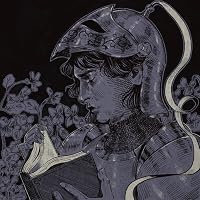
A queer and cli-fi reimagining of a Portuguese folktale about a young trans woman who must save her elder sisters from the King of the Air, the King of the Sea, and the King of Misery
Elixane lives in a village ravaged by waves, storms, and the encroaching forest. When she was too young to remember, her elder sisters each picked a flower and were whisked away: Borboleta to marry the King of the Air, Adelina to marry the King of the Sea, and her favorite sister Dores to marry the King of Misery, who promised: No one will ever love you as I will.
So when Elixane receives a mysterious message from a toad, she sets out to rescue Dores from the Kingdom of Misery. She is aided by the jester-like Marquês of Luck and his sister Jinx, the contrary and beautiful Marquesa of Misfortune. On the way, she’ll have to reunite with her sisters and their magical husbands, break several unbreakable curses—and, perhaps, find a magical love of her own.
"Would it be so bad?…To find something in misery worth loving?"
A whimsical, adventurous, queer fable that stretches its wings beyond its foundation as a cli-fi book into something fantastical and dream-tinged. MISERY’S WIFE was one of my most anticipated releases of the year, and it’s easily a contender for favorite of the year.
MISERY’S WIFE opens on a world that is like our own, “but more; like a sink overflowing,” in which the kingdoms of the earth have reclaimed themselves from man. It tells the tale of three daughters, born under the blessings of different elements, who idly wish to be wed. And in this world where lines are blurred and words hold power, the daughters' wishes come true, taking the women away from the land they know and into the arms of the King of the Sea, the King of the Air, and the King of Misery. But years later, the fourth daughter, a young trans woman born under the blessings of luck and fortune, discovers the truth of her sisters' disappearance and sets off on a quest to the kingdoms beyond with the help of trickster sibling duo Luck and Jinx.
This book is so necessary and exciting and refreshing. It speaks to the difficulties of life and the climate fears humanity faces, honing in specifically on the weight of grief and loneliness—strikingly familiar in our culture of individualism and isolation. And it addresses these darker themes with two things we need so much more of in our world: love and whimsy. This book is bursting with love—romantic love, familial love, love for one’s community, love for other communities, and unconditional love. And it is exploding with whimsy! If I had one adjective to describe this book, it would be whimsical!! It has talking animals in little suits! There are elemental palaces! There’s a magical monkey taxi! The love interest is the literal embodiment of bad luck and she’s a gay cat!
The writing has a note of simplicity, yet is so deliberate and contains a timeless voice that feels reminiscent of oral storytelling. And if anyone knows me or is familiar with my reviews, you'll know that any book that has a oral storytelling style is one I'm going to be obsessed with. I kept wanting to read it aloud, to feel the words upon my own tongue and to feel them hover in the air like clouds.
And just to mention it, the queerness and transness of this book is so wonderfully unimpressive. It’s not revolutionary (though that can be a great thing) and it’s not confrontational (though that can be a great thing); it’s just true. And that, here, is a great thing.
Everything about this book is so perfectly balanced, comforting without being avoidant, escapist without being removed, and adventurous without tipping away from its center. It nuzzled itself right into my heart, a warm, fuzzy, hopeful tale that will keep me company on my own quests through misery.
I would highly recommend this for fans of THE RIVER HAS ROOTS (little fable energy, a focus on sisterly love, and a sapphic romance between characters of different worlds), THE SPEAR CUTS THROUGH WATER (kinda Studio Ghibli vibes, but in an epic way rather than a cozy way, imaginative world building, quest), and THE GRACEKEEPERS (climate commentary but ambiguous and fabulist, living somewhere between dystopian and dreamlike).
Thank you SO much to the publisher for sending me an ARC of this book. This is my honest review.
This was lovely and genuinely felt like a fairy tale but imma be honest, if this hadn‘t been an audiobook I probably would have dnf-ed, because of the repetition.
Misery’s Wife is a retelling of a Portuguese folktale with a trans sapphic protagonist. It is set in a fairly peaceful post-apocalyptic fantastical version of our own world and follows Elixane as she tries to retrieve her three older sisters, who were all whisked away by magical kings. The blurb describes it as cli-fi, and as I said, it is set in a sort of post-apocalyptic world, but those seemed like fairly small parts of the story, which is much more focused on family relationships.
There’s sections that are repeated almost verbatim, just with different names, which is common in folktales. So for example, when Elixane travels to meet her first two sisters the text is very similar, in order to contrast with the text when she visits her last sister, which is then quite different. So I get why it was there, and I actually like it because it really helps to create this fairytale atmosphere, but if I had been reading the book version, that repetition would’ve probably made me consider dnf-ing.
And I think the audiobook is genuinely a great medium to enjoy this book. The narration is great as always. The narrator makes the pauses between sentences a bit longer than I’d have ideally wished, but it’s absolutely solid otherwise.
Tropes and such: - sapphic trans FMC - based on a Portuguese folktale - set on a fantastical future Earth - lovely sapphic romance - lots of family stuff - domestic violence, both physical and psychological ---- Many thanks to Macmillan Audio for the ALC
A gorgeously written and wonderfully whimsical queer fable for the end of the world and beyond - because life goes on. Each successive stop in this tale introduced a setting more magical than the last.
This is a story that is, at its heart, about family and hope and resilience against the temptation to give in to despair. As such, it’s a book that features babies/pregnancy as being representative of optimism for the future and the continuation of life, which I understood and respected (!) but on a personal level there was just simply WAY too much pregnancy in this book for me lol. This is a me issue, not a problem with the book.
I highly highly highly recommend listening to this as an audiobook. Not only is was this great for the pronunciation of Portuguese inspired names, it was also really immersive and helped me settle into the flow of the story. Misery’s Wife follows a strong fable/fairytale structure where whole segments are often repeated in threes, which did get repetitive even though I understood why it was happening. I think the great audio performance and sense of being told a traditional story alleviated my potential frustration with these parts.
Thanks to NetGalley and the publisher for providing me with an eARC in exchange for an honest review!
This is a little more literary than I tend to pick up but it came recommended by a friend and I’m very glad I took that recommendation (thanks Bri!) Climate Books™️ tend to give me the willies very easily but I appreciated that this is set so far in the future that whatever climate apocalypse has happened has become fairytale fodder. And that’s what this is, it’s a fairy tale, it’s got such a whimsical, lyrical quality that listening to the audiobook felt like having someone read me a bedtime story. Except this bedtime story is a lot gayer than the ones you remember.
This is a quick, easy, & magical read. I don’t generally go for fantasy books, but when I read this was a reimagining of a Portuguese folktale I was hooked. I really enjoyed how descriptive the author was and had fun imagining the characters at the bottom of the ocean or way up in the sky.
Questa è una favola, presa dal folklore portoghese, e come tale è trattata. Non è nemmeno chiaro in che periodo storico ci troviamo (a una certa sembra indicare un futuro distopico dove si sono alzati i mari, ma mai approfondito) e va bene così. E' una storia eroica di sorellanza, amicizia e amore con personaggi sopra le righe ma autentici e varie allegorie, soprattutto quella più iconica del "King of Misery" e tutto ciò che comporta vivere nel suo regno. Personalmente ho molto amato anche lo stile ricercato, anche se ogni tanto le similitudini erano davvero too much (sto ancora cercando di capire come sia avere la voce "come acqua che esce da un rubinetto rotto").
Thank you SOOOOO SO SO SO SOOOOOOOOOOO MUCH Flatiron Books and NetGalley for the reading copy of this book 💕
I wholeheartedly, totally, and completely adored this book!
Misery’s Wife is a lyrical tale of familial bonds, and an epic quest filled to the brim with whimsy. From the get go the cadence is reminiscent of classic texts in that it’s almost poetic in nature. This is a book that feels like a campfire story, embodying the folktale it’s reimagining. The pacing is perfectly steady while maintaining the excitement of its contents, a truly quite impressive feat.
The love story nestled within is tasteful, and does not overpower the narrative. While the characters were bright and full of life. Even minor characters felt rich.
This is a story I could not read quickly, it demanded to be savored. So I took my time and let it make a home in my bones.
I genuinely cannot say enough to articulate just how wonderful and refreshing Misery’s Wife is, and I cannot wait to reread it again and again.
this was very original and fun! climate fiction but not sci fi, more fantasy folktale. i liked the structure a lot and the world was cool. the resolutions felt a lil too easy at times and it could have had more depth to it but overall quite enjoyed it!
The story starts out very slowly with a strong folklore/fable feel. It felt rather repetitive at times, and I had a hard time staying engaged through the first two-thirds of the book The last third- takes on a different writing style- and feels more reflective of a modern/ younger generation- which I enjoyed more.
This story follows a trans woman on a quest to rescue her sister from the talons of the King of Misery. To do that, she has to convince her other two sisters—the Queen of the Air and the Queen of the Sea—to join her. She thinks she’ll need all the Luck she can get, but instead finds herself traveling with Luck’s sister, Jinx, which makes for an entertaining dynamic.
Overall, I liked the premise and appreciated the queer representation, but the slow pacing and inconsistent tone kept me from fully connecting with the story.
Thank you #NetGalley & #MacMillanAudio for the opportunity to review this ALC of #MiserysWife. Pub date 7/14/26
This book felt like a cozy folklore retelling in the same vein as Greenteeth and Nettle and Bone. It was imaginative and representative. I loved the way they addressed the FMC being trans without making it her entire personality. In fact, this was really all that was said:
“That was not the only mixup to accompany Elixane infancy. There was also the mistaken belief that Elixane was a son rather than daughter. A brother rather than sister. These things happen and are remedied easily enough once the child themself can put voice to the truth. And so Elixane was Elixane, the youngest of four sisters. The daughter of luck and fortune.”
Masterful. Absolutely fantastic.
Emilia Gil has such a relaxing and calming voice which I loved in the sense that it made this story so peaceful and gave it that sense of magic! But it was also hard to listen to at night because the plot would be going strong but I would get so sleepy.
This was an incredibly charming folk tale. The narrator did such an amazing job. I don't think they could have chosen a better person for the tone of this book
i loved all of the elements of this book. the symbols, the characters, the themes, the journey itself! the storytelling was incredible. i felt comforted by these characters. they were supportive, trusting, funny, loving through out it all. the story and lessons were whimsical and clever and i was happy to be included.
Special thanks to NetGalley and Flatiron Books for sending this book for review consideration. All opinions are my own.
I had such a good time with this one. As a reimagining of a Portuguese folklore, this book really leans into the writing style and overall feel of traditional fairytales, which was just such a fun twist on what I’ve grown to expect from fantasy & sci-fi. The only downside was that it would occasionally (mainly in the first few chapters) lull me to sleep if I tried reading in bed at night.
The story itself centers around one family—specifically, the family’s four daughters. After the eldest three are all swept away from their declining village by godly kings, the youngest, Elixane, is forced to grow up in the shadow cast by their absence. Rumors surrounding curses and sacrifices swirl through the town, with the girls’ parents being given all the blame. It isn’t until years later, when Elixane has reached adulthood herself, that she begins to receive messages from her sisters—delivered by magical creatures from their respective realms. One of these messages, come from her favorite sister, Dores, requests that Elixane come and save her from the King of Misery.
I really loved the whole journey that took place from here. The relationship that Elixane developed with the Marques of Luck was so entertaining to read, and I had so much fun traveling between worlds with them, visiting Elixane’s other sisters on the way to Dores. And then when she finally did reach the Kingdom of Misery, her budding relationship with Luck’s sister, Jinx, offered the perfect amount of levity to balance out the abundance of misery there.
A good folklore retelling. Minor mention of trans identity at the beginning, but the story has nothing to do with her identity as a trans woman. A sapphic love story. As it is folkloric in nature it can be very circular and repetitive, everything tending to happen in threes. But in between those parts the writing is engageing.
I thoroughly enjoyed this story. It had sisters, queerness, god-like creatures, struggles and overcoming those struggles. The book is told very much like a fairy tale or story of old, and it fit the vibe perfectly.
Thanks to NetGalley and Flatiron Books for this ARC.
4.5 Stars
Books rooted in folklore and retellings are generally my jam as long as they are not rooted in real people. Misery's Wife promised to be a retelling of Portugese folklore - something absolutely new to me but intriguing nontheless. This was such a fun romp in the woods!
Upon first glance, the ten "chapters" felt a little weird for a novel, but honestly it comes off as more dividing the story into relevant events. When one chapter began, the reader knew we were moving onto the next part of the journey.
The first chapter sets the stage for the story to come: here the voice of Joan Tierney really shines through. Full of humor and a teasing tone, I immediately felt like I was exploring the fairytales of my youth as the all knowing narrator let us know how our characters came to be. For each pregnancy, Agueda gets a strong craving that shapes the destiny of the daughter to be. Her first born she craves a fish of the sea but warns her husband to take no female fish as it is an omen to harm another mother when one is expecting. Upon his travel to the sea, Jaco first catches a pregnant fish but returns her to the sea and then brokers into a deal with the king of the sea. This cycle repeats with the second daughter, except with a patridge in the nearby forest, and the third daughter with an unusual craving for a thing that both exists and does not exist. When all the daughters grow up, their destinies come to catch them and take them onwards.
Watching this unfold was the fourth sister: Elixane. Elixane was not necessarily forgotten but after the loss of the first three, she got the brunt of the depression her parents had to work through. The age gap made it difficult for Elixane to connect with their sisters before they were whisked away, and afterwards the distance and respective situations kept them apart. So Elixane grew up in a village that started to see her as a witch when she begins to receive blessings from stewards connected to her missing sisters.
Then one day Dores sent a message to Elixane asking to be rescued. Without hesitation, she leaves to reconnect with her family and start her journey as a hero. What was refreshing about this is Elixane's heroism was not about fighting a monster or against a great wrong, but rather to see that their family is safe from harm. This not only felt relatable, but Elixane's responses to the situation at hand did not feel too much out of the realm of possibility and what I personally might do if I was in the same predicament.
Tierney engages a very clever voice that adds a certain whimsy to the story, lending it both a lighteheartedness as well as a feel of a fairytale. I adored Misery's Wife primarily due to the prose, but secondly because it was a fairytale retelling that felt refreshing and unique. Overall, I highly recommend this story to anyone who loves fairytales as it will really hit the spot.
After this, I am looking forward to more work by Tierney!
I really wanted to like this one. The prose is lovely and the folklore fascinating. But there were some glaring pacing issues (I quit halfway and still only getting through the premise in the summary), repetitive narrative structure (I get it, its a fairy tale, but it is SO cyclical it comes off as lazy), and most annoyingly, there was NO context for the Portuguese folklore so I had to keep stopping to look things up. I’m a skilled reader, I don’t mind building up from inferences, but this chick is giving me literally zero to work from. Give me a damn glossary if you don’t want to clunk up your prose.
If I can read Things Fall Apart without referencing the glossary, I should be able to get through a contemporary cozy fantasy without having to google things. It takes me out of the reading experience. Be better.
In Misery’s Wife, Joan Tierney weaves a folkloric tale of magic, love, luck, sorrow, and determination. Capturing the cadence of folklore is a feat that always impresses me. I’ve only found a few authors who can really pull it off, like Angela Carter, Catherynne Valente and A.G. Slatter. Authors who attempt this have to scale back their prose and rely on timeworn tropes like the rule of threes, while still giving readers enough of a sense of what the world looks like and how it functions. Fairy tales and folk lore arrive after centuries of being honed by countless story tellers and I marvel at writers who can achieve that feeling all on their own, in a much shorter period of time...
Lovely adventure with a true folktale vibe, that is written incredibly well. Excellent world-building. Diverse, fun characters (and amazing trans rep that thankfully doesn't involve any focus on the trauma of being queer in a straight world whatsoever). Things come in threes and fours - though some of this is a bit on the repetitive side - with the use of exact sentences being reused. That said, the plot does flow smoothly through various different worlds, different relationship dynamics, rescue attempts and plots, to spiral eventually towards a heart-warming fairytale ending.
As someone who loves folktales, and great queer representation, this book was totally for me. I will definitely be keeping my eye out for more from this author.
Huge gratitude to Netgalley and the publisher, Macmillan Audio, for an AudioARC of this book, in exchange for my honest review.
I loved the way this was told - the way it mirrored itself, the scenes using the same phrases and actions etc but in different ways, very lyrical! And fun! But some parts dragged on so long, like the dream in misery and especially the final chapter. I feel like i wasn't as attached to the characters as I could have been. But it was cute :)
It did also do this thing sometimes where it told stuff out of order which I was not a fan of, like in the forest kingdom where it details them walking up in the morning but then goes back to the night before for pages and pages BUT WHATEVER (it did a similar thing in the last chapter but more extreme). But I'm very nitpicky i know this :') it's still good, i just liked the first third or so better than the rest of it. I do like slow books but i did find myself getting rather bored lol
Misery's Wife is a modern retelling of a Portuguese folktale that delights and transports with its simple yet beautiful prose and winding tale of sisterly love. The story starts with a tale about a young wife who craved different foods during her pregnancy, and her devoted husband who sought to bring her the foods she needed and bound his three daughters to the king of the sea, the king of the air, and the king of misery. Years later the kings come to claim their brides, leaving only their much younger sister, Elixane, to grow up without them. After Elixane receives a message from a toad, she decides she needs to rescue her sister from Misery and sets out on a quest, accompanied by twins Luck and Jinx I love that author Joan Tierney gave this novel the feel of a folktale with her writing style. The prose was simple but beautiful and had a cadence to it that gave it the feel of an old tale told around a campfire or when tucked into bed. The audio version really enhanced this feeling through Emilia Gil's measured but melodic narration. The story is a retelling/reimagining of a Portuguese folktale, and there were elements that felt very similar to the tale of Bluebeard and it was dark and imaginative and light and sparkling all at once. I loved the setting for this. While the characters have Portuguese names, no specific locations are named besides the kingdoms of the sea, the air, the forest, and Misery, all of which were beautifully imagined and described with delightful detail. Elixane and her sisters grow up in a village that struggles to survive between the encroaching forest and the rising sea in a once great land that felt antiquated but is ultimately revealed to be so far into the future that nature is once again fighting to reclaim her spaces. This was a clever twist that I didn't see coming but definitely appreciated,. And I loved Elixane. She was such a striking character, full of contradictions and complications--she was brave but shy and clever but impulsive. It was a joy accompanying her through the kingdoms of her sisters to watch Elixane navigate her relationships and grow as an independent woman determined to save her sister. Elixane and her sisters were all clearly written with love by Tierney, described as joyous and round and strong and beautiful. I loved listening to the story and the joy of its characters, but more than once I wished for a beautifully illustrated version to pore over the pages as I had my favorite legends and tales when I was younger. This story and her characters were so rich an illustrator would have had a field day picking and choosing what to represent. And I have to again commend the beautiful narration by Emilia Gil. The characters of this tale have Portuguese names, and Emilia's pronunciation of the names sounded like bubbling music in the story, enhancing an already beautiful tale. This was my first novel by Joan Tierney, but it won't be my last as I'm already mourning leaving Elixane and her sisters behind. This is a perfect read for fans of fantasy and reimagined tales, and anyone who appreciates strong female characters.
*I received an advanced copy of the audiobook from the publisher, Macmillan Audio; this review is entirely my own opinion.
Narration Rating: 2.5 Stars Thanks to NetGalley and Macmillan Audio for giving me a copy of this ALC! This review and opinions are my own.
If you like slow, narrative-heavy, character-driven stories, I've got great news! Misery's Wife is exactly that. Which was a lovely change of pace from the faster-paced fantasy and romantasy I've run into recently, so that was awesome! However i can definitely see somebody who struggles with that kind of writing having a difficult time enjoying this book. It does not help that the narrator talks like this, with unnecessarily long pauses between sentences. Just. So unbearably slow! I almost always listen to audiobooks on 1x speed but I had to increase to 1.5x for a normal rate of speaking, and at one point really wished that I had an eyeball-reading copy instead of an ALC. Which honestly is too bad because aside from that Emilia Gil does a lovely job with the lyrical, melodic prose she's been given to work with (also pronouncing the Portuguese correctly which is a struggle for me).
The story itself I loved! The world was so lush, the characters had a dreamlike quality to them with each perfectly fitting their role within the classical versions of this tale while also being unique to Tierney's story. The way she wrote Misery's realm, Rei Tristeza, and Dores was almost suffocating: Dores is trapped in a way that is so real and far too many women can empathize with. The tone of the book captures the magical realism vibe of Latin American writers like Isabel Allende and Laura Esquivel (who would've guessed that Like Water for Chocolate and a fairytale about four sisters in a postapocalyptic magical world would have that much in common?) Tierney's lyrical prose lends itself well to a fairytale (and again when sped up Gil's narration is a perfect match). Using a fairytale as an avenue for climate fiction gives her the opportunity to experiment with the kind of magical realism that is also critique - the magical world only exists because mankind fucked up so hard that spirits came into the world to take over - except for Misery of course, he's been here the whole time because he's as old as life itself.
The end slows down so much that I stopped feeling really engaged with the story anymore, which was kind of frustrating given how much I enjoyed the book as a whole. Just generally speaking, if you're the kind of reader for whom pace is vital to your enjoyment of a book this might not be the best reading experience for you. Which is too bad, because I think everyone should read it! It's hard to convey how much I loved this book while also disliking aspects of the reading experience, but I think if you're willing to give it a chance and let the story take you where it wants to go you won't regret it!
I don't really know how to properly rate this book. On one hand, it was a lovely and engaging fantasy novel of a folktale retelling that I really enjoyed. On the other hand, as a story about a trans woman as this book is marketed, I wouldn't recommend it.
The first sentence of the blurb says this book is about a trans woman, the genre is listed, among others is trans fiction. Yet for the entirety of this book, literally one sentence is about being trans when right at the beginning of the novel it is mentioned Elixane was "mistakenly thought to be a son." And that's literally it. Personally, as a trans woman if I were to read a novel about a trans woman main character I am looking for the fact she is trans to be some point of her characterization, not just a footnote. I guess there is some liberal-esque argument about a characters transness not defining her, and sure for maybe a side character. But I picked up this book under the impression it was under trans fiction, and honestly, besides technically having a trans main character, this book is not.
In addition to all of that said some characterization of Elixane we do hear mentioned throughout the book is that she is described as tall and broad shouldered. Which is if how you're discussing a trans woman is... not great. I truly wonder if this book had any transfeminine sensitivity readers because that would have been caught in an instant especially when there is nothing else about Elixane's characteristic to balance out that masculine description outside of she constant she/her pronouns and being seen as a daughter and sister. But like in a book with sparce character description in general I'm not sure that's good enough.
BUT when it comes to the story of this book, I was very enthralled with it. It is truly a lovely story with prose that kept me intrigued. I do feel the love all the characters have for each other, both familial love and the romance this story wove in. I am unfamiliar with the Portuguese folk tale this is based on so it was a wonderful introduction to it.
There were lots of wonderful characters in all the sisters, the friends they made in their kingdoms, and lots of fun details and whimsy though the book as well that kept me very charmed.
I started this review very negative because I don't think I would have picked up this book if I knew it wasn't really a trans novel at all despite being marked as one. But since I did pick up this book, I did enjoy it quite a bit anyway (Despite not always loving Alixane's descriptions)
I'm going with three stars for my rating. If you're a trans person looking for trans fiction, this isn't the book to read. If you're looking for some lovely simple prose and a retelling of a fantasy story this is a lovely book.
Disclosure Statement: I received an ARC of this novel from the publisher. My thoughts and opinions of the book are entirely my own and have not been influenced by either the author or the publisher.
I love folk tales and fables, and have since I was a schoolkid. There's something extremely comforting to me about their structure and their rhythm, as well as the way they approach human life as something full of whimsy and mystery. Embedded in some folk tales are a larger cultural lesson, but often I think of these less as methods of the transmission of cultural values and more a blend of worldbuilding and cultural identity-making. But Misery's Wife turns the folktale toward a modern audience, repositioning it as a vehicle to restore feminine power from original readings and as a method of exploring difficult subject matter in a palatable, whimsical form.
Because at the heart of this novel is really a story of domestic abuse and how we identify it and pull someone out of it. The King of Misery, for all he proclaims to love his wife Dores, doesn't actually see Dores for who she is and treats her as simultaneously disposable but also as if she were a thing to be possessed (and possibly broken) instead of a person with her own agency and identity. The book is very careful never to break Dores's spirit, as if she were made of glass or as if she were ever deserving of the treatment she receives, but is deliberate in showcasing that escaping domestic violence is not easy and does require a connectedness to community that is so often difficult because of how abusers tend to isolate the people they abuse.
The book showcases healthy partnerships, too, as well as a wider range of maybe-partnerships, couplings or relationships that don't need to be defined by their permanence without diminishing their importance. It's also such a funny book in parts, not interested in weighing itself down too heavily over its heavier subject matter. The resulting novel feels light but emotionally grounded, feels fabulous while also containing that nuance I think modern audiences want to see. It feels like a proper evolution of the folk tradition, taking oral folklore and adapting it to our current needs and the substance of our moment.
I love books like Misery's Wife because they are simultaneously armed and disarming, totally enchanting and still capable of a profundity and depth I expect in my literature. This book made me laugh and feel and chitter, and it's going into my personal library immediately.
Misery’s Wife is a retelling of a Portuguese folktale. I’m not familiar with the original folktale, but I don’t think you need to be to enjoy this story.
What stood out for me in Misery’s Wife was the setting. Misery’s Wife is cli-fi (climate fiction), set in a future world where mankind struggles to survive and is at the mercy of nature, with only stories remaining about technology and mankind’s prior achievements. The conflict between the realms of nature (the woods and the ocean) is an integral part of the story, so the setting is more than just window dressing. It’s essential.
Misery’s Wife is very much a quest-style story, with clear objectives and clear stakes, although it has some excellent surprises along the way.
Tierney utilizes a repeating structure, which effectively frames expectations as the story progresses, then provides points where the story twists.
One of the interesting elements, for me, was seeing the world through the eyes of a sibling who’s much younger. Elixane’s experience with her parents is much different than the experience her older sisters had, and I think it’s something that much younger children will find relatable. It added a layer to Elixane’s character, because of her incredible devotion to sisters who were barely more than a memory.
For me, Elixane is memorable. The courage Elixane exhibits in being her true self and not succumbing to pressures to conform or fit in with her world is what carries her through her quest, and enables her to find solutions to the challenges she faces.
I also loved Luck and Jinx. The two provided an interesting way to think about luck and they both enhanced the story.
For me, Misery’s Wife is cozy post-apocalyptic. There’s something comforting in the subtext and repeating story structure that assures you of an eventual happy resolution, and I had full confidence in Elixane and her ability to fulfill her quest. Although civilization (as we know it) has collapsed and the world is a difficult place in this cli-fi retelling, there’s an undercurrent of hope. I also appreciated little nuggets of truth woven throughout, such as addressing long-standing conflicts that people inherited, and learning how to let conflict go and embrace an unfamiliar peace.
Notes For The Audience:
This story is ideal for people who love retellings, people interested in cli-fi, and people who appreciate trans representation in fiction.
Source:
I received an ARC of Misery’s Wife from the publisher. All opinions are my own and I’ve chosen to write about this book.