

What do you think?

Little Wild
Suffolk, 1937. As the English countryside swelters in a historic heat wave, preparations for a party at Snare House are in full swing. The Winthers’ only daughter, Joanie, is returning from a summer in Europe, a flying visit before she leaves for university in Oxford. Only Margaret, long-time ward of the family and Joanie’s closest friend, knows the Joanie won’t be going to Oxford. Instead, the two will be leaving the stultifying society they know to live together in London, as lovers.
Then the pair is discovered, and everything goes wrong. Banished to a cabin in the nearby woods, Margaret is alone with her estranged father. As summer curdles into fall and magpies throng the forest, Margaret begins to lose herself. Her dreams turn dark and terrifying, and she wakes from them with dirt on her soles and scratches on her back. Everything suggests that a perverse power is awakening within her—perhaps the very one which led to her mother’s ostracism and eventual death. If she can harness it, Margaret may be able to secure an approximation of the love she’s always craved—but at what cost?
Little Wild is at once a feminist fairy tale, a haunting meditation on the dangers of desire, and a gripping debut from a talented new voice.
Then the pair is discovered, and everything goes wrong. Banished to a cabin in the nearby woods, Margaret is alone with her estranged father. As summer curdles into fall and magpies throng the forest, Margaret begins to lose herself. Her dreams turn dark and terrifying, and she wakes from them with dirt on her soles and scratches on her back. Everything suggests that a perverse power is awakening within her—perhaps the very one which led to her mother’s ostracism and eventual death. If she can harness it, Margaret may be able to secure an approximation of the love she’s always craved—but at what cost?
Little Wild is at once a feminist fairy tale, a haunting meditation on the dangers of desire, and a gripping debut from a talented new voice.
320 pages, Hardcover
First published June 23, 2026
Ratings & Reviews
Friends & Following
Create a free account to discover what your friends think of this book!
Community Reviews
Displaying 1 - 30 of 217 reviews
Review of advance copy received from NetGalley
Early thoughts: I didn't really get into this on until 75 pages in. Hoping that gets explained. *edit It does. Sort of.
Feeling: Atmospheric but slow.
I’m curious about: This relationship! Will they make it? I can't tell you!
"My mother’s voice. Then, no, my own— my voice and not; a child’s, not a child’s. Am I singing with her? How can I be, when she’s dead? A stab, no , a rising tide of infant dread— then I realize, she isn’t gone , it hasn’t happened yet. She’s in the garden, hanging up the washing or bringing it in. Everything is as it should be." p162
Final thoughts:
I really do admire how fully this book commits to what it’s trying to do. It leans hard into that drifting, plotless, slightly bleak feeling of real life, where people change, contradict themselves, and don’t always make sense. There’s something kind of brave about that. It refuses to tidy anything up, and I can respect the confidence it takes to let a story just be messy and unresolved.
That said, that same commitment is also where it started to lose me. At a certain point, it stopped feeling like intentional messiness and started feeling like a lack of structure. Characters don’t always act like themselves so much as they act like the moment needs them to, and the magic especially feels more like a shortcut than something grounded in the world. By the end, the story moves quickly, but not in a way that feels earned, and the resolution leans on convenience in a way that undercuts what came before.
There were also a few elements that just didn’t sit right with me, especially around the golem and the relationship dynamics there. It raises some really complicated questions about agency, consent, and projection, but doesn’t fully engage with them, which left me feeling uneasy rather than challenged. I can absolutely see what the book is going for—a story about longing, change, and the instability of self—but for me, it never quite comes together. I respect the experiment, even if I didn’t fully enjoy living inside it.
What worked:
💖 The relationship, which sort of replaces the plot, is honestly very interesting.
👨🍼 I enjoyed the subtext about fathers and daughters and how that dynamic can play out on varying circumstances.
What didn’t: [optional, 1 real critique]
😑 I'm not into morally ambiguous sex in books.
🔄 Plot is the spine of a book. When it's missing, the other elements have to swell to shore up the story. Plotless books have to be brilliant experiments, or I won't go in for it. I can see what this author was doing, but I needed a little more.
Who this is for: Fans of queer witchy reads will probably enjoy this, though I wish it had been witchier!
Rating: ⭐⭐⭐
Thank you NetGalley and publisher for the arc!📚
Content Notes:
.
.
.
.
.
.
.
.
.
noncom, controlling parents, geographic separation, loss of a parent, long distance friendship,
Feeling: Atmospheric but slow.
I’m curious about: This relationship! Will they make it? I can't tell you!
"My mother’s voice. Then, no, my own— my voice and not; a child’s, not a child’s. Am I singing with her? How can I be, when she’s dead? A stab, no , a rising tide of infant dread— then I realize, she isn’t gone , it hasn’t happened yet. She’s in the garden, hanging up the washing or bringing it in. Everything is as it should be." p162
Final thoughts:
I really do admire how fully this book commits to what it’s trying to do. It leans hard into that drifting, plotless, slightly bleak feeling of real life, where people change, contradict themselves, and don’t always make sense. There’s something kind of brave about that. It refuses to tidy anything up, and I can respect the confidence it takes to let a story just be messy and unresolved.
That said, that same commitment is also where it started to lose me. At a certain point, it stopped feeling like intentional messiness and started feeling like a lack of structure. Characters don’t always act like themselves so much as they act like the moment needs them to, and the magic especially feels more like a shortcut than something grounded in the world. By the end, the story moves quickly, but not in a way that feels earned, and the resolution leans on convenience in a way that undercuts what came before.
There were also a few elements that just didn’t sit right with me, especially around the golem and the relationship dynamics there. It raises some really complicated questions about agency, consent, and projection, but doesn’t fully engage with them, which left me feeling uneasy rather than challenged. I can absolutely see what the book is going for—a story about longing, change, and the instability of self—but for me, it never quite comes together. I respect the experiment, even if I didn’t fully enjoy living inside it.
What worked:
💖 The relationship, which sort of replaces the plot, is honestly very interesting.
👨🍼 I enjoyed the subtext about fathers and daughters and how that dynamic can play out on varying circumstances.
What didn’t: [optional, 1 real critique]
😑 I'm not into morally ambiguous sex in books.
🔄 Plot is the spine of a book. When it's missing, the other elements have to swell to shore up the story. Plotless books have to be brilliant experiments, or I won't go in for it. I can see what this author was doing, but I needed a little more.
Who this is for: Fans of queer witchy reads will probably enjoy this, though I wish it had been witchier!
Rating: ⭐⭐⭐
Thank you NetGalley and publisher for the arc!📚
Content Notes:
.
.
.
.
.
.
.
.
.
noncom, controlling parents, geographic separation, loss of a parent, long distance friendship,
June 29, 2026
"Weyward meets Atonement in a shimmering debut novel of first love, betrayal, and revenge set on a crumbling British estate."
Snare House, Suffolk 1937 Joanie and Margaret have been raised together as childhood friends. As they reach college age, their relationship becomes romantic. During a heatwave on the eve of a party, the pair are discovered. Joanie does not go to Oxford and Margaret is banished with her father to the woods. Soon Margaret feels like she's having nightmares and wakes with soil on her feet. Is she channeling her mother's powers or is something more sinister afoot?
I had the highest of hopes for Little Wild. The prose is gorgeous and lush and the premise intoxicating. It is atmospheric and immersive in its scope. It is told from Margaret's perspective which ultimately didn't work for me. She seems to have random musings. Although the chapters are highly organized by time and place, Margaret's thoughts are not and are often hard to follow. I'm not even really sure what happened ultimately which is somewhat frustrating for this avid reader.
The audiobook performance by Tamaryn Payne (10 hours 22 minutes) is absolute perfection! She adds to the haunting atmospheric feel of the book.
Many thanks to NetGalley, Henry Holt, Macmillan Audio and Laura Evans for the gifted advance reader's copy, advance listening copy and galley. All opinions are my own. 🎧📚
Snare House, Suffolk 1937 Joanie and Margaret have been raised together as childhood friends. As they reach college age, their relationship becomes romantic. During a heatwave on the eve of a party, the pair are discovered. Joanie does not go to Oxford and Margaret is banished with her father to the woods. Soon Margaret feels like she's having nightmares and wakes with soil on her feet. Is she channeling her mother's powers or is something more sinister afoot?
I had the highest of hopes for Little Wild. The prose is gorgeous and lush and the premise intoxicating. It is atmospheric and immersive in its scope. It is told from Margaret's perspective which ultimately didn't work for me. She seems to have random musings. Although the chapters are highly organized by time and place, Margaret's thoughts are not and are often hard to follow. I'm not even really sure what happened ultimately which is somewhat frustrating for this avid reader.
The audiobook performance by Tamaryn Payne (10 hours 22 minutes) is absolute perfection! She adds to the haunting atmospheric feel of the book.
Many thanks to NetGalley, Henry Holt, Macmillan Audio and Laura Evans for the gifted advance reader's copy, advance listening copy and galley. All opinions are my own. 🎧📚

November 22, 2025
This was such a poetically well written novel about forbidden love on a beautiful setting in the countryside of England. Joanie and Margaret have a special bond that is so thoroughly expressed by the author. I was emotional as I read and when the affair is discovered I was so sad for Margaret. The book reads like a fairy tale but with raw emotion and a deep look into the characters lives. I received an advance review copy for free, and I am leaving this review voluntarily.

June 26, 2026
Little Wild was a DNF for me, though I kept plugging away and took my time making that decision. I quite like small-g gothics, and queer-inclusive anything is always a bonus. But here's the thing of it: I simply did not enjoy spending time with the two central female characters. Despite the differences between them, they shared
a) a preoccupation with self and
b) a tendency to quickly assume the worst regarding anyone's words or actions.
I was reminded of being a teenager and roller-coastering through a romance, when
a) I simply hadn't developed the skills I would have needed to be able to do my share of the work in a committed relationship that really had promise; and
b) I completely lacked the wisdom to tell the difference between a promising relationship and a guaranteed ongoing misery of a relationship that never should have started, but dragged on too long nonetheless and did significant harm to all involved.
If you're OK with novels in which those involved in the central romance have these traits (or the lack thereof), you should really enjoy this book. It's smart and complicated. I just didn't want to hang out with the characters.
I received a free electronic review copy of this title from the publisher via Edelweiss+; the opinions are my own.
a) a preoccupation with self and
b) a tendency to quickly assume the worst regarding anyone's words or actions.
I was reminded of being a teenager and roller-coastering through a romance, when
a) I simply hadn't developed the skills I would have needed to be able to do my share of the work in a committed relationship that really had promise; and
b) I completely lacked the wisdom to tell the difference between a promising relationship and a guaranteed ongoing misery of a relationship that never should have started, but dragged on too long nonetheless and did significant harm to all involved.
If you're OK with novels in which those involved in the central romance have these traits (or the lack thereof), you should really enjoy this book. It's smart and complicated. I just didn't want to hang out with the characters.
I received a free electronic review copy of this title from the publisher via Edelweiss+; the opinions are my own.

Review of advance copy received from Netgalley
Given the madness and magic motifs, I felt the author could've gone a lot further. It never felt 'mad' enough that I fully distrusted the unreliable narrative, but it was also layered a top a fairly conventional story. I didn't feel convinced the love affair wasn't one sided because Meg's neuroses overpowered any sense of Joanie.

Did Not Finish
June 20, 2026DNF at 23%
The blurb sounded really interesting but it’s moving so slowly that I already know I will not enjoy reading this. I‘m at 23% and yet basically nothing‘s happened yet. I really try not to DNF ARCs but I really don’t see any upsides to pushing myself through this book. It’s not bad exactly, it’s just way too slow paced for my brain.
The blurb sounded really interesting but it’s moving so slowly that I already know I will not enjoy reading this. I‘m at 23% and yet basically nothing‘s happened yet. I really try not to DNF ARCs but I really don’t see any upsides to pushing myself through this book. It’s not bad exactly, it’s just way too slow paced for my brain.

Want to Read
July 4, 2026🌿🖤 Little Wild 🖤🌿
📖 Bookish Thoughts
Full ARC Review to come!
✨ What to Expect
• Gothic Fiction
• Sapphic Romance
• Historical Setting
• Feminist Fairy Tale
• Folk Horror
• Dark Magic
_ _ _ _
🎧 Narration: Tamaryn Payne
📅 Pub Date: June 23, 2026
Thank you to Macmillan Audio and NetGalley for the advanced listening copy.
📖 Bookish Thoughts
Full ARC Review to come!
✨ What to Expect
• Gothic Fiction
• Sapphic Romance
• Historical Setting
• Feminist Fairy Tale
• Folk Horror
• Dark Magic
_ _ _ _
🎧 Narration: Tamaryn Payne
📅 Pub Date: June 23, 2026
Thank you to Macmillan Audio and NetGalley for the advanced listening copy.

Review of advance copy received from NetGalley
4.5 stars rounded up
Sapphic gothics are one of my favorite genres. What are the horrors found in a foggy shore, a dark wood, or a crumbling mansion compared to the suffering of being in a world that punishes you for the way you love? In response to those injustices, what if you become the horror yourself?
I love a deeply flawed queer protagonist. If cis and het characters get to be messy, queer and trans characters also deserve the full spectrum of humanity.
Our protagonist Meg is as unreliable of a narrator as they come.
She suddenly lost her mother a decade ago, and subsequently became estranged from her father, who fell into addiction in his grief. Meg has since been living in Snare House with the Winthers, the family who owns the land that families like hers rent from.
In 1937, when we first meet Meg, she’s quite literally counting down the hours and minutes until her first love, Joanie Winther, returns to the estate. Joanie has been away for 3 months, ‘summering’ across Europe. And oh man you betcha Meg has been yearning after her. This girl is so friggin good at the Queer Yearning™️!! She cannot wait to see Joanie, and yet cannot stomach the idea of it. Poor girl is all nerves:
Oh Meg babes, the pining and longing:
And she’s such a romantic! 😭😭 Same girl, same:
My girl is poetic 🥹🥹
The prose is quite exquisite. Laura Evans really knows how to write a gothic atmosphere.
Like what the heck, that’s…chilling? How did we go from illusions to blood in the woods? What’s going on in your head, Meg!!!
This isn’t a necessarily a traditional horror, but it’s definitely a supernatural gothic with some very dark moments and minimal gore/body horror. Often, the reader has to question Meg’s perspective, because she does. Powerful men get to incite Christianity to claim any woman who simply won’t obey them is a witch, and therefore publicly exile her to the margins of society. Meg doesn’t know what the truth is or who to trust, and rightfully so.
As Meg tries to claim any ounce of power in a world that refuses to give it to her, she grows more desperate and enraged, particularly in her ongoing grief at the devastating death of her mother. Readers have to discern if or when Meg is even being honest with herself, let alone us.
I love queer horrors where queer characters get to mourn and rage. Where maybe, they choose to become the terrifying monsters that society makes them out to be. But it’s on their terms, and you bet they are powerful as hell when they do it.
This novel is not about heroes and villains. Every single character is, at times, cruel and traitorous. And at others, generous and kind. And at others still, so heartbreakingly lonely, simply looking to be understood. We see how they try to protect themselves and their loved ones, and we must ask ourselves, how much are we willing to accept? Who deserves forgiveness and who deserves punishment? What if the answer isn’t clear?
This was a gorgeous debut from an author I will definitely be reading in the future. My only criticism is that the ending was weirdly paced and wrapped up too neatly. But it was still a 4.5, considering the gorgeous prose, incredible characterization and beautiful performance from Tamaryn Payne, who just became one of my favorite narrators.
Little Wild comes out on Tuesday, June 23rd.
Thank you to Netgalley, Macmillan Audio and the author for this advanced copy.
Sapphic gothics are one of my favorite genres. What are the horrors found in a foggy shore, a dark wood, or a crumbling mansion compared to the suffering of being in a world that punishes you for the way you love? In response to those injustices, what if you become the horror yourself?
I love a deeply flawed queer protagonist. If cis and het characters get to be messy, queer and trans characters also deserve the full spectrum of humanity.
Our protagonist Meg is as unreliable of a narrator as they come.
She suddenly lost her mother a decade ago, and subsequently became estranged from her father, who fell into addiction in his grief. Meg has since been living in Snare House with the Winthers, the family who owns the land that families like hers rent from.
In 1937, when we first meet Meg, she’s quite literally counting down the hours and minutes until her first love, Joanie Winther, returns to the estate. Joanie has been away for 3 months, ‘summering’ across Europe. And oh man you betcha Meg has been yearning after her. This girl is so friggin good at the Queer Yearning™️!! She cannot wait to see Joanie, and yet cannot stomach the idea of it. Poor girl is all nerves:
I remember I feel sick, or that my chest feels tight. And then I remember why. That it isn’t just the hay fever. And all I can think of is her, waking in her narrow berth, and washing and dressing and pinching her cheeks in the mirror, and breakfasting in the saloon. And piling […] into the cab to Liverpool Street, and boarding the train, and the train pulling out. And the distance between us shrinking from a hundred miles, to tens, to none.
Oh Meg babes, the pining and longing:
Maybe she thinks about this as the train pulls out and the houses thin and straggle. Maybe her stomach is wasps, as well. Maybe she tries to picture me, here, or on my bed with a book. Or taking a bath. Maybe she tries and feels sick. Maybe she pictures me, picturing her. And that is all we are today, reflections of the other, all the way down.
And she’s such a romantic! 😭😭 Same girl, same:
The only thing I've bought is a pair of teaspoons I found in a pawn shop in Bury. And I shouldn't have got them, except that they're engraved. One with an “M,” the other a “J.” Two spoons on a dusty shelf beside a metronome […] Leaving them there would have been tantamount to saying I don't believe in fate, which is like laughing at the gods.
My girl is poetic 🥹🥹
The prose is quite exquisite. Laura Evans really knows how to write a gothic atmosphere.
The woods are the woods, but also a forest. Also the world. Like that old illusion of the rabbit duck. The rest of them see the duck, never the rabbit.
But I see both at once.
One through the left eye, one through the right.
And think about breadcrumbs and blood on dry leaves.
Like what the heck, that’s…chilling? How did we go from illusions to blood in the woods? What’s going on in your head, Meg!!!
And the woods sucked at me like clay, not just underfoot, but all around. And all the way out, I felt eyes looking down. And every space between trees was a question.
This isn’t a necessarily a traditional horror, but it’s definitely a supernatural gothic with some very dark moments and minimal gore/body horror. Often, the reader has to question Meg’s perspective, because she does. Powerful men get to incite Christianity to claim any woman who simply won’t obey them is a witch, and therefore publicly exile her to the margins of society. Meg doesn’t know what the truth is or who to trust, and rightfully so.
As Meg tries to claim any ounce of power in a world that refuses to give it to her, she grows more desperate and enraged, particularly in her ongoing grief at the devastating death of her mother. Readers have to discern if or when Meg is even being honest with herself, let alone us.
I love queer horrors where queer characters get to mourn and rage. Where maybe, they choose to become the terrifying monsters that society makes them out to be. But it’s on their terms, and you bet they are powerful as hell when they do it.
This novel is not about heroes and villains. Every single character is, at times, cruel and traitorous. And at others, generous and kind. And at others still, so heartbreakingly lonely, simply looking to be understood. We see how they try to protect themselves and their loved ones, and we must ask ourselves, how much are we willing to accept? Who deserves forgiveness and who deserves punishment? What if the answer isn’t clear?
This was a gorgeous debut from an author I will definitely be reading in the future. My only criticism is that the ending was weirdly paced and wrapped up too neatly. But it was still a 4.5, considering the gorgeous prose, incredible characterization and beautiful performance from Tamaryn Payne, who just became one of my favorite narrators.
Little Wild comes out on Tuesday, June 23rd.
Thank you to Netgalley, Macmillan Audio and the author for this advanced copy.

July 20, 2026
Thank you so much for the copy!
3 stars!!!
Good god the writing in this is 👏🤌✨️
Absolutely amazing, but the story itself just didn't hit the way it did for me.
I wanted just a tad more from Meg but I also wanted her to sort of realise that Joanie wasn't all that LOL
3 stars!!!
Good god the writing in this is 👏🤌✨️
Absolutely amazing, but the story itself just didn't hit the way it did for me.
I wanted just a tad more from Meg but I also wanted her to sort of realise that Joanie wasn't all that LOL

May 22, 2026
Literary fiction, but make it gothic, witchy, and gay
I don't read literary fiction often, but Laura Evans’ debut Little Wild pulled me in anyway. The setting is 1937 Suffolk, England during a historic heat wave that won't break. There's a crumbling estate called Snare House, owned by the Winther family. Margaret lives with the family, but she's not part of the family. She narrates the whole story. She's sharp, watchful, and funny. And she's hopelessly in love and obsessed with her best friend Joanie, even though she knows every one of Joanie's careless rich-girl flaws (big Daisy Buchanan energy).
Margaret has survived a lot. Her mother died young. Her father came back from the war hollowed out and neglectful. She was raised at the edge of the Winther family's world just enough to taste a life that was never really hers. She and Joanie make a plan to run off to London together as lovers. Then they're discovered, and everything breaks. Margaret is banished to a falling-down cabin in the woods with her father, grieving and alone. There in the woods, something old and strange starts waking up in her - a power that might have come from her mother.
What kept me turning pages was that I was never sure how much to trust Margaret. Was this grief and isolation bending her mind, or was she actually tapping into something real? She has this ethereal quality, and apparently her mother did too, and Evans never tidily answers it.
The story touches on love, friendship, grief, poverty, mental illness, and society's expectations and rolls of women. The writing is gorgeous without ever trying too hard. It’s immersive and atmospheric, just flat-out good.
I went back and forth between the ARC and the audiobook. Tamaryn Payne's narration is wonderful. She nails every character's tone and pours all of Margaret's longing straight into your ears.
If you love historical fiction, queer love stories, magical realism, gothic vibes, or a family drama, this blends all of it and somehow makes it sing. I could not stop rooting for Margaret.
Thank you to Macmillan Audio for the gifted listen and Henry Holt for the gifted ARC.
I don't read literary fiction often, but Laura Evans’ debut Little Wild pulled me in anyway. The setting is 1937 Suffolk, England during a historic heat wave that won't break. There's a crumbling estate called Snare House, owned by the Winther family. Margaret lives with the family, but she's not part of the family. She narrates the whole story. She's sharp, watchful, and funny. And she's hopelessly in love and obsessed with her best friend Joanie, even though she knows every one of Joanie's careless rich-girl flaws (big Daisy Buchanan energy).
Margaret has survived a lot. Her mother died young. Her father came back from the war hollowed out and neglectful. She was raised at the edge of the Winther family's world just enough to taste a life that was never really hers. She and Joanie make a plan to run off to London together as lovers. Then they're discovered, and everything breaks. Margaret is banished to a falling-down cabin in the woods with her father, grieving and alone. There in the woods, something old and strange starts waking up in her - a power that might have come from her mother.
What kept me turning pages was that I was never sure how much to trust Margaret. Was this grief and isolation bending her mind, or was she actually tapping into something real? She has this ethereal quality, and apparently her mother did too, and Evans never tidily answers it.
The story touches on love, friendship, grief, poverty, mental illness, and society's expectations and rolls of women. The writing is gorgeous without ever trying too hard. It’s immersive and atmospheric, just flat-out good.
I went back and forth between the ARC and the audiobook. Tamaryn Payne's narration is wonderful. She nails every character's tone and pours all of Margaret's longing straight into your ears.
If you love historical fiction, queer love stories, magical realism, gothic vibes, or a family drama, this blends all of it and somehow makes it sing. I could not stop rooting for Margaret.
Thank you to Macmillan Audio for the gifted listen and Henry Holt for the gifted ARC.
August 29, 2026
This was a very slow moving book. I think meandering is a great way to describe the plot. It’s not uninteresting or boring, just not action packed. Margaret is an unreliable narrator so you can’t ever 100% trust her thought process. I wish we got another perspective at some point, if for no other reason than to bring some balance to the story. Overall, I did enjoy the story and especially the gothic atmosphere of it all. It’s a perfect read for autumn!!
Thank you to NetGalley and the publisher for the arc.
Thank you to NetGalley and the publisher for the arc.

Review of advance copy received from NetGalley
Little Wild feels steeped in moonlight while shadowed by longing. This is a story where darkness is not something to fear, but something soft, consuming, and strangely comforting. Laura Evans’ debut novel is deeply atmospheric, weaving together themes of isolation, obsession, devotion, and decay with stunning threads of magical realism.
Left alone with her grief, yearning, and isolation for so long, Margaret's mind slowly begins to blur the line between magic and madness. Her descent is slow and haunting and you are never fully certain whether something supernatural is truly lurking beneath the surface or whether loneliness itself has become her own form of haunting. That uncertainty makes every page ache with unease.
The continuous contrast between Light and Dark flickers through every part of this story, where the darkness becomes refuge, longing, and the place where we can finally let ourselves unravel while the light is harsh exposure, expectation, and scrutiny. Evans plays within that tension so beautifully that the novel begins to feel suspended between dream and reality, nightmare and delusion. The magpies flutter in and out like quiet omens and become symbols of mortality, devotion, and the terrifying things love can transform us into. Combined with Margaret and Joanie’s forbidden affection, the entire story feels feverish with yearning, as though they are endlessly being pulled both towards and away from each other like the tide.
Tamaryn Payne’s narration makes the audiobook utterly captivating. Every emotion feels raw and exposed; the yearning, obsession, blissfulness, and unraveling seep off the page and into your roots. Her performance doesn’t just tell the story — it breathes light into its darkness.
Little Wild is a haunting exploration of love, loneliness, and the soft darkness that exists between obsession and devotion.
Thank you NetGalley for the chance to read this ALC!
Favorite Quotes:
"I must have thought about her every hour of the past 12 weeks. But now, she's actually coming, I have wasps in my stomach. And at the slightest hint of her, they rise up buzzing."
"How better to frighten a crow than with its own mortality."
"Light and Good are supposed to go hand-in-hand. But there is an equal holiness in Dark. Dark is soothing, it demands no effort or pain. But the Light of heaven is stark and unforgiving. Darkness, for all its faults, is always soft."
"I thought about the last time I'd been in such bright moonlight. How this was that same moon. How, even now she was with the same moon over her. In the same light. Each of us drawing the other like tides."
"I was so overwhelmed with the closeness of her. The one I thought was mine. I could have caught light and turned to ash and still not be done burning. But she never was..."
Left alone with her grief, yearning, and isolation for so long, Margaret's mind slowly begins to blur the line between magic and madness. Her descent is slow and haunting and you are never fully certain whether something supernatural is truly lurking beneath the surface or whether loneliness itself has become her own form of haunting. That uncertainty makes every page ache with unease.
The continuous contrast between Light and Dark flickers through every part of this story, where the darkness becomes refuge, longing, and the place where we can finally let ourselves unravel while the light is harsh exposure, expectation, and scrutiny. Evans plays within that tension so beautifully that the novel begins to feel suspended between dream and reality, nightmare and delusion. The magpies flutter in and out like quiet omens and become symbols of mortality, devotion, and the terrifying things love can transform us into. Combined with Margaret and Joanie’s forbidden affection, the entire story feels feverish with yearning, as though they are endlessly being pulled both towards and away from each other like the tide.
Tamaryn Payne’s narration makes the audiobook utterly captivating. Every emotion feels raw and exposed; the yearning, obsession, blissfulness, and unraveling seep off the page and into your roots. Her performance doesn’t just tell the story — it breathes light into its darkness.
Little Wild is a haunting exploration of love, loneliness, and the soft darkness that exists between obsession and devotion.
Thank you NetGalley for the chance to read this ALC!
Favorite Quotes:
"I must have thought about her every hour of the past 12 weeks. But now, she's actually coming, I have wasps in my stomach. And at the slightest hint of her, they rise up buzzing."
"How better to frighten a crow than with its own mortality."
"Light and Good are supposed to go hand-in-hand. But there is an equal holiness in Dark. Dark is soothing, it demands no effort or pain. But the Light of heaven is stark and unforgiving. Darkness, for all its faults, is always soft."
"I thought about the last time I'd been in such bright moonlight. How this was that same moon. How, even now she was with the same moon over her. In the same light. Each of us drawing the other like tides."
"I was so overwhelmed with the closeness of her. The one I thought was mine. I could have caught light and turned to ash and still not be done burning. But she never was..."

July 12, 2026
4.25⭐️
December 16, 2025
Thank you to Henry Holt & Company for providing this ARC for review consideration via NetGalley. All opinions are my own.
Little Wild by Laura Evans is a magical realism story set during the interwar period in a rural area of England. Meg, our narrator, has spent the bulk of her childhood being raised with her friend Joanie, who she is in love with. After being caught kissing, she is thrown out of the house, and reconnects to the magical roots of her late mother and traumatized father.
Evans creates a narration that is descriptive in a deeply descriptive and poetic ways. Certain paragraphs and chapters straddle the line between poetry and prose. The story relies heavily on the atmospheric descriptions of the forest and dilapidated lodge. The author really effectively creates a mystical effect, that underlies the magic coursing through Meg and her surroundings. While this is lovely, at times the descriptive sentences outstrip the plot. At times the pacing of the narrative versus the active is out of balance. There were chapters that felt like the reader is waiting for something, anything, to happen.
I did appreciate that Meg is a slightly unreliable narrator. Throughout the book, it’s never entirely clear what she fully knows about her own family, or whether she’s exaggerating the relationship with Joanie. I think at times this gives her an obsessive, unhinged reasoning. Ambiguity is present throughout the novel, with several plot lines being not fully clear at the end of the story. Even those that do have a more concrete final answer are all slightly unsatisfying or disappointing. This isn’t a criticism of the story, rather to say that the book is not necessarily neatly wrapped up.
Personally, I did find myself underwhelmed by the story. I found that the plot line, while interesting, was overwhelmed by the set dressing. I would say that it’s a good option for lovers of magical realism, but not one of my personal top recommendations. 3/5.
Little Wild by Laura Evans is a magical realism story set during the interwar period in a rural area of England. Meg, our narrator, has spent the bulk of her childhood being raised with her friend Joanie, who she is in love with. After being caught kissing, she is thrown out of the house, and reconnects to the magical roots of her late mother and traumatized father.
Evans creates a narration that is descriptive in a deeply descriptive and poetic ways. Certain paragraphs and chapters straddle the line between poetry and prose. The story relies heavily on the atmospheric descriptions of the forest and dilapidated lodge. The author really effectively creates a mystical effect, that underlies the magic coursing through Meg and her surroundings. While this is lovely, at times the descriptive sentences outstrip the plot. At times the pacing of the narrative versus the active is out of balance. There were chapters that felt like the reader is waiting for something, anything, to happen.
I did appreciate that Meg is a slightly unreliable narrator. Throughout the book, it’s never entirely clear what she fully knows about her own family, or whether she’s exaggerating the relationship with Joanie. I think at times this gives her an obsessive, unhinged reasoning. Ambiguity is present throughout the novel, with several plot lines being not fully clear at the end of the story. Even those that do have a more concrete final answer are all slightly unsatisfying or disappointing. This isn’t a criticism of the story, rather to say that the book is not necessarily neatly wrapped up.
Personally, I did find myself underwhelmed by the story. I found that the plot line, while interesting, was overwhelmed by the set dressing. I would say that it’s a good option for lovers of magical realism, but not one of my personal top recommendations. 3/5.

Want to Read
December 29, 2025tbr for 2026 anyone ?

August 13, 2026
im a sucker for weird girl literature

June 11, 2026
A strange and poetic Weird Girl literary fiction that at its core examines loving the fantasy ideal of someone more than the living, breathing person with their complexities and opinions and habits.
Margaret is a product of her trauma, absolutely. She is a queer orphan living under the care of a wealthy and out of touch family who treat her like a pitiable creature rather than a member of the family. There’s a lot to unpack in terms of classism, homophobia, grief, fear of abandonment, the unravelling of the mind etc all in the baking, delirious heat of a never ending summer. She is also completely unhinged, and some of the things she does are irredeemable, but we love a chaotic protagonist here.
A great book, similar vibes to She Made Herself A Monster and Blood On Her Tongue
Many thanks to NetGalley and Pan MacMillan for the ARC!
Margaret is a product of her trauma, absolutely. She is a queer orphan living under the care of a wealthy and out of touch family who treat her like a pitiable creature rather than a member of the family. There’s a lot to unpack in terms of classism, homophobia, grief, fear of abandonment, the unravelling of the mind etc all in the baking, delirious heat of a never ending summer. She is also completely unhinged, and some of the things she does are irredeemable, but we love a chaotic protagonist here.
A great book, similar vibes to She Made Herself A Monster and Blood On Her Tongue
Many thanks to NetGalley and Pan MacMillan for the ARC!
June 20, 2026
4.5 stars
Review of arc from NetGalley
Happy publication day to Little Wild!
I loved this book. It starts very slowly but if you hold on, which I fortunately did, you are plunged into an atmospheric story full of quiet, sleepy horror and a lot of lesbian yearning.
Lesbian and sapphic horror is one of my favorite genres. Make it gothic, with the added bonus of beautiful writing, and this book was basically perfect.
The story is like the tangled undergrowth of the dark forest Meg is exiled to. You aren’t sure what you’ll find next or if the shadowy plot lines you stumble across are a figment of your imagination or Meg’s.
Desperation, helplessness, and her obsession with her childhood best friend and lover, Joanie, have filled Meg with a seething rage that slowly builds throughout the story as she tries to take back what was stolen from her. The way she goes about it is flawed and a little twisted; delightfully reminiscent of an old fairytale. In fact, this book clearly draws inspiration from fairytales, folklore, and myths alike, and, in doing so, creates something new and entrancing that I never grew bored of or wanted to stop reading, despite the slow pace.
The heavy heat of drought that pervades the chapters was, to me, very important to the book. It made the story feel like one of those hazy half-awake and half-asleep dreams you get when you fall asleep somewhere too hot in the summer.
The romance of Little Wild was interesting because the love interest is absent for most of the book, so you only know her through Meg’s memories and her obsessed version of the Joanie she loves, who is not quite the Joanie of reality. Mixed in with all of this are Meg’s memories and grief surrounding her mother, who died when Meg was a child. As Meg learns more about her mother and her death she learns more about herself and what she’s capable of. The story took several twists that I wasn’t expecting and ended in a way that partly satisfied me and partly left me wanting to know more.
This was an excellent debut. If Laura Evans writes another sapphic book I’ll definitely be reading it.
Review of arc from NetGalley
Happy publication day to Little Wild!
I loved this book. It starts very slowly but if you hold on, which I fortunately did, you are plunged into an atmospheric story full of quiet, sleepy horror and a lot of lesbian yearning.
Lesbian and sapphic horror is one of my favorite genres. Make it gothic, with the added bonus of beautiful writing, and this book was basically perfect.
The story is like the tangled undergrowth of the dark forest Meg is exiled to. You aren’t sure what you’ll find next or if the shadowy plot lines you stumble across are a figment of your imagination or Meg’s.
Desperation, helplessness, and her obsession with her childhood best friend and lover, Joanie, have filled Meg with a seething rage that slowly builds throughout the story as she tries to take back what was stolen from her. The way she goes about it is flawed and a little twisted; delightfully reminiscent of an old fairytale. In fact, this book clearly draws inspiration from fairytales, folklore, and myths alike, and, in doing so, creates something new and entrancing that I never grew bored of or wanted to stop reading, despite the slow pace.
The heavy heat of drought that pervades the chapters was, to me, very important to the book. It made the story feel like one of those hazy half-awake and half-asleep dreams you get when you fall asleep somewhere too hot in the summer.
The romance of Little Wild was interesting because the love interest is absent for most of the book, so you only know her through Meg’s memories and her obsessed version of the Joanie she loves, who is not quite the Joanie of reality. Mixed in with all of this are Meg’s memories and grief surrounding her mother, who died when Meg was a child. As Meg learns more about her mother and her death she learns more about herself and what she’s capable of. The story took several twists that I wasn’t expecting and ended in a way that partly satisfied me and partly left me wanting to know more.
This was an excellent debut. If Laura Evans writes another sapphic book I’ll definitely be reading it.

June 17, 2026
Review of advanced copy received from NetGalley
Definitely one for the atmospheric reader!! The vibes are creepy and queer with foreboding woods, all-knowing magpies, and witches with grudges. The writing was absolutely beautiful.
For me, the pacing of the book was quite slow up until the last few chapters. I wanted more of the original relationship, the lore of her mother, the truth about the magpies, etc. but I was very happy with the ending!! I would recommend it if you’re someone who loves gothic vibes but may take a while to get into if you’re someone who needs a fast-paced plot.
Definitely one for the atmospheric reader!! The vibes are creepy and queer with foreboding woods, all-knowing magpies, and witches with grudges. The writing was absolutely beautiful.
For me, the pacing of the book was quite slow up until the last few chapters. I wanted more of the original relationship, the lore of her mother, the truth about the magpies, etc. but I was very happy with the ending!! I would recommend it if you’re someone who loves gothic vibes but may take a while to get into if you’re someone who needs a fast-paced plot.

June 8, 2026
This was one of those books that sounded much better than it ended up being for me.
The ingredients were all there; a historical setting, forbidden love, folklore, magic, and a creeping sense of unease. On paper, I should have loved this.
I didn’t dislike it, but I never quite connected with it either.
Thank you to NetGalley and Macmillan Audio for the chance to listen to this title in exchange for my honest review.
The ingredients were all there; a historical setting, forbidden love, folklore, magic, and a creeping sense of unease. On paper, I should have loved this.
I didn’t dislike it, but I never quite connected with it either.
Thank you to NetGalley and Macmillan Audio for the chance to listen to this title in exchange for my honest review.
July 21, 2026
*I received an ARC of this book from Holt & Co. in exchange for an honest review*
Honestly, this book was not my cup of tea. The writing style was very stilted and not something I could get onboard with. There wasn’t much of a plot nor was there enough character development for this to be considered a “character-driven” novel. Margaret was not a complex main character in any way; I did not have sympathy for her past the inciting incident. She was borderline insufferable. There wasn’t anything unique or interesting about the witchcraft aspect of the book either. I don’t have much else to say; I just didn’t feel like this novel flowed in any way.
Honestly, this book was not my cup of tea. The writing style was very stilted and not something I could get onboard with. There wasn’t much of a plot nor was there enough character development for this to be considered a “character-driven” novel. Margaret was not a complex main character in any way; I did not have sympathy for her past the inciting incident. She was borderline insufferable. There wasn’t anything unique or interesting about the witchcraft aspect of the book either. I don’t have much else to say; I just didn’t feel like this novel flowed in any way.


Review of advance copy received from NetGalley
The Girl in the Woods, the Girl in the Mind, and the Life That Cannot Hold Them Both
In “Little Wild,” Laura Evans turns doubling, desire, and rural menace into something more corrosive than a gothic trick: a novel about the fantasy of loving someone without having to endure their separateness.
By Demetris Papadimitropoulos | April 16th, 2026
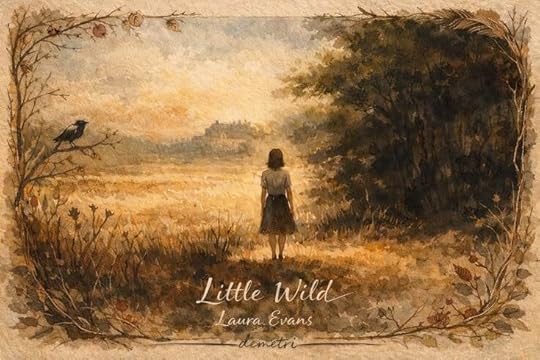
At the edge of field and wood, Margaret appears as a small figure before a landscape already holding its verdict.
Some novels of forbidden love ask whether desire can survive the world. Laura Evans’s “Little Wild” asks a nastier question: what love becomes once it can no longer bear the beloved’s separateness.
That is the novel’s real disturbance. Not simply that Margaret Goodall, the gamekeeper’s daughter at Snare House, loves Joanie Winther, the estate owner’s daughter, in 1937 Suffolk, where class hierarchy and sexual panic can ruin a life. It is that Margaret does not merely love Joanie. She rehearses her. She arranges a future for them so thoroughly that when Joanie returns from Europe changed – bronzed, sharpened, newly social, newly difficult to script – Margaret experiences not ordinary disappointment but something closer to authorial injury. The girl who comes home is still Joanie. That is precisely the problem. She is also more fully herself.
Evans is exquisitely alert to the humiliating ingenuity of obsession. Margaret has already furnished the future in her head: London, rooms, curtains, a lamp, a bed, the two of them stepping neatly into a shared life that feels to her less like fantasy than like overdue fact. So when Joanie comes back from the Riviera and Oxford glimmers on the near horizon, Margaret’s desire turns instantly theatrical. She is not only waiting for Joanie. She is waiting for a scene to happen correctly. The first third of “Little Wild” is brilliant on this distinction. Plot can count the calamities. Evans is after the smaller, uglier shift underneath them – the moment longing stops wanting a person and starts wanting a response.
The book’s great early set piece is Joanie’s homecoming and the party that follows, where everything Margaret has imagined curdles in her hands. Joanie does not rush to her. She is absorbed into the house’s social machinery, into family display, into beauty as performance, into the sort of glamorous return that leaves Margaret stranded in her own expectation. The resulting collapse is psychological, erotic, theatrical, and classed all at once. Margaret’s humiliation is not abstract heartbreak. It is physical, specific, sticky. Evans understands that shame arrives through objects: a slip, a hairbrush, a spoon, a scent, a dress, a letter, a sweet. “Little Wild” is a novel in which material things do not decorate feeling but conduct it.
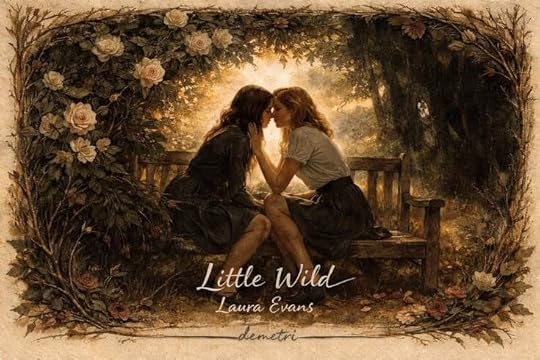
Under the rose canopy, tenderness and surveillance occupy the same narrow bench.
That gift for conduction is one of Evans’s greatest strengths. Her prose is lush without slackness, sensuous without prettification. It has the tactile insistence of private misery: pear drops, stale linen, sweat, broth, goat’s milk, old flowers, soap flakes, dust, overripe fruit, perfume drifting where it should not, breath gone sour in a closed room. Beauty in this novel rarely stays clean. It clings. It ferments. It turns. Evans writes the body as if emotion were always already a substance – something sticky, rancid, bruising, or over-sweet. Margaret’s voice, in particular, is a marvel of self-exposure. She is grandiose, acid, funny in ways that make one wince a second later, pitiless about other people’s poses and nearly blind to her own. The comedy is never imported from above. It grows naturally from desperation, vanity, and hurt.
After the party, the novel loosens into dated entries, but the diary form does not tidy Margaret. It makes her more dangerous. These entries do not march. They gum up. Time in “Little Wild” does not steadily pass so much as congeal around fixation. Margaret circles, revises, contradicts herself, touches the same charged objects over and over, worries a memory until it loses one meaning and acquires another. The drought that grips Suffolk during this period is not merely symbolic, but Evans knows exactly how to let environment and psyche contaminate each other. Fabian Winther’s grandiose plans for his rewilded estate, his terror of blight and failure, his fury at a world that will not obey him, begin to answer Margaret’s private derangement across the same scorched ground. The weather becomes less backdrop than public inscription. Private obsession has found a way to write itself onto the landscape.
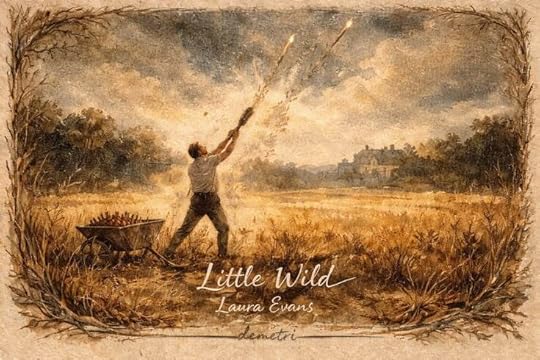
Fabian’s plea to the sky turns drought into spectacle and authority into farce.
If all this sounds perilously close to high literary gothic apparatus, that is because Evans is happy to use the apparatus – the big house, the servants, the brooding patriarch, the maddened parent, the half-sacred woods, the village suspicion, the magpies, the clocks, the drought, the whispers of witchcraft. What makes “Little Wild” more than a deft exercise in atmosphere is that its horror is household horror. The uncanny does not descend nobly onto the domestic. It crawls out of it. The novel’s most unsettling scenes are not the ones of overt rupture, but the ones organized around feeding, washing, dressing, covering, instructing, putting to bed, waking, correcting, and making use. Evans understands that domination often first appears not as melodrama but as management.
This is where the book takes its largest artistic risk, and where it becomes much more than an elegantly nasty queer gothic. Margaret, through an act of wild and half-comprehending making, produces another Joanie – a pale, helpless, initially near-speechless double she must teach almost everything. The counterfeit Joanie is a remarkable invention not because she is uncanny in any ordinary sense, though she is, but because of what she allows Evans to expose. This new creature is at once beloved, pupil, daughter, doll, accomplice, rehearsal body, and fantasy of perfect response. Margaret teaches her to chew, swallow, fasten hooks and eyes, wash herself, use a chamber pot, answer questions, move through a room, kiss back. Those scenes are almost unbearably intimate. They are also disgusting in the most artistically productive sense. Care and coercion become impossible to separate. The tenderness remains visible. That is what makes it so ugly.
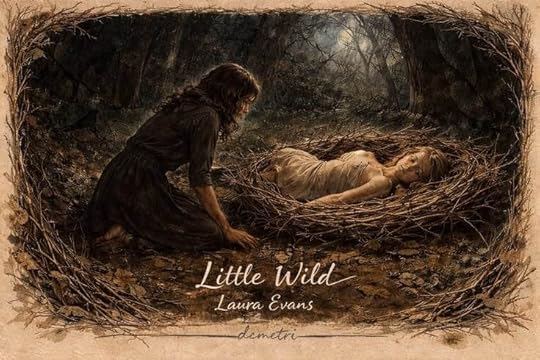
The counterfeit beloved arrives as miracle, theft, and accusation at once.
Many novels would either sentimentalize Margaret’s suffering or pathologize it into a neat moral diagnosis. Evans does neither. She is too exact for consolation and too intelligent for simplification. Margaret’s desire is shaped by queer isolation, by economic dependence, by class humiliation, by grief, by maternal trauma, by the punitive arrangements of the household that raised and used her. All of that matters. None of it absolves her. “Little Wild” is unusually clear on a point many novels prefer to blur: pain does not purify appetite. Margaret does not merely want Joanie near. She wants a Joanie who can be steadied, cued, instructed, hidden, improved, kept. Beneath the rhetoric of union lurks the fantasy of editability.
That may be the book’s most underdiscussed strength. Evans is willing to say that the dream of perfect intimacy often contains a wish to revise the beloved into legibility. She is also willing to say that queer suffering does not automatically ennoble queer desire. That is a serious risk – artistic, emotional, even intellectual – because it denies readers an easy allegiance. Margaret is not a monster in a simple sense, but neither is she merely the victim of a brutal world. She is both damaged and damaging. “Little Wild” does not ask to be admired for making her pitiable. It asks to be read closely enough that pity becomes only one response among several.
The novel is not without costs. Its atmosphere is so potent that, in the middle stretch, Evans occasionally lingers a beat too long in recurrence. One or two entries accumulate mood faster than consequence. The repetition is thematically defensible – obsession repeats, grief repeats, fantasy repeats – but even defensible repetition can slightly deaden momentum. There is also a real question about Joanie. Some of that is built into the design: Margaret experiences her as projection surface, prize, wound, accomplice, refuge. Full access to Joanie’s interior would alter the novel’s center of gravity. Even so, there are moments when Joanie feels less fully bodied than the book’s argument finally requires. She matters immensely, but not always with equal texture. The asymmetry is partly intentional. It is still an asymmetry.
Still, “Little Wild” keeps wriggling free of its nearest comparisons. One can invoke Shirley Jackson for moral weather, Angela Carter for appetite and theatrical menace, Sarah Waters for the charged social arrangements of queer historical fiction. All of those references illuminate something, and then they stop helping. Evans is doing something ranker and more domestic than any of them. Her world smells of bad tea and soap flakes, overripe fruit and dust, bedding aired too long, sweat under formal clothes, a room gone close with breath. Her comedy is sharper than one first expects, and her cruelty less ornamental. She does not merely stage obsession. She follows it into chores, routines, embarrassment, maintenance, and minor household tyrannies.
That is also why the novel feels current without any anxious scramble for topicality. Its deepest recognitions are not about 1937 alone. “Little Wild” is acutely alive to a fantasy that has hardly vanished: not simply to be loved, but to be loved by someone teachable, manageable, available on cue, responsive without remainder. It understands how domination often disguises itself as help, guidance, protection, or knowledge of what the other “really” wants. The book’s violence, before it becomes spectacular, is frequently administrative. It lives in correction, scheduling, concealment, routine.
Then Evans does something even bolder. She refuses to end where a cleaner gothic would end. Instead she carries Margaret and the real Joanie onward into Oxford, secrecy, compromise, sulks, routines, erotic continuance, petty resentment, and the drab afterlife of damaged love. This coda is not an appendix. It changes the whole novel behind it. What first looked like a queer rural gothic about obsession and doubling turns out also to be a book about what happens after fantasy fails and life keeps going anyway. Not redemption. Not judgment. Not even exactly punishment. Arrangement. Shared rooms. Tea going cold. Irritation. Dependency. Forgiveness that may or may not be wisdom. The humiliating persistence of love after revelation.
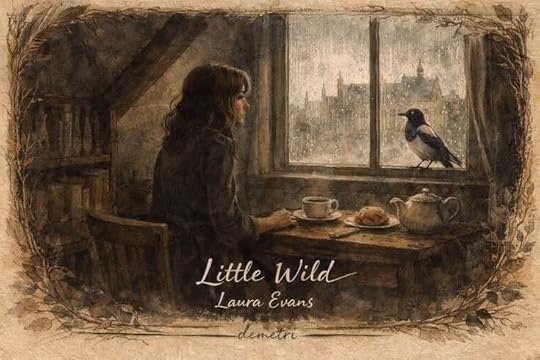
Rain, tea, and a magpie at the sill turn the Oxford aftermath into a room of suspended reckoning.
That ending is the book’s central achievement. Evans denies herself grandeur when grandeur would have been easy. She does not finish with a clean tragic stroke, or a final flourish of supernatural certitude, or a morally stabilizing explanation. She gives us aftermath instead – compromise, secrecy, weather, domestic coexistence, unease. The final movement sharpens the entire novel’s argument. The counterfeit girl in the woods no longer reads as a singular gothic marvel. She becomes the most literal expression of a temptation the book has been tracing all along: to replace the difficult beloved with a more manageable draft. Once the ending makes that plain, the whole book snaps into harsher focus.
I land at 89/100, which translates to 4/5 stars. That score reflects a novel that is often brilliant, occasionally overinsistent, and never tame. Its excellence is mainly artistic and emotional, though it is also intellectually shrewd in ways that do not announce themselves with lectures or prestige solemnity. What impresses me most is that Evans’s strengths are not generic strengths. She is not merely “good on atmosphere” or “good on voice,” though she is. She has written a novel with its own particular stain. It lingers.
What I will remember is not only the pale girl in the woods, though that image is ghastly enough, nor Fabian screaming into the heat for rain as if the sky itself had joined the conspiracy against him. It is the colder recognition beneath them. Disillusionment does not necessarily kill love. Sometimes it domesticates it. It sends it onward into rooms, habits, bargains, warmed nightclothes, hidden sweets, withheld letters, awkward breakfasts, and the long work of living beside what one has done. By the time the rain returns and the magpies begin again, innocence is long gone. Love, in its compromised and damaging form, remains. So does damage. What Evans leaves us with is not a purified feeling, but a life built out of both – and the sound, still carrying through the weather, of something wild refusing to stay fully housed.
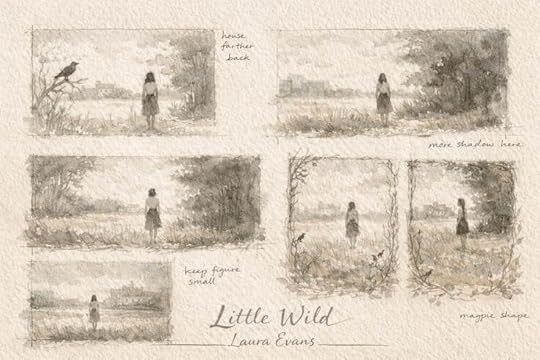
Early compositional thumbnails testing distance, exposure, enclosure, and the woman’s scale against the land.
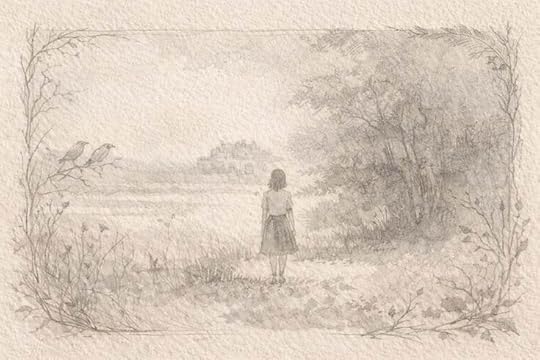
The graphite underdrawing lays in the emotional architecture before color begins to stain it.
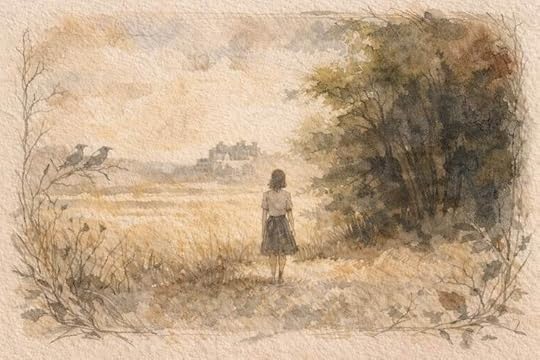
First washes establish heat, shadow, and threshold tension while much of the image still remains uncertain.
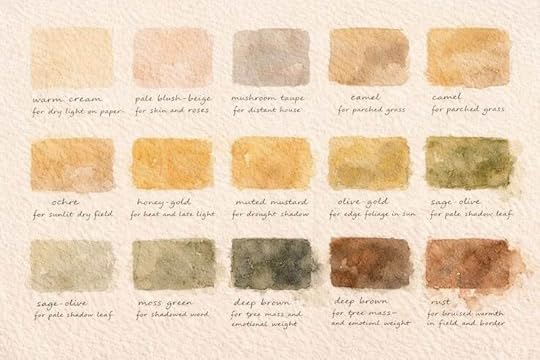
A cover-derived palette study maps the dry golds, bruised browns, and muted greens of the series.
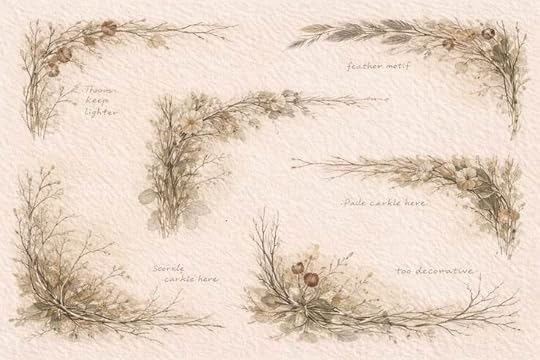
Border experiments search for a margin language of thorns, feathers, seedpods, and parched ornament.
All watercolor illustrations by Demetris Papadimitropoulos.
In “Little Wild,” Laura Evans turns doubling, desire, and rural menace into something more corrosive than a gothic trick: a novel about the fantasy of loving someone without having to endure their separateness.
By Demetris Papadimitropoulos | April 16th, 2026
At the edge of field and wood, Margaret appears as a small figure before a landscape already holding its verdict.
Some novels of forbidden love ask whether desire can survive the world. Laura Evans’s “Little Wild” asks a nastier question: what love becomes once it can no longer bear the beloved’s separateness.
That is the novel’s real disturbance. Not simply that Margaret Goodall, the gamekeeper’s daughter at Snare House, loves Joanie Winther, the estate owner’s daughter, in 1937 Suffolk, where class hierarchy and sexual panic can ruin a life. It is that Margaret does not merely love Joanie. She rehearses her. She arranges a future for them so thoroughly that when Joanie returns from Europe changed – bronzed, sharpened, newly social, newly difficult to script – Margaret experiences not ordinary disappointment but something closer to authorial injury. The girl who comes home is still Joanie. That is precisely the problem. She is also more fully herself.
Evans is exquisitely alert to the humiliating ingenuity of obsession. Margaret has already furnished the future in her head: London, rooms, curtains, a lamp, a bed, the two of them stepping neatly into a shared life that feels to her less like fantasy than like overdue fact. So when Joanie comes back from the Riviera and Oxford glimmers on the near horizon, Margaret’s desire turns instantly theatrical. She is not only waiting for Joanie. She is waiting for a scene to happen correctly. The first third of “Little Wild” is brilliant on this distinction. Plot can count the calamities. Evans is after the smaller, uglier shift underneath them – the moment longing stops wanting a person and starts wanting a response.
The book’s great early set piece is Joanie’s homecoming and the party that follows, where everything Margaret has imagined curdles in her hands. Joanie does not rush to her. She is absorbed into the house’s social machinery, into family display, into beauty as performance, into the sort of glamorous return that leaves Margaret stranded in her own expectation. The resulting collapse is psychological, erotic, theatrical, and classed all at once. Margaret’s humiliation is not abstract heartbreak. It is physical, specific, sticky. Evans understands that shame arrives through objects: a slip, a hairbrush, a spoon, a scent, a dress, a letter, a sweet. “Little Wild” is a novel in which material things do not decorate feeling but conduct it.
Under the rose canopy, tenderness and surveillance occupy the same narrow bench.
That gift for conduction is one of Evans’s greatest strengths. Her prose is lush without slackness, sensuous without prettification. It has the tactile insistence of private misery: pear drops, stale linen, sweat, broth, goat’s milk, old flowers, soap flakes, dust, overripe fruit, perfume drifting where it should not, breath gone sour in a closed room. Beauty in this novel rarely stays clean. It clings. It ferments. It turns. Evans writes the body as if emotion were always already a substance – something sticky, rancid, bruising, or over-sweet. Margaret’s voice, in particular, is a marvel of self-exposure. She is grandiose, acid, funny in ways that make one wince a second later, pitiless about other people’s poses and nearly blind to her own. The comedy is never imported from above. It grows naturally from desperation, vanity, and hurt.
After the party, the novel loosens into dated entries, but the diary form does not tidy Margaret. It makes her more dangerous. These entries do not march. They gum up. Time in “Little Wild” does not steadily pass so much as congeal around fixation. Margaret circles, revises, contradicts herself, touches the same charged objects over and over, worries a memory until it loses one meaning and acquires another. The drought that grips Suffolk during this period is not merely symbolic, but Evans knows exactly how to let environment and psyche contaminate each other. Fabian Winther’s grandiose plans for his rewilded estate, his terror of blight and failure, his fury at a world that will not obey him, begin to answer Margaret’s private derangement across the same scorched ground. The weather becomes less backdrop than public inscription. Private obsession has found a way to write itself onto the landscape.
Fabian’s plea to the sky turns drought into spectacle and authority into farce.
If all this sounds perilously close to high literary gothic apparatus, that is because Evans is happy to use the apparatus – the big house, the servants, the brooding patriarch, the maddened parent, the half-sacred woods, the village suspicion, the magpies, the clocks, the drought, the whispers of witchcraft. What makes “Little Wild” more than a deft exercise in atmosphere is that its horror is household horror. The uncanny does not descend nobly onto the domestic. It crawls out of it. The novel’s most unsettling scenes are not the ones of overt rupture, but the ones organized around feeding, washing, dressing, covering, instructing, putting to bed, waking, correcting, and making use. Evans understands that domination often first appears not as melodrama but as management.
This is where the book takes its largest artistic risk, and where it becomes much more than an elegantly nasty queer gothic. Margaret, through an act of wild and half-comprehending making, produces another Joanie – a pale, helpless, initially near-speechless double she must teach almost everything. The counterfeit Joanie is a remarkable invention not because she is uncanny in any ordinary sense, though she is, but because of what she allows Evans to expose. This new creature is at once beloved, pupil, daughter, doll, accomplice, rehearsal body, and fantasy of perfect response. Margaret teaches her to chew, swallow, fasten hooks and eyes, wash herself, use a chamber pot, answer questions, move through a room, kiss back. Those scenes are almost unbearably intimate. They are also disgusting in the most artistically productive sense. Care and coercion become impossible to separate. The tenderness remains visible. That is what makes it so ugly.
The counterfeit beloved arrives as miracle, theft, and accusation at once.
Many novels would either sentimentalize Margaret’s suffering or pathologize it into a neat moral diagnosis. Evans does neither. She is too exact for consolation and too intelligent for simplification. Margaret’s desire is shaped by queer isolation, by economic dependence, by class humiliation, by grief, by maternal trauma, by the punitive arrangements of the household that raised and used her. All of that matters. None of it absolves her. “Little Wild” is unusually clear on a point many novels prefer to blur: pain does not purify appetite. Margaret does not merely want Joanie near. She wants a Joanie who can be steadied, cued, instructed, hidden, improved, kept. Beneath the rhetoric of union lurks the fantasy of editability.
That may be the book’s most underdiscussed strength. Evans is willing to say that the dream of perfect intimacy often contains a wish to revise the beloved into legibility. She is also willing to say that queer suffering does not automatically ennoble queer desire. That is a serious risk – artistic, emotional, even intellectual – because it denies readers an easy allegiance. Margaret is not a monster in a simple sense, but neither is she merely the victim of a brutal world. She is both damaged and damaging. “Little Wild” does not ask to be admired for making her pitiable. It asks to be read closely enough that pity becomes only one response among several.
The novel is not without costs. Its atmosphere is so potent that, in the middle stretch, Evans occasionally lingers a beat too long in recurrence. One or two entries accumulate mood faster than consequence. The repetition is thematically defensible – obsession repeats, grief repeats, fantasy repeats – but even defensible repetition can slightly deaden momentum. There is also a real question about Joanie. Some of that is built into the design: Margaret experiences her as projection surface, prize, wound, accomplice, refuge. Full access to Joanie’s interior would alter the novel’s center of gravity. Even so, there are moments when Joanie feels less fully bodied than the book’s argument finally requires. She matters immensely, but not always with equal texture. The asymmetry is partly intentional. It is still an asymmetry.
Still, “Little Wild” keeps wriggling free of its nearest comparisons. One can invoke Shirley Jackson for moral weather, Angela Carter for appetite and theatrical menace, Sarah Waters for the charged social arrangements of queer historical fiction. All of those references illuminate something, and then they stop helping. Evans is doing something ranker and more domestic than any of them. Her world smells of bad tea and soap flakes, overripe fruit and dust, bedding aired too long, sweat under formal clothes, a room gone close with breath. Her comedy is sharper than one first expects, and her cruelty less ornamental. She does not merely stage obsession. She follows it into chores, routines, embarrassment, maintenance, and minor household tyrannies.
That is also why the novel feels current without any anxious scramble for topicality. Its deepest recognitions are not about 1937 alone. “Little Wild” is acutely alive to a fantasy that has hardly vanished: not simply to be loved, but to be loved by someone teachable, manageable, available on cue, responsive without remainder. It understands how domination often disguises itself as help, guidance, protection, or knowledge of what the other “really” wants. The book’s violence, before it becomes spectacular, is frequently administrative. It lives in correction, scheduling, concealment, routine.
Then Evans does something even bolder. She refuses to end where a cleaner gothic would end. Instead she carries Margaret and the real Joanie onward into Oxford, secrecy, compromise, sulks, routines, erotic continuance, petty resentment, and the drab afterlife of damaged love. This coda is not an appendix. It changes the whole novel behind it. What first looked like a queer rural gothic about obsession and doubling turns out also to be a book about what happens after fantasy fails and life keeps going anyway. Not redemption. Not judgment. Not even exactly punishment. Arrangement. Shared rooms. Tea going cold. Irritation. Dependency. Forgiveness that may or may not be wisdom. The humiliating persistence of love after revelation.
Rain, tea, and a magpie at the sill turn the Oxford aftermath into a room of suspended reckoning.
That ending is the book’s central achievement. Evans denies herself grandeur when grandeur would have been easy. She does not finish with a clean tragic stroke, or a final flourish of supernatural certitude, or a morally stabilizing explanation. She gives us aftermath instead – compromise, secrecy, weather, domestic coexistence, unease. The final movement sharpens the entire novel’s argument. The counterfeit girl in the woods no longer reads as a singular gothic marvel. She becomes the most literal expression of a temptation the book has been tracing all along: to replace the difficult beloved with a more manageable draft. Once the ending makes that plain, the whole book snaps into harsher focus.
I land at 89/100, which translates to 4/5 stars. That score reflects a novel that is often brilliant, occasionally overinsistent, and never tame. Its excellence is mainly artistic and emotional, though it is also intellectually shrewd in ways that do not announce themselves with lectures or prestige solemnity. What impresses me most is that Evans’s strengths are not generic strengths. She is not merely “good on atmosphere” or “good on voice,” though she is. She has written a novel with its own particular stain. It lingers.
What I will remember is not only the pale girl in the woods, though that image is ghastly enough, nor Fabian screaming into the heat for rain as if the sky itself had joined the conspiracy against him. It is the colder recognition beneath them. Disillusionment does not necessarily kill love. Sometimes it domesticates it. It sends it onward into rooms, habits, bargains, warmed nightclothes, hidden sweets, withheld letters, awkward breakfasts, and the long work of living beside what one has done. By the time the rain returns and the magpies begin again, innocence is long gone. Love, in its compromised and damaging form, remains. So does damage. What Evans leaves us with is not a purified feeling, but a life built out of both – and the sound, still carrying through the weather, of something wild refusing to stay fully housed.
Early compositional thumbnails testing distance, exposure, enclosure, and the woman’s scale against the land.
The graphite underdrawing lays in the emotional architecture before color begins to stain it.
First washes establish heat, shadow, and threshold tension while much of the image still remains uncertain.
A cover-derived palette study maps the dry golds, bruised browns, and muted greens of the series.
Border experiments search for a margin language of thorns, feathers, seedpods, and parched ornament.
All watercolor illustrations by Demetris Papadimitropoulos.
June 24, 2026
》review to come soon;; ☆ミ

June 30, 2026
Little Wild is a story of obsession and of power. It’s hugely atmospheric with its descriptions of the forest and lodge deeply detailed as we learn of Margaret’s change in circumstances following the party.
Laura Evans explores the interesting dynamics within the relationships between the girls and their fathers - Fabian’s grip on reality affecting Joanie’s decisions and Margaret’s father lost in his grief in the first with his birds.
Laura Evans explores the interesting dynamics within the relationships between the girls and their fathers - Fabian’s grip on reality affecting Joanie’s decisions and Margaret’s father lost in his grief in the first with his birds.

Review of advance copy received from NetGalley
Margaret Goodall (Meg) is an intoxicating character in which to reside for the spell of this debut novel. Laura Evans has written her so meticulously, so superbly, so remarkably that you feel you are her. Meg lives in a poem (‘Maybe she pictures me picturing her, and that is all we are today, reflections of the other all the way down’). Her mind is gentle, a bit sore; she’s like a bruise, but she’s also herself a brute.
Meg’s obsessiveness is like a villanelle – it helicopters around whatever she’s fixated with, and that is, the woman she loves, Joanie: ‘I must have thought about her almost every hour of the past twelve weeks, but now she’s actually coming I have wasps in my stomach, and at the slightest hint of her they rise up buzzing.’
The novel’s poeticism informs its pace; the two eat each other’s tails in the detail-rich, trance-like, delicately drawn, otherworldly realm of ‘Little Wild’. The setting is mystical whilst also feral; Evans has her backdrop hold space for these same two innate traits of her protagonist, who’s not so much an unreliable narrator as she is an unsettling narrator.
Immediately, you can taste the allegory in ‘Litte Wild’: the setting “Snare” House had me questioning whom it ensnared: the estate owner’s daughter Joanie, or the gamekeeper’s daughter Meg (or father-to-father, since they fought together at Flanders and cannot seem to cut the ties)? The whole novel is symbolism through and through, and I cherished every tiny part.
The novel recollected The Secret Garden for me: Evans situates us as an outsider in ‘The Big House’, engaging with the child of ‘the master of the house’, an overawing figure (Fabian Winther, ‘the Major, or His Lordship’; Meg’s father calls him God – the Grand Old Duke). As Frances Hodgson Burnett plays with fairy tale elements, so does Laura Evans. But ‘Little Wild’ enjoys turning the fairy tale pastoral dark.
Objects bear heavy meaning here, like in allegory and fairy tales: Meg has bought two spoons embossed with an M and a J, and she furnishes them symbolically with all the expectations she has of her imagined domestic future with Joanie. There’s also a slip that comes to stand in for its wearer; there’s a collection of jelly baby sweets, similarly, that Meg imbues with all the powers of poppets; not to mention the pivotal scene where what Meg carries in her basket into the woods (and out of the woods!) emblematises the plot absolutely. You won’t miss the nod to Little Red Riding Hood either.
Along with the magical artefact trope embodied by Meg’s objects, Laura Evans’s debut reaches for many other fairy tale components: the magical animal motif makes itself known immediately in the Goodall family’s tribe of familiar magpies, which also stand in for the classic ‘supernatural helper’ by the end of the novel. And we can easily read the forest beside the Goodall’s lodge in the woods as enchanted, given all the reports linking it to the Goodall women’s witchcraft.
As the novel moves to its close, the fairy tale in ‘Little Wild’ pulls towards the child-as-exchange trope, a parent trading a child to escape their predicament (Evans places ‘Little Wild’ in the 1937 drought-inducing heat wave). And then we’re asked to consider, in the very final passage, as every fairy tale gets a Happily Ever After, does Joanie live up in the end to Meg’s rehearsal of and her fantasy of their domestic life together? Maybe I’ll let that question rest and just call it a ‘Realistic Ever After’.
Often illustrated in fairy tales, the novel taken as a whole contends with the theme of the destruction of Family (capital F), whether it be the Goodalls or the Winthers. By way of archetypes, we have an evil queen/wicked stepmother in Lucille Winther; Joanie’s moronic brother Pip is certainly the stock small and weak ‘youngest son’ character (the girls say, ‘Pip is not quite a person’ and ‘is by nature at least half weasel’), in that (like his counterpart Zeus or Grimm’s littlest kid goat) he comes to have tremendous influence over the resolution of Meg and Joanie’s plot.
Familially, Meg’s estranged (and strange) father is almost as captivating a figure as Meg herself. Still more unfathomable, more arcane. I can’t think of an archetypal persona for him, unless he’s the shapeshifter/trickster Puck. Evans bestows him with a chameleon-like quality, he’s ever-changing throughout the novel. I suppose, like Puck, he’s subversive, but also – we come to see – acutely insightful.
Furthermore, just like Cinderella, Snow White, Rapunzel, Belle, Ariel, and all the other heroines from tales, Meg is motherless. We see this fundamental familial trauma clearly informing her ability to love others, but it also – classically – unlocks her inborn gift, her maternal inheritance; like storybook princesses before her, she finds her conventional ‘inner strength’ through her mother’s absence, in a uniquely unconventional episode.
Evans combines and conflates symbolism with essential narrative in the chapter where Meg assumes the mantle of her mother’s mysticism, and the unleashed riverbank episode that follows. What an understated showpiece! The scene is hazily cast in dim and misty tones, nostalgically hope-full; but what the author figuratively unearths from the murky water and muddy clay is literary fireworks – Evans has all my adulation for this set piece.
Which moves me on to the central plot point, the moment of crisis for Meg. I see other reviewers aren’t shying away from the spoiler, so let’s just say Evans quenches all my wants and needs from a book when she casts Meg as Hephaestus, shaping life from clay. What I want to spotlight is how Evans has written us an overtly allegorical/fairytale character within a novel covertly calling upon fairy tale imperatives. She fashions a character who is the personification of ‘the sleeping curse’. Her helpless clay creation is Meg’s own Pandora (we all know what that correlation prefigures). Meg has to waken her clay figurine (Meg becomes Pygmalion, her clay model Galataea). The fact that Evans has Meg make her clay doll the image of Joanie means that we also have an immaculate instance of the fairytale True Love’s Kiss.
As a classicist, it goes without saying that I’m in love with the touches from Classical Greek and Roman literature in ‘Little Wild’ – the clearest of which being Helen of Sparta’s birth from an egg after Zeus ravages her mother, Leda. In the narrative, Joanie has given Meg a book of poetry:
Thinking about Pygmalion and Galataea, ‘Little Wild’ – if we allow ourselves to step outside of Meg’s skewed and partial reality to think about our Galataea’s viewpoint – is the third novel I’ve read in a row that confronts the theme of coercion and lack of female body autonomy. It looks like it’s a 2026 theme (it’s also dealt with sensitively in the novel Honeysuckle by Bar Fridman-Tell).
Are we permitted to think of Meg as our villain, if she is Pygmalion, sculpting her perfect woman then bringing her to life just to possess her, to lust after her, to have her? My genuine feeling here is that Evans does actually involve herself in a truthful investigation of queer suffering, which – in Meg’s case – is the suffering of concealment, of separation, of isolation. I’ll let other reviewers dive deep into discussion of Meg’s villainhood or victimhood; for me, this was just the right book (along with Gentle Things: The Chilling Historical Fiction Novel Full of Secrets and Suspense by Danielle Giles, which I was reading congruently) to rinse out the recent spate of Dead Lesbian Syndrome perpetuation this year.
I can't express the gratitude I owe to Pan Macmillan | Mantle for the chance to read an eARC via NetGalley of this outstanding debut.
Meg’s obsessiveness is like a villanelle – it helicopters around whatever she’s fixated with, and that is, the woman she loves, Joanie: ‘I must have thought about her almost every hour of the past twelve weeks, but now she’s actually coming I have wasps in my stomach, and at the slightest hint of her they rise up buzzing.’
The novel’s poeticism informs its pace; the two eat each other’s tails in the detail-rich, trance-like, delicately drawn, otherworldly realm of ‘Little Wild’. The setting is mystical whilst also feral; Evans has her backdrop hold space for these same two innate traits of her protagonist, who’s not so much an unreliable narrator as she is an unsettling narrator.
Immediately, you can taste the allegory in ‘Litte Wild’: the setting “Snare” House had me questioning whom it ensnared: the estate owner’s daughter Joanie, or the gamekeeper’s daughter Meg (or father-to-father, since they fought together at Flanders and cannot seem to cut the ties)? The whole novel is symbolism through and through, and I cherished every tiny part.
The novel recollected The Secret Garden for me: Evans situates us as an outsider in ‘The Big House’, engaging with the child of ‘the master of the house’, an overawing figure (Fabian Winther, ‘the Major, or His Lordship’; Meg’s father calls him God – the Grand Old Duke). As Frances Hodgson Burnett plays with fairy tale elements, so does Laura Evans. But ‘Little Wild’ enjoys turning the fairy tale pastoral dark.
Objects bear heavy meaning here, like in allegory and fairy tales: Meg has bought two spoons embossed with an M and a J, and she furnishes them symbolically with all the expectations she has of her imagined domestic future with Joanie. There’s also a slip that comes to stand in for its wearer; there’s a collection of jelly baby sweets, similarly, that Meg imbues with all the powers of poppets; not to mention the pivotal scene where what Meg carries in her basket into the woods (and out of the woods!) emblematises the plot absolutely. You won’t miss the nod to Little Red Riding Hood either.
Along with the magical artefact trope embodied by Meg’s objects, Laura Evans’s debut reaches for many other fairy tale components: the magical animal motif makes itself known immediately in the Goodall family’s tribe of familiar magpies, which also stand in for the classic ‘supernatural helper’ by the end of the novel. And we can easily read the forest beside the Goodall’s lodge in the woods as enchanted, given all the reports linking it to the Goodall women’s witchcraft.
As the novel moves to its close, the fairy tale in ‘Little Wild’ pulls towards the child-as-exchange trope, a parent trading a child to escape their predicament (Evans places ‘Little Wild’ in the 1937 drought-inducing heat wave). And then we’re asked to consider, in the very final passage, as every fairy tale gets a Happily Ever After, does Joanie live up in the end to Meg’s rehearsal of and her fantasy of their domestic life together? Maybe I’ll let that question rest and just call it a ‘Realistic Ever After’.
Often illustrated in fairy tales, the novel taken as a whole contends with the theme of the destruction of Family (capital F), whether it be the Goodalls or the Winthers. By way of archetypes, we have an evil queen/wicked stepmother in Lucille Winther; Joanie’s moronic brother Pip is certainly the stock small and weak ‘youngest son’ character (the girls say, ‘Pip is not quite a person’ and ‘is by nature at least half weasel’), in that (like his counterpart Zeus or Grimm’s littlest kid goat) he comes to have tremendous influence over the resolution of Meg and Joanie’s plot.
Familially, Meg’s estranged (and strange) father is almost as captivating a figure as Meg herself. Still more unfathomable, more arcane. I can’t think of an archetypal persona for him, unless he’s the shapeshifter/trickster Puck. Evans bestows him with a chameleon-like quality, he’s ever-changing throughout the novel. I suppose, like Puck, he’s subversive, but also – we come to see – acutely insightful.
Furthermore, just like Cinderella, Snow White, Rapunzel, Belle, Ariel, and all the other heroines from tales, Meg is motherless. We see this fundamental familial trauma clearly informing her ability to love others, but it also – classically – unlocks her inborn gift, her maternal inheritance; like storybook princesses before her, she finds her conventional ‘inner strength’ through her mother’s absence, in a uniquely unconventional episode.
Evans combines and conflates symbolism with essential narrative in the chapter where Meg assumes the mantle of her mother’s mysticism, and the unleashed riverbank episode that follows. What an understated showpiece! The scene is hazily cast in dim and misty tones, nostalgically hope-full; but what the author figuratively unearths from the murky water and muddy clay is literary fireworks – Evans has all my adulation for this set piece.
Which moves me on to the central plot point, the moment of crisis for Meg. I see other reviewers aren’t shying away from the spoiler, so let’s just say Evans quenches all my wants and needs from a book when she casts Meg as Hephaestus, shaping life from clay. What I want to spotlight is how Evans has written us an overtly allegorical/fairytale character within a novel covertly calling upon fairy tale imperatives. She fashions a character who is the personification of ‘the sleeping curse’. Her helpless clay creation is Meg’s own Pandora (we all know what that correlation prefigures). Meg has to waken her clay figurine (Meg becomes Pygmalion, her clay model Galataea). The fact that Evans has Meg make her clay doll the image of Joanie means that we also have an immaculate instance of the fairytale True Love’s Kiss.
As a classicist, it goes without saying that I’m in love with the touches from Classical Greek and Roman literature in ‘Little Wild’ – the clearest of which being Helen of Sparta’s birth from an egg after Zeus ravages her mother, Leda. In the narrative, Joanie has given Meg a book of poetry:
‘But I’ve never got past the first poem: not the first in the book, but the one it happened to fall open at, weeks ago. It is about Leda and the swan, who was not a swan at all but Zeus disguised (if a woman is to be taken advantage of, it seems more plausible to have it done by a bird), and is a baffling sort of poetry, that makes you feel a lot of things at once without being sure what they are. But I keep coming back to it, this single violent perfect sonnet. The words floated in and out of meaning, and I lay there and thought about Leda caught beneath God: those beating wings, her neck already bruising, her terrified vague fingers. And after, his indifferent beak.’As we read on, we encounter Meg’s own intertwinedness with the symbolism of birds, waterbirds, eggs, birth and water. Laura Evans’s water imagery is especially entrancing in Meg’s association with water (the river, her sadness, her pooling emotions, her part in the drought). The fact that the true climactic scene upon Joanie Winther’s return takes place at the riverbank, calls back to Ovid’s Metamorphoses for me, whose shapeshifting females often liquify into tears and pools (Egeria, Cyane, Arethusa), or where grief and lament is linked to water, rivers, riverbanks, and that text is where we find the tales of Pandora, of Pygmalion, of Leda and Helen.
Thinking about Pygmalion and Galataea, ‘Little Wild’ – if we allow ourselves to step outside of Meg’s skewed and partial reality to think about our Galataea’s viewpoint – is the third novel I’ve read in a row that confronts the theme of coercion and lack of female body autonomy. It looks like it’s a 2026 theme (it’s also dealt with sensitively in the novel Honeysuckle by Bar Fridman-Tell).
Are we permitted to think of Meg as our villain, if she is Pygmalion, sculpting her perfect woman then bringing her to life just to possess her, to lust after her, to have her? My genuine feeling here is that Evans does actually involve herself in a truthful investigation of queer suffering, which – in Meg’s case – is the suffering of concealment, of separation, of isolation. I’ll let other reviewers dive deep into discussion of Meg’s villainhood or victimhood; for me, this was just the right book (along with Gentle Things: The Chilling Historical Fiction Novel Full of Secrets and Suspense by Danielle Giles, which I was reading congruently) to rinse out the recent spate of Dead Lesbian Syndrome perpetuation this year.
I can't express the gratitude I owe to Pan Macmillan | Mantle for the chance to read an eARC via NetGalley of this outstanding debut.
August 16, 2026
I found it really interesting how much time the narrative spent on just a few hours, and I think it paid off in how it conveyed how one reflects on their whole life in a day leading up to an anticipated event. I feel like there were a few points where the author lost me. When the MC was at the party, it was hard to decipher her goals and character statement. There's a part of the book that makes you go "Huh?" but the author wrapped it up in a way that made sense. I liked this take on witchery as being more abstract and everyday than a full-blown magic system. Would recommend.
June 23, 2026
Thanks to the publisher Henry Holt and Company for the advanced reader copy!
Probably 3.5 rounded up.
Little Wild is a very slow-paced, twisty, gothic tale. The first half of the book takes place all in one day and not much happens in that time. This is not to dissuade another reader from picking this up, though. Evans’ writing is beautiful, and while I did struggle to get into the story, I really enjoyed it once I got past 50 pages or so.
Meg is a weird character. She’s not quite lovable, as she is delusional, obsessive, and unreliable in many ways. However, I really did want to see how her story played out with Joanie. Joanie’s motivations and true thoughts are a mystery throughout the book, so it was interesting to see Meg create her own narrative about Joanie while constantly contradicting herself.
I was left a bit confused with the ending, but magical realism in novels is rarely explicitly explained, I suppose.
Probably 3.5 rounded up.
Little Wild is a very slow-paced, twisty, gothic tale. The first half of the book takes place all in one day and not much happens in that time. This is not to dissuade another reader from picking this up, though. Evans’ writing is beautiful, and while I did struggle to get into the story, I really enjoyed it once I got past 50 pages or so.
Meg is a weird character. She’s not quite lovable, as she is delusional, obsessive, and unreliable in many ways. However, I really did want to see how her story played out with Joanie. Joanie’s motivations and true thoughts are a mystery throughout the book, so it was interesting to see Meg create her own narrative about Joanie while constantly contradicting herself.
I was left a bit confused with the ending, but magical realism in novels is rarely explicitly explained, I suppose.
July 7, 2026
Not a horror novel, but instead deeply atmospheric historical fiction, with a focus on the natural world. If you like gothic-infused stories of earthy decay and ecological collapse and complicated relationships, give this a try. Obsessed with the author's ability to write about Mother Nature in a way that's both beautiful and infused with rot. Felt very similar vibes to Claire Fuller's writing, particularly Bitter Orange.(Thanks to Henry Holt for the arc)

June 25, 2026
"We are us, M and J, J and M, we brush each other's hair, we finish each other's sentences."
In Little Wild, Laura Evans combines lush, atmospheric prose with acute psychological insight to create a compelling narrative driven by longing, secrecy, and change. Through Margaret's intensely subjective narration, Evans transforms the Suffolk landscape into an emotional terrain, producing a novel that is both deeply immersive and narratively urgent.
It's 1937, and in the first part of the novel, we follow Margaret as she anxiously awaits the return of her closest friend, Joanie Winther, from travelling abroad. We feel that anticipation palpably on the page, captured beautifully in Evans's writing: "I have wasps in my stomach, and at the slightest hint of her they rise up buzzing." When Joanie finally arrives at Snare House, a sweltering heatwave sets the stage for a grand party celebrating her return.
The party serves as the novel's emotional turning point. What begins as a dazzling social occasion quickly becomes a site of revelation and rupture, exposing hidden desires and challenging the rigid expectations placed upon its characters. Only Margaret, ward of the Winther family, knows what is truly at stake: the two girls are deeply in love and planning to run away together. But when Joanie's father discovers the truth, Margaret is exiled to a remote lodge in the woods with her estranged father and his colony of magpies.
The novel then becomes as much about what Margaret does with that exile as it is about the love she's been severed from. Nature and civilisation collide throughout the novel, as humans attempt to control the untamed world around them, beautifully illustrated when Evans writes of "the Meadow illuminated not by moonlight... but the leach of our electric brightness." Evans repeatedly draws on imagery of witchcraft, haunting, and wildness to explore female inheritance and desire. Recurring bird imagery, rooted in her father's magpies ("she said her sisters were calling her. She meant the birds"), blurs the boundaries between folklore and reality. The birds become fascinating dual symbols of freedom and the wild feminine that society fears and seeks to domesticate, suggesting that women inherit not only their mothers' traits, but also society's anxieties about women who refuse to remain tame.
At its heart, Margaret and Joanie's sapphic relationship feels both liberating and destabilising. Through lyrical, intensely physical prose, Evans depicts first queer love as a force that shapes identity, offers refuge from loss, and imagines alternative futures, while never shying away from the dangers of idealisation. As the lines of their lives fold into each other "like paper cranes," Evans delivers wonderful twists that feel entirely fresh. Much of the novel's emotional power lies in Margaret's painful recognition that true love requires seeing another person as they actually are, rather than as we wish them to be.
This is a captivating, witty novel that hypnotises and leads readers into a world that is daring, daunting, and ultimately incredibly hopeful. If you enjoy sapphic love stories immersed in a historical, witchy setting, this won't disappoint.
Big thank you to Pan Macmillan and Book Break UK for the ARC!
#pudseyrecommends
In Little Wild, Laura Evans combines lush, atmospheric prose with acute psychological insight to create a compelling narrative driven by longing, secrecy, and change. Through Margaret's intensely subjective narration, Evans transforms the Suffolk landscape into an emotional terrain, producing a novel that is both deeply immersive and narratively urgent.
It's 1937, and in the first part of the novel, we follow Margaret as she anxiously awaits the return of her closest friend, Joanie Winther, from travelling abroad. We feel that anticipation palpably on the page, captured beautifully in Evans's writing: "I have wasps in my stomach, and at the slightest hint of her they rise up buzzing." When Joanie finally arrives at Snare House, a sweltering heatwave sets the stage for a grand party celebrating her return.
The party serves as the novel's emotional turning point. What begins as a dazzling social occasion quickly becomes a site of revelation and rupture, exposing hidden desires and challenging the rigid expectations placed upon its characters. Only Margaret, ward of the Winther family, knows what is truly at stake: the two girls are deeply in love and planning to run away together. But when Joanie's father discovers the truth, Margaret is exiled to a remote lodge in the woods with her estranged father and his colony of magpies.
The novel then becomes as much about what Margaret does with that exile as it is about the love she's been severed from. Nature and civilisation collide throughout the novel, as humans attempt to control the untamed world around them, beautifully illustrated when Evans writes of "the Meadow illuminated not by moonlight... but the leach of our electric brightness." Evans repeatedly draws on imagery of witchcraft, haunting, and wildness to explore female inheritance and desire. Recurring bird imagery, rooted in her father's magpies ("she said her sisters were calling her. She meant the birds"), blurs the boundaries between folklore and reality. The birds become fascinating dual symbols of freedom and the wild feminine that society fears and seeks to domesticate, suggesting that women inherit not only their mothers' traits, but also society's anxieties about women who refuse to remain tame.
At its heart, Margaret and Joanie's sapphic relationship feels both liberating and destabilising. Through lyrical, intensely physical prose, Evans depicts first queer love as a force that shapes identity, offers refuge from loss, and imagines alternative futures, while never shying away from the dangers of idealisation. As the lines of their lives fold into each other "like paper cranes," Evans delivers wonderful twists that feel entirely fresh. Much of the novel's emotional power lies in Margaret's painful recognition that true love requires seeing another person as they actually are, rather than as we wish them to be.
This is a captivating, witty novel that hypnotises and leads readers into a world that is daring, daunting, and ultimately incredibly hopeful. If you enjoy sapphic love stories immersed in a historical, witchy setting, this won't disappoint.
Big thank you to Pan Macmillan and Book Break UK for the ARC!
#pudseyrecommends
Displaying 1 - 30 of 217 reviews