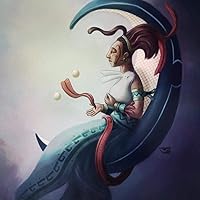
Orpheus is familiar from Greek mythology as a peerless bard, the Thracian son of a Muse with superhuman musical abilities that enabled him to win the release of his young wife Eurydice from Hades, only to lose her on the way back. But he was also considered an authentic poet preceding Hesiod and Homer and on a par with Musaeus, and was credited with poems, oracles, and the foundation of rituals in a tradition that remained vital and creative from Archaic Greece through to the Roman Empire and beyond. Essentially Dionysiac, but without the violence and blood sacrifice, and with a focus on theogony, cosmogony, and the origin and destiny of souls, Orphism was at once a distinctive and an open tradition, with significant change and development over time but with features that made the works and rituals cumulatively attributed to Orpheus identifiable to followers. This tradition endowed them with a lasting coherence despite the absence of dogma or control by priests. Although Orphism departed in profound and fascinating ways from conventional accounts, it proved highly adaptable to various religious and philosophical systems, especially Pythagorean and Neoplatonist but also Judaic and Christian.
This edition collects works representing the most ancient Orphic literature, excluding later mythological, scientific, and pseudo-scientific poems opportunistically attributed to him.
An order reigns within the cosmos, unfathomable to the mortal intellect. When insight into the divine potencies is attained, the sacred mysteries align the wandering psyche, the soul, and the daimon. Though a multitude of narratives exist, all embraced in their turn, some remain merely superficial, while others grasp the sublime essence; those who possess the art to read them are already thrice-blessed. For where order reigns, there flows a beautiful, polyonymous succession of powers. This is no stagnant, vulgar order as conceived by the common mind, but an order in perpetual motion, a divine choreography that the base intellect mistakes for chaos. He who perceives only discord will never navigate the golden threads of cosmic design. To live this truth is to embody this dynamic order like a taut bow; just as a mariner weathers tempest and calm upon the deep, yet steers inexorably by the immutable laws of the stars. Doctrines capable of acting as guiding lights are precisely that; yet the teachings that instruct the soul how to become a star are truly initiatory, for they preserve the unbroken chain of psychagogy. Even should all earthly wisdom be extinguished, a child gazing in adoration at the vault of heaven is tutored by the very wonders of the cosmos, destined to resurrect the ancient secrets, much like the primordial mystic of old, who attained wisdom through the perfect union of divine frenzy and absolute stillness.
...
Myth is the eternal echo of powers retold through human tragedy, beautiful, terrifying, charged with greatness and awe. Both the profound power, so remote from humankind, and the grand catastrophes, titanic falls and gargantuan rises that it occasions, constitute the tremendous mysterium that arches over all human toil. The human who, out of necessity and with right perception, captures the truth of these spectacles is himself at once tragic and beautiful. Those who cannot infuse the spectacle with the force of beauty, soul and humaneness are left to wander into the claws of a cold universal machine that crushes them into nothingness. That analytical machine, stripped of soul, is antihuman, antiHekatic and antiontological; it is the final step before the void-hanger is cast out of the phenomenal universe into the cinders of the chasms. It is the terror of being flung into utter alienation, a speck of dust, a pox upon the void that discovers too late how every power and essence of its being once drew upon the Divine streams. Deprived of them, it is left to wander in cosmic terror, cast away not from Edenic perception but from the Gardens of the Abyss.
The mortal must ever know his share, his measure, his ratio and his limit, lest he commit the abominable, self-destructive error of the anomaly: the one who, craving immortality, is immortalised only as a figurine, terrorised by the immense, incomprehensible, gargantuan infinity of space within the ocean of nothingness.We laugh and laugh and laugh, like a child mocking the counsel of a senex; then we suffer deeply, like a child who has fallen, still ignorant of the dangers against which we were warned. The wisdom of age requires that the adult live up to his gravity and approach such things with grave seriousness; a child is pardoned many things. May the Pleiades not weep…