

What do you think?

Write for Money and Power: The Anti-Starving Artist’s Guide to Becoming a Seven-Figure Writer
AMAZON BESTSELLING AUTHOR, TOP 30 BESTSELLING SUBSTACK NEWSLETTER CREATOR, AND 7-FIGURE WRITER AMY SUTO SPILLS HER SECRETS
Still buying the starving artist myth? Burn it — and get paid.
The gatekeepers told you poverty was noble so that you’d shut up and stay cheap. Ready to write your way out of the lie designed to keep you small, obedient, and broke?
If you’ve ever felt trapped in a writing career that pays in “exposure” or pocket change, this is your permission slip to demand more. Much more.
Amy Suto went from broke in the Hollywood trenches to becoming booked out as a seven-figure writer, bestselling author, and creator of a top 30 Substack newsletter. In Write for Money and Power, she shows you exactly how she did it — and how you can too, even if you’ve never made a dollar from your writing before.
Whether you’re a freelancer, a ghostwriter, a novelist, or any kind of writer with bills to pay and a vision to realize, this isn’t another “believe in yourself” pep talk. It’s a real, grown-up plan to make money and grow your personal power with your writing.
If you’d rather make history than excuses — keep reading.
In Write for Money and Power, You’ll Learn How To…
Crush the lie that artists should be broke with history’s real examples (Michelangelo invoiced like a boss, Shakespeare co-owned the damn theater.)Follow Amy's 12-month roadmap to build your writing empire. This is the exact plan she'd use to go from $0 to building a seven-figure writing empire from scratch.Rewire your brain for seven figures. Learn the pricing scripts, positioning plays, and simple mental models that allow you to generate money and power from your words and your laptop.Build a ghostwriting business that screams luxury. Trade cheap words for six- and seven-figure projects — and what film schools and gatekeepers are scared for you to find out.Grow a paid newsletter empire. Own your audience, write on your terms, and unlock the freedom of predictable, reader-funded income.Self-publish like a tycoon. Who needs permission to publish? It’s time to own your work. Taylor Swift bought back her masters. Brandon Sanderson pocketed $41 million on his self-published book launch on Kickstarter. Now? It’s your turn.Scale without burning out. Learn the systems, daily rituals, and non-negotiable boundaries that turn chaos into cash flow.Write from anywhere — on the couch, a coast, or a café in Rome.Why is this book different?Because this isn’t “wait your turn” advice — it’s how to skip the line.
Amy shares the exact systems she used to turn her writing into a seven-figure, work-from-anywhere biz.
Still skeptical?
“But I’m a total beginner.” Great. This book exists to make sure you don’t stay one. All you need is the willingness to bet on yourself.
“But no one will pay that much for writing.” Amy’s clients do — and so do so many other clients and readers. This book is here to build your confidence and smash your limiting beliefs so you can step into your power and charge more than you ever thought was possible.
Still buying the starving artist myth? Burn it — and get paid.
The gatekeepers told you poverty was noble so that you’d shut up and stay cheap. Ready to write your way out of the lie designed to keep you small, obedient, and broke?
If you’ve ever felt trapped in a writing career that pays in “exposure” or pocket change, this is your permission slip to demand more. Much more.
Amy Suto went from broke in the Hollywood trenches to becoming booked out as a seven-figure writer, bestselling author, and creator of a top 30 Substack newsletter. In Write for Money and Power, she shows you exactly how she did it — and how you can too, even if you’ve never made a dollar from your writing before.
Whether you’re a freelancer, a ghostwriter, a novelist, or any kind of writer with bills to pay and a vision to realize, this isn’t another “believe in yourself” pep talk. It’s a real, grown-up plan to make money and grow your personal power with your writing.
If you’d rather make history than excuses — keep reading.
In Write for Money and Power, You’ll Learn How To…
Crush the lie that artists should be broke with history’s real examples (Michelangelo invoiced like a boss, Shakespeare co-owned the damn theater.)Follow Amy's 12-month roadmap to build your writing empire. This is the exact plan she'd use to go from $0 to building a seven-figure writing empire from scratch.Rewire your brain for seven figures. Learn the pricing scripts, positioning plays, and simple mental models that allow you to generate money and power from your words and your laptop.Build a ghostwriting business that screams luxury. Trade cheap words for six- and seven-figure projects — and what film schools and gatekeepers are scared for you to find out.Grow a paid newsletter empire. Own your audience, write on your terms, and unlock the freedom of predictable, reader-funded income.Self-publish like a tycoon. Who needs permission to publish? It’s time to own your work. Taylor Swift bought back her masters. Brandon Sanderson pocketed $41 million on his self-published book launch on Kickstarter. Now? It’s your turn.Scale without burning out. Learn the systems, daily rituals, and non-negotiable boundaries that turn chaos into cash flow.Write from anywhere — on the couch, a coast, or a café in Rome.Why is this book different?Because this isn’t “wait your turn” advice — it’s how to skip the line.
Amy shares the exact systems she used to turn her writing into a seven-figure, work-from-anywhere biz.
Still skeptical?
“But I’m a total beginner.” Great. This book exists to make sure you don’t stay one. All you need is the willingness to bet on yourself.
“But no one will pay that much for writing.” Amy’s clients do — and so do so many other clients and readers. This book is here to build your confidence and smash your limiting beliefs so you can step into your power and charge more than you ever thought was possible.
269 pages, Kindle Edition
Published January 12, 2026
Ratings & Reviews
Friends & Following
Create a free account to discover what your friends think of this book!
Community Reviews
Displaying 1 - 30 of 50 reviews

February 22, 2026
I was hoping for something that I could follow in this book, even if on a much smaller scale. Unfortunately, it felt like having someone who drives a Ferrari giving directions to someone who rides a push-bike, then hinting they're the one to blame if they don't reach their destination intact, or for not being able to travel as fast.
I also thought it was odd that they were a lot of passages that felt like they were using too many words and saying so little, and the lines that said 'it's not x, it's y' etc. I thought surely someone earning so much and being so successful wouldn't use AI to write their book.
So, I was disappointed rather than surprised when the author said she had used AI to help write the book, as if this was a big reveal. It wasn't. I could tell.
I also thought it was odd that they were a lot of passages that felt like they were using too many words and saying so little, and the lines that said 'it's not x, it's y' etc. I thought surely someone earning so much and being so successful wouldn't use AI to write their book.
So, I was disappointed rather than surprised when the author said she had used AI to help write the book, as if this was a big reveal. It wasn't. I could tell.
October 22, 2025
"Motivating, but not groundbreaking for seasoned writers"
As someone who’s been a freelance content writer for years, I picked up Write for Money and Power hoping for some new strategies or deeper insights into scaling a writing business. Amy Suto’s voice is confident and motivating, and her story—from Hollywood burnout to creative freedom—is engaging and relatable.
That said, while the book is full of energy and empowerment (“be your own cavalry” is a recurring theme), much of the advice will feel familiar if you’ve already built a successful freelance career. Concepts like diversifying income streams, self-publishing, and building paid newsletters are solid but not particularly new.
Where Suto shines is in mindset—she’s great at dismantling the “starving artist” myth and encouraging writers to value their work and build systems that support their lives, not the other way around. Her personal journey through illness and reinvention adds authenticity and heart to the book.
If you’re newer to freelance writing or need a motivational reset, this is a great, high-energy read. If you’re already running a thriving content business, you might find yourself nodding along rather than taking notes.
As someone who’s been a freelance content writer for years, I picked up Write for Money and Power hoping for some new strategies or deeper insights into scaling a writing business. Amy Suto’s voice is confident and motivating, and her story—from Hollywood burnout to creative freedom—is engaging and relatable.
That said, while the book is full of energy and empowerment (“be your own cavalry” is a recurring theme), much of the advice will feel familiar if you’ve already built a successful freelance career. Concepts like diversifying income streams, self-publishing, and building paid newsletters are solid but not particularly new.
Where Suto shines is in mindset—she’s great at dismantling the “starving artist” myth and encouraging writers to value their work and build systems that support their lives, not the other way around. Her personal journey through illness and reinvention adds authenticity and heart to the book.
If you’re newer to freelance writing or need a motivational reset, this is a great, high-energy read. If you’re already running a thriving content business, you might find yourself nodding along rather than taking notes.

October 4, 2025
Like a kid watching an R-rated movie for the first time, I was wide-eyed and mouth agape while reading "Write for Money and Power," hanging on Amy's every word. It’s not just a practical guide. It’s the pep talk I didn’t know I needed. I can’t un-dream Amy’s fullproof plan, or stop the avalanche of creative energy hitting me now. Writers looking to get paid what they deserve—read this book now!
—Lauren Burke Meyer, an award-winning writer and founder of the Lauren's Law blog
—Lauren Burke Meyer, an award-winning writer and founder of the Lauren's Law blog

February 4, 2026
“Write for Money and Power” and the End of the Starving-Artist Myth: A Review of Amy Suto’s Playbook for Writers Who Want Leverage, Not Martyrdom
By Demetris Papadimitropoulos | February 4th, 2025
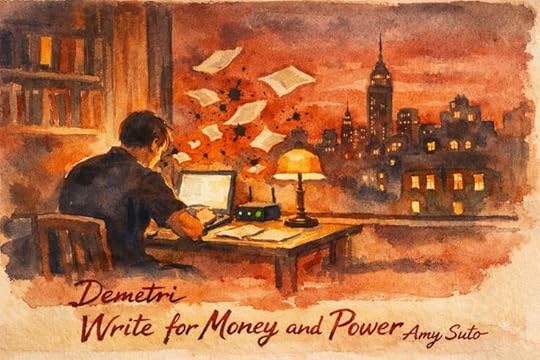
Watercolor Piece by Demetris Papadimitropoulos
In “Write for Money and Power,” Amy Suto arrives wearing two outfits at once: the silk robe of the artist and the tactical vest of the operator. She is here to romance you out of your shame about wanting money, then hand you a clipboard. She is here to seduce the starving artist myth into a dark alley and leave it there, blinking. She is here, most of all, to tell you that the modern writer’s problem is not talent. It’s architecture.
The book’s central argument is both blunt and strangely tender: money is not a moral compromise, it is “creative oxygen.” Power is not celebrity or domination, it’s freedom – the right to choose your work, your pace, your health, your life. If that sounds like a slogan, Suto anticipates the eye-roll and barrels through it anyway, because she writes like someone who has already lived through the alternative. Her pages are full of hard-won urgency, the kind you get after your body mutinies or your bank account does. She wants writers to stop treating their ambition as a guilty pleasure and start treating it as a business plan.
This is not a book about writing sentences so much as it is a book about writing as leverage. Suto’s true subject is the writer as a small, self-contained company – a “creator CEO” – building an engine that can generate income without requiring martyrdom. The prose comes with an espresso-shot tempo: short paragraphs, sharp pivots, a fondness for swaggering imperatives (“raise your rates,” “ship the draft,” “stop undercharging”), and metaphors that turn anxiety into a toy you can throw across the room. The vibe is equal parts confession and pep talk, with a San Francisco sheen: Substack subscriptions, remote workflows, high-end clients, the occasional rooftop bar, a sense that you are always one good system away from getting your life back.
Suto is also a reliable narrator of her own obsession: she likes frameworks the way some writers like sonnets. You can feel her pleasure in naming the parts. “Three pillars.” “Roadmaps.” “Laser protocols.” “Safety nets.” “Lean dream teams.” “Freedom seasons.” She writes in the gospel cadence of contemporary self-help – brisk, motivational, a little profane – yet she’s at her best when she lets the seams show: the moments when the book admits how fragile the whole enterprise can feel, especially for the kind of person who makes things out of language and then has to invoice for it.
The book is divided like a business blueprint with a novelist’s sense of momentum. Early chapters perform an exorcism: the inherited scripts about art, suffering, gatekeepers, and virtue. Suto positions traditional institutions – publishing, Hollywood, legacy media – less as villains than as collapsing infrastructures. She gestures at labor unrest and the shrinking middle of creative careers, at how the old ladder has missing rungs. In this landscape, her thesis isn’t merely aspirational; it’s an adaptive strategy. When she writes about “Wi-Fi and weaponized words,” she is naming a real shift in the culture: the way distribution has decoupled from permission. The writer with an email list and a payment link is no longer a quaint internet curiosity. They’re an economic unit.
Part Two of the book becomes a practical catechism: three income pillars (paid newsletter, self-published books, and luxury freelancing/ghostwriting) designed to reinforce one another. The logic is modern and slightly ruthless. You build recurring revenue (subscriptions) while you build assets (books) while you fund everything with high-ticket cashflow (services). This is, in essence, the creator economy’s answer to the old patronage system, updated for the era of platforms. If “The 4-Hour Workweek” sold a dream of escape through automation, Suto offers something more grounded: not escape, but control. She is less interested in vanishing to a beach than in waking up in your own life without dread.
Her most compelling practical chapter, “Your Roadmap From Zero to Seven-Figure Writer in 12 Months,” reads like a cinematic montage, all sprint and sweat and calendar blocks. It’s audacious on purpose, a kind of productive dare: if you aim at a million and land at half, you’ve still built a life. The month-by-month structure is a familiar self-help device, but Suto gives it bite by pairing it with a psychological argument about belief: “realistic” is not a neutral category, it’s a ceiling your nervous system enforces. The roadmap’s true function is less forecasting than permission-making. It asks the reader to behave like a professional before they feel like one – to publish before they’re “ready,” to pitch with imperfect confidence, to treat consistency as a moat.
The book’s best pages are the ones that understand how much of a writing career is actually mood management. Suto has a novelist’s instinct for the villain that lives inside the house. Perfectionism is “procrastination wearing Prada.” Catastrophic thinking is “misplaced imagination.” The enemy is rarely craft alone; it is the spiraling story the writer tells themselves about what they deserve. There are echoes here of “The War of Art” and “The Practice,” though Suto’s tone is less monkish and more boardroom-with-a-ring-light. Her spirituality is systems.
And then, in Part Three, she becomes something like a pragmatic maternal figure for the overworked freelancer: build the safety net, protect the body, hire help, stop trying to be the entire supply chain. In “Creating Your Safety Net,” she is notably clear-eyed about the fragility of being a one-person enterprise. The advice is “boring” by design: emergency funds, legal templates, insurance, sleep. But she writes about those fundamentals with the intensity most people reserve for plot twists, because she knows what it costs when they’re absent. It’s one of the book’s most convincing sections precisely because it is not glamorous. It is the anti-highlight reel.
“Build Your Lean Dream Team” continues this anti-fantasy: scaling doesn’t have to mean building an agency that eats your life. Suto favors specialists over bureaucracy, partnerships over payroll, small teams over sprawling structures. She cites research on small teams and makes it feel like commonsense: fewer moving parts, less overhead, more speed. Here the book quietly aligns with a broader cultural mood: the post-ZIRP hangover, the era in which “growth at all costs” looks like a hangover rather than a virtue. Suto’s ideal business is a well-tuned machine, not a kingdom.
The chapter that will likely provoke the most conversation is “Humans vs. AI: Win With Taste,” in which Suto discloses that she wrote this very book with AI assistance in 83 hours. This is both a marketing grenade and an argument in miniature. She frames AI not as replacement but as intern: summarizer, outliner, idea machine, proofreading assistant, a way to buy back thinking time. The rhetorical move is savvy. Instead of pretending purity, she admits the taboo and then attempts to control the moral framing. In the current climate – where generative tools are reshaping white-collar labor, where writers and artists are debating consent and compensation, where trust in “authentic” creation has become a consumer anxiety – her transparency is either refreshing or irritating, depending on your priors.
What Suto gets right is that AI accelerates the already-existing market pressure toward “serviceable” content. If the internet is about to drown in competent prose, the differentiator won’t be grammar. It will be judgment. Taste. Worldview. The particular scar tissue of a lived life. This is, arguably, the book’s most genuinely literary claim: that writing is not typing, it is thinking, and thinking is shaped by experience. AI can mimic structure; it can’t mint soul. Suto’s metaphor of the limited-edition press – the hand-bound object that survives mass production because it contains care – is one of her best images, and it reveals her true aesthetic: not maximal output, but signature perspective.
Still, the AI chapter also reveals one of the book’s tensions: Suto wants to argue for voice, but she often writes in the shared dialect of modern entrepreneurial self-help, a genre whose voice can become, ironically, serviceable. Her sentences move fast, her metaphors land cleanly, her advice is frequently useful – yet the book occasionally feels like it’s sprinting past its own complexities. The ethical questions around AI training data, compensation, and consent are acknowledged more as atmosphere than as a field of conflict. The labor politics of creative industries – the way power still concentrates even on “democratized” platforms – appear in the background, then recede. A more ambivalent, more searching version of this book might have lingered longer in those shadows.
There is also the question of audience. Suto writes as if her reader is ready to be converted into a high-functioning operator: someone who can pitch relentlessly, post consistently, build funnels, run audits, price confidently, and maintain a fitness regimen. For many writers, that is an exhilarating reframing; for others, it may feel like a new kind of pressure masquerading as liberation. The book argues, persuasively, that systems create oxygen. But systems also require a particular temperament. The most helpful pages are the ones that admit wobble, that treat iteration as the point, that allow for seasons. When Suto leans too hard into the “countdown clock” mentality, the book risks reproducing the very burnout culture it condemns, only in a cuter outfit.
And yet: for all its occasional over-caffeination, “Write for Money and Power” is hard to dismiss because it speaks to a real contemporary ache. We live in a moment when “making it” as a writer often means assembling income from scraps: freelance gigs, side hustles, content work, platform algorithms. The old dream – one big deal, one gatekeeper anointing – has become, for most, statistically remote. Meanwhile the new dream – direct-to-audience, community-backed, subscription-supported – is both plausible and precarious, dependent on attention economies that can shift overnight. Suto’s book is, at bottom, a survival manual for this era, dressed up as a manifesto so it can also be a spell.
Her strongest kinship is with a shelf of pragmatic inspiration: “Essentialism” in its insistence on focus; “Atomic Habits” in its love of small, compounding actions; “Deep Work” in its reverence for protected attention; “Show Your Work!” in its belief that visibility is part of the job; “Company of One” in its suspicion of bloated growth; “The $100M Offers” school of value-based packaging; even “Year of Yes” in its insistence that a new life begins with a series of uncomfortable decisions. Suto’s difference is that she speaks directly to writers – not founders who happen to write, but writers who have been taught to apologize for wanting stability. She doesn’t just tell you to monetize; she tells you to stop flinching when you do.
If I’m putting on my reviewer hat – the one that demands both appreciation and resistance – I’d say Suto’s book succeeds as a catalytic object. It is less a work of original theory than a high-voltage synthesis, delivered with enough charisma to make familiar ideas feel newly executable. It is also, unmistakably, a product of its time: an artifact of the creator economy’s coming-of-age, of post-pandemic remote normalization, of legacy media’s erosion, of AI’s sudden arrival at the writer’s desk like an uninvited assistant. Its limitations are those of the genre it inhabits: it can oversimplify, it can glamorize, it can talk like certainty is a personality trait. But its virtues are equally genre-native: it can propel, it can clarify, it can make action feel possible.
Suto’s most persuasive promise is not the seven figures. It’s the redefinition of what a writing life can be when it is built to sustain a body. The safety net chapter, the emphasis on sleep and nervous system care, the insistence that outsourcing is a life strategy – these are the book’s quiet moral center. If the earlier chapters are gasoline, these are the firebreaks.
By the end, you feel what Suto wants you to feel: that the gate is open, that the old shame is optional, that the “blinking cursor and a fully-charged laptop” is not just a cliché but a genuine tool of agency. You may not buy every claim. You may bristle at the swagger. You may want more nuance where the book chooses speed. But you will almost certainly finish with a sharper sense of the battlefield – and a clearer map of your own leverage.
I’d rate “Write for Money and Power” an 84 out of 100: an energetic, savvy, often genuinely useful manifesto that sometimes outruns its own complexity, but whose core insistence – that writers deserve money, systems, and freedom without self-betrayal – lands with the satisfying weight of something a little like truth.
By Demetris Papadimitropoulos | February 4th, 2025
Watercolor Piece by Demetris Papadimitropoulos
In “Write for Money and Power,” Amy Suto arrives wearing two outfits at once: the silk robe of the artist and the tactical vest of the operator. She is here to romance you out of your shame about wanting money, then hand you a clipboard. She is here to seduce the starving artist myth into a dark alley and leave it there, blinking. She is here, most of all, to tell you that the modern writer’s problem is not talent. It’s architecture.
The book’s central argument is both blunt and strangely tender: money is not a moral compromise, it is “creative oxygen.” Power is not celebrity or domination, it’s freedom – the right to choose your work, your pace, your health, your life. If that sounds like a slogan, Suto anticipates the eye-roll and barrels through it anyway, because she writes like someone who has already lived through the alternative. Her pages are full of hard-won urgency, the kind you get after your body mutinies or your bank account does. She wants writers to stop treating their ambition as a guilty pleasure and start treating it as a business plan.
This is not a book about writing sentences so much as it is a book about writing as leverage. Suto’s true subject is the writer as a small, self-contained company – a “creator CEO” – building an engine that can generate income without requiring martyrdom. The prose comes with an espresso-shot tempo: short paragraphs, sharp pivots, a fondness for swaggering imperatives (“raise your rates,” “ship the draft,” “stop undercharging”), and metaphors that turn anxiety into a toy you can throw across the room. The vibe is equal parts confession and pep talk, with a San Francisco sheen: Substack subscriptions, remote workflows, high-end clients, the occasional rooftop bar, a sense that you are always one good system away from getting your life back.
Suto is also a reliable narrator of her own obsession: she likes frameworks the way some writers like sonnets. You can feel her pleasure in naming the parts. “Three pillars.” “Roadmaps.” “Laser protocols.” “Safety nets.” “Lean dream teams.” “Freedom seasons.” She writes in the gospel cadence of contemporary self-help – brisk, motivational, a little profane – yet she’s at her best when she lets the seams show: the moments when the book admits how fragile the whole enterprise can feel, especially for the kind of person who makes things out of language and then has to invoice for it.
The book is divided like a business blueprint with a novelist’s sense of momentum. Early chapters perform an exorcism: the inherited scripts about art, suffering, gatekeepers, and virtue. Suto positions traditional institutions – publishing, Hollywood, legacy media – less as villains than as collapsing infrastructures. She gestures at labor unrest and the shrinking middle of creative careers, at how the old ladder has missing rungs. In this landscape, her thesis isn’t merely aspirational; it’s an adaptive strategy. When she writes about “Wi-Fi and weaponized words,” she is naming a real shift in the culture: the way distribution has decoupled from permission. The writer with an email list and a payment link is no longer a quaint internet curiosity. They’re an economic unit.
Part Two of the book becomes a practical catechism: three income pillars (paid newsletter, self-published books, and luxury freelancing/ghostwriting) designed to reinforce one another. The logic is modern and slightly ruthless. You build recurring revenue (subscriptions) while you build assets (books) while you fund everything with high-ticket cashflow (services). This is, in essence, the creator economy’s answer to the old patronage system, updated for the era of platforms. If “The 4-Hour Workweek” sold a dream of escape through automation, Suto offers something more grounded: not escape, but control. She is less interested in vanishing to a beach than in waking up in your own life without dread.
Her most compelling practical chapter, “Your Roadmap From Zero to Seven-Figure Writer in 12 Months,” reads like a cinematic montage, all sprint and sweat and calendar blocks. It’s audacious on purpose, a kind of productive dare: if you aim at a million and land at half, you’ve still built a life. The month-by-month structure is a familiar self-help device, but Suto gives it bite by pairing it with a psychological argument about belief: “realistic” is not a neutral category, it’s a ceiling your nervous system enforces. The roadmap’s true function is less forecasting than permission-making. It asks the reader to behave like a professional before they feel like one – to publish before they’re “ready,” to pitch with imperfect confidence, to treat consistency as a moat.
The book’s best pages are the ones that understand how much of a writing career is actually mood management. Suto has a novelist’s instinct for the villain that lives inside the house. Perfectionism is “procrastination wearing Prada.” Catastrophic thinking is “misplaced imagination.” The enemy is rarely craft alone; it is the spiraling story the writer tells themselves about what they deserve. There are echoes here of “The War of Art” and “The Practice,” though Suto’s tone is less monkish and more boardroom-with-a-ring-light. Her spirituality is systems.
And then, in Part Three, she becomes something like a pragmatic maternal figure for the overworked freelancer: build the safety net, protect the body, hire help, stop trying to be the entire supply chain. In “Creating Your Safety Net,” she is notably clear-eyed about the fragility of being a one-person enterprise. The advice is “boring” by design: emergency funds, legal templates, insurance, sleep. But she writes about those fundamentals with the intensity most people reserve for plot twists, because she knows what it costs when they’re absent. It’s one of the book’s most convincing sections precisely because it is not glamorous. It is the anti-highlight reel.
“Build Your Lean Dream Team” continues this anti-fantasy: scaling doesn’t have to mean building an agency that eats your life. Suto favors specialists over bureaucracy, partnerships over payroll, small teams over sprawling structures. She cites research on small teams and makes it feel like commonsense: fewer moving parts, less overhead, more speed. Here the book quietly aligns with a broader cultural mood: the post-ZIRP hangover, the era in which “growth at all costs” looks like a hangover rather than a virtue. Suto’s ideal business is a well-tuned machine, not a kingdom.
The chapter that will likely provoke the most conversation is “Humans vs. AI: Win With Taste,” in which Suto discloses that she wrote this very book with AI assistance in 83 hours. This is both a marketing grenade and an argument in miniature. She frames AI not as replacement but as intern: summarizer, outliner, idea machine, proofreading assistant, a way to buy back thinking time. The rhetorical move is savvy. Instead of pretending purity, she admits the taboo and then attempts to control the moral framing. In the current climate – where generative tools are reshaping white-collar labor, where writers and artists are debating consent and compensation, where trust in “authentic” creation has become a consumer anxiety – her transparency is either refreshing or irritating, depending on your priors.
What Suto gets right is that AI accelerates the already-existing market pressure toward “serviceable” content. If the internet is about to drown in competent prose, the differentiator won’t be grammar. It will be judgment. Taste. Worldview. The particular scar tissue of a lived life. This is, arguably, the book’s most genuinely literary claim: that writing is not typing, it is thinking, and thinking is shaped by experience. AI can mimic structure; it can’t mint soul. Suto’s metaphor of the limited-edition press – the hand-bound object that survives mass production because it contains care – is one of her best images, and it reveals her true aesthetic: not maximal output, but signature perspective.
Still, the AI chapter also reveals one of the book’s tensions: Suto wants to argue for voice, but she often writes in the shared dialect of modern entrepreneurial self-help, a genre whose voice can become, ironically, serviceable. Her sentences move fast, her metaphors land cleanly, her advice is frequently useful – yet the book occasionally feels like it’s sprinting past its own complexities. The ethical questions around AI training data, compensation, and consent are acknowledged more as atmosphere than as a field of conflict. The labor politics of creative industries – the way power still concentrates even on “democratized” platforms – appear in the background, then recede. A more ambivalent, more searching version of this book might have lingered longer in those shadows.
There is also the question of audience. Suto writes as if her reader is ready to be converted into a high-functioning operator: someone who can pitch relentlessly, post consistently, build funnels, run audits, price confidently, and maintain a fitness regimen. For many writers, that is an exhilarating reframing; for others, it may feel like a new kind of pressure masquerading as liberation. The book argues, persuasively, that systems create oxygen. But systems also require a particular temperament. The most helpful pages are the ones that admit wobble, that treat iteration as the point, that allow for seasons. When Suto leans too hard into the “countdown clock” mentality, the book risks reproducing the very burnout culture it condemns, only in a cuter outfit.
And yet: for all its occasional over-caffeination, “Write for Money and Power” is hard to dismiss because it speaks to a real contemporary ache. We live in a moment when “making it” as a writer often means assembling income from scraps: freelance gigs, side hustles, content work, platform algorithms. The old dream – one big deal, one gatekeeper anointing – has become, for most, statistically remote. Meanwhile the new dream – direct-to-audience, community-backed, subscription-supported – is both plausible and precarious, dependent on attention economies that can shift overnight. Suto’s book is, at bottom, a survival manual for this era, dressed up as a manifesto so it can also be a spell.
Her strongest kinship is with a shelf of pragmatic inspiration: “Essentialism” in its insistence on focus; “Atomic Habits” in its love of small, compounding actions; “Deep Work” in its reverence for protected attention; “Show Your Work!” in its belief that visibility is part of the job; “Company of One” in its suspicion of bloated growth; “The $100M Offers” school of value-based packaging; even “Year of Yes” in its insistence that a new life begins with a series of uncomfortable decisions. Suto’s difference is that she speaks directly to writers – not founders who happen to write, but writers who have been taught to apologize for wanting stability. She doesn’t just tell you to monetize; she tells you to stop flinching when you do.
If I’m putting on my reviewer hat – the one that demands both appreciation and resistance – I’d say Suto’s book succeeds as a catalytic object. It is less a work of original theory than a high-voltage synthesis, delivered with enough charisma to make familiar ideas feel newly executable. It is also, unmistakably, a product of its time: an artifact of the creator economy’s coming-of-age, of post-pandemic remote normalization, of legacy media’s erosion, of AI’s sudden arrival at the writer’s desk like an uninvited assistant. Its limitations are those of the genre it inhabits: it can oversimplify, it can glamorize, it can talk like certainty is a personality trait. But its virtues are equally genre-native: it can propel, it can clarify, it can make action feel possible.
Suto’s most persuasive promise is not the seven figures. It’s the redefinition of what a writing life can be when it is built to sustain a body. The safety net chapter, the emphasis on sleep and nervous system care, the insistence that outsourcing is a life strategy – these are the book’s quiet moral center. If the earlier chapters are gasoline, these are the firebreaks.
By the end, you feel what Suto wants you to feel: that the gate is open, that the old shame is optional, that the “blinking cursor and a fully-charged laptop” is not just a cliché but a genuine tool of agency. You may not buy every claim. You may bristle at the swagger. You may want more nuance where the book chooses speed. But you will almost certainly finish with a sharper sense of the battlefield – and a clearer map of your own leverage.
I’d rate “Write for Money and Power” an 84 out of 100: an energetic, savvy, often genuinely useful manifesto that sometimes outruns its own complexity, but whose core insistence – that writers deserve money, systems, and freedom without self-betrayal – lands with the satisfying weight of something a little like truth.

November 13, 2025
I found this book hard to get into, and some of the earlier chapters shared ideas that seemed a bit trite - maybe I'm just not her ideal audience, but I pushed through and found more value in the later chapters.
While I liked the general premise of this book - that artists don't need to starve and can in fact do quite well for themselves - I didn't quite get what I'd hoped out of this book. I definitely like Amy's 3-prong approach as a construct, but given that I know categorically that I don't want to work as a freelance writer or directly with clients in any capacity, I find myself stuck as to what to replace that leg of her strategy with. In other words, if you don't want to do pretty much what she does, then it's hard to get as much value from this book.
It definitely sparked ideas and new ways of looking at things that I hadn't considered before, and for that I'm very grateful. I also found the 12-month plan a bit "magical hand-wavy" in that she effectively says "do marketing and build an audience" which is the foundational engine of this entire strategy, and yet this can take much longer than her outlined timeframe, depending on niche, channels and content-creation skills.
Overall it has a bit of a "fox without a tail" feel to it - because this is what's worked for Amy, this is what she recommends - but you may struggle, like I did, to see how to adapt the approach more generally to fit the promise of the title or to achieve similar results.
Note: I was provided with a review copy of this book free of charge, and am leaving this review voluntarily.
While I liked the general premise of this book - that artists don't need to starve and can in fact do quite well for themselves - I didn't quite get what I'd hoped out of this book. I definitely like Amy's 3-prong approach as a construct, but given that I know categorically that I don't want to work as a freelance writer or directly with clients in any capacity, I find myself stuck as to what to replace that leg of her strategy with. In other words, if you don't want to do pretty much what she does, then it's hard to get as much value from this book.
It definitely sparked ideas and new ways of looking at things that I hadn't considered before, and for that I'm very grateful. I also found the 12-month plan a bit "magical hand-wavy" in that she effectively says "do marketing and build an audience" which is the foundational engine of this entire strategy, and yet this can take much longer than her outlined timeframe, depending on niche, channels and content-creation skills.
Overall it has a bit of a "fox without a tail" feel to it - because this is what's worked for Amy, this is what she recommends - but you may struggle, like I did, to see how to adapt the approach more generally to fit the promise of the title or to achieve similar results.
Note: I was provided with a review copy of this book free of charge, and am leaving this review voluntarily.

March 22, 2026
This felt a little like Tim Ferris's 4HWW, but for writers. Suto has clearly done well off the back of the premium ghostwriting and Substack movements, having coffee in numerous lovely literary locations along the way :D Then to release a romantasy novel is a shrewd move, again given the market, giving a trio of revenue steams in the domain.
The biggest strength of this book for me is in fighting limiting beliefs. Elevating your vision. Having just released a debut fiction trilogy of my own, I'm very much in the trenches here with imposter demons rearing their head on many occasions. Suto offers genuine encouragement and inspiration here and that is a call to action for the reader/writer.
It was interesting hearing about her Hollywood background and how that wasn't all it's cracked up to be. The book is also pragmatic in highlighting the keys of consistency and looking after your health (physical and mental) on the journey too.
Maybe because I'm British, I couldn't completely shake a scepticism about a few elements and "Will this actually work for me?" but I think that would missing the point. You have to make your own roadmap, set your own north start and carve your own path towards it.
I made lots of highlights and will go back to re-read certain sections for sure.
Note - I received a free ARC copy of the ebook from NetGalley - Thanks Amy!
The biggest strength of this book for me is in fighting limiting beliefs. Elevating your vision. Having just released a debut fiction trilogy of my own, I'm very much in the trenches here with imposter demons rearing their head on many occasions. Suto offers genuine encouragement and inspiration here and that is a call to action for the reader/writer.
It was interesting hearing about her Hollywood background and how that wasn't all it's cracked up to be. The book is also pragmatic in highlighting the keys of consistency and looking after your health (physical and mental) on the journey too.
Maybe because I'm British, I couldn't completely shake a scepticism about a few elements and "Will this actually work for me?" but I think that would missing the point. You have to make your own roadmap, set your own north start and carve your own path towards it.
I made lots of highlights and will go back to re-read certain sections for sure.
Note - I received a free ARC copy of the ebook from NetGalley - Thanks Amy!

February 1, 2026
I think the main benefit I got from this book was a major mindset change, that I am worthy of not only more payment but more broadly of having control and freedom over my creative life. I found the author's suggested one-year roadmap for a seven-figure writing business engaging and inspiring, though it is not my own goal nor the kind of life I want. I still got some high-level takeaways for paths to share and monetize my writing and works, and above all dared to start thinking I am worthy of more plenty and freedom.
I don't want an actual million-dollar business, to be clear, and if anything the candid discussions in the book about hiring lawyers and CPAs, buying liability insurance and so on simply reaffirmed that such large-scale operations would be a burden for me. And that's okay, since not everyone is cut out to run a high-powered business. Suto acknowledges this diversity of inclinations and goals, which I appreciated. The point is to internalize that there is no limit to what we as writers can achieve if we go at it with clear planning, goals, and above all action.
That said, where the book falls short and the reason for my first docked star is that it doesn't deliver on providing concrete methods for writers with different goals and needs than Amy Suto's. I understand that the author can't possibly cover the entire range of writing businesses for all writers in one book, but the book could have served a broader range of writers as promised by interviewing a few different writers representative of a range of career paths and goals. Arguably the specifics of marketing, revenue growth, etc. are lacking even for people who want to follow more or less the author's exact path, but maybe those are subjects better left to the author's newsletter, paid courses, and, as she kept bringing up, her website MakeWritingYourJob.com.
That leads me to two interconnected issues which are the reason for my second docked star: The relentless marketing and corporate speak and the role of "AI," or whichever LLM(s) Ms. Suto used. I'm sure the style is perfect for the author's "in" audience, but I found the constant repetition of catchphrases like "thought leadership" and especially "empire" off-putting after a while. Some of us do not associate the term with fuzzy warm feelings of personal freedom and empowerment, but I guess we're not part of the author's ideal audience. There were also strange mixed metaphors like "a brick in the empire you're building" or "crack in the empire you're building" (the two appear on the same page) that made the effect even weirder, together with a style consisting of try-hard impactful & punchy sentences and a string of sentence fragments that eventually wore on me.
I'm not necessarily blaming this style on the author's use of "AI," which was disclosed very late in the book in the second-to-last chapter. I appreciate her candor on that point, though given that her audience consists of writers who have a very fraught relationship with that technology--something she knows and acknowledges!--I would have appreciated it if she had disclosed it much sooner. At any rate, there's a very broad range of LLM usage and I'm not accusing the author of publishing unedited slop or putting no work into the book.
No, my bigger issue is that I am unable to tell if the soulless and repetitive corporate-speak is a regurgitation of LLM learning data or a product of the author's own leanings, because there is so little gap between machine speech and the speech of humans who have bought into the machine. This isn't a new phenomenon by any means: George Orwell's 1946 essay Politics and the English Language discusses the eerie experience of watching human speech that feels mechanical, observing that a "speaker who uses that kind of [lifeless, imitative] phraseology has gone some distance toward turning himself into a machine." I have similar feelings about the style of Write for Money and Power.
In sum, I got a few things of great value from this book but did not find it served a broad swathe of writers, and the writing style was a bad fit for me whether because that's the author's style or the style of the LLM she used and that she approved of--which come down to the same thing in the end. Hence my three stars, and I don't believe I'll be reading other books by the author. To Ms. Suto's credit I think she'll find this a satisfactory outcome, since she stated in the "AI" chapter that her goal isn't to make readers love her book but for us to have the writing careers we want. On that note, I've already drawn up a bunch of ideas that excite me, and this book gave me the courage and confidence to start down that path. That by itself made the book worth my time, my issues with it and all.
I received an advance review copy of this book through BookSirens for an honest review. I mean, would I be writing a review like this if I were a paid shill?
I don't want an actual million-dollar business, to be clear, and if anything the candid discussions in the book about hiring lawyers and CPAs, buying liability insurance and so on simply reaffirmed that such large-scale operations would be a burden for me. And that's okay, since not everyone is cut out to run a high-powered business. Suto acknowledges this diversity of inclinations and goals, which I appreciated. The point is to internalize that there is no limit to what we as writers can achieve if we go at it with clear planning, goals, and above all action.
That said, where the book falls short and the reason for my first docked star is that it doesn't deliver on providing concrete methods for writers with different goals and needs than Amy Suto's. I understand that the author can't possibly cover the entire range of writing businesses for all writers in one book, but the book could have served a broader range of writers as promised by interviewing a few different writers representative of a range of career paths and goals. Arguably the specifics of marketing, revenue growth, etc. are lacking even for people who want to follow more or less the author's exact path, but maybe those are subjects better left to the author's newsletter, paid courses, and, as she kept bringing up, her website MakeWritingYourJob.com.
That leads me to two interconnected issues which are the reason for my second docked star: The relentless marketing and corporate speak and the role of "AI," or whichever LLM(s) Ms. Suto used. I'm sure the style is perfect for the author's "in" audience, but I found the constant repetition of catchphrases like "thought leadership" and especially "empire" off-putting after a while. Some of us do not associate the term with fuzzy warm feelings of personal freedom and empowerment, but I guess we're not part of the author's ideal audience. There were also strange mixed metaphors like "a brick in the empire you're building" or "crack in the empire you're building" (the two appear on the same page) that made the effect even weirder, together with a style consisting of try-hard impactful & punchy sentences and a string of sentence fragments that eventually wore on me.
I'm not necessarily blaming this style on the author's use of "AI," which was disclosed very late in the book in the second-to-last chapter. I appreciate her candor on that point, though given that her audience consists of writers who have a very fraught relationship with that technology--something she knows and acknowledges!--I would have appreciated it if she had disclosed it much sooner. At any rate, there's a very broad range of LLM usage and I'm not accusing the author of publishing unedited slop or putting no work into the book.
No, my bigger issue is that I am unable to tell if the soulless and repetitive corporate-speak is a regurgitation of LLM learning data or a product of the author's own leanings, because there is so little gap between machine speech and the speech of humans who have bought into the machine. This isn't a new phenomenon by any means: George Orwell's 1946 essay Politics and the English Language discusses the eerie experience of watching human speech that feels mechanical, observing that a "speaker who uses that kind of [lifeless, imitative] phraseology has gone some distance toward turning himself into a machine." I have similar feelings about the style of Write for Money and Power.
In sum, I got a few things of great value from this book but did not find it served a broad swathe of writers, and the writing style was a bad fit for me whether because that's the author's style or the style of the LLM she used and that she approved of--which come down to the same thing in the end. Hence my three stars, and I don't believe I'll be reading other books by the author. To Ms. Suto's credit I think she'll find this a satisfactory outcome, since she stated in the "AI" chapter that her goal isn't to make readers love her book but for us to have the writing careers we want. On that note, I've already drawn up a bunch of ideas that excite me, and this book gave me the courage and confidence to start down that path. That by itself made the book worth my time, my issues with it and all.
I received an advance review copy of this book through BookSirens for an honest review. I mean, would I be writing a review like this if I were a paid shill?
February 2, 2026
Ditch the Starving Artist Myth: Amy Suto's Game-Changing Blueprint to Seven-Figure Writing Freedom.
I’ve never been inspired by a business strategy book as I’ve been from Amy Suto’s book, “Writing for Money and Power.” Her systems and methods spoke to me as if her book was written directly to me.
There are three parts to this easy read:
Part I: Your Mindset Makeover
Part II: How to Build the Money Engine
Part III: How to Scale the Power Play
In Part I, Amy encourages her readers to make a change in their mindset when it comes to organizing themselves, daily and weekly scheduling, and healthy habits. This is a great way to start the book off because it demonstrates the personal groundwork that is necessary to become a successful seven-figure business owner. I’ve worked to instill similar habits in my life and was inspired to continue this course.
Part II was a remarkable part of this book. It broke down why working as a writer for other businesses can be unfulfilling both spiritually and financially. Amy attempted to work in Hollywood after graduating from USC, but these years eventually caused job burnout which led to health issues for her. It was necessary that she change her mindset and her career course for the good of her health. Having experienced ‘job burn out’ myself, I found Amy’s trials relatable. Recognizing the emergence of the “Creator Economy”, Amy began to do freelance work and became a “digital nomad” who was able to travel the world while continuing to work as a freelancer, which eventually grew into a six-figure income. I had been reading about the “Creator Economy” since I began to pursue freelance work in 2023 and knew that the projection for the revenue is an astonishing figure. Amy’s research stated it is projected to surpass $480 billion by 2027! *Gulp*
Amy developed a successful system comprised of three financial streams that she ran simultaneously. Once these financial streams are set up and running smoothly, it can give the ambitious writer the power to have their own revenue streams that basically produce money for them while they sleep. This is the basis for creating a seven-figure writing business that gives the reader the power to make their own schedules, work as much or as little as they want, pick and choose the jobs they accept, and to have the freedom to work wherever they want.
I like these quotes from the book:
“I designed that life. And then I walked into it.”
“If you want freedom, stability, and a career that doesn’t make you want to fake your own death in Bali, you need a system.”
Part III gave advice for the support structures recommended to run a seven-figure business such as a ‘lean dream team’ of freelancers, legal and financial assistance, and even personal assistants that give you back the time you lose doing menial chores when you could be using that time more wisely.
I found that the main arguments in “Writing for Money and Power” were very solid. Throughout the book, Amy gives examples to back up the information she presents along with citation sources and a thorough bibliography. In addition, she references books for further reading.
Amy sprinkles descriptions of a lot of the places she and her partner Kyle traveled to and goes into detail about their activities and the food they enjoyed. I found this to be a bit unusual for a business nonfiction book. I realize Amy may have provided these details to help readers realize the possibilities open to them if they can achieve a seven-figure income. She is quick to acknowledge that everyone has different ideas as to what freedom and success feels like to them. Her style of writing is similar in her previous nonfiction book, “Six-Figure Freelance Writer” which I began reading after this book.
I became familiar with Amy Suto’s newsletter on Substack, “Make Writing Your Job” which is well done and provides legitimate and vetted open job positions for writers and much more. Amy presents herself as a consummate professional with a casual style which I found easy to relate to.
Readers who want to escape the 9-to-5 rat race will find a solid and well thought out system and owe it to themselves to read, “Writing for Money and Power”. I give this book a 5 out of 5 rating. Great job, Amy!
I’ve never been inspired by a business strategy book as I’ve been from Amy Suto’s book, “Writing for Money and Power.” Her systems and methods spoke to me as if her book was written directly to me.
There are three parts to this easy read:
Part I: Your Mindset Makeover
Part II: How to Build the Money Engine
Part III: How to Scale the Power Play
In Part I, Amy encourages her readers to make a change in their mindset when it comes to organizing themselves, daily and weekly scheduling, and healthy habits. This is a great way to start the book off because it demonstrates the personal groundwork that is necessary to become a successful seven-figure business owner. I’ve worked to instill similar habits in my life and was inspired to continue this course.
Part II was a remarkable part of this book. It broke down why working as a writer for other businesses can be unfulfilling both spiritually and financially. Amy attempted to work in Hollywood after graduating from USC, but these years eventually caused job burnout which led to health issues for her. It was necessary that she change her mindset and her career course for the good of her health. Having experienced ‘job burn out’ myself, I found Amy’s trials relatable. Recognizing the emergence of the “Creator Economy”, Amy began to do freelance work and became a “digital nomad” who was able to travel the world while continuing to work as a freelancer, which eventually grew into a six-figure income. I had been reading about the “Creator Economy” since I began to pursue freelance work in 2023 and knew that the projection for the revenue is an astonishing figure. Amy’s research stated it is projected to surpass $480 billion by 2027! *Gulp*
Amy developed a successful system comprised of three financial streams that she ran simultaneously. Once these financial streams are set up and running smoothly, it can give the ambitious writer the power to have their own revenue streams that basically produce money for them while they sleep. This is the basis for creating a seven-figure writing business that gives the reader the power to make their own schedules, work as much or as little as they want, pick and choose the jobs they accept, and to have the freedom to work wherever they want.
I like these quotes from the book:
“I designed that life. And then I walked into it.”
“If you want freedom, stability, and a career that doesn’t make you want to fake your own death in Bali, you need a system.”
Part III gave advice for the support structures recommended to run a seven-figure business such as a ‘lean dream team’ of freelancers, legal and financial assistance, and even personal assistants that give you back the time you lose doing menial chores when you could be using that time more wisely.
I found that the main arguments in “Writing for Money and Power” were very solid. Throughout the book, Amy gives examples to back up the information she presents along with citation sources and a thorough bibliography. In addition, she references books for further reading.
Amy sprinkles descriptions of a lot of the places she and her partner Kyle traveled to and goes into detail about their activities and the food they enjoyed. I found this to be a bit unusual for a business nonfiction book. I realize Amy may have provided these details to help readers realize the possibilities open to them if they can achieve a seven-figure income. She is quick to acknowledge that everyone has different ideas as to what freedom and success feels like to them. Her style of writing is similar in her previous nonfiction book, “Six-Figure Freelance Writer” which I began reading after this book.
I became familiar with Amy Suto’s newsletter on Substack, “Make Writing Your Job” which is well done and provides legitimate and vetted open job positions for writers and much more. Amy presents herself as a consummate professional with a casual style which I found easy to relate to.
Readers who want to escape the 9-to-5 rat race will find a solid and well thought out system and owe it to themselves to read, “Writing for Money and Power”. I give this book a 5 out of 5 rating. Great job, Amy!

February 22, 2026
I genuinely enjoyed the insight and honesty Amy brings to 𝐖𝐫𝐢𝐭𝐞 𝐅𝐨𝐫 𝐌𝐨𝐧𝐞𝐲 𝐚𝐧𝐝 𝐏𝐨𝐰𝐞𝐫 Even though I don’t currently have personal aspirations of becoming a professional writer, I found so much meaningful application to other creative pursuits I care about.
What makes this book stand out is Amy’s anti-gatekeeping approach. She doesn’t hoard knowledge or speak in vague inspiration - she shares specifics. Not just the 𝙬𝙝𝙖𝙩, but the 𝙝𝙤𝙬. From practical advice on branding, avoiding common pitfalls, and an illuminating look behind the curtain of traditional publishing, she gives readers real tools. Her insight on outsourcing, navigating contracts, and confidently asking for your worth financially is both empowering and refreshingly direct.
Her personal stories and journey serve as inspiration, but never as “and you should want the same thing”. There’s no exultation of her path as the only path. Instead, she continually redirects the focus back to the reader, urging you to define what your ideal life and work situation looks like. It makes the book feel expansive rather than prescriptive.
I also appreciated her take on AI, a topic that can 𝘲𝘶𝘪𝘤𝘬𝘭𝘺 become divisive. She approaches it as a tool - one to be learned and harnessed responsibly - not as a replacement for creativity. Her perspective feels realistic and forward-thinking, acknowledging that we are moving deeper into an AI-driven world while still honoring the irreplaceable human element in meaningful work.
One of her closing ideas resonated deeply with me: that writing for money and power is (ultimately) about building a life rich with wonder before time runs out, and there’s no shame in that desire. That line encapsulates the heart of this book.
Everything she outlines is active - it requires focus, consistency, and motivation. This isn’t a passive dream. It’s a deliberate choice to show up. If you’re willing to put in that work, Amy paints a compelling picture of how writing can become more than a craft, it can be a vehicle for building a life you truly love.
Special thanks to the author, NetGalley, and Sutoscience for the gifted copy
What makes this book stand out is Amy’s anti-gatekeeping approach. She doesn’t hoard knowledge or speak in vague inspiration - she shares specifics. Not just the 𝙬𝙝𝙖𝙩, but the 𝙝𝙤𝙬. From practical advice on branding, avoiding common pitfalls, and an illuminating look behind the curtain of traditional publishing, she gives readers real tools. Her insight on outsourcing, navigating contracts, and confidently asking for your worth financially is both empowering and refreshingly direct.
Her personal stories and journey serve as inspiration, but never as “and you should want the same thing”. There’s no exultation of her path as the only path. Instead, she continually redirects the focus back to the reader, urging you to define what your ideal life and work situation looks like. It makes the book feel expansive rather than prescriptive.
I also appreciated her take on AI, a topic that can 𝘲𝘶𝘪𝘤𝘬𝘭𝘺 become divisive. She approaches it as a tool - one to be learned and harnessed responsibly - not as a replacement for creativity. Her perspective feels realistic and forward-thinking, acknowledging that we are moving deeper into an AI-driven world while still honoring the irreplaceable human element in meaningful work.
One of her closing ideas resonated deeply with me: that writing for money and power is (ultimately) about building a life rich with wonder before time runs out, and there’s no shame in that desire. That line encapsulates the heart of this book.
Everything she outlines is active - it requires focus, consistency, and motivation. This isn’t a passive dream. It’s a deliberate choice to show up. If you’re willing to put in that work, Amy paints a compelling picture of how writing can become more than a craft, it can be a vehicle for building a life you truly love.
Special thanks to the author, NetGalley, and Sutoscience for the gifted copy
November 12, 2025
Here’s a little secret about getting rich:
If you’re not rich yet, you probably don’t really want to be yet.
I had to stop reading every five minutes to write down another note. It was annoyingly awesome. And then, when I found out Amy had successfully turned every niche and every business into six and seven figures, I decided that this is someone who hands me their success's blueprint and all I got to do is to apply those principles.
Some chapters and parts feeling like a self-help book but that's because some facts don't change: everything starts from within. If you do what every successful person does and yet you fail to be rich, then it's not the methods or the How-To, it's you.
She's here to tell you that you don't have to sacrifice yourself for the craft. That you can be a great writer and make as much as you would like. The starving artist is a myth. It was coined by those who want to milk us dry and keep us blind so they would give us crumbs instead of the whole cake.
We grew up thinking that Michael Angelo was one of the most talented artist in the world, lived in poverty and died in poverty (at least I had) only to find out that he signed contracts that are worth millions and millions in today's currency.
I believe everyone who found themselves just typing away words on their keyboard (or a typewriter if you are one of those) will find something for them in this book. You want to get paid for sharing your daily updates without vlogging or putting make up on for the camera? You can. You want to earn thousands and thousands writing someone else's life story? You can. You want to turn your novel into a series or open a fan club that pays for your vacations? You will find it there, too.
However, there is one warning: You won't become rich if you decided to read the book and do nothing with it. You have to put the book down, turn off your reader, and go and do something. Take huge action. Bet on yourself!
Amy writes, "What would the happy, healthy, seven figure version of me do today?" Think about that. Then go and
do it.
If you’re not rich yet, you probably don’t really want to be yet.
I had to stop reading every five minutes to write down another note. It was annoyingly awesome. And then, when I found out Amy had successfully turned every niche and every business into six and seven figures, I decided that this is someone who hands me their success's blueprint and all I got to do is to apply those principles.
Some chapters and parts feeling like a self-help book but that's because some facts don't change: everything starts from within. If you do what every successful person does and yet you fail to be rich, then it's not the methods or the How-To, it's you.
She's here to tell you that you don't have to sacrifice yourself for the craft. That you can be a great writer and make as much as you would like. The starving artist is a myth. It was coined by those who want to milk us dry and keep us blind so they would give us crumbs instead of the whole cake.
We grew up thinking that Michael Angelo was one of the most talented artist in the world, lived in poverty and died in poverty (at least I had) only to find out that he signed contracts that are worth millions and millions in today's currency.
I believe everyone who found themselves just typing away words on their keyboard (or a typewriter if you are one of those) will find something for them in this book. You want to get paid for sharing your daily updates without vlogging or putting make up on for the camera? You can. You want to earn thousands and thousands writing someone else's life story? You can. You want to turn your novel into a series or open a fan club that pays for your vacations? You will find it there, too.
However, there is one warning: You won't become rich if you decided to read the book and do nothing with it. You have to put the book down, turn off your reader, and go and do something. Take huge action. Bet on yourself!
Amy writes, "What would the happy, healthy, seven figure version of me do today?" Think about that. Then go and
do it.
November 9, 2025
Write for Money and Power by Amy Suto is a book I wish I’d had ten years ago! As a nonfiction ghostwriter, developmental editor, and self-published author, it took me years to build the confidence, focus, and strategy I now bring to my business. With this book, Amy condenses so much hard-earned wisdom into one empowering, clear, and deeply honest read.
If you’re a new writer aiming to go pro and make great money, please read this book. If you’ve been writing for years but want to level up your business, you also need this book! It will change your outlook and inspire you to reach higher.
Amy tells it like it is. Her honesty might make some readers uncomfortable, but that's what makes this book so powerful. She dismantles the myths about the “starving artist” mentality and offers a roadmap to creative and financial freedom. I especially love how Amy weaves together personal storytelling, research, and practical guidance. Her voice is both encouraging and grounded, reminding writers that success comes from clarity, boundaries, and consistent creative work.
Some of my favorite moments in the book are when Amy speaks directly to the emotional and energetic journey of being a creative. As she writes, “When you feel your defenses go up, it often means a deeper truth is knocking.” And she reminds us that “you are allowed to want more. You are allowed to leave when something is breaking you. You are allowed to get paid, get praised, and get free—all at once.” Perhaps the most liberating idea of all: “We were never meant to worship the struggle. We were meant to write, build, create, and thrive.” That’s the essence of this book—a guide for writers who are ready to claim both creative power and prosperity.
If you’ve ever doubted whether you can make a sustainable living from your words, Write for Money and Power will convince you otherwise. It’s equal parts pep talk, business manual, and creative manifesto—and it belongs on every writer’s shelf.
If you’re a new writer aiming to go pro and make great money, please read this book. If you’ve been writing for years but want to level up your business, you also need this book! It will change your outlook and inspire you to reach higher.
Amy tells it like it is. Her honesty might make some readers uncomfortable, but that's what makes this book so powerful. She dismantles the myths about the “starving artist” mentality and offers a roadmap to creative and financial freedom. I especially love how Amy weaves together personal storytelling, research, and practical guidance. Her voice is both encouraging and grounded, reminding writers that success comes from clarity, boundaries, and consistent creative work.
Some of my favorite moments in the book are when Amy speaks directly to the emotional and energetic journey of being a creative. As she writes, “When you feel your defenses go up, it often means a deeper truth is knocking.” And she reminds us that “you are allowed to want more. You are allowed to leave when something is breaking you. You are allowed to get paid, get praised, and get free—all at once.” Perhaps the most liberating idea of all: “We were never meant to worship the struggle. We were meant to write, build, create, and thrive.” That’s the essence of this book—a guide for writers who are ready to claim both creative power and prosperity.
If you’ve ever doubted whether you can make a sustainable living from your words, Write for Money and Power will convince you otherwise. It’s equal parts pep talk, business manual, and creative manifesto—and it belongs on every writer’s shelf.

February 1, 2026
As a published author, I fully respect and admire Amy Suto's work on this novel. She will open your eyes to allow you to see where you have probably been and where you need to go. This novel offers well executed ideas that have rarely been written about by those of us who have made it to the finish line of writing, publishing, and successfully selling our work. Amy truly learned, tested, and refined over the last decade what she has experienced in her life, and she truly believes in paying it forward. I wish every artist, writer, and creative person could find this book. There are so many nuggets of valuable insights in it that I am just going to name a few here:
Michelangelo's story (I never knew!)
Actual rules and concepts about distribution of work
The creator economy is here, and we need to step in (step forward) (and believe in ourselves and our work.)
Take action instead of waiting for approval.
How publishing works
How writing out your perfect life can change you.
Discovery and execution mode differences (I figured this out a while ago - but...I wish I had this book years ago!)
Branding concepts and Power moves.
All I can say is WOW! This is a novel that can and should race to the top of Amazon, Ingram Sparks, Kobo, Barnes & Noble, etc...as a critical novel for writers to read to help them be successful. I have read other recommended books on writing (not all of them but enough that I grasped concepts.) But this novel is the one that offers a more current focus on the needs of authors/writers. It still touches on the need to get the basics down and then let your career take off. I plan to buy the hard cover of this (because this was a digital copy) and read it regularly to remind me of where and what I need to do next (because every published novel comes with changes happening throughout the whole process. I know it and you know it.) Bravo Amy Suto. You've helped to educate us. You HAVE paid it forward.
Michelangelo's story (I never knew!)
Actual rules and concepts about distribution of work
The creator economy is here, and we need to step in (step forward) (and believe in ourselves and our work.)
Take action instead of waiting for approval.
How publishing works
How writing out your perfect life can change you.
Discovery and execution mode differences (I figured this out a while ago - but...I wish I had this book years ago!)
Branding concepts and Power moves.
All I can say is WOW! This is a novel that can and should race to the top of Amazon, Ingram Sparks, Kobo, Barnes & Noble, etc...as a critical novel for writers to read to help them be successful. I have read other recommended books on writing (not all of them but enough that I grasped concepts.) But this novel is the one that offers a more current focus on the needs of authors/writers. It still touches on the need to get the basics down and then let your career take off. I plan to buy the hard cover of this (because this was a digital copy) and read it regularly to remind me of where and what I need to do next (because every published novel comes with changes happening throughout the whole process. I know it and you know it.) Bravo Amy Suto. You've helped to educate us. You HAVE paid it forward.

October 3, 2025
I requested an arc of Write for Money and Power yesterday morning. It hit my inbox within an hour.
I finished the book last night around midnight. Holy moly.
If you’re a writer who’s ready to take control of your life, this is the book you need. I didn't think Amy Suto could write a book that's more helpful and insightful than Six-Figure Freelance Writer. I was very wrong. Turns out, Write for Money and Power obliterated the bounds of what I thought was possible from a writing career.
Amy's incredibly raw, honest, and "wake up" attitude to controlling your IP, piloting your own ship, and taking control of your life is what every creative needs. Thoughtful frameworks like growth weeks vs. maintenance weeks as a tempo for the writer lifestyle and concepts like building out your business with a clear promise, audience, and stance provide tangible, immediate steps and systems to implement. Seven figures as a writers isn't just possible, it's shockingly attainable with the framework Amy shares. And beyond practicality or tips-and-tricks, Amy hits you over the head with the most powerful one-liners that shift your mindset from starving artist to Creative CEO in a way that rewires how you think about yourself, your words, and your worth.
Not a single sentence of this book is wasted. It's a masterclass in writing in itself, and a direct shot of writerly adrenaline to get your butt into action, get those fingers on the keyboard, and grab ahold of that life you've always wanted.
I'll stop talking now. Just do yourself a favor and go read this book. Now. Stop procrastinating.
I finished the book last night around midnight. Holy moly.
If you’re a writer who’s ready to take control of your life, this is the book you need. I didn't think Amy Suto could write a book that's more helpful and insightful than Six-Figure Freelance Writer. I was very wrong. Turns out, Write for Money and Power obliterated the bounds of what I thought was possible from a writing career.
Amy's incredibly raw, honest, and "wake up" attitude to controlling your IP, piloting your own ship, and taking control of your life is what every creative needs. Thoughtful frameworks like growth weeks vs. maintenance weeks as a tempo for the writer lifestyle and concepts like building out your business with a clear promise, audience, and stance provide tangible, immediate steps and systems to implement. Seven figures as a writers isn't just possible, it's shockingly attainable with the framework Amy shares. And beyond practicality or tips-and-tricks, Amy hits you over the head with the most powerful one-liners that shift your mindset from starving artist to Creative CEO in a way that rewires how you think about yourself, your words, and your worth.
Not a single sentence of this book is wasted. It's a masterclass in writing in itself, and a direct shot of writerly adrenaline to get your butt into action, get those fingers on the keyboard, and grab ahold of that life you've always wanted.
I'll stop talking now. Just do yourself a favor and go read this book. Now. Stop procrastinating.

August 24, 2026
There is some useful stuff here, know your own worth, work out your hourly return and pay someone else to do things that cost you your time, ask for help, use shortcuts and menu delivery or laundry options or whatever. Treat your writing like the business it needs to be.
And it is a great pep talk - which of course MY brain thinks does not apply to me - but… publishing is changing SO FAST that this came out in January of 2026 and it is now late August of the same year; she wrote this using AI - and says so in the text - AND she relies on Substack for her income from followers. [there be nazis…]
Makes a face… both of those options are pretty sooty at the moment and maybe heading to full tar & feathers. I don’t know - who the hell DOES right now??? And this is also what she’s trying to tell people; PIVOT. Change, flex, whatever… stay in one place if the digital nomad thing crashes out.
And of course, if people follow her template, then there will be (probably) too many people all trying to use the exact formula to BE Amy Suto.
Like all those people who write a reverse harem fantasy romance set in a magic boarding school because that’s what one Kiwi author uses as her example in her course on how to write a fantasy romance series. [sooo many of them…]
I also wonder what happens to the people who graduate out of her on-line group to set up their own; when do they abandon her ship - is it possible to stay in both? probably not… so is she cannibalising her own clients? Maybe… shrugs.
3 as if this applies to me stars
And it is a great pep talk - which of course MY brain thinks does not apply to me - but… publishing is changing SO FAST that this came out in January of 2026 and it is now late August of the same year; she wrote this using AI - and says so in the text - AND she relies on Substack for her income from followers. [there be nazis…]
Makes a face… both of those options are pretty sooty at the moment and maybe heading to full tar & feathers. I don’t know - who the hell DOES right now??? And this is also what she’s trying to tell people; PIVOT. Change, flex, whatever… stay in one place if the digital nomad thing crashes out.
And of course, if people follow her template, then there will be (probably) too many people all trying to use the exact formula to BE Amy Suto.
Like all those people who write a reverse harem fantasy romance set in a magic boarding school because that’s what one Kiwi author uses as her example in her course on how to write a fantasy romance series. [sooo many of them…]
I also wonder what happens to the people who graduate out of her on-line group to set up their own; when do they abandon her ship - is it possible to stay in both? probably not… so is she cannibalising her own clients? Maybe… shrugs.
3 as if this applies to me stars

Review of advance copy received from Netgalley
If you’re a writer who’s ever felt trapped by the “starving artist” stereotype then Write for Money and Power just might be the book you’ve been waiting for. Amy Suto doesn’t offer gentle encouragement, but she gives you a game plan that you can actually use.
From the first page I was invested. Instead of being just a “chase your dreams” pep talk, Suto draws on her own experience, going from minimum-wage Hollywood jobs to a seven-figure writing income. She strips down exactly how she built a writing career that pays the bills and more, from stints in ghostwriting to newsletters to self-publishing.
What really sets this book apart is that it doesn’t leave you hanging. You get concrete, tactical advice, including pricing, pitching, building an audience, protecting your creative energy, and structuring your business so writing becomes not just passion or hobby, and instead becomes profit. Suddenly the idea of charging what you’re worth, and getting clients who pay it, doesn’t feel audacious - it feels right. I highly recommended this for any writer ready to step up, claim their value, and make writing their job.
Thank you so much to the author, NetGalley and Sutoscience LLC for the eARC of this book!
From the first page I was invested. Instead of being just a “chase your dreams” pep talk, Suto draws on her own experience, going from minimum-wage Hollywood jobs to a seven-figure writing income. She strips down exactly how she built a writing career that pays the bills and more, from stints in ghostwriting to newsletters to self-publishing.
What really sets this book apart is that it doesn’t leave you hanging. You get concrete, tactical advice, including pricing, pitching, building an audience, protecting your creative energy, and structuring your business so writing becomes not just passion or hobby, and instead becomes profit. Suddenly the idea of charging what you’re worth, and getting clients who pay it, doesn’t feel audacious - it feels right. I highly recommended this for any writer ready to step up, claim their value, and make writing their job.
Thank you so much to the author, NetGalley and Sutoscience LLC for the eARC of this book!
January 15, 2026
There are a zillion guides on how to turn writing into a side hustle, but very few are as equal parts compelling and battle-tested as Write for Money & Power.
Amy encourages you to break the shackles of permission mentality and confidently own your writing career.
This book is a testimony to what a young person can build with a laptop and unfettered belief in themselves. Spoiler: there is no limit when you have conviction about what you want your life to look like.
There is considerable depth of detail in these pacy sixteen chapters, particularly from the midpoint onwards; yet the reading never feels like a chore. I can’t recall a non-fiction book ever being described as a thriller, but I’ll declare it now: this is a first-class non-fiction thriller. A manifesto so sure of itself, and so empowering through lived experience, it is as much a page-turner and sleep-stealer as a Reacher novel.
It’s a scintillating pep talk not only on how to sell your writing, but how to confidently sell yourself.
Most importantly, this book affirms a transfer of power for authors who have spent too long seeking permission or validation. Be a CEO. Be a creative. And in doing so, free yourself from the restraints of agents, publishers and so-called gatekeepers.
Amy encourages you to break the shackles of permission mentality and confidently own your writing career.
This book is a testimony to what a young person can build with a laptop and unfettered belief in themselves. Spoiler: there is no limit when you have conviction about what you want your life to look like.
There is considerable depth of detail in these pacy sixteen chapters, particularly from the midpoint onwards; yet the reading never feels like a chore. I can’t recall a non-fiction book ever being described as a thriller, but I’ll declare it now: this is a first-class non-fiction thriller. A manifesto so sure of itself, and so empowering through lived experience, it is as much a page-turner and sleep-stealer as a Reacher novel.
It’s a scintillating pep talk not only on how to sell your writing, but how to confidently sell yourself.
Most importantly, this book affirms a transfer of power for authors who have spent too long seeking permission or validation. Be a CEO. Be a creative. And in doing so, free yourself from the restraints of agents, publishers and so-called gatekeepers.

Review of advance copy received from Netgalley
Write for Money and Power is equal parts memoir and life/business advice. Amy Suto shares her early experiences trying to make it as a script writer in Hollywood in a system where the odds are stacked against creatives and very much in favour of management. She shares her story in a way that is honest, vivid and very relatable. As a teacher keen to do some more writing, much of Amy’s advice can also be applied to schools.
Most of us know theoretically we should not undersell ourselves or give away our power too easily. When careers are presented as ‘dreams’ rather than professions, it is very easy to fall into these self-sacrificing traps. What this book offers is the steady reminder of why we shouldn't do that, and how to change it.
Amy writes from lived experience rather than theory. She traces her path from insecure, sporadically paid Hollywood work to a writing career that pays well and pays reliably. Seeing writing as a business is key as is valuing yourself as a professional.
For me this is a message that landed in a timely way. It might speak to you too!
With thanks to Amy Suto and Netgalley for the arc copy.
Most of us know theoretically we should not undersell ourselves or give away our power too easily. When careers are presented as ‘dreams’ rather than professions, it is very easy to fall into these self-sacrificing traps. What this book offers is the steady reminder of why we shouldn't do that, and how to change it.
Amy writes from lived experience rather than theory. She traces her path from insecure, sporadically paid Hollywood work to a writing career that pays well and pays reliably. Seeing writing as a business is key as is valuing yourself as a professional.
For me this is a message that landed in a timely way. It might speak to you too!
With thanks to Amy Suto and Netgalley for the arc copy.
Review of advance copy received from Publisher
What better way to greet the new year than a book primed to change the lives of countless creatives keen to change their fortunes? The latest book by Amy Suto Write for Money and Power: The Anti-Starving Artist’s Guide to Becoming a Seven-Figure Writer gives it a healthy crack with a refreshlingy candid, brave and inspiring account.
The book's triptech approach, that of top-Dollar ghostwriting, a paid newsletter and self-publishing, is informed by the author's lived experience. The book is a trove of information, how-to templates and get-off-your-ass invocations and is delivered with delicious dollops of common sense, home truths and disarming honesty.
The writer, for example, concedes to using AI to help circumnavigate the instutional delays of producing a book of high value in a dynamic market. This the book achieves, and more; the perfect start for those keen to ring the changes in 2026!
The book's triptech approach, that of top-Dollar ghostwriting, a paid newsletter and self-publishing, is informed by the author's lived experience. The book is a trove of information, how-to templates and get-off-your-ass invocations and is delivered with delicious dollops of common sense, home truths and disarming honesty.
The writer, for example, concedes to using AI to help circumnavigate the instutional delays of producing a book of high value in a dynamic market. This the book achieves, and more; the perfect start for those keen to ring the changes in 2026!

October 27, 2025
Amy Suto’s Write for Money and Power tackles the big, messy truth about creative work—writers deserve to get paid, and they deserve to get paid well. The book is equal parts mindset shift and strategy guide, breaking down what it really means to build a business around your words.
Suto’s writing voice is bold, confident, and a little bit rebellious. She’s not here to coddle anyone. I appreciated her transparency about pricing, systems, and building client pipelines, especially the concept of “growth weeks vs. maintenance weeks.” That’s practical gold.
Still, I found myself wanting more behind-the-scenes detail. The motivational tone sometimes overshadows the specifics, leaving you pumped up but unsure where to start. For writers who love direct talk and strong doses of entrepreneurial energy, this book delivers. For others, it might read more like an inspirational manifesto than a step-by-step guide.
Overall, a fierce, empowering read that helps dismantle the myth of the broke creative—but could benefit from more grounded, actionable examples.
Suto’s writing voice is bold, confident, and a little bit rebellious. She’s not here to coddle anyone. I appreciated her transparency about pricing, systems, and building client pipelines, especially the concept of “growth weeks vs. maintenance weeks.” That’s practical gold.
Still, I found myself wanting more behind-the-scenes detail. The motivational tone sometimes overshadows the specifics, leaving you pumped up but unsure where to start. For writers who love direct talk and strong doses of entrepreneurial energy, this book delivers. For others, it might read more like an inspirational manifesto than a step-by-step guide.
Overall, a fierce, empowering read that helps dismantle the myth of the broke creative—but could benefit from more grounded, actionable examples.

July 9, 2026
I like the empowerment message this book has, but I wasn't thrilled with the AI use (disclosed, conveniently, at the end). If people want to write (and read) AI books, well, that's a life choice you make. But at least let us know up front, y'know?
Also, I think there was a little bit of plagiarism in here. Amy says, at about location 2,591 (Kindle ebook) / page 203 (also Kindle ebook; I have no idea how well this lines up with other versions): "Think of this phase as creating gravity. You're pulling people into a cohesive brand experience—your website, your newsletter, your social presence—all aligned, all pointing toward your signature offers and your upcoming book."
To me, that sounds A LOT like the "creator gravity" concept coined by one of my favorite writers online, Alice Lemee. She wrote about it in detail on her Substack in December 2024. Amy wrote this book in 2025. Looks like some credit is due to poor Alice, if you ask me.
Also, I think there was a little bit of plagiarism in here. Amy says, at about location 2,591 (Kindle ebook) / page 203 (also Kindle ebook; I have no idea how well this lines up with other versions): "Think of this phase as creating gravity. You're pulling people into a cohesive brand experience—your website, your newsletter, your social presence—all aligned, all pointing toward your signature offers and your upcoming book."
To me, that sounds A LOT like the "creator gravity" concept coined by one of my favorite writers online, Alice Lemee. She wrote about it in detail on her Substack in December 2024. Amy wrote this book in 2025. Looks like some credit is due to poor Alice, if you ask me.

November 4, 2025
I read this as a beta reader, and I was prepared for all the same advice I'd always gotten from books that are supposed to help freelance writers make more money. I was surprised by what I actually found. Amy's story is in itself inspiring, and she really detailed how she got to where she is. But there was more. There were steps that actually seemed doable. I found myself making plans to start putting them in place myself. Yes, there was some cheerleading in there too--who doesn't need a cheerleader? I am also a subscriber to Amy's newsletter and job board, and I know she really puts her advice to work. I know this is how she's made herself successful, and I know that it's reproducible. She takes for granted that you have the skill to do what she does--so if you don't, maybe work on that. But if you have the skill and need a boost, read this. By the end, you'll feel confident that it can be done. And I really don't get that feeling from most books like this.
Read
December 21, 2025From the first chapter laying out the ugly realities of being a career writer if you don’t own what you produce, to writing with AI tools, to writing on the road this book is packed with useful information. This is one of those books I would call “content dense”. There are definitely sections I plan to go back and give more study.
Besides the volume of actionable information contained, the most noteworthy thing is Ms. Suto’s energy level. Her writing is both energized and inspiring—like having a writing coach and guru standing over your shoulder. So much so I went and purchased her earlier book, Six-Figure Freelance Writer
Whether you manage to achieve six-figure income status or not, this book is definitely worth the time of any writer.
I received a free copy of this book and am voluntarily leaving a review.
Besides the volume of actionable information contained, the most noteworthy thing is Ms. Suto’s energy level. Her writing is both energized and inspiring—like having a writing coach and guru standing over your shoulder. So much so I went and purchased her earlier book, Six-Figure Freelance Writer
Whether you manage to achieve six-figure income status or not, this book is definitely worth the time of any writer.
I received a free copy of this book and am voluntarily leaving a review.

June 9, 2026
El titulo refleja la estructura del libro realmente. Su forma tan peculiar en que algunas de las afirmaciones e ideas impactan por el hecho de que muchas creencias en cuestión al arte han rondado mucho dentro de nuestra sociedad. Y es que cuantas veces no hemos escuchado la frase "por amor al arte" que significa que no hay pago. Porque el arte cuan es relacionado con el no pago, la escasez o la pobreza al punto que estudiar una carrera de arte no te dará para comer y esta mal!! Pero son creencias muy muy arraigadas y la escritura al final es parte del arte, entonces, este libro nos aborda el como dominar la influencia financiera y construir riqueza con estrategia y confianza. Breve, práctica y centrada en resultados reales. E inclusive otorga una sección de IA porque vamos! la IA no esta peleada con el ser humano y se puede aprovechar. Inclusive otorga ejercicios realmente buenos

Read
February 2, 2026*Write for Money and Power* reframes writing as a business and a tool for long-term influence rather than just a creative pursuit. The book emphasizes treating writing like an enterprise, focusing on high-value opportunities, and positioning yourself as an authority to unlock premium income streams such as consulting, speaking, and intellectual property. It encourages writers to build assets like books, frameworks, and owned platforms that generate ongoing returns, while using writing strategically to create leverage, partnerships, and influence. By advocating for clear niche positioning, diversified monetization beyond traditional publishing, and a results-driven mindset, the book provides a practical roadmap for turning writing into both a profitable and powerful career tool.
April 3, 2026
Amy is going to inspire you to follow your dreams and share with you the tools to make it happen. This isn’t a “How To” writing book. Instead it is a business book that shows you where you are selling yourself short from reaching your true potential. Amy’s generosity of sharing her blueprint for success is rare. If you’ve been waiting to put your freelance career in motion, or letting self-doubt dictate your decisions, this book is for you. Amy shows you the way—it’s up to you to take what is already yours.
Write for Money and Power will inspire you to take charge of your creativity and encourage you to put the necessary and practical foundation in place to realize success. The starving artist is a myth. Trust Amy to show you a path forward.
Write for Money and Power will inspire you to take charge of your creativity and encourage you to put the necessary and practical foundation in place to realize success. The starving artist is a myth. Trust Amy to show you a path forward.
November 10, 2025
This book is amazing. Every time I read a few pages, I have to stop because I'm flooded with ideas.
For me, "Write to Make Money and Power" isn't just a book; it's a revelation. I work as an interpreter, and there are days when I feel like my ears are going to explode. I've chased the dream of making a lot of money writing, but it hasn't been easy.
Amy's words remind me of why I started. They ignite something inside me: that mix of longing, gratitude, and creative energy that drives me to build, write, and act.
I finished it feeling grateful, inspired, and full of plans.
Truly inspiring.
For me, "Write to Make Money and Power" isn't just a book; it's a revelation. I work as an interpreter, and there are days when I feel like my ears are going to explode. I've chased the dream of making a lot of money writing, but it hasn't been easy.
Amy's words remind me of why I started. They ignite something inside me: that mix of longing, gratitude, and creative energy that drives me to build, write, and act.
I finished it feeling grateful, inspired, and full of plans.
Truly inspiring.

Review of advance copy received from Author
This was such a good book! I joined Substack several months and quickly started following Amy's Make Writing Your Job substack. As I soon as I heard about this book, I knew I had to read it. As someone who loves to write and is looking at the possibilities for creating an income stream from writing, this book was a must-read for me. And I was not disappointed. This book is full of tips and tricks to succeed in 3 different types of writing as well as a timeline on how to put it all into practice. Going to back now and do a deeper dive into some of the sections and start working on my plan. Highly highly recommend this book if you are also looking at to Make Writing your Job!!
April 14, 2026
I was not a fan of this book. Not a lot contained in here that isn't already all over the place, it was like they compiled a list of things we already had come across several times before. On one of the earliest pages is the disclaimer "results not typical" which to me says this is over-hyped. How about a book that does have realistic expectations? Hard to get through, it also felt like it wasn't written by a human in several areas, kind of disjointed, and overall this wasn't worth it to me.
I received an advanced reader copy of this title from NetGalley in exchange for a fair and honest review.
I received an advanced reader copy of this title from NetGalley in exchange for a fair and honest review.

January 11, 2026
"Write for art. Write for fun. Write for rage. But don't be ashamed to write for money and power".
And what a powerful book this has been. So empowering and inspirational and talking the real talk. Part manifestation, part strategy manual, it is filled with strength and realness. The perfect pep talk + tools to really do the work.
I am grateful to have received this in order to share my view on it and I recommend it to anyone who it's on this path and maybe feel a bit comfortable by these two words: money and power. Just read it.
And what a powerful book this has been. So empowering and inspirational and talking the real talk. Part manifestation, part strategy manual, it is filled with strength and realness. The perfect pep talk + tools to really do the work.
I am grateful to have received this in order to share my view on it and I recommend it to anyone who it's on this path and maybe feel a bit comfortable by these two words: money and power. Just read it.
January 16, 2026
Feels like a book for reshaping the romanticized image of artists. Suto is assertive and curt, getting to her points with a razor sharp edge. No frills, almost like a tough love coach, she's advocating for writers to own their craft and liberate themselves from the destructive and toxic entertainment industry. She'll mention top earners with rapid comparisons on how it's possible for you to do the same. Props to her for including that; it's usually the opposite we read.
I don't necessarily agree with all of her points, but she makes valid observations on making priorities stick. Suto also doesn't necessarily give you the fine point-by-points. Choosing which doorway to self-publish, for instance, is one of them. Which makes sense, everyone has a different book with different needs. Yet it feels difficult for someone just starting out. Some sort of list of potential informational resources to start reading would be appreciated.
Motivational read that encourages a hesitating writer into immediate action, I'm wondering how this model could be future-proofed. Yes, it's potentially profitable now in the present. But I'm wondering what happens to this approach twenty years from now. Or the instant our electronic communication bubble pops. Will it still stick? Perhaps that is why Suto emphasizes speed over fine-tuning quality. Makes me curious to think about.
I will definitely try the private exercises she has throughout the book. I feel like that they will be always relevant for gaining creative clarity. Thank you for writing this, Suto. I hope to continue to learn from this one.
I received an advance review copy for free, and I am leaving this review voluntarily.
I don't necessarily agree with all of her points, but she makes valid observations on making priorities stick. Suto also doesn't necessarily give you the fine point-by-points. Choosing which doorway to self-publish, for instance, is one of them. Which makes sense, everyone has a different book with different needs. Yet it feels difficult for someone just starting out. Some sort of list of potential informational resources to start reading would be appreciated.
Motivational read that encourages a hesitating writer into immediate action, I'm wondering how this model could be future-proofed. Yes, it's potentially profitable now in the present. But I'm wondering what happens to this approach twenty years from now. Or the instant our electronic communication bubble pops. Will it still stick? Perhaps that is why Suto emphasizes speed over fine-tuning quality. Makes me curious to think about.
I will definitely try the private exercises she has throughout the book. I feel like that they will be always relevant for gaining creative clarity. Thank you for writing this, Suto. I hope to continue to learn from this one.
I received an advance review copy for free, and I am leaving this review voluntarily.
Displaying 1 - 30 of 50 reviews