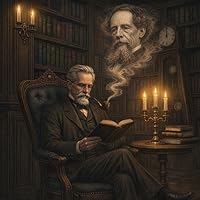
Summary (differentiated book): - Original book from 1848 - Book contains detailed biography of author - Includes photos/illustrations of the author
Book details: Redlaw is a teacher of chemistry who often broods over wrongs done him and grief from his past.
He is haunted by a spirit, who is not so much a ghost as Redlaw's phantom twin and is "an awful likeness of himself...with his features, and his bright eyes, and his grizzled hair, and dressed in the gloomy shadow of his dress..." This specter appears and proposes to Redlaw that he can allow him to "forget the sorrow, wrong, and trouble you have known...to cancel their remembrance..." Redlaw is hesitant at first, but finally agrees. However, before the spirit vanishes it imposes an additional consequence: "The gift that I have given you, you shall give again, go where you will."
Charles John Huffam Dickens (1812-1870) was a writer and social critic who created some of the world's best-known fictional characters and is regarded as the greatest novelist of the Victorian era. His works enjoyed unprecedented popularity during his lifetime, and by the twentieth century critics and scholars had recognised him as a literary genius. His novels and short stories enjoy lasting popularity.
Dickens left school to work in a factory when his father was incarcerated in a debtors' prison. Despite his lack of formal education, he edited a weekly journal for 20 years, wrote 15 novels, five novellas, hundreds of short stories and non-fiction articles, lectured and performed extensively, was an indefatigable letter writer, and campaigned vigorously for children's rights, education, and other social reforms.
Dickens was regarded as the literary colossus of his age. His 1843 novella, A Christmas Carol, remains popular and continues to inspire adaptations in every artistic genre. Oliver Twist and Great Expectations are also frequently adapted, and, like many of his novels, evoke images of early Victorian London. His 1859 novel, A Tale of Two Cities, set in London and Paris, is his best-known work of historical fiction. Dickens's creative genius has been praised by fellow writers—from Leo Tolstoy to George Orwell and G. K. Chesterton—for its realism, comedy, prose style, unique characterisations, and social criticism. On the other hand, Oscar Wilde, Henry James, and Virginia Woolf complained of a lack of psychological depth, loose writing, and a vein of saccharine sentimentalism. The term Dickensian is used to describe something that is reminiscent of Dickens and his writings, such as poor social conditions or comically repulsive characters.
On 8 June 1870, Dickens suffered another stroke at his home after a full day's work on Edwin Drood. He never regained consciousness, and the next day he died at Gad's Hill Place. Contrary to his wish to be buried at Rochester Cathedral "in an inexpensive, unostentatious, and strictly private manner," he was laid to rest in the Poets' Corner of Westminster Abbey. A printed epitaph circulated at the time of the funeral reads: "To the Memory of Charles Dickens (England's most popular author) who died at his residence, Higham, near Rochester, Kent, 9 June 1870, aged 58 years. He was a sympathiser with the poor, the suffering, and the oppressed; and by his death, one of England's greatest writers is lost to the world." His last words were: "On the ground", in response to his sister-in-law Georgina's request that he lie down.
Charles Dickens is often credited with inventing the modern idea of celebrating Christmas, with festive warmth and family games, mountains of presents, food feasts, trees and garlands. He also enjoyed casting a spooky, haunting mood over the holiday. To Dickens, Christmas was not only a time for festive warmth, but one for telling ghostly stories around the hearth, with a cosy fire blazing. Christmas takes place right after the winter solstice, when the weather has dropped colder, and on the longest nights of the year. It seems fitting to be a time for dark examination of the soul, too. For Victorians these ghost stories began to be associated with Christmas time, and the end of the year.
The Haunted Man and the Ghost’s Bargain is a curious Christmas Tale. It might almost been seen as the mirror image of “A Christmas Carol”, a darkly weird and bleak story for much of the time, although fear not, Dickens will give us his customary happy ending, of sorts.
The beginning though, is decidedly sombre. Just a few sentences in, we have:
“Who could have seen his hollow cheek; his sunken brilliant eye; his black-attired figure, indefinably grim, although well-knit and well-proportioned; his grizzled hair hanging, like tangled sea-weed, about his face,—as if he had been, through his whole life, a lonely mark for the chafing and beating of the great deep of humanity,—but might have said he looked like a haunted man?”
Moreover, his manner was “taciturn, thoughtful, gloomy, shadowed by habitual reserve”; his voice, “slow-speaking, deep, and grave”.
This then, is the character who will be at the centre of our tale. He is a Mr. Redlaw, a teacher of chemistry who often sits brooding over all the wrongs which have been done him, and the grief from his past. This is how we first encounter him, in his room which is “part library and part laboratory … so solitary and vault-like,—an old, retired part of an ancient endowment for students”.
The man and the room seem part and parcel of each other. But wait. What is this strange visitation. Is he dreaming the images he sees in the open fire, or is he seeing some spirit or ghost? We know how much Dickens loved his ghosts, phantoms and sprites, and here we have a visitor similar to Ebenezer Scrooge’s Marley. Is this a supernatural agent, an inner vision, a Mr. Hyde to his Jekyll, a Jungian shadow, a doppelganger? Should this perhaps more accurately have been entitled ?
“an awful likeness of himself …with his features, and his bright eyes, and his grizzled hair, and dressed in the gloomy shadow of his dress …”
Indeed, I did wonder that Dickens did not use this title, as this element comes so early in the tale, that it would hardly be a spoiler.
It seems as though Dickens himself was having a tussle with this tale, his fifth and final Christmas Book. Unlike the earlier ones which followed on each Christmas, his adoring public had to wait another year for this one. Perhaps he was wearying of the format of a short “Christmas spirit”-themed novel, and the fact that his many annual Christmas stories afterwards were far shorter, tends to bear this out. To his friend and mentor John Forster, he confided:
“Would there be any distinctly bad effect in holding this idea over for another twelvemonth? saying nothing whatever till November; and then announcing in the Dombey that its occupation of my entire time prevents the continuance of the Christmas series until next year, when it is purported to be renewed. I am very loath to lose the money. And still more so the leave any gap at Christmas firesides which I ought to fill.”
This seems so unlike the Dickens we know, who excelled at juggling several projects at once, that I wondered at the true motives. Was he finding either Dombey or this story particularly difficult to write? I do feel that this story is unique in his oeuvre; there’s nothing quite like it really.
The inspiration for The Haunted Man first came to Dickens in Lausanne, at the beginning of 1846. Actually, the ideas for three out of the five Christmas books had come to him whilst abroad, which is strange, as the books themselves feel very English. Yet “The Chimes” was inspired by the bells of Genoa, and the one previous to this, “The Battle of Life” was also written in Lausanne.
However, since Forster advised Dickens to wait, he did not actually write The Haunted Man until over a year later, in Broadstairs, during his autumn holiday. He took two months, completing it at the end of November at the Bedford Hotel in Brighton. When writing the first Christmas book, “A Christmas Carol” he had also been writing “Martin Chuzzlewit”, and “The Battle of Life” was written during the early days of “Dombey and Son”.
Just as parts of that novel are very dark and downbeat, so for the main part is The Haunted Man. It was staged as a Christmas Eve production of a play in 1862, and one wonders if the dour and sombre tone of the book pervaded this production. Certainly the one dramatisation of it that I have heard missed out the comedic elements completely.
For there is brilliant comedy. What would Dickens be without his irrepressible instinct to make everyone laugh at some absurdity, or let out an uncertain giggle after a grim, morose, gloom-ridden description, or tragic, savage, devastating part of the story. Here, Dickens seems conscious of drowning his readers in pessimism, with his lengthy descriptions of Mr. Redlaw and the ancient edifice he inhabits.
Before he has allowed the Phantom to be any more than a passing impression, he entertains us with William Swidger, the Keeper of the academic institution, followed shortly by his wife, “Mrs. William … composed and orderly … so placid and neat … a quiet mouse”, often quite “taken off her legs” by inclement weather. There is his father a “venerable old man with long grey hair”, forever insisting “I’m eighty-seven — eighty-seven!” The Swidgers, cheeryfaced, simple, innocent with an excess of bustling readiness for anything, are a perfect antidote to the story’s mood, and so they work their uplifting magic on Mr. Redlaw for a while, as we learn of another inhabitant in the unversity: a young student, who had not wanted his presence to be made known to his teacher.
But, the Phantom was not to be gainsaid. It would yet manifest itself:
“The room had darkened more and more. There was a very heavy gloom and shadow gathering behind the Chemist’s chair.”
Like Scrooge, Redlaw does not want to see the Phantom:
“I see you in the fire,” said the haunted man; “I hear you in music, in the wind, in the dead stillness of the night … Why do you come, to haunt me thus?”
And we learn the meaning of the subtitle, The Ghost’s Bargain. It is an extraordinary offer, one which the troubled Mr. Redlaw has seemed to crave:
“I would forget it if I could! Have I thought that, alone, or has it been the thought of thousands upon thousands, generation after generation? All human memory is fraught with sorrow and trouble.”
For the Phantom offers him oblivion; the ability to erase all the memories with which he is so obsessed. Mr. Redlaw does not hesitate:
“My memory is as the memory of other men, but other men have not this choice. Yes, I close the bargain. Yes! I WILL forget my sorrow, wrong, and trouble!”
And the Phantom adds a bonus. Mr Redlaw’s faculty for erased memories will be shared by all he encounters:
“The gift that I have given, you shall give again, go where you will. Without recovering yourself the power that you have yielded up, you shall henceforth destroy its like in all whom you approach. Your wisdom has discovered that the memory of sorrow, wrong, and trouble is the lot of all mankind, and that mankind would be the happier, in its other memories, without it. Go! Be its benefactor!”
This is has to be good doesn’t it? Or will it be, as in so many of the fairytales beloved by Dickens, that the fulfillment of a desire, or a wish when granted, becomes a curse? There are three sections: I—The Gift Bestowed, II—The Gift Diffused and III—The Gift Reversed, so it seems from this, quite likely that something will go badly wrong, now that Redlaw has had his memories erased.
First though, we meet another delightful family, the Tetterbys. A family who own a newspaper shop, this family had me grinning from ear to ear. The shop which tried so hard to be all things to all people, but actually succeeded at nothing; the tiny man enamoured of his pleasantly amply proportioned wife:
“She would have made two editions of himself, very easily. Considered as an individual, she was rather remarkable for being robust and portly; but considered with reference to her husband, her dimensions became magnificent. Nor did they assume a less imposing proportion, when studied with reference to the size of her seven sons, who were but diminutive. In the case of Sally, however, Mrs. Tetterby had asserted herself, at last; as nobody knew better than the victim Johnny, who weighed and measured that exacting idol every hour in the day.”
For this “Moloch” (the Canaanite devourer of childhood) of a whopping-sized baby, was carted around every hour of the day, by her adoring older brother Johnny. The four tiniest Tetterby brothers were all at various stages of wildness, and the oldest, Adolphus, varied his daily routine as a newspaper vendor, by altering the vowels in his shouted call, “Morning Pepper” … Morning Pipper”. Whenever the Tetterbys come centre stage, we sit up at the prospect of reading some of Dickens’s funniest writing, and most likeable characters. The Tetterbys are equivalent to the Cratchits, in “A Christmas Carol”. They represent a class and a social group with which Dickens was very familiar; his own family when he was a child. And here their portraits are not as sketchily drawn as the Cratchits, but beautifully filled out.
And yet … to me the balance is not right. We soon begin to see the Phantom’s baleful influence, as Mr. Redlaw rightly begins to think of his “gift” as a curse. Whoever he meets, becomes “infected”. We see the wonderful creations Dickens has made us love, become twisted into something dark and evil:
“they were fighting now, not only for the soap and water, but even for the breakfast which was yet in perspective. The hand of every little Tetterby was against the other little Tetterbys; and even Johnny’s hand — the patient, much-enduring, and devoted Johnny — rose against the baby! Yes, Mrs. Tetterby, going to the door by mere accident, saw him viciously pick out a weak place in the suit of armour where a slap would tell, and slap that blessed child.”
We see them lose all their kindness and goodness of heart; all their sunny-natured optimism. We see them become callous, brutal, bitter and wrathful. “What do I care what people do, or are done to?” We see them lose everything that is the best of humanity.
There are exceptions. One is a ragged urchin boy, so completely neglected and separate from society, experiencing “no humanizing touch”, that he functions almost an animal, driven only by the Darwinian instinct for survival. He is the equivalent of “Ignorance” in “A Christmas Carol”. Another is the opposite, . And we learn of course, who the student is, why he was so reticent, and what connection he has with Mr. Redlaw.
Redlaw becomes increasingly desolate. He is wretched and lonely, despite his “benevolent gift”. When he sees the Phantom, he begs it to allow others to be free of his curse even if he must remain under the curse of forgotten memories himself. He describes himself as:
“a man without a soul, as incapable of compassion, artistic sensitivity or spiritual understanding, as the abandoned waif whose neglected short life is equally barren of memories.”
The Phantom then appears with a shade that looks like someone familiar to him, directing Redlaw to “seek her out”. She is clearly the key to unlocking the curse of memory loss, although the Phantom does not say how or why.
The ending makes us realise why this is a Christmas book. It is an allegorical tale, in which the Phantom helps to effect the moral transformation of Mr. Redlaw. It is the spirit of Christmas which is evoked, rather than any literal interpretation of the Christmas story. Just as Scrooge is taught a lesson and turns his life around, this tale is also about redemption and reconciliation. Once Redlaw’s memories have been restored, he is no longer numb, but feels his emotions and human warmth again. It tells both Redlaw and us, that we need the bad as well as the good; only then do we appreciate what we have. As Dickens wrote to John Forster in 1848:
“My point is that bad and good are inextricably linked in remembrance, and that you could not chooser the enjoyment of recollecting only the good. To have all the best of it you must remember the worst also”
and in The Haunted Man, Redlaw realises that he:
“has lost his memory of sorrow, wrong, and trouble … and with that I have lost all men would remember!”
“…but for some trouble and sorrow we should never know half the good there is about us.”
Dickens was always very interested in the illustrations to his books, and often quite adamant about what, specifically, he wanted the artist to convey. For The Haunted Man, he commissioned no less than four artists, who had either worked for him before, or were to do so again: John Tenniel, Clarkson Stansfield, Frank Stone and John Leech.
Dickens realised that Leech’s strength lay in comedy, and steered him towards the boisterous Tetterby troop, writing:
“Bradbury told me you wished to do some comedy … You will find plenty of bits, I trust, in connexion with the Tetterby family”.
Although these illustrators excelled in humorous drawings, especially in some of the earlier novels — indeed, there is a lot to be said for each interpretation — I do personally prefer the illustrations in the volume I have reviewed here, which are by Charles Green. This volume is the fifth in the “Pears Centenary edition of Charles Dickens’ Christmas books”, which were published in 1912. Charles Green illustrated four out of the five books, and this one has more than 30 beautifully atmospheric monochrome watercolours, which have an almost photographic quality. They match the moodiness of this piece perfectly, and to me are more apt than the caricatures which suit some of his other work so well.
I do feel that this is a dark piece overall. Dickens has largely moved away from the domestic sentiment and communal cheer of the previous Christmas Books. Although it displays elements which preoccupied Dickens throughout his life, such as his interest in spirits, spectres and ghosts, psychology and doppelgangers, I feel he was exploring a dark side, and allowed this to overshadow the book’s ultimate message. The brooding darkness, for me, was done a little too well.
Perhaps Dickens was exorcising his own ghosts. He was all too familiar with traumatic pain from his past. Redlaw tells the Phantom that he was tortured by the memory of the death of his sister. It seem significant then, that Dickens’s own sister, Fanny, had died less than a month before he began his book. He had also, like Redlaw, been rejected by his true love (Maria Beadnell) in his youth.
But Dickens’s abiding trauma, which haunted him all his life, dated from his childhood, when he was forced to pawn his books, and drop out of school. He felt abandoned by his family, forced to work in a blacking factory at work he loathed. It has been said that even as an adult, Dickens would weep when passing by the site of the shoe blacking factory from his childhood. Another memory which was never far from the front of his mind, was when he was twelve, and his father was sent to debtor’s prison, the “Marshalsea”. The family was left penniless, the family home was given up, and his mother and all the other children lived in prison with their father. Dickens was money-conscious to the point of being obsessed with making it, for the rest of his life.
We see clearly throughout his work, that these vivid childhood memories informed much of his writing, in his politics; his sensitivity to the conditions of the poor, the imprisoned, and the disenfranchised. In The Haunted Man, when Redlaw speaks, we see echoes of Dickens’s own inner anguish:
“I am he, neglected in my youth and miserably poor, who strove and suffered and still strove and suffered … No mother’s self-dying love … No father’s counsel aided me … My parents, at the best, were of that sort whose care soon ends, and whose duty is soon done; who cast their offspring loose, early, as birds to theirs; and, if they do well, claim the merit; and, if ill, the pity.”
Apparently Dickens once met Dostoevsky, in 1862, at the offices of “All The Year Round” in London. Dostoevsky reported that Dickens told him:
“[t]here were two people in him … one who feels as he ought to feel and one who feels the opposite. From the one who feels the opposite I make my evil characters, from the one who feels as a man ought to feel I try to live my life.”
Certainly the feelings in this story are akin to the feelings evoked by Dostoevsky, who often explored humanity’s darker side. If Dickens could see himself as having two selves, then perhaps he could also see this as a way to construct a character as well. This does seem to be borne out by other such characters with darker sides, or two distinct selves such as in “A Tale of Two Cities”, , in “Our Mutual Friend” and in “The Mystery of Edwin Drood.
I find Dostoevsky’s bleakness hard to take, although of course I recognise his greatness. In a similar way, my rating of three stars here is a purely subjective one. Any writing by Dickens, for me, is streets ahead of most other writers. A more objective view may put this at 4 stars. But within his oeuvre, this remains at a middling three star read for me. I can now see why he preferred to keep the idea of the Phantom ambiguous: perhaps an actual ghost rather than Redlaw’s inner demons. Yet it is clearly a very personal story by Dickens, which perhaps answers my question near the beginning of this review: did he find this difficult to write?
When talking about his own harrowing past, Dickens said:
“I do not write resentfully or angrily, for I know how all these things have worked together to make me what I am.”
In The Haunted Man, Dickens is telling us that it is best to forgive, not to forget. But how difficult this must have felt for him personally, given the anguished memories which he constantly had to endure.
NOTE: I have now reviewed all five of Dickens's Christmas Books. My reviews of the others can be found on my shelves.
I’m not sure where the disconnect is between me and his short stories, but they are so disjointed and bland. I love his novels, so I continually return to the short stories to try again and ALWAYS end up disappointed!
"The Haunted Man and the Ghost's Bargain" is a Christmas story about the power of memory. The story involves a man, haunted by sorrowful memories, who is offered the opportunity to erase his memories. Dickens sets the scene well with his atmospheric descriptions.
Even if old memories recall hurtful times, they can be used in a positive manner to give us empathy for the sufferings and misfortunes of others. Forgiveness can lessen the hurt and regret that people carry in their hearts. Our memories are also important because both good and bad memories are linked together in our experiences, and our good memories are very precious. This was a thoughtful Christmas story that I enjoyed reading with the Dickensians group.
Ah, Dickens! The moment I begin to resent your paper-thin characters, your contrived plots, your transparent moralizing, you come at me with a sentence so glorious that all is forgiven. And needless to say, nobody does snowy nights, crackling fires, Christmas cheer or Christmas gloom like Dickens; imitators are legion, equals scarce indeed.
Then too, that moralizing bears a second thought. Yes, Dicken’s favored women—saintly, endlessly patient—are thinly sketched indeed, but when he broadens his morality play to indict his entire society, the political force of his message is undeniable: “woe, tenfold, to the nation” that tolerates children to suffer in poverty! Considering a lost and suffering child, Dickens has his Phantom declare: “There is not one of these—not one—but shows a harvest that mankind MUST REAP.” It is a message we prospering grandchildren of British capitalism would do well to heed.
The Haunted Man is Dickens' longest Christmas story, though it is mostly made of repetition and pointless metaphors.
A university chemist wishes for a spectre to remove all of his pain, anguish and painful memories, whilst giving him the ability to pass that terrible curse in to others. What follows is a story of how we cannot exist without our past pain, because good and evil must co-exist for there to be any humanity at all.
It is a touching tale but far too long and far too Dickensian for even me. There were also many twee moments, but the overall message you may gleam from the words is a nevertheless very important one.
Rating this separately to my collection of Dickens' Christmas stories. My views on it are in my review of the Christmas Carol and Other Christmas Writings clothbound edition.
I found this story particularly difficult to process. I felt as though it was almost overworking my brain, and at times boring me, perhaps because of the writing style. Definitely more so than any of his other works.
The opening paragraphs to this Christmas-redemption story might seem lengthy due to some repetitions, but they do much to set the mood, as do the descriptions of physical surroundings. The latter continue throughout the work and to great effect, especially as Redlaw traverses the streets with the orphan boy. (You worry about them both.)
The doubling of the “haunted man” and his” ghost” recalled for me the 'doubles' of A Tale of Two Cities, yet here the meaning is literal. In what was almost a throwaway line, the symbolism is extended with the student’s framed engraving of himself, the looker-on.
Milly is one of Dickens’ exasperatingly 'perfect' women (though they're usually young and she's not) but she didn't bother me till the end when she’s just a tad too ingenuous.
Though this story’s not specifically about Christmas, it does end on that day; and though Redlaw is no Scrooge, there are other elements reminiscent of the most famous of Dickens’ Christmas stories. I thought the last paragraph was perfect.
Μικρή χριστουγεννιάτικη ιστορία από τον ειδικό. Ο Dickens είναι απολαυστικός όπως πάντα! Παρασέρνει τον αναγνώστη με πλούσιες εικόνες και άψογο γράψιμο και δημιουργεί την τέλεια ατμόσφαιρα και στη μικρή φόρμα.
I loved this Christmas novella written by Dickens, apparently the last of his Christmas stories. I read this slowly with the marvelous Dickensians group. A beautiful story that explores how living through troubles and sorrows make our joys and gratitude that much stronger. Without these experiences or memories, we lose our ability to feel our emotions with any depth nor relate to others in the midst of their own despair. No compassion or empathy, just indifference. But it is a story of forgiveness and redemption as only Dickens can pull off.
As well as the many similar themes as in The Christmas Carol, some of the characters are reminiscent of those in that beloved story. I felt this story was a little darker and had a stronger gothic feel though out which I really enjoyed.
A shout out to our wonderful moderator of our journey, Petra, and especially for providing a plethora of illustrations that were produced for various editions.
Surely there had been no figure leaning on the back of his chair; no face looking over it. It is certain that no gliding footstep touched the floor, as he lifted up his head, with a start, and spoke. And yet there was no mirror in the room on whose surface his own form could have cast its shadow for a moment; and, Something had passed darkly and gone!
In the tradition that we have come to expect from Charles Dickens, this is a Christmas tale with a ghostly presence. It is beautifully done, with a lesson regarding the way hurt and sorrow enhance our lives, and how our memory of them works upon our souls and refines us.
I read this with the Dickensians group, under the leadership of Petra, who did a marvelous job of bringing this story to life. I must thank her here for all the remarkable illustrations that she found and posted for us. They added a very special element to the reading and are part of the charm Dickens intended his reader to experience.
Unfortunately this story was very difficult for me to digest.
Regarding its language, there is a lot of unnecessary repetition and it might be fun once or twice to let a husband and wife repeat the same sentences over and over again, but it gets dull soon. I've read that Dickens got paid by word count, so that might be an explanation for the overabundance of repetition, but it really dragged the story down.
The plot itself is rather confuse and more often than not the author failed to paint a clean picture of what was actually happening. He jumps between conversations, often it is even unclear how many people are involved in a scene.
But I could overlook all that, consider the time it has been written in and might be more forgiving in my rating, but what was really off-putting for me was the preachy way in which conservative ideals of family are celebrated. Every bachelor or single character is depicted as a miserable and selfish person, who ruins the lives of others. In contrast family values are celebrated as the holy grail of happiness and even when there is discourse between a couple, it seldomly lasts long or has a negative consequence. Misery itself is portrayed as something that is necessary to truly value the positive things in life, which is another conservative myth to uphold the power of the ruling classes from my point of view and humble the lower classes into submission.
I generally don't have an issue with conservative thinking, but when it is presented in such a preachy way as in this story, it leaves a very bad taste.
2017 is quite a special year in terms of reading to me in that it saw me finish the last of Dickens’s five Christmas books, which were published between 1843 and 1848 on a yearly basis. Finishing The Haunted Man and the Ghost’s Bargain was quite a memorable feat for me because even though I re-read most of Dickens’ novels and shorter pieces whenever I can and derive a great deal of enjoyment from doing so, I have always given his Christmas stories, with the exception of you-know-which-one, a wide berth. In fact, as Dickens could probably not write more than one of these stories a year without incurring severe damage to his health – at least, I am willing to give him the benefit of the doubt here –, so I found it impossible to read more than one of these stories during one year without a long-term disruption of my digestive system because, with the exception of the first one, they are as sweet and as heavy as plum pudding in aspic, with a double icing of dulce de leche. The aspic-tried Victorian palate might have developed a certain liking for such glutinous fare, but unlike most other works by Dickens, they have hardly stood the test of time, at least of my time.
Dickens himself seems to have found it increasingly difficult to muster up working hours and energy to write them because, as he confided to his friend Forster, this last Christmas novel required so much of his time – he started writing it in September 1847 – and energy that he began to have serious doubts as to whether he would find himself able to carry on the tradition of writing Christmas novellas, and so, The Haunted Man, which was finally published in December 1848, was to be the last of its kind.
Still, one may ask oneself whether a modern reader might not have greater difficulty in reading the novel than Dickens had in writing it. Unlike A Christmas Carol, the story of The Haunted Man is covered under debris of sentiment voiced by stock characters in melodramatic talk, which culminates in exclamations like
“’O Thou […] who through the teaching of pure love, hast graciously restored me to the memory which was the memory of Christ upon the Cross, and of all the good who perished in His cause, receive my thanks, and bless her!’”
Up to that final solution to the main character Redlaw’s personal plight, the reader has to go through an underwood of similarly sugar-coated and stage-drama-ridden talk and situations, and it is probably not without the support of stiff punch and punch-soaked shortbread that they may find the stamina to read through all the three parts of this Christmas story.
Yet, even this story is not wholly without its merits, because unlike the ghosts in Dickens’s first Christmas story, Redlaw’s ghost is definitely more a part of his inner self than a ghostly manifestation in its own right, and whereas Ebenezer Scrooge was, all in all, the caricature of a mean money-grubber (a closer reading of the text will make you qualify this assessment, though), Redlaw is not unkind and void of sympathy, but a victim of depression and pessimism, and therefore a much more complex character. Unluckily, the only one in this story. Be that as it may, The Haunted Man, with its ambivalent hero, could probably not have been written by the earlier Dickens, but marks a period in which the Inimitable had become more interested in psychological complexity – a surmise that is borne out when you consider that he was writing Dombey and Son in 1847, a novel about a merchant who is not essentially evil-minded but simply blinded by arrogance and unable to show tender feelings to his daughter.
Apart from that, like practically all Christmas stories, also The Haunted Man rewards the undaunted reader with passages of powerful and impressive prose such as this one:
”When the wind was blowing, shrill and shrewd, with the going down of the blurred sun. When it was just so dark, as that the forms of things were indistinct and big—but not wholly lost. When sitters by the fire began to see wild faces and figures, mountains and abysses, ambuscades and armies, in the coals. When people in the streets bent down their heads and ran before the weather. When those who were obliged to meet it, were stopped at angry corners, stung by wandering snow-flakes alighting on the lashes of their eyes,—which fell too sparingly, and were blown away too quickly, to leave a trace upon the frozen ground. When windows of private houses closed up tight and warm. When lighted gas began to burst forth in the busy and the quiet streets, fast blackening otherwise. When stray pedestrians, shivering along the latter, looked down at the glowing fires in kitchens, and sharpened their sharp appetites by sniffing up the fragrance of whole miles of dinners.
When travellers by land were bitter cold, and looked wearily on gloomy landscapes, rustling and shuddering in the blast. When mariners at sea, outlying upon icy yards, were tossed and swung above the howling ocean dreadfully. When lighthouses, on rocks and headlands, showed solitary and watchful; and benighted sea-birds breasted on against their ponderous lanterns, and fell dead. When little readers of story-books, by the firelight, trembled to think of Cassim Baba cut into quarters, hanging in the Robbers’ Cave, or had some small misgivings that the fierce little old woman, with the crutch, who used to start out of the box in the merchant Abudah’s bedroom, might, one of these nights, be found upon the stairs, in the long, cold, dusky journey up to bed.
When, in rustic places, the last glimmering of daylight died away from the ends of avenues; and the trees, arching overhead, were sullen and black. When, in parks and woods, the high wet fern and sodden moss, and beds of fallen leaves, and trunks of trees, were lost to view, in masses of impenetrable shade. When mists arose from dyke, and fen, and river. When lights in old halls and in cottage windows, were a cheerful sight. When the mill stopped, the wheelwright and the blacksmith shut their workshops, the turnpike-gate closed, the plough and harrow were left lonely in the fields, the labourer and team went home, and the striking of the church clock had a deeper sound than at noon, and the churchyard wicket would be swung no more that night.
[…]
—When a knock came at his door, in short, as he was sitting so, and roused him.”
Last not least, the story revolves around an impressive bit of wisdom, which could have been expressed without much melodramatic ado, but which still might help people who, especially at a time when yet another year is expiring, are prone to reflect upon their lives and may find more to despair about than to delight in, and which is summarized by Milly in the following words:
”’[T]hat but for some trouble and sorrow we should never know half the good there is about us.’”
This thought, which mirrors the famous idea according to which it is better to have loved and lost than never to have loved at all, shows that The Haunted Man, for all its syrupy prose and execution, is not merely a sentimental sugarplum, in that it states that there are moments of grief, disappointment and frustration in most people’s lives but that they should not try to ignore or deny them, nor use them as a reason to give themselves up to bitterness and callousness. Instead, they should embrace even those darker moments as parts of their lives, as stations on the journey that made them what they are. My, I start sounding sentimental myself now, but maybe I still managed to get my idea across, namely that there is a great deal of maturity in accepting life as it is and still not giving up improving it for yourself and others.
In the spirit of this idea, I wish you all a Happy 2018!
“… twilight everywhere released the shadows, prisoned up all day, that now closed in and gathered like mustering swarms of ghosts.”
I very much enjoyed this story, as I have Dickens’ other Christmas stories. I’ve found his lesser-known works often difficult to follow, so have really appreciated reading them with the Dickensians! group. They may work better for Dickens fans, after you have some of the novels under your belt.
Mr. Redlaw, a man of science, is overwhelmed with past sorrows, until he is taken on a journey of discovery. With many parallels to A Christmas Carol, this one revolves around the idea of memory, particularly the way remembering the bad things that have happened to us can work for our good. It’s an unusual theme, and as with so much of Dickens’ work, it pulled at my heartstrings. I will try to think of it, at Christmas and other times of year, when memories of loss threaten to interfere with happiness, and remember how valuable those memories truly are.
I wanted to listen to some short Christmas story and thought "why not Dickens?" Haven't read much of his novellas and loving A Christmas carol I wanted to give another ago. I ended up enjoying it quite a bit. Not sure why though as it doesn't have the same charm but something about it just worked for me. Maybe it was the scene with the couple giving each other a heavy angry banter just to realize how much they actually care and love another
This entire review has been hidden because of spoilers.
The Haunted Man had its first play premier in 1862. It was met with resounding success.
Mr. Redlaw, the main protagonist, is a chemist who is bitter against the world and all those in his past who, in his view, has wronged him. He is melancholy. Mr. Redlaw is visited by a ghost who has the power to remove all of Mr. Redlaw's bitterness from others on the condition that Mr. Redlaw, in turn, bestows the same benefit on others.
The story, like many other Charles Dickens' Classics has a redeeming theme aimed around the Christmas season.
I just read this story for the third time. Of Dickens' five short stories for Christmas, I think this one's message is the most profound and the most overtly Christian. Its supernatural events are not as spectacular as "A Christmas Carol," but it makes a stronger statement: that remembrance is the source of gratitude, even painful remembrances, the purpose of which is not to regret or resent the past, but to forgive it. To forget without forgiving brings bitterness and misery, but with forgiveness comes joy and hope. Like Phillip in the story I pray, "Lord, keep my memory green." I will enjoy reading this story again.
A man torn by troubles and sorrow from his life sees a phantom who promises he will take away his sorrow, wrongs and trouble he experienced in his life if he will but pass the gift on to others. He learns quickly enough that by removing wrongs he also removes the feelings of forgiveness and "loss all men would remember." A bit of a tie-in to "A Christmas Carol."
A charming yet broody follow up to A Christmas Carol written between Dombey and Son and David Copperfield. The plot has many similarities to A Christmas Carol. There are a ghost (perhaps only his mental state) and a redemptive end. I'm surprised this isn't performed at Christmas more often. I loved the imagery of the ending!
I felt as if this story was a bit too difficult to figure out what was actually happening. I still pulled out some bits that make me love reading Dickens, but on the whole this story was too much work. Perhaps my brain cells were not up to the challenge after the hectic holidays.
4.5 stars, though the high rating is for personal reasons. It spoke to my heart. It stabbed right to the center of it because I could relate to the theme and its moral. There were a few morals, but the main one for me was "don't be a wanton dick."
Often I deliberately turn my heart cold. I set it to stone, or iron even. It's more difficult nowadays, but sometimes I just don't want to feel. When one feels, he is subject to pain, and I don't always want that. Pain from wrongs done to me. Guilt over wrongs I've done others. Sadness over happy events that will never come again. Sometimes I just don't want to feel these things. Our main character had similar sentiments and was given the chance to nip the memories that caused such maudlin malaise right down in the bud. He took it and the consequences that went with it. Without the memories of things that caused him such woes, he was doomed to treat others rather poorly, and they were hurt.
I need my memories and feelings in order to grow, but that doesn't stop me from trying it this man's way sometimes (without the supernatural element, of course). I harden my heart, but invariably it cracks again. Through some self-help efforts, I'm assured that I will eventually no longer regret the past nor wish to shut the door on it, and I'm there most of the time. It's best to look things in the eye, see them for what they are instead of what I would wish for them to be, then move on. Lying to myself, and living dishonestly with rose colored glasses has never netted me any good results. (I have to be careful about wearing mud spattered glasses as well).
This story dredged up all that and more for me, and its affect on me is why it gets such a high rating. Otherwise I'd have given it three stars for the story itself.
It's classic Dickens. His prose is verbose but pleasantly so. Great turns-o-phrase abound. The coincidences which were lacking in the last Christmas book (The Battle Of Life) returned here. And there are the exaggerated and silly characters. I especially loved the Tetterby family. The ending is happy and leaves me with that warm, feel-good, Christmasy feeling, but it's not cloying.
The moral is expanded from what I mentioned above to include us needing our memories so that we can have the capacity to forgive. And that's another thing. I often ask God to forgive me my trespasses as I forgive those who trespass against me. I say it, though often the feeling inside is more like "God, kill ALL THE FUCKING BITCHES AND BASTARDS, if it be thy will, amen." So I have to be careful here. I'm asking the great Other who niggles at my mind throughout life to forgive me using the same exact standards with which I forgive others, and doesn't that just suck if I'm being cold-hearted? God dammit; can't win for tryin' sometimes, but it's good to be reminded of these kinds of things. It isn't always easy turning around and finding you're at the Magic Mirror Gate, but it's always instructive if you can face it. Thank you Mr. Dickens for hitting my defenses with a bunker buster, for I sure need it sometimes.
If any of this made any sense, then you'd probably enjoy this story immensely. If you're a fan of Dickens, you'd probably still really enjoy it, but maybe less so than I did if you can't relate. It was a gut puncher for me.
For the fourth year in a row now, I have been slowly but surely making my way through Dickens’ Christmas Books, with only one left to go. So far I’ve knocked out Christmas Carol, The Chimes, Cricket on the Hearth and now, A Haunted Man; unfortunately this is my least favorite, by a significant margin, of the stories.
I should start off by saying I love and admire Dickens writing, the man was so fantastically talented and his writing offers a certain type of reading experience that very few authors provide me. Some of my favorite prose on paper, wonderful and timeless characters, socially conscious stories that had something to say… and on and on.
This one, however, missed the mark, mostly. I did appreciate the message here, and it had moments of beautiful prose (unavoidable with Dickens), but I found this one to be convoluted in a way his stories usually aren’t for me. In fact I really struggled to follow it at times. It also had a few too many similarities with A Christmas Carol, a complaint that I also felt a bit with The Chimes but I enjoyed that story much more despite the similarities. I hate to say Dickens was trying to recapture the magic of the perfect A Christmas Carol, but it does seem like that may be the case a bit.
While this may have been a miss with me, I’d still recommend checking it out if you’re interested. Maybe you’ll see something I missed here, and any Dickens is worth reading for his writing style alone.
Charles Dickens is often credited with inventing the modern idea of celebrating Christmas, with festive warmth and family games, mountains of presents, food feasts, trees and garlands. He also enjoyed casting a spooky, haunting mood over the holiday. To Dickens, Christmas was not only a time for festive warmth, but one for telling ghostly stories around the hearth, with a cosy fire blazing. Christmas takes place right after the winter solstice, when the weather has dropped colder, and on the longest nights of the year. It seems fitting to be a time for dark examination of the soul, too. For Victorians these ghost stories began to be associated with Christmas time, and the end of the year.
The Haunted Man and the Ghost’s Bargain is a curious Christmas Tale. It might almost been seen as the mirror image of “A Christmas Carol”, a darkly weird and bleak story for much of the time, although fear not, Dickens will give us his customary happy ending, of sorts.
The beginning though, is decidedly sombre. Just a few sentences in, we have:
“Who could have seen his hollow cheek; his sunken brilliant eye; his black-attired figure, indefinably grim, although well-knit and well-proportioned; his grizzled hair hanging, like tangled sea-weed, about his face,—as if he had been, through his whole life, a lonely mark for the chafing and beating of the great deep of humanity,—but might have said he looked like a haunted man?”
Moreover, his manner was “taciturn, thoughtful, gloomy, shadowed by habitual reserve”; his voice, “slow-speaking, deep, and grave”.
This then, is the character who will be at the centre of our tale. He is a Mr. Redlaw, a teacher of chemistry who often sits brooding over all the wrongs which have been done him, and the grief from his past. This is how we first encounter him, in his room which is “part library and part laboratory … so solitary and vault-like,—an old, retired part of an ancient endowment for students”.
The man and the room seem part and parcel of each other. But wait. What is this strange visitation. Is he dreaming the images he sees in the open fire, or is he seeing some spirit or ghost? We know how much Dickens loved his ghosts, phantoms and sprites, and here we have a visitor similar to Ebenezer Scrooge’s Marley. Is this a supernatural agent, an inner vision, a Mr. Hyde to his Jekyll, a Jungian shadow, a doppelganger? Should this perhaps more accurately have been entitled ?
“an awful likeness of himself …with his features, and his bright eyes, and his grizzled hair, and dressed in the gloomy shadow of his dress …”
Indeed, I did wonder that Dickens did not use this title, as this element comes so early in the tale, that it would hardly be a spoiler.
Dickens was having difficulties with this tale, his fifth and final Christmas Book. Unlike the earlier ones which he wrote each Christmas, his adoring public had to wait another year for this one. Perhaps he was wearying of the format of a short “Christmas spirit”-themed novel, and the fact that his many annual Christmas stories afterwards were far shorter, tends to bear this out. To his friend and mentor John Forster, he confided:
“Would there be any distinctly bad effect in holding this idea over for another twelvemonth? saying nothing whatever till November; and then announcing in the Dombey that its occupation of my entire time prevents the continuance of the Christmas series until next year, when it is purported to be renewed. I am very loath to lose the money. And still more so the leave any gap at Christmas firesides which I ought to fill.”
This seems so unlike the Dickens we know, who excelled at juggling several projects at once, that I wondered at the true motives. Was he finding either Dombey or this story particularly difficult to write? I do feel that this story is unique in his oeuvre; there’s nothing quite like it really.
The inspiration for The Haunted Man first came to Dickens in Lausanne, at the beginning of 1846. Actually, the ideas for three out of the five Christmas books had come to him whilst abroad, which is strange, as the books themselves feel very English. Yet “The Chimes” was inspired by the bells of Genoa, and the one previous to this, “The Battle of Life” was also written in Lausanne.
However, since Forster advised Dickens to wait, he did not actually write The Haunted Man until over a year later, in Broadstairs, during his autumn holiday. He took two months, completing it at the end of November at the Bedford Hotel in Brighton. When writing the first Christmas book, “A Christmas Carol” he had also been writing “Martin Chuzzlewit”, and “The Battle of Life” was written during the early days of “Dombey and Son”.
Just as parts of that novel are very dark and downbeat, so for the main part is The Haunted Man. It was staged as a Christmas Eve production of a play in 1862, and one wonders if the dour and sombre tone of the book pervaded this production. Certainly the one dramatisation of it that I have heard missed out the comedic elements completely.
For there is brilliant comedy. What would Dickens be without his irrepressible instinct to make everyone laugh at some absurdity, or let out an uncertain giggle after a grim, morose, gloom-ridden description, or tragic, savage, devastating part of the story. Here, Dickens seems conscious of drowning his readers in pessimism, with his lengthy descriptions of Mr. Redlaw and the ancient edifice he inhabits.
Before he has allowed the Phantom to be any more than a passing impression, he entertains us with William Swidger, the Keeper of the academic institution, followed shortly by his wife, “Mrs. William … composed and orderly … so placid and neat … a quiet mouse”, often quite “taken off her legs” by inclement weather. There is his father a “venerable old man with long grey hair”, forever insisting “I’m eighty-seven — eighty-seven!” The Swidgers, cheeryfaced, simple, innocent with an excess of bustling readiness for anything, are a perfect antidote to the story’s mood, and so they work their uplifting magic on Mr. Redlaw for a while, as we learn of another inhabitant in the unversity: a young student, who had not wanted his presence to be made known to his teacher.
But, the Phantom was not to be gainsaid. It would yet manifest itself:
“The room had darkened more and more. There was a very heavy gloom and shadow gathering behind the Chemist’s chair.”
Like Scrooge, Redlaw does not want to see the Phantom:
“I see you in the fire,” said the haunted man; “I hear you in music, in the wind, in the dead stillness of the night … Why do you come, to haunt me thus?”
And we learn the meaning of the subtitle, The Ghost’s Bargain. It is an extraordinary offer, one which the troubled Mr. Redlaw has seemed to crave:
“I would forget it if I could! Have I thought that, alone, or has it been the thought of thousands upon thousands, generation after generation? All human memory is fraught with sorrow and trouble.”
For the Phantom offers him oblivion; the ability to erase all the memories with which he is so obsessed. Mr. Redlaw does not hesitate:
“My memory is as the memory of other men, but other men have not this choice. Yes, I close the bargain. Yes! I WILL forget my sorrow, wrong, and trouble!”
And the Phantom adds a bonus. Mr Redlaw’s faculty for erased memories will be shared by all he encounters:
“The gift that I have given, you shall give again, go where you will. Without recovering yourself the power that you have yielded up, you shall henceforth destroy its like in all whom you approach. Your wisdom has discovered that the memory of sorrow, wrong, and trouble is the lot of all mankind, and that mankind would be the happier, in its other memories, without it. Go! Be its benefactor!”
This is has to be good doesn’t it? Or will it be, as in so many of the fairytales beloved by Dickens, that the fulfillment of a desire, or a wish when granted, becomes a curse? There are three sections: I—The Gift Bestowed, II—The Gift Diffused and III—The Gift Reversed, so it seems from this, quite likely that something will go badly wrong, now that Redlaw has had his memories erased.
First though, we meet another delightful family, the Tetterbys. A family who own a newspaper shop, this family had me grinning from ear to ear. The shop which tried so hard to be all things to all people, but actually succeeded at nothing; the tiny man enamoured of his pleasantly amply proportioned wife:
“She would have made two editions of himself, very easily. Considered as an individual, she was rather remarkable for being robust and portly; but considered with reference to her husband, her dimensions became magnificent. Nor did they assume a less imposing proportion, when studied with reference to the size of her seven sons, who were but diminutive. In the case of Sally, however, Mrs. Tetterby had asserted herself, at last; as nobody knew better than the victim Johnny, who weighed and measured that exacting idol every hour in the day.”
For this “Moloch” (the Canaanite devourer of childhood) of a whopping-sized baby, was carted around every hour of the day, by her adoring older brother Johnny. The four tiniest Tetterby brothers were all at various stages of wildness, and the oldest, Adolphus, varied his daily routine as a newspaper vendor, by altering the vowels in his shouted call, “Morning Pepper” … Morning Pipper”. Whenever the Tetterbys come centre stage, we sit up at the prospect of reading some of Dickens’s funniest writing, and most likeable characters. The Tetterbys are equivalent to the Cratchits, in “A Christmas Carol”. They represent a class and a social group with which Dickens was very familiar; his own family when he was a child. And here their portraits are not as sketchily drawn as the Cratchits, but beautifully filled out.
And yet … to me the balance is not right. We soon begin to see the Phantom’s baleful influence, as Mr. Redlaw rightly begins to think of his “gift” as a curse. Whoever he meets, becomes “infected”. We see the wonderful creations Dickens has made us love, become twisted into something dark and evil:
“they were fighting now, not only for the soap and water, but even for the breakfast which was yet in perspective. The hand of every little Tetterby was against the other little Tetterbys; and even Johnny’s hand — the patient, much-enduring, and devoted Johnny — rose against the baby! Yes, Mrs. Tetterby, going to the door by mere accident, saw him viciously pick out a weak place in the suit of armour where a slap would tell, and slap that blessed child.”
We see them lose all their kindness and goodness of heart; all their sunny-natured optimism. We see them become callous, brutal, bitter and wrathful. “What do I care what people do, or are done to?” We see them lose everything that is the best of humanity.
There are exceptions. One is a ragged urchin boy, so completely neglected and separate from society, experiencing “no humanizing touch”, that he functions almost an animal, driven only by the Darwinian instinct for survival. He is the equivalent of “Ignorance” in “A Christmas Carol”. Another is the opposite, . And we learn of course, who the student is, why he was so reticent, and what connection he has with Mr. Redlaw.
Redlaw becomes increasingly desolate. He is wretched and lonely, despite his “benevolent gift”. When he sees the Phantom, he begs it to allow others to be free of his curse even if he must remain under the curse of forgotten memories himself. He describes himself as:
“a man without a soul, as incapable of compassion, artistic sensitivity or spiritual understanding, as the abandoned waif whose neglected short life is equally barren of memories.”
The Phantom then appears with a shade that looks like someone familiar to him, directing Redlaw to “seek her out”. She is clearly the key to unlocking the curse of memory loss, although the Phantom does not say how or why.
The ending makes us realise why this is a Christmas book. It is an allegorical tale, in which the Phantom helps to effect the moral transformation of Mr. Redlaw. It is the spirit of Christmas which is evoked, rather than any literal interpretation of the Christmas story. Just as Scrooge is taught a lesson and turns his life around, this tale is also about redemption and reconciliation. Once Redlaw’s memories have been restored, he is no longer numb, but feels his emotions and human warmth again. It tells both Redlaw and us, that we need the bad as well as the good; only then do we appreciate what we have. As Dickens wrote to John Forster in 1848:
“My point is that bad and good are inextricably linked in remembrance, and that you could not chooser the enjoyment of recollecting only the good. To have all the best of it you must remember the worst also”
and in The Haunted Man, Redlaw realises that he:
“has lost his memory of sorrow, wrong, and trouble … and with that I have lost all men would remember!”
“…but for some trouble and sorrow we should never know half the good there is about us.”
Dickens was always very interested in the illustrations to his books, and often quite adamant about what, specifically, he wanted the artist to convey. For The Haunted Man, he commissioned no less than four artists, who had either worked for him before, or were to do so again: John Tenniel, Clarkson Stansfield, Frank Stone and John Leech.
Dickens realised that Leech’s strength lay in comedy, and steered him towards the boisterous Tetterby troop, writing:
“Bradbury told me you wished to do some comedy … You will find plenty of bits, I trust, in connexion with the Tetterby family”.
I do feel that this is a dark piece overall. Dickens has largely moved away from the domestic sentiment and communal cheer of the previous Christmas Books. Although it displays elements which preoccupied Dickens throughout his life, such as his interest in spirits, spectres and ghosts, psychology and doppelgangers, I feel he was exploring a dark side, and allowed this to overshadow the book’s ultimate message. The brooding darkness, for me, was done a little too well.
Perhaps Dickens was exorcising his own ghosts. He was all too familiar with traumatic pain from his past. Redlaw tells the Phantom that he was tortured by the memory of the death of his sister. It seem significant then, that Dickens’s own sister, Fanny, had died less than a month before he began his book. He had also, like Redlaw, been rejected by his true love (Maria Beadnell) in his youth.
But Dickens’s abiding trauma, which haunted him all his life, dated from his childhood, when he was forced to pawn his books, and drop out of school. He felt abandoned by his family, forced to work in a blacking factory at work he loathed. It has been said that even as an adult, Dickens would weep when passing by the site of the shoe blacking factory from his childhood. Another memory which was never far from the front of his mind, was when he was twelve, and his father was sent to debtor’s prison, the “Marshalsea”. The family was left penniless, the family home was given up, and his mother and all the other children lived in prison with their father. Dickens was money-conscious to the point of being obsessed with making it, for the rest of his life.
We see clearly throughout his work, that these vivid childhood memories informed much of his writing, in his politics; his sensitivity to the conditions of the poor, the imprisoned, and the disenfranchised. In The Haunted Man, when Redlaw speaks, we see echoes of Dickens’s own inner anguish:
“I am he, neglected in my youth and miserably poor, who strove and suffered and still strove and suffered … No mother’s self-dying love … No father’s counsel aided me … My parents, at the best, were of that sort whose care soon ends, and whose duty is soon done; who cast their offspring loose, early, as birds to theirs; and, if they do well, claim the merit; and, if ill, the pity.”
Apparently Dickens once met Dostoevsky, in 1862, at the offices of “All The Year Round” in London. Dostoevsky reported that Dickens told him:
“[t]here were two people in him … one who feels as he ought to feel and one who feels the opposite. From the one who feels the opposite I make my evil characters, from the one who feels as a man ought to feel I try to live my life.”
Certainly the feelings in this story are akin to the feelings evoked by Dostoevsky, who often explored humanity’s darker side. If Dickens could see himself as having two selves, then perhaps he could also see this as a way to construct a character as well. This does seem to be borne out by other such characters with darker sides, or two distinct selves such as in “A Tale of Two Cities”, , in “Our Mutual Friend” and in “The Mystery of Edwin Drood.
Now we see why he preferred to keep the idea of the Phantom ambiguous: perhaps an actual ghost rather than Redlaw’s inner demons. It is clearly a very personal story by Dickens, which may answer my question near the beginning of this review: did he find this difficult to write?
When talking about his own harrowing past, Dickens said:
“I do not write resentfully or angrily, for I know how all these things have worked together to make me what I am.”
In The Haunted Man, Dickens is telling us that it is best to forgive, not to forget. But how difficult this must have felt for him personally, given the anguished memories which he constantly had to endure.
NOTE: I have reviewed all five of Dickens's Christmas Books. My reviews of the others can be found on my shelves.
Looking for some holiday reading that packs a punch, I turned to this novella by Charles Dickens, the fifth and last in his Christmas stories. Set in an English town, Dickens creates yet another story that speaks to the Christmas season. It appears to mirror aspects of the first story in this Christmas novella collection, where a man is visited by a number of spririts that seek to teach him a thing or two, Professor Redlaw sees glimpses of events alongside the spirits, which helps him right his life and the choices made from past and present. Will Redlaw be like Scrooge, or is there something else the reader can expect? Dickens delivers the final salvo, though it does not compare in quality to the first.
Christmas is the ideal reading time, no matter what genre interests you. This piece by Charles Dickens was a unique experience, though not entirely in a good way, nor does it echo the intensity of A Christmas Carol . This story takes a few tangents and there is a bland randomness to parts that left me feeling less than fulfilled with my reading experience. The narrative meanders from the opening page, creating a setting that is supposed to mimic the aforementioned stellar Christmas novella, but does not hit the mark. Things appear to gain momentum and, by the end, when everything is revealed, the story clips along at a better pace. The reader will soon discover the central theme and can decide for themselves what they feel Dickens was doing.
Characters are plentiful and presented throughout the piece. Dickens chooses those willing to offer their perspectives to the piece, adding emotion and clear determination to entertain and educate. Dickens seems eager to individualise those who grace the pages of the story, hoping the reader can pull from each of them, with subtle comparisons to the Scrooge novella. I was not sold by the characters, but that is likely because I am so ensconced with Scrooge that no other version of a themed carol matters.
Surprises emerge at various points of the story, keeping the reader wondering. Those who have a keen interest in Dickens will see his style and the way he leads the reader throughout the three sections, though I am not one of those who remains affixed to any twists on offer, as nothing leapt off the page for me. I felt less suspense than trying to make my way through to find something unique. My lack of affinity for classics is the reason this did not impact me, of that I am sure. Still, I hope some find a great angle they can praise from this final Christmas novella.
Kudos, Mr. Dickens, for trying to close out the novella collection, albeit in a replicating fashion.
A Christmas Carol was the first of five Christmas books written by Charles Dickens. "The Haunted Man and the Ghost's Bargain", a lesser known work, was the last of that series.
The Haunted Man, Professor Redlaw, is haunted by his sorrowful past. The only redeeming feature of his youth was a sister who died. The memories are continually brought before him by a Phantom who offers him relief. When he allowed the Spectre to cancel his remembrances, Redlaw made a surprising discovery. Not only did his memory of sorrow and wrong leave him, so did any element of softness and caring for others. Even worse, that gift is passed on to others around him with similar consequences.
Unaffected by this desire to forget sorrow and loss is Milly Swidger who had lost her only child. A sweet simple woman, Milly tells her husband, "I am happy in the recollection of it...All through life, it seems by me, to tell me something. For poor neglected children, my little child pleads as if it were alive, and had a voice I knew, with which to speak to me. When I hear of youth in suffering or shame, I think that my child might have come to that, perhaps, and that God took it from me in His mercy...that even when my little child was born and dead but a few days, and I was weak and sorrowful, and could not help grieving a little, the thought arose, that if I tried to lead a good life, I should meet in Heaven a bright creature, who would call me, Mother!"
Observing Milly's unusual application of her sorrow and loss, Redlaw comes to himself, praying, "O Thou who through the teaching of pure love, hast graciously restored me to the memory which was the memory of Christ upon the Cross, and of all the good who perished in His cause, receive my thanks, and bless her!"
At the end of the story, Dickens suggests "that the Ghost was but the representation of his gloomy thoughts, and Milly the embodiment of his better wisdom."
I have seen Dickens' moral carried out in everyday life. Many kind hearted people attempt to sympathize with those in sorrow and pain, but it is those with similar experiences who make the largest contributions to healing. A mother who has had a stillborn child can comfort another mother like no one else can. Military families who have sent their loved ones to war can understand each other's needs - often knowing what to do without being asked. A parent who has a wayward child can sit with another parent with a unique bonding and empathy. Those who have lost their jobs in an economic downturn are able to help each other in a special way. Homeless people can band together to become a community. And on it goes. People who have been there, done that are those who understand the most.
Christians have a Lord who empathizes with our sorrows and pains. His suffering was a choice - so that we knew that He could understand, empathize and give guidance and comfort when comfort is needed. That is what the apostle Paul meant when he wrote 2 Corinthians 1:3-5 (NIV):
"Praise be to the God and Father of our Lord Jesus Christ, the Father of compassion and the God of all comfort, who comforts us in all our troubles, so that we can comfort those in any trouble with the comfort we ourselves have received from God. For just as the sufferings of Christ flow over into our lives, so also through Christ our comfort overflows."
Another ghostly Christmas tale by Charles Dickens...
In this story, a man is visited by a ghost that makes him “forget the sorrow, wrong, and trouble” he has known throughout his life. In losing these memories, the man also loses all “feelings and associations” connected to “the banished recollections” (@23%), which causes him to become a kind of infectious poison. Where he once felt interest, compassion, and sympathy, he is filled with selfishness and ingratitude (@54%), and this affliction spreads to everyone the man has contact with. In this, like Mr. Scrooge in “A Christmas Carol,” the man learns some important life lessons and is given another chance at life and being a better person.
I liked this story, but I prefer Dickens’ “A Christmas Carol.”
The last of Dickens' Christmas books. About a man who allows a ghostly manifestation of himself to remove all his painful memories of sadness and loss, and then suffers an unintended consequence--losing the ability to sympathize with the sufferings of others. An early reviewer thought the story was somewhat incoherent, and I understand what he meant--the "gift" the ghost gives includes the proviso of inflicting the "gift" on others--so all the characters he meets similarly lose their painful memories along with their abilities to sympathize. There are a number of typically lovable Dickensian characters, and it is quite painful to watch them change from loving, patient figures into spiteful, argumentative jerks--ie real people. But the main character learns his lesson and all is happily restored. Doesn't hold a candle to A Christmas Carol, but has its charms. The most popular character of the piece is little Johnny Tetterby, a 10-year-old in a poor family, who is lumbered with looking after his enormous, drooling baby sister 24/7. While all the other children are running and playing, he's staggering along behind, lugging this huge baby. And he's been stuck with her now for about 150 years. I thought of him when I saw on TV Piper Palin doing the same thankless chore for her mother.
Three stars seems a bit generous for the last of Dickens' Christmas novels. With themes of remembrance and forgiveness, and complete with its own "ghost" (or is it?), The Haunted Man hearkens back to its more famous predecessor, A Christmas Carol. But the story lacks the strong narrative, well-developed back stories and relationships between the characters, and, ultimately, any reason the reader should care.
Despite that, like any work of Dickens, there are things in The Haunted Man that are worthy of appreciation, some little gems of wisdom, and some endearing and memorable characters, which make it worth reading, if not re-reading.







![Profile Image for [ J o ].](https://i.gr-assets.com/images/S/compressed.photo.goodreads.com/users/1673171874i/4639825._UY200_CR4,0,200,200_.jpg)