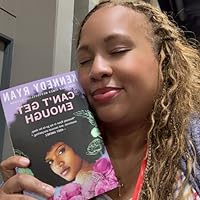
2 stars, and honestly that's me being generous out of pure stubbornness.
Buckle up, because this is gonna be a longer review. I really wanted to love this book and consider it a gripping thriller. By the end, though, it felt more like I'd been handed a checklist of harmful narratives and told to enjoy myself. 🙃
To be fair, the writing is fine, the pacing moves along at a decent clip, and the mystery provides a solid twist that I suspect will shock many readers. However, the book felt like it was lazily using the same harmful messages, stereotypes, and character roles that have been recycled for decades.
Quick genuine bright spot: the comment about the counsellor's cardigan addiction made me laugh because, as a fellow social worker with an unreasonable cardigan collection, ✨ accurate representation truly.✨ You'll have to pry them off my cold, dead, appropriately layered body. 🧥
Okay, onward. Here are my issues:
1. Trauma as a permanent hall pass
Kennedy Claire is a vile, morally bankrupt, and downright cruel character. Yet she's consistently given grace, forgiveness, and compassion that she HAS NOT EARNED because she had a difficult childhood and wants what's best for her children. 🫠
Babe. Being hurt doesn't come with a lifetime subscription to hurt other people.
This book handed that subscription out like Costco samples.Understanding someone's cruelty doesn't make them less cruel.
2. Pageant culture, misogyny, and fatphobia: a delightful little combo. 🙄
The pageant world here is… rough. Women and girls are constantly judged, pitted against each other, and expected to tolerate pain and cruelty in the name of being considered worthy. Apparently suffering in six-inch heels while performing errands is the pinnacle of female achievement? Love that for us. 👍🏻
There's also a pretty tired high-school dynamic where the "fat" friend's body is repeatedly used as a source of socially acceptable humiliation and disgustingly cruel jokes.
"Maybe it's better if she bleeds out before her blood sugar kills her." Are we serious? We're still using "fat" girls as the butt of the jokes and making them seem less worthy?
Additionally, it's 2026, and we're still explicitly writing the words ✨ boys will be boys✨ on the page, unironically, as a justification for teenage boys joking about murdering a girl because she cheated on her boyfriend — all while reducing her to nothing but *"a hot piece of ass."*
Gross. 🤢
And apparently grown women targeting children because their own children might lose is just part of the pageant experience? Fake friendships, sabotage, public humiliation, all of it just accepted and normalized.
I just kept thinking to myself, "Are we sure the adults are okay? This is a children's pageant, not the Hunger Games."
3. Addiction stigma, the whole tasting menu.
This one particularly bothered me.
A character in recovery gets privately investigated by her own family, publicly humiliated about alcohol in front of her daughter, and repeatedly treated like she has to keep re-earning the right to rebuild her life. Even her history of substance-induced psychosis gets used to make her sound unreliable when she's actually telling the truth.
Families can absolutely be hurt by what addiction has cost them. That's real. But there's a difference between acknowledging past harm and treating recovery like a debt that never gets paid off.
The repeated "well, what do you expect? She's a drunk" attitude was exhausting, too. And I was especially disappointed by how little trust this character receives from people who supposedly love her. Even her closest friend seems willing to treat her like she's a lost cause.
Then, to add insult to injury, when this character is MURDERED, her daughter's stepmother reframes it as just another way she's letting her daughter down again.
Like, girl. She's dead??
4. And then there's the gratuitous cruelty.
Probably my biggest craft complaint.
Several of the ugliest moments don't actually deepen the story. The point was already made, fully, and then the book throws another gut-punch on top like it's seasoning.
The casual sexualization of a murdered teenager. Another murder joke. Public addiction humiliation. Characters being stripped of dignity simply because the plot wants another shocking moment.
I mean, at one point, during the worst storm in Texas history, a man brings his BABY niece to the town hall so she doesn't freeze, and people are still mad he came?
I can only assume this was included for maximum emotional effect, but the 300 pages that came before it had already proved how horrible these people are.
Darkness isn't automatically depth.
5. And then the ending really goes for it.
The twist felt predictable to me, and the ending was deeply unsatisfying and, honestly, kind of gross.
One character's entire legacy gets posthumously destroyed by a fabricated confession, and years of previously shown kindness are retroactively interpreted as sinister. Not to mention, the poor son is left believing his dad was a murderer and a pedophile.
But my biggest issue with the ending is that a **completely new rape allegation** is fabricated by the actual murderer right after he dies, in front of the whole town.
The fake suicide letter already claimed he was the murderer of two people. WHY the heck, when there are already tons of people who believe women constantly make up false sexual-assault allegations to destroy men's lives, would this be added, for literally no reason!?
To use a rape allegation as a completely unnecessary plot device in 2026 is beyond disappointing. Like, what are we doing here? I'm so tired.
6. There is no redemption and no pushback against any of these harmful narratives.
Mean Girls came out in the early 2000s, and even that movie had a more hopeful and self-aware ending. The main characters actually showed growth and took accountability for their actions, however limited.
Like, the bar was on the ground, and the author still failed to give us any meaningful message, growth, accountability, pushback, or interrogation of the copious amounts of harmful messages included throughout the book.
So, to recap:
Misogyny played for laughs. Sexualization of women. Fatphobia. Women pitted against each other. Adults bullying children. Cruelty excused by trauma. Addiction used to undermine credibility. A sexual-assault allegation used as a plot device. Violence against women justified as normal teenage boy chatter.
I seriously started feeling like I was microdosing red-pill content.
Any one of these might have worked for me as an intentional element of a darker story. All of them together, with so little meaningful pushback from the narrative, is where I tapped out.
I know someone's gonna read this and go, "It's fiction. It's not that deep."
I've spent my career watching the real-world versions of many of these patterns play out, which made it hard for me to find entertainment in the face of an overwhelming number of harmful messages, beliefs, and actions.
So, respectfully, when a story repeatedly normalizes this kind of stuff without consequences or meaningful narrative challenge, it is that deep.
Ultimately, this book and I were not meant to be. My experience in helping professions made me unable to see the fun in this story. It was a terrible fit.
**Content note:** If you're navigating addiction (especially alcohol), disordered eating, or are sensitive to sexual-assault content, you may want to sit this one out.
Two stars. One of them is for the cardigans. 🧥