

What do you think?

Designers & Dragons #1
Designers & Dragons 1970s
PART ONE OF A FOUR-VOLUME SET!
EVERYTHING YOU’VE WANTED TO KNOW ABOUT THE ORIGINS OF ROLEPLAYING GAMES...
Designers & Dragons: The ’70s is a comprehensive picture of the beginnings of the RPG industry. This second edition expands the original single book into a series of four, and we’ve added over 50,000 new words to this volume alone. Learn about the colorful history of TSR and the wave of D&D inspired games (and gaming companies) to follow, and dip your toes into wargaming trivia. Regardless of your gaming background, Shannon Appelcline’s meticulously researched history won’t disappoint.
In this volume, you’ll find:
* A foreword by Greg Stafford, creator of Glorantha and author of King Arthur Pendragon
* Profiles for thirteen 1970s gaming companies including TSR, GDW, and Chaosium
* The inside scoop behind games like D&D, Traveller, and The Fantasy Trip
* Ten things you might not know about roleplaying in the ’70s
* An extensive bibliography and index
Meet the characters behind the characters and the gamers behind the games in Designers & Dragons: The ’70s!
EVERYTHING YOU’VE WANTED TO KNOW ABOUT THE ORIGINS OF ROLEPLAYING GAMES...
Designers & Dragons: The ’70s is a comprehensive picture of the beginnings of the RPG industry. This second edition expands the original single book into a series of four, and we’ve added over 50,000 new words to this volume alone. Learn about the colorful history of TSR and the wave of D&D inspired games (and gaming companies) to follow, and dip your toes into wargaming trivia. Regardless of your gaming background, Shannon Appelcline’s meticulously researched history won’t disappoint.
In this volume, you’ll find:
* A foreword by Greg Stafford, creator of Glorantha and author of King Arthur Pendragon
* Profiles for thirteen 1970s gaming companies including TSR, GDW, and Chaosium
* The inside scoop behind games like D&D, Traveller, and The Fantasy Trip
* Ten things you might not know about roleplaying in the ’70s
* An extensive bibliography and index
Meet the characters behind the characters and the gamers behind the games in Designers & Dragons: The ’70s!
519 pages, Kindle Edition
First published January 1, 2014
Ratings & Reviews
Friends & Following
Create a free account to discover what your friends think of this book!
Community Reviews
Displaying 1 - 30 of 85 reviews

September 25, 2014
Designers & Dragons: The '70s chronicles the history of role playing game companies whose genesis was in the hallowed decade of the 1970s.
Reading about role playing games isn't as exciting as playing them but I still found this to be an interesting look into the history of the hobby. While I knew quite a bit about TSR, Gary Gygax, and the father of all subsequent RPGs, Dungeons and Dragons, a lot of it was new to me.
Appelcline briefly touches on D&Ds wargaming roots and then proceeds to take the reader to school, covering companies that made their own D&D compatible products, like the Judge's Guild and Fantasy Games Unlimited, to competitors to Dungeons and Dragons and its parent company, TSR, like GDW and their Traveler game, Chaosium, Avalon Hill, and many others.
You have to have a certain level of nerdiness to really appreciate this book. What could have been a dull journey to Nerdville was made interesting by Appelcline's engaging writing style, interspersed with quotes from the people involved.
I don't have many gripes about the game. Companies I never heard of got a lot of pages and I feel like I now possess even more role playing game knowledge that I'll never need. I thought the title was a little misleading since it purports to be about RPGs during the 1970s but it's actually about companies who started during the '70s up either the present day or they went tits up.
I don't think I'd recommend it to gaming novices but people who remember spending sexless evenings covered in nerd-sweat and Cheetoh crumbs will get a kick out of it. Three out of five stars.
Reading about role playing games isn't as exciting as playing them but I still found this to be an interesting look into the history of the hobby. While I knew quite a bit about TSR, Gary Gygax, and the father of all subsequent RPGs, Dungeons and Dragons, a lot of it was new to me.
Appelcline briefly touches on D&Ds wargaming roots and then proceeds to take the reader to school, covering companies that made their own D&D compatible products, like the Judge's Guild and Fantasy Games Unlimited, to competitors to Dungeons and Dragons and its parent company, TSR, like GDW and their Traveler game, Chaosium, Avalon Hill, and many others.
You have to have a certain level of nerdiness to really appreciate this book. What could have been a dull journey to Nerdville was made interesting by Appelcline's engaging writing style, interspersed with quotes from the people involved.
I don't have many gripes about the game. Companies I never heard of got a lot of pages and I feel like I now possess even more role playing game knowledge that I'll never need. I thought the title was a little misleading since it purports to be about RPGs during the 1970s but it's actually about companies who started during the '70s up either the present day or they went tits up.
I don't think I'd recommend it to gaming novices but people who remember spending sexless evenings covered in nerd-sweat and Cheetoh crumbs will get a kick out of it. Three out of five stars.

September 12, 2014
Beware thou weary reader, for herein lies waaay the fuck more than you ever need to know about the beginnings of fantasy role playing games.
But wait up! Before you even get started on rpgs, Designers & Dragons goes even farther back. RPGs began with wargaming, which actually originated around the '50s. Well, if you want to be technical, you could say it started before that. Napoleon used huge maps and figurines representing army and navy units. Such miniature warfare was played in the Middle Ages as well. But gaming as we know it started with those WWII and Vietnam vets who liked to play out war strategies.
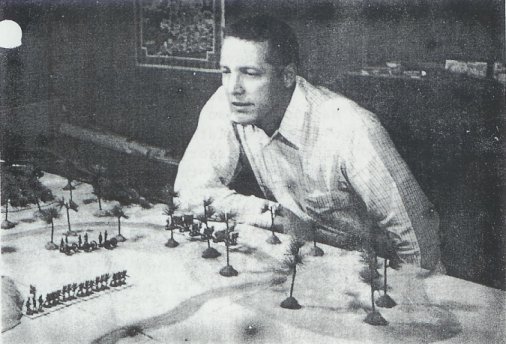
The emergence of fantasy literature, such as Lord of the Rings, in the late '60s meant it wasn't long before someone married the two ideas. After all, once a fan was done reading the book, s/he often wanted to continue on with the adventure, to inhabit the fantasy world just a little longer.
Thus was born Dungeons & Dragons. Appelcline's book is heavy on D&D, and rightly so as it dominated the RPG landscape. It was the game all the kids were playing. Other game-makers acknowledged this by attempting to license side products for the D&D system in the early days.
When I was a kid, it seemed like D&D came about around 1979-80. But that was only when the game "went viral". It had already long since enveloped the gaming underground. The original set was put out in 1974 and its true creation really started years before that in the late '60s.
Original D&D
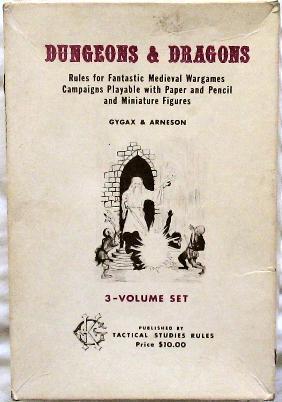
My main interest in reading this was to get a better understanding of the game I knew and loved as a boy. My version looked more like this...
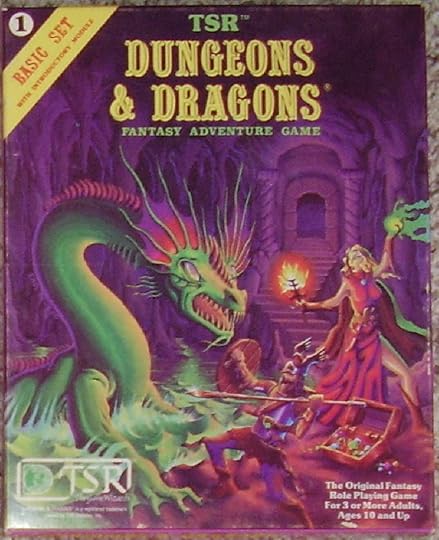
(I go into more detail on it here, if you're interested: https://www.goodreads.com/review/show...)
However, I prefer to get to know my history from the human perspective. In this instance, I wanted to know who created what or how so-and-so had to sleep in their van while they attempted to get their start-up off the ground. It was a brave new world and these fellows were courageous pioneers. I wanted to hear about them. Appelcline gives you plenty of that good stuff. Unfortunately, the book also gets bogged down in litigation and who licensed what to whom. For instance, owner of D&D, TSR Inc was a big ol' suer-rat. If it moved and there was money to be had, TSR sued it. So, D&D's history is embroiled in lawsuit after lawsuit, and Appelcline goes to great length in explaining it all. Frankly, I tired of it very quickly.
This is supposed to be about gaming in the 1970s, but it goes WAY beyond that. It would feel weird, incomplete in almost every case, to shut the door on a company's history at midnight on 12/31/1979 regardless of the story. So you get the whole story, from start to finish, even if that finish takes us right up to today. It was more than I expected and it gave me the opportunity to get to know all those game-makers I was in the dark about until reading this, like...
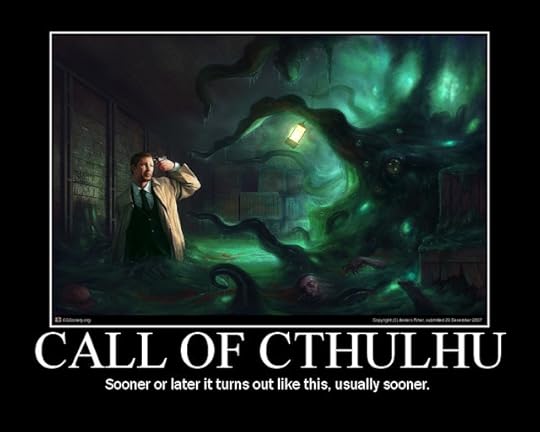
Chaosium and their main game Call of Cthulhu, a mindbendingly good time, so I'm told.
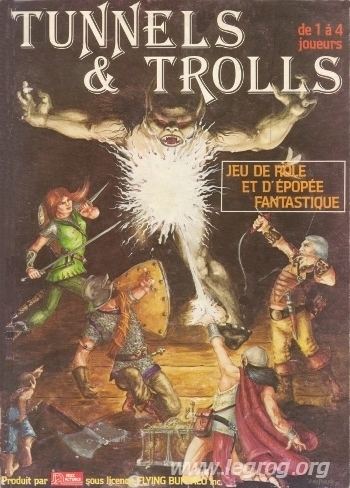
There was also Middle Earth-esque Tunnels & Trolls as created by Ken St. Andre, who got in on the ground floor with his simplified version of D&D. T&T never gained the same mass-popularity, but it survives to this day.
And then there was "satellite" creators, like Lou Zocchi, the man behind those enigmatic, odd-shaped dice role playing games are so well-known for.

That was good and all, but it took me a damn long time to finish this one, because it is very put-down-able. By which I mean, many of the company's stories are similar enough that reading the whole thing at once would be overkill. Plus, the book is logically broken into company-by-company sections, so once I was done, say, reading about Flying Buffalo, I'd put the book down before moving on to Games Workshop. Days upon days might pass before I was ready to read more.
One of my main gripes is that the writing is a bit amateurish at points. I guess I've grown used to today's writer's of history (Winchester, McCullough, Philbrick) with their smooth style. It really took me out of the story when I'd hit one of the many lines like "More on that later" or "Well return to that soon." It would be a minor point not worth mentioning but that there were so damn many instances of it. And another thing, if you say that a product was recalled due to its artwork and thus has become a hard-to-find collector's item, you really should explain what it was about the artwork that was so scandalous, because I have a very vivid imagination!
Complaints, yes, I had a few, but all in all this was good, good fun!
As a boy, D&D popped into my world almost as if by magic, so I was thrilled to finally get the chance to really learn about the world of gaming and discover the behind-the-scenes, origin stories that once mystified me. For that, I am grateful this book was created, and created with such obvious love for the subject matter. Appelcline once worked for Chaosium, so clearly this book and everything it stands for is important to him. It shows. Well done!
But wait up! Before you even get started on rpgs, Designers & Dragons goes even farther back. RPGs began with wargaming, which actually originated around the '50s. Well, if you want to be technical, you could say it started before that. Napoleon used huge maps and figurines representing army and navy units. Such miniature warfare was played in the Middle Ages as well. But gaming as we know it started with those WWII and Vietnam vets who liked to play out war strategies.
The emergence of fantasy literature, such as Lord of the Rings, in the late '60s meant it wasn't long before someone married the two ideas. After all, once a fan was done reading the book, s/he often wanted to continue on with the adventure, to inhabit the fantasy world just a little longer.
Thus was born Dungeons & Dragons. Appelcline's book is heavy on D&D, and rightly so as it dominated the RPG landscape. It was the game all the kids were playing. Other game-makers acknowledged this by attempting to license side products for the D&D system in the early days.
When I was a kid, it seemed like D&D came about around 1979-80. But that was only when the game "went viral". It had already long since enveloped the gaming underground. The original set was put out in 1974 and its true creation really started years before that in the late '60s.
Original D&D
My main interest in reading this was to get a better understanding of the game I knew and loved as a boy. My version looked more like this...
(I go into more detail on it here, if you're interested: https://www.goodreads.com/review/show...)
However, I prefer to get to know my history from the human perspective. In this instance, I wanted to know who created what or how so-and-so had to sleep in their van while they attempted to get their start-up off the ground. It was a brave new world and these fellows were courageous pioneers. I wanted to hear about them. Appelcline gives you plenty of that good stuff. Unfortunately, the book also gets bogged down in litigation and who licensed what to whom. For instance, owner of D&D, TSR Inc was a big ol' suer-rat. If it moved and there was money to be had, TSR sued it. So, D&D's history is embroiled in lawsuit after lawsuit, and Appelcline goes to great length in explaining it all. Frankly, I tired of it very quickly.
This is supposed to be about gaming in the 1970s, but it goes WAY beyond that. It would feel weird, incomplete in almost every case, to shut the door on a company's history at midnight on 12/31/1979 regardless of the story. So you get the whole story, from start to finish, even if that finish takes us right up to today. It was more than I expected and it gave me the opportunity to get to know all those game-makers I was in the dark about until reading this, like...
Chaosium and their main game Call of Cthulhu, a mindbendingly good time, so I'm told.
There was also Middle Earth-esque Tunnels & Trolls as created by Ken St. Andre, who got in on the ground floor with his simplified version of D&D. T&T never gained the same mass-popularity, but it survives to this day.
And then there was "satellite" creators, like Lou Zocchi, the man behind those enigmatic, odd-shaped dice role playing games are so well-known for.
That was good and all, but it took me a damn long time to finish this one, because it is very put-down-able. By which I mean, many of the company's stories are similar enough that reading the whole thing at once would be overkill. Plus, the book is logically broken into company-by-company sections, so once I was done, say, reading about Flying Buffalo, I'd put the book down before moving on to Games Workshop. Days upon days might pass before I was ready to read more.
One of my main gripes is that the writing is a bit amateurish at points. I guess I've grown used to today's writer's of history (Winchester, McCullough, Philbrick) with their smooth style. It really took me out of the story when I'd hit one of the many lines like "More on that later" or "Well return to that soon." It would be a minor point not worth mentioning but that there were so damn many instances of it. And another thing, if you say that a product was recalled due to its artwork and thus has become a hard-to-find collector's item, you really should explain what it was about the artwork that was so scandalous, because I have a very vivid imagination!
Complaints, yes, I had a few, but all in all this was good, good fun!
As a boy, D&D popped into my world almost as if by magic, so I was thrilled to finally get the chance to really learn about the world of gaming and discover the behind-the-scenes, origin stories that once mystified me. For that, I am grateful this book was created, and created with such obvious love for the subject matter. Appelcline once worked for Chaosium, so clearly this book and everything it stands for is important to him. It shows. Well done!

December 7, 2017
While I thoroughly enjoyed this book, I don't know that it's for everyone. As you may surmise, this is a history of the tabletop role playing game industry--Dungeons & Dragons being the archetypal such RPG. Specifically, this is volume 1, covering the 1970’s. There are four volumes in the series, each covering a different decade. A LOT of RPG publishers have come and gone since the early days.
The book is meticulously researched and cross referenced. Each chapter focuses on a different company that either formed in the 70's, or simply began publishing RPGs during that decade. Applecline covers the entire history of each company, even beyond the 70's if need be. As someone who started playing D&D around 1980 or so, and who’s spent a fair amount of time since then browsing the shelves of various hobby shops and bookstores, this book was like meeting old friends. While some of this history was familiar to me, much of it was new, and I’d had no inkling of some of the behind-the-scenes maneuvering. The book abounds with fascinating stories and tidbits of information.
So I'm clearly interested in the subject matter. I suspect that, if you're not into gaming at all, this book would possibly bore the snot out of you. It's basically stories about people and companies and games, and if you don't already have a vested interest in the topic, you're probably not going to get much out of it. For gamers, recommended! For ordinary mortals, feel free to check it out if it sounds interesting ...
The book is meticulously researched and cross referenced. Each chapter focuses on a different company that either formed in the 70's, or simply began publishing RPGs during that decade. Applecline covers the entire history of each company, even beyond the 70's if need be. As someone who started playing D&D around 1980 or so, and who’s spent a fair amount of time since then browsing the shelves of various hobby shops and bookstores, this book was like meeting old friends. While some of this history was familiar to me, much of it was new, and I’d had no inkling of some of the behind-the-scenes maneuvering. The book abounds with fascinating stories and tidbits of information.
So I'm clearly interested in the subject matter. I suspect that, if you're not into gaming at all, this book would possibly bore the snot out of you. It's basically stories about people and companies and games, and if you don't already have a vested interest in the topic, you're probably not going to get much out of it. For gamers, recommended! For ordinary mortals, feel free to check it out if it sounds interesting ...

December 4, 2016
Exhaustive research and an engaging writing style made this volume hard to put down. I played my first wargame in 1962 and picked up the first edition of D&D on a whim in 1974 and never looked back. I've logged many, many hours (and spent many, many dollars) in game shops and at conventions since and it was so nice to read the background of all the companies and products that I saw appearing and disappearing over the years. I've read several books on the history of TSR and wargaming but this is by far the most readable and detailed. Highly recommended. On to the second volume!

August 18, 2020
While certainly not for everyone, I found this book pretty damned amazing. Appelcline does a fantastic job detailing the history of the RPG industry in both a thorough and fun way. We follow several publishers who opened their doors in the earliest years of the hobby, and see their progress to the present day, or, for most, to their fall.
My version was the audiobook version, read by Colby Elliott. As of now, this is the only volume in the series that is on audio (released earlier this year), and I hope the others will follow soon. It made for an entertaining listen while painting minis.
My version was the audiobook version, read by Colby Elliott. As of now, this is the only volume in the series that is on audio (released earlier this year), and I hope the others will follow soon. It made for an entertaining listen while painting minis.
August 6, 2014
I already did a review of the 1st edition of this book, but I had to get the new edition as well. Readers should note that the new edition is 4 separate volumes each addressing a new decade. Overall, there is lots of great new material in the new edition. I think the series as a whole is a fabulous read (insider connections got me the chance to read it all early). I'm not even a role player, but there is lots of great material in here about the hobby game industry as a whole, and so all of the companies I followed as a kid in the 70's are discussed here: Metagaming, Task Force Games, etc. Reading the 70's book in particular brings back loads of great memories from when I was 8, 9, 10 years old and just discovering gaming in the form of Microgames. I also find all the game company shenanigans really engrossing. As a game designer, and someone who has self-published a time or two, it is really useful to learn the nitty-gritty of why so many game companies have tanked over the years, and why some have survived so well. I think if you are a gamer at all (not just a role-player) you have got to get this book.

March 18, 2018
Shannon Appelcline's Designer's & Dragons is a truly massive undertaking: A history of the entire roleplaying game industry from its beginnings to about 2010. Just the first volume, covering six years (1974–79), is 400 pages.
However, the structure is such that he is covering a lot more than those six years. Each chapter is a complete history of a single company, running to when they closed down, and many of the companies here are still running in one form or another today (and certainly, none of them ended in the '70s). This volume covers thirteen companies who had an impact on the RPG industry during the '70s, plus three 'mini-histories' of more peripheral companies, and one 'magazine history' (annoyingly, these last do not show up in the table of contents).
This does fracture a lot of subjects, notably how the industry and market was evolving, and how one company's releases were affecting the others. This is present, but because it bridges chapters, is not well served. And the the history of RPGs outside the companies is under-served. There is a nice bit of background on the Bay Area gaming scene (as the background of Arduin), but no similar coverage of the Los Angeles area, which was an important early center of RPG fandom (most surprising is that Alarums & Excursions doesn't even rate a mini-history box, even if it is a completely amateur production). Appelcline keeps solidly focused on his general subject, only touching on non-RPG products from a company where they impinge on the company and its RPG side as a whole, making several of those chapters noticeably incomplete on their subject.
And... the book is still 400 pages with all those omissions, and only covers the first corner of the industry. I want more, but I have to admit my interests are further reaching than most, and I would really like to see a good history that tackles wargaming, and frankly also 'adventure gaming' in general. It breaks these six years into four parts, with TSR and the genesis of the form being part one (which is available as a very generous free trial here), part two covering the first four major companies to leap onto RPGs, part three consisting of wargame publishers who moved into RPGs in the early days (though GDW is rightfully part of part two), and the fourth talking about the rise of 'universal' (as in 'for any game system', even when you know which game they really mean...) publishers.
Several of these companies I kind of consider 'childhood friends' of mine, having grown up around products by GDW, Flying Buffalo, and of course, TSR. Others, like GW, are less familiar. It is a little depressing seeing just how many ways a company can run into financial trouble, but it is nice to find out just what happened to a fair number of people who, from my fairly limited viewpoint, just disappeared along the way. Finding out more about games I saw ads for, but never knew anyone who had a copy was also a plus. The book was entertaining and informative, with just a few small editing issues. And I'm already most of the way through devouring the second book.
However, the structure is such that he is covering a lot more than those six years. Each chapter is a complete history of a single company, running to when they closed down, and many of the companies here are still running in one form or another today (and certainly, none of them ended in the '70s). This volume covers thirteen companies who had an impact on the RPG industry during the '70s, plus three 'mini-histories' of more peripheral companies, and one 'magazine history' (annoyingly, these last do not show up in the table of contents).
This does fracture a lot of subjects, notably how the industry and market was evolving, and how one company's releases were affecting the others. This is present, but because it bridges chapters, is not well served. And the the history of RPGs outside the companies is under-served. There is a nice bit of background on the Bay Area gaming scene (as the background of Arduin), but no similar coverage of the Los Angeles area, which was an important early center of RPG fandom (most surprising is that Alarums & Excursions doesn't even rate a mini-history box, even if it is a completely amateur production). Appelcline keeps solidly focused on his general subject, only touching on non-RPG products from a company where they impinge on the company and its RPG side as a whole, making several of those chapters noticeably incomplete on their subject.
And... the book is still 400 pages with all those omissions, and only covers the first corner of the industry. I want more, but I have to admit my interests are further reaching than most, and I would really like to see a good history that tackles wargaming, and frankly also 'adventure gaming' in general. It breaks these six years into four parts, with TSR and the genesis of the form being part one (which is available as a very generous free trial here), part two covering the first four major companies to leap onto RPGs, part three consisting of wargame publishers who moved into RPGs in the early days (though GDW is rightfully part of part two), and the fourth talking about the rise of 'universal' (as in 'for any game system', even when you know which game they really mean...) publishers.
Several of these companies I kind of consider 'childhood friends' of mine, having grown up around products by GDW, Flying Buffalo, and of course, TSR. Others, like GW, are less familiar. It is a little depressing seeing just how many ways a company can run into financial trouble, but it is nice to find out just what happened to a fair number of people who, from my fairly limited viewpoint, just disappeared along the way. Finding out more about games I saw ads for, but never knew anyone who had a copy was also a plus. The book was entertaining and informative, with just a few small editing issues. And I'm already most of the way through devouring the second book.

August 31, 2017
Excellent!!! Essential reading for anyone interested in the history of role-playing games, and a fascinating case study in the emergence of an industry, detailing the rise and fall of numerous individual companies. Also one hell of a nostalgia trip for an old gamer like me...

August 7, 2014
This series is an in depth look at the history of the RPG industry, focusing on the companies and personalities that shaped it. The first volume looks at the earliest days and the companies founded in the 1970s -- though it traces the history of each company through the following decades.
The book is very readable, and I would highly recommend it to any fan/follower of the industry. Author Shannon Appelcline really does a good job following the threads back and forth between the companies, and laying them out for the reader. While I had heard some of the stories contained in this first volume, there was a lot more that was new to me.
As of this writing (August 9, 2014) there is a kickstarter campaign running to fund print production of the series, and you can get all the books in electronic format.
The book is very readable, and I would highly recommend it to any fan/follower of the industry. Author Shannon Appelcline really does a good job following the threads back and forth between the companies, and laying them out for the reader. While I had heard some of the stories contained in this first volume, there was a lot more that was new to me.
As of this writing (August 9, 2014) there is a kickstarter campaign running to fund print production of the series, and you can get all the books in electronic format.

August 19, 2014
The decade that gave birth to RPGs has never been covered in much greater detail and scope elsewhere. About a third of this volume details TSR, which is understandable as the company published the Dungeons & Dragons and created an entirely new industry.
As a fan, I went through an emotional rollercoaster as I read the book: my heart soared as I shared in the victories and many firsts of the era, as RPGs are starting to rise to prominence, while I almost wept (with or without much gnashing of teeth as accompaniment) as companies floundered in the many upheavals of the industry and failed.
Having been introduced to RPGs around 1989 or so, and having grown up in a small backwater South-east Asian country, it is nice to know about the people (and games) that have all come before in this industry I will always be a part of.
On to the '80s!
As a fan, I went through an emotional rollercoaster as I read the book: my heart soared as I shared in the victories and many firsts of the era, as RPGs are starting to rise to prominence, while I almost wept (with or without much gnashing of teeth as accompaniment) as companies floundered in the many upheavals of the industry and failed.
Having been introduced to RPGs around 1989 or so, and having grown up in a small backwater South-east Asian country, it is nice to know about the people (and games) that have all come before in this industry I will always be a part of.
On to the '80s!

February 4, 2016
My past review glitched out somehow. This is great, get it!

Read
March 21, 2023Надо бы предупредить, кому эта книга подойдёт, а кому нет.
Свойственное мне задротство осваивать что-то с самого начала привело меня к этой книге. И вот для меня она очень близка к идеалу. Здесь собраны истории всех крупных и не очень издателей, которые дали начало НРИ. Каждый раздел рассказывает о конкретном издательстве, перечисляя основные событие и продукты. Хотя для меня это работает, у такой структуры есть масса минусов. Маловато внимания авторам, как по мне. Много бизнеса. Возня с репринтами и редакциями. Мало комплексности, которая позволила бы увидеть картину целиком. Упоминания других студия в главах есть, но по началу это плохо работает. История разных издателей бывает то веселее, то наоборот: читать про TSR было скучно (а это первые 10% книги), а про Games Workshop весело.
Автор в конце книги перечисляет ресурсы и книги, которые можно почитать. Возможно, многим эта часть будет наиболее полезна.
Свойственное мне задротство осваивать что-то с самого начала привело меня к этой книге. И вот для меня она очень близка к идеалу. Здесь собраны истории всех крупных и не очень издателей, которые дали начало НРИ. Каждый раздел рассказывает о конкретном издательстве, перечисляя основные событие и продукты. Хотя для меня это работает, у такой структуры есть масса минусов. Маловато внимания авторам, как по мне. Много бизнеса. Возня с репринтами и редакциями. Мало комплексности, которая позволила бы увидеть картину целиком. Упоминания других студия в главах есть, но по началу это плохо работает. История разных издателей бывает то веселее, то наоборот: читать про TSR было скучно (а это первые 10% книги), а про Games Workshop весело.
Автор в конце книги перечисляет ресурсы и книги, которые можно почитать. Возможно, многим эта часть будет наиболее полезна.

Read
October 12, 2019A priceless gem for those interested in the history of roleplaying games--that is, the roleplaying game industry, rather than a history of play or design.
I look forward to reading Playing at the World: A History of Simulating Wars, People, and Fantastic Adventure from Chess to Role-Playing Games, which I understand is an adjacent and more academic take on similar material, perhaps more focused on play and design.
(A part of the Shelf Love project: https://tinyurl.com/y5w8h4pa)
7P
I look forward to reading Playing at the World: A History of Simulating Wars, People, and Fantastic Adventure from Chess to Role-Playing Games, which I understand is an adjacent and more academic take on similar material, perhaps more focused on play and design.
(A part of the Shelf Love project: https://tinyurl.com/y5w8h4pa)
7P

April 14, 2015
First, let me start with the most important point - this book is a well-researched, engagingly-written, very thorough history of the role-playing game industry (well, the first volume of it, anyway). That alone made reading it worth-while for me, and I enjoyed it very much. That said, it is worth noting that the title is a bit misleading, inasmuch as the company histories in the book proceed up to the modern day (or the end of the company's life, as applicable); the "'70 to '79" refers instead to the origin date of the companies detailed within. And that, dear friends, brings me to my first complaint.
The book is organized as a collection of articles detailing the histories of individual companies in the industry, rather than as a synthesized, holistic account of the industry in a given decade. This leads to some odd features. Some information about the state of the industry at a given time is repeated from article to article, as if the author expects the reader to approach each article separately. In other cases, though, only casual mention is made of information included in earlier articles, even if that information is highly relevant to the issue under discussion. In other words, it seems as if the author cannot quite decide if the book is meant to be read straight through or as a reference, a collection of articles to be consumed piecemeal.
This approach constitutes the biggest flaw in the history (thus far), and also explains the other major flaw in the work. That secondary but also very important flaw is that the "parallel narrative" approach makes it harder for the reader to integrate the stories of the various companies to create a singular picture of the industry in a given era. The author seems to show some awareness of this inasmuch as he reiterates certain points from narrative to narrative (which reinforces them in the reader's mind, but also constitutes very clumsy writing), and also in the inclusion of an appendix that summarizes, in list form, the major features of role-playing as a hobby in the era under discussion. However, he lacked either the motivation or the skill (or both) to take his initial collection of articles and forge them into a more coherent historical narrative. This is unfortunate, and I am not looking forward to (potentially) having to look back to the first volume to refresh my memory on some aspect of the industry in the '80's, '90's, or '00's when I read those volumes, as I cannot be sure the information will be repeated in the articles found in those later books.
This general problem of awkward organization is likely a function of the author's lack of training in historiography. This lack of professional training as a historian shows up in other minor ways, as well: the prose, while straightforward and engaging, is littered with inapt and outright incorrect usages that will grate on a reader of scholarly sensibilities (if nothing else, graduate training in history might have persuaded Appelcline not to use quite so many adverbs); and though the book includes a bibliography, the author does not provide notes to source various claims of fact, which means that even a discerning reader is forced to rely solely on the author to weigh the reliability of various claims. This is not to cast aspersions on the author's intentions, here - I think Appelcline is perceptive and well-meaning, and probably represents the veracity of various claims of fact honestly as he understands them. But it is a mark of the amateur nature of the history that there is no immediate way for the reader to access the source material to judge the facts for him or her self.
All in all, I enjoyed the book very much, and, in fairness to the author, it does not represent itself as a scholarly history. Still, I feel that an opportunity was missed, here. Appelcline put in an unprecedented amount of research on the history of the role-playing industry from the earliest days to the present, going beyond even the efforts of the magisterial "Playing at the World" (albeit with narrower focus). This set could have been the definitive history of the industry. Instead what we have is a very good account of the industry that is nonetheless flawed in important ways that make it vastly less useful (and arguably useless) as a secondary source for further work in the field, and all because of just a few key mistakes owing to Appelcline's lack of formal training in history. I would dearly love to see a third edition of the book, revised by Appelcline with the assistance of a professional historian, working from his original notes, that could serve as a viable secondary source, but I believe I will likely have to be satisfied with what we have already. As these things go, there are worse fates.
The book is organized as a collection of articles detailing the histories of individual companies in the industry, rather than as a synthesized, holistic account of the industry in a given decade. This leads to some odd features. Some information about the state of the industry at a given time is repeated from article to article, as if the author expects the reader to approach each article separately. In other cases, though, only casual mention is made of information included in earlier articles, even if that information is highly relevant to the issue under discussion. In other words, it seems as if the author cannot quite decide if the book is meant to be read straight through or as a reference, a collection of articles to be consumed piecemeal.
This approach constitutes the biggest flaw in the history (thus far), and also explains the other major flaw in the work. That secondary but also very important flaw is that the "parallel narrative" approach makes it harder for the reader to integrate the stories of the various companies to create a singular picture of the industry in a given era. The author seems to show some awareness of this inasmuch as he reiterates certain points from narrative to narrative (which reinforces them in the reader's mind, but also constitutes very clumsy writing), and also in the inclusion of an appendix that summarizes, in list form, the major features of role-playing as a hobby in the era under discussion. However, he lacked either the motivation or the skill (or both) to take his initial collection of articles and forge them into a more coherent historical narrative. This is unfortunate, and I am not looking forward to (potentially) having to look back to the first volume to refresh my memory on some aspect of the industry in the '80's, '90's, or '00's when I read those volumes, as I cannot be sure the information will be repeated in the articles found in those later books.
This general problem of awkward organization is likely a function of the author's lack of training in historiography. This lack of professional training as a historian shows up in other minor ways, as well: the prose, while straightforward and engaging, is littered with inapt and outright incorrect usages that will grate on a reader of scholarly sensibilities (if nothing else, graduate training in history might have persuaded Appelcline not to use quite so many adverbs); and though the book includes a bibliography, the author does not provide notes to source various claims of fact, which means that even a discerning reader is forced to rely solely on the author to weigh the reliability of various claims. This is not to cast aspersions on the author's intentions, here - I think Appelcline is perceptive and well-meaning, and probably represents the veracity of various claims of fact honestly as he understands them. But it is a mark of the amateur nature of the history that there is no immediate way for the reader to access the source material to judge the facts for him or her self.
All in all, I enjoyed the book very much, and, in fairness to the author, it does not represent itself as a scholarly history. Still, I feel that an opportunity was missed, here. Appelcline put in an unprecedented amount of research on the history of the role-playing industry from the earliest days to the present, going beyond even the efforts of the magisterial "Playing at the World" (albeit with narrower focus). This set could have been the definitive history of the industry. Instead what we have is a very good account of the industry that is nonetheless flawed in important ways that make it vastly less useful (and arguably useless) as a secondary source for further work in the field, and all because of just a few key mistakes owing to Appelcline's lack of formal training in history. I would dearly love to see a third edition of the book, revised by Appelcline with the assistance of a professional historian, working from his original notes, that could serve as a viable secondary source, but I believe I will likely have to be satisfied with what we have already. As these things go, there are worse fates.

November 12, 2016
As a long-time gamer, game journalist, and friend to designers, I wasn’t sure how much I would learn from Designers & Dragons: The ‘70s. I supported this series of books as a Kickstarter project in hopes that they would become resources for my History of Games class. Well, that they will do, but they were also filled with lots of anecdotes and details that I didn’t have and even filled in some of the gaps I had in my industry history. It’s the book I thought I should have written, but this is better than what I would have done. Frankly, I’m impressed! It even caused me to buy some other books because of some of the terrific material Shannon Applecline unearthed. Better yet, when I do know the stories, Applecline’s version seems very balanced.
Plus, despite my notorious curiosity, there were some legal scandals that I largely ignored because they were outside the frame of my narrow focus on computer games (not that narrow, I guess, because I believed that tabletop games formed a dependable foundation for electronic games and made a number of contacts in that arena—including many personal heroes). Applecline clarified some mysteries surrounding the decline of Metagaming and FGU (Fantasy Games Unlimited). It’s amazing how specific references to lawsuits and direct quotations from the principals will clarify the muddy waters of rumor in the back of one’s mind. And, as far as I know, this is one of the best summaries of the history of Chaosium. Even after spending time with founder Greg Stafford and Bill Dunn (best known for the Prince Valiant RPG), as well as commissioning artist Mark Ferrari (Creatures of the Dreamlands) to provide the cover to Computer Gaming World #100, I hadn’t recognized how much of Chaosium’s initial output was a result of Stafford’s desire to write fiction. That was interesting because Greg transformed his fiction into games and Raymond Feist transformed his game world into the fascinating Krondor series.
Although I’m very happy with what is published in this volume, I wish there had been more mention of the innovative mechanics found in each game. Applecline writes about “weird dice” and those games developed strictly to use d6s instead of TSR’s proliferation of polyhedral dice, but what seemed missing to me were descriptions of: 1) hit location tables in TSR’s Boot Hill (and Runequest, for that matter) as well as its unique first-shot calculation, 2) the use of the spinner in FBI’s (Doug Malewicki’s) Nuclear War, 3) social status and dedicated enemies in GDW’s En Garde, 4) use of action points to clear up combat in Snapshot for Traveller, or 5) importance of birth order in Chivalry & Sorcery. Of course, such a large endeavor can’t have everything, so this is probably “whining” on my part.
There was plenty of synchronicity between my personal experiences with many of these designers and the authors. To my knowledge, I never met Philip E. Orbanes, but his history of Parker Brothers and books on Monopoly are vital parts of my game history archives. Still, I hadn’t realized that this was the same Orbanes who had founded Gamescience to publish wargames. I was only aware of Lou Zocchi’s era at Gamescience. But, Applecline’s descriptions of major players like Dave Arneson, Ken St. Andre, Steve Perrin, Steve Jackson (the U.S. designer), and Duke Siefried (of Heritage Games fame, but also the referee for one of the most amazing French & Indian War scenarios I’ve ever played—it was a theatrical production using miniatures, terrain, and sound) ring very true to the times I’ve rubbed shoulders with them.
In short, this is a marvelous volume. As a supporter of this project from its Kickstarter days, I look forward to devouring the sequel decades (starting with the ‘80s when I was more involved in the industry). Designers & Dragons: The ‘70s is, like the previously recommended Playing at the World, a tremendous addition to the literature on gaming history. Anyone interested in role-playing games at all, much less gaming history, needs this volume and its companion volumes.
Plus, despite my notorious curiosity, there were some legal scandals that I largely ignored because they were outside the frame of my narrow focus on computer games (not that narrow, I guess, because I believed that tabletop games formed a dependable foundation for electronic games and made a number of contacts in that arena—including many personal heroes). Applecline clarified some mysteries surrounding the decline of Metagaming and FGU (Fantasy Games Unlimited). It’s amazing how specific references to lawsuits and direct quotations from the principals will clarify the muddy waters of rumor in the back of one’s mind. And, as far as I know, this is one of the best summaries of the history of Chaosium. Even after spending time with founder Greg Stafford and Bill Dunn (best known for the Prince Valiant RPG), as well as commissioning artist Mark Ferrari (Creatures of the Dreamlands) to provide the cover to Computer Gaming World #100, I hadn’t recognized how much of Chaosium’s initial output was a result of Stafford’s desire to write fiction. That was interesting because Greg transformed his fiction into games and Raymond Feist transformed his game world into the fascinating Krondor series.
Although I’m very happy with what is published in this volume, I wish there had been more mention of the innovative mechanics found in each game. Applecline writes about “weird dice” and those games developed strictly to use d6s instead of TSR’s proliferation of polyhedral dice, but what seemed missing to me were descriptions of: 1) hit location tables in TSR’s Boot Hill (and Runequest, for that matter) as well as its unique first-shot calculation, 2) the use of the spinner in FBI’s (Doug Malewicki’s) Nuclear War, 3) social status and dedicated enemies in GDW’s En Garde, 4) use of action points to clear up combat in Snapshot for Traveller, or 5) importance of birth order in Chivalry & Sorcery. Of course, such a large endeavor can’t have everything, so this is probably “whining” on my part.
There was plenty of synchronicity between my personal experiences with many of these designers and the authors. To my knowledge, I never met Philip E. Orbanes, but his history of Parker Brothers and books on Monopoly are vital parts of my game history archives. Still, I hadn’t realized that this was the same Orbanes who had founded Gamescience to publish wargames. I was only aware of Lou Zocchi’s era at Gamescience. But, Applecline’s descriptions of major players like Dave Arneson, Ken St. Andre, Steve Perrin, Steve Jackson (the U.S. designer), and Duke Siefried (of Heritage Games fame, but also the referee for one of the most amazing French & Indian War scenarios I’ve ever played—it was a theatrical production using miniatures, terrain, and sound) ring very true to the times I’ve rubbed shoulders with them.
In short, this is a marvelous volume. As a supporter of this project from its Kickstarter days, I look forward to devouring the sequel decades (starting with the ‘80s when I was more involved in the industry). Designers & Dragons: The ‘70s is, like the previously recommended Playing at the World, a tremendous addition to the literature on gaming history. Anyone interested in role-playing games at all, much less gaming history, needs this volume and its companion volumes.

October 12, 2016
A fascinating look at the early days of role playing games, as a hobby and as a business.

November 26, 2014
I've only ever delved into the history of the tabletop roleplaying history a few times, and this was mainly snippets of information gleaned from books and interviews over the years. I’ve always been fascinated by the early days and the way the industry grew and continues to this day, and I’ve always enjoyed learning about the early days of the hobby. However, I’ve never really had the chance to really find out how it began and what happened to the individuals, games and companies involved.
Thank goodness, then, for Designers & Dragons: A History of the Roleplaying Game Industry.
This first volume of the series covers the 1970s, early days of the RPG scene and it's a glorious if depressing read - glorious in that it's amazing to see how these first firms kicked the whole thing off, their attitude and approach to the fledgling hobby and the almost off-handed way they handled new product. Depressing in that I wish I had been around to appreciate that initial burst of energy and passion.
After the hefty entry on the giant of the hobby, TSR, the book then covers Flying Buffalo, Games Workshop, GDW, Judges Guild, Metagaming Concepts, Fantasy Games Unlimited, Chaosium, Gamescience, Heritage Models, Grimoire Games, DayStar West Media and Midkemia Press. This is followed up by some neat little ‘Did you know?’ comments about the nature of roleplaying in the 1970s – which I found fascinating, as the attitude to gaming really has changed over the decades – and then a bibliography and acknowledgements.
There’s a real charm to this first book as it takes you back to the beginning and it’s not always a nice read; disagreements, rivalries and lawsuits rear their ugly heads as well as the stories of people reaching milestones, enjoying successes and pushing the hobby forward. It was great to read about the beginnings of the hobby but it was just as good to read about the approach that most companies had towards this new pastime. It almost comes across as clueless, sometimes, but the hobby was young and directionless and, coming out of the structured worlds of boardgames and wargames, many of the people involved had no true guidelines on how to approach this new and peculiar hobby.
It’s a solid read and while there may be moments when I felt that the book was simply listing facts and figures – which can’t be helped considering that it is trying to be complete and sometimes the detailed information just isn’t available – I honestly felt I learned something about my hobby and it’s origins. The book doesn’t take sides or root for any single person, game or company (although it does refer to some possible evidence or widely-regarded opinion on certain matters) and it gives the facts as cleanly, and as entertainingly, as possible.
As I mentioned earlier, there may have been times when I felt that the book was just calling out statistics or just reeling off product lines for a certain company’s production period, but even though I may have passed over these periods with a lot less interest than other points in the book, at no point did I feel completely bored or dissatisfied. These were fillers, information blurbs that took me through the workings of the company to make the history complete. All the time there’s cross-referencing and notes on what to read next, sidebars on details about certain things that readers might find interesting and notes that add flavour and background.
Well written, well laid out and, apart from the few rare moments where I felt I was reading material just to get to the juicier parts of the history (everyone loves a bit of gossip, don’t they?), I seriously enjoyed this book. I can't wait to get into the next book, the 1980s, which was my era, the decade when I entered the hobby.
Highly recommended.
Thank goodness, then, for Designers & Dragons: A History of the Roleplaying Game Industry.
This first volume of the series covers the 1970s, early days of the RPG scene and it's a glorious if depressing read - glorious in that it's amazing to see how these first firms kicked the whole thing off, their attitude and approach to the fledgling hobby and the almost off-handed way they handled new product. Depressing in that I wish I had been around to appreciate that initial burst of energy and passion.
After the hefty entry on the giant of the hobby, TSR, the book then covers Flying Buffalo, Games Workshop, GDW, Judges Guild, Metagaming Concepts, Fantasy Games Unlimited, Chaosium, Gamescience, Heritage Models, Grimoire Games, DayStar West Media and Midkemia Press. This is followed up by some neat little ‘Did you know?’ comments about the nature of roleplaying in the 1970s – which I found fascinating, as the attitude to gaming really has changed over the decades – and then a bibliography and acknowledgements.
There’s a real charm to this first book as it takes you back to the beginning and it’s not always a nice read; disagreements, rivalries and lawsuits rear their ugly heads as well as the stories of people reaching milestones, enjoying successes and pushing the hobby forward. It was great to read about the beginnings of the hobby but it was just as good to read about the approach that most companies had towards this new pastime. It almost comes across as clueless, sometimes, but the hobby was young and directionless and, coming out of the structured worlds of boardgames and wargames, many of the people involved had no true guidelines on how to approach this new and peculiar hobby.
It’s a solid read and while there may be moments when I felt that the book was simply listing facts and figures – which can’t be helped considering that it is trying to be complete and sometimes the detailed information just isn’t available – I honestly felt I learned something about my hobby and it’s origins. The book doesn’t take sides or root for any single person, game or company (although it does refer to some possible evidence or widely-regarded opinion on certain matters) and it gives the facts as cleanly, and as entertainingly, as possible.
As I mentioned earlier, there may have been times when I felt that the book was just calling out statistics or just reeling off product lines for a certain company’s production period, but even though I may have passed over these periods with a lot less interest than other points in the book, at no point did I feel completely bored or dissatisfied. These were fillers, information blurbs that took me through the workings of the company to make the history complete. All the time there’s cross-referencing and notes on what to read next, sidebars on details about certain things that readers might find interesting and notes that add flavour and background.
Well written, well laid out and, apart from the few rare moments where I felt I was reading material just to get to the juicier parts of the history (everyone loves a bit of gossip, don’t they?), I seriously enjoyed this book. I can't wait to get into the next book, the 1980s, which was my era, the decade when I entered the hobby.
Highly recommended.

June 9, 2020
Very readable, full of interesting facts about role playing history.
I was very close to giving it 5 stars, but the choices about the way it was organized (by company and what decade they started publishing RPGs) just seemed a little awkward. This meant to get information about certain actual games/designers that change companies, you may have to page through different volumes.
I was very close to giving it 5 stars, but the choices about the way it was organized (by company and what decade they started publishing RPGs) just seemed a little awkward. This meant to get information about certain actual games/designers that change companies, you may have to page through different volumes.
August 27, 2015
An interesting first volume! This installment covers the founding days of the industry, including many of the big firsts, and underscores how things are both different from and similar to today. (One surprising similarity is how big indie publishers and unlicensed third parties were, back in the day.) It was also striking to see quite how much of an 800-pound gorilla TSR was in the early days, something I'd only seen the tail-end of in the 1990s - seemed like most if not all of the other companies in the book had some brush with TSR, often of the unfriendly kind.
I enjoyed reading this book - it's very well-researched, with solid overviews of each company, and it continually reminds you how interconnected each was with other companies and trends of the day. There's a ton in there I hadn't heard of before - I doubt you could find a better book for an overview of the industry as a whole at the time.
That said, there are some minor issues. The book is very strong on the business and publishing side of things, and tracing important innovations in rules and concepts. However, it's weaker on the "human interest" angle, and could have used more biographies of the big names, or more anecdotes describing what people enjoyed about these early games. This might make it a dry read at times for anyone not already invested in the subject.
Also, I would have liked more broad-overview material, beyond the section introductions or the appendix at the end. Perhaps more sidebars, or even a timeline, to give a better sense of the big picture than you get bouncing from company to company. And I was a little disappointed that major non-US/UK RPGs only got tiny mentions (though I understand that would be an effort unto itself).
Of course, these complaints are ultimately just nitpicks, as what we did get is still an amazing achievement, with few predecessors (all of which were less comprehensive). I definitely recommend this for anyone with an interest in RPG history. (A)
I enjoyed reading this book - it's very well-researched, with solid overviews of each company, and it continually reminds you how interconnected each was with other companies and trends of the day. There's a ton in there I hadn't heard of before - I doubt you could find a better book for an overview of the industry as a whole at the time.
That said, there are some minor issues. The book is very strong on the business and publishing side of things, and tracing important innovations in rules and concepts. However, it's weaker on the "human interest" angle, and could have used more biographies of the big names, or more anecdotes describing what people enjoyed about these early games. This might make it a dry read at times for anyone not already invested in the subject.
Also, I would have liked more broad-overview material, beyond the section introductions or the appendix at the end. Perhaps more sidebars, or even a timeline, to give a better sense of the big picture than you get bouncing from company to company. And I was a little disappointed that major non-US/UK RPGs only got tiny mentions (though I understand that would be an effort unto itself).
Of course, these complaints are ultimately just nitpicks, as what we did get is still an amazing achievement, with few predecessors (all of which were less comprehensive). I definitely recommend this for anyone with an interest in RPG history. (A)

January 27, 2015
This four volume set of books describes the history of the role-playing industry from its infancy to the present. The amount of information contained in these books is staggering. That one individual was able to bring to fruition such a monumental undertaking is beyond impressive. Even more impressive is the quality of the writing. As a player of RPG's, I imagined that I might have a modest interest in the behind-the-scenes story. Here, the books are organized very well. Each individual chapter is self-contained and told in a very interesting and readable way. The four books don't have to be read cover to cover in order. Rather, readers can peruse individual chapters on specific companies. Where references to other chapters are given, just enough information is provided to allow the reader to understand the context without being over redundant. I was surprised at how much enjoyed this. Taken together, the content, the writing, the editorial judgment in finding a balance for including the appropriate amount of detail without being bogged down in minutiae results in a really exceptional book on the subject. One imagines that this four-volume series will become the seminal reference for any study of the RPG industry from 1970-2009. For those readers who think they might have an interest in understanding the history of the RPG industry, this is clearly the definitive work.

April 24, 2015
I couldn't finish this. I got through the history of TSR and then it started moving into the history of an RPG company I'd never heard of. The topic wasn't the tripping point for me - it was the way it was written. It was really just a very dry repeat of the historical publications and order of what came out when. There was very little narrative to the people or their motives. Literally pages of "And then this module was published in 1977 followed by this book in 1979 which lead to the expanded rules published in 1980".
Seriously not worth the time.
Seriously not worth the time.

August 28, 2014
An excellent overview of the early years of the Roleplaying Game industry. Impeccably researched and indexed with a great balance of facts, details and behind-the-scenes stories. A good read and a fantastic resource. I don't think there's anything else out there quite like it.

September 14, 2014
Good, deep and even-handed history of the Role-playing Game hobby.
I am a person that knows a lot of history about this hobby, yet I was surprised by this book consistently. I feel like I learned something interesting every few pages. I'm looking forward to reading the other 3 volumes.
I am a person that knows a lot of history about this hobby, yet I was surprised by this book consistently. I feel like I learned something interesting every few pages. I'm looking forward to reading the other 3 volumes.

August 14, 2016
Well done, Shannon.
It's fascinating to see how small companies of creative people grow and collapse from over expansion in a bust cycle.
Plus it's cool to see how the early companies were just completely fumbling around without any clear idea of what would succeed.
It's fascinating to see how small companies of creative people grow and collapse from over expansion in a bust cycle.
Plus it's cool to see how the early companies were just completely fumbling around without any clear idea of what would succeed.

December 18, 2020
Lots of good information regarding the history of Role Playing Games. It's even organized pretty well, with good linking information to cross-reference and jump to similar areas of interest depending on the company.

April 18, 2018
Shannon Appelcline’s Designers & Dragons: The 70s is an important history of the hobby and business of roleplaying games. If you want to know what happened when, who worked with whom, and what influenced what, this series is your starting point. Appelcline has performed some incredible research, pulling together the disparate histories and legends about RPG designers and companies from a variety of sources, and then ran his summaries by those involved in the games and movements he discusses. The result is a deeply informative and eminently readable history. It’s an impressive scholarly work, and I’m glad it has been written and published.
This is a set of books you come to for knowledge. It would only make a good casual read if you had lived through much of the history and are idly curious about all those publications you picked up in your youth.
The series of four volumes is organized by decades, and this first volume is all about the origins of the hobby through 1979. To say that is actually a little misleading, because the organization within that larger structure is by company. So, for example, this book begins with TSR. Appelcline then follows TSR from its pre-origins to the moment it was dissolved in 1997. Then he moves back to the early 70s to look at the history of Flying Buffalo and follows it through its lifespan. It’s a clever approach, because it avoids overwhelming the reader with all the companies and players in 1974, say, all at once. It would be clunky to stagger through the years and months with all these interacting histories. What you get instead is a layered effect of timelines being placed on top of one another. So after you understand a single company, you are introduced to the next company and see all the points of overlap and connection. Then the next company brings things into a sharper focus and more connections are pulled out. In the end, you have a sense of the scope of time and the movement of ideas and pursuits. Like I said, it’s very clever.
The organization also makes it easy to find whatever specific topic has piqued your interest, and as such the book becomes not only a history for reading but a reference book to keep returning to. In this same vein, the book is easily skimmable if your interest flags. Finally, the books ends with a top 10 list to summarize the lessons of the book about the state of the art of roleplaying games in its first full decade of life. It’s a great way to pull a lot of strings together, and it makes an easy place to start as well, if you want the gist of an era at a glance.
The writing is fantastic. It’s clear and easily followed and manages to be both scholarly and personal in tone. There are plenty of pictures of the various products and releases discussed, and often I recognized something I had picked up or scene in my youth that I would never have recognized from the title alone. Those covers make such an impact on the young mind that they had a lasting impression, and I remember them much more than the games or rules themselves.
This first volume is great stuff, and I’m looking forward to volume two.
This is a set of books you come to for knowledge. It would only make a good casual read if you had lived through much of the history and are idly curious about all those publications you picked up in your youth.
The series of four volumes is organized by decades, and this first volume is all about the origins of the hobby through 1979. To say that is actually a little misleading, because the organization within that larger structure is by company. So, for example, this book begins with TSR. Appelcline then follows TSR from its pre-origins to the moment it was dissolved in 1997. Then he moves back to the early 70s to look at the history of Flying Buffalo and follows it through its lifespan. It’s a clever approach, because it avoids overwhelming the reader with all the companies and players in 1974, say, all at once. It would be clunky to stagger through the years and months with all these interacting histories. What you get instead is a layered effect of timelines being placed on top of one another. So after you understand a single company, you are introduced to the next company and see all the points of overlap and connection. Then the next company brings things into a sharper focus and more connections are pulled out. In the end, you have a sense of the scope of time and the movement of ideas and pursuits. Like I said, it’s very clever.
The organization also makes it easy to find whatever specific topic has piqued your interest, and as such the book becomes not only a history for reading but a reference book to keep returning to. In this same vein, the book is easily skimmable if your interest flags. Finally, the books ends with a top 10 list to summarize the lessons of the book about the state of the art of roleplaying games in its first full decade of life. It’s a great way to pull a lot of strings together, and it makes an easy place to start as well, if you want the gist of an era at a glance.
The writing is fantastic. It’s clear and easily followed and manages to be both scholarly and personal in tone. There are plenty of pictures of the various products and releases discussed, and often I recognized something I had picked up or scene in my youth that I would never have recognized from the title alone. Those covers make such an impact on the young mind that they had a lasting impression, and I remember them much more than the games or rules themselves.
This first volume is great stuff, and I’m looking forward to volume two.

August 29, 2021
Hmmm....How can I describe this book? It is a pretty encompassing book about the very early days of the RPG community and how it spun out of the war gaming community and miniatures gaming community. I have grown interested in the history of the pen and pencil gaming community over the last couple of years, as I am trying to get back into sitting around a table with friends and enjoy that fun when I was a kid or a teenager. There are a number of history books out now and start with the seed about TSR and Dungeons and Dragons; then tell the story from that seed.
The title of this book is a misnomer though, in my honest opinion, since it isn't strictly held to the 1970s era events. Rather its about the games, designers, and companies that were started in the 1970s and even then some of them actually started a little earlier in the late 60s as war gaming got it start. The author also takes a company or a designer or a game system all the way from its initial publishing through into the 2000s. Trying to cover in a chapter each success and wart for an entry.
That is also what feels like a major drag to this book as well, is that with the author trying to cover so much stuff, the writing leaves something to be desired. There are references almost constantly in various chapters to have details expanded upon, but the author will say something like "If you want to know more go to the chapter on ACME..." and when you go to the chapter on ACME he then says "If you want to know more about this product line then go back to the chapter on ....." both times if feels as if there is a story missing here because of the need to flip back and forth for more details. I wonder if a better editor would have caught this and asked for a more coherent flow for the events and stories.
In addition to trying to cover everything some minor details seem to be spun out as being bigger than they should have been. While other events are only given a quick paragraph if you are lucky, and if they are given a chapter that sometimes is being generous with the aforementioned "Go to page X" references in the writing abound for about a page and a half chapter.
Finally at the end of every chapter is about 2-4 pages of "If you want to know more about this..." or "If you want to more about that..." sentences that seem to point more to this (and probably the whole series) being a reference book than an actual readable history of the tabletop role playing game industry. Which is a shame because the history of it all from TSR to GDW to Judges Guild and the many, many, many small time publishers and fanzines deserve their brief moment in the sun.
Overall, I would say this book is good and provides some interesting in sight into various companies and various games that I remember seeing on the shelves of my local hobby store and then eventually wondering what happened to them in the later years. Still it needs some work and not read like a encyclopedia article.
The title of this book is a misnomer though, in my honest opinion, since it isn't strictly held to the 1970s era events. Rather its about the games, designers, and companies that were started in the 1970s and even then some of them actually started a little earlier in the late 60s as war gaming got it start. The author also takes a company or a designer or a game system all the way from its initial publishing through into the 2000s. Trying to cover in a chapter each success and wart for an entry.
That is also what feels like a major drag to this book as well, is that with the author trying to cover so much stuff, the writing leaves something to be desired. There are references almost constantly in various chapters to have details expanded upon, but the author will say something like "If you want to know more go to the chapter on ACME..." and when you go to the chapter on ACME he then says "If you want to know more about this product line then go back to the chapter on ....." both times if feels as if there is a story missing here because of the need to flip back and forth for more details. I wonder if a better editor would have caught this and asked for a more coherent flow for the events and stories.
In addition to trying to cover everything some minor details seem to be spun out as being bigger than they should have been. While other events are only given a quick paragraph if you are lucky, and if they are given a chapter that sometimes is being generous with the aforementioned "Go to page X" references in the writing abound for about a page and a half chapter.
Finally at the end of every chapter is about 2-4 pages of "If you want to know more about this..." or "If you want to more about that..." sentences that seem to point more to this (and probably the whole series) being a reference book than an actual readable history of the tabletop role playing game industry. Which is a shame because the history of it all from TSR to GDW to Judges Guild and the many, many, many small time publishers and fanzines deserve their brief moment in the sun.
Overall, I would say this book is good and provides some interesting in sight into various companies and various games that I remember seeing on the shelves of my local hobby store and then eventually wondering what happened to them in the later years. Still it needs some work and not read like a encyclopedia article.
May 18, 2017
If there's one thing I learned from this book, it's that the game industry is extremely risky. The companies profiled in the first volume of Designers & Dragons went through so many problems and setbacks that it's amazing the tabletop RPG industry survived at all. Yet here we are.
I'm pretty new to the RPG scene, and I bought this series hoping to fill in the gaps in my knowledge about all the famous games that everyone else seems to know so much about. For the most part, I wasn't disappointed. Appelcline has detailed the histories of these companies as thoroughly as he possibly could, drawing upon countless sources, including firsthand accounts. I now have a pretty good idea of how things started out, and I'm eager to read the rest of the series.
The organization of the series was a little unexpected for me. Instead of detailing everything that happened in the 1970s chronologically and stopping there, as the title would imply, this book takes each company that started in the 1970s, one by one, and traces its history from beginning to end, sometimes leading all the way up to the year the book was printed (2013). While it's nice to get a complete picture of a single company's history in one place, it can be a little jarring to jump back and forth in time like that. I'm not sure it would have been my first choice of how to organize the content.
I also think the book sometimes assumes a certain level of knowledge about the RPG industry on the reader's part. Sometimes it was because of the aforementioned way the content was organized---the author would reference an organization or something as though I already knew what it was and wouldn't explain it until a later section. That was probably just an accidental relic of the author's particular writing process. But other times I really wished that he would go into more detail, such as how wargames actually worked and how D&D differed from that, or what an "adventure" supplement really meant. I mean, some of these things I could guess myself, but it would be nice to have more details so I have a better sense of what these games were like. I think the author is assuming that the reader has been a part of the RPG community for a long time and has played lots of these games, whereas I'm reading the book to find out what these games even are.
Still, it's a great history, and I'll definitely continue with the series. If you're looking for a comprehensive look at how the RPG industry has evolved, look no further than this book.
I'm pretty new to the RPG scene, and I bought this series hoping to fill in the gaps in my knowledge about all the famous games that everyone else seems to know so much about. For the most part, I wasn't disappointed. Appelcline has detailed the histories of these companies as thoroughly as he possibly could, drawing upon countless sources, including firsthand accounts. I now have a pretty good idea of how things started out, and I'm eager to read the rest of the series.
The organization of the series was a little unexpected for me. Instead of detailing everything that happened in the 1970s chronologically and stopping there, as the title would imply, this book takes each company that started in the 1970s, one by one, and traces its history from beginning to end, sometimes leading all the way up to the year the book was printed (2013). While it's nice to get a complete picture of a single company's history in one place, it can be a little jarring to jump back and forth in time like that. I'm not sure it would have been my first choice of how to organize the content.
I also think the book sometimes assumes a certain level of knowledge about the RPG industry on the reader's part. Sometimes it was because of the aforementioned way the content was organized---the author would reference an organization or something as though I already knew what it was and wouldn't explain it until a later section. That was probably just an accidental relic of the author's particular writing process. But other times I really wished that he would go into more detail, such as how wargames actually worked and how D&D differed from that, or what an "adventure" supplement really meant. I mean, some of these things I could guess myself, but it would be nice to have more details so I have a better sense of what these games were like. I think the author is assuming that the reader has been a part of the RPG community for a long time and has played lots of these games, whereas I'm reading the book to find out what these games even are.
Still, it's a great history, and I'll definitely continue with the series. If you're looking for a comprehensive look at how the RPG industry has evolved, look no further than this book.

October 22, 2025
I discovered Dungeons and Dragons in the late 70s, which is fairly early in many respects and a number of years before the 80s scare mania (which culminated in Rona Jaffe’s execrable Mazes and Monsters novel). It hit my sweet spot, combining the fantasy I devoured in my reading along with a mechanism for playing out my own fantasies. I introduced friends at school to it and we didn’t seem to care that it labeled us geeks, having already fallen to that label earlier. I’m not sure kids today can understand the level of bullying directed to those of us who liked SFF, comics, and other geeky things in the 80s, now that comic superheroes are some of the biggest box office draws and Star Wars and Harry Potter have become some of the most recognizable cultural touchpoints. But before all that, there existed this new thing called a role-playing game, and the first and best of them was D&D.
Well, not really the best. D&D had horrendous rule issues and led itself to gamemasters having to struggle to remember all the modifiers and conditions to apply to what should have been a simple attack roll. Which is why D&D spawned a number of competitors, basically people who had heard of the rules or played some games and decided to improve on it. Other designers wanted to expand the RPG concept into other realms, like space (Traveller) or spy-fi (Top Secret). It was both a glorious time to be gaming and frustrating: so much new, so much poorly produced.
This history of the RPG industry uses interviews with the designers and business people who created it. The author isn’t David McCullough, but then, the subject isn’t about the fate of the world, just one little gaming industry that went through a huge boom and bust. I really enjoyed learning some of the details. Your mileage may vary, depending on how interested you are in role-playing games and the business behind the creation of them.
Well, not really the best. D&D had horrendous rule issues and led itself to gamemasters having to struggle to remember all the modifiers and conditions to apply to what should have been a simple attack roll. Which is why D&D spawned a number of competitors, basically people who had heard of the rules or played some games and decided to improve on it. Other designers wanted to expand the RPG concept into other realms, like space (Traveller) or spy-fi (Top Secret). It was both a glorious time to be gaming and frustrating: so much new, so much poorly produced.
This history of the RPG industry uses interviews with the designers and business people who created it. The author isn’t David McCullough, but then, the subject isn’t about the fate of the world, just one little gaming industry that went through a huge boom and bust. I really enjoyed learning some of the details. Your mileage may vary, depending on how interested you are in role-playing games and the business behind the creation of them.

June 19, 2017
Shannon Appelcline's work Designers and Dragons: The '70s does a good job at stitching together the development of roleplaying games by decade. The author groups the work by companies, which allows the reader to see the end-to-end history of many of the roleplaying companies through their rise and fall. The work does become a little disjointed, as the author spends a fair amount of time writing "more on this later" or "we will come to that in another section," when presented with personalities during one company listing where the person has more impact later in another company. The other part that is a little jarring is that each company is presented in full, not just their time in the 70s. This means that TSR and Gameswork Shop receive a lion's share of the writing, and some of the start ups (that fizzled within the 70s) receive less focus, though they may have had significant impact. The author does work to present an even and thorough examination of each company, though the sourcing seemed to center (often) on the company's own periodicals and press releases. Overall, it was an interesting read and does present information that would make for a deep case-study into the rise and full of companies within a new and growing industry. It may be possible to use this work as a starting point to look at how the companies expanded, adapted, and either succeeded or failed within a market that was unknown in the early 1970s, became very popular by the late 70s, and then went through a number of booms and busts through the present time. I am interested in reading the other 3 x books in the series, especially to see if the author tries to provide more than just a historiography of roleplaying games - but rather a statement of how the successful succeeded.
Displaying 1 - 30 of 85 reviews