Works, such as the novels Crime and Punishment (1866), The Idiot (1869), and The Brothers Karamazov (1880), of Russian writer Feodor Mikhailovich Dostoyevsky or Dostoevski combine religious mysticism with profound psychological insight.
Fyodor Mikhailovich Dostoevsky composed short stories, essays, and journals. His literature explores humans in the troubled political, social, and spiritual atmospheres of 19th-century and engages with a variety of philosophies and themes. People most acclaimed his Demons(1872) .
Many literary critics rate him among the greatest authors of world literature and consider multiple books written by him to be highly influential masterpieces. They consider his Notes from Underground of the first existentialist literature. He is also well regarded as a philosopher and theologian.
Where to begin in reviewing such a brilliant work of literature? I absolutely loved this fantastic portrait of the human psyche. Raskolnikov's inner torment, and indeed his entire character throughout the novel, was incredibly relatable, even through decisions of his that I believed to be outrageous or completely thoughtless (or both!). The range of characters was just right, and I felt that I got to know each one intimately and just as well as I needed to in order to understand and be drawn into the novel. I never found myself asking important questions of the novel, characters, or plot that never ended up being answered, and felt that this novel was completely well-rounded in that aspect. The progression of time was slow at points, but it wasn't enough of a source of complaint to dock any points off of my rating because there was always a purpose to the pacing of the story. I felt the whole way through that I was living the story alongside Raskolnikov, and at times as Raskolnikov himself - a testament to the masterful writing of Dostoyevsky and the masterful and beautiful translation skills of Constance Garnett.
Guilt is a funny thing, and society's expectation of it yet another funny thing. I love the fact that Dostoyevsky challenged societal expectations of morality and guilt boldly through Raskolnikov, and gave readers around the world something to think about in terms of our laws, regulations, and senses of morality. What makes something wrong? Is it wrong simply because it is illegal? Who is to decide ultimately, amongst us humans, what is truly moral and what is not? All great questions, and just a few that were addressed in the novel.
I thoroughly enjoyed every minute of the nearly 15 hours spent reading Crime and Punishment and highly recommend it to any reader looking for a fantastic read addressing complex issues of the human condition. I highly recommend reading Constance Garnett's incredibly engaging translation.
Target audience: Common people, anyone interested in Russian literature, psychological novels, religion and morality.
About the author: According to Wikipedia, was a Russian novelist, short story writer, essayist, journalist and philosopher. Dostoyevsky's literary works explore human psychology in the troubled political, social, and spiritual atmosphere of 19th-century Russia, and engage with a variety of philosophical and religious themes. Dostoyevsky's oeuvre consists of 11 novels, three novellas, 17 short stories and numerous other works. Many literary critics rate him as one of the greatest psychologists in world literature. His books have been translated into more than 170 languages. His writings were widely read both within and beyond his native Russia and influenced an equally great number of later writers and philosophers.
Structure of the book: The book has 545 pages (in the version I read it), divided in 6 parts, each part is divided in 6-8 chapters, and an Epilogue.
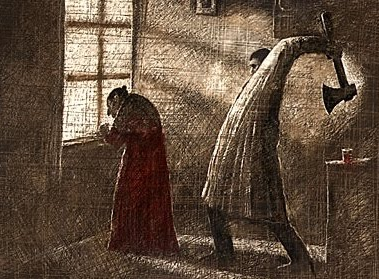
Overview:Crime and Punishment by Fyodor Dostoyevsky is a psychological drama that focuses on matters of morality, virtue and the rights for taking somebody’s life. First published in 1866, this exceptional book takes the reader into a swirl of thoughts and feelings. The core of the novel is a conflict of Rodion Raskolnikov with his own conscience. His character is intended to emphasize the people of that time, their despair and the way they are being misunderstood by society. The novel is full of various thrilling characters and events which together create an accurate picture of Saint Petersburg of the second half of the 19th century. Raskolnikov’s thoughts rankle him as he has two parallel natures fighting inside his mind. He is a smart, handsome young man who has a vibrant future ahead of him. At the same time, he is an ex-student who does not have money and is indifferent to other people. He lives inside an uncomfortable tiny room and wears tattered clothes. Raskolnikov has his own theory about “ordinary and extraordinary” people and God. On the one hand, he experiences rational egoism, cold thinking and has far-reaching plans. On the other hand, he realizes what he has done, acknowledges his sin and finally regrets it. It can be said that the main character suffers from delusion of grandeur: he desires to bear resemblance to his idol Napoleon and to become as great personality as he was. According to Raskolnikov’s theory, which was previously published, extraordinary people, unlike the ordinary men, are allowed to commit crimes, for which they are not going to be punished. Moreover, according to him any great beginning or idea is not worth a human life. In order to verify his theory, he decides to commit a crime – to kill an unscrupulous pawnbroker. He is baring this idea in mind but he also hesitates all the time, being tortured by the question: “am I a trembling creature or have I the right?” Finally, after he hears some men discussing that the woman deserves to die and that her money should be given to those in need, he dares on realizing his intention. After planning of the crime, he is coming to the woman’s house under the pretext of paying his rent. He knows that he has little time and, although he is very scared, he hits her with an ax. By unlucky coincidence, the victim’s sister appears at her home at time of the murder, Raskolnikov has no other choice but to kill her too. After the crimes, remorse begins: he starts to feel sick, loses consciousness and he even thinks to end his own life. However, his personality is not able to accept anybody’s judgment except Sonya Marmeladova, the most humiliated and insulted person and the woman he loves. Raskolnikov is being suspected by the detective Porifory. In the end, Raskolnikov is not able to bear his inside torment, his theory is wrong and he surrenders.
Quote: The first category is always the man of the present, the second the man of the future. The first preserve the world and people it, the second move the world and lead it to its goal
Strong points: Dostoyevsky proves once again he is one of the most incredible and genius authors of all times. His novels are characterized by deep physiological thinking, philosophy and religion. Very detailed-oriented, devoting much attention to every moment. He delivers his thoughts in the most accurate form and skillfully fills every character with life. The novel is full of diverse personalities with their own stories and inner disturbances. In fact, none of the characters is getting overshadowed by the central figures as it is usually in the case of novels. You can feel, hear their thoughts and disturbances, and look deep into their souls.
Weak points: This novel might be disturbing to some people. Dostoyevsky is fun and interesting to read, but not necessarily easy. Sometimes you have to read a book more than once in order to understand it. If you are not “trained” enough, Crime and Punishment might be even monotonous or boring, as for its most part the protagonist is found in his thoughts planning and later blaming himself for the committed crime. In addition, one of the negative sides of the book is the idea that happiness can be obtain only through pain, which I don’t fully agree. _______________
I'd like it better without the epic length digressions on philosophy shoved unconvincingly into whatever mouth is most conveniently located; HOWEVER, that's just classic Russian literature's way, especially in the hands of Dostoyevsky.
That said, it was deeply fascinating and the characters were both interesting and amusing in turn.
Finished 上. Surprisingly digestible language. Not sure what’s going to happen in the remaining two books. All we’ve had is the moral struggles of a murderer.