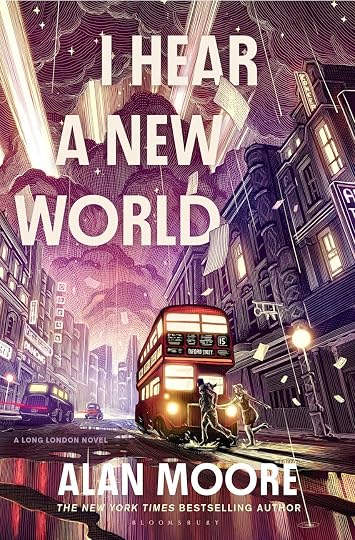
It's 1958 and Dennis Knuckleyard has decided to leave his adventures in the Great When in the past where they belong. For nine years, he's avoided so much as thinking about the magical version of London, until he rediscovers an unpleasant reminder of his last adventure-a key that he'd secretly brought into his own world from the other for safekeeping.
But while Dennis may believe he's done with the Great When, it's far from done with him. When Dennis gives the key to a friend, its magical properties reawaken, bringing creatures from the other world into Dennis's and sparking riots in Notting Hill. Even worse, Dennis's old crush Grace Shilling has been forced into the Great When to investigate strange happenings in both cities.
Desperate to keep Grace safe, Dennis follows her into Long London. But once inside the other city, it will not let him go away again so easily, and Dennis and Grace must fight to set things right in the Great When and their own world, or forever lose their lives-and each other.
Full of Moore's characteristically stunning world building and rollicking prose, I Hear a New World is the extraordinary second adventure in the Long London series.
Alan Moore is an English writer most famous for his influential work in comics, including the acclaimed graphic novels Watchmen, V for Vendetta and From Hell. He has also written a novel, Voice of the Fire, and performs "workings" (one-off performance art/spoken word pieces) with The Moon and Serpent Grand Egyptian Theatre of Marvels, some of which have been released on CD.
As a comics writer, Moore is notable for being one of the first writers to apply literary and formalist sensibilities to the mainstream of the medium. As well as including challenging subject matter and adult themes, he brings a wide range of influences to his work, from the literary–authors such as William S. Burroughs, Thomas Pynchon, Robert Anton Wilson and Iain Sinclair; New Wave science fiction writers such as Michael Moorcock; horror writers such as Clive Barker; to the cinematic–filmmakers such as Nicolas Roeg. Influences within comics include Will Eisner, Harvey Kurtzman, Jack Kirby and Bryan Talbot.
Despite being by Alan Moore, about London arcana, and heavily referencing not just Arthur Machen but probably my favourite Machen story, The Great When didn't altogether do it for me, and at first I worried its sequel might be headed down the same path. We open on protagonist Dennis Knuckleyard doing a bit better, a little less of a hapless patsy than he was in the first book – as you'd expect, given he was a teenager then and a decade has now passed. Only for the narrative to immediately delight in having him fall flat on his face again and be dragged right back into the orbit of terrifying former landlady Coffin Ada. It feels like a reset button and gratuitous authorial meanness all at once, though I can't deny I was chuckling despite myself as, thinking he's finally about to get his end away in circumstances less dismal than the lovingly enumerated prior approximations, the luckless Knuckleyard instead gets cock-blocked by Joe Meek. Who, with that title, was always going to play a part here, and, as the sixties emerge uncertainly from their chrysalis, is joined by various other spirits of the age, from Francis Bacon and Norman at the Coach and Horses to the more alarming likes of Rachman, Litvinoff and Kray. Plus, of course, the other sorts of spirit, from the even stranger city hidden behind the streets we know. It's still not perfect; a historical novel leaning too hard on the easy irony of hindsight will often get my back up, and the pacing feels lumpy, with our heroes on a life or death quest to save both cities which nevertheless often grinds to a halt for weeks on end over a lack of leads, and one character who's supposedly on his deathbed when first seen, then takes so long about the dying that even an opera crowd would be starting to tap their watches. As for the prose...it's been ever so slightly dialled down, I think, which is for the best, or else I was just more prepared for it. Certainly, there's a sense at times that Moore is mostly here to see what he can get away with, especially when it comes to never referring to a speaker the same way twice, so that Meek is "the disheartened producer", "the hit-maker", "the excitable entrepreneur", "the well-dressed nervous breakdown" and more across the course of that memorable first appearance (though my favourite comes later, "the hesitant pop nonconformist"). Which, every so often, becomes more exhausting than fun – but is mostly fun. Which is the appeal here, as much as anything, Moore not having to worry about sharing the spotlight with an artist anymore, free to juggle with language and, if he occasionally ends up dropping some on the audience's heads, nevertheless keeping more of it in the air than most; I'm still grinning at "she'd contrived to touch his hand and then smiled knowingly, though what she thought that she was knowing, Dennis didn't know." And by the end of it the bearded mage even seems sufficiently enlivened by his own performance to let poor bloody Dennis catch a break too, experience some growth that isn't promptly weedkillered, and if the epilogue reminds us it won't last, well, on that sort of timeline, what does?
Also, I never knew Margot Fonteyn had been involved in a coup in Panama.
The second volume in the Long London series continues to follow Dennis Knuckleyard through London and its more fantastical, disorienting counterpart a decade after the events of the first. We get to experience mystery, mayhem and meanderings Moore style as he incorporates his extensive knowledge of 1950s history and pop culture. The book is abuzz with historical figures, returning characters as well as unique new faces, mind-boggling descriptions of places real, and those constructed by Moore (the alternate London).
At times the reading experience felt exhausting. I don't think Moore deliberately set out to discombobulate the reader nonstop but he writes in a register which makes it almost inevitable! 😂I didn't feel that the work could be pared down or truncated (well maybe the sex scenes which felt needlessly gross in their graphic detail), its just that the profusion was overwhelming. However, despite moments of frustration, I did find the book entertaining be it the humour, the character interactions or the adventures of our protagonist. I came away with the feeling that I was reading from an author letting his creativity flow freely and having fun writing.
I'm surprised by how much of an engaging ride this book was, albeit a topsy-turvy one. I will continue the series and look forward to seeing what else Moore thinks he can get away with in the next volume!
When you have been reading the same writer for over forty years (fuck) you build up an overly familiar disrespect at times… you know their methods, you’ve read their idols, there’s a canny skepticism that takes over as you watch the puppeteer as much as the puppets. All of which is to say, when I say that Alan Moore is a hard fucking slog to get through, I mean it with love, and as a masochist who keeps coming back for more.
Alan Moore’s genius is for connections, finding poetic, historic, literary connections between the bits that fascinate him. His curse is his prose, his imagery buried in ever-bursting clusters of rich and flavorful words, too many goddamn nuggets in the cereal bowl. But you don’t get one without the other: the ferment of words and ideas creates the possibility of new connection, reorientation. More is more is Moore.
Comics were a way of organizing him, a polarized lens that pushed his light into regimented lines. (His scripts, though.) In prose, it’s as hard to look at as the sun. Take breaks. Look away for a while.
This one? A rather straightforward romance and whodunnit, ground through a series of mad, psychedelic gears, and imbued with pulp weirdness. The point, with Moore, is never the stew in the pot. It’s the sparks flying off the campfire.
PS I apologize for all the metaphors but I think when I was reading Moore I got some on me.
"Audible intermittently above the hiss and spatter of the cloudburst, an unearthly soundtrack seems to swirl about the dancing spectacle, an untuned radio that squeals and slides across the wave bands of a dozen unfamiliar eras"
Roaring into bookshops this sweltering May comes I Hear A New World, book two in the incandescent Long London series from Alan Moore. Slowly adjusting to adult life and his new profession is our by now slightly less hapless protagonist Dennis Knuckleyard, who has become a writer of sorts, churning out hilariously blunt and tropey erotic reader's letters for a London magazine, QT, and doing his level best to avoid all thought of his upending misadventures in The Great When, nearly ten years gone. Forces, criminal and supernatural, are beginning to arise again in his vicinity, and when he too eagerly passes on an eerie key to the iconic pop producer Joe Meek, a series of startling events are set in their irreversible motion. The author has really managed to work his talents into a broiling fantasy stew of a unique style and character, blending urban and occult history, humour, literary and cinematic reference (Dennis is now an enthusiastic Gormenghast fanboy) and a sexually and racially diverse cast full of the many vivid denizens of the '50s British metropolis, (Joe Meek, David Litvinoff and Ron Kray especially) into its mesmeric narrative. Whether it's outbreaks of intense violence or a long anticipated sex scene for two of the characters being at last resolved, all are particularly charming, with their lovemaking interspersed with admiring glances of her well chosen book collection, well-paced and used to punctuate their frenetic excursions into the multiphasic fantastic Other World that underlies ours. Narnia or Fantastica this ain't. A new creature introduced in this book, the gelatinous Prime Monster, leaves a lingering impression. Even more effective in its plethora of aims than the first book, readers of Long London and Alan M.'s work in general will find much to enthral and scramble their minds in this momentous hymn to the imagination that is shaping up to be something very special. Archly apocalyptic, hugely affecting, rollicking and wry, don't delay and go check it out, whether by library, book store or e-reader as soon as you can! And watch out for Charming Peter.
Ten years after the events of the first book, Dennis Knuckleyard is a struggling writer in Aldgate, having spent a decade trying to forget his teenage brush with the Great When—the hidden, symbolic version of London he survived by accidentally getting a serial killer eaten by a sentient street. As a parting “gift,” the luminous horsewoman Slenderhorse gave him an iron key, which he eventually fobbed off on the unstable record producer Joe Meek. Big mistake: the key turns out to be a breach object, and Meek starts experiencing genuine supernatural phenomena—a séance that predicts Buddy Holly’s death, and a vision of the same six-armed entity that was seen during the Notting Hill riots.
Dennis tries to ignore all this until he’s ambushed in his flat and wakes up taped to a chair, captive of his monstrous old landlady Coffin Ada Benson and her silent, terrifying enforcer Commotion Venables. Ada explains the real problem: the Great When’s City Heads went looking for Dennis to serve as their human agent again, and when they couldn’t find him, Grace Shilling—the Soho dancer who helped Dennis survive his first ordeal, and whom he’s never stopped caring about—volunteered to go in his place. Guilt-stricken, Dennis goes after her immediately, re-entering the Great When through a portal at Bride Lane.
He’s intercepted by Slenderhorse, who gives him a map of the other city and demands her key back before riding off. Dennis catches up to Grace, who’s being escorted by Maurice Calendar (a shapeshifting being currently manifesting as a beatnik) and protected by a gauzy guardian-Arcanum called Her Train. Their reunion is awkward—Dennis panics and attacks Her Train, electrocuting himself—but the tension breaks and they’re genuinely glad to see each other again.
Together they’re brought before the City Heads, who reveal the actual crisis: Button Dainty, a homicidal dwarf who serves as one of the Great When’s two enforcers, has been missing since the 1930s, and his unsupervised presence in real London threatens to destroy both worlds by the century’s end. Dennis and Grace are tasked with finding him. The investigation takes them through increasingly bizarre territory—a slime-mould Parliament made of squabbling Prime Ministers, skull-faced property developers plotting an expedition into real London, and a supernatural smog that conceals that expedition. In the real world, they get nowhere chasing leads through gangland (Rachman, the slippery fixer Litvinoff), but their shared trauma over what they’re seeing finally pushes Dennis and Grace into bed together.
The investigation stalls for months. Dennis eventually descends into the Great When’s version of Hell, where he learns that Prince Monolulu originally smuggled the breached book that started everything, under Slenderhorse’s orders—and that she later intercepted Dainty and recruited him into her own scheme. Realizing Slenderhorse has been manipulating events all along, Dennis finally returns her key (bringing along Joe Meek, who gets some private, ominous “reward” from her in exchange). Soon after, a tip from Litvinoff leads Dennis and Grace to a gangster’s billiard hall, where they finally find Dainty—a horrifying creature whose face is impossible to look at directly.
Dainty chases them through East London as a destructive whirlwind, cornering them at the ruined Cripplegate. Just as he’s about to kill them, his former partner—the sadistic talking cat Charming Peter—reappears and kills Dainty by turning him inside out. Meanwhile, the dying Ironfoot Jack has one last act of heroism: he has himself carried into the Great When to deliver a furious deathbed speech that talks the City Heads out of a civil war, then dies. In the aftermath, Dennis finally watches Grace’s striptease act, and the two of them go home and consummate things properly, with Dennis telling her he loves her. He accepts that he’s now permanently tied to the Great When. A coda set in the late 1990s shows an elderly Dennis being recognized—by name—by a strange figure on a London street, suggesting his past isn’t done with him yet.
Honestly, this one felt like a step down from the first book for me. Part of that might just be distance—I read the original back in 2024 and went into this one having forgotten most of the specifics, so I spent a fair amount of time trying to reorient myself rather than just enjoying the ride. But even accounting for that, the plotting felt looser than I remembered the first book being. There’s a lot of running between set pieces—Worstminster, the Barebones, the Crown & Dolphin, Hell—that are individually inventive but don’t always feel like they’re accumulating toward something. The Dainty hunt sometimes seems like a structure for touring the Great When rather than a mystery with real momentum, and I lost the thread a couple of times trying to track who knew what and why.
That said, the book has real strengths. The Slenderhorse reveal—that the entire Dainty crisis was a smokescreen for her actual long game involving Joe Meek—is a good payoff, and recontextualizes a lot of what came before in a way that’s satisfying even if the journey there meandered. The 1959 setting is also doing a lot of quiet work; the constant hum of “the sixties are coming” gives the book a melancholy, end-of-an-era texture that I liked. And the Dennis/Grace relationship is the emotional spine that actually holds together—their reconnection felt earned in a way the plot mechanics sometimes didn’t.
It’s a “good but not great” entry for me—competent, occasionally inspired, but a bit shapeless in the middle. Given how the coda sets up a much more personal, reckoning-focused third book, though, I’m still in. The pieces are there for something stronger; this one just felt like table-setting that ran a bit long.
This entire review has been hidden because of spoilers.
Alan Moore’s I Hear A New World is a striking, haunting, and fully immersive dark fantasy set in late 1950s London. As the second novel in the Long London series, it follows Dennis Knuckleyard, who has spent years attempting to escape the supernatural parallel city known as the “Great When.” After giving away a mysterious iron key linked to that hidden world, Dennis inadvertently unleashes dangerous magic when the key falls into the hands of an unsuspecting man, unleashing occult creatures and chaos across London.
When Dennis discovers that his former love, Grace Shilling, has returned to the Great When to investigate the disturbances, he is compelled to re-enter the surreal world he had tried to leave behind. Moore masterfully combines layered storytelling, dreamlike imagery, mythic beings, and political unrest to create a haunting narrative where the boundaries between fantasy and reality are constantly shifting.
The novel’s characters are vivid and deeply human, providing emotional depth to the surreal and hypnotic story. Moore’s bold writing style and rich world-building make I Hear A New World a compelling and rewarding read.
My thanks to both NetGalley and the publisher Bloomsbury Publishing Group for providing an e-arc and the opportunity to share an honest opinion.
It was nice to reacquaint with Dennis Knuckleyard and Grace Shilling. Charming Peter is back along with a new major threat in the form of Button Dainty (the character's names are marvelous). Moore's prose, turn of phrase, and humor are outstanding in this second installment of the Long London series. With plot ties to Arthur Machen's "The Green Round" and explicit thematic ties to Mervyn Peake's Ghormenghast, fans of either author will find something to like.
This is a review of an ARC from publisher Bloomsbury and Netgalley. Publication date is 21 May 2026. I previously reviewed The Great When here. Are you ready for more Long London? It’s ten years later, and Dennis Knuckleyard, now 28 and trying to make a career as a professional writer, tries not to think about the Great When. He mostly thinks about shagging, morning noon and night, but is mostly failing to score. He writes saucy stories for trashy magazines but often gets facts wrong. He’s left behind his horrible landlady and is living downstairs in a divided house. He’s not exactly thriving, but at least he has got rid of his souvenir from Long London, the iron key that some otherworldly creature gave him. And he has a date, and, well, it might be on tonight. But who’s this knocking at the door? The most obvious comparison to Alan Moore’s Long London for me would be the work of Tim Powers. Like Powers, Moore writes about the incursion into the real world of supernatural entities. His hapless hero has to negotiate these intrusions with only the shakiest understanding of what’s going on. And, just like Powers, Moore likes to include real characters and real historical events which send you, the reader, into rabbit holes. This is all slightly uncanny for me because Moore and I appear to be on parallel research tracks. The Great When was set in 1949, as was my novel Codename Hirondelle. I Hear a New World comes along with a late 1950s setting, and my next novel, Hard Rain, is set in 1957 and 1958. But Moore, of course, is going deep into the weird. A couple of the rabbit holes he sent me down this time:
David Litvinoff, aka David Levy, denizen of London’s Soho, associate of the Kray Twins, acquainted with Lucien Freud, well known around the jazz clubs, and organised crime adviser on the film Performance.
Iron Foot Jack, another Soho character, club owner, mystic, wannabe Crowley, itinerant, and a man with one leg shorter than the other, which he compensated for with an iron extension.
Joe Meek, record producer, space pop pioneer, and composer of the song from which this novel takes its name.
It’s easy to get distracted by all this fascinating background and lose track of the story, but I don’t think the story is the point. The point is to immerse yourself in Moore’s freewheeling invention and possibly drown in modifiers. I said of The Great When that it was overwritten at times, and the same is true here. But as I suggested above, I think too much is the whole point. The reader is overwhelmed by adjectives just as Dennis is overwhelmed by Long London. And while the overwriting can sometimes grate, you have to admire Moore’s ingenuity and his ability to riff. For example, here is a list of just some of the “second mentions” for record producer Joe Meek:
the producer the skiffle-vending lunatic the recording industry phenomenon the memory distraught producer the frenzied pop promoter the vinyl virtuoso the music man the hitmaker the excitable entrepreneur the well-dressed nervous breakdown the chemically bewildered sound magician
I’d been trying to describe the fantasy aspects of Alan Moore’s Long London book series after it’s first installment The Great When, and I found…I could not describe to people what the fantasy piece of it actually is; “there’s this upside-down London dimension they enter into and it get’s really wordy and it’s all in italics and things are kinda floating everywhere, they can see through history and shit…” Moore has identified as a magician for several decades now and has often proposed that writers are spell-casters of a sorts- which sounded really cool but I’ve always found the English language a bit stiff for that kind of thing. Fortunately these books have lended weight to the magical opinion, once again transporting me back to that shimmering floaty dimension of the Great When through all sorts of ethereal terminology’s and audacious descriptions of impossible events. While those moments had been extra difficult to read through in the first installment, here I felt like the hero Dennis Knuckleyard, no expert, but able to digest it all more easily, and boy does this 2nd book reward you for it, taking you to all sorts of odd spots across the When and comboing words you never thought could be chained together to illuminate your virtual eyes and ears to an incredible psychedelic effect. If you want a brief and accessible glimpse into the highest levels of the English language, this series is for you.
It is still the case that this is Alan Moore in his most accessible form, with a charming cast of characters and a fairly straightforward plot thread, almost to a fault, with this book repeating a similar action climax that maybe didn’t feel entirely climactic to me, these novels end up feeling more like a playground for the imagination than a thriller or tension builder, which does make it a very pleasant reading experience throughout, but more fine dining than a voracious consumption. There are definitely some satisfiying bookends with the characters that do feel perfect so I wouldn’t say the ending is a fault, just a feature, but I’d love to see a more dramatic finish in one of the next few books- of which there are supposed to be 3 more in the ‘quintet’.
Will keep coming back for the characters, world, and unprecedented scenes. Hopefully next time I finish faster and give each chapter the space to breath. This damn near took me the whole summer somehow.
I Hear a New World is the second book of Alan Moore’s Long London series.
I’ve really enjoyed both books. They’re a total tonic to publishing tendencies towards tropes and neat genre boxes.
In the second book, Dennis Knuckleyard, who has been avoiding the Great When quite nicely- thank you very much, is dragged back in when he hears Grace has entered Long London. This time, a ruthless being capable of unthinkable violence has entered Dennis’s London and is thought to be hanging out with infamous members of the criminal underworld. Brilliant. Just what Dennis needs.
Tense, offten grotesque, weird, warped and wonderful, and that’s just me. Each of these books took me a little time to read: Moore never uses one word, where fifty rare and rich ones will do, layering up the figurative devices in an explosion of allusions and imagery. Moore’s longitudinal -and fastidious-knowledge of London -& just about everything else-underpins everything.
You come out of reading these books feeling like you’ve really been plunged into them; emerging, you need a stiff drink, and a bath- a good scrub! You can’t unsee some of what you’ve experienced (the arcana sex scene is something else- I can’t find the words- but don’t worry, Moore does- all the words and then some.)
This is the grimy, physics defying, magical fantasy, alternate world of larger-than-life characters I’ve needed. And I’m here for the long haul- roll on Book 3!
Alan Moore's back with another Long London novel. I'll read just about anything this man writes. The Great When was a wonderful surprise, full of memorable characters and nightmarish creations. I Hear A New World is certainly more of the same, though this one seems more content to idle in place comparatively. Some have taken issue with Moore's prose, which is undoubtedly dense but lovely to read nice and slow. With the first book's exposition and the otherworldly setting firmly established, I kept waiting for an acceleration of conflict. The primarily plot feels too straight-forward. That said, I still enjoyed the read and have faith in Moore to guide this series to an excellent conclusion.
Alan Moore is the GOAT comic book writer, but his novels are pretty good too! I wrote a piece for Publishers Weekly about why fans of his old work should follow his pivot: https://www.publishersweekly.com/pw/b...
I wasn’t overly impressed with the first volume in the series and although volume two treads similar ground there’s not enough that is different - definitely a contender for the ‘Bad Sex of the year award’ but that’s not been awarded since 2019. It’s grossly overwritten, Alan Moore obviously luxuriating in his grotesquely baroque descriptions which rather cancel out any immediacy in the drama. I listened to 65%, didn’t listen whilst away for a week - returned to it for a further 2.5% and then felt I’d had enough.
When I was offered a review copy of I Hear A New World, I wasn’t sure what I was in for. I’d never read Alan Moore, though I was familiar with adaptations of his works, such as Watchman and From Hell, which I thought were excellent. I like to vary my reading so that I don’t get tired of any genre, and I was intrigued by the premise.
I Hear A New World is part of a series, and it is the second book, so when I accepted the ARC, I bought a copy of book 1, The Great When. I suppose you could try reading I Hear A New World without reading The Great When, but I know I wouldn’t have fully appreciated all the events occurring in the second book without the awareness of what happened in the first. Plus, knowing the history with the characters adds to the emotional moments in I Hear A New World.
Moore has a distinctive writing style that’s immersive and dense. When it came to the scenes occurring in Long London (the other realm, also referred to as The Great When), I had to let them wash over me. It was hard to feel anchored at some times because of the level of sensory detail and the way the setting and events are described, but it’s appropriate that those scenes would have an upside-down otherworldly feel to them, because they’re occurring in a different realm where things don’t exactly work the way they do in our world. The result is that these scenes took me more time to fully digest, but made me relate to Dennis because I could imagine how overwhelming, shocking, and confusing everything was. Moore delivered Dennis’s experience in an experiential way that made an impact on me.
Since Moore is an established, successful comics writer with multiple film adaptations, a lot of the “rules” that may apply to debut/newer authors do not apply to him. The early scenes in the books do not focus on the protagonist, but they’ll have relevance later. In that respect, I started off reading these books with clues in hand, and was wondering how they’d intersect with the core story. The answer? In ways I couldn’t always foresee or even guess at. I found these elements tantalizing, because my mind is always trying to form connections. They drew me in.
Dennis is an intriguing character, in part because he’s often treated as barely average. He’s not presented as being too smart or motivated. However, his journey reveals his values and qualities, and I found him to be quite endearing. He’s realistic. He isn’t like a superhero who seems to feel no fear - he’s terrified and I could relate to those moments with him because I’d be scared of what he was facing, too. In a way, perhaps he’s a hopeful symbol, too. If Dennis can survive what he faces, perhaps I could also somehow make it through the unthinkable. I was rooting for him all the way.
I was also rooting for Grace. Both Dennis and Grace have had hard lives. Neither moans about how unfair it is; they both get on with making the best of their situations. Despite how hard life has been, Grace is generous and considerate, intelligent and brave.
While the extended cast is filled with characters who are not always readily likeable (Coffin Adam for example), these characters are colorful and intriguing and unpredictable, which kept me on my toes as a reader and added to the story because their actions turned the story in different directions.
“Ada stopped what she was doing and rotated slowly to appraise him with the kind of look one might give dog shit.” - The Great When
“Like nearly everyone he knew, he much preferred to play his life as a light comedy, and didn’t think that he could take a shift of genre.” - The Great When
I like to avoid spoilers, so I don’t want to delve more into the details. If you’re looking for something unique, with its own social commentary on the history of post-war Britain, with characters who aren’t your typical heroes who find themselves in unfathomable situations, then you’ll love this series. It’s both entertaining and thought-provoking with the added bonus of distinct and immersive writing that makes it feel fresh and unique. The complexities of the plot don’t overshadow the character development that’s woven into the story’s fabric. For me, the strongest recommendation involves my own commitment to the series, and I will be back for more Dennis Knuckleyard and another return to Long London. Even if it terrifies me.
Notes For The Audience:
This story is ideal for fans of portal fantasies, those who enjoy history, and those who want unique and distinct fantasy realms that are not warm and cozy. This series is also perfect for anyone who wants a complex narrative with a distinct voice and excellent writing.
Source:
I received an ARC and a finished copy of I Hear A New World from Bloomsbury Publishing. This review is voluntary and my opinions are my own.
Alan Moore is using the Long London Quintet to write a five-decade secret history of 20th-century London, examining how myth, art, and human imagination physically shape the historical reality we inhabit
I Hear A New World (2026) is the second book in Alan Moore’s Long London series and jumps forward nine years to 1958. Dennis Knuckleyard is older and attempting to leave the strange events of 1949 behind.
Once again there are numerous historical figures popping up in the narrative. As something of a Soho obsessive I was delighted to see the return of Austin Osman Spare, “Ironfoot Jack” Neave, Francis Bacon, Lucien Freud, Prince Monolulu, and more Arthur Machen references. And that’s not to mention all the notable historical figures who appear in Long London.
That cast list is further enhanced by the new appearances of Joe Meek (who provides the title of this instalment), David “Litz” Litvinoff, Peter Rachman, Michael de Freitas (later Michael X), and Ronnie Kray.
I also delight in Alan Moore’s character names, alongside the return of Coffin Ada, Grace Shilling, Tolerable John, Blincoe, Slenderhorse, Button Dainty and Charming Peter, we also meet the fabulous Commotion Venables
Once again this is a superb blend of psychogeography, post-war history, and occult myth. As if that wasn’t enough, Alan Moore’s prose is again as wild and unrestrained as the fantastical tale he relates. This is an electrifying, magical read which, upon finishing, I could happily listen to all over again. Which reminds me, the audiobook is really something, and is again deftly narrated by Kobna Holdbrook-Smith.
I can’t wait to get my mitts on books 3-5. Apparently Book 3 will take place in the late 60s, Book 4 late 70s punk era London, and Book 5 in 1999 on the eve of the Millennium.
5/5
'Extraordinary' Susanna Clarke, bestselling author of Piranesi and Jonathan Strange & Mr Norrell
A continuation of The Great When; a dark and beguiling tour through the streets of London - fictional and real - by a legend of modern fantasy
It’s 1958. A time of Rock and Roll, of protest, riot and change… and London is full of danger. Dennis Knuckleyard is finally growing up, and above all he wants to leave the Great When in the past. For nine years, he’s avoided so much as thinking about the magical shadow version of London, managing even to palm off what should’ve been his last souvenir of that experience – an iron key he secretly brought back.
But while Dennis may believe he’s done with the Great When, it’s not done with him. The unsuspecting rube now in possession of the key has discovered its magical properties, bringing forth mythic, occult beings into Dennis’s London and sparking riots in the capital. Worse still, Dennis hears his first love Grace has returned to the Great When to investigate strange happenings in both cities.
Desperate to keep Grace safe and return London to normal, Dennis follows her back into the hidden city. But once it has him back, The Great When will not let him go away again so easily. He and Grace must fight to set things right or forever lose everything.
Electrifying, absurd, magical and more true than you might believe, I Hear A New World takes the reader back to Long London for a thrilling and fantastical second instalment.
Praise for The Great When: the first book in a new series by Sunday Times-bestseller and icon, Alan Moore.
'A breathless time-travelling classic. Savage, humane, comic, terrifying' Iain Sinclair
‘Brilliant and so powerfully imaginative’ Adam Curtis
'A weird book and a complete joy' Mariana Enríquez
'Extraordinary . . . very funny . . . It does what fantasy does best which is show us something beyond our experience' Susanna Clarke
I Hear A New World takes us back to Long London, or The Great When. Book one introduced us to Long London, a secret other London that exists alongside the real one. In a post war Britain, Dennis Knuckleyard, an awkward young bookseller’s assistant, accidentally comes into possession of a dangerous occult book that should not exist and things very quickly spiral out of control. What begins as a relatively simple errand ends up with run ins with gangsters, mystics, writers, and bizarre supernatural entities as Dennis is pulled into the chaotic hidden world beneath London’s surface. I Hear a New World sees us returning to Long London and takes place almost a decade later in 1958. Now an adult, Dennis has spent years trying to avoid anything connected to the magical other version of London, and wants to put the traumatic events of his teens behind. However, he discovers that a mysterious key he secretly kept from Long London has resurfaced and is creating chaos. The key creates a series of magical disturbances in ordinary London, bringing with it strange creatures and occult forces. Attempting to hide from it all, Dennis is forced back into Long London to save Grace Shilling, his former love interest, and the pair are forced together in an attempt to stop both Londons from collapsing into one another. While I do fully appreciate both books,and did enjoy them a lot, they just never quite fully what I was hoping for. Alan Moore’s imagination is genuinely incredible, and the sheer ambition of the Long London series is impossible not to respect. The worldbuilding is dense, strange, vivid, and unlike almost anything else I’ve ever read. Both books absolutely overflow with atmosphere, weirdness, occult mythology, and incredibly detailed descriptions of both Londons and their inhabitants make everything really come alive. I did find the book incredibly hard work at times, particularly the scenes set in Long London where it reads as a stream of consciousness. I also found that in I Hear A New World, scenes that were fairly simple got way over described, almost as if Alan Moore had too many ideas and had to get them all out. Dennis is an incredibly passive protagonist for the majority of the book with things constantly happening to him rather than because of him, and I sometimes struggled to stay emotionally invested. I guess he is like this by design, as he really doesn’t want to be involved in anything to do with Long London, but I just feel like he could have been just...more? One major gripe I had with this was the sex scenes. Yep you read that right. There are sex scenes. They were WAY over described and too full of metaphor, which ended up making it feel a little bit gross and awkward. It kinda felt like these bits were shoehorned in to maybe appeal to a whole other market of readers, but it actually just didn’t work and was wholly unappealing. I really did enjoy most of both books, especially the setting and sheer originality, but they also felt overly long, messy, and occasionally inaccessible. There were huge chunks where I kind of just glazed over a bit, and most likely skim read, but actually didn’t miss out on anything important. The series is definitely one for readers who are looking for something incredibly unique, ambitious and undeniably epic, but for me it just wasn't quite what I was looking for.
“First, and most ominously, he recalled that he was Dennis Knuckleyard, which surely wasn’t a good sign…”
“I read this book – but should you read it too?” Yeah, it’s not that bad…
I Hear A New World has us returning to ‘Short London’, reuniting with your favourite sack of uselessness, Dennis Knuckleyard, along with other favourites from the first book. Having now delved into ‘Long London’, you’re taken on a mystery tour of such, as Dennis and company are thrusted head first into….well, you’ll find out! Although still heavily overwritten, it’s an overall improvement from the first book, so give it another chance if you previously wrote this series off.
Plot: 8/10 Always tricky to improve on a plot, where so much to be discovered has now been discovered. However, I’d say the storyline this time around was actually better than the first book! It’s more of a historical fiction mixed with a little mystery, which was fine – added to the adventure. For me, the plot is what kept me hooked.
Characters: 7/10 Still a strong point throughout the book, but a little less depth than before. Even though you meet a bunch of new characters, there doesn’t seem to be too much detail around them. Whether this is intentional or not, I’m not sure, but I feel it differed from the first book where we got a lot more detail on everyone.
Worldbuilding: 7/10 I think having already covered what ‘Long London’ looks like, there was certainly a feel of ‘less importance’ when it came to the worldbuilding this time around. Sure, you’re taken to new areas of London, and this is what earned the decent rating – otherwise I got the sense that you were just supposed to remember what a certain place looked and felt like, which might not be enjoyable for everyone.
Writing Style: 5/10 Slightly improved from book one – although still be prepared for numerous ramblings and pages of irrelevant history lessons. It’s honestly a little frustrating that this sort of thing is a feature of this series, as I feel more time could’ve been spent on finer details (descriptions of surroundings, character development, etc.), but instead I feel like I was back in school for page after page. Oh, and the endless descriptions and focus on certain characters ‘private life’ was just pointless, that could’ve all been removed and nothing would’ve changed in the story.
Summary I Hear A New World is an improvement from the trawling-feel of The Great When, although still be prepared for random ramblings and history lessons. I’m starting to wonder if this whole series is just an experiment for Alan Moore to share his vast knowledge and see how far he can push metaphors and analogies – which in some ways was enjoyable. However, in others, it was just difficult. Overall, it was still quite a slow read and was frustrating in parts, but better than book one.
I love Alan Moore. I love him so much that I still think about his comic books and “book” books on a regular basis. I even love interviews of him talking about his books or society in general. So, I wanted to love I Hear a New World. At the very least I wanted to like it. But, that was hard for me to do.
I didn’t exactly love The Great When and I think it’s because I’m just not a fantasy genre guy. But I found plenty to enjoy in it, and plenty to irk me. Unfortunately, it’s the irksome parts that you’re getting more of in this book. There are plenty of hits I felt I took reading this book, and the hardest one was the language. It’s clear that Moore wants to build a magical world a-la Harry Potter, but he’s chosen to do so in a very convoluted way. A lot of this book deals with the Great When, an alternate reality to the London we know, and his choice to use disorienting language to describe it is incredibly frustrating. The language is so purposely florid that I found it confusing. Also, when you CAN follow what’s happening, it’s kind of silly, and frankly, stupid. I’ve known Moore to be a funny and witty writer, and you can tell he’s trying to be daring and clever, but it’s all kind of shallow and unamusing. Even the new characters are ridiculous.
Then there’s our hero Dennis, who Moore seems to have contempt for. I don’t know if he’s going to grow and develop in future books but at this point he’s written as an insecure, cowardly, unintelligent, and dense individual. At least Moore describes him as such, even though his actions prove otherwise. And it’s clear that everyone, including his girlfriend Grace, is supposed to be better than him. Really, Grace should be the hero of this book.
Finally, I Hear a New World feels severely overwritten. Any actions or events are described using complicated and convoluted language, as if Moore is afraid to get to the point. That even happens in the story itself which stretches out over the course of years for no apparent reason. People are content just sitting around and waiting.
So yeah, I’m bummed. I think that’s it for me and the Long London books.
I Hear a New World is not quite as strong as its predecessor, but if you are an Alan Moore fan, it has basically everything you'd want, so it's hard to complain. No, New World doesn't radically expand on The Great When in terms of lore or characters, and in fact, we mostly rehash a lot fo the same beats from the earlier book in that something is missing from Long London, and Dennis and his oddball compatriots must find that thing and return it, escalating with a chase through regular London, as well as a Deus Ex Machina to save the heroes at the last moment. However repetitive this might seem in shorthand, Moore's evocative use of language and his strong character work make I Hear a New World an always engaging read.
Plus, we get some of my favorite staples of Moore-ville, including laundry lists of alliterative adjectives for characters like Joe Meek and Maurice Calendar, and the wonderful use of historical background, of which Moore seems to be a never ending wellspring. My delight at figuring out a then-unnamed lunatic character was actually one of the notorious Kray Brothers before Moore's third act reveal is a pleasure of connection and association I find unique to reading Moore, who litters his works with ghosts of real individuals and events even when not making them explicit character or plot points.
Lastly, Alan Moore is one of the current reigning kings of the grotesque and the strange, and his first two books in this series read like the best Clive Barker of the 80s (better, honestly). The images and prose are beautiful in their bizarreness, and even though you might want to tear through the book at breakneck speed, slowing down to take in each turn of phrase, or multi-claused sentence is highly recommended. So, maybe this is not the next League of Extraordinary Gentleman in terms of epic scale across volumes, but the Long London series finds Alan Moore clearly having fun, a ton of it, which is how fun is measured, and luckily, having fun is one of the most infectious qualities I know.
Alan Moore continues to stun with his absolutely delirious exploration of London throughout history and throughout whatever corporeal realms his madness has us traversing. This book and series is not for the faint hearted. This is choc-a-block with literary, political, and general pop-culture references of the 1950s ranging from Arthur Machen, to Enoch Powell, to Mervyn Peake all creating layered imagery and commentary to form the development of London and our protagonist, Dennis Knuckleyard.
There is a reason I can only rate this 4.25, and why the first book has such an astoundingly low rating. Dennis Knuckleyard's journey to save London by entering the surreal parallel Long World of the Great When is difficult. His prose is testing, the imagery surreal, and the thematic explorations dense. His switch of tense from past in our London, to the present tense of The Great When will throw people out of their comfort zone. That's the point! Embrace a master exploring form! I encourage everyone to give this series a go if you're looking for that challenge. This is Alan Moore, a living legend; someone for a time that I never thought we would ever get art from again. This is like David Lynch coming back for Twin Peaks: The Return, and I think we should all be appreciative of having his voice in the world.
Even elements that feel like something pulled from a few decades ago - like the amount of sex scenes or our protagonist as a struggling writer with a woman who is a dancer - all resolve beautifully at the end to explore the shifting dynamics of London post-war, creating a rumination on art and who decides what makes art worthwhile. For such an incredibly funny and zany book, it is filled to the brim with brilliant ideas to delve into.
Alan Moore’s I Hear a New World is a dizzying, delirious journey through London—both real and fantastical—seen through the eyes of Dennis Knuckleyard, now ten years older but no less hapless. Moore’s prose is dense, playful, and often overwhelming, packed with literary, political, and pop-cultural references that layer the city with history, myth, and surreal invention. From Arthur Machen to Joe Meek, from the Kray twins to obscure Soho mystics, Moore pulls real and imagined figures into a tangled, intoxicating tapestry.
Fans of The Great When—which I described as “part surreal dream and part overly verbose nightmare… many will love, just as many hate”—will recognise Moore’s signature style: tense shifts, sprawling digressions, and a love of modifiers that keeps readers on their toes. Humour, sex, and zaniness punctuate the narrative, balancing its intellectual and surreal density. Dennis’s growth is slow and often comically thwarted, making him a relatable anchor amidst the chaos.
At times, the pacing feels uneven, and Moore’s verbosity can feel relentless, yet his ingenuity, wit, and ability to riff on language are mesmerising. Fans of literary and fantastical fiction who relish historical and pop-cultural rabbit holes will delight in the novel’s rich, unpredictable world. I Hear a New World is a testament to Moore’s mastery, a book to be savoured, marvelled at, and occasionally got lost in—exactly as it should be.
Thanks to NetGalley, Bloomsbury Publishing and the author for an advance copy.
Thanks to Netgalley and the publisher for this ARC in return for an honest review.
I wish I could have a walk around London with Alan Moore. Just stroll in that wonderful metropolis and hear him talk all the weird and obscure history and characters he seems to have gathered while writing this series. I wouldn’t say a single word about Watchmen or V. London would be more than enough. I want to hear him talk about all the weird and wonderful characters that inhabit this book like the king of bohemians Ironfoot Jack, Prince Monolulu, genius music producer Jack Meeks and of course all the gangsters; David Litvinoff who taught Edward Fox to act like a criminal, slumlord Peter rachman (whose biography I have in my TBR) and of course the Krays. Moores books about London keep sending me down wikipedia rabbit holes.
The review for this one is pretty easy. If you liked the first book you’ll like this one too. If you felt that Moore’s prose got a bit too flowery and purple in the first one you might actually like this one a bit more. He still sounds like a mashup of Eliot, Ginsberg and Lord Dunsany when the characters enter the long London but I got the feeling that he has dialed it back a bit. His fantasy version of London is still seriously weird and it’s truly fantastical fantasy.
Moore drops a few hints about where this series is heading and even though I didn’t like this one as much as the first (it’s still a great novel) I get the feeling he’s moving his pieces on the board for the next one and I’m looking forward to read the next installment.
Well, gosh. I liked #1, but I remember it being a bit of a slog at times.
This one sparkles and coruscates with Moore's amazing writing - the vocabulary, the ear for rhythm and sounds, the descriptions, sometimes cruel, sometimes hilarious, sometimes both (it's the British way).
Great start, except for [cough cough] Coffin Ada which [cough cough cough] was approaching Jar-Jar Binks [cough cough] territory in the first book and [cough hack hork ptooey gasp] and here is just "Oh, Alan, this is beneath you. Please stop!"
But poor old Dennis, golly, how can he make it to book 5? He's a schlub, he knows he is, and he's doing his best not to be - with some success. I was never much with only-he/she/they-can save the world plots, and that applies here.
And Long London, whee, what was Moore smoking. I like the idea that everything is happening, will happen and has happened all at once. Especially the idea [Cromwell] that one can somehow [Chamberlain] navigate this, or be [Beowulf] navigated by it, to get to where one needs to be.
The prose, brilliant as it is, gets heavy at times, like the winter duvet one hasn't got around to taking off the bed just yet. And each time we slip into Long London [hideous monsters with superb manners] it gets a little heavier.
I have given up halfway through book two. It's like eating six pieces of cheesecake; it's good but I just can't have any more.
Also, I found that I didn't much care what happened to anyone. Dennis is in a world where even if he is successful I don't want to read about.
Im fascinated by what Alan Moore has created with this series, this is just book two and yet it might be one of the most wild and imaginative fantasy worlds out there. If you can call London itself fantastical. Building from The Great When Moore presents us with a more concise narrative, having already introduced the world on that first book now it’s easier to explore it on a different level. The prose itself it’s a little more subdued than last time, but it still feels like Moore was having a lot of fun writing. The story itself feels a little more straightforward than last time and even a little simple, of course that is until the twist happens. Dennis is just such a great character doing his best, Grace beautiful in every sense of the word and the character I fear for the most going forward. All the characters real or fictional that Moore presents are as last time memorable and it’s a great way to learn about the people that populated the London of the last century. One final note the edition I read had an essay by Moore titled And What Are We Supposed To Do With All These Busted Myths? which is such great piece that not just presents some of central ideas of the whole series but presents Moore’s own philosophy. It is one of the finest pieces I’ve read this year and many people would do well on reading it. I can’t wait for the next three books.
As always for a novel such as this being published in installments, I can't really give on opinion about how successful this book is (besides the trite "So far, so good") until I've read the entire narrative. Here at least two characters are introduced whose stories will likely become significant with future volumes.
Now, Alan Moore is a writer who is much better understood and appreciated though the entirety of his output, rather than just limiting to his famous comic books (V for Vendetta, Watchmen) - which at this point were published over 40 years ago.
Seeds for "Long London" are in the text sections - which the comics fans most likely skipped - of Moore's magnum opus "The League of Extraordinary Gentlemen", the overlapping Northampton through time and space in the novel "Voice of the Fire" and his recent Kabbalistic confessional "The Moon and Serpent Bumper Book of Magic". For instance, the dance sequence near the end is based on the Dutch Dolls companions/lovers of Galley-Wag from League.
Moore is very playful with language, throwing in pastiches and parodies left and right, including the alliterative Stan Lee type introductions whenever real-life record producer Joe Meak makes an appearance.
Rating subject to change after I read the final page of Book Five.
Semesta fantasi kelam khas Alan Moor kali ini mengambil latar tahun 1958 di tengah era awal musik rock and roll dan pergolakan sosial. Sembilan tahun setelah peristiwa di seri pertama Long Londhon, Dennis Knuckleyard berusaha keras melupakan petualangan magisnya di The Great When atau versi mistisnya London, hingga ia mendadak menemukan kembali sebuah kunci besi pusaka yang pernah ia bawa pulang. Ketika Dennis menyerahkan kunci tersebut kepada seorang teman, kekuatan gaib di dalamnya terbangun kembali, melepaskan makhluk-makhluk mitologi ke dunia nyata dan memicu kerusuhan besar di wilayah Notting Hill. Keadaan semakin mendesak saat cinta pertamanya, Grace Shilling, terpaksa masuk kembali ke dunia bayangan tersebut untuk menyelidiki anomali yang mengancam kedua dimensi. Demi melindungi Grace dan mengembalikan stabilitas kota London, Dennis harus melangkah kembali ke dalam labirin The Great When, tempat berbahaya yang kini menjebaknya dan enggan melepaskannya keluar dengan mudah. https://blog.periplus.com/2026/05/25/...
A slow start and the story doesn't feel very advanced at the end, but I can forgive a great deal for the pleasure of Alan Moore's beautiful and evocative descriptions of time and place. In a recent online talk, Moore said that Dennis was a reluctant hero that had to be dragged back into the story. That reluctance translates into a very slow start that did get a little wearing, particularly a long chapter of Ada's endless coughing. When Grace re-enters the fray things finally start to move along and there are some genuinely scary and horrific moments. Turning someone inside out has never been described so vividly! Moore's descriptions are often dazzling. He describes a trip to the cinema and I could hear the Pearl & Dean trailer and taste the melting choc ice. There are so many wonderful turns of phrase, many of which made me laugh out loud. His descriptions of the other London conjure wonders and terrors and feel all too real. I'm not too sure where this series is going but I'm along for the ride.
This is a superb follow-up to The Great When (which you need to have read before embarking on this), and was everything I had hoped for in the sequel.
We're back with the unfortunate Denis Knuckleyard and Grace, as well as many of the huge cast of characters from the previous book. But it is now 1958 and a decade on, at least in our version of London, times (and people) have changed. Denis thought (or hoped) he was done with the Great When, but is is far from done with him, forcing him on a search for the, frankly terrifying, Button Dainty across both versions of London.
Taking in many real people from the time (Joe Meek and the Krays, amongst others, turn up), this is a brilliantly well written, disturbing and dizzying novel, with Moore's prose making it a joy to read and I absolutely loved it.
Like the previous book it felt like a slog at times. Maybe even more so once it gets to the mid section.
I get that Moore is very clever and has a real feel for rhythmic prose and at times a wonderful way with words.
However it’s also the thing that can work against the book the most. For me it started to get tiresome and long winded (The Long Winded London quintet).
It’s a real mixed bag of a book and not a great choice for a holiday read. Perhaps better spread out.
Sections of the book are great of course and it’s very funny in places. However, huge sections are borderline boring. It’s strengths lie in the wonderful characters where there’s dialogue exchanges the book zips along nicely - but they are quite few and far between, in the gaps of huge chunks of descriptive prose.
Even having enjoyed a lot of it, I’m not sure I would have stuck with it for any other author than Moore.
This all said, I will continue to read further volumes.