

What do you think?
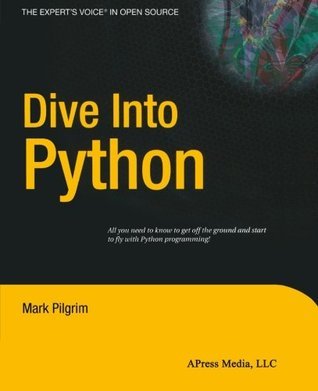
Dive Into Python
* Quick start to learning python―very example oriented approach * Book has its own Web site established by the Author is well known in the Open Source community and the book has a unique quick approach to learning an object oriented language.
413 pages, Paperback
First published May 20, 2004
Ratings & Reviews
Friends & Following
Create a free account to discover what your friends think of this book!
Community Reviews
Displaying 1 - 22 of 22 reviews

May 2, 2018
A good book for someone who has prior programming experience and wants to learn Python. Moreover, this book may be a bit too much for someone who is looking to begin learning programming.
Dive Into Python really stayed with me over the years, because it was the first book I had read that did not feel like a copycat and had contents that are used by me even now at work.
P.S. Python 2 is dead. If you are looking to buy this book, don't. Instead obtain the Dive Into Python 3 book.
Dive Into Python really stayed with me over the years, because it was the first book I had read that did not feel like a copycat and had contents that are used by me even now at work.
P.S. Python 2 is dead. If you are looking to buy this book, don't. Instead obtain the Dive Into Python 3 book.
Read
September 28, 2009We have some books on python, but I believe they are a bit dated. This is a user friendly guide that is up to date and would be a great resource for computer science students learning code (as the scripts are some of the most user friendly and introductory).
I would recommend it for the general collection.
NP
I would recommend it for the general collection.
NP


November 21, 2019
Half way through the book was about web and html. Not what I was looking for. But the beginning was great! If you are a programmer and want to know about python this can help.
Read
April 14, 2017> Whether you're an experienced programmer looking to get into Python or grizzled Python veteran who remembers the days when you had to import the string module, *Dive Into Python* is your 'desert island' Python book.
— Joey deVilla, Slashdot contributor
> As a complete newbie to the language...I constantly had those little thoughts like, 'this is the way a programming language should be taught.'
— Lasse Koskela , JavaRanch
> Apress has been profuse in both its quantity and quality of releasesand (this book is) surely worth adding to your technical reading budget for skills development.
— Blane Warrene, Technology Notes
> I am reading this ... because the language seems like a good way to accomplish programming tasks that don't require the low-level bit handling power of C.
— Richard Bejtlich, TaoSecurity
Python is a new and innovative scripting language. It is set to replace Perl as the programming language of choice for shell scripters, and for serious application developers who want a feature-rich, yet simple language to deploy their products.
*Dive Into Python* is a hands-on guide to the Python language. Each chapter starts with a real, complete code sample, proceeds to pick it apart and explain the pieces, and then puts it all back together in a summary at the end.
This is the perfect resource for you if you like to jump into languages fast and get going right away. If you're just starting to learn Python, first pick up a copy of Magnus Lie Hetland's *Practical Python*.
**Table of Contents**
1. Installing Python
2. Your First Python Program
3. Native Datatypes
4. The Power of Introspection
5. Objects and Object-Orientation
6. Exceptions and File Handling
7. Regular Expressions
8. HTML Processing
9. XML Processing
10. Scripts and Streams
11. HTTP Web Services
12. SOAP Web Services
13. Unit Testing
14. Test-First Programming
15. Refactoring
16. Functional Programming
17. Dynamic Functions
18. Performance Tuning
Advertising
Read More
— Joey deVilla, Slashdot contributor
> As a complete newbie to the language...I constantly had those little thoughts like, 'this is the way a programming language should be taught.'
— Lasse Koskela , JavaRanch
> Apress has been profuse in both its quantity and quality of releasesand (this book is) surely worth adding to your technical reading budget for skills development.
— Blane Warrene, Technology Notes
> I am reading this ... because the language seems like a good way to accomplish programming tasks that don't require the low-level bit handling power of C.
— Richard Bejtlich, TaoSecurity
Python is a new and innovative scripting language. It is set to replace Perl as the programming language of choice for shell scripters, and for serious application developers who want a feature-rich, yet simple language to deploy their products.
*Dive Into Python* is a hands-on guide to the Python language. Each chapter starts with a real, complete code sample, proceeds to pick it apart and explain the pieces, and then puts it all back together in a summary at the end.
This is the perfect resource for you if you like to jump into languages fast and get going right away. If you're just starting to learn Python, first pick up a copy of Magnus Lie Hetland's *Practical Python*.
**Table of Contents**
1. Installing Python
2. Your First Python Program
3. Native Datatypes
4. The Power of Introspection
5. Objects and Object-Orientation
6. Exceptions and File Handling
7. Regular Expressions
8. HTML Processing
9. XML Processing
10. Scripts and Streams
11. HTTP Web Services
12. SOAP Web Services
13. Unit Testing
14. Test-First Programming
15. Refactoring
16. Functional Programming
17. Dynamic Functions
18. Performance Tuning
Advertising
Read More
May 29, 2012
Half way through Chp5 of 2004's "Dive Into Python" book, I decided to switch to the "Dive Into Python 3" book, which targets Python 3 instead of Python 2. At this moment in time, I think it is hard for someone learning Python to choose between Python 2 or Python 3. They are different enough that Python 2 programs will not work on a Python 3 interpreter, and vice-versa (when basic constructs like "print" have a different syntax, I feel comfortable pronouncing "will not work"). The IDEs (Titanium Studio) & interpreter variants (Jython, PyPy) seem to be stuck in the 2.7 node, but Python 3 seems to be the point where they really cleaned up the language. I decided to target Python 3 (using Eclipse & PyDev) for my learning.
As an advanced programmer but a beginner with Python, the level of this book is good. Mark Pilgrim goes a bit too slowly with basic concepts (yes, I freaking know how a list works, already). The real "sell" for me is that he frequently contrasts Python standards vs. many of the other languages (C, C++, Perl, Java come up frequently), which helps me put the language mechanics in perspective.
As an advanced programmer but a beginner with Python, the level of this book is good. Mark Pilgrim goes a bit too slowly with basic concepts (yes, I freaking know how a list works, already). The real "sell" for me is that he frequently contrasts Python standards vs. many of the other languages (C, C++, Perl, Java come up frequently), which helps me put the language mechanics in perspective.

August 12, 2007
A pithy, lucid primer to one of the more useful and accessible programming languages out there. The full text of this book is available online at no cost, and that's how I read it, but I bought the book out of sheer gratitude.
May 2, 2011
The book is good enough to see how wide is the area of Python applications. But it does not discover all core Python programming techniques. Reader becomes rather excited with the language possibilities than gets applicable skills to implement own programs effectively.

July 28, 2013
Admittedly, it is a dull and dry read, but I am not complaining. Plowing through this book has given me a fairly good grasp of Python's syntax, strengths, limitations, and design philosophy. I also appreciate the occasional tips, tricks, or caveats specific to programming in Python.
August 25, 2007
NICE BOOk !

September 14, 2008
Much better than the python tutorial at www.python.org Go through this after you do the tutorial, its much more in depth and has better exercises.

October 19, 2008
A must read for those interested in Python. You can read it for free online, but it's worth buying if you don't like reading books on the computer.

Read
March 3, 2011was good
Read
April 15, 2011python ? who would not know about it.
June 5, 2011
I can't say I liked the writing style of this. Lots of the important information is here, I gather the python 3 version is much better. But no one seems to use python 3 yet.

Want to Read
February 8, 2012Available online for free! Bless them.
November 20, 2012
Good intro to Python, have different topics, but for me It wasn't the best. Didn't like It much, but that's a personal taste anyway.
May 6, 2013
too much of the book deals with stuff I don't care about (xml parsing), skipped most of it
May 25, 2014
I can't really recommend this book to anyone, sure it has some great concepts but it's a tad old and some of the stuff that Mark Pilgrim teaches is old and should never be used in real life.
June 9, 2016
This is good book but old version, for the newer one check Dive Into Python 3. I parse through it to see if contains any different information, none found. The new version is better btw.
September 17, 2009
Awesome!
Displaying 1 - 22 of 22 reviews