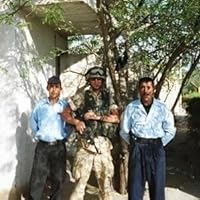
Basra and Back follows Salamanca Company, a unit of British infantry deployed to Iraq as part of the peacekeeping effort after the 2003 invasion, known as Operation TELIC.
Drawn from units in southwest England, Salamanca Company wasted no time in assuming its duties, providing security to the coalition’s provisional government and navigating the tense, dusty streets of Basra City. Insurgents had infiltrated the city, sowing discord among the population already grappling with shortages of essential resources like food, water, fuel, and electricity. The soldiers understood the gravity of the situation and braced themselves for civil unrest and worse, knowing their deployment would lead them into even more dangerous territory. For six months in 2004, the officers and men of The Rifle Volunteers found themselves as reservists on the frontline. Now that the war had been won, it was time to win the peace.
Told through the eyes of Matthew Okuhara, a young soldier called into regular service, Basra and Back gives a true and overlooked account of the UK's military reserve at war. Narrated with an abstract sense of humour, Matthew is initially out of place but eventually discovers his role as the unit medic within ‘3 Platoon’. The book also covers the military history of reserve soldiers during the War on Terror, with the deployment of so many volunteers marking a historic moment for the British Army, as was the first time in nearly half a century that a formed unit of reservists is deployed in a ground holding role since the Suez an experiment that created a strategy that continued in military deployments for years to come.
We expect war books to be loud. Explosions, firefights, heroism, maybe a dash of trauma. Basra and Back isn’t that kind of book. There are no clear villains, no grand speeches, no final act redemption. Just soldiers, sweat, kit that doesn’t work, and days that blur together until one of them doesn’t.
Writing this book, I wasn’t interested in glorifying my time in Iraq, nor was I trying to unravel it with psychological analysis. I just wanted to tell the truth as it was lived: fractured, human, occasionally surreal. A truth built from the space between incidents—the waiting, the joking, the broken air conditioning, the calluses, the tea-making, the injuries that get ignored.
Most of soldiering isn’t combat. It’s routine. Paperwork. Route planning. GDA patrols. Stacking sandbags. Checking fluid levels. You do the same things every day, until something snaps—someone passes out, an IED goes off, or you get a knock on the door telling you the general wants a brew and you’re the “chatty little twat” who’s been picked for tea duty.
It’s this rhythm—boredom cut with bursts of chaos—that defines life on deployment. It’s what I tried to capture. The reality that the body breaks before the spirit does. That blood and sweat matter as much as bullets. That grief sometimes arrives in the form of a woman screaming outside a hospital, then disappears without explanation. There’s a lot about war that doesn’t make sense until later. Why we patrolled in Northern Ireland-era Land Rovers in southern Iraq. Why private contractors had better gear, better sunglasses, and better pay, despite doing what looked like less work. Why a cracked thumbnail from a slammed vehicle door hurt worse than some wounds we treated in the field.
There’s no single message in Basra and Back, but there are questions. What is a soldier worth? What do we carry home with us? Who gets remembered, and who gets written out? These aren’t grand political arguments—they’re the kinds of things you think about while sweeping sand out of a ready room, or watching Love Actually for the fifth time because someone broke the DVD player again. One question I get asked is whether the humour in the book is a mask. “Isn’t it all just deflection?” Maybe. But I don’t think so.
The dry humour, the swearing, the mockery—it’s culture, not coping. It’s how we talk to each other. How we survive the job, the heat, the boredom, the absurdity of taking enemy fire in one hour and cleaning blood out of your kit the next. It’s not a punchline. It’s punctuation. When Uzi asked me to pop the blood blister under his nail with a red-hot needle, it wasn’t about being tough. It was about trust. About not making a big deal of pain. About knowing that the job carries on, and you still have to carry the ECM, even if your thumb’s fucked.
I didn’t write Basra and Back to make a political point. But I can tell you this: the people on the ground always know more than the posters in the recruiting office. We know what works and what doesn’t. We know what it means to carry weight, to drag stretchers, to sweat through the night, to get handed a commendation that doesn’t match what we remember.
This is a book for those who were there—and for those who weren’t but want to understand. It’s not tidy. Neither was the war.
It’s a collection of moments. Stitched together like torn webbing. Held in place with a bit of sports tape and dry sarcasm. And if you’ve served, or worked alongside those who have, you’ll recognise the smell, the sound, the shape of it.