

What do you think?

A Little More Social: How Small Choices Create Unexpected Happiness, Health, and Connection
We know that social connection enriches our lives—so why do we hesitate to connect?
“A Little More Social explores the power and promise of the human connections that most of us never make—but could make so easily if we just opened our eyes. This is the eye-opener. Insightful, engaging, scientifically grounded and beautifully written, A Little More Social is one of those rare books that might actually change your life.” —Daniel Gilbert, New York Times bestselling author of Stumbling on Happiness
There is a fundamental paradox at the core of human life. We are a highly social species uniquely equipped to connect with other people and doing so is better for us. Yet we so often choose to be unsocial. We avoid talking to the stranger who sits next to us. We struggle to move beyond small talk with an acquaintance. We are reluctant to express our gratitude to people we appreciate. Every day, we avoid opportunities to connect with strangers, neighbors, colleagues, friends, and family. By missing those moments, we miss out on all the benefits of a more social life—one that is happier and healthier for everyone.
University of Chicago psychologist and author of Mindwise, Nicholas Epley has spent his career studying the way we connect, and he has found that our social fears often keep us from reaching out. But bridging the gap between two people is easier than we think—and success is more likely than we imagine. We just have to be a little more social. Epley shows us how to seize the small moments with insights such
Social connection is a choice we make based on expectations about how others will respond to us—expectations that tend to be overly pessimistic.Introverts and extroverts alike benefit from choosing to be a little more social.Mistaken expectations can cause us to avoid interacting in ways that create strong connections—such as having a conversation—in favor of less satisfying interactions—such as social media or texting.While many books promise one big fix, making a habit of small connections is much more likely to improve your life.The habits and practices that Epley advocates are approachable. The beauty of this book is that small acts have an outsized impact on the most important parts of our lives.
Epley draws on decades of research, his own experiences, and the stories of everyday people to deliver groundbreaking conclusions about the psychology behind our social decisions. A Little More Social shows how we can put science into practice and change our lives, one small choice at a time.
“A Little More Social explores the power and promise of the human connections that most of us never make—but could make so easily if we just opened our eyes. This is the eye-opener. Insightful, engaging, scientifically grounded and beautifully written, A Little More Social is one of those rare books that might actually change your life.” —Daniel Gilbert, New York Times bestselling author of Stumbling on Happiness
There is a fundamental paradox at the core of human life. We are a highly social species uniquely equipped to connect with other people and doing so is better for us. Yet we so often choose to be unsocial. We avoid talking to the stranger who sits next to us. We struggle to move beyond small talk with an acquaintance. We are reluctant to express our gratitude to people we appreciate. Every day, we avoid opportunities to connect with strangers, neighbors, colleagues, friends, and family. By missing those moments, we miss out on all the benefits of a more social life—one that is happier and healthier for everyone.
University of Chicago psychologist and author of Mindwise, Nicholas Epley has spent his career studying the way we connect, and he has found that our social fears often keep us from reaching out. But bridging the gap between two people is easier than we think—and success is more likely than we imagine. We just have to be a little more social. Epley shows us how to seize the small moments with insights such
Social connection is a choice we make based on expectations about how others will respond to us—expectations that tend to be overly pessimistic.Introverts and extroverts alike benefit from choosing to be a little more social.Mistaken expectations can cause us to avoid interacting in ways that create strong connections—such as having a conversation—in favor of less satisfying interactions—such as social media or texting.While many books promise one big fix, making a habit of small connections is much more likely to improve your life.The habits and practices that Epley advocates are approachable. The beauty of this book is that small acts have an outsized impact on the most important parts of our lives.
Epley draws on decades of research, his own experiences, and the stories of everyday people to deliver groundbreaking conclusions about the psychology behind our social decisions. A Little More Social shows how we can put science into practice and change our lives, one small choice at a time.
305 pages, Kindle Edition
Published May 19, 2026
Ratings & Reviews
Friends & Following
Create a free account to discover what your friends think of this book!
Community Reviews
Displaying 1 - 30 of 73 reviews
June 3, 2026
Good concept but didn’t need to be so long. It was quite repetitive and redundant in parts. Overall the idea is to be more social and challenge yourself to be more extroverted/ talk to people when you can. It’s nothing new but I did enjoy the writing style and the fun facts but this could’ve been a multi part blog post and it would’ve gotten the idea across pretty successfully.

June 15, 2026
I think the overall message is good in this and the research presented is both interesting and funny. I do agree with the sentiment that small changes in ones life can have drastic effects on happiness, but damn this shit did not need to be this long. Book had me honk shoo honk shoo mimimimi in some parts. Also the author admitted to not including neurodivergent people in his research, so lowkey L mans.
Maybe i will be a little more social!
Maybe i will be a little more social!

June 18, 2026
Epley has done the research and is a great and inspiring speaker who walks the walk. Definitely check out his interviews and ted talks — ironically, his ideas come across better in dialogue than in the context of a mass market pop psych book. He’s great!

June 9, 2026
I went to an author talk with Nick Epley tonight. When asked, he admitted that he has never included neurodivergent people in his research. I think that is an important point to keep in mind when his advice is to approach strangers. He slipped in a caveat that following social norms is important, which is a big read flag for many of the people who would be most interested in this book.

August 21, 2026
Great read with interesting study reflections from the author. He admittedly didn’t include neurodivergent folks which makes for a big hole in the findings, and it was a bit repetitive.

August 13, 2026
Good info, glad I read it.
It did feel like he had a minimum word count he was going for though.
It did feel like he had a minimum word count he was going for though.

August 3, 2026
This is an eminently fun read-- also, totally stealing the idea for a compliment advent calendar! The points are simple and repeated often in different ways, and it's not really anything new while also being scientifically backed data that may seem new to us: we always have the choice to be a little more social, and it almost always turns out much more positively than we think it will.
In a nutshell:
1. We are more concerned with how competent we come across to others, whereas others are more concerned about how warm we are.
2. We have a wildly disproportional and pessimistic gap between our expectations of social interactions and our actual experience of them.
3. Kindness and honesty will never go out of style.
If anything, this book has been a launchpad for other books I've put on hold, namely Jessica Pan's Sorry I'm Late, I Didn't Want to Come: An Introvert's Year of Living Dangerously , Jia Jiang's Rejection Proof: How I Beat Fear and Became Invincible Through 100 Days of Rejection , and Michael Slepian's The Secret Life of Secrets: How Our Inner Worlds Shape Well-Being, Relationships, and Who We Are . (Tried searching for Daniel Diermeier's Reputation Rules: Strategies for Building Your Company's Most Valuable Asset , but my library sadly didn't have it.)
In a nutshell:
1. We are more concerned with how competent we come across to others, whereas others are more concerned about how warm we are.
2. We have a wildly disproportional and pessimistic gap between our expectations of social interactions and our actual experience of them.
3. Kindness and honesty will never go out of style.
If anything, this book has been a launchpad for other books I've put on hold, namely Jessica Pan's Sorry I'm Late, I Didn't Want to Come: An Introvert's Year of Living Dangerously , Jia Jiang's Rejection Proof: How I Beat Fear and Became Invincible Through 100 Days of Rejection , and Michael Slepian's The Secret Life of Secrets: How Our Inner Worlds Shape Well-Being, Relationships, and Who We Are . (Tried searching for Daniel Diermeier's Reputation Rules: Strategies for Building Your Company's Most Valuable Asset , but my library sadly didn't have it.)

August 12, 2026
إنّ الشعور بالألم عند الشعور بالوحدة يُخبرنا بشيء أساسي جدًا حول ما نحتاجه للبقاء والازدهار. فأجسادنا، في نهاية المطاف، ليست معتادة على إرسال رسائل مزعجة إلينا. عندما نشعر بالسعادة، فهذه إشارة إلى أن الأمور تسير على ما يرام، وربما ينبغي تكرارها. وعندما نشعر بالسوء، فهذه إشارة إلى وجود خلل ما، وربما نحتاج إلى التغيير. والسبب في أن شرب كوب كبير من الماء عند الشعور بالعطش يُشعرنا بالراحة هو نفسه السبب في أن عناقًا دافئًا من صديق حميم عند الشعور بالحزن يُشعرنا بالراحة: إنه نظام المكافأة في دماغنا يُخبرنا أن هذا أمر جيد. ولهذا السبب نشعر بالسعادة، عكس الشعور بالوحدة.
إن سبب تصميم أدمغتنا للعمل بهذه الطريقة واضحٌ تمامًا. فعلى مدار معظم تاريخ البشرية، كان الشعور بالوحدة أو النبذ لفترة طويلة بمثابة حكم بالإعدام. أما أولئك القادرون على الحفاظ على علاقات اجتماعية قوية، فكانوا أكثر عرضةً للعيش لفترة أطول ونقل هذه الصفات التعاونية إلى الأجيال القادمة من خلال إنجاب المزيد من الأطفال. حتى داروين أقرّ بالقيمة التطورية للسلوك الاجتماعي الإيجابي، مشيرًا إلى أن "الأشخاص الأنانيين والمثيرين للمشاكل لن يتماسكوا، وبدون التماسك لا يمكن تحقيق أي شيء". في الواقع، تشير نتائج الدراسات الاستقصائية إلى أن الأشخاص الذين يتسمون بالأنانية باستمرار حتى اليوم يكسبون أموالًا أقل وينجبون عددًا أقل من الأطفال. ببساطة، الدماغ البشري الذي يجعل التواصل الاجتماعي أولوية قصوى يعيش لفترة أطول ويحقق نجاحًا أكبر من الدماغ الذي لا يفعل ذلك.
.
Nicholas Epley
A Little More Social
Translated By #Maher_Razouk
إن سبب تصميم أدمغتنا للعمل بهذه الطريقة واضحٌ تمامًا. فعلى مدار معظم تاريخ البشرية، كان الشعور بالوحدة أو النبذ لفترة طويلة بمثابة حكم بالإعدام. أما أولئك القادرون على الحفاظ على علاقات اجتماعية قوية، فكانوا أكثر عرضةً للعيش لفترة أطول ونقل هذه الصفات التعاونية إلى الأجيال القادمة من خلال إنجاب المزيد من الأطفال. حتى داروين أقرّ بالقيمة التطورية للسلوك الاجتماعي الإيجابي، مشيرًا إلى أن "الأشخاص الأنانيين والمثيرين للمشاكل لن يتماسكوا، وبدون التماسك لا يمكن تحقيق أي شيء". في الواقع، تشير نتائج الدراسات الاستقصائية إلى أن الأشخاص الذين يتسمون بالأنانية باستمرار حتى اليوم يكسبون أموالًا أقل وينجبون عددًا أقل من الأطفال. ببساطة، الدماغ البشري الذي يجعل التواصل الاجتماعي أولوية قصوى يعيش لفترة أطول ويحقق نجاحًا أكبر من الدماغ الذي لا يفعل ذلك.
.
Nicholas Epley
A Little More Social
Translated By #Maher_Razouk

Review of advance copy received from Publisher
The Weather Before Speech
In “A Little More Social,” Nicholas Epley turns the smallest social hesitation into a study of warmth withheld.
By Demetris Papadimitropoulos | May 16th, 2026
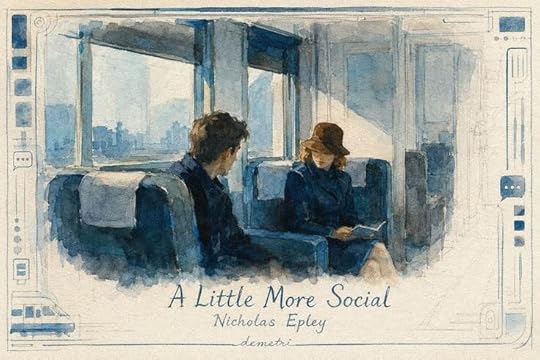
A quiet train car, a red hat, and the almost-spoken hello at the heart of “A Little More Social” – a study in the fragile interval where hesitation, hope, and human contact are all still deciding whether to enter the air.
In “A Little More Social,” the first hinge is nearly invisible until Nicholas Epley slows it down. No slammed door. No operatic betrayal. No late-night confession with rain politely tapping the window.
Just a train car, a stranger in a red hat, and Epley sitting beside her, rehearsing the courteous evasions by which a day stays colder than necessary. What if she does not want to talk? What if he seems strange? What if the next half hour is made worse by his attempt to make it better?
A whole book gathers in that pause. Epley’s real subject is not connection as an abstract virtue, but the weather before speech: the pre-lived awkwardness, the imagined rejection, the private forecast that persuades a generous impulse to stay indoors. Before the hello, there is a prediction. Before the compliment, the thank-you note, the phone call, the useful truth, there is another one. Much of “A Little More Social” argues that this forecast often underestimates the welcome waiting on the other side. Not gloriously wrong. Not wrong in a way that will make strangers clasp hands and sing in railway aisles. Wrong in the smaller, more consequential way that turns possible warmth into another silent commute.
Epley, a behavioral scientist at the University of Chicago and the author of “Mindwise,” begins with an old truth and narrows it to the moment where it matters. Relationships are not ornaments; they hold up more of a life than we notice. Aristotle got there early, and he did not even have to endure a group text. Epley’s sharper contribution is to ask why people who already know this let the knowledge stall at the exact second it might become useful. His answer is not that we are cruel, cold, or hopelessly antisocial. More often, we are poor meteorologists of our interpersonal futures.
We mistake dread for data. We treat the voice saying “this will be awkward” as if it has already returned from the future carrying proof.
The woman in the red hat becomes the book in miniature. Epley sees a train car full of people physically close and socially sealed, bodies near and voices absent, each commuter protecting a little acreage of solitude. When the woman sits beside him, he attempts the smallest possible opening. His first line is not exactly Shakespeare: he compliments her hat and jokes that he has one just like it. It is the kind of line that, if it had knees, might be knocking them together. But she brightens. Conversation follows. The commute improves. Epley’s fear had felt like information. It was only a guess.
From that scene, “A Little More Social” builds a progression of tests: why connection matters, why people avoid it, what happens when they choose differently, and how they might become, in Epley’s phrase, more wisely social. The structure is nearly diagrammatic, but the diagram earns its keep. The chapters test the idea through train talk, gratitude letters, phone calls, requests, compliments, support, and honest sentences. The sequence matters because it moves from low-stakes contact to more exposed acts of thanks, help, and candor. By the end, sociability has stopped meaning talkativeness and has started meaning delivery – getting attention, gratitude, care, and truth to the person who needs them.
That shift is where the book stops being advice about chatter and becomes an argument about conduct. A lesser version would have stopped at smiling at baristas and called it a day. Epley’s book is better than that. Its strongest chapters show that “being more social” is not an argument for extroversion by attrition. It is a case against leaving warmth undelivered. We feel grateful and leave the thanks unspoken. We notice someone in pain and do not know how to step closer. We need help and do not ask. We know a truth that might spare another person embarrassment or loneliness or confusion, and we choose the safer fog. The book becomes most interesting when it stops asking whether we should talk to strangers and starts asking why so many good things die in rehearsal.
The recurring proof pattern is clear; by the later chapters, the gears begin to show. Commuters expect solitude to be better than conversation, then report the reverse. People worry that gratitude letters will sound awkward, while recipients feel deeply moved. Compliment-givers overestimate how strange they will seem and underestimate how bright the compliment will make the other person feel. Those who ask for help imagine imposition; those being asked often experience the request as a chance to be useful. Honesty, too, is less catastrophic than forecast: what seems, in rehearsal, like a sentence that will detonate a relationship may arrive instead as trust, relief, or long-delayed oxygen. In chapter after chapter, the world rehearsed in the head before we speak is stingier than the one that often answers.
That cycle is both the argument’s engine and its limitation: dread, test, surprise, revised belief. By the later chapters, the reader can sometimes hear the lesson clearing its throat before it enters the room. Epley varies the examples, and the escalation from strangers to gratitude to kindness to honesty gives the book genuine moral movement. Still, “A Little More Social” is most vulnerable when it demonstrates one more time that the feared encounter goes better than expected. Its clarity has a cost. It becomes so good at proving its best idea that one occasionally wishes for a more stubborn case against it.
But some rooms are not train cars. Some silences are not merely mistaken predictions. Some barriers are not wobbly fence posts but built walls: trauma, hierarchy, danger, exhaustion, prejudice, cultural difference, professional risk, the accumulated evidence that a particular room will not receive candor kindly. Epley is not reckless about this. The final chapter’s emphasis on being “wisely social” gives the book’s buoyancy necessary ballast. He is not asking readers to treat every passing human as an assignment. He understands that social anxiety cannot be wished away by cheerful prescription, and that avoidance can sometimes be protection rather than error. Even so, his instinct is toward reassurance. At times, the book is so eager to hand sorrow a useful handle that it sands down the splinters.
Epley’s prose behaves like the advice: it approaches gently, keeps its voice level, and tries not to make the reader flinch. He writes in plain, companionable sentences, often beginning in common experience, opening the window onto research, and landing in something the reader might actually try. He wants the experiment to work in your life by Tuesday.
He can be funny without elbowing the reader in the ribs. Children, he notes in effect, are not a steady source of bliss but an emotional roller coaster; if all parents did with children were fun things, parenthood would have another name. The humor does not cheapen the feeling. It keeps the book from developing a halo and drifting off into the wellness ether.
The imagery stays close to the ground because the argument needs trains, phones, notes, and queues. Epley’s world is made of the places where people stand near one another while pretending not to: coffee lines, waiting rooms, office corridors, DMV queues, the little public stages of private withdrawal. The phone is not the villain here; it is the alibi, always ready to give solitude the look of business. One of the book’s sharper contemporary threads is the difference between being reachable and being reached. A text can maintain contact. A voice can restore a person.
The obvious comparison is to “The Power of Strangers” by Joe Keohane, another book interested in the neglected possibility of people we do not yet know. But Epley’s more revealing shelf-mate may be “Stumbling on Happiness” by Daniel Gilbert, because both books are about the mind’s confidence in its own misread futures. Epley is less mischievous than Gilbert and less journalistic than Keohane. He is warmer, more practical, less stylishly barbed. His book wants not simply to be admired, but to be enacted in small, testable increments: one call, one note, one honest sentence, one greeting that does not get smothered before it reaches the air.
The family material lowers the book’s voice. Epley writes about the death of his unborn daughter, Sophie, and the later adoption of Lindsay, a child with Down syndrome, not as memoir garnish but as the premise tested by grief and adoption. The research on connection does not stay safely in train cars and coffee shops. It enters disability, uncertainty, family, and love. These pages are moving because Epley does not inflate them. He lets them show a harder version of the same principle: social courage is not always cheerful. Sometimes it means asking people what their lives have actually been like. Sometimes it means allowing other families’ testimony to correct your fear. Sometimes it means discovering that love is larger than the imagined catastrophe.
The book is strongest and most vulnerable in this same move. Epley’s gift is to turn advice that can sound embroidered into testable behavior. “Relationships matter” is agreeable enough to be nearly inert. “You may be misreading how your warmth will be received” is sharper. It gives the reader something to examine in real time. Am I avoiding because this is genuinely unwise, or because I have mistaken discomfort for prophecy? Am I protecting someone, or am I protecting myself from the feeling of being awkward? Am I being kind by staying silent, or have I merely dressed fear in good manners?
The book does not need to advertise its relevance; the train car supplies it. We live in a phone-bright present of abundant contact and persistent loneliness, of platforms crowded with expression and rooms full of people not speaking. Epley does not belabor this, which is wise. He does not write as if screens invented avoidance, or as if the cure for isolation is to become aggressively charming in public spaces until city ordinances intervene. His claim is quieter and more durable. The tools have changed; the hesitation has older roots. Human beings have always feared rejection, bungled gratitude, postponed truth, and mistaken silence for safety. The current age has simply made it easier to look occupied while doing so.
Formally, Epley stays on a well-marked road, but he walks it with purpose. “A Little More Social” belongs to the popular behavioral-science tradition: anecdote, study, finding, application. Within that recognizable design, though, it completes its chosen task with unusual steadiness. It makes the next human act feel both less grand and more consequential. You do not have to be dazzling. The compliment can be inelegant. The hello can wobble. The gratitude note can contain a sentence that will not trouble the anthologies. Warmth does not always need good tailoring.
My rating: 84/100, which corresponds to 4/5 stars on Goodreads. The score reflects a humane, lucid, practical book whose friendliness has more structure beneath it than first appears, while acknowledging its repetition and the limits of its optimism. It is not the final word on loneliness, social fear, or the harder politics of who gets safely to speak. It is better understood as an intervention in the instant before impulse becomes conduct.
The book’s last and best service is to make that instant visible – that tiny place where kindness either enters the world or quietly turns back. A hello with a question mark can remain tucked behind the teeth, where nothing happens and no one is rejected. Or it can step into the air, imperfect and alive, and become a period.
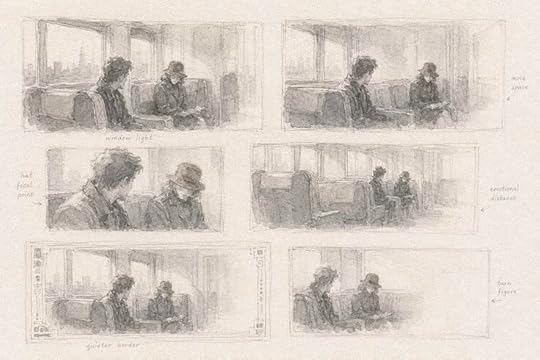
Early compositional thumbnails searching for the right balance of solitude, proximity, and suspended possibility before the final image found its quiet social weather.
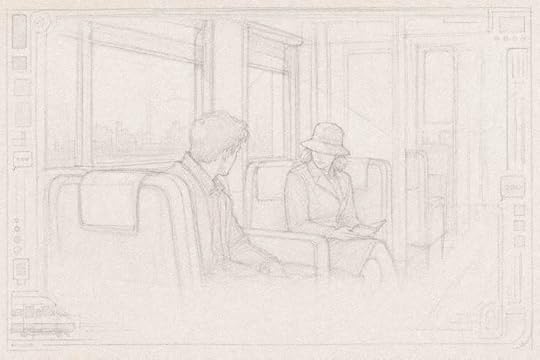
A faint graphite underdrawing mapping the architecture of the scene, where posture, distance, and the slight turn toward another person begin carrying the book’s emotional argument before color arrives.

A figure study refining the seated body, the turned head, and the held-back physical tension that make the almost-hello feel human, vulnerable, and believable rather than merely symbolic.

A border study testing how the frame itself could echo the book’s themes through spare motifs of transit, communication, and withheld contact without crowding the central stillness of the image.
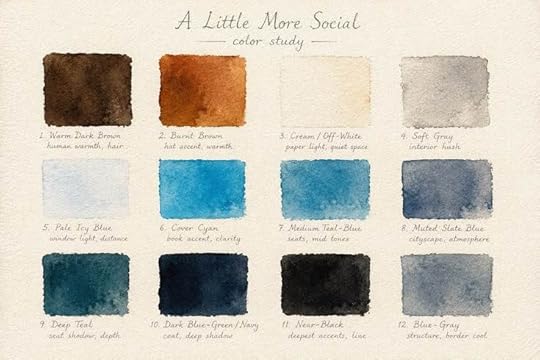
A swatch sheet translating the cover palette into watercolor terms, establishing the cool blues, muted neutrals, and warm brown accents that give the final piece its restrained emotional temperature.

The first wash settling over the pencil scaffold, where the train car begins to gather atmosphere and the image starts moving from structural thought into felt emotional space.

A process detail of the red-hat focal moment, where the painting narrows to its smallest hinge and the book’s central drama becomes visible in one hesitant human approach.
All watercolor illustrations by Demetris Papadimitropoulos.
Watercolors are done on 140lb vellum and then scanned into the computer using an Epson scanner. From there, they are finalized in Procreate. All art and opinions are my own.
In “A Little More Social,” Nicholas Epley turns the smallest social hesitation into a study of warmth withheld.
By Demetris Papadimitropoulos | May 16th, 2026
A quiet train car, a red hat, and the almost-spoken hello at the heart of “A Little More Social” – a study in the fragile interval where hesitation, hope, and human contact are all still deciding whether to enter the air.
In “A Little More Social,” the first hinge is nearly invisible until Nicholas Epley slows it down. No slammed door. No operatic betrayal. No late-night confession with rain politely tapping the window.
Just a train car, a stranger in a red hat, and Epley sitting beside her, rehearsing the courteous evasions by which a day stays colder than necessary. What if she does not want to talk? What if he seems strange? What if the next half hour is made worse by his attempt to make it better?
A whole book gathers in that pause. Epley’s real subject is not connection as an abstract virtue, but the weather before speech: the pre-lived awkwardness, the imagined rejection, the private forecast that persuades a generous impulse to stay indoors. Before the hello, there is a prediction. Before the compliment, the thank-you note, the phone call, the useful truth, there is another one. Much of “A Little More Social” argues that this forecast often underestimates the welcome waiting on the other side. Not gloriously wrong. Not wrong in a way that will make strangers clasp hands and sing in railway aisles. Wrong in the smaller, more consequential way that turns possible warmth into another silent commute.
Epley, a behavioral scientist at the University of Chicago and the author of “Mindwise,” begins with an old truth and narrows it to the moment where it matters. Relationships are not ornaments; they hold up more of a life than we notice. Aristotle got there early, and he did not even have to endure a group text. Epley’s sharper contribution is to ask why people who already know this let the knowledge stall at the exact second it might become useful. His answer is not that we are cruel, cold, or hopelessly antisocial. More often, we are poor meteorologists of our interpersonal futures.
We mistake dread for data. We treat the voice saying “this will be awkward” as if it has already returned from the future carrying proof.
The woman in the red hat becomes the book in miniature. Epley sees a train car full of people physically close and socially sealed, bodies near and voices absent, each commuter protecting a little acreage of solitude. When the woman sits beside him, he attempts the smallest possible opening. His first line is not exactly Shakespeare: he compliments her hat and jokes that he has one just like it. It is the kind of line that, if it had knees, might be knocking them together. But she brightens. Conversation follows. The commute improves. Epley’s fear had felt like information. It was only a guess.
From that scene, “A Little More Social” builds a progression of tests: why connection matters, why people avoid it, what happens when they choose differently, and how they might become, in Epley’s phrase, more wisely social. The structure is nearly diagrammatic, but the diagram earns its keep. The chapters test the idea through train talk, gratitude letters, phone calls, requests, compliments, support, and honest sentences. The sequence matters because it moves from low-stakes contact to more exposed acts of thanks, help, and candor. By the end, sociability has stopped meaning talkativeness and has started meaning delivery – getting attention, gratitude, care, and truth to the person who needs them.
That shift is where the book stops being advice about chatter and becomes an argument about conduct. A lesser version would have stopped at smiling at baristas and called it a day. Epley’s book is better than that. Its strongest chapters show that “being more social” is not an argument for extroversion by attrition. It is a case against leaving warmth undelivered. We feel grateful and leave the thanks unspoken. We notice someone in pain and do not know how to step closer. We need help and do not ask. We know a truth that might spare another person embarrassment or loneliness or confusion, and we choose the safer fog. The book becomes most interesting when it stops asking whether we should talk to strangers and starts asking why so many good things die in rehearsal.
The recurring proof pattern is clear; by the later chapters, the gears begin to show. Commuters expect solitude to be better than conversation, then report the reverse. People worry that gratitude letters will sound awkward, while recipients feel deeply moved. Compliment-givers overestimate how strange they will seem and underestimate how bright the compliment will make the other person feel. Those who ask for help imagine imposition; those being asked often experience the request as a chance to be useful. Honesty, too, is less catastrophic than forecast: what seems, in rehearsal, like a sentence that will detonate a relationship may arrive instead as trust, relief, or long-delayed oxygen. In chapter after chapter, the world rehearsed in the head before we speak is stingier than the one that often answers.
That cycle is both the argument’s engine and its limitation: dread, test, surprise, revised belief. By the later chapters, the reader can sometimes hear the lesson clearing its throat before it enters the room. Epley varies the examples, and the escalation from strangers to gratitude to kindness to honesty gives the book genuine moral movement. Still, “A Little More Social” is most vulnerable when it demonstrates one more time that the feared encounter goes better than expected. Its clarity has a cost. It becomes so good at proving its best idea that one occasionally wishes for a more stubborn case against it.
But some rooms are not train cars. Some silences are not merely mistaken predictions. Some barriers are not wobbly fence posts but built walls: trauma, hierarchy, danger, exhaustion, prejudice, cultural difference, professional risk, the accumulated evidence that a particular room will not receive candor kindly. Epley is not reckless about this. The final chapter’s emphasis on being “wisely social” gives the book’s buoyancy necessary ballast. He is not asking readers to treat every passing human as an assignment. He understands that social anxiety cannot be wished away by cheerful prescription, and that avoidance can sometimes be protection rather than error. Even so, his instinct is toward reassurance. At times, the book is so eager to hand sorrow a useful handle that it sands down the splinters.
Epley’s prose behaves like the advice: it approaches gently, keeps its voice level, and tries not to make the reader flinch. He writes in plain, companionable sentences, often beginning in common experience, opening the window onto research, and landing in something the reader might actually try. He wants the experiment to work in your life by Tuesday.
He can be funny without elbowing the reader in the ribs. Children, he notes in effect, are not a steady source of bliss but an emotional roller coaster; if all parents did with children were fun things, parenthood would have another name. The humor does not cheapen the feeling. It keeps the book from developing a halo and drifting off into the wellness ether.
The imagery stays close to the ground because the argument needs trains, phones, notes, and queues. Epley’s world is made of the places where people stand near one another while pretending not to: coffee lines, waiting rooms, office corridors, DMV queues, the little public stages of private withdrawal. The phone is not the villain here; it is the alibi, always ready to give solitude the look of business. One of the book’s sharper contemporary threads is the difference between being reachable and being reached. A text can maintain contact. A voice can restore a person.
The obvious comparison is to “The Power of Strangers” by Joe Keohane, another book interested in the neglected possibility of people we do not yet know. But Epley’s more revealing shelf-mate may be “Stumbling on Happiness” by Daniel Gilbert, because both books are about the mind’s confidence in its own misread futures. Epley is less mischievous than Gilbert and less journalistic than Keohane. He is warmer, more practical, less stylishly barbed. His book wants not simply to be admired, but to be enacted in small, testable increments: one call, one note, one honest sentence, one greeting that does not get smothered before it reaches the air.
The family material lowers the book’s voice. Epley writes about the death of his unborn daughter, Sophie, and the later adoption of Lindsay, a child with Down syndrome, not as memoir garnish but as the premise tested by grief and adoption. The research on connection does not stay safely in train cars and coffee shops. It enters disability, uncertainty, family, and love. These pages are moving because Epley does not inflate them. He lets them show a harder version of the same principle: social courage is not always cheerful. Sometimes it means asking people what their lives have actually been like. Sometimes it means allowing other families’ testimony to correct your fear. Sometimes it means discovering that love is larger than the imagined catastrophe.
The book is strongest and most vulnerable in this same move. Epley’s gift is to turn advice that can sound embroidered into testable behavior. “Relationships matter” is agreeable enough to be nearly inert. “You may be misreading how your warmth will be received” is sharper. It gives the reader something to examine in real time. Am I avoiding because this is genuinely unwise, or because I have mistaken discomfort for prophecy? Am I protecting someone, or am I protecting myself from the feeling of being awkward? Am I being kind by staying silent, or have I merely dressed fear in good manners?
The book does not need to advertise its relevance; the train car supplies it. We live in a phone-bright present of abundant contact and persistent loneliness, of platforms crowded with expression and rooms full of people not speaking. Epley does not belabor this, which is wise. He does not write as if screens invented avoidance, or as if the cure for isolation is to become aggressively charming in public spaces until city ordinances intervene. His claim is quieter and more durable. The tools have changed; the hesitation has older roots. Human beings have always feared rejection, bungled gratitude, postponed truth, and mistaken silence for safety. The current age has simply made it easier to look occupied while doing so.
Formally, Epley stays on a well-marked road, but he walks it with purpose. “A Little More Social” belongs to the popular behavioral-science tradition: anecdote, study, finding, application. Within that recognizable design, though, it completes its chosen task with unusual steadiness. It makes the next human act feel both less grand and more consequential. You do not have to be dazzling. The compliment can be inelegant. The hello can wobble. The gratitude note can contain a sentence that will not trouble the anthologies. Warmth does not always need good tailoring.
My rating: 84/100, which corresponds to 4/5 stars on Goodreads. The score reflects a humane, lucid, practical book whose friendliness has more structure beneath it than first appears, while acknowledging its repetition and the limits of its optimism. It is not the final word on loneliness, social fear, or the harder politics of who gets safely to speak. It is better understood as an intervention in the instant before impulse becomes conduct.
The book’s last and best service is to make that instant visible – that tiny place where kindness either enters the world or quietly turns back. A hello with a question mark can remain tucked behind the teeth, where nothing happens and no one is rejected. Or it can step into the air, imperfect and alive, and become a period.
Early compositional thumbnails searching for the right balance of solitude, proximity, and suspended possibility before the final image found its quiet social weather.
A faint graphite underdrawing mapping the architecture of the scene, where posture, distance, and the slight turn toward another person begin carrying the book’s emotional argument before color arrives.
A figure study refining the seated body, the turned head, and the held-back physical tension that make the almost-hello feel human, vulnerable, and believable rather than merely symbolic.
A border study testing how the frame itself could echo the book’s themes through spare motifs of transit, communication, and withheld contact without crowding the central stillness of the image.
A swatch sheet translating the cover palette into watercolor terms, establishing the cool blues, muted neutrals, and warm brown accents that give the final piece its restrained emotional temperature.
The first wash settling over the pencil scaffold, where the train car begins to gather atmosphere and the image starts moving from structural thought into felt emotional space.
A process detail of the red-hat focal moment, where the painting narrows to its smallest hinge and the book’s central drama becomes visible in one hesitant human approach.
All watercolor illustrations by Demetris Papadimitropoulos.
Watercolors are done on 140lb vellum and then scanned into the computer using an Epson scanner. From there, they are finalized in Procreate. All art and opinions are my own.

August 5, 2026
The author quoted widely disproved Harry Harlow at the beginning—needs to read the Good Mother Myth?!?
I don’t disagree with the thesis—that it’s good to be more social—but I thought the book, including the research and examples it incorporated, could have been better. And the voice section seemed to lack nuance?
I don’t disagree with the thesis—that it’s good to be more social—but I thought the book, including the research and examples it incorporated, could have been better. And the voice section seemed to lack nuance?

June 12, 2026
People actually value warmth over competence. Lots of interesting studies presenting in an easy to follow format.
This entire review has been hidden because of spoilers.

July 2, 2026
I appreciate the logic and science behind the premise of the book: we need to talk more to other people and we need to find ways to be more curious. That being said, as an extroverted teacher, this was just kind of hitting me over the head with things I already knew. I could see it being more useful for someone who believes that communicating with strangers is a waste of time or for someone who needs evidence to nudge them into making more social choices. If anything, I suppose it saddens me that this book is even necessary, but that’s the problem our society is facing, I suppose.
Want to Read
June 8, 2026As heard on The Happiness Lab with Dr. Laurie Santos (The Surprising Case for Oversharing)
https://omny.fm/shows/the-happiness-l...
We’re kicking off a new season of The Happiness Lab with some happiness hot takes — bold claims that challenge conventional wisdom about what it really takes to feel happier. Today's hot take is all about oversharing.
We’re usually told that revealing too much is cringe-worthy. That it demonstrates social ignorance. That when it comes to overly personal information, save it for your therapist, because less is usually more.
Dr. Laurie argues that revealing more than feels comfortable can actually strengthen our social connections and boost our wellbeing. She speaks with Harvard Business School professor Leslie John, author of Revealing, about why TLI (too little information) is often more dangerous than TMI, and chats with University of Chicago psychologist Nick Epley, author of A Little More Social, about what “embracing the cringe” can teach us about connection, vulnerability, and trust.
Together, they explore the line between sharing and oversharing, and explain why what feels like “too much information” is often just information.
Experts Mentioned:
Leslie John, James. E. Burke Professor of Business Administration at Harvard Business School Nick Epley, John Templeton Keller Distinguished Service Professor of Behavioral Science and Faculty Director of the Roman Family Center for Decision Research at the University of Chicago Booth School of Business Bronnie Ware, author and palliative carerResources Mentioned:
Revealing: The Underrated Power of Oversharing, by Leslie John (2026) “Putting feelings into words: Affect labeling as implicit emotion regulation” by Jared Torre and Matthew Lieberman (Emotion Review, 2018) The Top Five Regrets of the Dying: A Life Transformed by the Dearly Departing, by Bronnie Ware (2011) A Little More Social: How Small Choices Create Unexpected Happiness, Health, and Connection, by Nick Epley (2026) “Undervaluing gratitude: Expressers misunderstand the consequences of showing appreciation,” by Amit Kumar and Nick Epley (Psychological Science, 2018) “Insufficiently complimentary?: Underestimating the positive impact of compliments creates a barrier to expressing them” by Xuan Zhao and Nick Epley (Journal of Personality and Social Psychology, 2021)Related Episodes:
“The Secret to Making Friends as an Adult” “Why Giving is a Great Daily Habit” “Caring What You’re Sharing”See omnystudio.com/listener for privacy information.
https://omny.fm/shows/the-happiness-l...
May 31, 2026
I received a free copy of this book through a Goodreads giveaway!
I always feel weird rating non-fiction, but I particularly feel strange rating this one. I don't think I'm the target audience here, but I'm trying to not let that make me a harsh critic. I do think this is a worthwhile and helpful read for folks that experience social anxiety.
1. I think this is a great *starter* for people that experience cognitive distortions or catastrophize. The "why" is laid out: "The purpose of our sociometer--our self esteem-- is to steer us into situations that keep us positively connected to others, and away from situations that leave us disconnected or rejected. This doesn't mean that our sociometer functions with perfect accuracy" (11). I like explanations like this that teach us how our feelings show us our needs. This is a common conversation I have with people (e.g. anger isn't "bad," it tells us that something needs to change; anxiety isn't "bad," it's trying to protect us). What feels like is missing from the book is the next part: Sometimes, though, because of trauma or other signals that our body is picking up, the feelings might be disproportionate. This is why we can't logic our way through feelings, etc. etc.. Which leads me to:
2. I understand the framing of social interaction as a "choice," but it's hard for me to truly back and suggest this book because it lacks an acknowledgement of regulation. For the people who read this book and still struggle, pointing them towards anxiety management skills + somatic grounding techniques would be helpful. In other words, when people do want to (or have to) socialize but feel like they can't, teaching them the other choices they can make to help them get to that point. I know that this isn't a "coping skills" book, but I would've liked to have seen more acknowledgement of this concept.
3. Not enough asterisks/caveats in this book for me! Very familiar with a strengths-based approach (which in this book is optimism vs. pessimism). I like the spectrums of approach to avoidance and that kind of concept. When talking about a story where a young girl converses with an intruder and he ends up not harming her or her dad, the takeaway is like /the power of conversation/, which, yes, is powerful, but we can't just be one-dimensional in psychology. It is well-known (like in that one episode of Grey's Anatomy where a character starts telling a shooter personal facts about herself) that humanizing yourself can make an attacker less likely to hurt you, but we should really just acknowledge that proper safety really is important, too. (Going back to anxiety serves a purpose).
4. A huge miss for me in most psychology things is when we don't talk about technology more. There's a little bit of it in the beginning where Epley mentions that people are too busy being on their phones to talk to each other on the train, but what's missing for me is the idea that the "choice" to socialize is also the choice to put the phone down. Then we get to the same issue I had in #1, where the "how" is missing. How do you put your phone down! It's addicting!
4. I love the graphs! The notes section is perhaps my favorite part. Lots of good data in there.
5. I also like the acknowledgement that learning how to have a conversation is often a learned skill, and that tools can help us converse (like that card game, We're Not Really Strangers).
Overall, I do think Epley is aware of all of the points above. He is a professor and intellectual. But to make a pop psychology book, things unfortunately have to be simplified or narrowed down :/
I always feel weird rating non-fiction, but I particularly feel strange rating this one. I don't think I'm the target audience here, but I'm trying to not let that make me a harsh critic. I do think this is a worthwhile and helpful read for folks that experience social anxiety.
1. I think this is a great *starter* for people that experience cognitive distortions or catastrophize. The "why" is laid out: "The purpose of our sociometer--our self esteem-- is to steer us into situations that keep us positively connected to others, and away from situations that leave us disconnected or rejected. This doesn't mean that our sociometer functions with perfect accuracy" (11). I like explanations like this that teach us how our feelings show us our needs. This is a common conversation I have with people (e.g. anger isn't "bad," it tells us that something needs to change; anxiety isn't "bad," it's trying to protect us). What feels like is missing from the book is the next part: Sometimes, though, because of trauma or other signals that our body is picking up, the feelings might be disproportionate. This is why we can't logic our way through feelings, etc. etc.. Which leads me to:
2. I understand the framing of social interaction as a "choice," but it's hard for me to truly back and suggest this book because it lacks an acknowledgement of regulation. For the people who read this book and still struggle, pointing them towards anxiety management skills + somatic grounding techniques would be helpful. In other words, when people do want to (or have to) socialize but feel like they can't, teaching them the other choices they can make to help them get to that point. I know that this isn't a "coping skills" book, but I would've liked to have seen more acknowledgement of this concept.
3. Not enough asterisks/caveats in this book for me! Very familiar with a strengths-based approach (which in this book is optimism vs. pessimism). I like the spectrums of approach to avoidance and that kind of concept. When talking about a story where a young girl converses with an intruder and he ends up not harming her or her dad, the takeaway is like /the power of conversation/, which, yes, is powerful, but we can't just be one-dimensional in psychology. It is well-known (like in that one episode of Grey's Anatomy where a character starts telling a shooter personal facts about herself) that humanizing yourself can make an attacker less likely to hurt you, but we should really just acknowledge that proper safety really is important, too. (Going back to anxiety serves a purpose).
4. A huge miss for me in most psychology things is when we don't talk about technology more. There's a little bit of it in the beginning where Epley mentions that people are too busy being on their phones to talk to each other on the train, but what's missing for me is the idea that the "choice" to socialize is also the choice to put the phone down. Then we get to the same issue I had in #1, where the "how" is missing. How do you put your phone down! It's addicting!
4. I love the graphs! The notes section is perhaps my favorite part. Lots of good data in there.
5. I also like the acknowledgement that learning how to have a conversation is often a learned skill, and that tools can help us converse (like that card game, We're Not Really Strangers).
Overall, I do think Epley is aware of all of the points above. He is a professor and intellectual. But to make a pop psychology book, things unfortunately have to be simplified or narrowed down :/

July 26, 2026
Heard as an audiobook, narrated by the author
* I really enjoyed this book and would recommend it to anyone. It goes by quickly, and it’s both insightful and heartwarming. Having said that, I don’t think I can be fully objective in evaluating it. Nick Epley was my professor at the University of Chicago, and he is one of the best teachers I have ever had. He is clear, passionate, and for some reason I always find him very motivating.
* The book is an invitation to connect more proactively with other people instead of with our phones. It advocates for the value of these connections, even if they’re just trivial, fleeting chats with strangers.
* While we may think we won’t have much in common with a stranger, it often takes very little to discover shared interests and create a more meaningful connection.
* Small talk is the default for many people because we assume deeper conversations will be awkward, especially with people we interact with only briefly. The book argues that connecting at a deeper level is much easier—and much more fulfilling—than we expect.
* People tend to predict that conversations with strangers will be awkward or uncomfortable and that they’ll be judged harshly. In reality, others evaluate these interactions much more generously than we forecast. Even a “bad” conversation is usually not as bad for the other person as we fear. Conversely, an okay conversation in our eyes may have been a great one in theirs.
* I loved the idea that others tend to evaluate us mostly on our warmth, while we evaluate ourselves mostly on our competence. That gap between perception and reality means we can take more social risks: people are more likely to appreciate our willingness to connect than to judge whether we said exactly the right thing.
* It doesn’t take much to start a conversation. A simple “Hi, I’m Camilo” works. Eight or nine out of ten times people will respond positively. And when they don’t, that’s okay—I can simply move on.
* I also loved the story about the guy who intentionally set out to ask strangers for “impossible” favors, expecting to fail, only to discover that people were surprisingly willing to help.
* Not every conversation will be memorable. But: the cost of starting one is much lower—and the potential upside much higher—than we usually assume.
* The book reminded me that we are always works in progress. We can improve the quality of our lives through small changes in how we interact with others. There is no age at which we stop growing or becoming better at connecting with people.
* I really enjoyed this book and would recommend it to anyone. It goes by quickly, and it’s both insightful and heartwarming. Having said that, I don’t think I can be fully objective in evaluating it. Nick Epley was my professor at the University of Chicago, and he is one of the best teachers I have ever had. He is clear, passionate, and for some reason I always find him very motivating.
* The book is an invitation to connect more proactively with other people instead of with our phones. It advocates for the value of these connections, even if they’re just trivial, fleeting chats with strangers.
* While we may think we won’t have much in common with a stranger, it often takes very little to discover shared interests and create a more meaningful connection.
* Small talk is the default for many people because we assume deeper conversations will be awkward, especially with people we interact with only briefly. The book argues that connecting at a deeper level is much easier—and much more fulfilling—than we expect.
* People tend to predict that conversations with strangers will be awkward or uncomfortable and that they’ll be judged harshly. In reality, others evaluate these interactions much more generously than we forecast. Even a “bad” conversation is usually not as bad for the other person as we fear. Conversely, an okay conversation in our eyes may have been a great one in theirs.
* I loved the idea that others tend to evaluate us mostly on our warmth, while we evaluate ourselves mostly on our competence. That gap between perception and reality means we can take more social risks: people are more likely to appreciate our willingness to connect than to judge whether we said exactly the right thing.
* It doesn’t take much to start a conversation. A simple “Hi, I’m Camilo” works. Eight or nine out of ten times people will respond positively. And when they don’t, that’s okay—I can simply move on.
* I also loved the story about the guy who intentionally set out to ask strangers for “impossible” favors, expecting to fail, only to discover that people were surprisingly willing to help.
* Not every conversation will be memorable. But: the cost of starting one is much lower—and the potential upside much higher—than we usually assume.
* The book reminded me that we are always works in progress. We can improve the quality of our lives through small changes in how we interact with others. There is no age at which we stop growing or becoming better at connecting with people.

June 8, 2026
Nick states the main point of this wonderfully well-researched book in the Preface: “… Sociality is a need on par with eating and sleeping … it’s likely to be far more important for your happiness than even money.” We know being social is important! Number one driver of human happiness. Phone a friend! Talk to strangers! So why do we sit silently together on trains and planes with everyone entombed in their own echo chamber and social media feeds? Well, it’s a bit confusing at first, but this book reveals the answer: the only thing we fear more than a bad outcome … is an uncertain one. One of many fascinating studies here shows people will pay less money for the chance to win a $50-100 gift card … than a $50 one. What? Yes! We hate uncertainty! We don’t want to try things where we don’t know what’ll happen. Conversations with strangers? That’s uncertain! We think it’ll go horribly wrong. In his talks, Nick asks people to pair up and ask each other two questions: “What are you most grateful for in your life?” and “Can you tell me about one of the last times you cried in front of another person?” Sounds tough! People do not think this will go well …. yet it does! Check out this graph from Page 51:
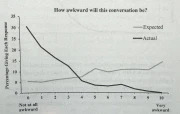
In general, our expectations around being proactively social are dead wrong. This graph comes from Page 69:
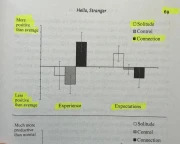
What sounds like a perhaps-obvious takeaway is given fresh life and energy with new research from University of Chicago professor and beaming beacon of kindness Nick Epley. This is a book to help push you, bit by bit, to being (yes) a little more social and a lot more happy.
In general, our expectations around being proactively social are dead wrong. This graph comes from Page 69:
What sounds like a perhaps-obvious takeaway is given fresh life and energy with new research from University of Chicago professor and beaming beacon of kindness Nick Epley. This is a book to help push you, bit by bit, to being (yes) a little more social and a lot more happy.
July 6, 2026
A fascinating book that has the subject of saying hello and continuing on to a conversation. He explains how little we talk to others. We text, talk on the phone but seldom to a human being outside of your family and friends. A question asked might be “ Why do we, the most social species, often choose silence over connection?” Are we afraid to what might happen by talking to someone we don’t know? Worry we might be ignored? Or have we lost the ability to communicate ? I don’t think so. We are just afraid of the reaction that we might or not might get. Is there any way to be comfortable and just say hello to someone you don’t know? Epley answer these questions and more. He gives suggestions on how to start and the rewards you personally received en if it ends up being temporary.
The author has written a book that is interesting as he includes his own xperiences of saying hello to “strangers.” There are scientific studies backing him up. The book include bibliographic notes. While I read his book, I thought of a time doing my “hellos” to people I didn’t know. I remember one time being asked if I needed help while I waited for my friend was getting the car. It was done so nicely. I said no but it was such a lovely experience. I won’t forget it. It didn’t urprise me that a book like this was published.
Disclaimer: I received an arc of this book from the author/publisher from Netgalley. I wasn’t obligated to write a favorable review. The opinions expressed are strictly my own.
The author has written a book that is interesting as he includes his own xperiences of saying hello to “strangers.” There are scientific studies backing him up. The book include bibliographic notes. While I read his book, I thought of a time doing my “hellos” to people I didn’t know. I remember one time being asked if I needed help while I waited for my friend was getting the car. It was done so nicely. I said no but it was such a lovely experience. I won’t forget it. It didn’t urprise me that a book like this was published.
Disclaimer: I received an arc of this book from the author/publisher from Netgalley. I wasn’t obligated to write a favorable review. The opinions expressed are strictly my own.

July 2, 2026
I try to implement the core advice in this book of being a little more social. It's good, and I was sold on it years ago based on all the "talk to the barista" experiments.
But could it be that people willing to fill out surveys and participate in experiments are already a little more social :p? The studies mentioned in this book are focused on averages, yes, on average if you strike up a conversation with someone it will end well, you will feel good, they will feel good. But sometimes things don't go well. e.g. the talkative taxidriver categorically dislikes a certain ethnicity or that secret someone tells you ends up keeping you company in your head for the rest of your life. And there was no study mentioned of how well people are able to carry the burdens and surprises that other people shared with them. It's like, on average, if I watch a murder mystery or a police procedural I will be entertained and have no regrets. But every once in a while the crime is disturbing in a way that stays with me unbidden for years. So I don't spend as much time with these TV shows. Maybe it's a poor parallel, but I think the book makes a solid case that social encounters end up better than people expect most of the time, while it fails to account for the cost of the negative interactions.
But could it be that people willing to fill out surveys and participate in experiments are already a little more social :p? The studies mentioned in this book are focused on averages, yes, on average if you strike up a conversation with someone it will end well, you will feel good, they will feel good. But sometimes things don't go well. e.g. the talkative taxidriver categorically dislikes a certain ethnicity or that secret someone tells you ends up keeping you company in your head for the rest of your life. And there was no study mentioned of how well people are able to carry the burdens and surprises that other people shared with them. It's like, on average, if I watch a murder mystery or a police procedural I will be entertained and have no regrets. But every once in a while the crime is disturbing in a way that stays with me unbidden for years. So I don't spend as much time with these TV shows. Maybe it's a poor parallel, but I think the book makes a solid case that social encounters end up better than people expect most of the time, while it fails to account for the cost of the negative interactions.

August 9, 2026
Nicholas Epley fills this book with winsome anecdotes that rang true to my experience as someone who regularly talks to strangers and frequently sees conversations quickly grow vulnerable. Epley’s reading on the audiobook makes the stories that much more engaging. While the results of his academic studies sometimes arrive from small sample sizes, I found it interesting that the findings proved consistent across different environments and even different cultures on different continents. His work points beyond personality types like extroversion and introversion to realities of the human condition. I appreciated the self-deprecating disclosures related to his surprise at study findings and the results of his real-life personal experimentation. I liked that the final chapter is a call to both wisdom and courage, of managing the tension inside us differently than we have in the past—now with more realistic expectations. I started recommending this book before I even finished listening to it. As someone who facilitates faith discussion spaces, I expect chapter 6 will stick with me for a long time.
August 11, 2026
We are social creatures, but routinely choose solitude over connection due to our pessimistic expectations about how others will react.
Throughout A Little More Social, Epley presents many fascinating behavioral experiments to prove his point- making simple connections generally costs us nothing, and the payoff is surprisingly high.
As Epley puts it: “My goal in writing this book isn’t to convince you that every research finding will apply perfectly to you. Instead, my goal is to invite you to consider what overly pessimistic beliefs might be keeping you from reaching out and connecting with people a little more often, and to gently start testing those barriers yourself.”
I can’t tell you many times I’ve passed up the opportunities, while commuting, on a plane, waiting in lines, at work, or in coffee shops. I actually JUST missed an opportunity while in the doctor’s office READING THIS BOOK! But I’m learning, and I’m committing to “recognize easy opportunities routinely”.

August 28, 2026
** 4 stars **
Epley provides a fascinating overview of how most of us have overly pessimistic views of how our interactions with other people might go and how those views keep us from reaching out to people and being "a little more social." His research demonstrates, however, that there are basically no adverse effects of social interaction with others. In the overwhelming majority of cases, both people felt more positively after talking with someone else. Our self-evaluation of our ability to talk with others is often based on competence (e.g. "Will I say something stupid?", "I don't have anything interesting to talk about," "Will I say something wrong or offensive?"), but others judge us mainly on our warmth rather than our competence, so it is more important to be authentic and kind than it is to be an intellectual or someone with the gift of gab.
Would recommend if you enjoy nonfiction, especially about psychology or interpersonal communication. The author narrates the audiobook himself, and I thought he did a good job.
Epley provides a fascinating overview of how most of us have overly pessimistic views of how our interactions with other people might go and how those views keep us from reaching out to people and being "a little more social." His research demonstrates, however, that there are basically no adverse effects of social interaction with others. In the overwhelming majority of cases, both people felt more positively after talking with someone else. Our self-evaluation of our ability to talk with others is often based on competence (e.g. "Will I say something stupid?", "I don't have anything interesting to talk about," "Will I say something wrong or offensive?"), but others judge us mainly on our warmth rather than our competence, so it is more important to be authentic and kind than it is to be an intellectual or someone with the gift of gab.
Would recommend if you enjoy nonfiction, especially about psychology or interpersonal communication. The author narrates the audiobook himself, and I thought he did a good job.
July 5, 2026
This is not a life-changing book for me, but it was a timely reminder.
As someone in my mid-30s who isn’t naturally very socially active, I appreciated its message that meaningful connection doesn’t have to come from big gestures. Sometimes it’s the small, everyday actions like a brief conversation, a genuine compliment, or simply showing kindness.
My favorite idea in the book was the comparison of humans to porcupines. We all want warmth and connection, yet we also fear getting hurt. So we keep just enough distance to stay comfortably warm while avoiding each other’s quills. I found that metaphor incredibly relatable and a gentle reminder that while boundaries protect us, they can also keep us from the very connections we seek.
A quiet, thoughtful read that reminded me of the kind of person I want to be.
As someone in my mid-30s who isn’t naturally very socially active, I appreciated its message that meaningful connection doesn’t have to come from big gestures. Sometimes it’s the small, everyday actions like a brief conversation, a genuine compliment, or simply showing kindness.
My favorite idea in the book was the comparison of humans to porcupines. We all want warmth and connection, yet we also fear getting hurt. So we keep just enough distance to stay comfortably warm while avoiding each other’s quills. I found that metaphor incredibly relatable and a gentle reminder that while boundaries protect us, they can also keep us from the very connections we seek.
A quiet, thoughtful read that reminded me of the kind of person I want to be.
June 11, 2026
I enjoyed this thoroughly researched book and while there's nothing groundbreaking, it's really a great reminder of the value in connecting with other human beings, not only strangers but close friends and family. Seems particularly relevant in an age where most people never look up from their phones and we're still recovering from the isolation of Covid 19. It's hard to develop meaningful relationships when you're working from home. I know that when I've engaged with strangers on a plane instead of immediately putting on my noise cancelling headphones, good things have happened. I need to do it more often. Nothing to lose and lots to gain.

August 9, 2026
Great book! I am just on a roll.
Notes:
Before the 1800s people didn't experience psychological loneliness and there wasn't really a word for it.
Choices are guided not by how a decision will actually make you feel, but rather by how you think it will make you feel because the choice hasn't happened yet. It's in the future and you could only think about it, you can't resort to actual real feelings.
Acting extroverted makes people feel more positive.
Keeping secrets hurts because it's isolating.
Smaller more frequent occurrences of happiness is overall better than larger ones that aren't as frequent. Because mood is tied to emotion and those things fluctuate.
Notes:
Before the 1800s people didn't experience psychological loneliness and there wasn't really a word for it.
Choices are guided not by how a decision will actually make you feel, but rather by how you think it will make you feel because the choice hasn't happened yet. It's in the future and you could only think about it, you can't resort to actual real feelings.
Acting extroverted makes people feel more positive.
Keeping secrets hurts because it's isolating.
Smaller more frequent occurrences of happiness is overall better than larger ones that aren't as frequent. Because mood is tied to emotion and those things fluctuate.
July 4, 2026
Epley's research is a good reminder to have a healthy appreciation for the importance of social interaction. As a person who finds it fairly interesting and easy to talk to strangers I've tried to balance that with an appreciation for more quiet, introspective people. A example of the value Epley's research brings is the importance of overcoming barriers when one wants to convey caring to another person experiencing grief. I hope to remember to aim for a balance in all interactions with authenticity and genuine curiosity and warmth.

June 25, 2026
I picked up this book because socializing has never come naturally to me, so I was hoping to learn something new. Overall, it was a nice read, but it felt a bit fluffy.
The main message is basically to reach out more, be kind, and be honest with people. All good advice, but it often felt more like common sense than genuine insight.
Still, it was a pleasant read and a good reminder of the value of human connection, even if it didn’t give me many new ideas.
The main message is basically to reach out more, be kind, and be honest with people. All good advice, but it often felt more like common sense than genuine insight.
Still, it was a pleasant read and a good reminder of the value of human connection, even if it didn’t give me many new ideas.

July 30, 2026
I listened to this as an audiobook. If you, like me, are a citation checker… this is a book that benefits from a physical copy. I’m not sure about the quality of research discussed/cited but am choosing to assume it’s sound.
First third or so was especially interesting. I generally enjoyed this book, but I’m not sure it’s changing my life. Biggest idea reframe I appreciated was intro/extroversion as a series of habits rather than inherent personality traits.
First third or so was especially interesting. I generally enjoyed this book, but I’m not sure it’s changing my life. Biggest idea reframe I appreciated was intro/extroversion as a series of habits rather than inherent personality traits.

June 30, 2026
I really enjoyed the book. The first half is heavily academic in tone, but if you persevere the second half will give you things you can do. Iff we were all a Little More Social, this would be a much happier place. I am speaking up more, and I have started a quest to write a letter of appreciation each month. Hopefully, I can increase it to a letter a week.
This entire review has been hidden because of spoilers.

July 29, 2026
I liked this book in that it explained the fears people (including myself) have about reaching out to new people. It explains that most actually welcome people who have a little pizazz in them, and it seems that the world would be a better place if more did so. It could have gone a bit deeper understanding the reasons people don't reach out more, but I'll take it.
August 3, 2026
Little more than a data dump. Instead of a few well selected studies to elucidate the author’s points, this was but a research pile-up. Sooo many statistics. Sooo much repetition. Sooo boring. (I’ve gone back and forth on this but have ultimately decided to give the book three stars instead of two because I did actually finish it, even if I WAS rolling my eyes in annoyance thru the book’s final quarter.)
Displaying 1 - 30 of 73 reviews