

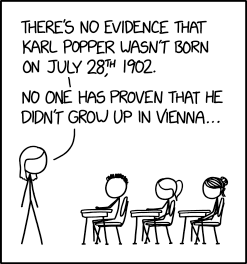
What do you think?

The World of Parmenides: Essays on the Presocratic Enlightenment
This unique collection of essays not only explores the complexity of ancient Greek thought, but also reveals Popper's engagement with Presocratic philosophy and the enlightenment he experienced in reading Parmenides. It includes writings on Greek science, philosophy and history, and demonstrates Popper's lifelong fascination and admiration of the Presocratic philosophers, in particular Parmenides, Xenophanes and Heraclitus.
352 pages, Paperback
First published March 1, 1990
About the author
Karl Popper
311 books1,793 followersSir Karl Raimund Popper, FRS, rose from a modest background as an assistant cabinet maker and school teacher to become one of the most influential theorists and leading philosophers. Popper commanded international audiences and conversation with him was an intellectual adventure—even if a little rough—animated by a myriad of philosophical problems. He contributed to a field of thought encompassing (among others) political theory, quantum mechanics, logic, scientific method and evolutionary theory.
Popper challenged some of the ruling orthodoxies of philosophy: logical positivism, Marxism, determinism and linguistic philosophy. He argued that there are no subject matters but only problems and our desire to solve them. He said that scientific theories cannot be verified but only tentatively refuted, and that the best philosophy is about profound problems, not word meanings. Isaiah Berlin rightly said that Popper produced one of the most devastating refutations of Marxism. Through his ideas Popper promoted a critical ethos, a world in which the give and take of debate is highly esteemed in the precept that we are all infinitely ignorant, that we differ only in the little bits of knowledge that we do have, and that with some co-operative effort we may get nearer to the truth.
Nearly every first-year philosophy student knows that Popper regarded his solutions to the problems of induction and the demarcation of science from pseudo-science as his greatest contributions. He is less known for the problems of verisimilitude, of probability (a life-long love of his), and of the relationship between the mind and body.
Popper was a Fellow of the Royal Society, Fellow of the British Academy, and Membre de I'Institute de France. He was an Honorary member of the Harvard Chapter of Phi Beta Kappa, and an Honorary Fellow of the London School of Economics, King's College London, and of Darwin College Cambridge. He was awarded prizes and honours throughout the world, including the Austrian Grand Decoration of Honour in Gold, the Lippincott Award of the American Political Science Association, and the Sonning Prize for merit in work which had furthered European civilization.
Karl Popper was knighted by Queen Elizabeth II in 1965 and invested by her with the Insignia of a Companion of Honour in 1982.
(edited from http://www.tkpw.net/intro_popper/intr...)
Popper challenged some of the ruling orthodoxies of philosophy: logical positivism, Marxism, determinism and linguistic philosophy. He argued that there are no subject matters but only problems and our desire to solve them. He said that scientific theories cannot be verified but only tentatively refuted, and that the best philosophy is about profound problems, not word meanings. Isaiah Berlin rightly said that Popper produced one of the most devastating refutations of Marxism. Through his ideas Popper promoted a critical ethos, a world in which the give and take of debate is highly esteemed in the precept that we are all infinitely ignorant, that we differ only in the little bits of knowledge that we do have, and that with some co-operative effort we may get nearer to the truth.
Nearly every first-year philosophy student knows that Popper regarded his solutions to the problems of induction and the demarcation of science from pseudo-science as his greatest contributions. He is less known for the problems of verisimilitude, of probability (a life-long love of his), and of the relationship between the mind and body.
Popper was a Fellow of the Royal Society, Fellow of the British Academy, and Membre de I'Institute de France. He was an Honorary member of the Harvard Chapter of Phi Beta Kappa, and an Honorary Fellow of the London School of Economics, King's College London, and of Darwin College Cambridge. He was awarded prizes and honours throughout the world, including the Austrian Grand Decoration of Honour in Gold, the Lippincott Award of the American Political Science Association, and the Sonning Prize for merit in work which had furthered European civilization.
Karl Popper was knighted by Queen Elizabeth II in 1965 and invested by her with the Insignia of a Companion of Honour in 1982.
(edited from http://www.tkpw.net/intro_popper/intr...)
Ratings & Reviews
Friends & Following
Create a free account to discover what your friends think of this book!
Community Reviews
Displaying 1 - 10 of 10 reviews

November 13, 2016
Saggi e conferenze tenute da Popper tra gli anni '60 e '90 del XX secolo sulla filofofia presocratica: Talete Anassimandro, Eraclito, Senofane, ma soprattutto Parmenide. E'lui il vero protagonista della raccolta, visto principalmente come epistemologo e fondatore ante litteram del metodo scientifico ipotetico-deduttivo.
Un bel libro questo di Popper, non c'è che dire, anche se a tratti difficilissimo se non incomprensibile, per me (vedi quanto tratta della presenza del "parmenidismo" nella fisica moderna).
Posso dire di aver su Parmenide imparato più da Popper (che ne è innamoratissimo) che da altre letture.
Un bel libro questo di Popper, non c'è che dire, anche se a tratti difficilissimo se non incomprensibile, per me (vedi quanto tratta della presenza del "parmenidismo" nella fisica moderna).
Posso dire di aver su Parmenide imparato più da Popper (che ne è innamoratissimo) che da altre letture.

March 2, 2016
A wonderful read about the presocratic philosophers and in particular Parmenides, this book is in fact a series of articles put together on similar topics. The first chapters are relatively easy to read and very didactic in a good way (that is understandable by non specialists). However, the later chapters are extremely technical and require a very high level of prerequisite knowledge in advanced logic and in fundamental physics. I found the repetition (due to the structure in articles) a bit fastidious at times. This said, it's a very good read and relatively accessible. Karl Popper presents innovative ideas about ancient thinkers and link them to modern philosophy in a way which is both surprising and comforting.

September 3, 2018
This book is a posthumously published collection of Popper's writings on the Presocratics (mostly; there is some discussion of Socrates, Plato, and Aristotle). The essays were written over a nearly forty year period (the earliest was from 1958, and some were still being worked on when he died.) As one would expect, given Popper's own philosophy of science, he constantly modified his views as a result of criticism and self-criticism, but there is a constant thread through all of them.
The first essay, and the earliest, is his 1958 Presidential Address before the Aristotelian Society, "Back to the Presocratics", in which he outlines his viewpoint on the Presocratics as essentially the first thinkers in history to form a critical tradition, one in which hypotheses could be improved by criticism rather than simply accepted or rejected as dogmas. I've long held the same view of the Presocratics, and I largely agree with Popper's viewpoint (although he sometimes interprets them as coming a bit too close to his own philosophy of science, which he calls "critical rationalism"). Like most writers on the Presocratics, he is in my opinion unfair to Anaximenes; if he had applied his own view that the Presocratic philosophies were all based on criticism of their predecessors, rather than taking Anaximenes as a sort of exception who didn't really understand Anaximander's ideas, I think he might have seen that Anaximenes represented a step forward rather than a step backwards. I know I'm in a minority here and I might not be understanding him correctly -- after all we don't have anything but a few fragments and testimonia to go on, but the ancients themselves considered him as the culmination of the Milesian philosophy and they knew more about both Anaximander and Anaximenes than we do. This is just a minor point, however.
The second essay is one of the best things I have ever read on Xenophanes -- actually the only thing I have read that takes him seriously as a thinker.
Most of the book, however, is devoted to Parmenides, and contains four versions of Popper's argument as he developed it over time. I agree with Popper's views that Parmenides was one of the most important figures in the history of philosophy, and has been long misinterpreted; and that the Way of Seeming is intended seriously and is also a step forward, especially in astronomy, although it was soon to be superseded by the Atomists, who came to their view through criticism of Parmenides. (Popper totally ignores Anaxagoras, who I think was also reacting to Parmenides.) He has two very interesting if unprovable (and unrefutable!) ideas about the origins of the Way of Truth -- that it may have been suggested by Parmenides' discovery that the phases of the Moon are illusions caused by reflected light from the Sun; and that he may have been color blind (or had a blind relative) -- to understand this argument you need to read the book.
The longest essay is his Opening Remarks to a 1965 Conference on Philosophy of Science, "Beyond the Search for Invariants", in which he argues that Parmenides' ideas have been one of the major tendencies in the history of science right down to the present, and discusses Parmenidean and anti-Parmenidean hypotheses in science, inter alia in Newton, Einstein, and thermodynamics.
The later essays are "work in progress", many fragmentary, but of interest.
The first essay, and the earliest, is his 1958 Presidential Address before the Aristotelian Society, "Back to the Presocratics", in which he outlines his viewpoint on the Presocratics as essentially the first thinkers in history to form a critical tradition, one in which hypotheses could be improved by criticism rather than simply accepted or rejected as dogmas. I've long held the same view of the Presocratics, and I largely agree with Popper's viewpoint (although he sometimes interprets them as coming a bit too close to his own philosophy of science, which he calls "critical rationalism"). Like most writers on the Presocratics, he is in my opinion unfair to Anaximenes; if he had applied his own view that the Presocratic philosophies were all based on criticism of their predecessors, rather than taking Anaximenes as a sort of exception who didn't really understand Anaximander's ideas, I think he might have seen that Anaximenes represented a step forward rather than a step backwards. I know I'm in a minority here and I might not be understanding him correctly -- after all we don't have anything but a few fragments and testimonia to go on, but the ancients themselves considered him as the culmination of the Milesian philosophy and they knew more about both Anaximander and Anaximenes than we do. This is just a minor point, however.
The second essay is one of the best things I have ever read on Xenophanes -- actually the only thing I have read that takes him seriously as a thinker.
Most of the book, however, is devoted to Parmenides, and contains four versions of Popper's argument as he developed it over time. I agree with Popper's views that Parmenides was one of the most important figures in the history of philosophy, and has been long misinterpreted; and that the Way of Seeming is intended seriously and is also a step forward, especially in astronomy, although it was soon to be superseded by the Atomists, who came to their view through criticism of Parmenides. (Popper totally ignores Anaxagoras, who I think was also reacting to Parmenides.) He has two very interesting if unprovable (and unrefutable!) ideas about the origins of the Way of Truth -- that it may have been suggested by Parmenides' discovery that the phases of the Moon are illusions caused by reflected light from the Sun; and that he may have been color blind (or had a blind relative) -- to understand this argument you need to read the book.
The longest essay is his Opening Remarks to a 1965 Conference on Philosophy of Science, "Beyond the Search for Invariants", in which he argues that Parmenides' ideas have been one of the major tendencies in the history of science right down to the present, and discusses Parmenidean and anti-Parmenidean hypotheses in science, inter alia in Newton, Einstein, and thermodynamics.
The later essays are "work in progress", many fragmentary, but of interest.
March 22, 2020
Most profound combination of cosmological theories from the Presocratics discussed and analysed with acutely succinct critical approach that raises only admiration. Through the end are included essays that offer explanation of most astonishing theories of physics which are again critically discussed and their relation to inquiry and methodology. Sir Karl Popper never disappoints.

July 7, 2023
I've put-off writing this review for over a year.....just because there is so much in the book and, I figured, tht it would take me ages to pull my own ideas and responses together. I was right. It is taking me a long time. But that's partly because the book is actually a collection of essays. It was never written as a complete work on its own. And much of the material is repetitive....though most of it fascinating. I've long been an admirer of Karl Popper's work and his thinking. I'm not going to try and write an abstract of the book ....just highlight a few of the gems that I found interesting.
With the sole exception, perhaps, of Protagoras, who seems to argue against it, all serious thinkers before Aristotle made a sharp distinction between knowledge, real knowledge, certain truth (saphes, alétheia; later: epistemö, which is divine and only accessible to the gods, and opinion (doxa), which mortals are able to possess, and is interpreted by Xenophanes as guesswork that could be improved. It seems that the first who revolted against this view was Protagoras; "About the gods we don't know anything, so we don't know what they know. Thus human knowledge must be taken as our standard, as our measure." Yet after Protagoras — but only until Aristotle — most thinkers of importance continued to hold the view of Parmenides and his predecessors that only the gods have knowledge. Popper is critical of Aristotle: "Aristotle killed the critical science to which he himself had made a leading contribution. The philosophy of nature, the theory of nature, the great original attempts in cosmology, broke down after Aristotle, owing mainly to the influence of his epistemology, which demanded proof (including inductive proof).I think this is in brief the story of how epistemology as we know it came to be dominated by what Parmenides would have called a wrong way, the way of induction".
On words and their meaning: "The mistaken (‘essentialist') doctrine that we can define (or explicate) a word or term or concept, that we can make its meaning 'definite' or 'precise', is in every way analogous to the mistaken doctrine that we can prove or establish or justify the truth of a theory; in fact, it is part of the latter (justificationist) doctrine.
Every rational discussion , that is every discussion is based on principles, which in actual fact are ethical principles. I should like to state three of them.
The principle of fallibility. Perhaps I am wrong and perhaps you right, but of course, we may both be wrong.
The principle of rational discussion. We need to test critically and, of course, as impersonally as possible the various (criticizable) theories that are in dispute.
The principle of approximation to truth. We can nearly always come closer to the truth with the help of such critical discussions; and we can nearly always improve our understanding, even in cases where we do not reach agreement.
To quote Boltzmann himself.
For the universe as a whole the two directions of time are indistinguishable, just as in space there is no up and down. But there can be a rare downward movement away from the entropy equilibrium position and time would be experienced here as the the direction of going from the less probably to the more probable. (That is, time could be reversed)....."In spite of the unquestioned victory of the ideas for which Boltzmann fought and died, one cannot say that the situation remains completely satisfactory even now.
Popper has clearly been greatly influenced by part of a poem by Parmenides describing the moon where Parmenides says the round moon points her face to the sun even though the sun is below the horizon and interprets this as Parmenides understanding that the phases of the moon (ie change) actually involved no change in the moon itself....just in the way we observed it......so change was an illusion. He says:
"My hypothesis is that Parmenides' great discovery of the cause of the phases of the Moon shocked and overwhelmed its initiator, who extended it to the entire cosmos. There is nothing unlikely in such a story.
But arguing for his tremendous new message on empirical grounds was not possible for Parmenides. An a priori argument had to be found - a solid proof:
(1) Only what is, is.
(2) The nothing cannot be.
(3) There is no empty space.
(4) The world is full.
(5) Motion and change (which is a kind of motion) are impossible:
(6) There is no room for motion, and thus for change, if the world is full.
This is the goddess's proof; as a proof it is infallible and thus divine. If we look at it as a human achievement, it is staggering. It derives a priori the great empirical discovery of the unmoving Moon, and generalizes it. So his discovery is explained, and with it the cosmos!"
Popper also suggests that Parmenides "way of Truth" might be reconstructed as follows: Premise: Only what is truly the case (such as what is known) can be the case, and can truly be.
First conclusion: The non-existing cannot be.
Second conclusion: Nothingness, or the void, cannot be.
Third conclusion: The world is full: it is a continuous block without any division.
Fourth conclusion: Since the world is full, motion is impossible.
In this way, the cosmology of the goddess, the theory of the block universe, is deductively derived from her theory of genuine knowledge.
though Popper mentions here two of the tenets of Parmenides' theory of knowledge which he regards as mistaken.
I've just pulled a few of the gems from this fascinating work by Popper. Must say that I was blown-away by his casual name dropping about discussions with people like Schrödinger and Einstein. And, I'm also reminded that in a course I completed on Plato and Platonism, my professor warned us against reading Plato's Parmenides ...on the grounds that it was too complex/difficult and required a lot of background knowledge. Having completed the current book, I can understand my professor's wisdom. But the current book would certainly benefit from being re-read. There is a lot there. Happy to give it five stars.
With the sole exception, perhaps, of Protagoras, who seems to argue against it, all serious thinkers before Aristotle made a sharp distinction between knowledge, real knowledge, certain truth (saphes, alétheia; later: epistemö, which is divine and only accessible to the gods, and opinion (doxa), which mortals are able to possess, and is interpreted by Xenophanes as guesswork that could be improved. It seems that the first who revolted against this view was Protagoras; "About the gods we don't know anything, so we don't know what they know. Thus human knowledge must be taken as our standard, as our measure." Yet after Protagoras — but only until Aristotle — most thinkers of importance continued to hold the view of Parmenides and his predecessors that only the gods have knowledge. Popper is critical of Aristotle: "Aristotle killed the critical science to which he himself had made a leading contribution. The philosophy of nature, the theory of nature, the great original attempts in cosmology, broke down after Aristotle, owing mainly to the influence of his epistemology, which demanded proof (including inductive proof).I think this is in brief the story of how epistemology as we know it came to be dominated by what Parmenides would have called a wrong way, the way of induction".
On words and their meaning: "The mistaken (‘essentialist') doctrine that we can define (or explicate) a word or term or concept, that we can make its meaning 'definite' or 'precise', is in every way analogous to the mistaken doctrine that we can prove or establish or justify the truth of a theory; in fact, it is part of the latter (justificationist) doctrine.
Every rational discussion , that is every discussion is based on principles, which in actual fact are ethical principles. I should like to state three of them.
The principle of fallibility. Perhaps I am wrong and perhaps you right, but of course, we may both be wrong.
The principle of rational discussion. We need to test critically and, of course, as impersonally as possible the various (criticizable) theories that are in dispute.
The principle of approximation to truth. We can nearly always come closer to the truth with the help of such critical discussions; and we can nearly always improve our understanding, even in cases where we do not reach agreement.
To quote Boltzmann himself.
For the universe as a whole the two directions of time are indistinguishable, just as in space there is no up and down. But there can be a rare downward movement away from the entropy equilibrium position and time would be experienced here as the the direction of going from the less probably to the more probable. (That is, time could be reversed)....."In spite of the unquestioned victory of the ideas for which Boltzmann fought and died, one cannot say that the situation remains completely satisfactory even now.
Popper has clearly been greatly influenced by part of a poem by Parmenides describing the moon where Parmenides says the round moon points her face to the sun even though the sun is below the horizon and interprets this as Parmenides understanding that the phases of the moon (ie change) actually involved no change in the moon itself....just in the way we observed it......so change was an illusion. He says:
"My hypothesis is that Parmenides' great discovery of the cause of the phases of the Moon shocked and overwhelmed its initiator, who extended it to the entire cosmos. There is nothing unlikely in such a story.
But arguing for his tremendous new message on empirical grounds was not possible for Parmenides. An a priori argument had to be found - a solid proof:
(1) Only what is, is.
(2) The nothing cannot be.
(3) There is no empty space.
(4) The world is full.
(5) Motion and change (which is a kind of motion) are impossible:
(6) There is no room for motion, and thus for change, if the world is full.
This is the goddess's proof; as a proof it is infallible and thus divine. If we look at it as a human achievement, it is staggering. It derives a priori the great empirical discovery of the unmoving Moon, and generalizes it. So his discovery is explained, and with it the cosmos!"
Popper also suggests that Parmenides "way of Truth" might be reconstructed as follows: Premise: Only what is truly the case (such as what is known) can be the case, and can truly be.
First conclusion: The non-existing cannot be.
Second conclusion: Nothingness, or the void, cannot be.
Third conclusion: The world is full: it is a continuous block without any division.
Fourth conclusion: Since the world is full, motion is impossible.
In this way, the cosmology of the goddess, the theory of the block universe, is deductively derived from her theory of genuine knowledge.
though Popper mentions here two of the tenets of Parmenides' theory of knowledge which he regards as mistaken.
I've just pulled a few of the gems from this fascinating work by Popper. Must say that I was blown-away by his casual name dropping about discussions with people like Schrödinger and Einstein. And, I'm also reminded that in a course I completed on Plato and Platonism, my professor warned us against reading Plato's Parmenides ...on the grounds that it was too complex/difficult and required a lot of background knowledge. Having completed the current book, I can understand my professor's wisdom. But the current book would certainly benefit from being re-read. There is a lot there. Happy to give it five stars.

August 6, 2018
Not quite the first book by Popper to read, only for 'die Liebhaber' (with an interest in ancient Greek). A compelling narative in favour of a certain interpretation of Parmenidian philosophy, this (deliberately) repetive book shows Popper's lifetime commitment to understanding ancient texts based on some very scarce sources about presocratics (I hate this denigrating term). I can't judge his view, but it has given me additional incentives to take up ancient Greek again and improve my understanding and mastery of probability theory - Popper having devoloped his own (probably faulty) probability theory. His Logic of Scientific Discovery and Open Society are definitely mustreads, but this book is just a book for the diehard fans. Not always an easy read, but still far more readable than so many texts written by 20th century philosophers.

January 31, 2018
Liked Nietzsche's hypothetical „Parmenidean turn“ much better. He turned away from empiricism because he realized the moon was spherical? Really, Karl?

May 23, 2025
I read most of the essays in this collection, and while parts of it were interesting, others were quite challenging—especially when Popper ventured into areas like geometry, the nature of time, and metaphysical themes that don’t resonate with my particular philosophical interests.
This book came to me as part of a large secondhand collection I purchased, and I’m glad I gave it a try. Popper clearly had a deep fascination with the Presocratics, especially Parmenides, and he brings together a lifetime of work and reflection here. But for me, it felt more like an educational exercise than something that spoke deeply to my soul.
If you are drawn to the Presocratic thinkers and interested in the intersection between early philosophy and science, this book may be valuable. But if, like me, your philosophical home lies elsewhere—perhaps in ethics, existentialism, or spiritual interiority—it may not fully land.
Still, I’m pleased to have read it, and I leave it behind with gratitude and the quiet joy of moving forward to themes more aligned with my path.
This book came to me as part of a large secondhand collection I purchased, and I’m glad I gave it a try. Popper clearly had a deep fascination with the Presocratics, especially Parmenides, and he brings together a lifetime of work and reflection here. But for me, it felt more like an educational exercise than something that spoke deeply to my soul.
If you are drawn to the Presocratic thinkers and interested in the intersection between early philosophy and science, this book may be valuable. But if, like me, your philosophical home lies elsewhere—perhaps in ethics, existentialism, or spiritual interiority—it may not fully land.
Still, I’m pleased to have read it, and I leave it behind with gratitude and the quiet joy of moving forward to themes more aligned with my path.
July 5, 2024
Some brilliant ideas, especially on the origin of Parmenides thought being inspired by his discoveries with the phases of the moon, but a repetitive selection of work and draws in some of Poppers highly pedantic analysis of the original sources. I love the broad ideas, the pedantic analysis does little to convince me further - the ideas are enough

February 24, 2022
Popper's enthusiasm for the bold theories of the pre-socratics is infectious.
Displaying 1 - 10 of 10 reviews