

What do you think?

Freedom Round the Globe: A World History of the American Revolution
A truly global reckoning with one of the most revolutionary moments in modern history
In 1776, the world was in flux. Winds of change were blowing far beyond the shores of the nascent United States of America, whether in the debating clubs of Edinburgh, where women were demanding happiness along with men, or the brutal sugar plantations of the Caribbean, where enslaved Africans were rising up in rebellion.
In this authoritative revisionist history, Sarah M. S. Pearsall restores the shock and drama of that epoch-defining moment, revealing how the fires of change that sparked the American Revolution were igniting all around the world. From St. Kitts to Kolkata, Ghana to Guangzhou, all kinds of people, not just the men declaring independence in Philadelphia, asserted their rights to life, liberty, and the pursuit of happiness.
As we approach the 250th anniversary of the Revolution, Freedom Round the Globe tells a story the world needs to hear, of the fraught origins of a nation that by turns perplexes, fascinates and horrifies us. It is a story of global transformation and revolutionary fervour, of triumph as well as tragedy, and of the insurgents, lovers, and dreamers who dared to imagine better societies.
In 1776, the world was in flux. Winds of change were blowing far beyond the shores of the nascent United States of America, whether in the debating clubs of Edinburgh, where women were demanding happiness along with men, or the brutal sugar plantations of the Caribbean, where enslaved Africans were rising up in rebellion.
In this authoritative revisionist history, Sarah M. S. Pearsall restores the shock and drama of that epoch-defining moment, revealing how the fires of change that sparked the American Revolution were igniting all around the world. From St. Kitts to Kolkata, Ghana to Guangzhou, all kinds of people, not just the men declaring independence in Philadelphia, asserted their rights to life, liberty, and the pursuit of happiness.
As we approach the 250th anniversary of the Revolution, Freedom Round the Globe tells a story the world needs to hear, of the fraught origins of a nation that by turns perplexes, fascinates and horrifies us. It is a story of global transformation and revolutionary fervour, of triumph as well as tragedy, and of the insurgents, lovers, and dreamers who dared to imagine better societies.
432 pages, Hardcover
First published May 14, 2026
Ratings & Reviews
Friends & Following
Create a free account to discover what your friends think of this book!
Community Reviews
Displaying 1 - 22 of 22 reviews

June 27, 2026
It’s revolutionary summer, and a new trend is taking hold among historians of American history: the Revolution not as an anomaly but as part of a global phenomenon, stretching all the way from India to Ireland to Sierra Leone. That’s the general premise, anyway. Richard Bell’s The American Revolution and the Fate of the World did a solid job of showing how events across the globe contributed to the success of the Revolution, and Danielle S. Allen’s Radical Duke traced the roots of the war’s ideology back to dissidents within Britain’s parliament. (Curiously, this new crop of books is largely uninterested in what happened after the war, namely the domino effect the American Revolution had throughout Latin America, which was arguably much more momentous.) Sarah Pearsall’s Freedom Round the Globe follows an arc similar to Bell’s, but without the same cohesiveness that made Bell’s book both accessible and persuasive. This isn’t to say that Pearsall is a poor writer—far from it. Her prose contains a fluidity that many academic works lack, and the details she includes help paint a portrait of eighteenth-century America that can be lost when adhering strictly to political or military history. Buried in this book are tales about feuding couples who took out newspaper ads against each other, European recruitments, the exaggerated misconceptions foreigners had about Americans, and the influence Native ideologies had on the young nation. Most notable for this reader was Pearsall’s effort to explain why other British colonies in North America declined to join the fight, a pressing question that is often left unanswered in retellings of the Revolution.
Informative though they may be, Pearsall’s long string of side-tangents muddies the waters and give Freedom Round the Globe a scatterbrained, unfocused feel. Pearsall will jump from talking about a runaway slave (or rather an enslaved person who liberated themselves, to use her parlance) to a British lecturer promoting miracle beds to a dog who was tarred and feathered with strips of newspaper within the span of a few pages. In the conclusion, she claims this book debunks American exceptionalism because people in other countries were also advocating for rights and liberties at the time, even though they were largely unsuccessful (and again, the places that did successfully secede from one empire or another after the war are left unmentioned). Pearsall devotes a great deal of time to regaling anecdotes about indigenous and enslaved peoples, which is a perfectly valid research topic on its own, but runs counter to this book’s premise, which is about the people and places outside of the United States. (And naturally, because of the time we live in, there had to be at least one reference to “twenty-first century insurrectionists” slipped in before the end.)
And that’s the real root of the problem here: for a book that’s supposed to be about the influence that other countries had on the American Revolution, Freedom Round the Globe doesn’t provide much analysis on either the war or the rest of the world. If you don’t already have a basic understanding for the timeline of the war, you won’t find one here, and the role of the foreigners discussed is fairly well-trodden ground: the Americans enlisted the French for help, the British enlisted the Hessians, and some black freedmen relocated to African at the end of the war. For the most part, Freedom Round the Globe is just a mishmash of anecdotes—interesting, yes, but not quite what the audience was promised.
Informative though they may be, Pearsall’s long string of side-tangents muddies the waters and give Freedom Round the Globe a scatterbrained, unfocused feel. Pearsall will jump from talking about a runaway slave (or rather an enslaved person who liberated themselves, to use her parlance) to a British lecturer promoting miracle beds to a dog who was tarred and feathered with strips of newspaper within the span of a few pages. In the conclusion, she claims this book debunks American exceptionalism because people in other countries were also advocating for rights and liberties at the time, even though they were largely unsuccessful (and again, the places that did successfully secede from one empire or another after the war are left unmentioned). Pearsall devotes a great deal of time to regaling anecdotes about indigenous and enslaved peoples, which is a perfectly valid research topic on its own, but runs counter to this book’s premise, which is about the people and places outside of the United States. (And naturally, because of the time we live in, there had to be at least one reference to “twenty-first century insurrectionists” slipped in before the end.)
And that’s the real root of the problem here: for a book that’s supposed to be about the influence that other countries had on the American Revolution, Freedom Round the Globe doesn’t provide much analysis on either the war or the rest of the world. If you don’t already have a basic understanding for the timeline of the war, you won’t find one here, and the role of the foreigners discussed is fairly well-trodden ground: the Americans enlisted the French for help, the British enlisted the Hessians, and some black freedmen relocated to African at the end of the war. For the most part, Freedom Round the Globe is just a mishmash of anecdotes—interesting, yes, but not quite what the audience was promised.

Review of advance copy
Liberty, Close Enough to Read
Sarah M. S. Pearsall’s Global History of the American Revolution Shows How Founding Words Traveled Farther Than Their Owners Intended.
By Demetris Papadimitropoulos | May 23rd, 2026
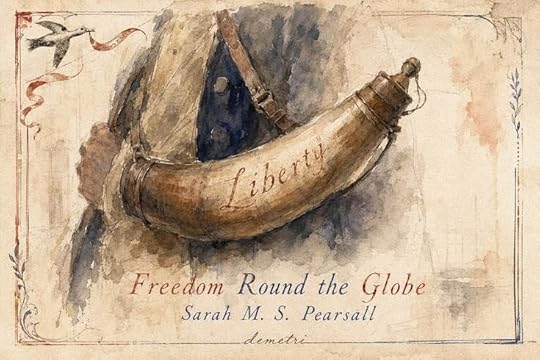
The Word on the Powder Horn – Prince Simbo’s inscribed horn becomes the visual thesis of “Freedom Round the Globe,” holding beauty, violence, ownership, and the unfinished promise of liberty close to the body.
In Sarah M. S. Pearsall’s “Freedom Round the Globe: A World History of the American Revolution,” liberty first appears not as a word with a pedestal under it, but as an inscription on a powder horn. Prince Simbo, a Black soldier in the Continental Army, carried that horn close to his body in 1777. It was workaday, beautiful, lethal – and morally uncanny.
It held gunpowder. It turned military equipment into American folk art. It carried borrowed motifs from Atlantic, Indigenous, European, and imperial visual languages. And it bore a summons that could not possibly have been simple for the man who owned it.
Whether Simbo himself was enslaved remains unclear. What is clear is that he moved through a world where slavery was everywhere, where Black people were often denied weapons, ownership, mobility, and personhood. “Liberty” could be close enough to read but not close enough to possess. Pearsall knows exactly what she has found in that horn. It is not just an artifact. It is history already arguing with itself.
“Freedom Round the Globe” arrives just as the republic is oiling its semiquincentennial machinery. It is not bunting in book form. Pearsall calls it, winningly, a “wonky celebration” of the 250th anniversary of the “Declaration of Independence,” and the phrase is just right: affectionate, corrective without becoming dutiful, and dryly self-puncturing, as if the word “celebration” had been assigned a chaperone with archival credentials.
This is a book about the American Revolution, but it is impatient with the habit of treating the Revolution as if it emerged from thirteen colonies peering heroically into a mirror. Pearsall tilts the old portrait until its background starts talking. Liberty, equality, consent, security: these promises were not sitting obediently in Philadelphia, waiting to be invented by eloquent men in buckled shoes. They were already changing hands, accents, and consequences across a world of war, slavery, empire, famine, Indigenous diplomacy, women’s constraint, commerce, exile, and revolt.
The elegance of the structure is also its risk. Pearsall organizes thirteen chapters around positive keywords drawn from the “Declaration of Independence,” each paired with a place outside, adjacent to, or meaningfully beyond the schoolroom thirteen-colony story. That is the governing contradiction: the book loosens America’s grip on revolutionary ideals by anchoring every chapter to the document most often used to claim them.
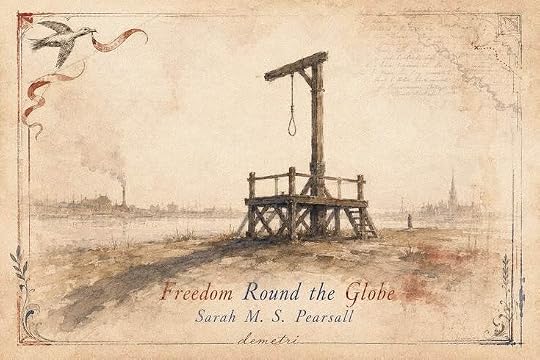
A Gallows in Bkejwanong – The gallows stands in spare parchment light as “Freedom Round the Globe” begins its account of unity not with Congress, but with coercion, erasure, and competing claims to justice.
Unity begins not in Congress but at a gallows in Bkejwanong, or Detroit, where an unnamed enslaved Indigenous woman is executed after being accused of murdering her master. Consent begins in a tavern in St. Kitts, among white colonists outraged by the Stamp Act while dependent on enslaved labor. Governments moves through Kolkata and the Bengal famine, where East India Company rule makes imperial extraction impossible to separate from American complaints about tyranny. From there the book moves through Edinburgh salons, West African forts, Québec snow, German villages, French halls, Haudenosaunee fields, Caribbean waters, Chinese trade, and Sierra Leone’s precarious experiment in equality. On paper, the design can sound like a curriculum of grievance and gunpowder. The life is in the detours.
Pearsall has a talent for beginning with a concrete thing – a horn, a gallows, a tavern, a street, a cornfield, a mansion, a settlement – and letting it unfold into the machinery of tax, hunger, law, sex, land, and force. The method is not additive bookkeeping, even though Pearsall does restore many people to view. The sharper question sits beneath the map: who gets custody of ideals? Not just who pronounces them, but who pays for them, enforces them, is excluded from them, or has to make them livable after the speeches end?
That question turns “Freedom Round the Globe” from a widened Revolutionary history into something more precise and more unsettling. Pearsall’s great achievement is that she makes polished civic words less possessable, more crowded, and less likely to sit quietly in a civics display. “Unity,” for example, is not allowed to remain a civic greeting-card virtue. In the first chapter, the execution of the unnamed Panis woman opens into the Great Lakes world of French-Indigenous accommodation, Native enslavement, British imperial arrogance, Pontiac’s resistance, the Paxton Boys’ murders, and the uneasy emergence of settler solidarity. Unity can mean Indigenous confederation against British coercion. It can also mean colonial togetherness built by excluding, fearing, and killing others. The unsettling point is not that revolutionary language is fraudulent. It is that such language can stretch far enough to shelter enemies.
Her account of “security” makes the reversal colder. Seen from within a national founding story, security can sound like the most reasonable word at the table: constitutions, common defense, sober responsibility. Seen from a Six Nations cornfield, it looks rather different. Pearsall’s treatment of the Sullivan campaign and the devastation of Haudenosaunee towns, orchards, and crops turns the term inside out. Corn is food, labor, season, sovereignty, winter storage, and future. To burn it is to make political theory winter in the body.
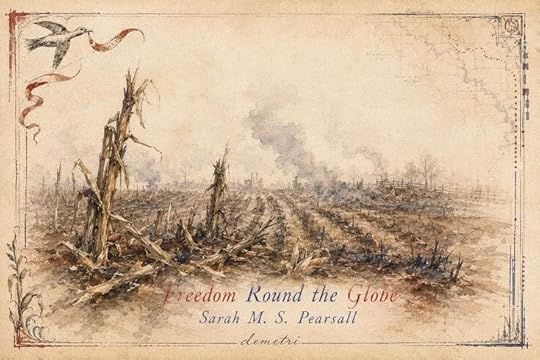
Security in the Cornfield – Broken corn stalks and cold open ground turn the word “security” into food, winter storage, sovereignty, and survival placed under deliberate assault.
Pearsall’s prose is one of the book’s quieter pleasures, even when it carries more luggage than the sentence quite wants. She keeps the archive door open. Her sentences gather detail before pivoting into interpretation. She favors the quick widening aperture: first the object, then the hand that held it, then the system that made that hand vulnerable, then the empire, then the word. The diction moves between the archival and the conversational. She can discuss sovereignty, imperial extraction, and revolutionary ideology, then give us grubby breeches, wampum, glitter, gunpowder, petticoats, blankets, tea, silk robes, and soap. In the best pages, the eighteenth century feels tactile without being stuffed into a costume cupboard.
She is also funny in the way good historians can be funny: not by making the past cute, but by letting its absurdities and vanities show. Her description of the “Declaration” as seeming, at first glance, like the product of grumpy old men telling the world to get off their olde lawn has a little snap to it, but the joke is not evasive. It opens a door. Pearsall understands that reverence and irreverence are not opposites. Sometimes one must be irreverent toward the ceremonial packaging in order to take the ideal seriously.
For all its fluency, the prose sometimes carries too much at once. Pearsall is often moving among scene, archive, geography, interpretation, and connective tissue within the same paragraph. Those wanting a clean military-political chronology of the Revolution may find the account crowded. It advances by displacement: each new scene widens the founding crisis. You enter one location, learn its local pressures, and then discover why a founding word has been waiting there all along. The suspense is geographic and ethical. Not “what happens next?” but “where else has this word been?”
The design works because displacement becomes discovery. Pearsall’s decision to begin each chapter away from the expected American landmarks is especially effective. Boston, Philadelphia, Yorktown, and Jefferson all appear, but they do not get to monopolize the light. The Revolution is made strange again because the reader is repeatedly displaced before being returned. Why Kolkata, St. Kitts, Guangzhou, Sierra Leone? Because the rebellion’s grand vocabulary was shaped by routes and institutions Americans did not merely resist but inhabited, extended, and profited from: slavery, land hunger, imperial trade, military alliance, financial speculation, constitutional compromise.
The same design takes its toll. One sometimes hears the joinery creak. Each chapter must serve several masters: a place, a keyword, a cast of historical actors, a global connection, an American Revolutionary development, and a reversal in meaning. Pearsall usually earns the pattern. At moments, though, the material can feel arranged rather than stumbled upon, as if the chapter has been asked to prove the aptness of its assigned term. The pattern holds, though the pattern can be heard. “Freedom Round the Globe” can feel more like a brilliantly curated atlas than a fully propulsive narrative.
Among recent histories, Maya Jasanoff’s “Liberty’s Exiles” is the closest cousin: another account of the Revolution as an event that scattered people across the British world rather than ending neatly at Yorktown. David Armitage’s “The Declaration of Independence: A Global History” is another useful point of reference, though Pearsall’s account is warmer, more peopled, more committed to scenes and bodies. She writes document history with muddy shoes: the text matters, but so do the roads, ships, fields, and bodies around it. The map matters; so does the hand holding it; so does the person erased by its border.
Pearsall’s sharpest move is to refuse two lazy reflexes. She does not treat the American Revolution as a spotless origin story. Nor does she reduce its principles to ornamental hypocrisy. She is too attentive to enslaved petitioners, Indigenous diplomats, women boycotters, German soldiers, Black Loyalists, Spanish imperial actors, South Asian resisters, and displaced refugees to let any single account harden into convenience. Her Revolution is liberating and coercive, provincial and international, brave and predatory, rhetorically universal and selectively administered. She does not ask readers to choose between admiration and indictment. She asks them to notice that the most consequential promises are often the ones people fail to honor most spectacularly.
The final chapters make comfort harder to sustain. In Sierra Leone, Pearsall follows Black poor and Black Loyalist settlers into an experiment that promised land, self-government, and equality beyond slavery. The settlement is not romanticized. It is beset by delay, hunger, disease, storms, rotten provisions, conflict with local Temne people, and proximity to slave-trading economies. Yet it also briefly makes equality more concrete than the new United States often dared to do. Households, including women-headed households, matter politically. Land distribution is imagined with striking egalitarian force. Freedom is no longer only a word in a declaration; it is acreage, voting, survival, soap, and the right to be ordinary without permission.
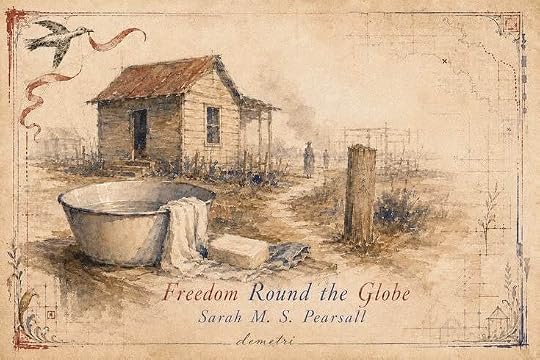
Land, Soap, and a New Ordinary – In the Sierra Leone settlement image, freedom becomes modest and material: a parcel line, a basin, a dwelling, and the precarious right to ordinary life.
Then Pearsall turns back to the United States, where the Constitution both stabilizes and narrows revolutionary possibility. Slavery is protected while being verbally avoided. Equality yields to property, security, compromise, and fear. The words “slave” and “slavery” need not appear for slavery’s power to be felt.
A nation may omit a word in order to preserve the thing.
The Word Omitted – A pale constitutional field, crossed by shadow and blank space, gives visual form to the book’s coldest lesson: a nation may omit a word in order to preserve the thing.
The ending does not cancel the Revolution; it unsettles the terms on which it can be praised. That is precisely what makes the book valuable in a season of official remembrance. “Freedom Round the Globe” is not a sermon delivered over birthday cake. It is something more useful: a reminder that celebration without complication is just decoration, and complication without seriousness is just cleverness in a powdered wig. Pearsall offers neither bunting nor easy acid. She offers a history in which the principles remain luminous because so many people, including those denied their benefits, kept forcing them to mean more than their official guardians intended.
Its crowdedness is the bargain: enlargement requires labor. For me, that makes “Freedom Round the Globe” an 88/100, 4/5 stars. This is a strong, ambitious work of public history whose design is more seamless in conception than in every paragraph of execution. It asks the reader to hold Bengal famine, Great Lakes diplomacy, Caribbean slavery, Scottish sociability, German conscription, French courtcraft, Indigenous devastation, Spanish silver, Chinese trade, Black resettlement, and American constitutional compromise in the same field of vision.
By the end, the powder horn from the introduction has become more than an opening image. It is the book’s quiet accusation. Here is liberty, carved into an object made for war, carried by a Black soldier in a world that could speak freedom fluently while rationing it cruelly. Here is beauty, danger, ownership, aspiration, and contradiction strapped close to the body. Pearsall’s book does not let Americans throw that horn into a display case and walk away proud. It asks us to keep looking at the word on its surface until it stops behaving like an heirloom and starts behaving like a demand.
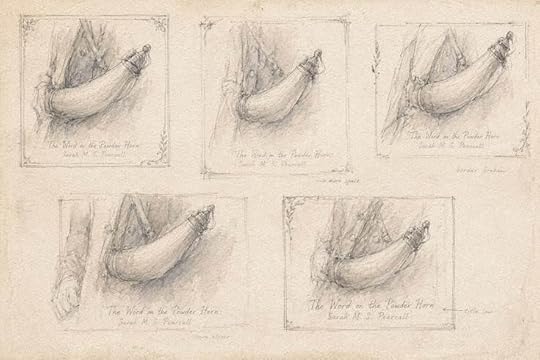
Compositional thumbnail sheet – Early thumbnail studies search for the right balance between horn, body, border, and negative space, showing how the image’s moral pressure begins as a problem of placement.
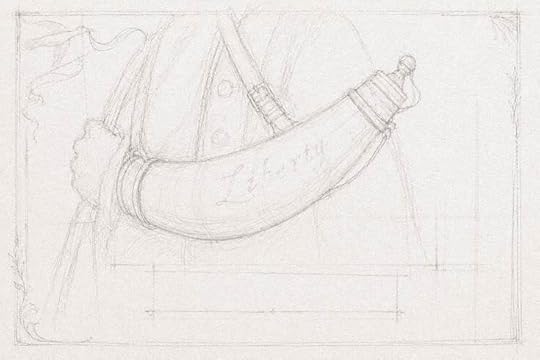
Faint pencil underdrawing – The first graphite structure fixes the horn’s curve, strap, partial body, and border geometry while leaving enough open paper for the finished watercolor to remain fragile and unresolved.
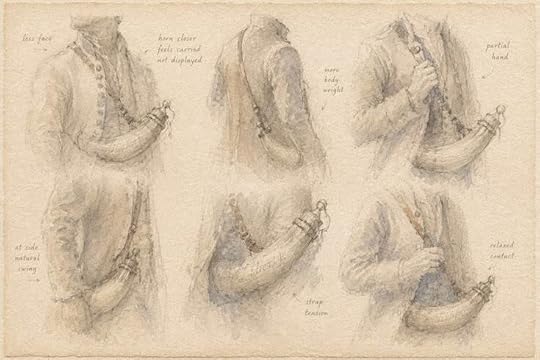
Character anatomical / posture study – These partial figure studies explore how little of Prince Simbo’s body needs to appear for the horn to feel carried rather than displayed.
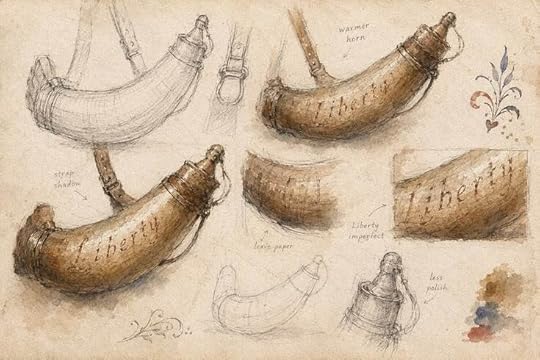
Powder horn detail / inscription study – A close study of the horn’s curve, surface, and imperfect “Liberty” inscription shows how the central object becomes both artifact and accusation.
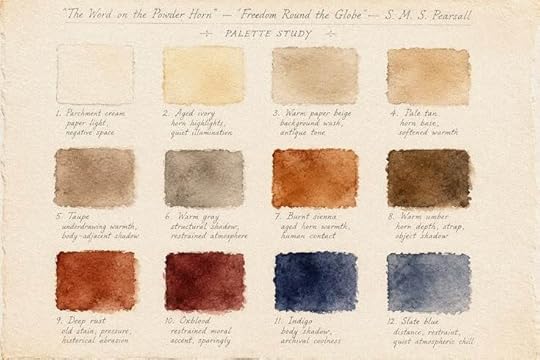
Color swatch sheet – The cover palette is tested in parchment neutrals, burnt sienna, indigo, oxblood, slate blue, and warm umber, establishing the restrained historical atmosphere of the final image.
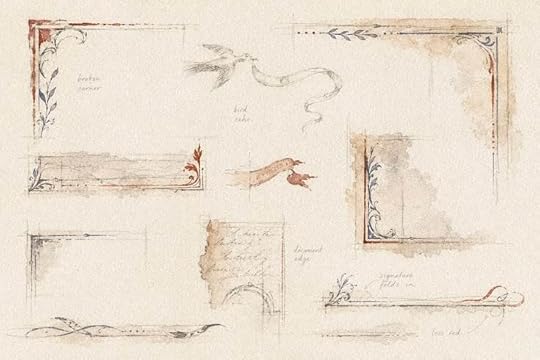
Watercolor border study – Border experiments draw from archival documents, bird-and-banner motifs, and Revolutionary-era printed matter, shaping a frame that feels historical without becoming decorative clutter.
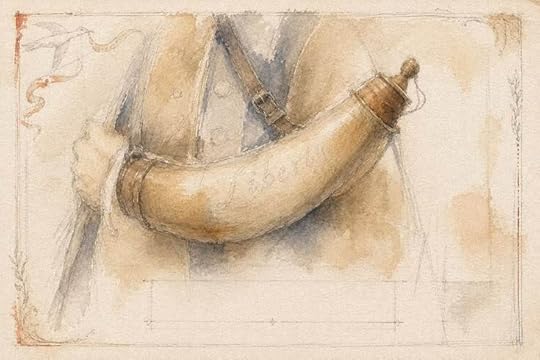
Pencil-plus-first-wash stage – The first washes bring warmth, shadow, and breath into the underdrawing while preserving visible graphite, open paper, and the image’s deliberately unfinished intelligence.
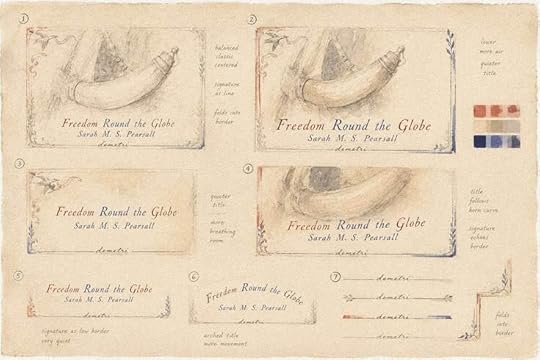
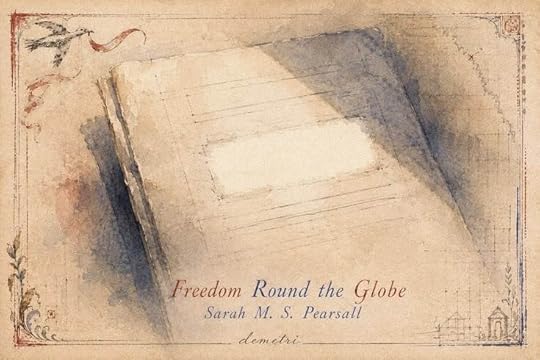
Lettering and signature placement study – Title, author name, and the extended “demetri” signature are tested as part of the watercolor’s architecture, turning text into a quiet extension of the border.
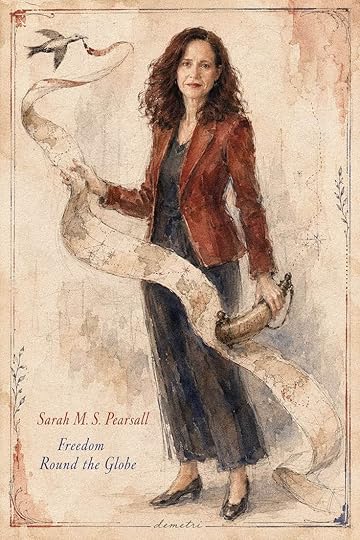
Author portrait of Sarah M. S. Pearsall – A literary watercolor caricature filtered through the book’s global, archival imagination: the historian as guide, mapmaker, and keeper of an unfinished word.
All watercolor illustrations by Demetris Papadimitropoulos.
Watercolors are done on 140lb vellum and then scanned into the computer using an Epson scanner. From there, they are finalized in Procreate. All art and opinions are my own.
Sarah M. S. Pearsall’s Global History of the American Revolution Shows How Founding Words Traveled Farther Than Their Owners Intended.
By Demetris Papadimitropoulos | May 23rd, 2026
The Word on the Powder Horn – Prince Simbo’s inscribed horn becomes the visual thesis of “Freedom Round the Globe,” holding beauty, violence, ownership, and the unfinished promise of liberty close to the body.
In Sarah M. S. Pearsall’s “Freedom Round the Globe: A World History of the American Revolution,” liberty first appears not as a word with a pedestal under it, but as an inscription on a powder horn. Prince Simbo, a Black soldier in the Continental Army, carried that horn close to his body in 1777. It was workaday, beautiful, lethal – and morally uncanny.
It held gunpowder. It turned military equipment into American folk art. It carried borrowed motifs from Atlantic, Indigenous, European, and imperial visual languages. And it bore a summons that could not possibly have been simple for the man who owned it.
Whether Simbo himself was enslaved remains unclear. What is clear is that he moved through a world where slavery was everywhere, where Black people were often denied weapons, ownership, mobility, and personhood. “Liberty” could be close enough to read but not close enough to possess. Pearsall knows exactly what she has found in that horn. It is not just an artifact. It is history already arguing with itself.
“Freedom Round the Globe” arrives just as the republic is oiling its semiquincentennial machinery. It is not bunting in book form. Pearsall calls it, winningly, a “wonky celebration” of the 250th anniversary of the “Declaration of Independence,” and the phrase is just right: affectionate, corrective without becoming dutiful, and dryly self-puncturing, as if the word “celebration” had been assigned a chaperone with archival credentials.
This is a book about the American Revolution, but it is impatient with the habit of treating the Revolution as if it emerged from thirteen colonies peering heroically into a mirror. Pearsall tilts the old portrait until its background starts talking. Liberty, equality, consent, security: these promises were not sitting obediently in Philadelphia, waiting to be invented by eloquent men in buckled shoes. They were already changing hands, accents, and consequences across a world of war, slavery, empire, famine, Indigenous diplomacy, women’s constraint, commerce, exile, and revolt.
The elegance of the structure is also its risk. Pearsall organizes thirteen chapters around positive keywords drawn from the “Declaration of Independence,” each paired with a place outside, adjacent to, or meaningfully beyond the schoolroom thirteen-colony story. That is the governing contradiction: the book loosens America’s grip on revolutionary ideals by anchoring every chapter to the document most often used to claim them.
A Gallows in Bkejwanong – The gallows stands in spare parchment light as “Freedom Round the Globe” begins its account of unity not with Congress, but with coercion, erasure, and competing claims to justice.
Unity begins not in Congress but at a gallows in Bkejwanong, or Detroit, where an unnamed enslaved Indigenous woman is executed after being accused of murdering her master. Consent begins in a tavern in St. Kitts, among white colonists outraged by the Stamp Act while dependent on enslaved labor. Governments moves through Kolkata and the Bengal famine, where East India Company rule makes imperial extraction impossible to separate from American complaints about tyranny. From there the book moves through Edinburgh salons, West African forts, Québec snow, German villages, French halls, Haudenosaunee fields, Caribbean waters, Chinese trade, and Sierra Leone’s precarious experiment in equality. On paper, the design can sound like a curriculum of grievance and gunpowder. The life is in the detours.
Pearsall has a talent for beginning with a concrete thing – a horn, a gallows, a tavern, a street, a cornfield, a mansion, a settlement – and letting it unfold into the machinery of tax, hunger, law, sex, land, and force. The method is not additive bookkeeping, even though Pearsall does restore many people to view. The sharper question sits beneath the map: who gets custody of ideals? Not just who pronounces them, but who pays for them, enforces them, is excluded from them, or has to make them livable after the speeches end?
That question turns “Freedom Round the Globe” from a widened Revolutionary history into something more precise and more unsettling. Pearsall’s great achievement is that she makes polished civic words less possessable, more crowded, and less likely to sit quietly in a civics display. “Unity,” for example, is not allowed to remain a civic greeting-card virtue. In the first chapter, the execution of the unnamed Panis woman opens into the Great Lakes world of French-Indigenous accommodation, Native enslavement, British imperial arrogance, Pontiac’s resistance, the Paxton Boys’ murders, and the uneasy emergence of settler solidarity. Unity can mean Indigenous confederation against British coercion. It can also mean colonial togetherness built by excluding, fearing, and killing others. The unsettling point is not that revolutionary language is fraudulent. It is that such language can stretch far enough to shelter enemies.
Her account of “security” makes the reversal colder. Seen from within a national founding story, security can sound like the most reasonable word at the table: constitutions, common defense, sober responsibility. Seen from a Six Nations cornfield, it looks rather different. Pearsall’s treatment of the Sullivan campaign and the devastation of Haudenosaunee towns, orchards, and crops turns the term inside out. Corn is food, labor, season, sovereignty, winter storage, and future. To burn it is to make political theory winter in the body.
Security in the Cornfield – Broken corn stalks and cold open ground turn the word “security” into food, winter storage, sovereignty, and survival placed under deliberate assault.
Pearsall’s prose is one of the book’s quieter pleasures, even when it carries more luggage than the sentence quite wants. She keeps the archive door open. Her sentences gather detail before pivoting into interpretation. She favors the quick widening aperture: first the object, then the hand that held it, then the system that made that hand vulnerable, then the empire, then the word. The diction moves between the archival and the conversational. She can discuss sovereignty, imperial extraction, and revolutionary ideology, then give us grubby breeches, wampum, glitter, gunpowder, petticoats, blankets, tea, silk robes, and soap. In the best pages, the eighteenth century feels tactile without being stuffed into a costume cupboard.
She is also funny in the way good historians can be funny: not by making the past cute, but by letting its absurdities and vanities show. Her description of the “Declaration” as seeming, at first glance, like the product of grumpy old men telling the world to get off their olde lawn has a little snap to it, but the joke is not evasive. It opens a door. Pearsall understands that reverence and irreverence are not opposites. Sometimes one must be irreverent toward the ceremonial packaging in order to take the ideal seriously.
For all its fluency, the prose sometimes carries too much at once. Pearsall is often moving among scene, archive, geography, interpretation, and connective tissue within the same paragraph. Those wanting a clean military-political chronology of the Revolution may find the account crowded. It advances by displacement: each new scene widens the founding crisis. You enter one location, learn its local pressures, and then discover why a founding word has been waiting there all along. The suspense is geographic and ethical. Not “what happens next?” but “where else has this word been?”
The design works because displacement becomes discovery. Pearsall’s decision to begin each chapter away from the expected American landmarks is especially effective. Boston, Philadelphia, Yorktown, and Jefferson all appear, but they do not get to monopolize the light. The Revolution is made strange again because the reader is repeatedly displaced before being returned. Why Kolkata, St. Kitts, Guangzhou, Sierra Leone? Because the rebellion’s grand vocabulary was shaped by routes and institutions Americans did not merely resist but inhabited, extended, and profited from: slavery, land hunger, imperial trade, military alliance, financial speculation, constitutional compromise.
The same design takes its toll. One sometimes hears the joinery creak. Each chapter must serve several masters: a place, a keyword, a cast of historical actors, a global connection, an American Revolutionary development, and a reversal in meaning. Pearsall usually earns the pattern. At moments, though, the material can feel arranged rather than stumbled upon, as if the chapter has been asked to prove the aptness of its assigned term. The pattern holds, though the pattern can be heard. “Freedom Round the Globe” can feel more like a brilliantly curated atlas than a fully propulsive narrative.
Among recent histories, Maya Jasanoff’s “Liberty’s Exiles” is the closest cousin: another account of the Revolution as an event that scattered people across the British world rather than ending neatly at Yorktown. David Armitage’s “The Declaration of Independence: A Global History” is another useful point of reference, though Pearsall’s account is warmer, more peopled, more committed to scenes and bodies. She writes document history with muddy shoes: the text matters, but so do the roads, ships, fields, and bodies around it. The map matters; so does the hand holding it; so does the person erased by its border.
Pearsall’s sharpest move is to refuse two lazy reflexes. She does not treat the American Revolution as a spotless origin story. Nor does she reduce its principles to ornamental hypocrisy. She is too attentive to enslaved petitioners, Indigenous diplomats, women boycotters, German soldiers, Black Loyalists, Spanish imperial actors, South Asian resisters, and displaced refugees to let any single account harden into convenience. Her Revolution is liberating and coercive, provincial and international, brave and predatory, rhetorically universal and selectively administered. She does not ask readers to choose between admiration and indictment. She asks them to notice that the most consequential promises are often the ones people fail to honor most spectacularly.
The final chapters make comfort harder to sustain. In Sierra Leone, Pearsall follows Black poor and Black Loyalist settlers into an experiment that promised land, self-government, and equality beyond slavery. The settlement is not romanticized. It is beset by delay, hunger, disease, storms, rotten provisions, conflict with local Temne people, and proximity to slave-trading economies. Yet it also briefly makes equality more concrete than the new United States often dared to do. Households, including women-headed households, matter politically. Land distribution is imagined with striking egalitarian force. Freedom is no longer only a word in a declaration; it is acreage, voting, survival, soap, and the right to be ordinary without permission.
Land, Soap, and a New Ordinary – In the Sierra Leone settlement image, freedom becomes modest and material: a parcel line, a basin, a dwelling, and the precarious right to ordinary life.
Then Pearsall turns back to the United States, where the Constitution both stabilizes and narrows revolutionary possibility. Slavery is protected while being verbally avoided. Equality yields to property, security, compromise, and fear. The words “slave” and “slavery” need not appear for slavery’s power to be felt.
A nation may omit a word in order to preserve the thing.
The Word Omitted – A pale constitutional field, crossed by shadow and blank space, gives visual form to the book’s coldest lesson: a nation may omit a word in order to preserve the thing.
The ending does not cancel the Revolution; it unsettles the terms on which it can be praised. That is precisely what makes the book valuable in a season of official remembrance. “Freedom Round the Globe” is not a sermon delivered over birthday cake. It is something more useful: a reminder that celebration without complication is just decoration, and complication without seriousness is just cleverness in a powdered wig. Pearsall offers neither bunting nor easy acid. She offers a history in which the principles remain luminous because so many people, including those denied their benefits, kept forcing them to mean more than their official guardians intended.
Its crowdedness is the bargain: enlargement requires labor. For me, that makes “Freedom Round the Globe” an 88/100, 4/5 stars. This is a strong, ambitious work of public history whose design is more seamless in conception than in every paragraph of execution. It asks the reader to hold Bengal famine, Great Lakes diplomacy, Caribbean slavery, Scottish sociability, German conscription, French courtcraft, Indigenous devastation, Spanish silver, Chinese trade, Black resettlement, and American constitutional compromise in the same field of vision.
By the end, the powder horn from the introduction has become more than an opening image. It is the book’s quiet accusation. Here is liberty, carved into an object made for war, carried by a Black soldier in a world that could speak freedom fluently while rationing it cruelly. Here is beauty, danger, ownership, aspiration, and contradiction strapped close to the body. Pearsall’s book does not let Americans throw that horn into a display case and walk away proud. It asks us to keep looking at the word on its surface until it stops behaving like an heirloom and starts behaving like a demand.
Compositional thumbnail sheet – Early thumbnail studies search for the right balance between horn, body, border, and negative space, showing how the image’s moral pressure begins as a problem of placement.
Faint pencil underdrawing – The first graphite structure fixes the horn’s curve, strap, partial body, and border geometry while leaving enough open paper for the finished watercolor to remain fragile and unresolved.
Character anatomical / posture study – These partial figure studies explore how little of Prince Simbo’s body needs to appear for the horn to feel carried rather than displayed.
Powder horn detail / inscription study – A close study of the horn’s curve, surface, and imperfect “Liberty” inscription shows how the central object becomes both artifact and accusation.
Color swatch sheet – The cover palette is tested in parchment neutrals, burnt sienna, indigo, oxblood, slate blue, and warm umber, establishing the restrained historical atmosphere of the final image.
Watercolor border study – Border experiments draw from archival documents, bird-and-banner motifs, and Revolutionary-era printed matter, shaping a frame that feels historical without becoming decorative clutter.
Pencil-plus-first-wash stage – The first washes bring warmth, shadow, and breath into the underdrawing while preserving visible graphite, open paper, and the image’s deliberately unfinished intelligence.
Lettering and signature placement study – Title, author name, and the extended “demetri” signature are tested as part of the watercolor’s architecture, turning text into a quiet extension of the border.
Author portrait of Sarah M. S. Pearsall – A literary watercolor caricature filtered through the book’s global, archival imagination: the historian as guide, mapmaker, and keeper of an unfinished word.
All watercolor illustrations by Demetris Papadimitropoulos.
Watercolors are done on 140lb vellum and then scanned into the computer using an Epson scanner. From there, they are finalized in Procreate. All art and opinions are my own.
October 7, 2026
Revolution round the globe
Sometimes writers or police detectives or even historians will take a lot of facts and “throw them against the wall to see what sticks.” This is sort of what we have here. The Ms. Pearsall takes a lot of facts from 1776, late 18th century era and throws them against the wall and see what fits into thesis that the North American colonial revolution was no different than what she calls “revolutions” in other places involving the British government and its attempt to establish other colonies to expand its empire. The author is from the Socio-cultural school of modern historians who analyze the cultural milieu and social consciousness of people to determine what is going on in their minds and judges accordingly. So, we get a helping of psychological analysis and insights into the minds of the individuals present at this time. However, she misunderstands the meaning of “revolution.” To revolt usually one has to be a citizen of the empire to which you belong or a member of a family or tribe. Certainly, the North American colonists were and considered themselves to be citizens of Great Britain, including Canada after the conquest of 1759. And the American colonists revolted against King and Country and established their own free and independent state. However, the other peoples she cites in this tome were not subjects of Great Britain and already considered themselves to be part of a free and independent nation with a government, whether it was a nation of American Indian tribes or residents of India or Africa. They were not just revolting; they refused to be subjects of the British whom they considered to be invaders of their country.
Furthermore, African slaves in North America and the Caribbean were not citizens and were considered chattel property by government and law. Slaves could fight for their freedom but not citizenship.
Why is this important? It’s important to the author’s theme of revolution round the world. American Indians already considered themselves free people who belonged to their own independent Nation or tribe. This is not 1848 where numerous countries experienced revolts from within by their citizens mainly against Empires imposed on them by the likes of the Hapsburgs or Russian Czars. But this idea of world-wide revolution is really just a façade for the Author’s true purpose: To lodge a complaint against the American revolutionaries for not engaging in a social revolution. That is the Founders’ sin and the author holds them up to ridicule, slander and libel and snarky insults for not achieving a social and economic revolution.
After the revolution of 1776-1783, the rich were still rich; the poor were still poor; farmers were still farmers; slaves were still enslaved. Many more people were broken in both mind and wallet and had a very hard time putting their lives back together. Many would leave the former colonies and seek their fortunes elsewhere. Many more would stay and build upon the ashes of the war. There was very little change in social or economic status. This was the true sin of the revolutionary brotherhood according to the author: they did not upset the social order. There were no Bolsheviks; no people mouthing mantras like the end justifies the means. People were tired of fighting. The big losers of course were the slaves who fought hoping they would be freed after hostilities ended.
How dull! No radical courts, no guillotines, no wholesale slaughter of the rich and powerful. Where is all the male toxicity? The new country stumbled along under the Articles of Confederation only to find political and economic confusion and the inability to act like an effective and efficiently run state.
The author correctly notes that women were subject to serious physical and emotional deprivations including, rape and other abuse. Women were also pressed into the jobs of nursing the wounded and forced to endure being assistants in the grizzly form of surgery practiced in the 18th century as well as helping to bury the dead. Many women were left alone running the farm while their husbands were off fighting the war, no easy chore in the 1700’s. No one was immune to suffering, especially children.
But the author cannot help making all kinds of contemptible and spurious remarks. George Washinton is characterized as being ‘delusional.’ The Authors of the Declaration and the Constitution are ‘well heeled.’ She fails to note that they were well educated in law, science, military strategy, government, agriculture and business and were leaders in their individual communities. Ms. Pearsall gives the impression that they were all dandies and dilettantes or slave drivers of little brain. We may be appalled by the status quo then but it is difficult for 21st century people to accept the socio-economic conditions of 18th century people. It reminds us of the previous thousands of years where most people were enslaved and labored on the lower rungs of societies everywhere under sovereign kings and queens and their nobles who effectively controlled everything. But things began to change in 1776 with help of ideas from people like John Locke, Hobbes, Newton and Shaftesbury. Unfortunately, in a few years the blood would flow in torrents in France, Mexico, again in the United States, Russia and Cuba, to name a few, all to achieve that social change that the author longs for.
Another awkward thing about this book is that the author refers to Canada and the colonies (now he United States) as “settler nations.” This is to my way of thinking a term from the 21st century. To me this euphemism is a term used by terrorists to justify their terrorism. That is, the term is used to imply a conqueror or thief of land, and to justify one’s struggle against a perceived enemy. So, take this book for what it is: a poorly contrived mish-mash of half-baked sociological and culturally radical ideas applied to the times.
Sometimes writers or police detectives or even historians will take a lot of facts and “throw them against the wall to see what sticks.” This is sort of what we have here. The Ms. Pearsall takes a lot of facts from 1776, late 18th century era and throws them against the wall and see what fits into thesis that the North American colonial revolution was no different than what she calls “revolutions” in other places involving the British government and its attempt to establish other colonies to expand its empire. The author is from the Socio-cultural school of modern historians who analyze the cultural milieu and social consciousness of people to determine what is going on in their minds and judges accordingly. So, we get a helping of psychological analysis and insights into the minds of the individuals present at this time. However, she misunderstands the meaning of “revolution.” To revolt usually one has to be a citizen of the empire to which you belong or a member of a family or tribe. Certainly, the North American colonists were and considered themselves to be citizens of Great Britain, including Canada after the conquest of 1759. And the American colonists revolted against King and Country and established their own free and independent state. However, the other peoples she cites in this tome were not subjects of Great Britain and already considered themselves to be part of a free and independent nation with a government, whether it was a nation of American Indian tribes or residents of India or Africa. They were not just revolting; they refused to be subjects of the British whom they considered to be invaders of their country.
Furthermore, African slaves in North America and the Caribbean were not citizens and were considered chattel property by government and law. Slaves could fight for their freedom but not citizenship.
Why is this important? It’s important to the author’s theme of revolution round the world. American Indians already considered themselves free people who belonged to their own independent Nation or tribe. This is not 1848 where numerous countries experienced revolts from within by their citizens mainly against Empires imposed on them by the likes of the Hapsburgs or Russian Czars. But this idea of world-wide revolution is really just a façade for the Author’s true purpose: To lodge a complaint against the American revolutionaries for not engaging in a social revolution. That is the Founders’ sin and the author holds them up to ridicule, slander and libel and snarky insults for not achieving a social and economic revolution.
After the revolution of 1776-1783, the rich were still rich; the poor were still poor; farmers were still farmers; slaves were still enslaved. Many more people were broken in both mind and wallet and had a very hard time putting their lives back together. Many would leave the former colonies and seek their fortunes elsewhere. Many more would stay and build upon the ashes of the war. There was very little change in social or economic status. This was the true sin of the revolutionary brotherhood according to the author: they did not upset the social order. There were no Bolsheviks; no people mouthing mantras like the end justifies the means. People were tired of fighting. The big losers of course were the slaves who fought hoping they would be freed after hostilities ended.
How dull! No radical courts, no guillotines, no wholesale slaughter of the rich and powerful. Where is all the male toxicity? The new country stumbled along under the Articles of Confederation only to find political and economic confusion and the inability to act like an effective and efficiently run state.
The author correctly notes that women were subject to serious physical and emotional deprivations including, rape and other abuse. Women were also pressed into the jobs of nursing the wounded and forced to endure being assistants in the grizzly form of surgery practiced in the 18th century as well as helping to bury the dead. Many women were left alone running the farm while their husbands were off fighting the war, no easy chore in the 1700’s. No one was immune to suffering, especially children.
But the author cannot help making all kinds of contemptible and spurious remarks. George Washinton is characterized as being ‘delusional.’ The Authors of the Declaration and the Constitution are ‘well heeled.’ She fails to note that they were well educated in law, science, military strategy, government, agriculture and business and were leaders in their individual communities. Ms. Pearsall gives the impression that they were all dandies and dilettantes or slave drivers of little brain. We may be appalled by the status quo then but it is difficult for 21st century people to accept the socio-economic conditions of 18th century people. It reminds us of the previous thousands of years where most people were enslaved and labored on the lower rungs of societies everywhere under sovereign kings and queens and their nobles who effectively controlled everything. But things began to change in 1776 with help of ideas from people like John Locke, Hobbes, Newton and Shaftesbury. Unfortunately, in a few years the blood would flow in torrents in France, Mexico, again in the United States, Russia and Cuba, to name a few, all to achieve that social change that the author longs for.
Another awkward thing about this book is that the author refers to Canada and the colonies (now he United States) as “settler nations.” This is to my way of thinking a term from the 21st century. To me this euphemism is a term used by terrorists to justify their terrorism. That is, the term is used to imply a conqueror or thief of land, and to justify one’s struggle against a perceived enemy. So, take this book for what it is: a poorly contrived mish-mash of half-baked sociological and culturally radical ideas applied to the times.
July 4, 2026
Key events, struggles, and people involved in the American Revolution have taken foothold in the national memory. But for all the stories frequently told, and even those that are starting to get more notoriety, there is frequently a very eastern coastal focus. Many works explore the colony's influence on other places in the world. A few even acknowledge the European, in particular French, markers on the development of the declaration's ideals. In her way, Pearsall revisits some of these. But not as the focal point.
"Freedom Round the Globe" takes a much broader look at the war for Independence to see how developments in the relations between the colonies and Britain were nudged by less common fronts, how their decisions influenced areas that were tangentially connected, and the minorities that often get forgotten or pushed aside. Framed by prompts that come from ideas within the Declaration, this work spans half a globe in matters of trade, commerce, the ripple effects of environmental factors, and philosophies.
Some ground is a least a little familiar. There's much discussion in one way or another about various dealings both sides of the conflict had with the Six Nations. It faces the double standard of seeking freedom while slavery was so vital to both sides at the time. And, of course, how women were left out of consideration. Yet even those are addressed in fresh ways. For instance, it looks how populations influenced decisions and tactics of the time. Both from what it would take to supply peoples, to the power control over a number addressed, to how a woman's role as continual mother was attached both to replenishing troops and to the prevalence of birth control measures.
The Hessians that solved some of those soldier quotas become more than just paid swords. The author notes their broad origins, from those in it for the compensation and those conscripted. They become individuals who had distinct opinions about this American land not just a faceless force.
Then there are the slightly more far flung issues that I've never really heard covered well. Yes, it's well known that the Caribbean was a valuable resource and a front all on its own. From St. Kitts to Cuba, many of the islands rotated in and out of significance. This book dives deeply not only to the commodities, tactics, the technicality of slavery rules, but to how rebellions there and the fear of motivated ambitions and allegiances.
Further we explore places like Sierra Leone that became a refugee for those after the war. The early attempt to establish independent trade with Asia. India's involvement both as being a supplier for the British, a source of taxes, a target for resistance against taxation, and later a target following France's entry in the war wasn't something I had ever heard touched on anywhere.
A truly enlightening, broad, look at a time that we only think we know so well. Absolutely a book I will revisit and get even more of. Sparks the curiosity to learn more of these forgotten groups and places.
"Freedom Round the Globe" takes a much broader look at the war for Independence to see how developments in the relations between the colonies and Britain were nudged by less common fronts, how their decisions influenced areas that were tangentially connected, and the minorities that often get forgotten or pushed aside. Framed by prompts that come from ideas within the Declaration, this work spans half a globe in matters of trade, commerce, the ripple effects of environmental factors, and philosophies.
Some ground is a least a little familiar. There's much discussion in one way or another about various dealings both sides of the conflict had with the Six Nations. It faces the double standard of seeking freedom while slavery was so vital to both sides at the time. And, of course, how women were left out of consideration. Yet even those are addressed in fresh ways. For instance, it looks how populations influenced decisions and tactics of the time. Both from what it would take to supply peoples, to the power control over a number addressed, to how a woman's role as continual mother was attached both to replenishing troops and to the prevalence of birth control measures.
The Hessians that solved some of those soldier quotas become more than just paid swords. The author notes their broad origins, from those in it for the compensation and those conscripted. They become individuals who had distinct opinions about this American land not just a faceless force.
Then there are the slightly more far flung issues that I've never really heard covered well. Yes, it's well known that the Caribbean was a valuable resource and a front all on its own. From St. Kitts to Cuba, many of the islands rotated in and out of significance. This book dives deeply not only to the commodities, tactics, the technicality of slavery rules, but to how rebellions there and the fear of motivated ambitions and allegiances.
Further we explore places like Sierra Leone that became a refugee for those after the war. The early attempt to establish independent trade with Asia. India's involvement both as being a supplier for the British, a source of taxes, a target for resistance against taxation, and later a target following France's entry in the war wasn't something I had ever heard touched on anywhere.
A truly enlightening, broad, look at a time that we only think we know so well. Absolutely a book I will revisit and get even more of. Sparks the curiosity to learn more of these forgotten groups and places.

September 17, 2026
Sarah M.S. Pearsall’s “Freedom Round the Globe: A World History of the American Revolution” is a brisk, provocative antidote to the familiar, tidy version of the Revolution: thirteen colonies, a few powdered wigs, some tea in Boston Harbor, and—cue fireworks—the birth of the United States. Pearsall insists that the Revolution was never merely an American family quarrel with Britain. It was a globe-spanning upheaval whose arguments, armies, refugees, commerce, and ideas moved across oceans with startling speed. Her central achievement is scale without losing human texture. The book travels from North America to the Caribbean, Europe, Africa, India, and the Pacific, showing how the fight for American independence became entangled with imperial rivalry, slavery, Indigenous sovereignty, religious movements, and the volatile politics of freedom itself. Britain’s defeat at Yorktown was not simply a military embarrassment; it rearranged strategic calculations from London to Calcutta. Likewise, lofty declarations about liberty sounded very different to an enslaved person seeking escape, a Native community defending homelands, or a loyalist family boarding a ship for an uncertain future. Pearsall is especially good at exposing the Revolution’s contradictions without reducing it to hypocrisy alone. The Americans’ rhetoric was genuinely radical and immensely influential, but its promises were unevenly distributed. Freedom could mean representative government to one group, emancipation to another, commercial opportunity to a third, and devastating dispossession to someone else. That ambiguity gives the book much of its intellectual energy. The prose is clear, lively, and confident, even when the subject sprawls across multiple continents. Pearsall writes like an excellent guide leading readers through a crowded museum after hours: she points out the grand canvases, then directs your attention to the revealing details in the corners. Her narrative makes familiar names—Washington, Franklin, George III—feel less like marble statues and more like actors in a vast, unpredictable international drama. Readers looking for a conventional battlefield history may wish for more sustained operational detail. Pearsall’s interest lies less in campaigns than in consequences, networks, and competing meanings of liberty. But that is also the book’s strength. “Freedom Round the Globe” makes the American Revolution feel strange again: not inevitable, not self-contained, and not safely finished. It is an engaging reminder that revolutions rarely stay where they begin—and that “freedom” has always traveled with baggage.
September 20, 2026
I had high hopes for this book, and it honestly did not live up to my expectations. While Pearsall provides an excellent and extraordinarily well evidenced account and narrative of the American Revolution from a global perspective, I wish she did more to highlight the throughlines from the events and concepts she discusses to the present. At times, I noticed such throughlines, and if I were more well versed in American history, I'm sure I would notice more, but I wish she drew them out more. For example, she discussed at length the phrase "separate but equal" and its various meanings over the course of America's founding, but in my opinion, she could have done more to connect the emerging globalism of the 18th century to the globalism that emerged in the mid-20th century. Similarly, and maybe this is just my idle curiosity, I wish she pointed out relations between the historical figures she discussed and presently relevant figures: for example, when discussing Romney and Clinton of the American Revolution, *that* Romney and Clinton? (I believe the answer is yes, but it would be helpful to most readers to explicitly comment on things like this.) And with the major tradesman Morris of the 18th century, any relation to the Philip Morris of tobacco trading fame? Pearsall does much to challenge exceptionalism, racism, and heterosexism in the histories she presents of the American Revolution, and she especially challenges the Founding Myth that America is a nation founded on a set of ideals -- true, but more because this made for an effective tactic to fight the War and build the nation, not so much because these were firmly held principles by the "Fathers," as is clear from their behavior on the issues of Life, Liberty, and the Pursuit of Happiness for individuals over whose lives they had power. However, Pearsall leaves open American meritocracy by not commenting on lineages and how things are connected to the present. There is a central irony that Pearsall alludes to that America was founded as a refutation to nobility and aristocracy but, nevertheless, reproduced it, and while Pearsall mentions this, drawing throughlines to the present would highlight it.

July 23, 2026
This was a refreshing and thought-provoking reexamination of one of history’s most studied events. Rather than telling the familiar story centered solely on the thirteen American colonies, Pearsall broadens the lens to reveal the American Revolution as part of a much larger global struggle over liberty, empire, and power. By using her compelling ability to weave together political, military, social, and cultural history into a cohesive narrative Drawing readers from North America to the Caribbean, Europe, Africa, India, and China, she demonstrates that the revolutionary spirit was not confined to Philadelphia—it was reshaping societies across the world.
She also gives long-overlooked voices—including Indigenous peoples, enslaved individuals, women, and revolutionaries beyond America’s borders—the attention they deserve, illustrating how their struggles influenced the course of the Revolution and its lasting legacy. It made for interesting read where I even learned something new. Pearsall writes with clarity and purpose, which I greatly appreciated, making complex global connections accessible without sacrificing scholarly depth.
She also gives long-overlooked voices—including Indigenous peoples, enslaved individuals, women, and revolutionaries beyond America’s borders—the attention they deserve, illustrating how their struggles influenced the course of the Revolution and its lasting legacy. It made for interesting read where I even learned something new. Pearsall writes with clarity and purpose, which I greatly appreciated, making complex global connections accessible without sacrificing scholarly depth.

July 7, 2026
During the summer of the 250th birthday of the United States, the “Freedom 250” propaganda (competing with the official “America 250”) and the forced efforts to whitewash history as told by the National Park Service and academia is contrasted with books like this - a simple telling of the good, the bad, and ugly of history. Beyond the central theme of the American independence movement in a global context (recently well-treated by historian Richard Bell as well), I appreciated this book’s review of the new nation’s darker sides (namely, slavery and the appalling treatment of First Nations people) as well as a look at loyalists as human beings with dignity and not the one-dimensional “bad guy” cliche we Americans are often subjected to. I will note that while I agree with the observations of others that the author occasionally goes down sidetracks, I found the rabbit holes to be rather interesting - then again, I’m the kind of guy who also likes reading a good footnote. Particularly in this period of antithesis in the march of progress and enlightenment, I recommend this book.

October 4, 2026
B: An interesting look at the American revolution and why it succeeded while other revolutions or discontents with the British empire did not. It also looks at the differing interpretations of what were the words in our founding document—that all men are created equal (except when they are not), life, liberty, and happiness; concepts of honor, and freedom. If until recently we were a nation intent on living up to these concepts, to regain that striving for a more perfect union we must look at all sides of these concepts and come to consensus. Not just by accepting one individual or group’s fiat.

September 8, 2026
Super mixed on this book. I found the book’s structure to be a real hinderance to what it was trying to achieve. Really great premise to reconnect the American Revolution to the larger global forces that encouraged it but ultimately dragged down by trying to force everything around the symbolic meaning of 13.
I believe Pearsall’s arguments helped expand my view on the American Revolution so ultimately I would recommend to those interested with the caveat that I would not jump in without a solid reading foundation of 1776 and its consequences
I believe Pearsall’s arguments helped expand my view on the American Revolution so ultimately I would recommend to those interested with the caveat that I would not jump in without a solid reading foundation of 1776 and its consequences
June 11, 2026
Uptdate: I just finished it and enjoyed it IMMENSELY. I'd love to see more from this author.
I'm only just past the introduction and I'm already genuinely interested. Its bright and lively but even more important (to me) it doesn't ring with the same empty propaganda that almost all revolutionary topics do
I'm only just past the introduction and I'm already genuinely interested. Its bright and lively but even more important (to me) it doesn't ring with the same empty propaganda that almost all revolutionary topics do
July 4, 2026
A fitting 4th of July book, taking a revolution I only looked at from US/Britiish/Indigenous nations perspectives and introducing a global account. From Cuba to Gibraltar to Canada to St. Kitts to Sierra Leone and more, the history lessons are presented in clear and interesting ways.

August 17, 2026
Really 3 1/2 stars but I'm rounding up because I liked the project so much.
I think this is a really intriguing idea and I just wish the treatment had been more consistent, with more detail about colonies outside what would become the United States, more analysis, and less anecdata.
I think this is a really intriguing idea and I just wish the treatment had been more consistent, with more detail about colonies outside what would become the United States, more analysis, and less anecdata.
September 15, 2026
I am not a history buff so I think I learned a lot. This book goes shallow with many topics and not deep into one. It was good to learn about the American Revolution from not an “America is the hero” perspective.
July 8, 2026
Very fascinating read! I highly recommend.

August 18, 2026
disorganized. full of cliches
Hopscoth. Some good vignettes but much filler and too many quotes. Straining to make her points. No clear argument. And whatever happened to Gibraltar?
Hopscoth. Some good vignettes but much filler and too many quotes. Straining to make her points. No clear argument. And whatever happened to Gibraltar?
September 11, 2026
Some pretty interesting history put together with a very unique way to organize it. However, I think she was really reaching to make some of the connections.

September 17, 2026
Freedom Round the Globe, by Sarah Pearsoll is a very good introduction as an overview and introduction the the context of the American Revolution in its times and in its world. As such, I award it a “B” giving it Three Stars *** in my ranking. This is a “Good” beginning, inviting the reader or listener to delve deeper into the perspectives and historic record examined by Sarah Pearson.
June 16, 2026
In this compelling world history of what has historically been interpreted as a regional affair, Pearsall helps us to understand the ideas and events that inspired or contributed to the American Revolution. The world comes together in Freedom Round the Globe, united under the colonists’ fight for freedom, liberty, and unalienable rights.
We can consider this book a combination of the lesser-known histories of the revolution, how the world influenced or was involved in the war, and the role of foreign ideas, personalities, and military in our fight for said freedom. Pearsall addresses several points throughout the work, including:
- What was the role of the other British colonies in igniting revolutionary fervor in America?
- What even is the word liberty? And how did 18th century folks interpret compared to how we do today?
- How did minority groups like Native Americans, enslaved persons, and women fight for the grander revolution, as well as battles of their own?
I thoroughly enjoyed learning about new profiles, reviewing established events in a different light, and connecting what I previously assumed were disparate actions across the world.
We can consider this book a combination of the lesser-known histories of the revolution, how the world influenced or was involved in the war, and the role of foreign ideas, personalities, and military in our fight for said freedom. Pearsall addresses several points throughout the work, including:
- What was the role of the other British colonies in igniting revolutionary fervor in America?
- What even is the word liberty? And how did 18th century folks interpret compared to how we do today?
- How did minority groups like Native Americans, enslaved persons, and women fight for the grander revolution, as well as battles of their own?
I thoroughly enjoyed learning about new profiles, reviewing established events in a different light, and connecting what I previously assumed were disparate actions across the world.

July 18, 2026
First book I've DNF'd on Goodreads.
I just couldn't make it past the first chapter. Not even halfway into the first section and my bingo card is already filling up with the academic tropes -- frontier forts described as being "spaces dominated by men" (they're filled with solders in the 1750's; what else is one to expect?), Native American tribes (Pearsall prefers "Indigenous nations") enslaving defeated tribes is lightened to "captive-taking", Native American torture of captives written off as them "carving their rage onto bodies."
I picked up this book to understand how events around the world impacted the American Revolution. A chapter in, all I was getting was a rambling diatribe about Native Americans in Detroit. I closed the book to stop wasting my time. I know there are better books out to expand my knowledge of the American Revolution.
I just couldn't make it past the first chapter. Not even halfway into the first section and my bingo card is already filling up with the academic tropes -- frontier forts described as being "spaces dominated by men" (they're filled with solders in the 1750's; what else is one to expect?), Native American tribes (Pearsall prefers "Indigenous nations") enslaving defeated tribes is lightened to "captive-taking", Native American torture of captives written off as them "carving their rage onto bodies."
I picked up this book to understand how events around the world impacted the American Revolution. A chapter in, all I was getting was a rambling diatribe about Native Americans in Detroit. I closed the book to stop wasting my time. I know there are better books out to expand my knowledge of the American Revolution.

Read
June 23, 2026Would make a great book in a global history class
Displaying 1 - 22 of 22 reviews