Jump to ratings and reviews
Rate this book

Those Who Are About To Die: Gladiators and the Roman World

Rate this book
Dressed in armour and clutching a bloody sword, the Roman gladiator is the most iconic figure of the ancient world. Both fascinating and repulsive to us now, he was in his own time a deeply controversial character, by turns hated and idealized – and always at the heart of Roman culture.

But what did he really mean to the Romans? What did they see in the gladiator and the spectacle of the games? And what does he reveal to us today about the Roman way of life?

Brilliantly written and meticulously researched, this book tells the stories of the gladiators and those who observed them – from grand emperors to lowly slaves – illuminating and analysing the all-consuming passion of the Roman Empire for the spectacle of mortal combat. In doing so, it reveals Roman ideas about everything from freedom and servitude to sex and desire, from courage and cowardice to death and the afterlife.

Taking readers on an unforgettable twenty-four-hour adventure – beginning the night before the games and ending the evening after – Those Who Are About To Die gives a blow-by-blow account of what life was really like in the brutally unforgiving arena of the ancient world.

416 pages, Hardcover

Published August 28, 2025

Loading...
Loading...

About the author

Harry Sidebottom

51 books548 followers
Harry Sidebottom is Lecturer in Ancient History at Merton College, Oxford, and part-time lecturer in Classics and Ancient History at the University of Warwick. He has written for and contributed to many publications, including Classical Review, Journal of Roman Studies, and War and Society in the Roman World.

Ratings & Reviews

What do you think?
Rate this book

Friends & Following

Create a free account to discover what your friends think of this book!

Community Reviews

5 stars
59 (15%)
4 stars
150 (38%)
3 stars
147 (37%)
2 stars
30 (7%)
1 star
4 (1%)
Displaying 1 - 30 of 75 reviews
Profile Image for Dimitrios Mistriotis.
Author 1 book47 followers
November 8, 2025
Definitely did not click for me. Compared to other books on the subject or Ancient Rome in general, author seems to jump from around with details about gladiators as the main glue but not the subject… which is supposed to be what the book is about.

Feels like someone reading an article on a webpage and then clicking a link or a reference, then perhaps another reference from within a reference and then coming back to the main article only to click on again in a bit.

Was too happy to see this book in Waterstones and too eager to buy it… :(
Profile Image for Faith.
2,329 reviews713 followers
July 7, 2026
This book describes the lives of gladiators using the device of tracking them through a single day. I have read other books that used this device, and they worked better. I think one of the problems may have been that there is not enough information available about gladiators to really track them in this way - so the book was a little repetitive. If the author had told me one more time that gladiators were fat, I would have screamed.

The majority of the book is about other aspects of Roman life and history. For example, there is a lengthy section on the Roman way of analyzing dreams. The book had interesting parts, but I was not completely engaged. I guess I was expecting it to be more focused on the life of a gladiator. I usually prefer history books over historical fiction, but in this case maybe fiction would have been better. 3.5 stars

I received a free copy of this book from the publisher.
Profile Image for Cheri.
137 reviews5 followers
October 13, 2026

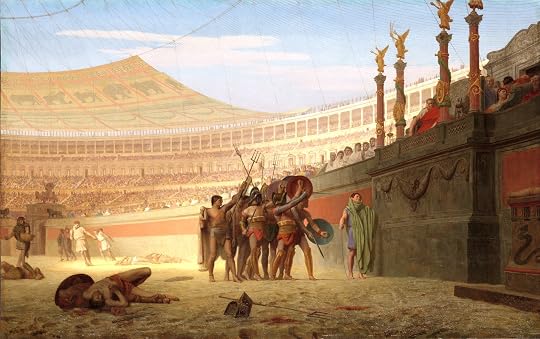
Hail Caesar! We Who Are about to Die Salute You by Jean-Léon Gérôme


A refreshing way to glimpse the life of Roman gladiators in the span of 24 hours. Sidebottom’s experience as a novelist helped him create quite an entertaining and convincing narrative. This book is not fiction though, it has proper research and study on the existence and use of gladiators during the Roman Republic and Roman Empire and also discusses a lot of aspects of Roman philosophy and society. How have I forgotten that the pagan Roman society was bloodthirsty, extremely bloodthirsty compared to our present-day common sense? Or perhaps, it has always been this way? Some of us seem to gravitate towards entertainment that raises our adrenaline even if the cost is sweat and blood on the arena ring.

To understand the gladiators, it is best to distance our perception of them from what has been portrayed by Hollywood movies or romance novels. Gladiators were, at best, slaves owned by their trainers to fight for the public entertainment. They came from condemned criminals, prisoners of war, and outright slaves who were being trained in gladiatorial schools owned by wealthy patricians. As such, there was not enough freedom in their life because their purpose was simply to fight in the amphitheatre and to die according to the general mood of what the audience wanted at that moment (freedom can be granted of course as a prize but it takes more than just fighting well, like actors in a theatre, gladiators can improvise by engaging the audience and perhaps receiving their favour and becoming popular). Essentially, they are the objects of pagan entertainment and considered, class-wise, the lowest of the low that has no dignity as a human.

“To become a gladiator brought infamia (disgrace). This was a Roman legal concept that branded someone as intrinsically untrustworthy. They could not represent themselves or anyone else in court, witness a will, vote, serve in the army, act as a magistrate or juror, or go to the theatre. They had no recourse from arbitrary physical punishment by magistrates. Infamia came from specific acts: any conviction in court, bankruptcy, a soldier shirking his duty, or showing cowardice in battle, a judge taking a bribe. It also adhered in general to certain professions: prostitutes, pimps, actors, and trainers of gladiators (lanistae). Along with gladiators, all these brought disgrace on themselves by taking money to exhibit their bodies, or the bodies of those they controlled, for the pleasure of others.” ~Vesper, page 19.


On top of that, physically, unlike what the popular imagination likes to portray them as healthy and fit, they were considered ugly, fat, and had rotten teeth due to their unique diets in the gladiatorial school. They must be fat so they don’t get killed easily and can be seen drenched in blood while still being able to keep fighting.

“Stuffed with sagina, gladiators were fat. They had bad teeth, worse than the rest of the population. This was caused by their pulpy, carbohydrate-rich diet, and their lifestyle: the physical and psychological stresses they were under reduced their production of saliva. It would have given them even worse breath than most of the poor. Their trade was inscribed on their bodies : scars from blades and whips, bites from wild animals. By the early fourth century AD men condemned to a gladiatorial school or the mines were tattooed on their faces.” ~Prima Vigilia, page 71.


But gladiators were only one part of public entertainment. The amphitheatre presents a full-blown bloodbath of executions of condemned criminals (other times, hated groups of communities such as the Christians) and senseless executions of wild animals as well. It’s what the ancient society wants (at best, the modern equivalent would be UFC fighting that sees fighters get bloodied and injured).

Sidebottom doesn’t shy away from discussing many philosophies of Roman society no matter how alien they’re now compared to our modern-day common sense. This book is valuable to help us understand ancient Rome without the romanticisation. Those Who Are About to Die is pure history that is written in such an engaging way.
Profile Image for Stephen.
1,332 reviews20 followers
August 31, 2026
Harry Sidebottom writes great novels, and one of the things that makes them great is that he is a lecturer in Ancient History at Oxford. This adds meticulous detail to his works, and lets the reader feel they are living in the age he is describing. But this book is not a work of fiction. It is a history centred around the lives of gladiators. Not a story but the same meticulous detail, without getting bogged down or dull.

I suppose anyone wanting a Harry Sidebottom novel will be disappointed. But just as for his novels, Sidebottom carries the reader into ancient Rome, and into the lives of Romans, and especially Gladiators. It's an informative work, and I feel much better informed for having read it.
278 reviews
November 5, 2025
Very informative, but if like me you are expecting and hoping for a blood soaked tour through the colosseum, then think again. The bit underneath the title should be the real title. This is more of a deep dive into how the Romans thought about themselves which he ties to gladiators rather than a Russell Crowe epic. He also gets a bit snotty at one point about what he describes as amateur historians, i.e - the people who have just read his book. It was a good book but not really what I thought I was getting.
Profile Image for Chad Manske.
1,663 reviews47 followers
July 12, 2026
Harry Sidebottom’s “Those Who Are About to Die: A Day in the Life of a Roman Gladiator” is that rare work of popular history which feels both cinematically vivid and intellectually unsettling. Sidebottom structures the book as a tightly controlled twenty‑four‑hour chronicle around a single day in and around the Colosseum, moving from the gladiators’ evening meal and gambling before the games through the long night of fitful sleep and into the rising roar of the arena at dawn. The conceit sounds simple, but it gives the narrative an almost thriller‑like momentum, while allowing him to drop down into every layer of Roman society: ludi training schools, imperial box, back‑alley bookmaker, and terrified condemned prisoner. What makes the book truly fascinating is Sidebottom’s relentless demolition of our Hollywood‑fed myths. Gladiatorial combat, he reminds us, was not the industrialized slaughter of “Spartacus” or “Gladiator”: the average death rate per bout was closer to one in eight, with matches often just once or twice a year, making survival a plausible, if brutal, career. The iconic “Those who are about to die salute you” turns out to be a near‑phantom in the sources, probably a one‑off episode rather than a stock gladiatorial chant. Even the bodies are wrong: instead of sculpted, Crowe‑like torsos, gladiators were kept deliberately fleshy, their pulpy, high‑carb diet designed to generate dramatic blood without catastrophic organ damage. Sidebottom’s great strength lies in marrying hard scholarship to a novelist’s eye. As an Oxford classicist and experienced storyteller, he uses the “watches” of the Roman night—Vesper, Prima Vigilia, Secunda Vigilia—almost like chapter beats, each opening a different window onto Roman attitudes to sex, violence, honour, servitude, and the afterlife. He revels in unexpected detail—the taxonomy of at least nine distinct gladiator types, from trident‑wielding retiarii to equites fighting from horseback—yet the prose remains energetic, mordantly funny, and never clogged with jargon. By the time the day closes at “Solis Occasus,” the reader has not only stalked the amphitheatre’s sand but inhabited the Roman mindscape that built and sustained this monstrous, expensive entertainment machine. It is, in the best sense, a book that entertains while quietly rewiring how you think about empire, spectacle, and the human cost of keeping a crowd enthralled.
Profile Image for John.
198 reviews13 followers
June 16, 2026
I enjoyed this book, but readers should be aware that it is less about the minutiae of gladiatorial fights, and more about the Roman mind. Sidebottom takes the reader on an enjoyable tour of the back streets of Rome as well as the salons of the upper classes pointing out various of the inhabitants’ customs, what they ate, and their attitudes to life and death. He gives us an insight into how Romans thought about things and how that manner of thinking filtered into the spectacle of gladiatorial games.

By Sidebottom’s own admission, however, there are precious few contemporary sources that tell us exactly what went on in the arena once the various gladiatorial struggles (unarmed man vs. beast, net-and-trident fighters vs. men of arms, heavily-armed men against each other) commenced. It seems his sole original source is the various tombstone inscriptions memorializing gladiators who had been killed in the arena, though he draws on some of the posters and inscriptions in the ruins of Pompeii.

As a reader I am fascinated by the sophistication of ancient Rome in an age where our technological tools were not even to be dreamed of. Thus, in spite of the fact that Those Who are About to Die does not live up to its dust-jacket premise, I can recommend this as an enjoyable read for those who share my interest in things Roman.
Profile Image for Anne.
173 reviews4 followers
January 4, 2026
This is a remarkably great read. It takes as a construct 24 hours in the life of a gladiator, and thereby takes a theme by theme approach which covers every conceivable aspect of both the life and death of gladiators and the concept of the games themselves. It is meticulously backed up and researched but written in the most accessible manner, with plenty of dry wit and tongue in cheek asides by the author. It really is a one-stop shop in gladiators, the games and the entire world within which they existed.

My one gripe is that he used the term pleb as a synonym for poor/lower class - often using them as a social class below “equestrians”. In fact all a pleb was was a non-patrician, and there were very few patricians, so there were many, many rich and distinguished plebs (Pompey and Antony to name only two) and indeed a lot of the equestrians were themselves plebs. Pleb was not a class. I know he must know this and used it as convenience and using the modern understanding of pleb but it did annoy me!
7 reviews1 follower
September 11, 2026
As a history of Rome and Roman culture, maybe a 4.5 star. The problem is that the book is titled with the expectation that this is a day in the life of a gladiator on the day of the games. Instead it's an opportunity for the author to give details into all of Roman culture with only a sprinkling of actual Gladiatorial detail.
Profile Image for Debra.
608 reviews3 followers
March 31, 2026
Thanks for the free ARC AAKnopf #AAKnopfPartner #PRHPartner . These thoughts are my own:

Through Sidebottom's prose, I was incredibly engaged and strangely invested in the lives, routines, and feelings of the gladiators of ancient Rome--a subject that I hadn't given much thought to prior to reading this book. Like most people, my mental imaginings of gladiators have been created by movies such as Spartacus and Gladiator. The reality is, of course less...Hollywood-ish. Through a composite of a 24-hour-day in the life of a gladiator, broader Roman practices and cultural norms are presented through a number of different viewpoints. A picture of Roman society emerges, as does a general sweep of the 700 years during which gladiator matches were prevalent, stitched together engagingly from a broad variety of primary and secondary sources. The influence of the same Roman value of courage that was embodied by gladiatorial combat is still felt today, and despite the myriad differences in customs and expectations between then and some 2000 years later, our shared humanity shines through. I thoroughly enjoyed being brought along on this fascinating, interesting journey.

#ABorzoiBook
Profile Image for Philip.
234 reviews6 followers
May 10, 2026
The title of this book was what drew me to this book, in the first place. I was not disappointed. It is a uniquely constructed tale of the day in the life of the Roman gladiator! I learned so much about the gladiators life , both men and women (which quite a revelation). Not did the author reveal the daily events of the gladiator, but the evolution of the Gladiatorial Games, from beginning in the Republican Roman world of the second century BC to their zenith in the pre emperor and pagan world of the subsequent pagan Emperor of the First and Second centuries AD. And how the advent of Christian emperors led to their demise in the later two centuries of the Roman era. I loved this book and learned so much about the importance of the Gladiatorial Games and their importance to the status quo of the individuals in power!
Profile Image for Nick Byers.
268 reviews
May 29, 2026
An interesting look at the life of a gladiator. The author uses gladiatorial games as a lens to study Ancient Roman culture and society through.
Profile Image for Stanislav Stanchev.
38 reviews9 followers
June 24, 2026
Ultimately quite disappointed. I think the idea of structing the book around a "day in Ancient Rome" is good in theory but fails in practice. Even though it did not impress me massively, 24 Hours in Ancient Rome: A Day in the Life of the People Who Lived There was a much better execution of the same concept. The latter worked because its scope - in the title and in its content - sought to bring forth a broader understanding of everyday life and customs in Ancient Rome. Its added value for me was that it went beyond geopolitics and the sweep of political and military history of Rome.

The problem with Sidebottom's book as that it supposedly has a more narrow focus on gladiators and the institution of gladiatorial games. However that "...and the Roman Mind" is actually an important suffix to the title. The book's greatest weakness is that it is incredibly meandering and at times very, very repetitive. Instead of a topical structure, the somewhat forced "24 hours in Rome" framework leads to discussions of religion, philosophy, gladiators, contemporary novels, geography, cartography, sex, gladiators, architecture, sociology. It sound comprehensive, but is in effect more of a chaotic mix. And though understanding how the inhabitants of the Roman Republic/Empire lived, thought, bathed, made love, wrote, slept, ate and fit in the social fabric provides useful context for the spectacle of gladiatorial combat, the red thread gets lost way too many times. It makes it harder to put everything in temporal or topical context. Without shoehorning the narrative into the 24 hours frame, I think the same content would have been delivered in a much better and more cohesive way.

My biggest praise for Sidebottom is that he often presents different interpretations by historians new and old and then weighs in on what the evidence supports or not (evidently in Sidebottom's own view). Personal biases aside, I appreciate this style of popular history literature because it constantly reminds the reader how we are trying to interpret texts, art, architecture and snippets of second-hand information centuries and millenia after their actual context. It is a humbling perspective on the discipline of history and I appreciated these discussions, as they appear many times throughout the text.
Profile Image for Sean.
45 reviews
May 23, 2026
Was skeptical of the “24 hours in the life of” format but in the end it added much needed contextualization/commentary of society, to me the strength of this book.
Profile Image for Kate.
156 reviews2 followers
May 21, 2026
It's about more than just gladiators, their origine, history and roles. Takes you through an ordinary Roman 24 hours, describes what is now known about the lives of slaves, ordinary people etc.
Profile Image for Kym Jackson.
231 reviews4 followers
January 5, 2026
Lots of good information but presented poorly in my opinion which makes the book hard to read.

Ostensibly the book is laid out as a fictional story of 24 hours in the lives of two gladiators, Demetrius and Diodorus. Each chapter begins or ends with a short snapshot of what they are doing at that time and then follows much interesting information in the chapter itself.

This can be a bit weird—for example the first chapter obviously begins at midnight and is largely devoted to how Romans slept and how they told the time and so on—extremely interesting but not exactly what I was expecting.

Most of the book is like that; it jumps around from topic to topic covering a huge amount of detail about how Romans lived and always with gladiators as the focus but looping away from the gladiators and back again as the facts and explanations and tangents that arise lead the way rather than being marshalled and controlled by the author. The structure is very loose. So much so that every time Demetrius and Diodorus were mentioned I found myself surprised and had to remind myself who they were.

All in all very enjoyable and I learned a lot but the structure made this harder to read than it should have been.

Overall: recommended.
Profile Image for Sergei.
20 reviews
May 7, 2026
Really great book, though readers should be aware that it's really covering a much broader topic. I would say, it is much more about the broader daily lives during the Roman empire viewed through the lens of the Gladiators. It talks a lot about them, for sure, but also has lengthy asides about daily life, the political environment, the different regions of the empire, but all well grounded in how those related to the gladiators. The book also comes through with a sense of style and humor which is nice in a popular history - it should be fun to read.
Profile Image for Brian Terence.
Author 20 books67 followers
September 27, 2025
Just finished the audio version, I've enjoyed many of Harry Sidebottom's fiction works. I used to play a lot of Rome Total War.
This was a well-written and well-read audiobook; there has clearly been a huge amount of research into the subject. The style was entertaining and flowed well.
It combines enough descriptions of action to avoid becoming a dry textbook.
For fans of Rome: Total War, it's worth a read.
Profile Image for David Tice.
Author 1 book2 followers
April 23, 2026
Everything you wanted to know about gladiators but were afraid to ask…. Detailed recounting of the history of gladiators and gladiatorial games during the Roman Empire. Obviously thoroughly researched and well written. My one small nit to pick is that there are numerous times the author refers to the same information, sometimes within a couple of pages. I realize some of the content can be hard to follow, thus the use of callbacks, but these mentions that annoyed me were not needed in that sense (at least IMHO). Overall however this book is well worth reading if you have an interest in the topic or the Romans in general.
Profile Image for Anthony Chitko.
39 reviews1 follower
May 7, 2026
Great insight into the gladiatorial arts of Ancient Rome.
Profile Image for Ken-uhh-D.
227 reviews3 followers
Read
June 22, 2026
I've said it before, and I'll say it again, I refuse to rate non-fiction books. What, I don't like your facts? You picked the wrong time period and I'm mad about it? No.

I find Ancient Rome supremely interesting. It's where we spent our honeymoon. I knew very little about gladiators before going into this.

Now I need to go back to the coliseum and imagine what I've learned from this book.

Excellent way to break up a reading slump.
Profile Image for Ben.
951 reviews18 followers
May 4, 2026
A deep dive into this topic, with plenty of extra context. It can occasionally get a bit dry, but is overall a fairly accessible and fascinating look at this historical icon, and the ways in which it is similar and different from what you probably assume based on pop culture appearances.
Profile Image for Zoë Routh.
Author 15 books76 followers
October 12, 2025
Loved finding out more about gladiators, their day to day lives, how they fit within the Roman world. The book is rich with research and interesting facts. It did however read too much like a textbook and I found it a bit laborious in parts.
Profile Image for Dilys Guthrie.
154 reviews3 followers
December 29, 2025
I love Harry's style of writing and can honestly say, this is one of his best! It gives a great explanation of the life of a gladiator. The endnotes and bibliography finish the book off perfectly.
2,199 reviews62 followers
Review of advance copy received from Netgalley
March 11, 2026
My thanks to NetGalley and Knopf, Pantheon, Vintage, and Anchor for an advance copy profiling one of the fascinating of historical sports figures, the gladiators of ancient Rome, and what a day in their life was like, what was true, and what has been mythologized, and their legacy today.

Captain Oveur once asked of a visitor to his plane's cockpit in the movie Airplane! "Joey, do you like movies about gladiators?". The answer would have to be a resounding yes, yes we do. Sand-and-sandal movies were a major export of the Italian film industry, creating long line of imitators, and careers. Academy award winning films, long running television shows, books, comics, poems, even songs tell of gladiators and their battles in arenas. Today we have professional wrestling to capture the spectacle, and the UFC and mixed martial arts for the blood, modern gladiator battles in rings and octagons, making millions for owners, and long-lasting pain for the combatants. Gladiators are something that people, well men think about once a day along with Rome itself. However most of what we know is not real, mostly myth making, from the ancient times, and to the shows we watch today. What was life like for these men and a few women. Were the entertainers, traitors, well-rewarded, or waiting for death. Questions this book answers, as well as a real view of what life in Roman Empire was like. Those Who Are About to Die: A Day in the Life of a Roman Gladiator by writer and educator Harry Sidebottom is a look at life from dawn to dawn for a gladiator, with discussions about wider issues about life in Rome, where tales of gladiators came from, and the shadow they have cast on history, both fictional and in understanding the ancient world.

The introduction discusses where the idea of the book came from, and something that I did not know about our understanding of gladiators. Sidebottom is using the same technique as another historical book, looking at 24 hours during the French Revolution. Though the French Revolution it seems has a whole lot more sources and paperwork than ancient Rome. Sidebottom shares that most of what we know about the bread and circuses are based on different works, both fictional and nonfictional. Some stories, some poems. Historical mentions in memoirs, or travelogues and history of areas. There was no formal discussion of gladiators or their history. Sidebottom then describes their days from dawn, where one could watch the gladiators eat, to the next day, with training, fights, more entertainment, and finally rest. As Sidebottom breaks the day into sections, he looks at the broader history. The pay scale for gladiators, and the promise of estates. How people became gladiators, and what they gave up to do so. Sidebottom looks at those in power who used this entertainment to prove their wealth, and the attempts by certain Emperors to control what gladiators made. Even food and drink are discussed giving a broader sense about life in Rome, a far more personal examination than I expected.

A very well-written and well-researched book, one that gave me more of an understanding of the ancient world than I expected. I had always thought there was more research, more understanding about gladiators, not realizing that most historians treated it like many historians would, Not that important, and not as understood at the time. As if someone wrote about the 60's and didn't discuss the music, and changes in entertainment. Gladiators in many ways were professional wrestlers. Trying not to get hurt, nor hurt, at least too much their fellow workers in the arena, people they trained with, drank with and had to fight with. Sidebottom also has written a series of fictional stories set in Rome, and this writing helps add excitement, and look at things from different points of view. A really excellent and fascinating history.

This is the first I have read by Sidebottom, either fiction or non-fiction, but I really learned quite a bit, and enjoyed the narrative. I look forward to reading more by Harry Sidebottom and learning more about Rome.
Profile Image for Anibal.
325 reviews2 followers
October 10, 2026
This book’s greatest strength is its use of gladiators to explain Roman society. The author certainly understands that this broad ambition can weaken the focus and momentum of the “day in the life” structure, but the trade-off is an exploration not only of life in the *ludus*, but also of the ways Romans thought and acted… an explanation of society itself through twenty-four hours in the life of a gladiator. I believe the first book I read using this technique was *A Day in the Life of Ancient Rome* by Alberto Angela, although several others followed. The format may not be entirely original, but Sidebottom executes it flawlessly.

Sidebottom is also aware that the available evidence is scattered both geographically and chronologically, yet he still explains the cultural meaning of the games. He connects the spectacle with courage, hierarchy, imperial domination and public generosity. The seating arrangements and displays of exotic animals become evidence of how Romans understood their place in society and their power over the world. Especially valuable is his explanation that ancient objections often concerned the spectators’ loss of self-control. This helps readers understand Roman moral priorities without falling into intellectual anachronism by assuming they resembled our own.

You will also find detailed information about the human and professional complexity of gladiators. Their food, training, earnings, injuries and prospects of survival reveal an organised occupation operating within a coercive system. Their curious combination of social disgrace and celebrity status is particularly illuminating! Sidebottom also explains why owners had an economic interest in keeping trained fighters alive. All these details make the danger more comprehensible: survival was possible, but depended upon skill, circumstances and other people’s decisions.

The author brings a valuable range of evidence to this work: literary anecdotes, inscriptions, tombstones, visual representations and archaeological discoveries provide many different perspectives on the subject. Funerary inscriptions are especially useful because they preserve something of how fighters and their families wished their lives to be remembered! This breadth helps the reader appreciate the work involved in reconstructing a world whose evidence survives unevenly.

One of the coolest aspects of the book is that it makes scholarship accessible and memorable. The author uses his great storytelling skills (his historical novels are superb) to introduce each chapter with a plausible reconstruction of an event. The opening, for example, demonstrates Sidebottom’s ability to convey the physical experience of fighting: restricted vision, noise, fatigue and concentration. The result is an enjoyable, occasionally quite funny book that makes the information easier to remember.

Finally, the book also encourages readers to question comfortable explanations on several topics. Its discussion of the games’ disappearance considers funding, patronage and changing forms of elite self-display alongside Christianity. Sidebottom also challenges modern interpretations of the salute and thumb gestures, among other subjects.

A straight five stars for this one.
Profile Image for Janine.
2,885 reviews42 followers
Review of advance copy received from Netgalley
March 13, 2026
I love Roman history, probably from my four years of high school Latin and cheesy 1950s movies like Demetrius the Gladiator. So when this showed up I was excited for the read (thank you NetGalley and Knopf) and it did not fail to deliver.

First, this is an incredibly researched book. As a history nerd I’ve read many fine Roman history books (SPQR, Twelve Caesars, Rubicon, etc), so I’m pleased to be adding this among my reads. And having read these other books, the veracity of the information is impressive and important to be aware of. You are getting a certifiable accurate book!

This book in part explores myths about gladiators. A gladiatorial contest was not a death sentence. A contestant had a one in eight chance of dying per match which was once or twice a year. Also a man might only be a gladiator for three years so survival was not out of the question. Also, these guys were not the six-pack men we think of today. Their diet of barley stew cause them to bulk up so they if they were cut in a contest, the fat round protect vital organs but it was the blood the people most liked to see.

The book’s structure is most captivating. Taking apart a 24 hour period, the book provides what are “watches” of the day (Prima Vigilia, etc) from the evening meal before the next days games through to the events of the day. I think this was a splendid way to structure the book to give you an authentic feel for a gladiator’s life.

But the book is more than just a gladiator’s story. We are treated to aspects of Roman life - diet, literature, sex, sleep m, dreams, politics. The book name drops the names of emperors - who is not aware of Commodus, the gladiator emperor from Gladiator. This also helps put the gladiator into context.

Finally this is an easy-to-read book. It’s not dry but contains some funny moments. It’s a book anyone interested in learning more about Rome and Roman life can enjoy.
Displaying 1 - 30 of 75 reviews