Jump to ratings and reviews
Rate this book

Heaven and Hell Trilogy #2

The Sorrow of Angels

Rate this book
The second installment in Stefánsson’s Trilogy About the Boy is a timeless story that portrays the human struggle for hope within the ferocious majesty of Iceland. 

It’s been three weeks since the boy came to town, carrying a book of poetry to return to the old sea captain—the poetry Bárður died for. Just three weeks, but already Bárður's ghost has faded. Snow falls so heavily that it binds heaven and earth together.

As the villagers gather in the inn to drink schnapps and coffee while the boy reads to them from Hamlet, Jens the postman stumbles in half-dead, having almost frozen to his horse. On his next journey to the fjords, Jens is accompanied by the boy, and both must risk their lives for each other, and for an unusual item of mail.

The second installment in Stefánsson’s elemental Trilogy About the Boy, The Sorrow of Angels is a timeless literary masterpiece that evokes the human struggle within the ferocious majesty of nature.

282 pages, Kindle Edition

First published January 1, 2009

178 people are currently reading
4109 people want to read

About the author

Jón Kalman Stefánsson

56 books1,309 followers
Jón moved to Keflavík when he was 12 and returned to Reykjavík in 1986 with his highschool diploma. From 1975 – 1982 he spent a good deal of his time in West Iceland, where he did various jobs: worked in a slaughterhouse, in the fishing industry, doing masonry and for one summer as a police officer at Keflavík International Airport. Jón Kalman studied literature at the University of Iceland from 1986 until 1991 but did not finish his degree. He taught literature at two highschools for a period of time and wrote articles and criticism for Morgunblaðið newspaper for a number of years. Jón lived in Copenhagen from 1992 – 1995, reading, washing floors and counting buses. He worked as a librarian at the Mosfellsbær Library near Reykjavík until the year 2000. Since then he has been a full time writer.

His first published work, the poetry collection, Með byssuleyfi á eilífðina, came out in 1988. He has published two other collections of poetry and a number of novels. His novel Sumarljós, og svo kemur nóttin (Summer Light, and Then Comes the Night) won The Icelandic Literature Prize in 2005. Three of his books have also been nominated for The Nordic Council's Literature Prize.

He was the recipient of the Per Olov Enquists Prize for 2011, awarded at the book fair in Gautaborg in September 2011.

Ratings & Reviews

What do you think?
Rate this book

Friends & Following

Create a free account to discover what your friends think of this book!

Community Reviews

5 stars
1,326 (46%)
4 stars
1,141 (39%)
3 stars
319 (11%)
2 stars
64 (2%)
1 star
25 (<1%)
Displaying 1 - 30 of 344 reviews
Profile Image for Valeriu Gherghel.
Author 6 books2,067 followers
May 20, 2025
Băiatul îl însoțește pe domnul Poștaș Jens să ducă veștile și scrisorile în cătunele din Islanda, străbat furtuni de zăpadă, noiane de întuneric, și, într-un final, se prăbușesc într-o prăpastie. Drumul celor doi seamănă cu o călătorie la iad. Mai mult nu am voie să spun. Citiți și ultimul volum al trilogiei lui Stefánsson, Inima omului, ca să vedeți dacă au supraviețuit.

Nu cred că v-am spus pînă acum. Dar nu mai pot ține acest secret înfipt ca un piron înroșit în inima mea. M-am îndrăgostit de Geirþrúður. Da, de fatala Geirþrúður. Pînă aici mi-a fost. Căci Geirþrúður are din plin tot ceea ce trebuie să aibă o femeie ca să fascineze definitiv un bărbat sensibil ca mine. Și anume:

1. 35 de ani cu aproximație, hai, 40 (Între cer și pămînt,Tristețea îngerilor, passim).

2. Părul negru-negru (Tristețea..., p.14), doi ochi scrutători, buze orgolioase, bărbia ascuțită, pistrui (Între pămînt și cer, p.134). În legătură cu părul, adaug o scenă de voyeurism pentru amatori. Băiatul trebuie s-o anunțe ceva, intră în cameră și, piei drace: „O vede pe Geirþrúður [în cadă, n. m.], plete negre corb și un umăr dalb, pomeții înalți, o jumătate de sîn [nu-i nevoie de mai mult, se-nțelege, n. m.] și cîteva picături de apă prelinse pe piele” (Tristețea..., p.13).

2. Dezinvoltură, umor, lipsa inhibițiilor puritane, conștiința propriei frumuseți triumfătoare: „Poți foarte bine să te întorci cu fața, sînt chiar atît de urîtă? întreabă Geirþrúður. Nu-l mai chinui pe băiat, se aude vocea Helgăi. Dar ce rău poate să i se întîmple dacă vede o femeie bătrînă dezbrăcată? răspunde Geirþrúður, și băiatul [are în totul vreo 15 ani și, uneori, vise erotice de care se rușinează, n. m.] o aude ieșind din cadă” (Tristețea..., p.14).

3. Dinți strălucitori și „canini ascuțiți, ca de prădător”. Numai dinții de jos, chiar cei din față, sînt puțin strîmbi, desăvîrșirea plictisește. Și, în orice caz, „fără păcate viața nu-i viață” (Între cer și pămînt, p.222).

4. Ținuta dreaptă, mîndră, nesupusă (Între cer și pămînt, Tristețea îngerilor, passim).

5. „Glasul puțin răgușit, întunecat” (Între cer și pămînt, p.201).

6. Ironia, tonul franc, lipsit de orice iluzie, o nobilă nepăsare. Vorbește bătrînul Guðjón, soțul ei: „Eram singur şi am întrebat-o dacă vrea să vadă lumea, e ceva de văzut, m-a întrebat, papa de la Roma, i-am zis eu atunci, nu-i decît un bătrînel plin de pofte şi de superstiţii, mi-a răspuns ea” (Între cer și pămînt, p.134).

6. Echitate cu privire la prețul omului și al vieții. Tot bătrînul Guðjón spune unui martor: „Viaţa nu mai avea nici un farmec nici pentru ea, nici pentru mine, era logic să ne căsătorim, diferenţa de vîrstă n-are a face” (Între cer și pămînt, p.135).

7. Patima cititului pasiv (aural, cu urechea), gustul poeziei, simțul spectacolului. Îi plac piesele lui Shakespeare, Hamlet, Othello, în lectura băiatului (Tristețea..., pp.26-27).

8. Geirþrúður fusese slujnică la un hotel din Reykjavík, poate curtezană, mai mult nu știm despre trecutul ei (Între cer și pămînt, p.134, 138, passim). Acolo o întîlnise Guðjón, acolo o întrebase despre papa de la Roma și tot acolo primise răspunsul blazat, citat mai sus.

9. Făptura ei păstrează, bineînțeles, „ceva care nu poate fi prins în cuvinte” (Între pămînt și cer, p.134).

10. În fine, deși n-ar mai fi nevoie să precizez, Geirþrúður nu este o femeie întru totul aievea, se ivește din închipuirile cititorilor și pune stăpînire pe ei. Pe mine m-a sedus instantaneu...
Profile Image for Vit Babenco.
1,782 reviews5,778 followers
August 25, 2023
The boy becomes a village dweller…
The struggle for life and dreams don’t go together, poetry and salt fish are irreconcilable, and no-one eats his own dreams.
That’s how we live.

The Sorrow of Angels is a metaphor for snow – it is as white as feathers of their wings and it wraps the earth… And the real sorrow wraps those who inhabit the earth… The boy lives among them and he observes their lives and their grief… And he falls for a girl…
And he watched.
But why watch a girl; what use is that, what does it do for the heart, uncertainty; does life become better in some way, more beautiful?

The boy gets a dangerous assignment to help a postman to deliver the post to the fishing village in the far north… They are caught in the blizzard that turns into the real snowstorm… And the boy must pass through this deadly snowy ordeal…
Hopefully he’ll be buried in snow and the Devil will take his remains at the first opportunity. The boy looks around but sees nothing through the blowing snow, the snowfall, knows nothing but his own fatigue…

When you’re young the door is open and the entire world is waiting.
Profile Image for Cecily.
1,320 reviews5,329 followers
May 27, 2020


Impressions through the clouded lens of snowflakes, the eponymous sorrow of angels

Death, ever present, death.
Lurking in the murderous winter landscape, the roof of Hell.
Lurking in empty bellies and a cough that won’t stop.
Lingering in memories, dreams, and visions.
The dead, entwine with the living, urging some to live, but luring others towards death.

“Does one betray the dead by continuing to live?”
How to bear “the guilt of being alive and desiring life.”
By the anchoring bonds with family and friends who live.
By the power of promises, carried in hopeful hearts.

Life, tenacious but ephemeral, battles relentless hardship across the barren snow.
For what? Delivering letters. Letters. And the dead.
Optimism or idiocy - what’s the real difference?

Because “Words are the seventh wonder of the world.”
Words from one soul to another.
Words to change the world.
Assassins or saviours? Bullets or rescue teams?
Words from beyond the grave.
Words that may take postman Jens and the boy to theirs.
And then, after agonising survival, an oddly comic, but possibly deadly descent.

At the end of the world, coffee “warm as Heaven, black as Hell” may save, but liquor can slay.
There’s a fiercely independent woman serving both, her generosity hidden beneath the wings of her raven’s heart.
And a boy, who doesn’t want physical strength or reckless masculinity, but words and education.
If he lives.

Bodies: dead bodies, lost bodies, bodies reaching out, bodies making love.
A wet, glistening sweet, from one mouth to another and “A thousand years passed”.
Body parts:
“The heart is a muscle.”
“Shoulders of moonlight.”
And eyes.

So many eyes of every colour and kind: blue, flint-coloured, pearls, bulging boils, black... frozen puddles of death.
A tentative, tender kiss on the eyes.
Blind eyes that penetrate and see more than sighted eyes. One of many reasons not to judge from afar.
And yet “You can always know a person by where he or she looks… Eyes don’t lie.”

Snow blind, blind drunk, dead drunk, blindsight, snow.
But blind from lack of love? If love returns, will sight?

"And then the world goes out."
Stunning. Literally and literarily.
I was left snow blind; fed, but still hungry.
I crawled out of the shelter of my snow-cave, craving more.
More words. Words to change the world, to change me.
The world went out, and so did I - straight to The Heart of Man.

Quotes

No plot spoilers. They’re hidden for brevity and easy scrolling.

Words and Books


Life and Death


Weather


The Sea


Love


Eyes, Sight, Blindness


Dreams


Miscellaneous


“Nothing is sweet to me, without you.”

Three-Volume Novel

This is not a trilogy; it’s one novel in three, very closely-related parts, covering just a few weeks:

1. Heaven and Hell, reviewed HERE.
2. The Sorrow of Angels, this book.
3. The Heart of Man, review HERE.

For a more concrete idea of setting, plot, characters, and writing style, see my overview HERE.

Image of snowflake contact lens:
http://ep.yimg.com/ay/1stepcontacts/w...
Profile Image for Dolors.
605 reviews2,812 followers
October 22, 2017
The epic journey of survival against all odds that moulds the identity of the nameless boy continues in this second installment of Stéfansson’s trilogy, setting the perfect foreground tone for the fiercest struggle between man and the hostile wilderness of the Icelandic remote lands.

Divided in two main sections; the youthful main character ponders about the value of literature, getting more acquainted with it in the first part of the narration and missing it acutely in the second one, where the extreme weather conditions become the main protagonist of the story, befogging the voice of the omniscient narrator with inner monologue, tragicomic dialogue and the incantatory poetry that breathes life into the menacing yet wondrous presence of the landscape that consumes it all.
The boundaries separating Heaven and Hell, Sky and Earth, the Living and the Dead, dissipate into a muddled blankness that evokes the oblivion of non-being.

What is the use of printed pages in the face of the unbearable iciness that benumbs hearts and drowns men in the depths of the Polar Sea? Why read Milton, Shakespeare or Dickens if the whiteness of the snow will end up blinding those who dare to question, who dare to look out?
And yet Jens the postman puts his life in danger to deliver letters, written words, at the end of the world, where angels weep tears of sorrow that coat slopes, gullies and ridges with whitewash made of gelid blizzards and biting snowflakes. Humanity is reduced to nothingness in front of the inexorable forces of nature that create and destroy in their wake.

Surely, the hazardous trip that boy and man embark on together to make a special delivery is a metaphor for mankind's pursuit of answers to fight against absurdity, to infuse meaning into a seemingly pointless existence, presented through the dual prism of Stéfansson’s artistry.
The inquisitive boy, whose unquenchable doubts nudge him to speak out, and the grumpy postman, who avoids words as if they were summoned by the same devil, will see their destinies irremediably intertwined in a mission that might shake the ground of their deeply rooted beliefs not only about the importance of words, but also about the fine line separating life from death, lust from love and reality from hallucination.

Stéfansson is a poet, but the lyrical hues of his darkly sensuous prose is aerated with an outstanding understanding of the human psyche, moving shrewdly between realistic narrative, folklore and myth, blending the moralistic tale with the archetypal existentialist coming-of-age story. His painstaking eye for detail draws an incredibly nuanced portrait of the Icelandic people, their precarious life conditions and the unusual mixture of coarseness and sensitivity that constitutes their collective ethos.
In a place where man’s angst, fear and impotence mean nothing against the undaunted harshness of nature, a place where his dreams, yearnings and minuscule joys don’t have the slightest impact on his untamable habitat; words might be futile or they might be the rescue team that melts petrified souls lost in the maelstrom of existence back into the throbbing pain of being alive. It’s only a matter of finding the courage to give them free entrance into the core of what makes us human.
Profile Image for بثينة العيسى.
Author 27 books29.5k followers
December 20, 2016
‏رواية ⁧‫#حزن_الملائكة‬⁩ مثل قصيدة تخترق الصقيع، القصيدة - إياها - التي لا نريد لها أن تنتهي. مغرمة أنا بكل صفحة من هذه الكتابة السماوية.

في انتظار الجزء الأخير من الثلاثية البديعة. شكرًا دار المنى.
Profile Image for Luís.
2,370 reviews1,357 followers
October 9, 2025
To add a stone to the building of the numerous criticisms of "The Sadness of the Angels" by Jón Kalman Stefánsson, I would evoke the formidable Nordic epic of this novel, where the young hero, like a new Telemachus traversing the desolate fjords of Iceland, goes from meeting to meeting, between the living almost dead and the dead still alive. Stefánsson, in a very Balzacian way, gives a universal dimension to the Icelandic journey through his lapidary formulas and his ability to paint an original human comedy through striking portraits.
Profile Image for JimZ.
1,297 reviews757 followers
August 22, 2020
At many times in this book I knew I was reading simply beautiful writing. Writing that I appreciated. Prose that I knew made this author an extraordinary writer. And no doubt because this was originally in Icelandic the translator contributed to my appreciation of the written word.
So I can say that this was a solid 3 star book.

So there has to be a “but…”. Why wasn’t this 4 or 5 stars? I gave the first book in the trilogy “Heaven and Hell” 4 stars.

But I’m not done writing down what impressed me or what stuck with me after reading this book, set in rural Iceland in the late 19th century. Among the more salient things:

• I always thought if one was in a blinding snowstorm that at least you would not be wanting for water. You could stuff your mouth with snow and eventually …instant water. Well, Jens and the boy for most of the book were in horrendous snowstorms and I guess because the temperature was so cold and the wind was so fierce that putting the snow in their numbed lips and into their mouths actually hurt and so they did not do that. So they were at times very thirsty. How ironic…it was the same as if they were in a desert — they lacked water in a snowstorm.

• I figured that if this book was about snow that I would enjoy the read because living in the midwestern United States I love when it snows. Last winter it snowed a bit less than usual and I think we had two decent sized snows (4-6 inches/10-15 cm) — I love watching snow come down. After a while when into this book and by the book’s end I was sick of, and sickened and fearful of snow. Jens and the boy nearly died several times in the snow. Up to their armpits in snow. Digging out a mule that accompanies them on part of the trip hundreds of times. The boy on more than one occasion in a snow storm (unrelenting for hours) lay down in the snow and a sleepy warmth was close to overtaking him when Jens roughly shook him awake…because the boy would be dead probably within 30 minutes had he fallen asleep in the snow. In the same way that the character in “To Build a Fire” in Jack London’s classic short story died. All warm and cozy as he went to sleep in the snow…he only felt warm and cozy because he was near death…his body was shutting down…he was dying.

• The impoverished farmers and their families they met in their sojourn in the snow (this wasn’t the dead of winter by the way…it was near the end of April) and the conditions in which they lived was actually hard to read. I know this was fiction but it’s not hard to understand the situations he made up were close to reality. The humans had bags under their eyes so Jens and the boy realized they were starving. Reading about children who are starving is not a pleasant read. A father cannot have the family recite the Lord’s prayer because the children will start crying after they recite the word “bread” in the prayer (..give us this day our daily bread…). One little boy had such a bad cough his lips were blue. And they were living in decrepit conditions in very small spaces. Jens took pity on one family they shared the night with and left a blank sheet of paper for the children. And this was like manna from heaven to the children — they would debate whether to use if to writing or drawing… Like "oh my God"! Hopefully the winter storms would abate and summer would come and the children would no longer be hungry…but only for a while for the weather would set in again.

• “The boy” was somebody I would like to meet. He is given no name in that book as well as in this — he I simply referred to as “the boy”. We know in the first book of the trilogy he has lost his entire family and only had one best friend left, Bardour…and Bardour died during a fishing expedition in the winter — he died because he was not wearing protective raingear as he forgot to bring it with him on the boat because he was too busy reading Paradise Lost by Milton (he was a book lover). The boy returns the book to its original owner, a blind boat captain who live with two women, Helga and Geirprudur, who take pity on the boy and take him into their lives. He is employed to read to the blind captain for he shares a love of reading with his best friend Bardour. I’m not sure they ever state the age of the boy in either that novel or this novel…I would guess he was late in his teenage years. He is wise for his age and just a decent human being — you can tell.

Something struck me as funny (one is not going to come across a lot of yuck-yucks in this novel) and profound: “…Kjartan would course roundly if he dared, but God is, despite all else, higher than all storms and men; he hears everything, forgets nothing and collects his dues from us on the final day for every thought, every word, every touch, every detail. It can be tedious and downright depressing to have such a God hanging over one; we’ll likely exchange him as soon as something better is available.”

I took 3 pages of notes while reading this book. Because sometimes I was captivated by the writing. Because sometimes I needed/wanted to write something down because I knew if I did not odds are whatever I just wrote down would be referred to later on…the act of writing down the note enabled me to keep that in my short-term memory so I could appreciate a passage later on in the book. Without writing down my notes, some of the significance of the book would have been lost.

By writing all of this stuff down, I realize that I have twisted my arm to change my rating to 4 stars. 😊

So now I can briefly state what is my main gripe about the book:
• Imagine reading a >300-page book and the ending is a gunfight between the good guy and the bad guy, and it is just as likely one will triumph over the other. A gunshot rings out and one falls to the ground. The End. WTF? Who fell to the ground….who won the gunfight? Such an ending occurs in this book. The only saving grace is that this is the second book of a trilogy, so I can find out how it ends in the third and final book of the trilogy. But is that the way books in a trilogy are supposed to end? The first book, Heaven and Hell, ended where it was somewhat of a self-contained unit — it had an ending. Are trilogies structured sometimes so that one book ends with a cliffhanger ending…and you have to wait to buy/read the next book to find out the answer? I hope not…I just finished a first book of a trilogy by Joyce Cary, Herself Surprised, and I believe each of the three books have an ending. Perhaps my GR friends can enlighten me about the structure of trilogies. 🤨

Reviews:
https://www.independent.co.uk/arts-en...
From a blog site (and a GR member) that I like very much based on reading her other reviews: https://jacquiwine.wordpress.com/2014...
https://www.heraldscotland.com/arts_e...
http://www.thebookbag.co.uk/w/index.p...
http://messybooker.blogspot.com/2014/...
Jim: none of the reviews above mentioned the lack of an ending (or what I perceive as such) so once again I prove myself to be the lonesome outlier.
Profile Image for Marc Lamot.
3,461 reviews1,975 followers
January 29, 2025
In this second part of the Heaven and Hell trilogy, the epic nature of the story by Icelandic author Jon Stefansson really comes to the fore. From beginning to end we find ourselves in an almost extra-terrestrial snowstorm. And for most of the story we follow the still unnamed 'boy' on a perilous journey together with the imposing but sturdy postman Jens, to remote areas in Iceland, through that hellish snowstorm. The snowflakes are constantly flying around, interpreted as 'tears’ or the ‘sorrow’ of the angels (hence the title), and that says enough about the gloomy nature of this novel. Jens and the boy regularly get into trouble and a few times it seems as if they are not going to survive. So, just like in the first part, death plays an important role, sometimes literally when they have to drag (on a sledge) a coffin with a deceased woman along in the last part of their journey, just as hilarious and grotesque as in the fantastic As I Lay Dying by William Faulkner.

As a reader, you become more and more intrigued by the narrative style in this second part: it is intense, descriptive, but also reflective, with humor that regularly shifts to sarcasm. Eventually, you start to wonder who is talking here (that will only become clearer in the third part). But just like in the first part, this epic story includes a lot of reflection, both from the voice-over and in the thoughts of the ‘boy’. A lot about death, of course, in a langurous, poetic style that often made me think of the Spanish Grandmaster Javier Marias. “The boy thinks about Bárður and misses him. He who dies never returns, we’ve lost him, no power in the universe is able to bring us the warmth of a vanished life, the sound of a voice, the hand movements, the touch of humor. All the details that comprise life and give it validity have vanished into eternity, vanished only to leave an open wound in the heart that time gradually transforms into a swollen scar. Yet he who dies never leaves us completely, which is a paradox that comforts and torments at once; he who dies is both near and far.

More and more, friendship and love also slide into the picture, as a (vain?) antidote to death: both Jens and the boy struggle with the desire for an ‘other’, the first already marked by his own shortcomings and disappointments, the second still naively feeling his way in that mysterious territory. And against that background, on their hellish journey, they also regularly meet other persons, who are also marked by life, but sometimes still strive for that ‘more’. And finally, like in the first part, Stefansson regularly brings up the relationship between words and life, again as a (once again vain?) antidote to death. In the end, this second, epic part of the trilogy really tends towards metafiction, a second layer next to the existential one. Very well done.
Profile Image for Emilio Gonzalez.
185 reviews109 followers
June 5, 2021
Es una novela muy humana que muestra con dureza la fragilidad de quienes viven en las tierras altas y ahonda en temas tocados en el libro anterior como la muerte y la culpa que sienten aquellos que en circunstancias difíciles quedan con vida pero sufren la perdida de seres cercanos.

El argumento es sencillo y pasa por una larga travesía que deberá hacer el cartero Jens junto a un desconocido muchacho cruzando fiordos, mares, montañas nevadas con peligrosas laderas y acantilados, y la carga constante de tormentas de nieve y viento helado.

Esta es la segunda parte de la llamada “Trilogía del muchacho” y desde ese lugar es sin duda una continuación natural y muy solida de Entre cielo y tierra; e igual que aquella tiene como uno de sus puntos mas fuertes el exquisito lenguaje del autor, quien parece elegir con un cuidado absoluto cada palabra y consigue el tono justo para una narración que hace pie fuertemente en el atractivo visual de la geografía de Islandia y su durísimo clima.

Lo único que criticaría es la cantidad de nombres propios que hay y lo similares que son en muchos casos, pero es una novela muy recomendable aunque sugiero comenzar por Entre cielo y tierra y no por esta.
4,5
Profile Image for Yasmine Mohamed.
179 reviews24 followers
February 6, 2020
هل تبكي الملائكة على حالنا؟ هل تحزن لمشقة رحلتنا؟ أم تشفق على ضياعنا في متاهة أنفسنا؟


يأخذنا كالمان في رحلة وسط العاصفة الثلجية المظلمة بداخلنا.
عاصفة شتوية قارصة البرودة ومجردة من الرحمة.
يتجاذبنا خيط الموت والحياة ، الظلام والنور، الأرض والسماء والجنة والجحيم.

تلك هي معركتنا، إنها معركة الإنخراط في صراع الحياة والموت مع أنفسنا، فرص النصر والهزيمة متساويان.

فماذا سيختار الفتى؟ هل يستسلم ويستقر الجليد على ذكرياته كلها، على أحلامه وقلبه وفي النهاية يغير عليه الشتاء الأبدي؟
أم يختار الربيع ليسكن قلبه والأمل لتحقيق أحلامه وأحلام من أحبهم وعانقهم الصقيع ؟

في هذه الرحلة يسافرا معا الفتى وساعي البريد ينز خلال الجحيم إلى اخر الدنيا، يشاهدا الحياة، ويعثرا على الموت.
القدر ربطهما معا والوثاق الذي يربطهما لا ينقطع أبدا.

في رحلة بحثه يجد الفتى دوما أناس جاهزون لإيقافه على قدميه (وطبعا ليست بمفاجأة كبيرة أن معظمهم نساء ): الثالوث كولبين هيلغا وغيرترود، ماريا الأم محبة القراءة ، آنا التي يخبو نور عينيها، آستا الشبح التي تنقذه من الموت، هيالتي عامل المزرعة العملاق.

الجنة تأتي أحيانا في هيئة بشر لم يفقدوا إنسانيتهم، والجحيم يتمثل في أناس تجمدوا بحزن الملائكة.

رحلتي القطبية مازالت مستمرة مع قلب الفتى.
Profile Image for Zahraa زهراء.
481 reviews321 followers
July 22, 2025
لماذا هو خطر؟
هو يهدد بتغييرنا، يجعلنا نشك، يرغمنا على مراجعة تصورنا للعالم، وامثال هؤلاء الرجال اعتبروا دائما خطيرين. نحن نفضل الموافقة على التحريض ، نفضل التجريد على المحفز، نفضل الخدر على التنبه. ولهذا يلجأ الناس الى الاغاني الشعبية بدلا من الشعر، لهذا لا يشككون في الاشياء اكثر مما تفعل الخراف،
أما انت فمختلف جدا..
أنت تمد يدك إلى الكتب، تنظر فيها
أعتقد أن ذهنك لا يتوقف عند بيوت الشعر السفيهة والبغيضة

أنت تسير في عاصفة خارج العالم، وتكلم باردور
أنت ميت، وعلى الرغم من ذلك؛ أنت هنا
يبتسم باردور ويصبح المشي أسهل
لهذا أنا أحب هذا الفتى الآيسلندي غريب الأطوار
أهو توأمي الروحي soulmate?
يحدث أن تجد شخصا كأن وجوده يعزف على نغم وجودك ذاته، أفضل هذا التعبير حول الفتى وأدب ستفانسون، وكما يقول هارولد بلوم، أشعر كما لو أني من كتبها.
فأجد نفسي في هذه الملحمة السماوية. أنا ذات الشعر الأحمر التي تكتب رسائل متخبطة للفتى، فقط للثرثرة، لكن الكلمات تخونها دائما فتشعر بالحرج. لا أملك سوى شعر أحمر وفقر مدقع، وما أكتبه في منتهى السخافة.
أنا كنت كيارتان والفتى معا، في ذلك المشهد البديع الذي جمعهما، بمشاعره وإرهاقه.
كأني أنا من يقول: بدا لي.. أن المرء لا يمكن أن يكون حزينا وهو محاط بكم هائل من الكتب..
أنا أحد تلك الأشباح التي رافقت ينز والفتى طول رحلتهما
ما نعرفه، ما تعلمناه، لم ينبع من الموت؛ بل نبع من قصيدة شعر، من اليأس، وأخيرا من ذكريات السعادة
أنا هيالتي وكنا في العاصفة في تخوم الجبال نقنع ينز بالعودة حيا لسالفر
لكن أنت يا أخي، تحتاج أن تنهي الرحلة حيا، وأن تهزم العاصفة المظلمة داخلك، تلك هي معركتك، إنها معركة انخراطك في صراع الحياة والموت الخاص بك.

الجزء الثاني من ثلاثية جنة وجحيم، القراءة الثالثة لكن كل مرة تبدو كما لو أنها الأولى.
تتبع تفاصيل رحلة الفتى وينز ساعي البريد في تخوم آخر الدنيا، سائرين على الأقدام ،تتلقفهما العواصف والريح ،والأشباح. شخصيات الرواية لم تقتصر على البشر والأشباح، بل الجبال والخلجان والرياح شاركت، أنت تحس بوحدة عجيبة بين كل ما في الرواية من عناصر، كأن ستفانسون نفخ الحياة في كل شيء مع هيمنة الموت في نفس الوقت.
ربما ليست الرواية تمثيلا لصراع بين الإنسان والطبيعة بقدر ما هي تمثيل لصراع الإنسان مع نفسه، رغم عنف الطبيعة ولا مبالاتها المستفزة. فالفتى لا تكاد تهلكه العاصفة نفسها بل غفلته وتضييع طريقه. هو السبب المباشر والطبيعة سبب غير مباشر
يمضيان في هذه الرحلة لأن ينز يريد التفكير، كأنها طقس روحي شاذ، تجربة الدنو من الموت. رجلان عالقان معا خارج الزمان والمكان، لعلهما يشبهان الكيخوتي وسانشو في شيء. ثنائي المثالية والواقعية، واللذان من خلال الحوار، يتغيران.

لكن ستيفانسون أراد أن يسري عن وحدتهما، فمن تعتقد أشرك معهما؟
تابوت!
إضافة مثالية لدرجة تفوق التصور. الموت يطوقهما من كل جانب، حتى تجسد أخيرا -مصحوبا برائحة اللحم المدخن.
فذلك الذي يجتاز المروج في يوم صيفي مسالم تحت نور الشمس قد يشعر كما لو أنه أضحى في الجنة. لكن جوا كهذا يبقى منتنميا إلى عالم آخر في الشتاء الايسلندي.
جحيم هو البرد.
إنها ببساطة جنة وجحيم.

الثلج يتساقط بكثافة عظيمة، إلى درجة أنه يربط السماء بالأرض.
الكلمات هي الشيء الوحيد الذي يبدو أن الزمن لا يستطيع أن يطأه باستخفاف. هو يخترق الحياة والحياة تصبح موتا، هو يخترق بيتا ويحوله إلى غبار، بل حتى الجبال نفسها تفسح له المجال في النهاية، تلك الأكوام الملوكية من الصخر..
إلا أن بعض الكلمات تبدو أنها تتحمل قوة الزمن المدمرة،
هذا غريب جدا؛ فهي تتآكل بالتأكيد، ربما تفقد بريقها قليلا، بيد أنها تصمد وتصون الحياة التي مضى على رحيلها زمن طويل، تصون دقات القلب المندثرة، أصوات الأطفال المندثرة، تصون القبل المغرفة في القدم
بعض الكلمات قواقع في الزمن، وضمنها ربما ذكريات عنكم.

ربما لذلك كتبت الرواية في النهاية..
Profile Image for Ahmed Taha.
208 reviews
February 7, 2020
" لا شيء حلو في نظري بدونك "

هل الموت يمتلك الأجوبة؟
عندما يسأل ينز الفتى " ما الذي يجعلك تهيم هنا على وجهك؟ "
يقول الفتى "أحاول استيعاب هذه الحياة اللعينة"
فيجيب ينز " عليك أن تموت لتستوعبها "
ينفي يون هذا في أول الرواية فيقول :
Capture
"ما نعرفه وما تعلمناه لم ينبع من الموت، بل نبع من قصيدة شعر، من اليأس، وأخيرا من ذكريات السعادة .. نحن لا نتملك الحكمة، لكن ما يعتمل فينا يتحكم بنا، وهذا ربما أفضل"
لا أدري يا عم يون هل هذا أفضل أم لا .. لكن صدقت .. ما يعتمل فينا يتحكم بنا، فهذه رواية في صقيع أيسلندا لكن صدقا لمن اشعر بمثل هذا الدفء أثناء قراءة كتاب ما مسبقا،
لأني أحسست أني من كتب هذا الكتاب، أحسست أن الفتى ينطق بلساني، وأن أهز رأسي من كل سؤال يسأله، ربما القصة ليست بحبكة مميزة ولا فريدة، لكن التساؤلات هي مدار الكتاب،
عندما يشغل فكرك موضوع ما، تساؤل وجودي ما، ماذا أفعل في هذه الحياة، لماذا أنا ضعيف، لماذا لا يحبني أحد، لماذا لا أتغير وأكون أفضل، لماذا أنا عاجز، تجد نفسك أنك تفكر مرارا وتكرارا، أنت متيقظ وأنت نائم وأنت تعمل وأنت تأكل وأنت تلبي نداءات الطبيعة، هكذا يفعل يون في الكتاب، أصابني هذا بالحيرة في الجزء الأول من جنة وجحيم ولكني فهمت الآن لماذا يفعل هذا، لأننا في الواقع نفعل هذا، لكن لا نصدق عندما نقرأ ذلك أو عندما نشاهد أحد أمامنا يفعل ذلك، لأن هذا يصيبنا بالاضطراب.
يدندن يون عن الموت وعن الصقيع وعن الحب وعن الإله وعن الحياة، لكن من منا لا يفعل؟
هو فقط يسأل ولكن لا يمتلك الأجوبة، حسنا، من منا يفعل؟
يقول يون :
88

لم أندم على استكمال قراءة السلسلة لأني وجدت كاتبا مفضلا جديدا، ولا أبالغ إن قلت أن هذا الكتاب يكفيني لأحب قلم يون، لكن الرحلة لم تنتهي بعد.
-ولا شيء حلو في نظري بدونك.-
199
Profile Image for Sandra Deaconu.
796 reviews128 followers
March 11, 2020
Atât de tare mă răscolește povestea asta și nu vreau să se termine! Dulce agonie! Mai multe citate aici: https://sandradeaconu.blogspot.com/20....

,,Timpul trece prin viață și o preschimbă în moarte, trece prin case și le preface în pulbere, chiar și munții, mărețe lanțuri de piatră, se înclină în fața lui. Doar unele cuvinte par să țină piept puterii lui distrugătoare, tare ciudat, într-adevăr, cuvintele se uzează puțin, suprafața lor capătă o patină anume, dar rezistă până la sfârșit, păstrând în ele viețile înghițite de timp, bătăile inimilor dispărute, ecoul unui glas de copil, cuvintele sunt paznicii săruturilor din vremuri de mult trecute. În miezul timpului cuvintele se rotunjesc ca niște învelișuri, și în ele se află poate amintirea ta. Andrea, scrie băiatul, timpul poate să fie atât de crud, nu ne dă ceva decât ca să ni-l smulgă mai repede. Atâtea lucruri pierdem noi. Pentru că n-avem curaj, oare? Mama spunea că puterea cea mai de preț a omului e curajul de a te îndoi.''
Profile Image for Nader Qasem.
59 reviews41 followers
February 7, 2020
F88-D57-D9-82-C0-4-B82-BE60-4-B253227-FEEE


587-D0-FE1-78-E4-4-B52-A28-D-BA09-D87-EEFE9


‎هناك أحزان بارده
‎أحزان مخفيه
‎أحزان تدور تفاصيلها في الخفاء
‎لان العلانيه لا تتسع لها
‎نعم
‎فبعض الاحزان لا توثق بأوراق رسميه
‎ولا يستخرج لها شهاده حكوميه
‎ولا يقام لها مراسم بكائيه
‎ولا تكرم ب طقوس عزائيه
‎احزان لا تمت ل عالمنا نحن بصله
‎احزان أواخر الكره الارضيه
‎احزان بعيده ببعد الدول الاسكندفانيه
‎نعم ..... انها احزان الملائكه


‎"الموت لا يوجع الموتى، الموت يوجع الأحياء"
‎هكذا وصف الموت الشاعر الكبير محمود درويش، لكن هناك شخص اخر في أواخر الكره الارضيه من يؤمن ان هناك مرحله أخرى لما بعد الموت
‎ان هناك عالم اخر يعيش به الموتئ عالمهم الخاص ، حيث يستشعرون به الوجع ، عالم اخر يعيش به الإنسان حياه لا تشبه سائر مخلوقات الارض، عالم يعيش به البشر ثم يموتون به مره ثانيه غير الميته الاولى ، يقول يون كالمان في حزن الملائكه .. " هناك موت وبعد ذلك موت آخر، نوعان مختلفان جدا، فالخراف الميته ميته ، وكذلك الحال ب النسبه الى السمك ، أما الإنسان فلا يتاح له أن يموت ب السهوله ذاتها.


‎في حزن الملائكه وهي الجزء الثاني من الثلاثيه الايسلنديه جنه وجحيم ، يستمر كالمان في تسطير لنا رحله البقاء على قيد الحياة ضد كل الصعاب، بلغته المبهره يعرفنا الكاتب اكثر على هوية الصبي المجهول اسمه حتى الأن.


‎يقسم الكاتب الروايه بين شخصيتان رئيسيتان الشخصية الرئيسية الاولى هو الشاب المتساءل دائما عن قيمة الأدب ، وهي الشخصيه الرئيسيه نفسها من الجزء الاول "جنه وجحيم" نتعرف عليه قليلا في الروايه الاولى ونفهمه اكثر في الروايه الثانيه ، حيث تصبح الظروف المناخية القاسية هي العنصر الأهم للقصة، اما الشخصيه الرئيسيه الثانيه هي "ينز" رجل البريد الذي سيخوض مع الفتى رحله ملحميه مكتظه ب البرد والفلسفة ، الفلسفه الوجوديه التي تبحث عن الحدود التي تفصل بين الجنه والجحيم ، السماء والأرض ، الأحياء والأموات الوجود والعدم.


‎رحله ملحميه قد تكلف المرء حياته وأكثر، مع ذلك فإن ساعي البريد "ينز" والفتى يعرضان حياتهما للخطر من أجل تسليم تلك الرسائل والكلمات المكتوبة في صفحات يتسلل اليها الصقيع في نهاية العالم، نهايه العالم حيث تبكي الملائكة دموع الحزن التي تلطخ المنحدرات والأخاديد والمرتفعات مع عواصف ثلجية جليدية بيضاء
‎، نهايه العالم حيث تقل درجات الإنسانية حتى تكاد تصل إلى العدم.


‎نعم "كالمان" شاعر ، لكن الأشكال الغنائية من نثره الحسي تثبت لنا ان هذه الشخص له فهم عميق اكبر للنفسية الإنسانية ، قد يكون هذا الرجل متمكن من اللغه كثيرا لكنه بارع في استخدامها اكثر، التحرك ببراعة بين السرد الواقعي والفولكلور والأسطورة ، المزج بين القصة الأخلاقية مع قصه بدء الوجود،الرسم المضني لتفاصيل صورة شعبه الإيسلندي وظروف حياتهم المحفوفة بالمخاطر، كل ذلك السرد والإبداع الكتابي جعلني أتفنن في القراءه لهذا الكاتب، "حزن الملائكه" كان تحفه فنيه مدراره ...وإنا متحمس ل الجزء الأخير من الروايه التي ستكون تحت اسم "قلب الرجل" متحمس لها لعل معها يعود لي دفئ الصيف.


‎أدناه اقتباسات راقت لي كثيرا .


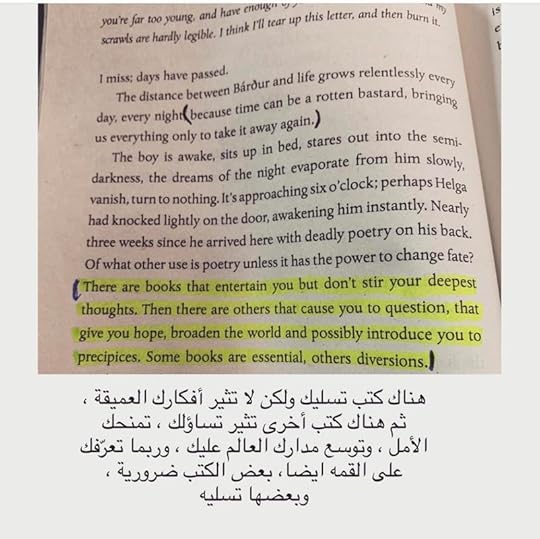
‎"هناك كتب تسليك ولكن لا تثير أفكارك العميقة ، ثم هناك كتب أخرى تثير تساؤلك ، تمنحك الأمل ، وتوسع مدارك العالم عليك ، وربما تعرّفك على القمه ايضا، بعض الكتب ضرورية ، وبعضها تسليه"


‎"ما يهم قلما ما يكون معقدا، ومع ذلك مازلنا بحاجه الى الموت من اجل ان نصل الى استنتاج واضح"

‎"الشعر في أعماقه يتظمن جوهر، جمال وسخف أمه بأكملها، لكن سبعمائة سنه من الكفاح شكلتنا ونقحتنا، وفي محطه من طريقنا الطويل فقدنا الثقه بأهميه الشعر"


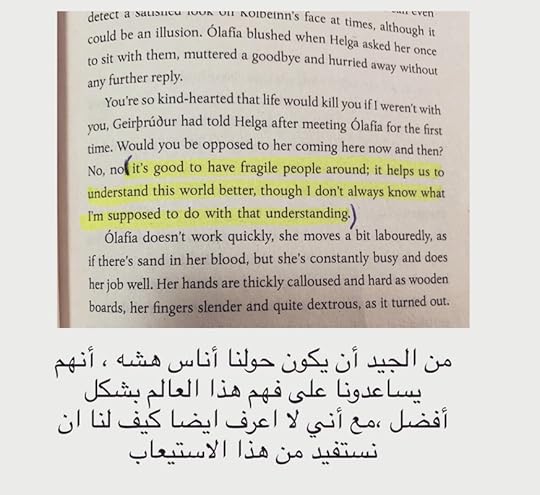
‎"من الجيد أن يكون حولنا أناس هشه حولنا ، إنهم يساعدونا على فهم هذا العالم بشكل أفضل ،مع أني لا اعرف ايضا كيف لنا ان نستفيد من هذا الاستيعاب"


‎"تسري السخونة في كافه أعضاء جسمه، يتسارع جريان دمه، يموج في عروقه، ويبقى واقفا ثابتا بلا حراك، ينظر الى الأمان مباشره ، بلا تعبير وجه ، كما لو أنه لايفكر في شيئ على الإطلاق"


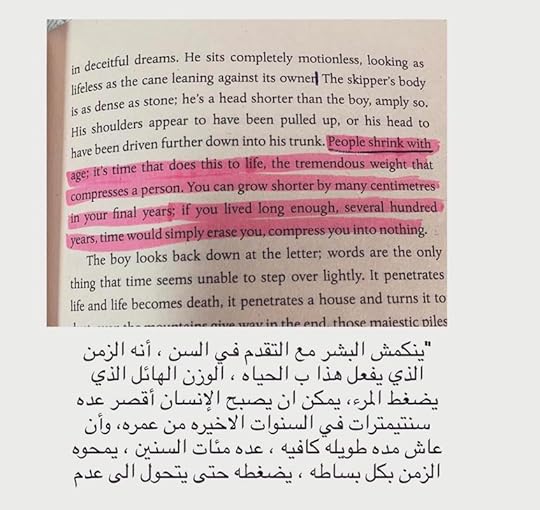
‎"ينكمش البشر مع التقدم في السن ، أنه الزمن الذي يفعل هذا ب الحياه ، الوزن الهائل الذي يضغط المرء، يمكن ان يصبح الإنسان أقصر عده سنتيمترات في السنوات الاخيره من عمره، وأن عاش مده طويله كافيه ، عده مئات السنين ، يمحوه الزمن بكل بساطه ، يضغطه حتى يتحول الى عدم"


‎"الحياه سهله على أولئك المجردين من الأخلاق ، فهم يتدبرون أمورهم جيدا ويعيشون في بيوت كبيره"


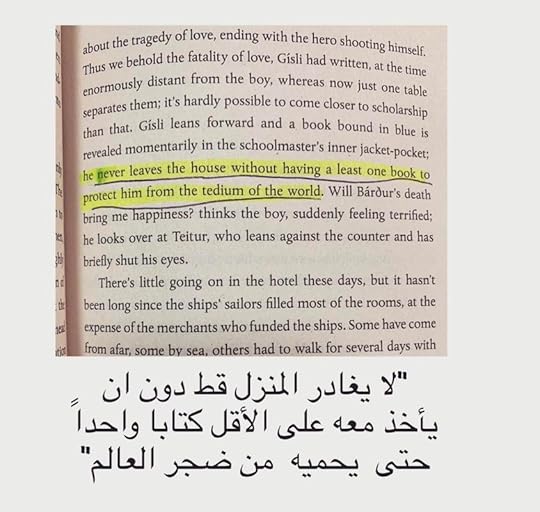
‎"لا يغادر المنزل قط دون ان يأخذ معه على الأقل كتابا واحداً حتى يحميه من ضجر العالم"


‎"يتوقف لان الكلمات استعصت عليه فجأة، لغه كامله تلاشت ، تاركه خلفها الصمت فقط، حتى المسافه بينهم أمست معدومه. "


‎"الحياه على كل حال بسيطه نوعا ما، أولئك الذين يضعون قدما أمام أخرئ، ثم يعكسون الآيه ويكررون ذلك بما يكفي يصلون في النهايه الى وجهتهم"


‎"ف الرب على الرغم من كل شي أسمى من العواصف والبشر ، يسمع كل شي ، ولاينسئ شيئا ، وفي الإخره يجمع مستحقاته منا على كل فكره وكل كلمه و لمسه وكل شارده ووارده ، وجود مثل هذا الإله المتربص بالمرء يمكن أن يكون مضجراً ومدعاه كآبه خالصه، وربما نقايضه بشئ أخر حالما يتوافر لدينا ماهو افضل"


‎"أين يذهب أولئك الذين يموتون أيمكن بلوغ ذلك المكان، أينتظرنا فجر جديد هناك وراء العواصف كلها، وراء الحياه وراء الموت، فجر جديد ، أفق ساطع ونغم وديع يسكن ألمنا بعد الحياه؟"


‎"ذاك الذي يموت لا يعود أبدا ، فقدناه ولاقوه في الكون قادره على أن تعيد لنا دفء حياه تلاشت، لا وقع الصوت ولا حركات اليد وحس الفكاهة، جميع التفاصيل التي تحتوي على الحياه وتمنحها الصلاحية تتلاشى في حنايا الابديه ، تتلاشى من غير ان تخلف وراءها الا جرحا مفتوحا في القلب يتحول مع الزمن الى ندبه متورمه"


392-DDA1-E-4378-4-F21-9-A95-C882-FCF8-FDD7

ADF39176-839-C-4751-B3-DD-0345-EAE24025
dr fell poem


B3-F91653-FAE4-4-AD8-9-CBC-B16785-B27-ACA


E22356-A7-96-DD-4-ADF-87-C4-FFA216844-E4-A
Profile Image for Ema.
268 reviews791 followers
February 9, 2017
În „Tristețea îngerilor”, Stefánsson continuă povestea băiatului fără nume, la câteva săptămâni după ce a străbătut munții pentru a înapoia „Paradisul pierdut” al lui Milton. El pleacă într-o călătorie până la marginea lumii, acolo unde începe tărâmul iernii veșnice, în tovărășia unui bărbat cât se poate de diferit: Jens poștașul, un munte de om morocănos și scump la vorbă, care ia în piept landele cele mai primejdioase, dar se teme de mare, de slăbiciune, de a fi el însuși.

Stefánsson ne poartă spre nordul Islandei, care pentru unii reprezintă capătul lumii, iar pentru alții înseamnă acasă, chiar dacă lungul anotimp hibernal îi izolează aproape zece luni pe an, iar existența se dovedește o continuă luptă pentru supraviețuire. Te întrebi cum de aleg unii oamenii să trăiască aici, într-un ținut atât de dur și neprimitor, unde nu sunt nici muzee, nici bulevarde, iar vremea transformă totul, mărind distanța dintre suflete și reducând ființa umană la proporții insignifiante.

Aici, ceea ce se numește vară trece într-o clipită, iar zăpada gonește prea iute iarba, florile, cântecul și susurul de ape, învelind pământul într-o tăcere mormântală, spartă doar de șuierul vântului și de vuietul Mării Înghețate. Aici, un călător neatent poate călca peste acoperișul unei biserici micuțe, cu totul scufundată în nămeți, sau poate trece pe lângă o fermă izolată, fără a bănui că sub stratul gros de zăpadă respiră câteva suflete. Din trâmbele de fulgi strunjiți după aripi de înger, apar uneori oameni despre care nu se știe prea sigur dacă sunt vii sau au murit demult, poate că sunt strigoii care îi ademenesc pe cei rătăciți spre tărâmul de dincolo. Aici, în îmbrățișarea frigului năucitor, viețile se pierd ca flăcăruia stinsă de vânt, deși e mai înțelept să-ți amâni moartea până la primăvară, altfel n-are cine să-ți care sicriul peste landele cuprinse de viscol, până la cea mai apropiată parohie.

Stefánsson construiește neîncetat paralele între întâmplările prin care trec eroii săi și ființa umană, cu toate slăbiciunile și defectele care-i zădărnicesc șansele la o existență împlinită și fericită. Este o dojană uneori blândă, alteori usturătoare, presărată cu ironie și umor, dar ceea ce am observat, înainte de toate, este faptul că din cartea aceasta se desprinde o imensă dragoste de oameni și de viață, laolaltă cu o mare iubire pentru cărți și cuvinte. Cuvintele par a fi singurele lucruri de pe lume pe care timpul n-are puterea să le calce în picioare.

Puteți citi aici recenzia mai lungă, scrisă pentru blog: http://lecturile-emei.blogspot.ro/201...

| Blog | Facebook | Instagram |
Profile Image for Mark.
443 reviews105 followers
December 4, 2024
“Life is quite simple, but a person is not; what we call the puzzles of life are our own complications and murky depths”. p9

I recently read Heaven and Hell by Jón Kalman Stefánsson, the first book in a series of three. Someone urged me to read the second and third in the trilogy while it was fresh in my mind, and while that is not my usual habit, I’m so pleased I followed that advice. The Sorrow of Angels is is epic and Stefánsson proves himself again as one of the most unique, poetic and profound writers I have come across.

The themes of life and death continue to permeate this work, as we follow the boy, three weeks after the death of his closest friend Bárður, questioning and pondering the complexities of existence, the power of words, the relentlessness of time, the interplay between death and life, the implication of fate, and the power of the poetic. It’s all rather profound, and Stefánsson has a way of weaving words together that build a narrative that is not only an epic story but also a deep commentary on the complications of life. The journey of grief is clear in this work, and the connection between the one who has died and the one who lives is a recurring theme.

Set against the backdrop of the northern Icelandic winter, The Sorrow of Angels somehow epitomises the landscape of life, a life, many lives, the terrain that is all to evident externally, in some ways metaphorical for the internal landscape of every human who has walked the face of earth. Stefánsson beautifully captures this thought…

“There can be such a gulf between one’s exterior and interior lives, and this should tell us something, it should teach us not to trust appearances too much; he who does so misses the essence.” p57/8

The boy finds himself accompanying Jens, the postman, on a monumental journey against the harshest of the winter elements to deliver the mail to remote farming and fishing villages. This is a story about a journey yet it is not a story about a journey. The journey is life and the Icelandic winter elements serve to accentuate the depths that Jens and the boy must plumb as they navigate their own internal work. The relationship that is forged is authentic and absolutely beautiful, raw and real.

“They plough their way onward through snow and wind, two men in search of themselves; will they find gold or just dull stones.” p225

I found this book utterly mesmerising. I was present on every page. The last page left me desperate for more… 5 stars.
Profile Image for Algernon.
1,839 reviews1,163 followers
October 9, 2025

Poetry is the world behind the world. And it’s beautiful.

... it’s also deadly, for those who forget that they must live in the real world, a cruel and merciless world where a moment of distraction over a poem cuts short a very young life.
All of this happened in the first book of this Icelandic series that isn’t really a series but a single story split up on publication into three parts. This second episode picks up several minutes after the last page of the first book, so I would recommend reading it as soon as possible after finishing Heaven and Hell.

The boy who lost his best friend at sea and who travelled through a blizzard to return the book of poetry that caused the incident has found shelter in the house of a rich widow. He is encouraged by this Geirbrudur to start on his education while he helps around the tavern and reads Shakespeare to the blind captain Kolbeinn, another refugee living in the house. There’s also a budding romance with a young girl living in the village, but the real story is still that of man’s survival at the edge of the world, a poetic interrogation of existence written in the same exhilarating style from the first book.

We’ve travelled far, further than anyone before us, our eyes are like raindrops, full of sky, pure air and nothing. So it’s safe for you to listen to us. But if you forget to live you end up like us, this hounded herd between life and death. So dead, so cold, so dead.

The Greek Chorus of ghosts lost at sea or on the frozen moors of Iceland is back with its running commentary on the events. Some of them spirits will actually play a role in the events to follow. Who among us doesn’t have imaginary conversations with the spirits of our beloved departed? What else could they tell us but: live your life, don’t waste even one moment of it because it is precious and it can be lost in the blink of an eye. Especially in this turn of the century Iceland, where spring is still a distant memory in the month of April and a heavy blanket of white covers all the land.

The sky holds an endless amount of snow. Here come the angels’ tears, say the Indians in northern Canada when snow falls. It snows a great deal here and the sorrow of the heavens is beautiful, it’s a cover protecting the earth from frost and bringing light to a heavy winter, but it can also be cold and devoid of mercy.

It’s perhaps a hallucination, but through it we whisper poems and stories, joy and despair, hope and hopelessness.

Beauty and pain, heaven and hell, angels and sorrow – each title reinforces this duality that nature imposes on the spirit of man. Survival is a constant struggle, but what good is survival without leaving something behind? A child ... a poem ... a dream ... a story ...
I find this love for the written word on every page of this unique book, maybe because I love poetry and reading myself to distraction, to the point of forgetting the real world outside while I’m immersed in a good book. I guess I’m just lucky I was born in a gentler climate and a kinder society.

The struggle for life and dreams don’t go together, poetry and salt fish are irreconcilable, and no one eats his own dreams.
That’s how we live.
Man dies if you take his bread from him, but he withers without dreams.


There is a plot here, there are memorable characters that the boy meets and learns from, but for me everything turns into metaphor in the hands of Stefansson. And the scarier the circumstances for these people, the more beautiful and significant their lives become.

We’re in a leaky rowing boat with a rotted net, and we’re going to catch stars.

Translating Milton and Shakespeare into Icelandic might seem a futile effort in a country still mostly illiterate and focused on a bare-knuckled fight for survival, but words are all we have to help us make sense of our lives, to help us preserve the memories and the stories of people who lost the fight and have joined the ghostly chorus of the dead. ( Some words are shells in time, and within them are perhaps memories of you )
Kolbeinn’s blindness is real enough, but it is probably also a metaphor for living in a world without words. Light and darkness is another of these dualities that the author likes to deploy in support of his arguments:

... somewhere along the way we lost faith in the power of poetry, started to see it as a giddy daydream, a party decoration, and put all our trust in numbers and obvious facts, what we didn’t understand or feared was shut up inside relatively harmless folk tales.

He read, he took them away and Kolbeinn sat motionless in his darkness while Shakespeare’s words entered it like glowing torches.

The boy is an orphan. At a very young age he lost in quick succession his father, his mother, his sister, his best friend. He contemplated leaving the world of the living in despair, and it was only words that led his feet to his current shelter. Now he must live and bear witness for all those voices that only he can hear:

These words are boats that ferry his mother’s life, the life of Lilja and his father, away from oblivion and absolute death. And it’s up to him not to let the boat wreck and the cargo sink unobstructed into the dark sea. Him and no other.

Each day brings new stories to the boy’s attention. One of them will take him away from his shelter and cast him once more in the path of the storm: Jens, the local mailman, must deliver three heavy sacks of mail to distant settlements. Jens is exhausted after a gruesome winter trip back from the capital and is also terrified of the sea, so the boy is to accompany him on this extraordinary trip.

The Journey takes more than half of this second book, with Jens and the boy caught repeatedly in blizzards and whiteouts, tested to the limits of their endurance and barely reaching shelter in an isolated farm or church. But every step they take is charged with as much beauty as pain, and every time they rest they meet more of these extraordinary people who have built their homes at the northern limit of habitable earth.

You can’t see a thing in storms as this one, that I can tell you, neither your own nor anyone else’s ass, everything’s white and there’s no difference between sky and land, let alone if it’s blowing, as it’s doing right now; at such times people wander about disoriented, lost, until they walk heedlessly over the brink and fall.

Each of these new people we meet has a story to tell, each deserves to be caught in the web of words that spin through the mind of the boy like the snow flurries driven by icy winds on the moors. I will not name names, but domestic abuse, consumption, hunger, old age, depression, alcoholism are constant companions on the journey. Even love has a hard time surviving in this cold climate, so much more terrible than the cosy romances of a Nancy Mitford, for example.

There’s nothing so loathsome as beating one’s wife; both hands should be cut off any man who does so. Yet what would I do after five years, after ten years? Can I trust my hands?

Jens is man of very few words, like so many of his compatriots. He even resents the talkative nature of the boy, who is constantly asking questions, probing, searching for something more from life ( Only he who questions lives, that’s well-put. is a modern reinterpretation of the old Socratic dictum about the unexamined life). The evolving dynamic between these two unlikely companions on the road is one of the highlights of this second part of the story.

... where’s the light, where’s the spring, wasn’t there once green grass?

Such a long journey, and so many white tears falling from Heaven. So many sacrifices life requires from these hardened people. It seems like spring, the colour green, the sun have all departed for distant shores, leaving our heroes to proceed blindly into the whiteout.
The book ends on a monumental cliffhanger, but that’s all right, because I know I can pick up the third book from my night stand and continue the journey. There’s no reason to wait.

Now I know how icicles laugh.
Profile Image for Wyndy.
241 reviews106 followers
March 7, 2024
4.5 stars.

The “boy” is back in this second entry in Jón Kalman Stefánsson’s Icelandic ‘Heaven and Hell’ trilogy, He is settling into his new life in The Village after returning the fateful copy of ‘Paradise Lost’ to its owner. There is ‘Othello’ to read to the blind seaman and Dickens to translate into Icelandic. There are errands to run and letters to write and dreams to ponder. Then, unexpectedly, barely into his recuperation and fragile solace, the “boy” is sent to accompany Postman Jens on an unfamiliar and dangerous postal route to the Vetrarströnd coast. And here begins an epic tale of man versus nature/man versus himself, a tale of camaraderie, determination and perseverance in one of the harshest climes in the world.

It is impossible for me to describe the way
a particular author or book can sometimes resonate so perfectly with me. Stefánsson, along with superb translator Philip Roughton, have emotionally and intellectually transported and immersed me yet again through their powerful words, creating people and imagery that won’t be forgotten. I don’t want to read books like this all the time but for now, I’m totally invested. The only other series I’ve read with this much pleasure and dedication to completion is ‘The Neapolitan Novels.’ Despite a few niggles with repetition and some overly theatrical scenes, I’m rounding this up for all the stars. Again.

“Of what other use is poetry unless it has the power to change fate? There are books that entertain you but don’t stir your deepest thoughts. Then there are others that cause you to question, that give you hope, broaden the world and possibly introduce you to precipices. Some books are essential, others diversions.” ~ the “boy”
Profile Image for João Carlos.
670 reviews316 followers
February 8, 2017

Islândia - Fotografia de Britt-Arnhild Wigum Lindland

“A Tristeza dos Anjos” do escritor islandês Jón Kalman Stefánsson (n 1963) é o segundo livro de uma trilogia, sendo que o primeiro livro é “Paraíso e Inferno”(5*).
Tal como na análise de “Paraíso e Inferno” existe, igualmente, em “A Tristeza dos Anjos” uma questão determinante: Devemos fazer uma análise factual da história e dos acontecimentos nela descritos? Ou devemos procurar fazer uma análise alegórica dos factos - como num sonho - numa representação susceptível de múltiplas aparências ou interpretações? Ou no conjunto das duas anteriores interrogações?
A estrutura de “A Tristeza dos Anjos” é brilhante. Começa com um “capítulo” intitulado “Os Nossos Olhos São Como Gotas de Chuva” e logo nas primeiras frases a magia literária de Jón Kalman Stefánsson se evidencia: “Seria agora bom dormir até os sonhos se converterem num céu, num calmo e silencioso céu, com uma ou duas penas de anjo a flutuarem, e nada mais além de êxtase do esquecimento. O sono, contudo, ilude os mortos. Quando fechamos os nossos olhos, são as recordações que nos chegam, não o sono. A princípio, surgem sozinhas e tão bonitas quanto a prata, mas depressa se tornam uma neve escura e sufocante… O tempo passa, as pessoas morrem, o corpo afunda-se no chão e nós nada mais sabemos… A vida é bastante simples mas as pessoas não o são; aquilo a que chamamos os enigmas da vida são as nossas próprias complicações e profundezas sombrias.” (Pág. 7)
Histórias de desespero e de desesperança, dominadas pelas sombras profundas da vida e da morte, de recordações de felicidade e de amor que são apenas fragmentos de um poema e de sonhos que se afogaram há muito no esquecimento.
Depois, no “segundo capítulo”, com o título “Algumas Palavras São Conchas no Tempo e Dentro Delas Estão Talvez Recordações de Ti”, reencontramos o “rapaz” - adoptado por duas mulheres, Geirprudur e Helga, a quem é atribuído algumas tarefas domésticas e pelo velho comandante, cego, amante da poesia e da literatura, Kolbeinn, a quem lê Shakespeare - a viver na Aldeia, onde as agruras do inóspito clima islandês, com noites escuras e silenciosas, fustigadas pelas tempestades de chuva e de neve, e pelo barulho ensurdecedor do vento, que o “rapaz” abre a porta ao carteiro Jens, um gigante atormentado, pela sua vida e pelos seus sonhos.
É nesta casa/hotel que o “rapaz” dorme, há três semanas, após a morte do seu amigo Bárdur ("Paraíso e Inferno"), “com poesia mortal às suas costas” e com o poder de mudar o seu destino. “Que outro uso tem a poesia a não ser ter o poder de mudar o destino? Há livros que te entretêm, mas que não movem os teus pensamentos mais profundos. Existem, porém, outros que te levam a questionar, que te dão esperança, que alargam o teu mundo e, possivelmente, te conduzem a precipícios. Alguns livros são essenciais, outros apenas distracções.” (Pág. 23)
Depois segue-se o “capítulo” “A Morte Não Traz Paz” num contraditório entre a vida e a morte, nas sombras de seres invisíveis, na procura do alívio, da amargura e da maldade.
E por fim surge “A Viagem: Se o Diabo Criou Alguma Coisa Neste Mundo Além do Dinheiro Foi o Vento com Neve nas Montanhas”: e são estas duas personagens – o “rapaz” e o carteiro Jens – que nos vão conduzir, na inclemência do tempo, ao longo dos fiordes, da charneca e das montanhas, coberta de uma neve profunda e de um vento glaciar, numa perigosa expedição, repleta de desafios físicos e de desafios existenciais. É nesta marcha, de um estoicismo atroz, com momentos dramáticos, de emoções fortes, onde a ternura e a intimidade se interligam, na superação das adversidades, que se revelam dois seres na busca de um sentido para as suas vidas; entre a vida, o amor e a morte, numa tentativa de se reencontrarem consigo próprios e com os seus fantasmas existenciais, e sobretudo, de expiarem o seus “pecados” e das suas dúvidas e tremores em relação às “suas” mulheres e aos seus amores.
E é entre o cansaço e o medo, com tempestades e fantasmas, que encontramos Kjartan, o gigante Hjalti e Ásta, onde surge, momentaneamente, alguma “claridade” no meio da escuridão gelada.

Jón Kalman Stefánsson escreve mais um livro desesperante e divinal, com personagens inesquecíveis e emblemáticas, enquadrado pelo cenário das magníficas paisagens islandesas, inóspitas e mortais, numa escrita poética sem limites.
Ligeiramente melhor do que "Paraíso e Inferno".
Agora só falta ler “Hjarta Mannsins”.

“Amor retribuído é algo que não te peço,
- só as jovens perguntam e esperam do amante. –
Conheço a vida, e agora sei,
Ter já dela os tristes sinais no meu semblante.

E em silêncio e por palavras vens a assimilar
Que os desejos se escondem na profundeza abissal,
E sabes que nunca abri a mão para flores secas revelar,
Nem nunca beijei os teus lábios pálidos e frios como tal.

Mas eu ainda te amo, como uma perdição,
Sem isso, a minha vida seria a morte.
Nem Deus nem o homem me poderiam consertar o coração.
Tendo o meu coração privado da sua sorte.
(Pág. 197 – Poema de Ólof de Hladir)
Profile Image for Laysee.
630 reviews342 followers
July 22, 2016

"It snows a great deal here and the sorrow of the heavens is beautiful, it's a cover protecting the earth from the frost and bringing light to a heavy winter, but it can also be cold and devoid of mercy." – The Sorrow of Angels, Jon K. Stefansson

“The Sorrow of Angels” strikes me as a lovely, poetic title for a novel set in Iceland. In this second novel, Jon Stefansson continues the story of ‘Heaven and Hell” during the season when winter segues into spring, and tells it with the same philosophical and lyrical elegance.

The blinding beauty of snow, the ferocity of the winds, and the pitiless and overpowering force of wintry gales envelop everything that happens in this story. I read this book while visiting Iceland this summer when the temperature hovered between 2 and at most 12 degrees Celsius. I was also thrown off my feet once by exceedingly strong winds when trying to close the car door. If this is summer, then I shudder to think what life is like in winter. I read this novel then with a heightened awareness of the sorrow of angels, a phrase Stefansson uses to refer to snow (angels weeping) in Iceland. When people live on the border of the habitable world, snow is merciless and potentially deadly. Stefansson has myriad descriptors for the harshness of the landscape where postmen can lose their lives while collecting or delivering mail: "They toil against the North wind, which is stronger than anything in this country..."; "The weather changes everything here, the north wind and cold make us huddle in our homes and increase the distance between people."

It has been three weeks since the nameless boy lost his friend, Bardur, on a fishing trip. He finds refuge in the house of three cafe owners (Helga, Geirpruour, Kolbeinn) who have extended hospitality to him. He does chores around the house and reads Shakespeare to Kolbeinn who is visually impaired. His new family recognizes his love for books and wishes to educate him, seeing he is too dreamy to become a fisherman. For the first time he has his own room, a bed, and oil lamps to read into the night. This sounds like bliss, yet the boy struggles with the guilt of living. Does one betray the dead by continuing to live? Bardur's death has led the boy to a different set of living circumstances where he has opportunities to meet learned individuals such as Gisli, the schoolmaster. Will and should Bardur’s death bring him happiness? Before long, the boy leaves the security of the cafe and embarks on a journey with Jens, the mailman, on a high-risk mail delivery assignment over a stormy fjord and windswept glacier. They are later joined by another man, Hjalti, to make a "special” delivery for a grieving family. This, in sum, is the plot of this novel.

Reading their interminable hardship and continued battering by the forces of nature almost wears me out even though I marvel at the dogged perseverance of the characters. The journey through snow and frost is unimaginably arduous and I feel relief whenever the party stumbles on a turf farm shelter buried in the snow. There is some heartwarming writing in the growing closeness of the three men (“A cord of three strand is not easily broken”). They begin to communicate more openly than ever before about individuals who matter to them and how they should live their lives if they have a chance to survive the tyranny of the harsh and deadly cold.

“The Sorrow of Angels” pits mere mortals against the natural elements and celebrates the triumph and resilience of the human spirit. There is in each man "a light that flickers and refuses to go out, refuses to give in to the heavy darkness and suffocating death. This light nourishes us and torments us, it persuaded us to keep going instead of lying down like dumb beasts and waiting for whatever might never come."

As in its predecessor, "Heaven and Hell", this novel also celebrates the power of words as “rescue teams”. The boy, previously taciturn, begins to speak much more to Jens and to recite poetry out loud when the exposed terrain threatens to overwhelm him. "Of what other use is poetry unless it has the power to change fate?" For readers who live in words, we know there is truth in this.

Beautifully written book.
Profile Image for Alma.
751 reviews
June 27, 2022
“A noite é escura e muito silenciosa no Inverno. Ouvimos os peixes suspirar no fundo do mar, e aqueles que sobem montanhas ou atravessam charnecas altas conseguem escutar a música das estrelas. Os velhotes, que detinham a sabedoria da experiência, disseram que não havia lá nada excepto terreno aberto e perigo de morte. Morremos se não prestarmos atenção à experiência, mas apodrecemos se atentarmos demasiado na mesma.”
Profile Image for Laura .
447 reviews222 followers
March 4, 2025
My apologies to the Friends who have read, reviewed and enjoyed this - but I cannot force myself through any more snow, ice, cold, and helping-women who blend together into a kind of mush. I think this book is a prime example of why I avoid fiction by men.

Jens moves his right shoulder slightly, reflexively, in Sigurdur's parlour; Salvor bites it so that she can't be heard in the silent family room, in the silence that is broken by the snores and the mumbling of dreams. Entirely by accident, Jens had discovered the magical power of his fingers; they lay close together and waited for the darkness of the evening to put everyone to sleep, but of course it's impossible to be living and lie so close together and simply breathe, their hands had to do something and they started moving, all four, roaming about their bodies and quite by coincidence he placed his thumb and index finger between her legs, entered and found a place that made her gasp for breath in such a way that he could barely think of anything else over the next few weeks. I didn't know that place exited, she whispered hoarsely after the first time, and kissed the bite marks on this shoulder. What place? Where I went, whence I was coming, almost as if, I were going through the horizon! Jen looked at her in surprise and she giggled, which she likely hadn't done in fifteen years, and then grasped his penis. Come, she whispered as she spread her legs, and I'll take you there.

That, is why sex scenes are notoriously hard to write. Apart from man has to instruct woman and only man can please woman - there is so much more to cringe at. I struggled with those four hands roving - oh yes two people, four hands.


It's not the sexism and the fact it gets boring; it's also the arrogance of Jens. He's been set an impossible task by the tyrannical Sigurdur, who threatens him with the loss of his livelihood, should Jens not deliver the post on time. Many people help Jens and the boy on their journey, with food, shelter, and warmth. They are literally revitalised, brought back to life on each occasion when they arrive at a hut, or underground home in the wilderness. Each time these people advise Jens to wait, to rest, and wait out the storm and each time Jens refuses.

It's true Jens didn't ask for a companion. The two women who house and care for the boy have sent him along with Jens, but they were not to know that Jens will refuse the sensible advise of the local people; Jens who ploughs on thinking only to prove that he can do the impossible.

This is where I gave up. What is the point? Yes, an epic journey is about attempting the impossible, knowing that what you are doing is likely to end in death. But, it's a death invited: a gamble between surviving or not; a risk, creating a heightened sense of vitality, which is what Jens enjoys. But, he also plays with the boy's life. How dare he play this game with an innocent, a boy who is prepared to follow and risk everything simply because he has been told to help this other, the postman.

Does Jens think that Sigurdur will be impressed? Will he reward him for his timely return or effective delivery of the mail bags? No - it is a trap. So, what is the point of encountering almost certain death?

Are we supposed to admire these men - all the men who have set out on countless missions, across centuries and around the world? Is this the commendable and laudable way of viewing our history? Is that the point of this story? The world has to put the boy through some kind of endurance test before he can truly understand the words in the books he loves, or before he can understand the power of the word to change what is happening around him.

I'm beginning to see Stefansson's structure, but I can't get past his 2D women, and the crude male stance of women as sexualised objects.
Profile Image for Ubik 2.0.
1,073 reviews294 followers
May 9, 2016
“Se il diavolo ha creato qualcosa in questo mondo, a parte il denaro, è una bufera di neve sulle montagne”

Si parte da dove si concludeva “Paradiso e inferno”, così che “La tristezza degli angeli”, più che il secondo romanzo di una trilogia, sembra la seconda parte di un medesimo volume.

A differenza del primo libro che trovava il suo fulcro epico e narrativo nell’eccezionale episodio iniziale della battuta di pesca, qui la vicenda comincia in sordina riprendendo i legami e i personaggi della comunità del villaggio posto all’estremo limite del mondo abitabile all’insegna dell’isolamento pressoché totale. C’è lo stesso protagonista senza nome, indicato per tutto il libro semplicemente come “il ragazzo” e soprattutto c’è la natura lunare e inospitale dell’Islanda di Nord-Ovest.

Poi, in crescendo, a partire da un terzo del libro quando pare che il romanzo sconti il confronto con la grandezza e le conseguenti aspettative suscitate dal capolavoro “Paradiso e inferno” e ci si appresta a proseguire la lettura di nulla più che un onesto romanzo ben scritto, “La tristezza degli angeli” prende il volo.

La rampa di lancio è l’occasionale necessità di aggregare “il ragazzo” al viaggio che il sostituto postino dovrà intraprendere per consegnare posta e giornali nelle più lontane località della regione. Ciò che dovrebbe risultare solo un’impegnativa esperienza di lavoro, si rivelerà una sfida titanica agli estremi del mondo abitabile e ai limiti della stessa capacità di sopravvivenza.

Se da un lato non oso immaginare l’impatto di questo libro sui tanti che nei commenti anobiiani esprimono lamentazioni per la “lentezza” di romanzi avari di azioni adrenaliniche, per quanto mi riguarda non ho mai incontrato nella mia lunga esperienza di lettore un’opera che trasmettesse con tale efficacia il malessere fisico e il disagio psicologico di una marcia senza speranza, al limite e ben oltre le risorse umane di resistenza.

Il percorso del ragazzo e del laconico postino Jens attraverso i ghiacci, i burroni, le tormente di vento, le lande attraversate con la neve a metà coscia, rappresentano quasi un’esperienza fisica anche per il lettore e ci si scopre ad accogliere con percepibile sollievo il raro imbattersi in un capanno abbandonato in grado di offrire temporaneo riparo o addirittura, massima delle speranze realizzabili, nel casale di un pastore di anime o nella fattoria di un contadino che, barricati con le loro pallide famigliole e le provviste sempre più scarse, attendono da mesi la fine dell’inverno glaciale ma non lesinano un pur modesto ristoro ai viandanti.

Fra questi miseri rifugi esiste solo la distesa dei ghiacci, l’assenza di colore, il vento sferzante, l’eco e il cupo rimbombo del Mar Glaciale sullo sfondo, il latrato di cani in lontananza o forse l’impressione, la visione di un fantasma che sembra indicare la rotta, i ricordi, le poesie e le filastrocche con cui la mente di chi cammina da giorni cerca di ingannare la consapevolezza dell’isolamento estremo.

Un’esperienza indimenticabile.
Profile Image for Ana.
230 reviews91 followers
October 4, 2016
Este segundo livro da trilogia Paraíso e Inferno relata uma viagem épica através do inverno e das tempestades de neve e gelo nos fiordes do norte da Islândia. Uma alegoria sobre as batalhas que o ser humano tem de travar com o mundo e consigo próprio, e a expiação dos fardos que carrega.

A parte inicial do romance, que antecede a viagem do "rapaz" e do carteiro Jens pareceu-me estender-se em demasia, tanto em número de páginas como em detalhes e sobretudo no número de personagens fugazes com nomes impronunciáveis e sem contributo relevante para o desenrolar na narrativa. A partir do momento em que a viagem se inicia a leitura torna-se mais fluida e interessante, e as personagens que vamos encontrando pelo caminho nunca são desprovidas de significado. No final o cliffhanger convida à leitura do terceiro livro cuja edição portuguesa ainda se aguarda.
"Dois homens imersos nos seus pensamentos enquanto viajam sob um temporal daqueles não é uma coisa simples, tendo em conta que se tem de usar toda e energia apenas para continuar a caminhar em frente, ir de um lado para o outro sem morrer, o que significa que pensar e, além de tudo isso, tentar perceber a vida deve ser algo épico. Eles abrem caminho através da neve e do vento, dois homens à procura de si mesmos; encontrarão ouro ou apenas pedras pardacentas?" (p. 191-192)

"Mas tu, irmão, precisas de chegar lá abaixo vivo e depois derrotar a tempestade escura que existe dentro de ti; é essa a tua luta, é onde deves travar a tua luta de vida ou de morte." (p. 261)

Profile Image for Dolf Patijn.
795 reviews52 followers
November 17, 2018
Beklemmend mooi. Het tweede deel van deze trilogie gaat voornamelijk over een barre tocht van de jongen met de postbode Jens, waarin hij zichzelf, de dood en het leven in allerlei facetten tegenkomt. Het boek eindigt letterlijk op een cliffhanger. Net als het eerste deel is dit weer een aanrader.
Profile Image for janetonic.
28 reviews14 followers
October 19, 2019
Hó, hideg, fagy, szél, fehér minden, és csak menni, menni, és közben elmúlik az idegenség két ember közt, bármennyire ég és föld (menny és pokol?) a kettő. Bízom a harmadik kötet tavaszában.
Profile Image for Angela Serban.
556 reviews17 followers
June 9, 2020
Trilogia fiordurilor ne povesteşte cum se trăia în Islanda, cu vreo sută de ani în urmă, deşi nici în prezent nu cred că e foarte mare diferență. Într-un ținut în care pescarii, oamenii care habar n-aveau să înoate, ieşeau la pescuit în marea înghețată, plutind pe-o scândură subțire de lemn şi punându-şi speranța doar în Dumnezeu. Zăpadă, ger, viscol şi valuri înalte, toate te fac să te întrebi ce îi determină pe oameni să trăiască acolo, unde soarele e la fel de rar cum sunt eclipsele la noi, unde natura e atât de vitregă şi pământul veşnic înghețat, unde uiți culoarea ierbii tot aşteptând ca vara să se hotărască să vină. Povestea ne poartă chiar mai departe, într-o călătorie spre capătul lumii, spre pol, unde oricât de surprinzător ar suna, mai găseşti oameni care se simt ca acasă, unde iarna durează zece luni pe an şi unde fiecare pas e o luptă, unde furtuna de zăpadă pare a nu se sfârşi niciodată, unde poți muri de sete înconjurat de o mare de fulgi.

Da. Da. Te-ar putea degusta. Ți-ar putea inspira ceva miasme puturoase. Te-ar putea chiar revolta să citeşti pagini întregi ce povestesc doar despre nimicnicia şi zădărnicia vieții. Ai putea simți multe, dacă ai citi cărțile astea. Căci Stefánsson nu scrie cu pudoare sau ipocrizie. Nici nu-l interesează a ce-ți miroase, căci fiecare trăieşte cu nasul lui şi percepția poate fi diferită ca de la cer la pământ. Iar, aici, într-un sat de pescari, de la capătul lumii, unde codul e viața, nici n-are a ce să-ți miroasă decât a peşte puturos şi ținut la vânt. Aici, nu poți decât pescui în adâncuri peşti şi vise într-un sicriu deschis care se zbate ca o coajă de nucă prinsă într-o furtună ce-ți neagă şi dreptul să vezi cerul sau pământul; doar valurile agitate ale Mării Înghețate îți sunt permise.
https://ciucamaciuca79.wordpress.com/...
Profile Image for Hajar Masrour.
182 reviews96 followers
July 29, 2023
قرأتَ كثيرا يا فتى. من الخطر أن يقرأ المرء كثيرًا.
Profile Image for David Carrasco.
Author 1 book146 followers
August 11, 2025
Yo creía que la nieve era silencio. Hasta que viví una noche en la que el viento la arrojaba contra las ventanas como si quisiera entrar. Recordé esa noche mientras leía La tristeza de los ángeles, la segunda entrega de la Trilogía del muchacho, y entendí que a veces la nieve grita más que el fuego. Quizá por eso un amigo islandés me dijo que allá, el silencio puede matar más que el frío. Y entonces me pregunté: ¿y si el verdadero infierno no fuera el fuego, sino la nieve? No esa nieve de postal que endulza las navidades, sino la otra, la que cae sin permiso, sin fin, como una sentencia. ¿Y si ese silencio blanco fuera más cruel que cualquier grito?

La tristeza de los ángeles es, en apariencia, una continuación. Pero solo en apariencia. Porque lo que Jón Kalman Stefánsson construye aquí no es una “segunda parte” al uso, sino un descenso más hondo, más lento, más insoportable, al corazón de esa Islandia helada donde la vida se mide en grados bajo cero y en silencios demasiado largos. El muchacho sin nombre sigue siendo nuestro guía —ese joven que en Entre cielo y tierra cargaba el cuerpo de su amigo muerto como quien arrastra su propia conciencia—, pero ahora no lleva un cadáver. Lleva palabras. O mejor dicho, intenta llevarlas. Porque esta novela es, más que nada, el relato de un viaje imposible: llevar una carta a través de una tormenta que parece haberlo olvidado todo, incluso el hecho de que existen caminos.

La trama, mínima, es casi un pretexto: un cartero, Jens —mitad profeta del hielo, mitad burócrata del fin del mundo— necesita entregar unas sacas de correo fuera de su ruta habitual. El muchacho le acompaña. Y lo que debería ser un trayecto de unas horas se convierte en una odisea de días, atrapados en la ventisca, cruzando aldeas que parecen salidas de un sueño enfermo, hablando con muertos, con viejos, con hombres que han olvidado cómo se amaba. En ese viaje no pasa “nada”, y sin embargo lo pasa todo. Es una novela sobre avanzar cuando ya no queda fe. Sobre caminar cuando ya no hay norte. Sobre sobrevivir a base de recuerdos prestados y café tibio.

La prosa de Stefánsson aquí se vuelve aún más hipnótica, si es que eso era posible. Si en la primera novela había un equilibrio entre lirismo y brutalidad, aquí el lirismo se desborda, pero sin caer nunca en el empalago. Es una prosa empapada de nieve y de preguntas que no buscan respuesta. Cada frase parece escrita no con tinta, sino con el aliento de alguien que lleva horas caminando contra el viento. Hay párrafos que uno quisiera leer en voz alta en mitad de la noche, solo para comprobar si el eco devuelve algo más que soledad. Y a ratos, ese estilo se torna casi febril, como si el narrador —ese mismo coro de muertos, esa voz plural que viene de la tierra congelada— estuviera intentando convencerse de que todavía existe algo como el calor.

Ese mismo pulso irregular, a ratos febril y a ratos contenido, se refleja también en la estructura del libro. Una estructura que se sostiene como puede, como los propios personajes. Hay capítulos que parecen desviarse, detenerse, casi rendirse. Pero es solo un espejismo. Porque el viaje, como el dolor, nunca se detiene de verdad. Lo que cambia es la intensidad con la que nos atraviesa. Y es ahí donde Stefánsson demuestra una vez más su maestría: convierte lo intrascendente en revelación. Una conversación con un anciano. Una frase murmurada antes de dormir. Un recuerdo de infancia que surge en mitad del vendaval. Esos pequeños gestos —esos “nadas”— construyen un universo.

Y los personajes… Ah, los personajes. El cartero Jens, tan brutal como tierno, tan desesperado como necesario, es de esos que se quedan contigo. No por lo que hace, sino por lo que calla. Por cómo, sin decirlo nunca, sabemos que lleva años acumulando culpas, pérdidas, ausencias. El muchacho, por su parte, sigue siendo una figura trágica: quiere entender, quiere salvarse, quiere escribir… pero cada paso que da parece alejarlo más de todo. Hay algo de Kafka en su desorientación, algo de Dostoievski en su sensibilidad, y algo de Sísifo en su condena. Cada personaje que se cruza en su camino parece salido de un purgatorio con forma de granja: hombres y mujeres que sobrevivieron a algo peor que la muerte. Y sin embargo, siguen ofreciendo café. Siguen compartiendo cuentos. Siguen vivos, de alguna forma.

Comparada con Entre cielo y tierra , esta segunda entrega es más sombría, más introspectiva, más inmóvil incluso. Si la primera era el grito tras la pérdida, esta es el murmullo que queda cuando ya no se puede gritar. La muerte de Bárður pesaba, sí, pero al menos tenía un nombre, una razón. Aquí, lo que pesa es lo que no se nombra: el tiempo detenido, la culpa sin forma, la nostalgia por algo que quizás nunca existió. Y si la primera novela se sostenía sobre el vértigo de la poesía como salvación, esta parece preguntarse si acaso esa salvación no es también una condena. Porque entender demasiado puede ser tan peligroso como no entender nada.

Hay ecos, como en la primera novela, de Pedro Páramo . Pero aquí el tono se vuelve aún más onírico, más desdibujado. También se siente la sombra de Los muertos de Joyce, con esa tristeza envuelta en palabras, esa sensación de que estamos vivos solo porque no hemos tenido tiempo de morir del todo. Y por momentos, el ritmo lento, la atención obsesiva a lo cotidiano, quizá te recuerden a los paisajes interiores de Stoner de John Williams. Esa misma tristeza elegante, esa dignidad en lo mínimo.

No es casual: en el trasfondo de todas estas resonancias laten los temas de siempre. El duelo, claro. La soledad. El lenguaje como trampa. La imposibilidad de comunicar lo que realmente importa. Pero también la ternura. Y esa idea tan devastadora como hermosa de que el afecto —incluso el más torpe— es lo único que nos mantiene a flote. Hay una escena, mínima, en la que alguien susurra para sí una canción de cuna, que es casi como si nos la susurrara al oído. Una escena que, en otro libro, pasaría sin pena ni gloria. Pero aquí se siente como un milagro. Porque en este mundo de hielo, cualquier calor es una rebelión.

La tristeza de los ángeles no es un libro para todos. Es lento, es exigente, y duele. Pero si entras en su ritmo —si aceptas el pacto de caminar junto al cartero y al muchacho bajo la nieve interminable—, entonces puede que descubras algo más que una historia. Puede que te descubras a ti mismo, temblando, recordando a alguien a quien no pensabas recordar, deseando una taza de café y una voz que te diga que todo irá bien, aunque sea mentira.

Y cuando cierres el libro, quizá te quedes en silencio. Como cuando nieva y nadie se atreve a hablar. Como cuando uno recuerda, de golpe, que está solo. Pero también vivo. Aunque duela. Aunque nieve. Aunque no sepamos por qué.
Displaying 1 - 30 of 344 reviews

Can't find what you're looking for?

Get help and learn more about the design.