Kenneth C. Davis is the New York Times bestselling author of the Don't Know Much About® series of books and audios for adults and children. Don't Know Much About® History, the first title in the series, became a New York Times bestseller in 1991 and remained on the paperback list for 35 consecutive weeks. It has since been revised several times and now has more than 1.6 million copies in print. The 30th anniversary edition of the book was published with a new preface, "From an Era of Broken Trust to an Era of Broken Democracy."
Davis is, according to Publishers Weekly, "a go-to guy for historical insight and analysis."
AMERICA'S HIDDEN HISTORY also became a New York Times bestseller. A NATION RISING also uses dramatic narratives to tell the "stories your textbooks left out." His book, THE HIDDEN HISTORY OF AMERICA AT WAR (May 5, 2015) was called "searing" analysis by Publishers Weekly.
Kenneth C. Davis’s success aptly makes the case that Americans don’t hate history, just the dull version they slept through in class. Davis’s approach is to refresh us on the subjects we should have learned in school. He does it by busting myths, setting the record straight, and always remembering that fun is not a four-word letter word.
His IN THE SHADOW OF LIBERTY: THE HIDDEN HISTORY OF SLAVERY, FOUR PRESIDENTS, AND FIVE BLACK LIVES looks at the lives of five people enslaved by four of America's most famous Presidents and the role of slavery in American history and the presidency. In May 2018, MORE DEADLY THAN WAR: The Hidden History of the Spanish Flu and the First World War was published.
STRONGMAN: The Rise of Five Dictators and the Fall of Democracy was published by Holt. It was named among the best books of 2020 by Kirkus Reviews and the Washington Post.
In November 2022 GREAT SHORT BOOKS: A Year of Reading--Briefly was published by SCribner. A compendium of 58 great short works Davis read during the pandemic lock down, it is a joyous celebration of reading.
Coming in October 2024 is THE WORLD IN BOOKS: 52 WORKS OF GREAT SHORT NONFICTION. It is an accessible and comprehensive guide to some of the most influential and important works of nonfiction, from the earliest days of writing to contemporary times. Each entry includes information about the writers behind these consequential books and the time in which they lived.
Now I first read Kenneth C. Davis' Don't Know Much About Geography: Everything You Need to Know About the World but Never Learned when it originally appeared on the market in 1992 (it was a nice and most welcome break from my massive and literary mega-tomes heavy German PhD Comprehensive Exams reading list and I certainly at that time did in fact sorely need a perusal choice that was both informative and engaging, but also without too much academic dryness and monotony). And yes, considering what I was expecting and wanting from Don't Know Much About Geography: Everything You Need to Know About the World but Never Learned the book (and by extension of course also the author) indeed very much achieved and more than reached my expectations (a fast and fun read, and although I did at times think that Kenneth C. Davis' repeated mocking of the Bible, while not inappropriate and an issue to and for me personally and in and of itself, might have perhaps been just a trifle too off topic with regard to a book specifically about geography, generally, I did really and truly enjoy Don't Know Much About Geography: Everything You Need to Know About the World but Never Learned and the author's staunchly politically liberal, centrist and very much anti fundamentalist and right wing extremist tone of narrational voice, and in retrospect, especially that Davis was warning about man-made, pollution caused climate change and resulting global warming tendencies at a time where and when these were not even a topic that most meteorologists and climate scientists were as yet considering with in any manner sufficient urgency and concern).
However and the above having all been said, and while on my recent reread, I still very much and with all my heart tend to actively do agree with Kenneth C. Davis's political stance and the liberally centrist (most delightfully anti extremist and fundamentalist) tone and feel of Don't Know Much About Geography: Everything You Need to Know About the World but Never Learned, there are simply too many factual (often calendar date and time based) mistakes presented and featured for me to now consider more than a three star ranking at best. As honestly, Kenneth C. Davis getting the date wrong with regard to when North and South Vietnam reunited, as well as making some rather basic errors with regard to the timing of both the Apollo and Viking space missions and a few other such doozies, this really, this truly should not happen, and albeit it does in no way make me in any way despise Don't Know Much About Geography: Everything You Need to Know About the World but Never Learned, it definitely and indeed does take some of the shine off of my erstwhile wholehearted and total enjoyment and appreciation of and for this book.
I read this book, and found much of the information interesting and fascinating. However, I found numerous factual errors, including the following:
1. Davis writes that Texas was annexed into the United States in 1836 - This actually occurred in December, 1845. (p. 116) 2. Davis writes that the Bikini Atoll in the Pacific was the site of the detonation of the first nuclear bomb in 1946 - The first nuclear bomb was actually detonated on July 16, 1945 in Almagordo, New Mexico. (p. 184) 3. In his list of the longest rivers in the world, Davis neglects to mention the Volga River in Russia. (p. 188) 4. Davis wrote, "In its post-1854 quest for modern power, Japan did not make the mistake of turning inwards as so many other countries have done." (p. 258) However, this statement ignores the fact that beginning in 1603, Japan did just that, and isolated herself from the outside world for two and a half centuries. 5. Davis writes that North and South Vietnam were reunited in 1976 - This actually happened in 1975, following the fall of Saigon. (p. 264) 6. Davis writes that on July 11, 1969, Apollo 11 landed on the moon, and Neil Armstrong became the first man to set foot on the moon - This event actually took place on July 20, 1969. (p. 324) 7. Davis writes that In August, 1975, Viking 1 landed on Mars, and Viking 2 landed on Mars in September, 1975 - The actual dates for these two landings were July 20, 1976 for Viking 1 and August 7, 1976 for Viking 2. (p. 325)
In addition, I found that Davis wrote with a fairly strong liberal bias throughout the entire book.
While I found the book quite readable and learned many fascinating facts, I was disappointed by the factual errors that I recognized in the book. If Davis was wrong about the facts I listed above, what other facts did he get wrong in this book?
Written by a historian, this book is chock full of facts, trivia, and tidbits about history, geography, and science. It's an interesting read, especially if you enjoy learning about a wide range of social studies. While it's interesting, there is one major flaw: a lack of maps. Sure, there are a few maps thrown in, but they are historical maps (like, the first maps that were made) and not useful to a modern reader. This book is indexed comprehensively like it is designed to be a reference book, but without maps it cannot be a usable reference book. There really is no excuse for the lack of maps (which I figure were not added either for budget concerns or because maps would have swollen the book to between 450 and 500 pages). My other complaint about this book lies in its billing as a humorous book, when in fact the humor is almost unnoticeable. Yes, there are attempts at humor, but they are mostly so overdone that they fall flat ("Who killed the Dead Sea?", "Help me, Rwanda", etc). While this book is interesting because of the wealth of information in it, it's certainly not a must-read.
I enjoyed learning certain aspects of the book (weather patterns, deserts, planets, cyclones, etc.) That was also its downfall: not enough geography and more about other history and astronomy. I also found that the author didn't go into enough detail (e.g. the difference between an ocean and a sea) and just randomly put things together without much thought behind it.
Don't know much about geography? You're not alone. Neither does the author. Or, to be more precise, sometimes the author confuses writing about geography in such a way as to educate, inform, and amuse audiences who often consider geography to be boring with writing thinly veiled propaganda that engages in double-standards in terms of what the author seeks to promote and what he seeks to attack. This is the sort of book that is written for the people who know little about biblical historical geography and like it less, given the author's hostility towards the Bible and to the high regard that many people still have for it. It is written by people who are left of center politically, in that the author whines about how environmentalists are often considered to be extremists and about the threats to intrusive regulations from Republican administrations, promoting bogus scientific theories like the Gaia hypothesis and holding to scare tactics about global warming and the like, showing that bad science is acceptable if it promotes wealth redistribution to poorer countries and serves progressive political agendas. In addition, this book writes in such a way as to guarantee its obsolescence, especially in that it writes about geography from a current affairs perspective rather than seeking to write about that which is timeless and true and of evergreen relevance.
In terms of its contents, the author divides geography into several sections and discusses various topics of importance by seeking to answer humorous questions. After a short introduction that discusses a harrowing experience as a child being confused that the Nile was shown as flowing up, the first chapter discusses matters of conceiving the world and on mapping it, areas of fundamental importance in geography. The next chapter talks about the naming of places under the guise of pondering why the badlands are called bad, looking at mountains and making most of the book's blunders in exploring physical geography while seeking to mock the Bible. The third chapter explores the geography of the oceans and seas. The fourth chapter, in looking at elephants in the alps, addresses matters of political geography and the effect of human geography, even the unsavory personal lives of some explorers, like polar pedophile Robert Peary, whose book about exploring the North pole included child pornography under the guise of "ethnographic studies (217)." After this the author spends an entire chapter talking about environmental geography and progressive social causes and the view that the earth is some sort of living organism, and another chapter talking about space, in which he shows his knowledge of astronomy to be particularly slight, not including any of the recent planets and their discoveries, while making the odd claim that Pluto may be part of another solar system (314). After this the author includes explanations of the names of states and their nicknames and a listing of the nations of the world and their status vis-a-vis the United Nations that appears as if it would have been accurate in 1992, at best.
The subtitle of this book is "Everything you need to know about the world but never learned," but it is clear that the author has a skewed form of knowledge. In writing a book in such a fashion as to attempt to enlist contemporary conditions for political causes, the author leaves himself open to criticism in being biased in several ways. For one, this is not geography written with an eye towards education, but rather indoctrination into some sort of leftist viewpoint that views the wealth given to certain countries not as a gift from God to be carefully stewarded, which would be the biblical perspective, but rather that it should be given to poorer countries despite their corruption and their gross inability to handle the resources they have already been given. Nearly everything about this book that is viewed as relevant is relevant only to serve some sort of bogus political aims, not because it is actually worthwhile or necessary knowledge. In fact, someone who read this book would not be wiser than most people in terms of their actual geographical knowledge, but because their so-called knowledge would correspond to the prejudices and political worldview of a certain unsavory class of people, they would feel themselves to be a lot smarter than they were, like many of the people who post the leftist drivel that is so common on contemporary social media. There is a worse thing than being ignorant, and that is being ignorant and thinking oneself to be wise, which is a mistake this author makes to a large degree.
Puts me to sleep sometimes but I'm learning things. Some of those things are interesting.
The book sprinkles excerpts from people in history. My favorite is by Neil Amrstrong the man on the moon:
"We were still thousands of miles away, but close enough, so that the Moon almost filled our circular window. It was eclipsing the Sun, from our position, and the corona of the Sun was visible around the limb of the Moon as a gigantic lens-shaped or saucer-shaped light, stretching out to several lunar diameters. It was magnificent, but the Moon was even more so. We were in its shadow, so there was no part of it illuminated by the Sun. It was illuminated only by earthshine. It made the Moon appear blue-gray, and the entire scene looked decidedly three-dimensional... The sky is black, you know. It's a very dark sky. But it still seemed more like daylight than darkness as we looked out the window. It's a peculiar thing, but the surface looked very warm and inviting. It was the sort of situation in which you felt like going out there in nothing but a swimming suit to get a little sun. From the cockpit, the surface seemed to be tan. It's hard to account for that, because later when I held this material in my hand, it wasn't tan at all. It was black, gray and so on. It's some kind of lighting effect, but out the window the surface looks much more like light desert sand than black sand..." (p.324)
This book is so bad I stopped reading. Don’t bother. I read America’s Hidden History and loved every second, read that one instead, it’s wonderful and you won’t regret it.
Interesting, although with almost more history than geography - and an (I think inappropriately) opinionated outlook on a lot of things - stating things as fact which are actually controversial.
DON'T KNOW MUCH ABOUT EDITING Great idea. Good overview of a range of geography topics. But the execution was poor. There were so many mistakes and misleading statements I started keeping track. When I finished I saw other reviews listing many other mistakes that I hadn't seen because they were out of my area of knowledge. Add to that a very uneven tone--at turns formal, humorous, and condescending, more often cynical and sometimes crass--"Who the hell is a hoosier? " for instance. Etymological references regarding place names are similarly uneven. Sometimes a word is an "Iroquois"or an "Oto Indian" word, other times it is "an Indian word for." Does that work in Europe? A "European" word for? He dismisses all creationists as practitioners of "pseudoscience" without illustration and without definition of science. (have I met pseudoscience in Creationism? Yes. Are all Creationists pseudoscientists? Sorry but you haven't convinced me of that!) Here is a list of some of the statements that jumped out at me as problematic: *Supposedly Lucian (died c 180 A.D.) describes "Pumpkin Island" where "pirates sailed out on boats carved from huge pumpkins" (p48). More astonishing to me would be the idea that Lucian knew about pumpkins a millenia before they were brought from the New World! *"Parts of Borneo joined Singapore when it became independent." p 111 I think he means Indonesia, not Singapore. *Uses the word corn to refer to ancient Roman crops (did he become suddenly British or did he forget that American corn was not native to Europe?) *According to Davis scouts reported large numbers of Indians gathering against Custer. (231)That's the first way I've heard it told that way. Every other indication is that Custer attacked a summer encampment of Indians. *He repeatedly makes confused, misleading statements about the relationship between mass and heat. For instance, "Land tends to be colder than water because of its density "(p 287), and "Without an atmosphere to trap heat, Mercury is very cold" (p312). Yes, Mercury can be very cold. But it can be very hot as well! If it has been extensively revised and edited, definitely choose a later version. I read the 1992 edition. If it has not been revised, you will be constantly fact-checking (not a bad practice on occasion when reading, but tiring to constantly question reliability.) My favorite quote: "The universe has a sneaky way of walking up to us and saying,'You think you're so smart, but you've got it all wrong'" (p62).
Good book, similar to "America's Hidden History". The author claims he's going to make Geography less dry for readers, but I don't think he really accomplishes that by discussing such things as ancient Mesopotamia, Egypt, Greek, Persian, etc. societies. Certainly his tidbits are informational if you are already interested in Geography, but not enough to make the layman suddenly become a fan. I also thought his chapter on climate was too preachy. And I don't know if there's an updated edition, but the copy I read was copyrighted in approximately 1993. He mentions several times about how there's going to be an update to his figures in the late 90's, but it's annoying to know that we've passed that milestone and here I'm reading about outdated material.
read with my son for our geography course, it was a thorough trek thru history seen through the eyes of a real estate broker (location, location, location). where it was history we had already covered, it was great. but when it was more recent, and we didn't have the base knowledge, it was hard to grasp because - let's face it - geography without a framework is a boring list of never-heard-of places.
the book was published in the early 90's and it's a product of it's time - pushing an environmental agenda and raising all sorts of warning bells. actually it was quite a downer in that aspect. all the worries for the environmental age have gone nowhere - acid rain, artic ice melting, the hole in the ozone layer, carbon emissions...
This was just the book I was looking for. Geography is a science not just of place names and boundaries, but of politics and culture and environment and history. I learned tons about exploration and wars and colonization and weather and climate and more, all in bite-sized chunks that somehow managed to be very accessible without talking down to the reader. I never felt embarrassed by my lack of knowledge, and it opened my eyes to a number of subjects I never knew could be interesting. Definitely recommended as a solid introduction.
I admit it. I am a geography nerd. I grew up reading National Geographic. I hoped that this CD, which I listened to in the car from 6/5 to 6/21, would be full of fun and unusual facts. It was, frankly, a bit boring-listing dates and events, just reminding you of the explorers and their accomplishments, and much worse, inserting the writer's politics on global warming and other subjects into the mix.
This book was not well-designed to last very long. The writing is filled with references that might have been clever in 1992 but have become dated in 2017. Not only that, but the paperback version I'm reading literally fell apart as I read it. Brittle glue, I guess. It was enjoyable in many ways, but the attempt to be more interesting by constant reference to how georgraphy affects current events got old, literally.
I love history and geography and was hopeful that this book would add to my knowledge and encourage my passion. Unfortunately I found the book too simplistic. If you do not have a basic knowledge of the world it might be for you, but I found myself distracted by its errors and longing for more depth.
I had the privilege of meeting Davis when we were both presenting at a regional conference for social studies teachers. I missed his presentation, but he joined me inside the giant globe I was exhibiting. His curiosity and enthusiasm for learning were infectious ... and carry over to this important and delightful book!
And yet another informative book about a subject I really don't know much about. I don't know how this author does all this research and puts it together in such a pleasant and easy-going style.
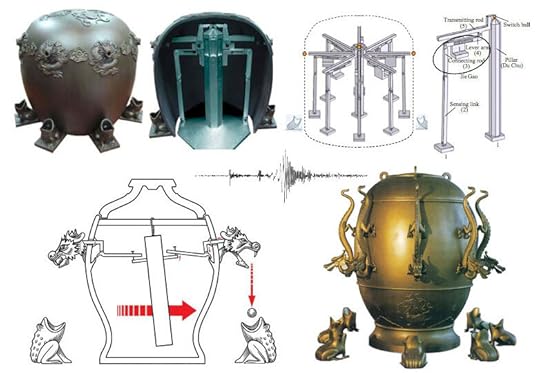
(edited and reposted 2/10, added image of seismograph and a comment re the Date Line.)
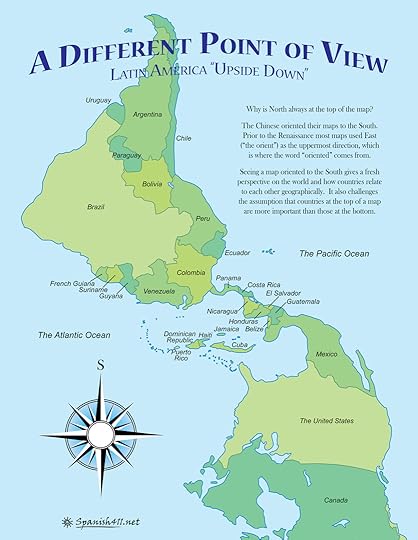
--“upside down” map of Americas. Not the same image that's in the book, but close enough.
3 or 4 stars. Owned this book for a very long time, and started it well over a year ago, sometime in 2023 or even 2022. Obviously I read it slowly, very sloooooowly-- a few pages at a time every other week or more, only when I was between books and needed something --anything!-- to read. (We book addicts know what I mean.) Or to put me to sleep. Yes, it can be a bit dry here and there. I skipped a few paragraphs that got a bit too weedy for me, but much of it is fascinating. Really! A few things in particular jumped out at me and are quoted below. (I’ve learned to dictate long passages into an email that I send to myself, then paste to Word.) The 1992 warnings (when it was written) about global warming are of course pertinent to today. It’s frightening how little we’ve done in the interim to reverse the trend. In fact, we’ve lost ground.
Maybe everyone’s seen one of the “upside down” Earth maps such as the one above. It’s not upside down, of course, just a different perspective that is exactly as valid as the maps we generally refer to. An example of such geo-centrism, myself being the guilty party: I believe I’d always assumed Alaska’s Denali (“Mt. McKinley”) is the tallest peak in the Americas. As I learned on 119, though, Cerro Aconcagua in the Andes is in fact the tallest. How ‘bout that, he said, sheepishly. (I can apologize to the mountain from a distance when I see it in the next few months, if travel plans work out.)
Some excerpts. P91 Re China, which has been prone to earthquakes for much of recorded history … “The first recorded earthquake occurred there in 1831 BC, and after a quake in 1177 BC, the Chinese began to keep regular records of quakes. An extraordinary Chinese scientist astronomer named Zhang Heng developed the first seismograph in the year 132. When a tremor hit, a ball fell from the mouth of a bronze dragon into the mouth of one of a series of bronze frogs below to indicate the direction of the earthquakes or origin.” Cool dat!
141 “Time, as we think of it today, is a relatively recent invention. The internationally accepted “Standard Time “was established a little more than 100 years ago. Before then, people in different places set their clocks – another fairly recent invention – to arbitrary notions of the hour, which usually came from when the sun entered their area. There was a time, for instance, when clocks in Camden, New Jersey, were set differently from those in nearby Philadelphia. As the world entered the modern scientific age, the advent of ocean navigation, steamship timetables, telegraphic communication, and train station schedules all demanded coordination; the world needed to get on one time standard. In 1983, they did it and cleverly called it standard time. …” Note: There is an interesting, very detailed discussion of this in one of Bill Bryson’s books. Before standardization, clocks were wildly different even in nearby towns.)
As for the international dateline, note these oddities! P143 “In practical terms, the date is one day earlier on the eastern side of the line; and it is one day later on the western side of the line. A traveler crossing the date line westward advances the calendar – for example, 5 AM Sunday becomes 5 AM Monday. A traveler crossing the dateline eastward has to put back the calendar from 5 AM Monday to 5 AM Sunday. Depending on which side of the dateline the traveler is on, he is now 12 hours different from London, either earlier or later.” I.e, standing/floating/hovering right on or above the international dateline would be even cooler and weirder than standing on the U.S.' four corners, no? Are selfie photo ops and souvenir shoppes a thing on the International Date Line? Well, apparently the date line zigzags to avoid any significant land masses. I've crossed the line several times in a plane but the pilot, rudely, wasn't willing to hover just so I could be stuck in time momentarily, ala Billy Pilgrim.
P282 “In South America, Chili’s Atacama desert is very small. It is hemmed in by the Andes, which keeps out winds and any rain. The Atacama has the distinction of being the driest place on earth. In 1971, it received rain for the first time in 400 years."
A geography book needs more maps ! A few maps are included but the reader needs more if they are to truly learn about geography. This is a historical trivia book loosely based around geography. This book is quite dense and drones on as a textbook at times. More focus and maps would help make this book easier to read and understand. There are also a number of factual errors in this book. So be careful which edition you are reading.
The spoiler contains a few random thoughts & factual errors in this book:
This book I completed through an effort to improve my knowledge of geography, which is the subject in which I am deficient the most. I know because in answering trivia questions I’m frequently frustrated that I simply don’t know the answer to which lake, river, or desert is where.
This book covers much more than “where?,” though. It traces geography from ancient times (and our origins in prehistory - the Australopithecus ancestors) through the years of discovery and exploration, on into the first voyages into space. It also covers the weather, climate change, acid rain, and the importance of the geography of famous battlefields.
Since this book was written in the early 1990s, events like the unification of East and West Germany and the breakup of the former USSR are mentioned frequently, as obviously they affect the map by creating new countries and land boundaries. Also, the author is critical of Dan Quayle and the rest of the George H.W. Bush administration in its short-sightedness relating to climate change, in favor of more short-term political wins. I think the criticism is deserved, and politics and other factors hold sway over geography in any era. In its info I give it a four. I feel more prepared for trivia shows now!
An interesting read that talks about geography through the lens of history, which is a cool idea. It also expands into space exploration / mapping / discovery -> ok, but kinda off the rails. It also deals somewhat w/ politics -> ok, but a bit further off the rails. It also sprinkles in sort of an athiestic view of the world & science, but doesn't dwell heavily in this so ehh... kinda valid view point as religion has dominated soceities throughout time.
My main gripe is it spends an inordinant amount of time on climate change, mostly pushing a political view point ignoring / dismissing opposing view points -> slight relation to geography as far as land use is concerned, but 95% irrelevant as far as geography. The author showed a tendency to do this with political points (rather strong progressive) throughout the book, but somewhat seemed to try to attach each opinion to geography, even if loosely.
In all honesty, this style of writing will probably turn me off other books by this author. Sad, because connecting geography to historical events does seem like a good idea. Almost like the 2 subjects should be taught as 1?
Funny, but this book was a bit of a mood lifter. Not only did I enjoy Davis’ humor; but, I also enjoyed looking up current data on much of the outdated information, and, in many instances, finding that we humans have progressed on several environmental issues and in space exploration. But, then comes the let down, Trump administration is systematically killing many areas of environmental legislative progress! That will eventually, unless some one, some organization(s) put a stop to it, take us all back decades, losing all progress towards clean rain and air, not to mention healthier oceans, rivers, wetlands…… By the way, we cannot depend on SCOTUS or Congress to save us and our children!! “—— it was like using a kitchen knife to do brain surgery, and with the lights turned off.” Funny how Davis’ quote describing space exploration before modern tools SO describes the Trump administration……IDIOTS!
This book by Kenneth Davis is full of different types of facts, topics, and historical tidbits. What is a bit confusing is that a person opening the book for geographical will find taht the author on many occassions highjacks the book in order to attack biblical concepts. He doesn't merely factually point out how perhaps some biblical information may compare or measure up to actual geographic or scientific facts but seems to personally be on a rampage against the bible. This is confusing and simply doesn't belong in a book that claims to be about geography. Otherwise the book is jampacked full of the most bizare geographical and historical information that takes the reader through the ages and around the globe.
A fantastic book if you want to listen to someone tell you what a horrible person you are if you live in the US. I kept waiting for geography but it’s mostly a hate America book. All of us, exempting himself because he’s the savior bringing us the great knowledge, are horrible because we don’t live in poverty to give an equal wage to everyone in the world. More geography and less propaganda would have made for a great book, however this book failed. If the politics were removed this book would be about one third it’s current size or possibly smaller. It’s all politics.
Controversial book in my opinion. Kenneth C. Davis often mocks faith and religion. A full supporter of science, this book is quite contrary to what I've learned in many ways. In some instances I like it. He writes about geography from mainly a historical perspective. He describes many different cultures and their roles in geography. He covers a lot in this book, and I do think it's a worthwhile read. Also his humor is frequent and it's a nice compliment to his style.
An interesting but "dated" book at this time. But noteworthy for addressing a number of environmental issues that have become prevalent since this book was published in 1992. Global warming, acid rain, climate change, fossil fuels and pollution among others. A number interesting anecdotes about many of the aspects of geography he touches upon. The appendix on U.S. States and their names/nicknames is somewhat candid. "The Puke State"?